
Mannar, Sri Lanka: The Island I Almost Skipped

Many unexpected things happened during my trip to Sri Lanka. For example, I did not expect what I felt at the Dambulla Royal Cave Temple

Similarly, there are places like Puttalam. Puttalam stands out with its ancient history, wildlife, coconut plantation, and ideal ambiance for stargazing. 

However, of course, Puttalam is not as celebrated as the cultural richness of Kandy or the thrill of a Kandy to Ella train ride. It is more like a hidden gem. 

Now, talking about hidden gems, Mannar is another destination I almost missed. 

I am glad that I did not ultimately, as in recent times, it has become the land where women are fighting for the protection of the bodies and land impacted by industrialization, bypassing their consent. 

In this article, I will share my experience in Mannar, and of course, why women in this coastal village are putting up such a strong fight. 

However, I will begin with why I almost missed it.

This Is Why I Almost Missed Mannar

This Is Why I Almost Missed Mannar

Mannar is not a usual or bucket-list destination when planning a trip to Sri Lanka. So, it was not originally on my list even after multiple visits to the country. 

For the first time, Jaffna and its Tamil culture were my priority. 

Also, for the next time, it was quite a predictable loop with Ella for the hills, Kandy for the temples, and Mirissa for the beaches

Again, while Mannar kept popping up as a suggestion, most forums described it as “connected by a causeway, has some baobab trees, not much else.” 

So, I never had Mannar on my mind. 

However, when I visited Sri Lanka for the third time, my focus was more on historical exploration in the country that is so connected to the country I come from, India. 

So, I was staying in Anuradhapura, and Adeesha, the guesthouse owner, told me about Mannar. 

He said, “Mannar is where Sri Lanka forgets it’s an island for a while. The wind never stops, and neither do the birds.

This description stayed with me.

And in three days, I took to the Medawachchiya-Talaimannar Highway for a road trip to Mannar. 

The distance was around 119 km, and it took around 2 hours and 17 minutes. 

Initially, I thought that it was a mistake as I saw the landscape flattening out into salt pans and scrub. 

However, I had not! 

Mannar Reminded Me Of Art Of Slow Travel: We All Know It But Often Forget 

I planned a half-day detour and ended up staying two nights, and even that felt like less. 

What I appreciated most was how little the island tried to perform for visitors.

You don’t have a polished tour script to follow. Also, from the causeway moment to standing on the spot where two countries meet, you will not notice the crowd for photo ops. 

And do you know what you have as your companions here? 

Just baobabs older than most nations, donkeys that own the road, flamingos that don’t care if you’re watching, and a stretch of water that people once believed connected two entire countries!

So, Mannar is more than worth being beyond an afterthought when you are planning a trip to Sri Lanka. 

I certainly did not expect a forgotten causeway town to end up as one of my favorite stops in the entire country, but that’s exactly what happened.

Here are more details about my days in Mannar, from the causeway moment to visiting the historical fort. 

1. The Causeway Moment

There’s a specific moment on the drive-in that I still think about. 

I left the palm-fringed road of the mainland behind, and the land narrowed into a causeway with water pressing in on both sides. 

I rolled the window down, and I instantly felt the gush of wind on my face. 

My driver, Aslam, laughed and said I should get used to it. 

Talaimannar, further west, is considered one of the windiest points in the country, which is exactly why it’s become a magnet for kite-surfers.

Crossing that causeway felt like flipping a switch. The dense, wet green of the rest of the island gave way to something drier, flatter, and quieter. 

I hadn’t expected Sri Lanka to have a landscape like this, and it was closer in spirit to the Deccan scrublands than to a tropical postcard.

2. First Impressions Of Mannar Town

Mannar town itself is unhurried in a way that took me a day to appreciate. 

My first afternoon, I wandered past fishing boats pulled up on the shore, nets drying in loose piles.

I also spotted a handful of tea shops where conversations paused just long enough for someone to glance at the obvious outsider before returning to their card game. 

Nobody tried to sell me anything. It was the first place in Sri Lanka where I felt like a guest rather than a customer.

3. Meeting The Giant Of Pallimunai

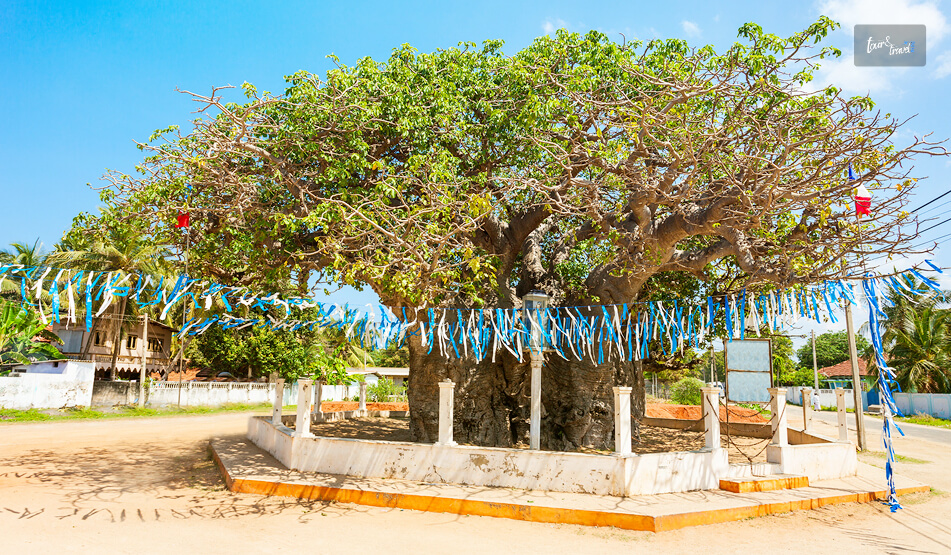
I was not prepared for the first baobab tree I spotted in Mannar. Seeing it for real is a different experience than seeing the photos. 

The barrel-shaped trunk was wider than a small room, and the branches moved upward. 

Furthermore, it had a thick and wrinkled grey bark, which gave it the name of the “Elephant Tree” from the locals. 

However, the most famous one among the baobab trees in Mannar is the one in the village of Pallimunai. 

It has a history of 600 to 800 years. 

Furthermore, it was fascinating to think that baobabs are native to Africa and Madagascar, not South Asia.

Common sayings are that the Arab traders carried the seeds here centuries ago, possibly using the leaves as camel fodder during the long sea crossings.

The seeds eventually took root in Mannar’s dry soil.

I sat under that tree for a good twenty minutes, and a local teenager on a bicycle stopped to chat, half in English and half in gestures. 

He told me his grandfather used to tell him the tree was older than any building on the island. Looking up at it, I believed him completely.

Things To Know About The Baobab Trees In Mannar

Mannar has around thirty baobab trees scattered across the district. 

All of them are not as gigantic as you expect them to be. However, even the smaller ones along back roads and behind houses will grab your attention with their unique silhouette. 

4. The Donkeys Of Mannar

The feral donkeys are a part of Mannar’s wildlife identity. 

They come from the animals the Arab merchant brought generations ago. 

When I reached Mannar, I spotted them wandering freely across the island. They were unbothered by traffic or tourists.

Even I watched one calmly block an entire lane of road near the causeway, chewing grass with the unhurried confidence of something that knows it has the right of way.

Aslam just waited it out, grinning. “This is Mannar traffic,” he said.

5. Flamingos At Vankalai

My visit to the Vankalai Sanctuary and the nearby wetland was one of the highlights of my trip to Mannar. 

I spotted flamingos, and they looked unreal for the first few minutes. I have never been so up close to these majestic birds. 

Furthermore, I spotted a flock lift off a shallow lagoon at dusk, and it was dusk. So, they were catching the last orange light for the day. 

Everything around me paused for a while. 

6. Adam’s Bridge And Talaimannar: Standing Where Two Countries Almost Touch

The furthest point of my trip was Talaimannar. 

It was right at the western tip of the island, where a chain of limestone shoals, the Adam’s Bridge, stretches out toward Rameswaram in India. 

In Hindu tradition, this is the causeway said to have been built by Rama’s army in the Ramayana.

Furthermore, geologically, it is a natural formation due to sedimentation and shifting sea levels over thousands of years.

The Moment…

I was standing on the shoreline, and the wind hammered at my jacket. 

I squinted toward the horizon and tried to make out India. Certainly, I could not. 

Now, being from the land of spirituality, the myth was quite fascinating. However, the practical history seemed more tantalizing. 

It was one of the busiest pearl-trading points in ancient times, and it was famous even in Rome. 

7. The Fort That Changed Hands Three Times

On the way back, I stopped at Mannar Fort, a low, weathered structure sitting near the causeway. 

The Portuguese built it in 1560, and then the Dutch took over until they surrendered to the British.

Compared to the grandeur of the Galle Fort or the Sigiriya Rock Fortress, it is a small, crumbling monument to how many empires passed through this one unassuming stretch of coastline. 

There wasn’t a ticket booth or a gift shop. The caretaker nodded me through, and I wandered the ramparts alone, looking out over the water as the light started to fade.

My Two Days In Mannar: The Itinerary 

Here is my two-day slow travel itinerary in Mannar.

Day 1: Causeway, Town, And Giants

Time Activity
MorningThe Road Trip to Mannar
Late MorningThe Causeway Moment
Early AfternoonCheck-in and Town Exploration
Late AfternoonThe Giant of Pallimunai
EveningMannar “Traffic” and Dinner

Day 2: Ancient Connections, Wildlife, And Heritage

TimeActivity
MorningJourney to Talaimannar
Mid-DayAdam’s Bridge Experience
AfternoonVisiting the Fort of Three Empires
DuskSpotting Flamingos at Vankalai Sanctuary

That’s it from my days in Mannar. However, I want to conclude with a brief discussion on how women in Mannar are fighting for their bodies and soil. 

Konniyan Kudiyirippu: A Mannar Village Where Women Fight For Their Bodies And Soil 

Konniyan Kudiyirippu is a small coastal village on the southern edge of Mannar. Here, the lives of the women revolve around the soil and palmyrah.

However, the setting up of a windmill here without consent has ruined their lives by poisoning the water and flooding the land. 

That is not all! A mining company is eyeing this village. 

I was reading about this news on eathjournalism.net, and there, a 32-year-old woman and a kindergarten teacher from the village, Vashingtina, mentioned, 

We use everything from nature to earn an income.

So, due to the industrialization without consent, the village economy based on nature is about to get ruined. 

The women of this village are putting up a fight against this and the violation of “the right to free, prior and informed consent.

So, come and visit Mannar to see how the women here are fighting one of the biggest battles of mankind, saving the environment vs. industrialization.

Share on Social Media

Sibashree is a travel, culture, and leisure writer who has been writing since the age of 12 and professionally since 2014. With more than a decade of travel writing experience and journeys across India and several parts of the world, she brings a deeply personal and thoughtful perspective to her work. A student of English Literature and Mass Communication, Sibashree has always viewed travel as more than movement — for her, it has been a way of understanding people, cultures, and herself. Her passion for spiritual exploration has also led her to many unusual and meaningful destinations over the years. Outside of writing, Sibashree enjoys watching European cinema, reading about global politics, and reflecting on the stories hidden within everyday places.

Leave a Reply

Your email address will not be published. Required fields are marked *

title-img Related

READ MORE places to visit in Matara

What Are The Places To Visit In Matara? A Southern Sri Lankan Commercial Hub With Dutch Colonial Heritage

BY  Sibashree May 4, 2026

Matara, the second-largest city in southern Sri Lanka, is an important gateway to Dickwella Beach, Hiriketiya Beach, or Talalla Beach.   However, beyond that, Matara is a place where the Dutch colonial heritage meets vibrant culture.  Now, talking about this part of Sri Lanka, places such as Mirissa or Galle get more prominence.  However, as I have also mentioned on my blog on Talalla Beach, Matara felt more intimate.  First of all, it was not tourist-heavy, and it is yet to get out of its shell of a hidden gem. Secondly, from beaches to historical landmarks and spiritual retreats, you will find everything in and around Matara.  So, in this blog, I will talk about the places to visit in Matara in detail.  What Are The Best Places To Visit In Matara?  Matara is now gearing up for the Sri Buddha Year 2570 State Vesak Festival on 27th May 2026.   It will take place at the Midellawala Ancient Temple premises at Thihagoda in Matara.  The program involves a week-long celebration and will continue till 2nd June, 2026.  From moral teaching to spiritual learning and sessions on environmental conservation, this week will be significant for the people of Matara and the followers of Buddhism in the country.  Nevertheless, if you are in Matara, do not forget to visit these places.  1. Polhena Beach: Swim, Snorkel, And Relax Polhena Beach impresses at first sight with its calm water. The water here is shallow, making it one of the most family-friendly beaches in Sri Lanka.  Furthermore, the protected coral reef here makes it ideal for snorkeling, even for beginners.  When you snorkel or swim here, you can find many species of reef fish. I could even spot a few sea turtles here as I walked a few meters from the shore.  Above all, Polhena Beach is a great place to unwind. Also, watching the sunset here was a wonderful experience, with the sky changing colors and those colors reflecting in the water.  2. Matara Fort: A Must-Visit For A History Buff  If you are fascinated by the colonial history of Sri Lanka, Matara Fort is a must-visit.  You know, the Galle Fort is iconic. However, the Matara Fort also has a history of Portuguese and Dutch colonialism in this part of the world.  The Portuguese built this fort, and later in the 17th century, the Dutch reinforced it.  Furthermore, the best part of the Matara Fort is how it still has an active presence in the daily life of the town.  There are schools, government offices, and shops inside the wall. Moreover, when I reached, I heard the noise of local boys who were playing cricket inside the fort.  I started talking to them, from Sangakkara to the rising P Nissanka, we covered a lot of players from the country in our discussion.  It was a fun interaction. Now, talking about cricket has been one of the most important things to do in Sri Lanka for me.  Again, as I walked through the fort, I visited the old Dutch church, which was built in 1706. Moreover, from the Matara Fort, I enjoyed amazing views of the Indian Ocean.  Being a public district, the fort does not have an entry fee, and you can enjoy a walk anytime you want.  3. Paravi Duwa Temple: One Of The Best Spiritual Places To Visit In Matara  The floating temple, or the Paravi Duwa Temple, is on a small island called Pigeon Island or Paravi Duwa.  You have to walk through the footbridge connecting the mainland and the island. If Matara Fort offers you an insight into the region’s history, this floating temple is all about serenity.  The temple has many stunning Buddha statues and a golden Stupa. However, the most fascinating thing is the replica of the footprint on Adam’s Peak.  Furthermore, here, you will enjoy a stunning coastal backdrop.   The temple remains open from 6 AM to 6 PM, and it is best if you walk through the bridge during the sunrise.  4. Weherahena Temple: A Proud Example Of Modern Buddhist Architecture  On the east side of Matara, the Weherahena Temple has the biggest seated Buddha Statue of Sri Lanka.  The statue is 39 meters tall, and here you will find an underground tunnel.  Now, walking through the tunnel was a fascinating experience. There, you will see more than 200 murals about the life of Lord Buddha.  Moreover, the tunnel remains open from 6 AM to 8 PM.  5. Star Fort: A Dutch Colonial Heritage  The Star Fort, close to the Matara Fort, originally went by the name of Redoute Van Eck.  It is a hidden gem in Matara, but the architecture here is equally fascinating.  Furthermore, the fort gets its name from its unique six-pointed star shape. Built in 1765, the fort had a strategic position to prevent attacks from the land.  The Matara Fort, however, was more instrumental in protecting against attacks from the sea.  Also, you must not miss a visit to the Star Fort museum, which offers insights into the Dutch colonial history of Sri Lanka.  The fort remains open from 9 AM to 4 PM, and I had to pay an entry fee of around ₹100.  6. Dondra Head Lighthouse: Sri Lanka’s Southernmost Part  I took a short tuk-tuk ride from Matara to Dondra, the southernmost part of Sri Lanka.  The Dondra Light House, with a height of 49 meters, is the tallest lighthouse in the country, and this 1889 fort offers an amazing view of the Indian Ocean.  However, they did not allow the visitors to climb up the lighthouse. So, instead, you can enjoy a coastal walk and take the best snaps for your socials.  7. Matara Local Markets: Offering Insights About Local Culture And Flavors  I always believe that to know a place, you have to explore its local markets. The Matara local market smells of handicrafts, tropical fruits, and spices.  Moreover, here, you will enjoy prawn fritters or isso wade and pol sambol, even kottu roti, the authentic delicacies of Sri Lanka.  Furthermore, despite the language barrier, the crowd there was so friendly and knowing I am from India, some of them even shared how they feel the solidarity.  So, the next time you are in Matara, don’t just treat it as a stopover for the popular southern Sri Lankan beaches.  Try to soak in the history, culture, and spiritual vibe of this beautiful coastal town.

READ MORE things to do in japan

What Are The Things To Do In Japan? Know Why Gen Z Travelers Love Japan The Most  

BY  Sibashree Apr 7, 2026

Japan is now approaching Golden Week, and everyone will have their own list of things to do in Japan.  From 29th April to 6th May, Japan will have the most colorful parades and horse races. This Golden Week celebration is important to hail the rich culture of Japan. And it is this rich culture and a distinct sensory experience that make Japan a favorite among young people, especially Gen Z travelers.  Also, on the Berkshire Hathaway Travel Protection list, Japan has been consecutively securing the 9th position as the safest country in the world for the last 2 years.  Nevertheless, as I was saying, the things to do in Japan that make the country a favorite place to visit are not the same as the run-of-the-mill lists you see on the internet.  So, here, I have tried to keep it honest, based on the places I have visited and tried to decode in respect to those places why Japan is the France of the 21st century.  What Are The Things To Do In Japan?  Japan slowly grows on you. It’s not nuclear power; it has one of the largest domestic energy products (around 40% according to the International Energy Agency).  On the contrary, as Joseph Nye, a political scientist at Harvard, has pointed out, it is the soft power that has helped Japan to emerge as an idea, mode of entertainment, or aesthetics.  Can you call a sushi just Japanese these days? Or, a bowl of ramen? All these are very much present in our daily lives.  So, while exploring authentic local cuisine remains one of the best things to do in Japan, here are more activities you cannot miss.  Also, you can check whether Japan is expensive to visit or not, and the entire cost breakdown. 1. Visiting The Japanese Shrines The Japanese shrines practice the local Shinto religion of Japan. Furthermore, these shrines are places for worshipping Kami, the spirit of nature.  These shrines can be easily identified by the Torii gates. Furthermore, once you enter the Torii gates, you will find the worship hall and the inner sanctum.  Moreover, the most popular Japanese shrines are the Fushimi Inari Shrine in Kyoto, Meiji Shrine in Tokyo, Toshogu Shrine in Nikko, and Itsukushima Shrine in Miyajima.  2. Exploring The Japanese Temples Buddhism and the rise and fall of various sects across centuries have shaped the famous Japanese temples.  Furthermore, these temples are defined by architectural features such as pagodas, lecture halls, bellfries, and cemeteries.  While Todai-ji Temple in Nara remains the most popular temple to visit in Japan, the other temples to visit in Japan are the Senso-Ji Temple in Kyoto, Sanbutsu-Ji Temple in Misasa, Daisho-In Temple in Miyajima, etc.  3. Experiencing Shinjuku Shinjuku was very different from the other parts of Japan I visited. It offered an eclectic fusion of retro vibes and high-tech experiences.  Especially, thanks to the Godzilla Road, exploring Shinjuku is one of the best things to do in Japan if you are traveling with kids.  Along with the roar of Godzilla at the Godzilla Road, the Shinjuku 3D Cat near the Shinjuku Station East Exit is another major attraction for kids here.  Read more about what to do in Shinjuku.  4.  Enjoying The Ultimate Dark Academia Fan Moment At Jimbocho Book Town Uttered with an equal respect as the “Kaifeng and China book towns,” the Jimbocho Book Town is the ultimate place to visit for Dark Academia fans in Japan.  This town started booming when many law schools were established here in the late 19th century and early 20th century.  Today, it has more than 400 book stores, selling vernacular and foreign-language books.  Furthermore, every year, this book town holds the Aozora Kohon Ichiba or the Kanda Used Book Festival from Late October to early November. It is an attraction for book lovers around the globe. 5. Enjoying The Cherry Blossom Season In Kyoto If you want to experience romance in Japan, you have to be present during the cherry blossom season in Kyoto.  The Philosopher’s Walk is the most popular place to experience the cherry blossom scene here. If you are done soaking in the meditative vibe here, you can next head to the Shimbashi Street.  It is the most beautiful street in Asia.  The Kiyomizu-Dera Temple and Maruyama Park are other amazing places to see cherry blossoms in Kyoto.  6. Trying Osaka Food Osaka Food now represents Japanese cuisine worldwide, and it has left Tokyo behind in this regard. Thus, it fully justifies its nickname of “Japan’s Kitchen.”  Furthermore, Dotonbori is the epicenter of the best Osaka food and street stalls.  Takoyaki, Daifuku Mochi, Okonomiyaki, and the staples, Sushi and Ramen, are some of the must-try items here.  7. Visiting Oshino Hakkai Sensory seeking is one of the biggest reasons why young travelers seek Japan, and there has been a 1300% surge in the bookings of young and Gen Z travelers from 2019, according to a report by American Express.  Furthermore, the Instagrammable places in Japan, such as Oshino Hakkai, have played a major role in satisfying this sensory quest.  Now, as I have mentioned in my Oshino Hakkai guide, it is a place I got to know about from Instagram.  You can see the snow-capped peaks of Mount Fuji from Oshino Hakkai, and the eight sacred ponds here were the highlights of my Tokyo to Mount Fuji day trip.  Furthermore, the Wakuike Pond is one of these eight ponds, and its water was carried to space in the Space Shuttle Challenger in 1983 to conduct an experiment on snowmaking in space.  8. Planning A Two-Day Trip To Nara Do you know why Japan attracts anxious young travelers? It kind of strikes a balance. How?  When places in Japan feel like the future, think of Tokyo or the speed of the bullet trains. Some parts of the country bring back the order of the past.  One such place is Nara, the first permanent capital of Japan and home to 8 UNESCO World Heritage Sites. The Todai-ji Temple is the most famous among them.  Before Kyoto became the country’s capital in 794 AD, it served as the seat of power.  Along with the Todai-Ji Temple, you must also visit Kasuga Taisha, Mt. Wakakusa, and the Heijo Palace in Nara.  Read my complete guide on things to do in Nara to understand why you cannot miss a 2-day trip here.  9. Visiting Hokkaido Beach And Sapporo The Hokkaido Beach is in Western Japan, and it looks straight out from the works of Hakura Murakami.  It’s surreal to see the coexistence of the snow-capped peaks and dunes, and it’s only possible in Hokkaido.  Along with the Hokkaido Beach, Sapporo, the capital of Hokkaido, also stands out with its green parks and shrines like the Sapporo Suitengu Shrine.  So, when you are next in Japan, plan a Tokyo to Hokkaido trip.  10. Visiting Hakone  The things to do in Hakone are all about soaking in the quiet moments that are most powerful.  I am glad that I did not follow the usual loop, including the train, cable car, and ship circuit.  If the Open Air Art Museum with 100 sculptures is the highlight of my Hakone visit, the Choan-ji Shrine, with small stone statues of monks, is what will stay with me forever.  Also, another fun part here was washing my money at the Fukazawa Zeniaria Benzaiten Shrine.  I have not got a bigger return yet, but there is no harm in believing in a custom that locals have been following for so many years.  Moreover, if you are in Hakone, don’t forget to take a bath in the Onsen or hot springs. Furthermore, you can relive history by taking a ride on the Hakone Tozan Railway here. So, it is no wonder that visiting Hakone is one of the best day trips from Tokyo you can plan.

READ MORE Kudawella Beach

Where Is Kudawella Beach? What To Do In Kudawella Beach For Beginners?

BY  Sibashree May 5, 2026

Very close to the Hiriketiya Beach, Kudawella Beach is a pristine, small, and beginner-friendly beach for surfers.  However, even if you are not a surfer, you can visit this hidden gem to find the turtle nests and the surrounding mangroves.  Also, at Kudawella Beach, you can enjoy the beauty of the Indian Ocean or just laze around on the sand.  Here is more about this beautiful, sickle-shaped beach on the southern coast of Sri Lanka.  Where Is Kudawella Beach? How To Reach Kudawella Beach As I have mentioned, Kudawella Beach is on the southern coast of Sri Lanka, and it stretches from west to east.  Furthermore, the beach is around 10 km away from Dickwella, the closest major town to the beach.  Moreover, if you are already visiting the Hiriketiya Beach, you can just take a 10-minute tuk-tuk ride to reach the Kudawella Beach.  The most popular way to reach the Kudawella Beach is to take a direct car or taxi from Colombo, which is at a distance of around 160 km.  The journey by road will take close to 5 hours, and the taxi fare will be over 30000 LKR.  However, I was already in Ella and had a day after visiting the iconic Nine Arch Bridge and exploring all the other top attractions in Ella.  So, I took a bus from Ella to Galle. The bus #31 was moderately crowded, and I was enjoying the local experience.  That bus from Ella to Kudawella Beach took around 6 hours, and the ticket price was LKR 350.  What Are The Things To Do In Kudawella Beach?  Kudawella Beach is a place that offers you the ultimate flexibility.  Yes, there are a few hotspots when you are on the beach. However, you can spend your entire day without doing anything.  Moreover, it is a delightful place for amateur surfers.  Still, here are a few things to do in Kudawella Beach, along with surfing and chilling.  1. A Walk To The Hummanaya Blow Hole I loved walking to the Hummanaya Blow Hole on the eastern side of the Kudawella Beach. However, to see the water shooting up, you have to reach the viewing point at the top of a cliff.  The cliff also has a safety barrier.  It is the only blowhole in Sri Lanka and the second-largest in the world, shooting the water at a height of 25-30 meters when the water forcibly enters a narrow cavern.  I saw the blowing taking place at least 5-6 times during the short moment I halted there. The water shoots up as the sea movement builds pressure in the tunnels in the rock.  2. A Walk To The Nilwella Beach If you want even a more idyllic retreat, you can visit the Nilwella Beach from the Kudawella Beach.  This beach has blonde sand, and the waves here are gentle.  Moreover, I loved walking across the beach to reach a rocky island. The rocky island had many palm trees and pandanus trees.  There was also a hiking trail, and as I advanced, I found many little coves and unique geographical shapes.  3. Kayaking Around Mawella Lagoon Mawella Lagoon was pretty, and the water was covered by beautiful lily flowers.  Furthermore, there are many hotel rooms and massage rooms near the lake where you can chill or enjoy a relaxing massage session.  However, just behind the Kudawella Beach, this lagoon is also ideal for kayaking around.  It cost me around 8000 LKR, and I spotted many birds such as storks, beeaters, and kingfishers there.  I heard that sometimes you can also spot crocodiles here.  Kudawella Beach: The Best Spot For Surfing For Beginners  As I have mentioned, Kudawella Beach is a beginner-friendly surfing spot.  Unlike Hiriketiya, you will not find outer waves here. You can only surf here at the beach break, which is further on the inside of the bay.  So, it is safer than Hiriketiya Beach.  In fact, even in the dry season from November to March, the waves seldom reach a height of more than 4 feet.  However, you have to be watchful of the few rocks in the water. Having said that, during the dry season or the peak surfing season, the water of the Indian Ocean is crystal clear.  So, you will be able to see the rocks clearly.  Moreover, on the Kudawella Beach, there are two surf rentals. However, when I visited, there was a longer queue in front of the Saranga at Kudawella Surf School, and its surfboard-shaped signboard also looked pretty cool.  What Is The Best Time To Visit Kudawella Beach?  November to March, or the dry season, is the best time to visit the Kudawella Beach.  Long hours of sunshine make these months ideal for beach activities. However, there can be sudden rainfalls. So, you have to carry your rain gear.  However, the wet season from March to August, despite having fewer crowds, is not ideal as there can be harsh storms and heavy rainfall.  Where To Stay Near The Kudawella Beach?  When I visited Kudawella Beach, it was still very pristine, and thus it is a quintessential beach on the southwestern coast of Sri Lanka.  You will find only a few hotels here.  Also, if you want to find an accommodation here, you can stay on the beachfront or in hotels near the lagoon.  Here are some of the places where you can stay.  Sisi Place The Sisi Place is on the hilltop at the west end of the beach. It is the most budget-friendly option here with clean and comfy rooms.  Simply Peace  Choose Simply Peace if you are looking for a luxury accommodation near the lagoon.  It is a beautiful pool where you can relax. Furthermore, it has a garden where you can enjoy birdwatching.  Calma I loved the pastries and coffee at the on-site cafe of Calma. With a sand front, it exudes a quintessential Balinese bungalow aesthetic.  Moreover, you can take a short tuk-tuk ride from Kudawella Beach to Hiriketiya Beach. There, you will find more diverse accommodation options, including Airbnbs.