
Dambulla Royal Cave Temple: History, Entrance Fee, And More About This UNESCO Heritage Site 

The Dambulla Royal Cave Temple is gearing up for the much-acclaimed “Walk for Peace” which will start from 21st April, 2026. 

Respected Paññakāra Thero and 12 other monks from the Maha Sangha will lead the walk. 

Furthermore, this walk, originating in the United States, will spread the teachings of Lord Buddha, “Caratha bhikkhave carikam bahujana hitaya bahujana sukhaya lokanukampaya.

It can be roughly translated as a monk should always wander forth out of their compassion for the world and for the happiness and well-being of many. 

After the inauguration of the event at Anuradhapura and special observations at Ruwanweliseya premises, the walk will start from the Dambulla Royal Cave Temple, and then it will slowly proceed to Kandy to continue the walk. 

Now, it is no wonder that the Rangiri Dambulla Cave Temple has been chosen as the starting point for the walk. 

With a history that goes back to the 3rd century BCE, and home to the Buddhist mural paintings and 157 statues, it remains one of the most important Buddhist landmarks in Sri Lanka. 

Here is a detailed guide on my experience at Dambulla Royal Cave Temple, its significance, history, entry fee, and more! 

The Dambulla Royal Cave Temple: Quick Facts 

The Dambulla Royal Cave Temple Quick Facts

Dambulla is an important shrine in the Buddhist religion in Sri Lanka, remarkable for its association with the long-standing and wide-spread tradition of living Buddhist ritual practices and pilgrimage for more than two millennia.

UNESCO World Heritage Convention. 

Here are some quick facts about the most well-preserved and largest cave-temple complex in Sri Lanka.

Number of Sanctuaries 5
Buddhist Mural PaintingsAcross an Area of 2,100 m2
Number of Statues157
HistorySince the 3rd Century BCE
The Current Interior FormsBuilt in the 18th Century
Type of SculpturesPolychrome
Ownership The Asgiriya Chapter of Buddhist monks
Monument Protection Protected Monument under the legal protection of the Department of Archaeology of the Government of Sri Lanka, which administers the Antiquities Ordinance of 1940 (rev. 1998) at the national level.
Entry Fee2000 LKR
Hours Open7 AM to 7 PM (The Ticket Counter Closes at 5 PM)
Steps 300
Average Climbing Time20 Minutes 

Where Is The Dambulla Royal Cave Temple? (Along With Some Nearby Attractions)

The Dambulla Royal Cave Temple is in Dambulla Town. Now, Dambulla itself is the gateway to many places to visit in Sri Lanka. 

For example, the Hurulu Eco Park is just a distance of 45 minutes from Dambulla. On the other hand, it is just 52 minutes away from the Kaudulla National Park

Furthermore, the distance between Dambulla and Kandy is around 73 km. So, many people include a visit to the Dambulla Royal Cave Temple in their itinerary of the things to do in Kandy

Moreover, Sigiriya is just 17 km away. So, you can plan a combined trip of a visit to the Royal Cave Temple with a hike to the  Sigiriya Rock and Pidurangala Rock

In addition, you will have a similar experience of exploring an ancient Buddhist monastery and its remains at the Ritigala Forest Monastery, at a distance of 35 km. 

Also, if you are a cricket buff like me, don’t miss a visit to the Dambulla International Cricket Ground. 

How To Reach The Dambulla Royal Cave Temple?

How To Reach The Dambulla Royal Cave Temple

Even if you are not staying in Dambulla, Habarana, or Sigiriya can be your base. 

Habarana is just 22 km away from Dambulla, and Sigiriya is just 17 km away. 

From both locations, you can take a private taxi or tuk-tuk ride to reach Dambulla Town, which has the Dambulla Royal Cave Temple in the heartland. 

Furthermore, from Habarana, you will get Sri Lanka Transport Board – SLTB ICT buses to Dambulla. 

Nevertheless, I took a tuk-tuk from Sigiriya to Dambulla, and it cost me around 2500 LKR. 

What Is The History Of The Dambulla Royal Cave Temple?

As I have mentioned, the history of the Dambulla Royal Cave Temple goes back to the 3rd Century BCE. 

Buddhist monks started living here, and these natural caves started functioning as monasteries. 

Furthermore, in 100 BCE, King Vattagamani Abhaya (Valagamba) fled his capital and took refuge here for 15 years. 

Then, out of his gratitude, he built this majestic Dambulla Royal Cave Temple. 

However, most of its constructions, including the sculptures and murals, are from the Anuradhapura and Polonnaruwa periods. 

Also, the current interior we see is the outcome of the renovation in the 18th century. In addition, it was designated as a UNESCO World Heritage Site in 1991.

Today, it is a part of the prestigious Cultural Triangle of Sri Lanka, along with Anuradhapura, Polonnaruwa, and Sigiriya Rock Fortress. 

My Experience Of Visiting The Dambulla Royal Cave Temple (Things To See And Top Attractions)

My Experience Of Visiting The Dambulla Royal Cave Temple (Things To See And Top Attractions)

Before I get into the details of my experience at the Dambulla Royal Cave Temple, I want to give you a clear idea about the five main caves. 

The Caves of The Dambulla Royal Cave TempleNamesMain Attractions 
Cave 1Devaraja LenaIt is the Temple of the King of Gods. 
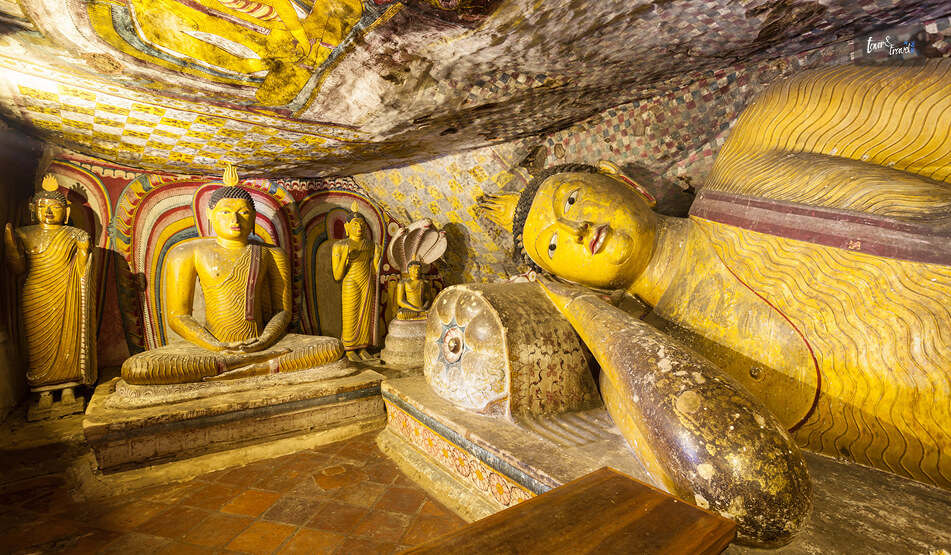
The reclining Buddha statue here is mesmerizing.
Cave 2 Maharaja LenaThis one is the largest among all caves, and it has 56 statues. 
Moreover, it is the Temple of the Great Kings, and don’t miss the sacred pot with the dripping water here. 
Cave 3Maha Alut ViharayaThe Maha Alut Viharaya is a wonderful example of 18th-century art. 
Furthermore, as the Great New Temple, it is home to 18th-century Kandyan-style paintings and statues.  
Cave 4Paschima ViharayaIt is the western temple. 
Cave 5Devana Alut ViharayaIt is the second new temple in the temple complex. 

However, to see these caves, you have to take 300 steps. You will not feel the fatigue anyway, as you will love the views and spotting the groups of macaques jumping through branches. 

Also, once you reach the top, you will need to take off your shoes and further walk to the cave. 

Here are some of the highlights of my visit to the Dambulla Royal Cave Temple. 

1. Before Entering The Caves 

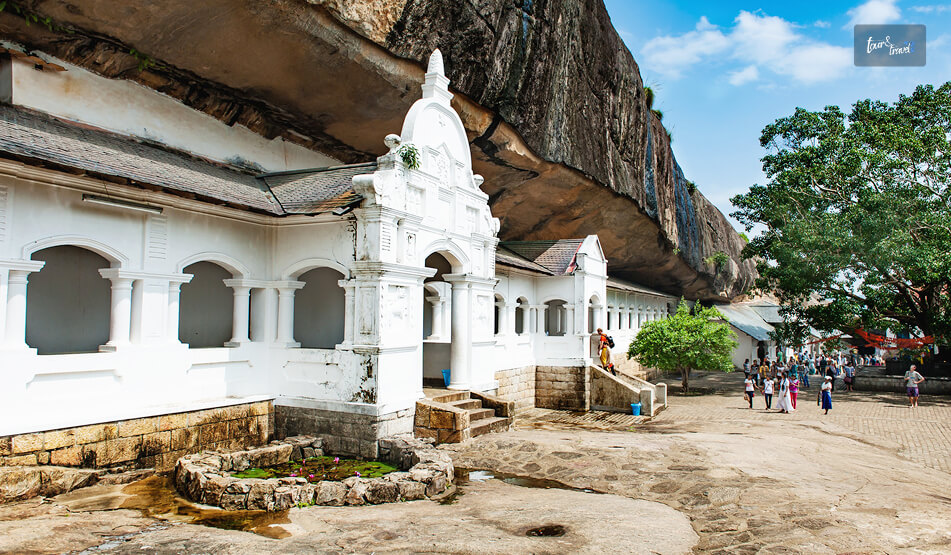
I entered the cave temple complex, and a massive courtyard opened before my eyes. On one side of the courtyard, there was the shrine and the Bodhi Tree. 

Furthermore, on the other side, there is the rock and the cave temples. 

The Engraving Of Kirti Nissankamalla

I found the engraving of the Kirti Nissankamalla before entering the first cave. Dated to the 12th century, it narrates the contributions of King Nissankamalla to Buddhism. 

The engraving, however, is in ancient Sinhalese. So, you can ask a local guide or a local person to help you understand the details. 

Or, you can read the translation of the engraving next to it. 

2. The Caves 

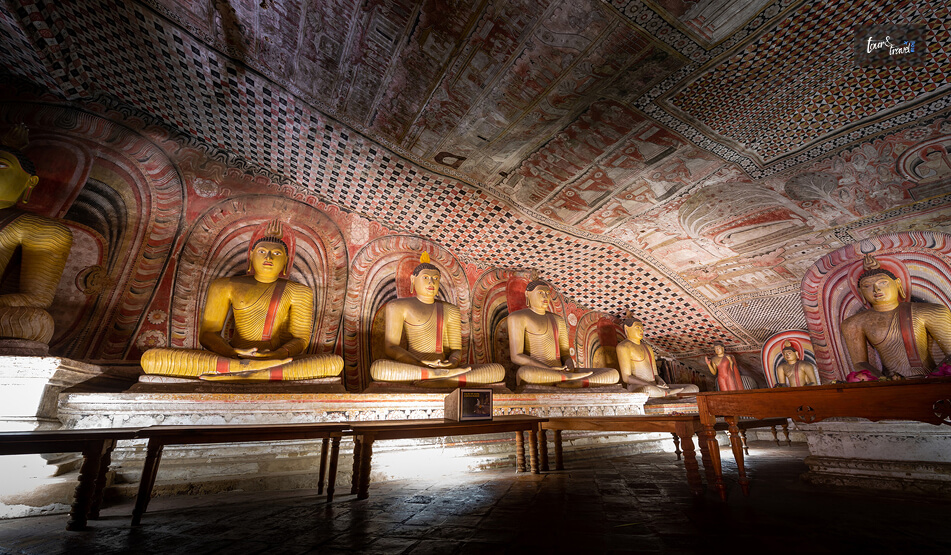
I have already introduced the caves to you. However, everywhere you look, you will find Buddhist murals, depicting the important figures and myths of Buddhism. 

Furthermore, there are golden statues of Lord Buddha along the walls, and the lifelike paintings of Buddha-like figures evoke awe. 

Moreover, with repeating patterns, the ceilings look kaleidoscopic. 

However, the first time I experienced magnificence in these caves was when I saw the reclining Buddha statue. 

The Reclining Buddha Statue (1st Cave)

The reclining Buddha statue inside the first cave of the complex reminded me of the Lord Vishnu idol of Sree Padmanabhaswamy Temple in Kerala, India. 

In fact, in some traditions of the Hindu religion, Buddha is the ninth of the ten Avatars or incarnations of Lord Vishnu. Here, the connection felt real. 

The serene expression of Lord Buddha with his head resting on a pillow made me feel peaceful. I offered some fresh lily flowers that I bought on the way up the steps. 

Furthermore, the lotus flowers drawn on Lord Buddha’s feet or Buddhapada symbolize spiritual awakening, and these are among the 108 holy marks that represent the holy journey of Buddha on the earth. 

The Natural Spring (The Second Cave)

It was amazing to find a natural spring in the second cave, and even in the dry season, it has water. 

The water of the spring drips through the ceiling, and the drops are collected in a vessel. 

Furthermore, it has 56 Buddha statues, and it is the most aesthetic with stunning murals and paintings. 

The Series Of Buddha Statues (The Second Cave)

Again, inside Cave 2, I found a series of similar Buddha statues in a seated position, and the next one was always a bit bigger than the previous one. 

However, instead of the Dhyana mudra or the meditation gesture, the statues here were seated in a Bhumisparsha mudra or as the earth witness. Thus, these statues stare directly into your eyes. 

These statues looked more vibrant, and with an earthy tone, they complemented the overall aesthetics of the cave temples. 

Also, don’t miss the little lily pond just outside cave 2. 

The Stupa Inside The Cave (The Second Cave)

The second cave has an entire Stupa built inside it. 

Furthermore, the stupa is adorned with an orange robe. Various statues of Lord Buddha in a seated position surround the stupa, and these are accompanied by nagas. 

These nagas or snakes play the role of a protector or guardian when Lord Buddha is meditating. Moreover, they symbolize the subjugation of worldly desires and spiritual awakening. 

The 3rd cave also has many statues, and the fourth one is smaller with a stupa inside. After exploring the 3rd, 4th, and 5th caves, I finally approached the end of the cave. 

You know what stayed with me, that the temples are still alive and they have made people from a different millennium, with humans of today in the same row with the thread of devotion, peace, and love. 

Once again, with non-violence and peace having so much power, the current geopolitical situations only look like futility. 

3. The Viewpoint 

As I got out of the caves, I found a quaint viewpoint behind the entry counter. I saw many young tourists flocking there, and the views from there were simply amazing. 

I stopped and took some snaps. 

4. The Golden Buddha Statue 

I consciously chose a different route while getting down from the caves. I found many aesthetic lampposts along the way. 

However, I did not follow the lamp posts and took the left to walk down, and the road was quite steep. 

However, the reward I got at the end of the road was absolutely worth it. 

There was a magnificent golden Buddha statue on the elaborately designed building of the museum complex. 

I could not explore the museum due to a time crunch, and I did not want to dilute what I saw and how I felt at the cave temples.

What Is The Best Time To Visit The Dambulla Royal Cave Temple?

In a day, early mornings, from 7 AM to 9 AM, or late afternoons, after 4 PM, are the best hours for visiting the Dambulla Royal Cave. 

Furthermore, December to February are the best months for visiting these cave temples due to dry and pleasant weather conditions.

Share on Social Media

Meet Sibashree Bhattacharya, a travel enthusiast who has a decade-long experience in transcending virtual barriers with her words! Her deep love for travel is apparent from her travel escapades to the mountain, often taking her readers on a journey, her words acting as Portkey! Fun fact: Sibashree loves to dive deep into the history of the places she is about to visit, making her travels even more wholesome. If you were wondering how her articles are not short of time travel, this answers it!

Leave a Reply

Your email address will not be published. Required fields are marked *

title-img Related

READ MORE Jimbocho Book Town

What Are The Things To Do In Jimbocho Book Town? Visit The Best Book Stores And Cafes 

BY  Sibashree Mar 30, 2026

Jimbocho Book Town is a massive book district or book town with more than 400 book stores.  It is one of the oldest and biggest in the world and is often uttered with respect equal to the Kaifeng and China book towns.  Also, it is a great place for dark academia fans, students, and readers, as they will find most of the second-hand books in Japan here.  Furthermore, it’s not just about the love for the book and the “intellectual” aspect of it.  Time Out has named it the best neighborhood in the world in 2025.  But do you know about the best book stores and cafes in the Jimbocho Book Town? Here is a detailed list.  However, let’s talk about the history, accessibility, and the best things to do in this book town.  Jimbocho Book Town: A Neighborhood That Survived World War II The Kanda-Jinbōchō area started getting many law schools in the late 19th century and early 20th century, and this is how the book town came.  Many bookshops opened then, and students of the law schools often sold their old books to these shops at a cheaper rate. Thus, this concept of second-hand books came.  New students used to buy these books because they were cheaper.  Furthermore, it is nothing short of a miracle that this book town survived the bombing and destruction during World War II.  Jimbocho started flourishing as a book town once World War II was over, and today, it is the most fascinating place for bibliophiles.  Furthermore, Shūeisha (Jump Manga Magazines), Iwanami, and many other leading publication houses have their headquarters in the Jimbocho Book Town.  Moreover, the curry restaurants and cafes here have been hosting the most famous authors for the longest time.  I must mention Ladrio in this context. It was built in 1949 as the reading room of a bookstop. It was also the first place that brought Viennese coffee to Japan.  Now, it was more than an elevation in the texture and flavor. The whipped cream helped to keep the coffee warm for longer as the intellectuals here took part in debates and hot discussions.  How To Reach The Jimbocho Book Town?  The central location of Jimbocho in Tokyo makes it easy to visit. You can take a ride on the Subway network to make this commute.  Reach Jimbocho Book Town By Subway  The nearest subway station is the Jimbocho Station. You will take the subway to the station on the following lines.  Toei Mita Line Tokyo Metro Hanzomon Line And, Toei Shinjuku Line Moreover, once you reach the subway station and exit from A5 or A6, you can find the book stores along Yasukuni-dori.  Reach Jimbocho Book Town From Shinjuku And Shibuya The journey through the Toei Shinjuku Line from Shinjuku Station is the easiest way to reach the Jimbocho Book Town. It does not need any transfer.  Furthermore, the travel time is about 15 minutes.  On the other hand, from Shibuya Station, you can take a ride through the Tokyo Metro Hanzomon Line to reach Jimbocho Station within 20 minutes. Reach Jimbocho Book Town From Tokyo Station From Tokyo Station, you have to take a Rapid ride on the R Chuo Line and reach Kanda Station.  Then, you have to reach the Toei Mita Line or the Toei Shinjuku Line to complete the journey in 5 minutes. Shopping For Old And Rare Books And Magazines: The Best Thing To Do In Jimbocho Book Town  From antiquarian books and documents to specialized books and first editions, you will find all the books in the Hakusan-dori and Yasukuni-dori intersections of the Jimbocho Book Town.  Starting from the Meiji Era(1868-1912) to today, it has been a book town par excellence.  Furthermore, the Aozora Kohon Ichiba, or the annual Kanda Used Book Festival, draws book lovers across the globe to the Jimbocho Book Town.   This festival is held in late October or early November, and it was celebrated from October 24th to November 3rd in 2025.   What Are The Book Stores You Must Visit In The Jimbocho Book Town?  Do you think that the Jimbocho Book Town only has Japanese books? You will get books in various languages in the book stores here.  Here are the book stores you must visit.  1. Kitazawa Book Store  The Kitazawa Book Store is the best book store to find English books and classics in the Jimbocho Book Town.  It started in 1902 and has thus completed more than 125 years in serving as a beacon of Western literature connoisseurs in Jimbocho Book Town.  You will mostly find foreign and humanities-related books here.  2. Magnif Zinebocho Magnif Zinebocho is a paradise for readers and lovers of retro magazines. You will mostly find lifestyle and fashion magazines from the last few decades here.  Though it mostly sells Japanese retro magazines, you will also find magazines that overcome language barriers.  Furthermore, the Mondrian artwork on the bookstore’s facade is really impressive, and you will find retro magazines such as Olive and Relax. 3. Books Tokyodo Built in 1890, Books Tokyodo is one of the oldest book stores in the Jimbocho Book Town. Here, you will find books of different genres from the bygone eras and modern times.  Furthermore, it is one of the book stores that has helped to create a community of book lovers, and that is the most cherished thing about it.  4. Komiyana Tokyo The history of Komiyana Tokyo goes back to 1939. It is a dedicated 4-story building with each floor offering distinct attractions to book and art lovers.  You will find here books on history, Japanese art, Western art, and fashion.  Furthermore, it has the widest collection of photo books, and most of them are by the original photographers or painters.  Also, watch out for the weekend “Garage Sale” behind the shop.  You never know when you can find a diamond.  5. Bohemian’s Guild  The Bohemian’s Guild is a great place to find vintage books on visual art and design.  Furthermore, the bookstore has been there since the Taisho era (1912-1926). The first floor of the store has all the books and a warm lighting that, along with the brown wooden floor, creates an inviting atmosphere.  Furthermore, on the second floor, the book gallery allows you to explore the lithographs, paints and prints.   What Are The Best Cafes To Visit In The Jimbocho Book Town?  Kissaten, or the coffee house culture of Japan, is unique. The best cafes in the Jimbocho Book Town allow you to get familiar with that.  Furthermore, the cafes here celebrate the history and origin of the book town. So, here are my favorites. 1. Sabouru With an origin in 1955,  Sabouru stands out with its unique Showa-era charm and nostalgic vibe.  You must try the cream soda here, and it is available in seven colors. They also make an excellent strawberry juice smoothie.  Moreover, the adjacent Sabouru 2 is a popular place here to have classic “Japanese Napolitan Spaghetti.”  2. Milonga Nuova Built in 1953, Milonga Nuova is a paradise for Tango lovers.  Furthermore, the charcoal-roasted coffee here hits different, and that is often accompanied by the signature desserts.  Moreover, you will find more than 30 varieties of imported beers here.  Along with these cafes, Jimbocho Book Town also has various curry restaurants. From Mandala to Bondy, these restaurants celebrate the tradition started in the Meiji era.  The book lovers found it very convenient to eat curry with one hand while the other hand was busy holding the book or flipping the pages.  Read Also: Is The Japan Rail Pass Worth It In 2026? Should I Buy Or Avoid It As A Conscious Tourist? Cherry Blossom Kyoto Japan: 2026 Season And The Top Viewing Spots Osaka Food: Know What To Eat In The Streets Of Osaka

READ MORE ahangama

Ahangama: Why Is It More Than Just Another Beach Town In Sri Lanka? 

BY  Sibashree Apr 7, 2026

If you could only cover the beaches in Sri Lanka, you would know how Sri Lanka, despite being a smaller country, carries the spirit of the subcontinent, “Unity in Diversity.”  If the beaches in Jaffna were a lesson to understand the livelihood of the local fishermen, the Hiriketiya Beach, with its unique horseshoe shape, has been a surfer’s delight.  Now, I am going to talk about Ahangama, another popular beach town in Sri Lanka, famous for its cool vibe and surfer breaks.  Earlier, it was known for its 19th-century Buddhist temple and the art of stilt fishing. However,  this beach town, in the southern coast of Sri Lanka, is now also known as a lifestyle destination.  The likes of Condé Nast Traveller are backing its charm as a cool fishing town.  Also, today, you may even ditch the best hotels in Galle, one of the major cities near the beach, thanks to the cafes such as The KIP, Marshmello Cafe or La Cafe Bistro.  Nevertheless, while surfing is Ahangama’s claim to fame and the budding food scene is the most happening thing right now, here are more things you can plan here.  What Are The Things To Do In Ahangama? Ahangama is now emerging as a really cool place, as, despite being a beach town in Sri Lanka, it has the right amenities for digital nomads.  While the surf and beaches offer the right dose of relaxation and the diverse communities offer the most eclectic experience, it also boasts many air-conditioned co-working and co-living spaces.  In fact, despite Galle getting more attention, if you are planning to try things to do in Galle, Ahangama, around 20 km away, will be a better base due to the presence of cool hotels, good food, and cafes.  Nevertheless, it is not just about breaking the waves.  Here are tons of other things to do in Ahangama. 1. Hitting The Surf The reef breaks of Ahangama are the best for intermediate and advanced surfers. The waves on the south coast are world-class.  Kabalana Beach itself is a great place to start your surfing expedition in Ahangama. Furthermore, you will easily get board rentals for around 800 LKR, and the sessions usually cost around 4000 LKR.  You can also surf near the Kabalana Rock, Sticks Surf Break, Rams Right, and Midigama.  2. Some Adventure At The Lamana Skatepark Lamana Skatepark is one of the best places if you want to experience the party scene in Ahangama.  Local skaters hit the bowl here daily. However, the live bands and the DJ music add some spunk to the air.  3. Swimming With The Turtles Dalawella Beach, a short tuk-tuk ride from Ahangama, is the place where you can swim with giant sea turtles.  Here, meeting the sea turtles was a different experience from how I saw them at the Sea Turtles Conservation Centre near Mount Lavinia Beach.  Also, some of the turtles here were around 50 years old, and they weighed around 200 kgs.  You can rent a snorkeling mask for around 300 LKR. However, stay away from feeding these turtles,  4. Safari At The Udawalawe National Park If nothing else, I will remember Sri Lanka for the endless and most delightful encounters with elephants.  I had mentioned spotting the elephants at the Udawalawe National Park as one of the best things to do in Ella.  However, as Ella is just 58 km away from Ahangama, you can also plan a safari if the latter is your base.  Along with the baby and mother elephants, you will also love spotting peacocks, monkeys, and buffalo here.  Moreover, when you are in Ella, don’t miss the iconic train ride on the Nine Arch Bridge.  5. Climbing Devil’s Rock With jungle walkways and eerie rock formations, the Devil’s Rock feels like a piece of Jurassic Park in Sri Lanka.  You will find this group of scary rocks as you go east from Ahangama and stop just before Midigama.  However, the only catch is that you will have to swim through the water with a medium current and during the low tide to reach Devil’s Rock.  The hike is also quite strenuous. So, it may not be the best thing to do in Ahangama if you are not a pro swimmer or fit hiker.  6. Scuba Diving In Unawatuna You have done diving in Raja Ampat, the Maldives, or Bali. However, scuba diving in Unawatuna is something different.  While you cannot expect the grandeur of these diving sites at Unawatuna, you can definitely find the Lord Nelson Shipwreck, exotic micro critters, coral reefs, and more in the water, at a temperature of around 20 degrees Celsius.  You can reach Unawatuna by taking a drive for just 15 minutes from Ahangama.     7. Cruising To Ying Yang Shack The term “hidden gems” has become so cliché these days! However, places like Ying Yang Shack can still keep the magic of the phrase alive.  Here, you literally take a ride in a handmade boat, and our boatman confided that he had made this boat with his brother.  I, along with the other riders to the Ying Yang Shack, had a chilled beer in my hand as our boatman cruised through the water and talked about the lush greenery.  I also spotted a monitor lizard and majestic eagles.  Then came the sunset, and our boatman started singing, and his voice echoed as the bats and birds filled the red sky.  The day ended well as his family made the most delicious and spicy BBQ meal for us. Where Is Ahangama? Ahangama is located in the Galle District of Southern Sri Lanka. It is located between Unawatuna and Midigama.  Furthermore, this surfing and swimming paradise is located at a distance of around 3 hours from Colombo.  How To Reach Ahangama? The Bandaranaike International Airport is the closest to Ahangama. The distance is around 143 km, and that can be covered by a car in around 3 hours.  Furthermore, you can take a train from the Colombo Fort Station and take a train to Ahangama via Galle.  In addition, you can take a tuk-tuk ride from Midigama or Weligama to reach Ahangama. Why Is Ahangama More Than Just A Beach Town In Sri Lanka?  The elite food scene and the amenities for digital nomads make it more than just a beach town in Sri Lanka.  With brunch spots such as Black Honey and dining spaces such as Coco Kitchen, it can now beat Galle for trying local and fusion cuisines in Sri Lanka.  Moreover, it offers a steady 30-80 Mbps internet connection, and the cafes and air-conditioned coworking spaces here have the infrastructure to support the lifestyle of digital nomads.  Ahangama: Frequently Asked Questions (FAQs)  Here are the frequently asked questions and answers about Ahangama Beach Town. 1. Is Ahangama Better Than Mirissa?  It is hard to pick a favorite between Ahangama and Mirissa. Ahangama is famous for its surfing breaks and a laid-back vibe. On the other hand, Mirissa has a classic beach vibe, and it is more famous for whale watching.  2. Should I Stay In Ahangama Or Weligama? Ahangama is your go-to place if you want to enjoy a boho-chic vibe during a beach holiday. On the other hand, Weligama is more of a hub for surfers who are beginning their journey.Also, despite a happening nightlife, Ahangama is a quieter retreat at night as compared to Weligama.  3. What Is The Ahangama To Mirissa Distance?  The distance between Ahangama and Mirissa is around 16 km. The travel time to cover the distance is around 32 minutes by road. However, you can also take a train from Ahangama to Mirissa and travel the distance in 19 minutes. 

READ MORE Jaffna Cultural Guide

A Jaffna Cultural Guide: How To Experience Tamil Culture In Jaffna? 

BY  Sibashree Jan 6, 2026

With the Sri Lanka Tourism Development Authority (SLTDA) planning to diversify the tourism offerings, Jaffna, the northernmost part, comes into the limelight. Jaffna is the place to know about the local Tamil culture and heritage of the country.  Jaffna has beautiful temples, and the Jaffna temple etiquette shows how the people here are sincere about their customs and traditions. Also, major festivals such as the Nallur Annual Festival are celebrated around the temples here.  On the other hand, the Jaffna food scene is a celebration of locally-sourced ingredients such as fresh seafood, palm flour, and roasted spices.  SLTDA is proactively improving the infrastructure without compromising the sustainability aspect. Thus, in 2026, Jaffna is going to emerge as an eco-tourism leader, which promotes its culture and heritage.  Also, during my last visit, I found Jaffna to be a rhythm. I woke up with the sound of temple bells at 5 AM and the smell of jasmine and roasted curry powder. As I crossed the Elephant Pass, it was a paradigm shift from the greens of the Sinhalese South. Suddenly, I was in a sun-drenched, rugged terrain of palmyrah palms and limestone.  The humble and soft curves of the Buddhist Stupas were replaced by the towering Gopurams of the Hindu temples.  Life moves at a gentle pace here, and everyone works together, keeping a century-old tradition and heritage alive.  In this Tour and Travel Blog, I will talk about how to experience Tamil culture in Jaffna, every day, through festivals, temple visits, and more.  How To Experience Tamil Culture In Jaffna? Reading The Streets And Daily Rituals  Taking a walk down the streets of Jaffna is the best way to learn about the local Tamil culture. And the best part is the inclusivity.  It does not matter the social strata you belong to. The customs, festivals, and temples are accessible to all. Nevertheless, these are the daily rituals and road customs that offer insights into the culture of Jaffna. 1. The Kolam (Doorstep Art) I walked along the lanes of Jaffna at dawn and saw women sweeping their doorsteps and drawing intricate geometric patterns with white rice flour. It is called the Kolam.  Kolam has deeper spiritual and environmental implications. Kolam at the doorstep is a gesture of non-violence or Ahimsa. Also, the design is made using rice flour, which ants and birds eat. Thus, the first act of the day becomes about giving.  Furthermore, during a special festival or wedding in the house, the white lines are bordered with Kaavi (red brick powder). The red lines offer spiritual protection from evil eyes.  Also, if you see a house with no Kolam for many days, it means that the family is mourning. It signifies that the rhythm of joy has paused for a certain period for the family. 2. The Pottu And Vibuthi (Forehead Markings) Pottu and Vibuthi are two different types of forehead markings, and these are the visual language of faith. a. Vibuthi (The Ash) Vibuthi means three horizontal lines drawn on the foreheads of the devotees of Shiva. It means the burning away of the ego and the impermanence of life.  Also, the followers of Lord Shiva often smear ash on their forehead after a morning temple visit.  b. The Sandalwood Paste It is a yellow dot made of sandalwood paste. Many people even smear the sandalwood paste on the entire forehead. It signifies mental clarity and cooling. c. Pottu (The Dot) Pottu, often red (vermillion), the dot symbolizes the "third eye" or the seat of Shakti (divine power). It means that a woman is married.  You will also notice black dots (with Kajal/Kohl) on the forehead of young children as a mark to ward off evil eyes.  3. The Home Visit Etiquette And Tamil Hospitality Customs The Tamil hospitality customs are warm and welcoming. However, when you visit a Jaffna home, you have to follow certain social norms.  Follow The Evil Eye Or Drishti Rule  You cannot praise the beauty and health of a child excessively when visiting their home. It is considered a bad omen or an act of jealousy. If you want to adore a child, praise them briefly and share your good wishes.  The Plate Rule Of Eating  It does not matter how much you liked the food. You cannot polish your plate. Contrary to Western culture, here, leaving a polished plate means that you are still hungry or the host failed to provide enough.  The custom is to leave a tiny, symbolic amount of food on the plate. It shows that you have been provided with an abundant amount of food. 4. Caste & Conservatism: Managing Expectations In my Jaffna travel guide, I have talked about the cultural richness of the Sri Lankan northern city. However, beyond the cosmopolitan buzz of Colombo, a socially conservative vibe reigns in this region of Sri Lanka.  So, PDA or public displays of affection, even holding hands, can draw uncomfortable stares from the older generation.  Furthermore, you cannot wear short skirts or shorts in public. Your clothing has to be modest, and usually your knees and shoulders should be covered.  Temple Culture Beyond Sightseeing: A Jaffna Cultural Guide The Nallur Kandaswamy Kovil is the majestic spiritual and cultural heart of the city. However, the village kovils or the smaller temples are the places where local communities gather, and the atmosphere is very intimate.  The Archana Basket Ritual At The Temples  You can buy a small wicker basket near the temple entrance. It contains bananas, a coconut, flowers, and betel leaves.  Once you enter the temple, you have to hand it over to the priest at the inner sanctum. He will offer the basket to the deity and chant a blessing.  Furthermore, the priest will return with a flaming lamp (Aarti). Hover your hands over the flame and then touch your eyes to receive the light’s blessing. The Temple Sound: Nadaswaram And Thavil When you are in Jaffna, you don’t have to look for music. The music will find you. The sound of Nadaswaram or a long wind instrument exudes a piercing and soulful melody.  Then, the Thavil or drum has a thundering sound, and it is heard during every major temple festival. Nallur Festival Traditions And Jaffna Festival Calendar FestivalMonthWhat to ExpectThai PongalJanuaryA harvest festival where "Pongal" (rice and milk) is boiled until it spills over, symbolizing abundance.Nallur FestivalAugustA massive 25-day celebration culminating in a grand chariot procession where thousands of men pull the deity's carriage.DeepavaliNovemberThe Festival of Lights; homes have oil lamps, and the city exudes the scent of traditional sweets. Immersive Cultural Experiences For an immersive cultural experience, you must meet a traditional weaver in Inuvil and see how artisans create the most intricate textiles on hand-operated looms from cotton and palmyrah fibers.  Also, you must give the restaurants a miss for the day. Visit a local homestay where you can have cooking lessons. Grind spices using a stone grinder or Miris Gala and feel the aroma.  Do you love Bharatanatyam Dance? Visit an art school like the Jaffna Kalai Thoothu. You can watch students rehearse this ancient, highly disciplined classical dance form. You can even join sessions such as the Vibrant Rhythms of Jaffna, where you can also try some moves.  The Authority Voices On The Jaffna Cultural Guide Anuk Arudpragasam (Booker Prize Shortlisted Author): “Jaffna is a place of memory. The culture here isn't just performed; it is held onto tightly as a way of surviving history.” (Context: Discussing the resilience of Tamil culture post-war). The "Jaffna Boy" (Local Cultural Blogger): “To know Jaffna, you must wake up before the sun. The culture lives in the sweeping of the front yard and the drawing of the Kolam before the heat sets in.” Serious Eats (Culinary Authority): “The hospitality in Jaffna is aggressive in the best way possible. You do not just 'eat' here; you are fed.” A Jaffna Cultural Guide: Know The Expert Tips  “Saptingala” or “Have you eaten?” This is the common term I have heard from the locals I encountered. Seldom have I come across a city where people are so caring, even in casual greetings.  However, it’s safe to say “Yes.” Otherwise, they will feel obligated to feed you. Apart from these gestures, some other things you need to keep in mind when you are in Jaffna. 1. Don’t Touch The Head The head is the most sacred part of the body. So, you cannot pat a child on the head. Furthermore, you cannot touch a priest or monk randomly.  2. Use Your Clean Right Hand  You have to keep your right hand clean. You must use your right hand for shaking hands, eating, giving money and gifts, and pointing.  3. Men And Shirts  You will often find older men not wearing a shirt in their house. There is nothing offensive about the custom. In the hot and humid north, it is a tradition that ensures comfort.  4. Don’t Photograph Women Bathing In Holy Places Keerimalai Springs is a holy bathing place, and local women often take a bath in sarees at public wells. You must not photograph them.  It is a daily ritual for them and not meant for any tourist show.  5. The Quintessential Jaffna Siesta  Most shops and house doors are closed between 1 PM and 4 PM. It is the Jaffna Siesta time. It once again shows how life in Jaffna moves at a different pace than the rest of the world.  6. Gold Is Security  Women in Jaffna roam around wearing massive amounts of gold jewelry. It is their financial security. Also, Thattam or the gold coin jewelry is especially famous here.  It is disrespectful if you ask a woman whether the ornaments she is wearing are real or not. It is always real.  7. The Jasmine Rule  During my stay in Jaffna, I always wore a string of fresh jasmine flowers in my hair. It was one of the reasons why I connected with the local people very quickly.  A Jaffna Cultural Guide: Frequently Asked Questions (FAQs) Here are the frequently asked questions and answers about the Jaffna cultural guide.  1. What Is The Main Religion In Jaffna?  Hinduism is the main religion in Jaffna. Furthermore, people here are mostly devotees of Lord Shiva and Murugan. The religious beliefs of the people here impact the local culture, food, and daily rhythm. 2. Can I Shake Hands With Local Women? The Jaffna society is conservative. So, most women here will not be comfortable shaking hands with you at the first meeting. You can fold your hands and say “Vanakkam” with a smile for a perfect greeting.  3. What Language Do The People In Jaffna Speak? Tamil is the primary language in Jaffna. People here rarely speak the Sinhalese language.Furthermore, you will find people speaking in English in hotels and other facilities. However, as you explore the villages, you will find very few people speaking English.  4. Is Jaffna Culture Similar To India?  Yes, the culture of Jaffna is very similar to that of Tamil Nadu in South India. In fact, if you visit Jaffna from Colombo, you will experience a huge cultural shift. The Tamil people in Jaffna are very protective and proud of their distinct identity, cuisine, and dialect.  5. Can I Enter A Home In Jaffna If I Am Invited? Yes, it is a huge honor to visit a home in Jaffna on invitation. Just remember to take off your shoes at the gate or door. Furthermore, when you visit a home in Jaffna, you can carry flowers and sweets as gifts. You must not carry alcohol as a gift if you are visiting a home in Jaffna for the first time. 6. Why Is Vegetarian Food So Common In Jaffna?  Vegetarian food is very common in Jaffna due to the strong Hindu influence. Many locals are vegetarians here due to religious beliefs. Also, many local Tamil families here follow the custom of eating vegetarian food on Tuesdays, Fridays, and other holy days. 7. Is It Rude To Leave Food On My Plate In Jaffna? No, it is not rude to leave food on your plate when you are eating in Jaffna. In fact, when you leave a little amount of food on your plate, in Jaffna, it means that the host has served you an abundant amount of food. If you polish your plate off completely, the host may serve you another mountain of rice, considering you are not full yet.