I shared my experience of visiting the Kumana National Park recently. Now, it’s time to talk about the Yala National Park, with which the Kumana National Park shares a contiguous border.
The park is home to lush lagoons, open plains, forests, and dunes.
As a result, it attracts diverse wildlife and birds. Including elephants, Yala National Park has around 44 species of mammals and 215 species of birds.
In addition, the Yala National Park safari allows you to spot leopards as it has one of the largest populations of leopards. In just Block 1, you will see around 25 leopards.
However, this diversity has further posed a problem for the wildlife and ecology of the national park. Mongabay reports that Yala National Park had 380000 visitors in the first half of 2025.
Backed by the social media boom, this increasing number of visitors has further triggered jeep jams and the problems of speeding jeeps in the national park.
Conservationists plan to restrict these, and rightly so, to maintain the experience of the Yala National Park safari.
Nevertheless, in this article, I will talk about the Yala National Park safari price, my experience, location, transportation options, and more.
Let’s begin with a quick overview of the Yala National Park and the safari price details.
An Overview Of The Yala National Park
Location
South-Western Sri Lanka
Size
– 979 Square Kilometers – Total Five Blocks with Block 1 as the Main Tourist Spot
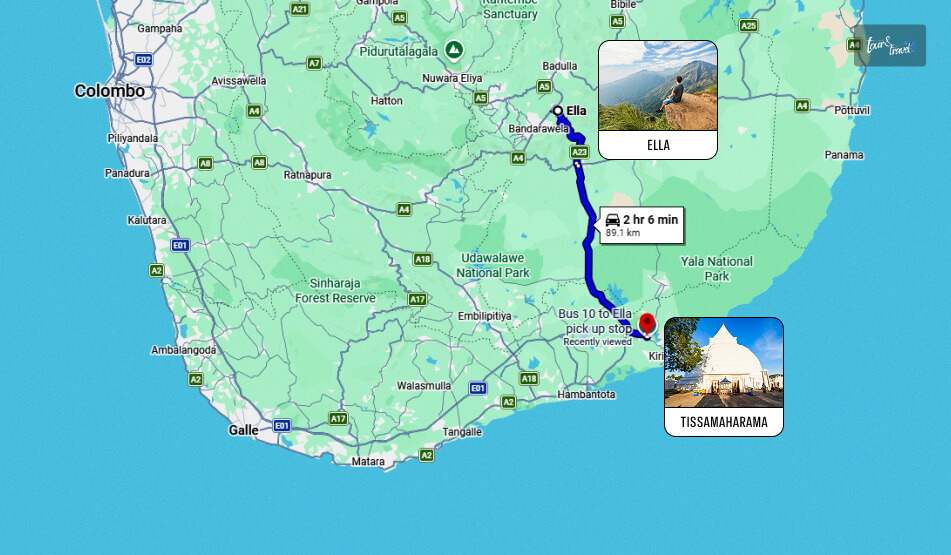
So, here are the details of how to reach the Yala National Park from various parts of Sri Lanka.
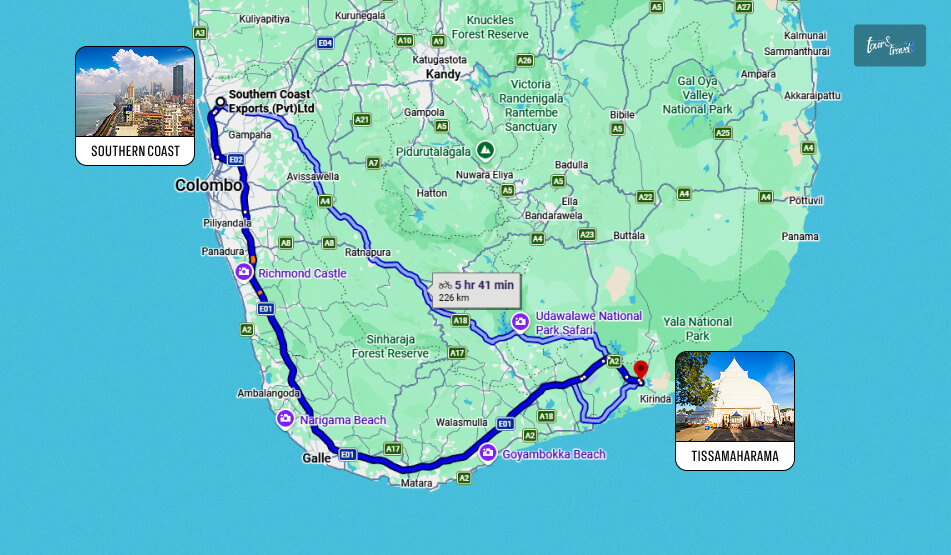
1. From The Southern Coast To Tissamaharama
The surfing towns on the southern coast are well connected to the Yala National Park.
The best way to travel is to take a train from Mirissa to Colombo Fort Station and then walk to the Colombo Bastian Mawatha Bus Terminal to catch a bus to Kataragama.
From Kataragama, you can hire a 4×4 jeep to reach the Yala National Park.
Check the table below to know how you can reach the Yala National Park from Mirissa.
Stage 1: Train from Mirissa to Colombo Fort Station
Stage 2: Taking a Bus from Colombo Bastian Mawatha Bus Terminal to Kataragama
– Time: 5 Hours Onward – Ticket Price: LKR 750
Stage 3: 4×4 Jeep Ride from Kataragama to the Yala National Park
Travel Time – 30 Minutes to Katagamuwa Entrance – Around 1 Hour to the Main Entrance or the Palatupana Entrance – Around 45 Minutes to Galge Entrance Price (Per Vehicle) – LKR 9000 to 18000
3. From Ella To Tissamaharama
From Ella, you can either take a bus or a private transport to reach Tissamaharama.
Bus Ride
The bus passes through Wellawaya and takes 4.5 hours to complete the journey. Furthermore, the ticket price will be around LKR 200.
Also, a local told me of a bus route from Bandarawela to Kataragama, having Tissamaharama and Ella as stopovers. However, I could not fact-check the availability of such services.
Private Transfer
For a premium and flexible travel experience, you can book a private transfer to cover the distance in a shorter time.
The journey is for 2.5 hours. However, the cost will be around LKR 10000.
Also, if you are planning to take a private transfer, choose Uber for a safe journey at a reasonable price.
By Train
There is no direct railway connectivity to Yala. However, if you are traveling from the southern coast, you can get off at Matara.
From Matara, you can take a tuk-tuk, bus, or taxi to reach the Yala National Park.
What Is The History Of The Yala National Park?
The history of Yala National Park as a protected wilderness is at least a century old. As an ecotourism zone, it is a bucket-list destination for anyone on a trip to Sri Lanka.
However, earlier, it was a hunting ground for the British colonial elites. However, at the beginning of the 20th century, the colonial administration took effective steps for the preservation of the park.
The Designation As A Wildlife Sanctuary
The British government designated the area as a wildlife sanctuary in 1900. It was an attempt to restrict and regulate game hunting.
The Designation As A National Park
Under the Fauna and Flora Protection Ordinance, Yala became a national park in 1938.
Thus, the core activity here became absolute wildlife protection from managed hunting.
Mid-Century Turmoil And Restoration
The park faced several challenges during the mid-to-late 20th century. Furthermore, during the 1970s and 1980s, Yala suffered from ivory hunting, illegal poaching, and agricultural encroachment along its borders.
DWC, or the Department of Wildlife Conservation, along with dedicated non-governmental organizations, launched sustained anti-poaching patrols and habitat restoration initiatives.
These endeavors established the delicate ecological equilibrium of the national park. Also, the population of the elephants and leopards made a recovery during this time span.
The 2004 Tsunami And Ecological Resilience
The coastal fringe of Yala was massively impacted due to the Indian Ocean tsunami on 26th December 2004.
However, fortunately, deer, leopards, and elephants had fled to higher ground hours before the tsunami hit.
Furthermore, the land has made a tremendous recovery over the last two decades. There has been a proper regeneration of the coastal scrub, showcasing the profound resilience of this coastal wilderness.
The Five Blocks Of The Yala National Park
The expansive area of the Yala National Park has five different geographical blocks for better management of the expansive area.
Have a look at the table below to understand the uniqueness of each block.
Blocks in the Yala National Park
Uniqueness
Block I (Palatupana)
– The Crown Jewel of Yala – The Most-Visited, Wildlife-Dense, and Most Accessible Block of the National Park. – It features an Excellent Mix of open grasslands, monsoon forests, and Brackish Lagoons.
Block II (Katagamuwa)
– A Quiter, Transitional Zone – It Offers Exceptional Opportunities for Elephant Viewings and Excellent Birdwatching.
Blocks III, IV, and V
– The Deeper and Wilder Interior of Yala – These Northern Blocks Have Thick Vegetation, Minimal Tourist Infrastructure, and a Rugged Geology – Authentic Wilderness Experience Devoid of Jeep Convoys.
The Wildlife Experience I Had On The Yala National Park Safari
The Yala ecosystem is not just about the elephants and leopards. Furthermore, the ecosystem of Yala relies on a rich web of biodiversity, including hundreds of species.
1. The Sri Lankan Leopard
The Yala National Park does not have tigers or lions. Thus, Sri Lankan leopards rule as the undisputed predators of the zone.
Furthermore, Yala National Park is home to one of the biggest populations of Sri Lankan leopards. As a result, leopards are more visible here compared to different parts of India and Africa.
2. The Asian Elephants
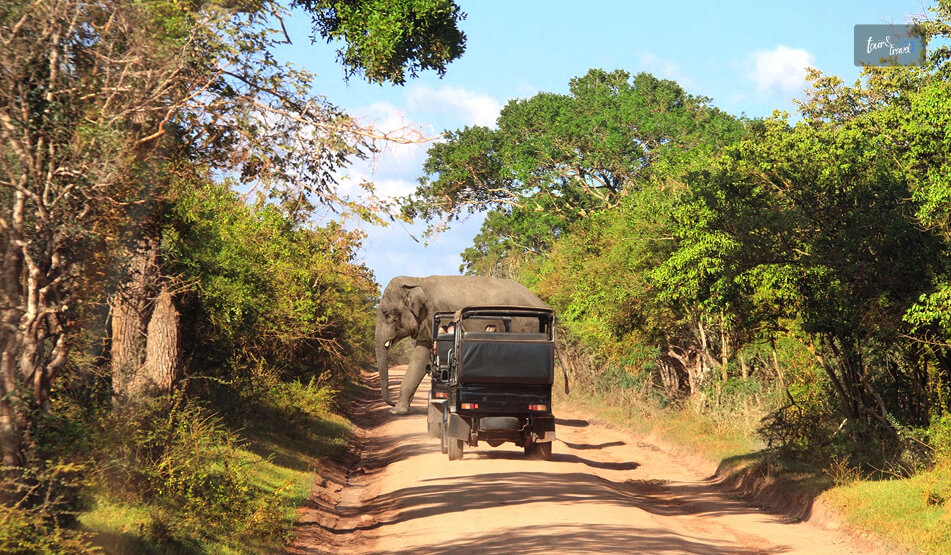
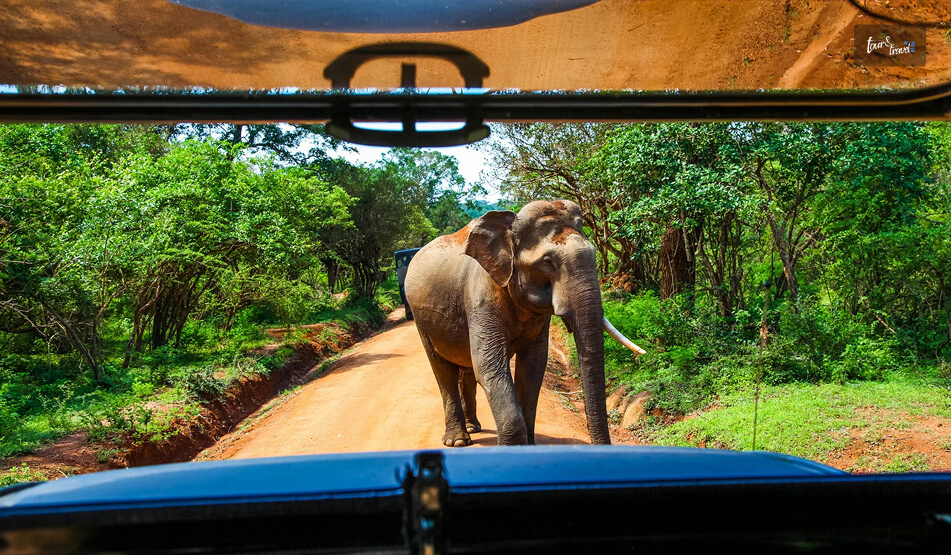
Solitary bull elephants and large herds roam freely in the Yala National Park. These majestic creatures rely on inland lagoons and seasonal watering holes for bathing and feeding.
3. The Sri Lankan Sloth Bear
These animals are territorial and highly elusive. Furthermore, these shaggy, insect-eating animals are most frequently spotted during the fruiting season of the Palu tree.
4. Other Wildlife
The dry zone of the Yala National Park teems with wildlife. Along with these massive mammals, I could even spot a spotted
Deer (Chital)
Sambar Deer
Wild Boar
Tufted Gray Langurs
Toque Macaques
Water Buffalo
Water Monitor Lizards
Mugger Crocodiles
These animals were mostly visible near the water.
5. A Paradise For Birdwatchers
Yala National Park is a premier global destination for birdwatching. There are more than 215 bird species in the national park.
Furthermore, November to January is the ideal time for spotting the migratory waterfowl that fly to Sri Lanka to escape the strong winter of the Northern hemisphere.
– Green Bee-Eaters – Indian Peacocks – Malabar Pied Hornbills
The Fascinating Yala National Park Safari Experience
The Yala National Park safari offers a sensory and intense experience. Furthermore, the safari experience begins before sunrise.
1. The Dawn Patrol
The safari began at 4 AM from Tissamaharama. It was still pitch black, and we took a sip of the local coffee.
Then, the cold morning breeze touched us, and we advanced with the jeep headlights piercing through the predawn mist.
Furthermore, by 5:15 AM, we reached the main Palatupana Gate. The drivers waited for the park rangers to issue permits.
Then, the gates opened at 6 AM, and the vehicles started roaring through the dirt tracks of Block I.
2. The Landscape And The Sighting
When the first rays of the Sun touch the Yala National Park, the landscape looks very African.
It has scattered grasslands, spindly thorn scrub, and flat plains. Furthermore, the air was thick with humidity.
Then, the driver spotted a leopard suddenly, and the driver made a coordinated dash across the park.
The leopard was standing tall across a massive granite boulder in the soft morning light.
3. Midday Solace At Patanangala
As the day progressed, the wild creatures made a retreat deep into the thick shade with surging heat.
So, our jeep, along with many others, united at the Patanangala Beach picnic area.
In this part of the park, its rugged self became visible. The crashing waves of the Indian Ocean met the vast rocky outcrops.
Also, it was the place to stretch our legs and relax.
4. Exploring The Sacred Ruins In The Scrub
Along with rich wildlife, Yala National Park also stands out due to its deep historical and cultural footprint.
Especially in Block I of the national park, you will find some well-preserved ruins that depict the picture of an ancient civilization.
Sithulpahuwa Rock Temple
This rock temple is around 2200 years old and is a prominent architectural feature of the Kingdom of Ruhuna.
Once, thousands of Buddhist monks used to live in this temple. Today, you can see its white stupas rise dramatically above the forest canopy from a massive granite peak.
Furthermore, monks still live in this rock temple, and you can see leopards and tigers roaming in the courtyard.
Magul Maha Vihara
Magul Maha Vihara is on the southern fringes of the Yala National Park. It is believed to be the ancient site where King Kavantissa married Princess Viharamahadevi.
You can admire the intricate moonstones and stone pillars of the Vihara.
What Is The Best Time For The Yala National Park Safari?
February to July, or the dry season in the southern coast of Sri Lanka, is the ideal time to plan a Yala National Park safari.
In these months, the grass in the park thins out, and the secondary waterholes dry up completely. So, the animals have to gather around the water in search of water.
Furthermore, November to April is the best time for birdwatching in the Yala National Park.
Also, remember that the Department of Wildlife Conservation typically closes Yala National Park for the entire month of September (sometimes extending into early October).
Yala National Park Safari And The Overtourism Issues
The rising popularity of the Yala National Park, especially on social media, now impacts the intimate wilderness experience.
It feels like a rushed safari tour, and by sunrise, hundreds of high-clearance safari jeeps queue at the Palatupana Gate.
Moreover, drivers are under immense pressure from their clients to find the “Big Three.”
So, whenever there is a radio transmission about a leopard getting spotted, the jeeps get into a frantic race.
Furthermore, the rush of these jeeps is disrupting the ecology and the natural wildlife behaviors of the national park.
In an interview with Mongabay, warden Ravindra Kumara, while narrating the controversial case of the male leopard Lucas’ encounter with a jeep, mentioned,
“Usually, when a safari jeep is close to an animal, jeep drivers have been advised to switch off the engine.
But this driver had turned on the engine, and it had scared away the animal. However, Lucas was spotted the following night near Yala junction, the animal’s usual territory, and is in good health.”
However, the driver training programs conducted by the Department of Wildlife Conservation and the Wildlife and Nature Protection Society are proactive measures to avoid such unwanted disturbances.
In addition, the opening of remote blocks in the park can reduce the concentrated traffic in Block I.
So, Is The Yala National Park Safari Worth It?
Yes, the Yala National Park safari is absolutely worth the hype. I could see leopards softly walking through the scrub, elephant herds roaming, and peacocks dancing on open plains.
Furthermore, the shift in the landscape is dramatic.
However, the safari of this expansive area is quite demanding, and that is why you need to keep several things in mind.
What Are The Things To Keep In Mind For A Yala National Park Safari?
The rest stops and toilets are limited, and you will find the facilities near the main gate and the Patanangala Beach.
Furthermore, you must carry cash, preferably LKR, to pay for the permits and other expenses at the park.
Sibashree is a travel, culture, and leisure writer who has been writing since the age of 12 and professionally since 2014. With more than a decade of travel writing experience and journeys across India and several parts of the world, she brings a deeply personal and thoughtful perspective to her work. A student of English Literature and Mass Communication, Sibashree has always viewed travel as more than movement — for her, it has been a way of understanding people, cultures, and herself. Her passion for spiritual exploration has also led her to many unusual and meaningful destinations over the years. Outside of writing, Sibashree enjoys watching European cinema, reading about global politics, and reflecting on the stories hidden within everyday places.
Kandy is the City of Kings in Sri Lanka, and it is undisputedly the cultural capital of Sri Lanka.
It has amazing green hills, and the vibrant destination here serves as the spiritual heart of the island.
Furthermore, it is home to the Temple of the Sacred Tooth Relic, the most revered Buddhist shrine in Sri Lanka. It has a sacred tooth portion of Lord Buddha.
Along with this cultural richness and its spiritual vibe, Kandy also stands out with a sensory experience of delightful chaos.
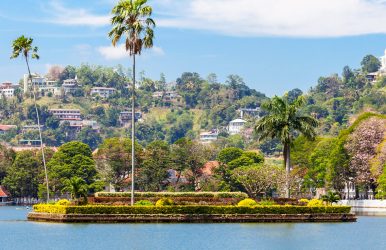
It has bustling markets, aromatic local eateries, and historical colonial architecture, and of course, the picturesque Kandy Lake.
So, naturally, Kandy was a major stop on my trip to Sri Lanka. Finding the right accommodation here is crucial to enjoying the endless things to do in Kandy.
The right accommodation helps you to soak in the tranquil beauty of the hill country and the high energy of the city together.
So, here is a guide on where to stay in Kandy.
Where To Stay In Kandy? An Overview Of Kandy Hotel
Before I discuss the specific neighborhoods to stay in Kandy, let me share a quick overview of the best accommodation options.
CategoryAccommodation ChoiceBest Luxury StayW15 Hanthana EstateBest Mid-Range StayHeritage Boutique Best Budget StayHelga’s FollyHow to Get AroundWalking and Local Tuk-TuksBest Time to Visit KandyJanuary to April (Dry Season)
What Are The Best Places To Stay In Kandy? (Know The Best Areas)
Kandy has a mountainous terrain and winding roads. The accommodations here are spread across distinct zones.
So, you have to choose a locality that will help in shaping your experience.
Downtown Kandy Area
If you want to immerse yourself in the authentic pulse of Kandy, you must find an accommodation in Downtown Kandy.
You can listen to the cacophony of sights and sounds. It has British colonial facades mixed with bustling commercial markets.
Pros and cons of finding a place to stay in Downtown Kandy.
ProsCons- Kandy allows you to explore the Tooth Relic, Kandy Lake, and traditional Kandyan dance halls.- Furthermore, the central train and bus stations in Kandy make exploring various parts of the country enjoyable. - Loud- Congested- Hectic
The best place to stay in Kandy is Heritage Boutique.
The Kandy Hills
High above the valley floor, the Kandy Hills offer an escape from the chaos of Kandy Downtown.
It has misty mornings, sweeping forest views, and cool breezes. Furthermore, it has the most premium boutique hotels.
ProsCons- Quiet- Peaceful- Scenic- Perfect for Unwinding- Steep Terrain- Dependency on Tuk-Tuks for Transit
W15 Hanthana Estate, Helga’s Folly, 36 Bed & Breakfast are the best recommendations for accommodations in the Kandy Hill area.
Kandy Lake Area
Kandy Lake is an ideal middle ground in Kandy. It offers a peaceful buffer zone with quick access to the historic core of the cultural hub of Kandy.
ProsCons- Scenic Walking Paths- Close to the Central Sights and Major Shrines. - Properties Close to the Lake Get Filled up Quickly.
The Ru Boutique Hotel is one of the best places to stay in the Kandy Lake area.
Northern Kandy Area
Northern Kandy stretches toward the banks of the Mahaweli River.
The Mahaweli River is the longest waterway of Sri Lanka, and Northern Kandy is an affluent and sprawling neighborhood of Kandy.
Moreover, here are the pros and cons of finding an accommodation in Northern Kandy.
ProsCons- Home to expansive, high-end resorts.- It offers you insights into the way of slow living in Kandy. - Visually Isolated from the Town.
Taru Villas Kandy and Mahaweli Reach are some of the best accommodations in Northern Kandy.
What Are The Best Places To Stay In Kandy? (Know The Accommodations)
Here are some of the best places to stay in Kandy when you are visiting with your family.
1. Helga’s Folly: The Most Budget-Friendly Accommodation
Helga’s Folly won my heart instantly with its whimsical Sri Lankan artwork.
It has been the childhood home of high-society owner Helga de Silva Blow Perera.
Furthermore, it has hosted the names such as Mahatma Gandhi and Gregory Peck.
The garden here looks like a dreamscape. However, the actual amazement awaits in the interior.
It has 35 rooms where you will find family portraits, vivid murals, and dripping candles.
Overall, this accommodation is intriguing, and I loved it for its aesthetics and its unhinged nature.
W15 Hanthana Estate Kandy: The Best Luxury Accommodation In Kandy
W15 Hanthana Estate is on a historic tea plantation in the Hanthana Hills. It has nine bedrooms and unmatched colonial luxury.
Furthermore, the meticulous restoration work here has also made the accommodation score quite high on amenities.
Also, if you choose to stay here, you will get a personal butler to attend to your requirements.
Moreover, it has perfectly manicured lawns, and from here, you can enjoy amazing views of the Knuckles Range.
In addition, it offers the ultimate vintage experience in which you can enjoy a ride in an open-top vintage Land Rover Defender and explore the rugged hillside.
Heritage Boutique: The Best Mid-Range Stay In Kandy
You can take a short walk from the Temple of the Sacred Tooth Relic to reach Heritage Boutique.
It has four stately and royally themed rooms. Furthermore, this accommodation focuses highly on personalized experiences.
So, it is the ultimate accommodation in urban areas.
Practical Tips For Your Trip To Kandy
If you want to make the most of your time in Kandy, the cultural capital of Sri Lanka, keep these practical things in mind.
The most beautiful mode of transport from Colombo Fort to Kandy is via train.
Once you reach the city, you can take a tuk-tuk or use local ride-hailing apps to explore different areas.
Furthermore, cover your shoulders and knees when visiting the Temple of the Tooth Relic.
You will also need to remove your shoes before entering the temple complex.
Overall, be respectful to the cultural heritage and Buddhist traditions of Kandy to enjoy a seamless experience.
Like how I had pulled over for St. Clair's Fall, the same thing happened a few kilometers along the A7.
The driver asked me not to keep my camera aside yet, and suddenly the hillside opened up.
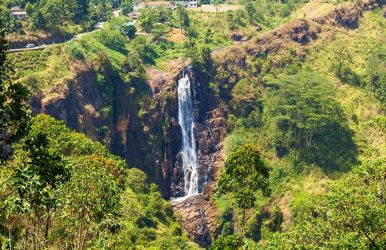
There was a long, narrow ribbon of white water dropping almost straight down into a gorge of tea bushes.
It was Devon Falls, the “Veil of the Valley” in Sri Lanka’s Tea Country. The name comes from how it falls a long way.
So, it more than makes up for the lack of width compared to St. Clair's Waterfall. Here is more about this beautiful waterfall that should be on your Sri Lanka itinerary the next time you visit.
Some Quick Facts About Devon Falls, Nuwara Eliya
Details Information Height Around 97 Meters Number of Drops 3 Tiers River A Tributary of the Kotmale Oya, Part of the Mahaweli River System Location 6 KM West of Talawakele, Nuwara Eliya District, Central Province Elevation Around 1140 Meters Above Sea Level Entry Fee Free and Viewable from Roadside Platform Nickname The Veil of the Valley Rank 19th Highest Waterfall in Sri Lanka
Where Is Devon Falls And How To Get There?
Around 6 kilometers west of Talawakele, Devon Falls is on the A7 highway that connects Colombo to Nuwara Eliya via Hatton.
This waterfall in the Nuwara Eliya District is at an elevation of around 1140 meters. It is in the heart of the Dimbula tea-growing region.
From Nuwara Eliya
The distance between Nuwara Eliya and Devon Waterfall is around 30 kilometers. I took a car from Nuwara Eliya, and it cost me around 3000 LKR.
You can also take a tuk-tuk, which costs around LKR 2000.
The road passes directly above the falls. So, even before you reach the viewpoint, you will get your first glimpse of it through the windscreen.
From Kandy Or Colombo
If you are traveling from Kandy by road, you will reach Devon Falls within 2 to 2.5 hours via Gampola and Nawalapitiya.
Furthermore, from Colombo, it is a 4-hour drive on the Avissawella–Hatton route. Since it is a long journey from Colombo, you can pair it with a night in Hatton or Nuwara Eliya rather than a same-day round trip.
On Foot From The Road
There are two designated car parks along the A7 that double as observation platforms.
Both offer a clear view of the three-tiered drop without any walking required.
If you want a closer look, a short trail leads about a kilometre through the surrounding tea estate toward the base, though the pool itself is not easy to reach.
The Story Behind The Name Of Devon Falls
Devon Falls gets its name from Devon, a pioneering English coffee planter.
His plantation once occupied the land nearby.
When coffee cultivation collapsed across Sri Lanka's hill country in the late 19th century due to a leaf-rust blight, tea took its place.
Today, the falls tumble past neat rows of tea bushes rather than coffee, though the name from that earlier era stuck.
What I found most memorable about Devon Falls was not just its height, but how sudden it feels.
St. Clair's spreads its water wide and slow.
Devon narrows it and lets it drop, almost in a single unbroken curtain through the first two tiers before spreading again near the base.
Moreover, standing at the main viewpoint opposite the Mlesna Tea Centre, you get the full length of the fall in one frame, framed by steep, green escarpments on both sides.
What Is The Best Time To Visit Devon Falls?
Season Months What to Expect Wet Season May to September Fuller, more dramatic flow, though mist can obscure the view Dry Season December to March Clearer skies, better for photography, lighter flow Early Morning Any Season, Before 9 AM Less roadside traffic and softer light on the water
Pairing Devon Falls With St. Clair's
Because the two falls sit only a few kilometres apart on the same road, almost nobody visits just one.
St. Clair's is the wider, more famous of the pair, while Devon is the taller and, to my eye, the more dramatic.
Seeing both in a single stop along the A7 takes less than half a day, which makes this stretch of road one of the most efficient sightseeing detours in the hill country.
A One-Day Itinerary Around Devon Falls
Here's how I'd plan a day trip centred on Devon Falls, starting from Nuwara Eliya or Hatton.
Time Stop Note 8:30 AM Depart Nuwara Eliya or Hatton Aim to reach the falls before the midday tour-bus crowds. 9:30 AM St. Clair's Falls Roadside viewpoint, about 6 km east of Devon. 10:30 AM Devon Falls View from the main platform opposite Mlesna Tea Centre. 11:15 AM Tea estate walk or factory visit Several estates in Dimbula offer short tours. 12:30 PM Lunch in Talawakele Local rice-and-curry spots along the main road. 2:00 PM Onward to Hatton or Nuwara Eliya Or continue toward Adam's Peak if timing allows.
Practical Tips For A Visit To Devon Falls
Both viewpoints are roadside, so no hiking is required if you just want the classic photo.
Traffic along the A7 can be heavy with tour vans in the late morning. So, an early start helps.
Skip swimming here. The pool is difficult to access, and the currents near the base are not considered safe.
Pack a light jacket. At over 1,100 m elevation, mornings can be genuinely chilly even in the dry season.
We only stopped for about fifteen minutes at Devon Falls.
However, it was one of those places that have stayed with me. That long, narrow drop through the tea hills, half-hidden in mist, is hard to shake.
My trip to Sri Lanka crossed many dramatic turns, especially in the Northern part of the country.
With Vavuniya feeling like a crossroads rather than a stopover and Mannar being a high point where the wind never stops, the next stop was Mullaitivu.
Mullaitivu was a name that I had only read about in the news archives.
Mullaitivu is even in the news today as the people of Keppapilavu have been protesting for days now for the return of their ancestral lands.
Thurairasa Ravikaran and Sivagnanam Shritharan, two Tamil parliamentarians, have shown their support and solidarity to this protest.
Nevertheless, while Trincomalee beaches and the rich culture of Jaffna dominate the conversations about Northern Sri Lanka, Mullaitivu surfaced as a place talking about the past.
In this article, I will talk about my two days in Mullaitivu, from the drive in to the lagoon that ended a war, and why I think this coastline deserves more than a passing mention on a map.
Why Mullaitivu Almost Stayed Off My List
The day I spent at Vavuniya, the guesthouse caretaker there, a soft-spoken man named Selvam, was the one who first brought up Mullaitivu.
About Mullaitivu, he mentioned,
“The beaches were empty, the lagoon was calm, and the town had not yet learned how to perform for tourists.”
This stirred me, as most travel forums I had checked mentioned Mullaitivu as a former war zone with a nice coastline and not much infrastructure.
While this is not false, this is only a fragmented picture of Mullaitivu.
How I Reached Mullaitivu
From Vavuniya, I took A34 to reach Mullaitivu. It was a distance of around 54 kilometers, and I reached within an hour and a half.
The road narrowed past Puthukkudiyiruppu, cutting through scrubland, paddy fields, and the occasional stretch of forest before the land flattens out toward the coast.
How Mullaitivu Felt At First Sight?
Mullaitivu was once a small fishing harbor.
It was a small fishing harbor and a stop for sailing vessels moving goods between Colombo and Jaffna in the early twentieth century.
Today, it also remains a fishing town, unbothered and unhurried by outsiders.
As I entered the town, my driver, Ravi, pointed out the old lighthouse. It was built in 1896, and it has lost its original iron frame.
So, when you visit the lighthouse today, you can only find a faded signboard.
Nevertheless, I spent my first evening walking along Mullaitivu Beach.
Fishing boats had gathered there, forming neat rows, and the nets were drying on the sand.
Also, it was most delightful to find children playing cricket on the sand with a tennis ball.
Being from the country where cricket is a religion, I joined them.
We bonded big time talking over big names such as Kumar Sangakkara and Kusal Mendis.
A few meters away from them, an elderly woman was mending a fishing net.
It felt like a scene from a Sanjeewa Pushpakumara movie. Like his films, Flying Fish and The Venishing, it was like a scene depicting the raw portrayal of survival.
What Are The Places To Visit In Mullaitivu?
I was not prepared for the amount of Civil War history Mullaitivu offered me.
Also, the birds and the sanctuary where the beach and lagoon meet allowed me to unwind with so many things going on in my head about life during and after the Civil War in Sri Lanka.
Nanthikadal Lagoon: Where The War Ended
At a glance, the Nanthikadal Lagoon looks like a shallow, sand-fringed body of water. It is on the northeastern edge of the district.
Small rivers feed it, and it finally opens into the Indian Ocean.
When I reached the lagoon, I found some egrets standing motionless in the shallows. Then, a kingfisher dropped into the water and came up empty.
Ravi then took me to an old man, a local school teacher called Rajan. He narrated the entire story of the Nanthikadal Lagoon to me.
What Happened At Nanthikadal Lagoon
The 26-year Civil War of Sri Lanka ended at Nanthikadal Lagoon in May 2009.
Here, the government forces cornered the last LTTE fighters. The group's leader, Velupillai Prabhakaran, was also killed.
In the weeks before that, civilians had been pushed into a shrinking strip of land along this same lagoon. They were between the fighting lines.
In a report published on 17th January 2009, The Guardian wrote,
“International concern is intensifying over the fate of around 350,000 civilians trapped in a rapidly shrinking rebel-controlled pocket of land in Sri Lanka's north east, as the military steps up its campaign to end the civil war by crushing the Tamil Tiger forces.
There is no specific count of the number of human casualties in these final months.
A 2011 UN Panel of Experts report stated that credible sources estimated as many as 40,000 civilian deaths.
Another report, published by The Times (UK) on 29th May 2009 based on confidential UN documents the paper obtained, reported that civilian deaths in the no-fire zone rose sharply from late April.
The deaths averaged around 1,000 killed per day until May 19, 2009. Thus, it had put the total civilian death toll at over 20,000. (Source: Al Jazeera).
The Sri Lankan Government has shown a much lower figure.
However, in the UN Rights Council: Act on Sri Lanka Report published on 13th September 2011, Brad Adams, the Asia director at Human Rights Watch, mentioned,
“When a UN Panel of Experts report concludes up to 40,000 civilians died amid war crimes, the Human Rights Council should feel compelled to act.
The council should order a full international investigation – anything less would be a shameful abdication of responsibility.”
How Nanthikadal Lagoon Looks Back At Those Days Every Year
Tamil families gather at Mullivaikkal, close to the lagoon, on 19th May every year to remember relatives lost in the final days.
They light lamps and plant coconut saplings in their memory.
Standing at the water's edge, with fishermen casting nets a short distance away, I found it hard to reconcile the stillness in front of me with what this ground had witnessed.
The Victory Monument, The Museum, And The Submarines
The Puthukkudiyiruppu Victory Monument was on the Paranthan-Mullaitivu road, which was a short drive from the lagoon.
It was unveiled in 2019, and it depicts a soldier carrying the national flag.
Furthermore, the surrounding pond and lilies represent the ocean around the island and the nation itself.
An adjoining war museum displays weapons, vehicles, and vessels used during the conflict's final phase.
Entry to the museum was free, and it remains open from 8 AM to 5 PM.
Also nearby, there were rusted hulls, and it was the site where the government troops discovered an abandoned Sea Tiger boatyard in 2009.
It is where the LTTE's naval wing used to build improvised submarines and semi-submersible craft.
I want to be honest about something here.
This is a site that different communities in Sri Lanka read very differently, and I do not think a two-day visit qualifies anyone to settle that.
What I can say is that visiting both the lagoon and the monument on the same day gave me a fuller, more uncomfortable picture than either would have alone.
The Kokkilai Lagoon: Where The Coastline Turns Peaceful Again
On the second afternoon, I drove out to Kokkilai Lagoon.
It was a wetland sanctuary around 25 kilometers southeast of town.
It has been a protected bird sanctuary since 1951, and I could spot pelicans, herons, and occasional flamingos moving along the shallows.
The crowd of birdwatchers was small, and the overall ambiance was quiet.
Chundikulam
Further along the coast, Chundikulam allowed me to relax. It was a sanctuary with no visitors.
I quietly cherished the view of the beach and lagoon blurring into one uninterrupted stretch of sand and water.
Coming back from Chundikulam, I had some spicy crab curry and rice at a roadside stall. It was similar to what I had in Jaffna, but it tasted even better.
Ravi said, “It was the only reason to end the day here.”
My Two Days In Mullaitivu: The Itinerary
Day TimeActivities/Places to VisitDay 1MorningDrive from Vavuniya via the A34MiddayCheck-in and Walk through Mullaitivu TownAfternoonNanthikadal Lagoon and the CausewayEveningMullaitivu Beach at SunsetDay 2MorningPuthukkudiyiruppu Victory Monument and War MuseumMiddaySea Tiger Submarine YardAfternoonKokkilai Lagoon BirdwatchingEveningChundikulam Coastline and Seafood Dinner
Mullaitivu: A Quiet Place That Asks You To Listen
Away from the grandeur of Kandy and Colombo, Mullaitivu is a place that simply exists.
It tells the stories of human survival, and it is still recovering and fishing despite the stains and the lives lost in the Civil War.
So, if you are already tracing the north of Sri Lanka through Vavuniya, Kilinochchi, or Mannar, I would not leave Mullaitivu off the route.
Just go with the understanding that this is not a beach add-on. It is a place that holds two very different stories at once, and it does not owe you a tidy conclusion to either.





 Related