
Devon Falls, Nuwara Eliya: Know The Timings, Entry Fee, Experience, How To Reach And More

Like how I had pulled over for St. Clair’s Fall, the same thing happened a few kilometers along the A7.  

The driver asked me not to keep my camera aside yet, and suddenly the hillside opened up.  

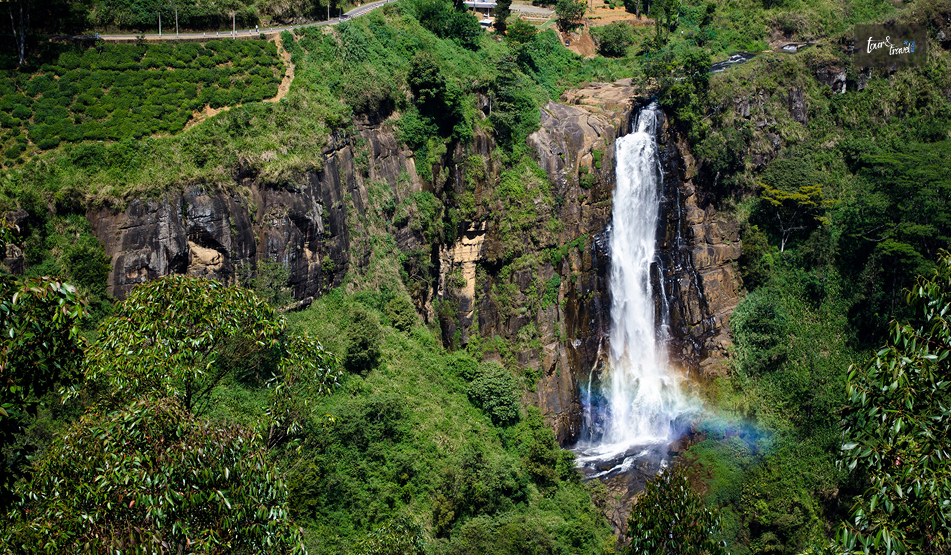
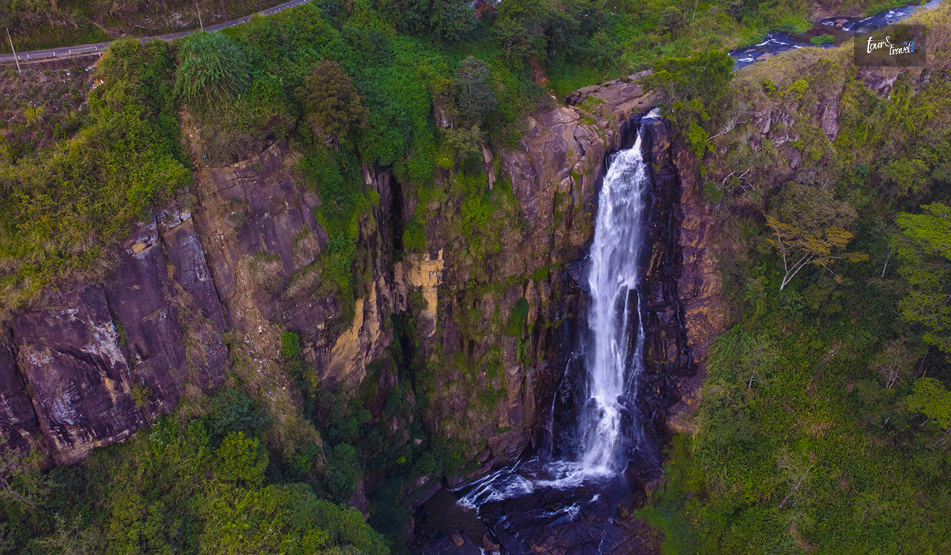
There was a long, narrow ribbon of white water dropping almost straight down into a gorge of tea bushes. 

It was Devon Falls, the “Veil of the Valley” in Sri Lanka’s Tea Country. The name comes from how it falls a long way.  

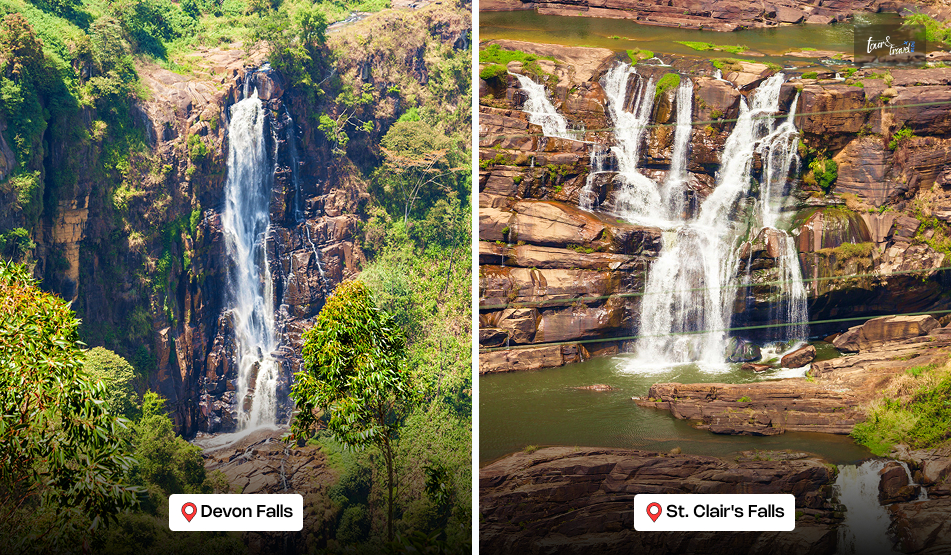
So, it more than makes up for the lack of width compared to St. Clair’s Waterfall. Here is more about this beautiful waterfall that should be on your Sri Lanka itinerary the next time you visit.  

Some Quick Facts About Devon Falls, Nuwara Eliya  

Details  Information 
Height Around 97 Meters 
Number of Drops  3 Tiers 
River A Tributary of the Kotmale Oya, Part of the Mahaweli River System 
Location 6 KM West of Talawakele, Nuwara Eliya District, Central Province 
Elevation Around 1140 Meters Above Sea Level 
Entry Fee Free and Viewable from Roadside Platform 
Nickname The Veil of the Valley 
Rank 19th Highest Waterfall in Sri Lanka 

Where Is Devon Falls And How To Get There?

Devon Falls, Nuwara Eliya: Know The Timings, Entry Fee, Experience, How To Reach And More

Around 6 kilometers west of Talawakele, Devon Falls is on the A7 highway that connects Colombo to Nuwara Eliya via Hatton. 

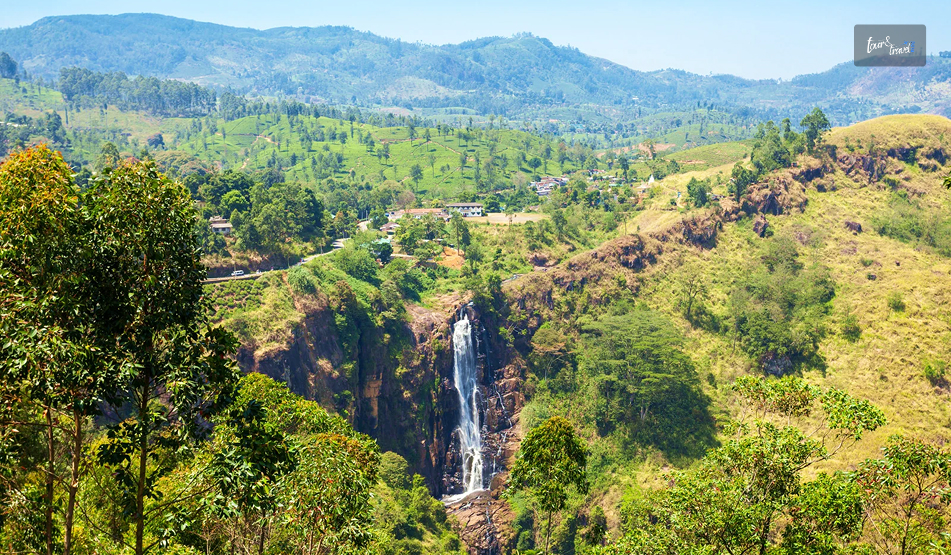
This waterfall in the Nuwara Eliya District is at an elevation of around 1140 meters. It is in the heart of the Dimbula tea-growing region.  

From Nuwara Eliya 

The distance between Nuwara Eliya and Devon Waterfall is around 30 kilometers. I took a car from Nuwara Eliya, and it cost me around 3000 LKR.  

You can also take a tuk-tuk, which costs around LKR 2000.  

The road passes directly above the falls. So, even before you reach the viewpoint, you will get your first glimpse of it through the windscreen. 

From Kandy Or Colombo 

If you are traveling from Kandy by road, you will reach Devon Falls within 2 to 2.5 hours via Gampola and Nawalapitiya.  

Furthermore, from Colombo, it is a 4-hour drive on the Avissawella–Hatton route. Since it is a long journey from Colombo, you can pair it with a night in Hatton or Nuwara Eliya rather than a same-day round trip. 

On Foot From The Road 

There are two designated car parks along the A7 that double as observation platforms.  

Both offer a clear view of the three-tiered drop without any walking required.  

If you want a closer look, a short trail leads about a kilometre through the surrounding tea estate toward the base, though the pool itself is not easy to reach. 

The Story Behind The Name Of Devon Falls

Devon Falls, Nuwara Eliya: Know The Timings, Entry Fee, Experience, How To Reach And More

Devon Falls gets its name from Devon, a pioneering English coffee planter.  

His plantation once occupied the land nearby.  

When coffee cultivation collapsed across Sri Lanka’s hill country in the late 19th century due to a leaf-rust blight, tea took its place. 

Today, the falls tumble past neat rows of tea bushes rather than coffee, though the name from that earlier era stuck. 

What I found most memorable about Devon Falls was not just its height, but how sudden it feels.  

St. Clair’s spreads its water wide and slow. 

Devon narrows it and lets it drop, almost in a single unbroken curtain through the first two tiers before spreading again near the base.  

Moreover, standing at the main viewpoint opposite the Mlesna Tea Centre, you get the full length of the fall in one frame, framed by steep, green escarpments on both sides. 

What Is The Best Time To Visit Devon Falls? 

Season Months What to Expect 
Wet Season May to September Fuller, more dramatic flow, though mist can obscure the view 
Dry Season December to March Clearer skies, better for photography, lighter flow 
Early Morning Any Season, Before 9 AM Less roadside traffic and softer light on the water 

Pairing Devon Falls With St. Clair’s

Devon Falls, Nuwara Eliya: Know The Timings, Entry Fee, Experience, How To Reach And More

Because the two falls sit only a few kilometres apart on the same road, almost nobody visits just one.  

St. Clair’s is the wider, more famous of the pair, while Devon is the taller and, to my eye, the more dramatic.  

Seeing both in a single stop along the A7 takes less than half a day, which makes this stretch of road one of the most efficient sightseeing detours in the hill country. 

A One-Day Itinerary Around Devon Falls

Devon Falls, Nuwara Eliya: Know The Timings, Entry Fee, Experience, How To Reach And More

Here’s how I’d plan a day trip centred on Devon Falls, starting from Nuwara Eliya or Hatton. 

Time Stop Note  
8:30 AM Depart Nuwara Eliya or Hatton Aim to reach the falls before the midday tour-bus crowds.  
9:30 AM St. Clair’s Falls Roadside viewpoint, about 6 km east of Devon.  
10:30 AM Devon Falls View from the main platform opposite Mlesna Tea Centre.  
11:15 AM Tea estate walk or factory visit Several estates in Dimbula offer short tours.  
12:30 PM Lunch in Talawakele Local rice-and-curry spots along the main road.  
2:00 PM Onward to Hatton or Nuwara Eliya Or continue toward Adam’s Peak if timing allows.  

Practical Tips For A Visit To Devon Falls 

  • Both viewpoints are roadside, so no hiking is required if you just want the classic photo. 
  • Traffic along the A7 can be heavy with tour vans in the late morning. So, an early start helps. 
  • Skip swimming here. The pool is difficult to access, and the currents near the base are not considered safe. 
  • Pack a light jacket. At over 1,100 m elevation, mornings can be genuinely chilly even in the dry season. 

We only stopped for about fifteen minutes at Devon Falls. 

However, it was one of those places that have stayed with me. That long, narrow drop through the tea hills, half-hidden in mist, is hard to shake.

Share on Social Media

Sibashree is a travel, culture, and leisure writer who has been writing since the age of 12 and professionally since 2014. With more than a decade of travel writing experience and journeys across India and several parts of the world, she brings a deeply personal and thoughtful perspective to her work. A student of English Literature and Mass Communication, Sibashree has always viewed travel as more than movement — for her, it has been a way of understanding people, cultures, and herself. Her passion for spiritual exploration has also led her to many unusual and meaningful destinations over the years. Outside of writing, Sibashree enjoys watching European cinema, reading about global politics, and reflecting on the stories hidden within everyday places.

Leave a Reply

Your email address will not be published. Required fields are marked *

title-img Related

READ MORE Polonnaruwa

What Are The Best Things To Do In Polonnaruwa? [Ultimate Travel Guide]

BY  Sibashree Jun 3, 2026

Polonnaruwa is filled with ancient structures, shrines, and temples. So, it draws the attention of people who are interested in visiting a place of great historical importance. In this article, I will give you some important tips and talk about the places, sites, and the history of the place that drew my attention. A Brief History Of Polonnaruwa Before getting into other details, we should take a look at the history of the place. Furthermore, knowing the history of Polonnaruwa will make the trip more interesting. Polonnaruwa was the second major capital of Sri Lanka, which came to prominence after the destruction of Anuradhapura in 993 AD. Moreover, it was the most important commercial and religious center of that time. Polonnaruwa reached its golden age in the 12th century under King Parakramabahu I.  The Chola Period (10th Century To 11th Century) The South Indian Chola dynasty conquered the ancient capital of Anuradhapura and made Polonnaruwa their new capital. Moreover, they renamed the city Jananathamangalam and built several Brahmanical monuments like the Siva Devale temple. Furthermore, the Cholas chose Polonnaruwa over Anuradhapura as the capital because it was positioned strategically in the heart of Sri Lanka. Additionally, the position of the city also gave them protection against the rebellion of the Ruhunu Sinhalese kingdom. Sinhalese Golden Age (11th Century To 12th Century) The strategically positioned capital couldn't stay protected from the Sinhalese. Eventually, in 1070, the Sinhalese King Vijayabahu I defeated the Cholas and restored Sinhalese rule. He also kept Polonnaruwa as the capital of the Sinhalese kingdom. The city reached its highest glory under his successors: King Parakramabahu 1 (1153 to 1186): King Parakramabahu 1 is often called the Great. He turned the city into a beautiful garden city during his rule. Additionally, he built Vaijayanta Pasada (Royal Palace) and intricate temples like the Lankatilaka Temple. Moreover, he built a massive 25-square-kilometer artificial lake known as Parakrama Samudra to secure water for his people. King Nissanka Malla (1187 to 1196): King Nissanka Malla also tried to match his predecessors' construction projects. In trying to do so, he ended up bankrupting the kingdom. Decline And Rediscovery (13th Century Onwards) There were several invasions and turmoils going on because of which the city’s resources and administrative system collapsed in the early 13th century.  The capital moved to the southwestern side of the island, and gradually, the jungle spread through Polonnaruwa. Finally, archeologists rediscovered the ruins of Polonnaruwa in 1860, and the forgotten city stands as a UNESCO World Heritage Site. Places To Visit In Polonnaruwa Polonnaruwa is a place of historical significance. The ancient structures, shrines, and temples draw the attention of visitors.  What amazed me was the well-preserved ancient remains. Moreover, I feel that a bicycle is an amazing option for traveling through the city. Places I found most amazing in Polonnaruwa are: The Gal Vihara The Gal Vihara is four giant Buddha statues, which are carved out of a large granite gneiss rock. The images consist of a large seated figure, another smaller seated figure inside an artificial cavern, a standing figure, and a reclining figure. Additionally, King Parakramabahu I fashioned this rock structure in the 12th century. Moreover, there is a story regarding this rock structure, which is one of the four statues, that isn't actually Buddha. Many people say that it is one of his grieving apprentices. The Polonnaruwa Vatadage Remaining unnoticed for several centuries, the excavation of Polonnaruwa Vatadage started in 1903. Many people believe that Parakramabahu 1 built this place to hold the relic of the tooth of Buddha. Moreover, another group of people believes that King Nissanka Malla built this place to hold the alms bowl used by Buddha. Additionally, the structure has two stone platforms decorated with stone carvings. You can enter the lower platform through a single entrance, which is facing the north. You can enter the second platform through four doorways facing four cardinal points. Hatadage Hatadage is another place that I found very fascinating. This place is found next to the Vatadage. This place holds a historical importance for tourists. Hatadage is located in the ancient city of Polonnaruwa. According to historians, King Nissanka Malla built this place. Moreover, Nissanka Malla built this place as a shrine to keep the relic of the tooth of the Buddha. Furthermore, many people say that the place holds sixty relics. I found this place very fascinating to visit. The Lankatilaka Temple The Lankatilaka Temple is another interesting place to visit. The temple is located on Panhalgala Rock in Udunuwara. Moreover, King Bhuvanekabahu 4 constructed this temple. Additionally, the temple has beautiful stonework, rock inscriptions in both Sinhala and Tamil, and a striking dragon arch. The walls of the temple reach 17 meters in height and have a large statue of Buddha. Furthermore, the design of the stairways of the temple drew my attention. Every step of the stairway is only 10 centimeters wide. So, it is difficult to climb. Moreover, with such short steps, the only way to climb down is sideways. While climbing down this manner, you won't be able to turn your back towards the statue of Buddha, which is also considered disrespectful. Rankoth Vehera Stupa The Rankoth Vehera Stupa is the largest stupa in the ancient city of Polonnaruwa. King Nissanka Malla built it. The fascinating part of the stupa is that it is built entirely of brick, and it is set upon a large square terrace. When you walk around the stupa, you will get to know how big it is. How To Go Around Polonnaruwa? There are several ways to go around Polonnaruwa. The two most convenient ways are: Bicycle According to me, the best way to see Polonnaruwa is by bicycle. Moreover, there are many ruins spread out throughout Polonnaruwa, and a bicycle will let you move freely from one place to another. Furthermore, there are many hotels and shops in Polonnaruwa from where you can rent a bicycle. Finally, renting a bicycle will make your trip convenient and budget-friendly. Tuk Tuk  Tuk-tuk is also a good option for going around in Polonnaruwa. Moreover, hiring a tuk tuk will also provide you with a driver as a guide, which is very amazing to see the ancient city. Furthermore, you should choose a tuk-tuk if you are in a hurry. Though I prefer renting a bicycle. How To Reach Polonnaruwa? I will give a few routes for Polonnaruwa with cost and travel time. You can choose the convenient one for you. From Sigiriya To Polonnaruwa Bus: Sigiriya – Inamaluwa – Polonnaruwa – Kaduruwela | After a short tuk-tuk journey from Sigiriya to Inamaluwa, jump on the bus to Kaduruwela. Cost: Tuk-tuk from Sigiriya to Inamaluwa 500 LKR, ($2.8) | Bus from Inamaluwa to Polonnaruwa 200 LKR, ($1) per person Travel time: 1.5 hours From Dambulla To Polonnaruwa Bus: Dambulla – Polonnaruwa – Kaduruwela | Take a direct bus that heads for Kaduruwela from the Dambulla Main bus stop. The bus leaves every 20-30 minutes starting from 7 am. Cost:  Bus from Dambulla to Kaduruwela – 220 LKR ($1) per person Travel time: 1.5 to 2 hours From Trincomalee To Polonnaruwa Bus: Trincomalee – Habarana – Polonnaruwa | A quite difficult journey. From Trincomalee, take a bus heading for Dambulla or Colombo. Tip: Before entering, ask if the bus driver stops in Habarana and if there is a connection to Polonnaruwa. Generally, you’ll find buses that stop in Polonnaruwa at the Habarana Junction. Cost: Bus from Trincomalee to Habarana – 120 LKR, ($0.70) | Bus from Habarana to Polonnaruwa – 80 LKR, ($0,50) Travel time: 4 hours From Colombo To Polonnaruwa Train: Colombo Fort – Polonnaruwa | A rough journey that is packed and heads out to the east coast of Sri Lanka. Personally, I recommend visiting Kandy and Sigiriya in between. Cost: 2nd class: 350 LKR ($2) per person, 3rd class: 200 LKR ($1) per person Travel time: 6.5 hours What To Eat In Polonnaruwa? In Polonnaruwa, you should always go for authentic Sri Lankan rice and curry. I will mention some of the best dishes according to my choice: Traditional Rice And Curry There are many places in Polonnaruwa where you can get an authentic Sri Lankan platter or buffet. In this platter, you will get 10 to 30 freshly made vegetable and meat curries. Moreover, this will be served on a lotus leaf. String Hoppers String hoppers are a breakfast and dinner dish. It is made of steamed rice flour noodles. Additionally, they serve it with spicy coconut sambal (Pol Sambol) and dal (Lentil) curry. Polos (Young Jackfruit) Curry It is a green jackfruit curry. It is cooked slowly and looks like meat. Additionally, they cook it with regional spices, which enhance the taste of the dish. Where To Eat In Polonnaruwa There are some places you can go to get high-quality, authentic Sri Lankan food. I will share some places that I liked. Jaga Food It is a good place you can go to have your Sri Lankan buffet prepared in a traditional clay pot. Moreover, this is a place with an excellent outdoor seating arrangement. Priyamali Gedara It serves authentic, high-quality local home-cooked curries. Tree Hut Restaurant I found this place amazing because of its blend of traditional local dishes with Chinese-inspired options.

READ MORE Kudawella Beach

Where Is Kudawella Beach? What To Do In Kudawella Beach For Beginners?

BY  Sibashree May 5, 2026

Very close to the Hiriketiya Beach, Kudawella Beach is a pristine, small, and beginner-friendly beach for surfers.  However, even if you are not a surfer, you can visit this hidden gem to find the turtle nests and the surrounding mangroves.  Also, at Kudawella Beach, you can enjoy the beauty of the Indian Ocean or just laze around on the sand.  Here is more about this beautiful, sickle-shaped beach on the southern coast of Sri Lanka.  Where Is Kudawella Beach? How To Reach Kudawella Beach As I have mentioned, Kudawella Beach is on the southern coast of Sri Lanka, and it stretches from west to east.  Furthermore, the beach is around 10 km away from Dickwella, the closest major town to the beach.  Moreover, if you are already visiting the Hiriketiya Beach, you can just take a 10-minute tuk-tuk ride to reach the Kudawella Beach.  The most popular way to reach the Kudawella Beach is to take a direct car or taxi from Colombo, which is at a distance of around 160 km.  The journey by road will take close to 5 hours, and the taxi fare will be over 30000 LKR.  However, I was already in Ella and had a day after visiting the iconic Nine Arch Bridge and exploring all the other top attractions in Ella.  So, I took a bus from Ella to Galle. The bus #31 was moderately crowded, and I was enjoying the local experience.  That bus from Ella to Kudawella Beach took around 6 hours, and the ticket price was LKR 350.  What Are The Things To Do In Kudawella Beach?  Kudawella Beach is a place that offers you the ultimate flexibility.  Yes, there are a few hotspots when you are on the beach. However, you can spend your entire day without doing anything.  Moreover, it is a delightful place for amateur surfers.  Still, here are a few things to do in Kudawella Beach, along with surfing and chilling.  1. A Walk To The Hummanaya Blow Hole I loved walking to the Hummanaya Blow Hole on the eastern side of the Kudawella Beach. However, to see the water shooting up, you have to reach the viewing point at the top of a cliff.  The cliff also has a safety barrier.  It is the only blowhole in Sri Lanka and the second-largest in the world, shooting the water at a height of 25-30 meters when the water forcibly enters a narrow cavern.  I saw the blowing taking place at least 5-6 times during the short moment I halted there. The water shoots up as the sea movement builds pressure in the tunnels in the rock.  2. A Walk To The Nilwella Beach If you want even a more idyllic retreat, you can visit the Nilwella Beach from the Kudawella Beach.  This beach has blonde sand, and the waves here are gentle.  Moreover, I loved walking across the beach to reach a rocky island. The rocky island had many palm trees and pandanus trees.  There was also a hiking trail, and as I advanced, I found many little coves and unique geographical shapes.  3. Kayaking Around Mawella Lagoon Mawella Lagoon was pretty, and the water was covered by beautiful lily flowers.  Furthermore, there are many hotel rooms and massage rooms near the lake where you can chill or enjoy a relaxing massage session.  However, just behind the Kudawella Beach, this lagoon is also ideal for kayaking around.  It cost me around 8000 LKR, and I spotted many birds such as storks, beeaters, and kingfishers there.  I heard that sometimes you can also spot crocodiles here.  Kudawella Beach: The Best Spot For Surfing For Beginners  As I have mentioned, Kudawella Beach is a beginner-friendly surfing spot.  Unlike Hiriketiya, you will not find outer waves here. You can only surf here at the beach break, which is further on the inside of the bay.  So, it is safer than Hiriketiya Beach.  In fact, even in the dry season from November to March, the waves seldom reach a height of more than 4 feet.  However, you have to be watchful of the few rocks in the water. Having said that, during the dry season or the peak surfing season, the water of the Indian Ocean is crystal clear.  So, you will be able to see the rocks clearly.  Moreover, on the Kudawella Beach, there are two surf rentals. However, when I visited, there was a longer queue in front of the Saranga at Kudawella Surf School, and its surfboard-shaped signboard also looked pretty cool.  What Is The Best Time To Visit Kudawella Beach?  November to March, or the dry season, is the best time to visit the Kudawella Beach.  Long hours of sunshine make these months ideal for beach activities. However, there can be sudden rainfalls. So, you have to carry your rain gear.  However, the wet season from March to August, despite having fewer crowds, is not ideal as there can be harsh storms and heavy rainfall.  Where To Stay Near The Kudawella Beach?  When I visited Kudawella Beach, it was still very pristine, and thus it is a quintessential beach on the southwestern coast of Sri Lanka.  You will find only a few hotels here.  Also, if you want to find an accommodation here, you can stay on the beachfront or in hotels near the lagoon.  Here are some of the places where you can stay.  Sisi Place The Sisi Place is on the hilltop at the west end of the beach. It is the most budget-friendly option here with clean and comfy rooms.  Simply Peace  Choose Simply Peace if you are looking for a luxury accommodation near the lagoon.  It is a beautiful pool where you can relax. Furthermore, it has a garden where you can enjoy birdwatching.  Calma I loved the pastries and coffee at the on-site cafe of Calma. With a sand front, it exudes a quintessential Balinese bungalow aesthetic.  Moreover, you can take a short tuk-tuk ride from Kudawella Beach to Hiriketiya Beach. There, you will find more diverse accommodation options, including Airbnbs.

READ MORE things to do in arugam bay

What Are The Things To Do In Arugam Bay? Know Why A Visit To Arugam Bay Is Worth It

BY  Sibashree May 29, 2026

Golden sands, world-class surf breaks, and a distinct bohemian charm!  All these make Arugam Bay, another southeastern coastal gem of Sri Lanka, stand out.  This sleepy fishing village wakes up with the swelling of the ocean. Also, the destination creates an expert balance between a high-energy aquatic sports culture and a deeply relaxing and off-the-beaten-path atmosphere.  You can even be an experienced longboarder ready to ride an iconic right-hand point break. You are also an enthusiast of slow travel, looking to explore ancient temples in the jungle or pristine national parks.  Arugam Bay offers an unforgettable tropical escape for all types of travelers.  Moreover, since Arugam Bay is not as busy as the traditional central southwestern travel loop of Sri Lanka, it still has a raw and authentic identity.  So, in this article, I will discuss the things to do in Arugam Bay and my experience there.  What Are The Things To Do In Arugam Bay?  Arugam Bay is not the usual idyllic coastal getaway you are looking for.  From being an adventure hub for surfers across all expertise levels to climbing the Elephant Rock and hiking to the Ancient Kudumbigala Monastery, it is a versatile destination for backpackers, solo travelers, and families.  1. Learn To Surf The Legendary East Coast Waves  The local coastline is home to a happening surf community, and the dotting crescent bays offer optimal wave conditions for every tier of experience.  Moreover, as I walked through the main street, I found an abundance of surf shops offering professional instruction and gear rental.  Surfing For Beginners At Arugam Bay  If you are a beginner, you have to stick to the main crescent of Arugam Bay Beach.  Furthermore, the sandy bottom here is incredibly forgiving. So, if you are a beginner, you can pay 2,000 to 3,500 LKR to a local instructor for a 1.5-hour lesson.    Moreover, the board rentals are highly economical, and you have to pay around 400 to 800 LKR for a board rental for a day.  If You Are An Intermediate Or Advanced Surfer  You can take a short tuk-tuk ride north to Pottuvil Point or Whiskey Point.  Furthermore, if you are seeking maximum power, you must visit the Main Point or venture south to the secluded A-frame waves at Peanut Frame.  2. Relaxing At Arugam Bay Beach The central beachfront of Arugam Bay is one of the most beautiful shorelines in Sri Lanka.  The golden sand and leaning coconut palms welcome you to relax at the end of a multi-day itinerary.  Enjoy a fresh king coconut, lay out a towel, or rent a dedicated sunbed from popular beachside establishments like Friends Indeed or the Upali Beach Resort. Moreover, you can enjoy a refreshing swim, and if you don’t want to navigate around surfboard traffic, you can walk to the right-hand side of the bay. 3. Watching The Sunset From The Elephant Rock  Elephant Rock is the best location to watch the sunset in Arugam Bay. I just took a short drive for 20 minutes from the town to reach this massive natural rock formation.  This rock formation stands at the end of the unpaved track where the jungle meets the sea.  The Climb  After reaching the trail, I had to take a steep 10-minute walk to reach the top of the Elephant Rock.  From the top of the rock, you will enjoy a 360-degree view of the wild coastline and watch surfers in action. Wildlife Precautions  At the base of the rock, there is a tidal lagoon, and it is a known habitat of wild crocodiles.  So, you must not wade into this water.  Moreover, elephants roam through this corridor during twilight frequently. So, you must come down from the rock and depart the place before darkness.  Cost  A tuk-tuk ride from Elephant Rock to Arugam Bay costs between LKR 800 and 1000. 4. Hiking To The Ancient Kudumbigala Monastery  The Kudumbigala Monastery is located at a distance of around 30 kilometers from Arugam Bay. This monastery was built in 246 BC during the reign of King Devanampiyatissa. This was a sweeping rock monastery, which was a sanctuary for the Buddhist monks who wanted to retreat from urban centers.  The site is expansive, and here, you will see around 200 ancient caves beneath monolithic boulders.  I trekked up a series of carved stone stairs through dense jungle canopy to reach the summit.  There stands the Belumgala Stupa, the only surviving cylindrical stupa of Sri Lanka. Moreover, from here, you can enjoy an uninterrupted view of the Kumana National Park's emerald forests extending all the way to the Indian Ocean. However, this area is a wild animal migration path. So, you have to exercise caution or hire an experienced local driver while exploring the area.  5. Wilderness Safari In Kumana National Park If you are done exploring the southwestern reserves, you can head to Yala East or the Kumana National Park.  Very close to the south of Arugam Bay, it offers an intimate environment for a wilderness safari as it receives a low volume of tourist jeeps.  Furthermore, this national park stands out as the sanctuary of many migratory birds, which mostly visit between April and July.  Also, on a usual 3-hour drive in the morning or afternoon, you will spot wild Sri Lankan elephants roaming the marshes, mugger crocodiles, wild boars, golden jackals, and, if fortune favors you, an elusive leopard.  Moreover, the national park remains open from 6 AM to 6 PM, and you can easily arrange private 4x4 game drives through experienced local services like Arugambay Agenda or Budget Arugam Bay Tours & Safari on the main strip. 6. Marveling At The Seaside Muhudu Maha Viharaya Stupa The Muhudu Maha Viharaya is amidst the sand dunes of Pottuvil Beach. It is a fascinating historic site, and it is known as the “Temple of the Ocean.”  Moreover, the history of the stupa goes back 2000 years, and this peaceful white stupa has many statues. 7. A Peaceful Pottuvil Lagoon Safari  If you want a non-motorized, tranquil experience, you must take a boat ride through the Pottuvil Lagoon's mangroves, operated by local fishermen. Moreover, this is an amazing activity to spot wildlife such as elephants, water buffalo, and monitor lizards up close.  You must join a local community-based tour of 2 hours here. The tour will cost 2,000 LKR ($6 USD) per person. Read Also: What Are The Places To Visit In Matara? A Southern Sri Lankan Commercial Hub With Dutch Colonial Heritage What Are The Best Places To See In The Sacred City Of Anuradhapura, Sri Lanka? Why Is Habarana Beyond Just A Gateway To The Cultural Triangle Of Sri Lanka?