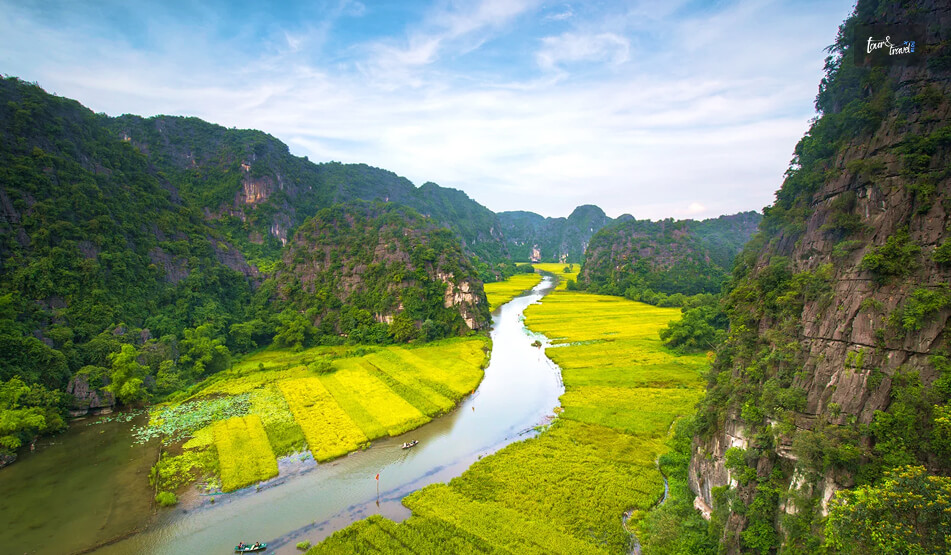
Ninh Binh or Halong Bay on Land is a UNESCO-protected site and a hidden gem in the tourism landscape of Vietnam.
It has ancient temples, a surreal riverine landscape, and dramatic limestone mountains. A Ninh Binh boat tour and climbing up its beautiful peaks is the best way to explore this serene place.
Moreover, if you see Ninh Binh on the map, you will find it in the northern region of the country. Along with its natural abundance, it is also known for its historical and cultural heritage.
Hi, in today’s blog, I will talk about what Ninh Binh is famous for, how to reach Ninh Binh from Hanoi, the things to do in Ninh Binh, where to eat in Ninh Binh, and more.
What Is Ninh Binh Famous For?
If you are a follower of the TheLowDownUnder Travel philosophy, Ninh Binh will become your instant favorite. It’s authentic, sustainable, and perfect for mastering the art of slow traveling.
In this way, Ninh Binh reminds me of Luang Prabang in Laos. During my Luang Prabang itinerary planner, I found out how it practices sustainable tourism.
In fact, being environmentally responsible is a common feature of these two neighbors.
Nevertheless, here are the reasons why Ninh Binh is famous for.
1. Waterways And Wetlands
Ninh Binh is a lush and fertile region blessed by a network of waterways. The Red River and the Day River function as the lifeline of this region, and at the same time, many smaller rivers have added to the fertility and unique topography of the region.
You can enjoy a boat tour of these waterways and experience an adrenaline rush.
Moreover, these wetlands, especially in places such as the Van Long Nature Reserve, are home to different types of birds and other animals.
2. Karst Limestone Cliffs
Trang An, Tam Coc, and Van Long Nature Reserve are some of the most famous Karst limestone cliff areas in Ninh.
Most of the karst limestone formations here rise from the waterways and the rice paddies. Thus, this sudden rise against the lows of the waterway creates a sense of drama.
3. Grottes And Caves
The limestone karsts in Nin Binh are all the more fascinating due to the underground exploration and adventure opportunities they offer.
Some of them, especially the ones in Phong Nha-Ke Bang National Park, come with caves and grottes. Moreover, these caves and grottes are some of the largest in Southeast Asia.
The Hanoi to Ninh Binh journey by road takes around 2 hours. Drive south from Hanoi, and you will reach the former capital of the country.
However, despite this proximity, Ninh Binh has maintained its idyllic charm. So, often, it is the go-to destination for a day trip or weekend trip from Hanoi to Ninh Binh.
5. Transportation Hubs
The Ninh Binh City railway station is the gateway to the Ninh Binh region for the rest of the country.
Furthermore, Ninh Binh is well-connected via road. Thus, this scenic region of Vietnam is quite easily accessible.
6. Gateway To Exploration
Ninh Binh is the gateway to Halong Bay in the east and the Phong Nha-Ke Bang National Park.
Furthermore, from Ninh Binh, you can explore northern regions such as Sapa and the Vietnam-China border.
7. Historical And Cultural Heritage
Ninh Binh is home to Hoa Lu, the first capital of independent Vietnam. The Dinh and Early Le dynasties ruled over Hoa Lu from 968 to 1010 AD before the capital was moved to Hanoi.
You will find here 10th-century temples dedicated to Kings Dinh and Le in Hoa Lu.
Furthermore, Nin Binh has many ancient pagodas, and its cultural significance lies in being a UNESCO-Protected Site.
8. Scenic Beauty
The waterways of Ninh Binh are tranquil. Furthermore, the lush landscape and karst limestone formations act as the most dramatic backdrop.
You will love trekking, birdwatching, and of course boating at Ninh Binh.
How To Get From Hanoi To Ninh Binh?
A Ninh Binh day trip from Hanoi is quite common. You can take a bus or train, or reserve a private car for the day trip.
1. Hanoi To Ninh Binh By Train
You can take a train ride from Hanoi to the Ninh Binh Railway Station.
Depending on the class, your ticket price will be between VND 60000 and 200000, or around $8 USD.
Moreover, the travel time will be around 2.5 hours.
2. Hanoi To Ninh Binh By Bus
If you are a budget traveler, you can take a bus from Hanoi to Ninh Binh. The buses, however, take a little longer, and based on the traffic, it may take up to 3 hours.
The ticket price for a Hanoi to Ninh Binh bus ride is around USD 6 or VND 70000-150000.
3. Hanoi To Ninh Binh By Car
You can book an Uber or just take a private car to reach Ninh Binh by car from Hanoi. Of course, it is the most expensive mode of transportation and costs around 1,380,000 VND or USD 60.
Furthermore, the travel time will be around 1.5 hours.
Moving Around Ninh Binh
Once you are in Ninh Binh and want to explore it locally, you can do it on foot. The city of Ninh Binh is very walkable.
However, if you want to explore more, you can take a bicycle or rent a bike.
1. Exploring Ninh Binh On A Bicycle
It’s a miss if you are in Ninh Binh and don’t explore Tam Coc or other quieter areas of Ninh Binh.
I got a bicycle from the homestay I was staying in for free. However, some homestays can charge a little for the bicycle rental.
2. Exploring Ning Binh On A Bike
Renting a motorbike is the best way to roam around Ninh Binh. You have to spend around $6 USD or VND 80,000–150,000 to rent a bike for a day.
Then, you can explore all corners of this UNESCO Protected Site and explore how history speaks in its every corner.
What Are The Things To Do In Ninh Binh?
The Ninh Binh Vietnam attractions are endless. You have to just figure out the best time to visit Vietnam based on your areas of interest.
Also, the things to do or the places to visit will depend on your duration of stay. Here, I have enlisted the activities that will fit well into your Ninh Binh itinerary for two days.
Nevertheless, here are the details on what to do in Ninh Binh.
1. Ninh Binh Trang An Tour
Tràng An is designated by UNESCO as a heritage site, and you can reach it by taking a no-hassle boat ride from Ninh Binh.
The boatride in the serene rivers with the karst limestone cliffs in the background feels cinematic.
Furthermore, on the way, you will find a few temples where you can sniff history and appreciate the architecture.
Why Take A Trang An Tour
You must take a Trang An Tour because it is not as expensive as a trip to Bến Thạch Bích. Bến Thạch Bích tour is expensive and has now become a tourist scam.
A tour to Trang An costs around $10 USD or 250000 VND per person.
2. Hiking The Lying Dragon Mountain Or Núi Ngoạ Long
The boat rides through the ancient waterways, watched over by the karst limestones, are not the only adventures offered by Ninh Binh.
You can plan a hike to the Lying Dragon Mountain top. You have to climb 500 steps to reach the top, and the view from there is unreal.
From the top, you will see the lush paddy fields and the waterways winding through the limestone cliffs. There is even a temple on a rocky spire.
Ideal Time For Hiking The Lying Dragon Mountain
Sunrise and sunset hours are the best for hiking the Lying Dragon Mountain. You can enjoy the golden and red glow from the top of the mountain.
Also, if you are hiking early in the morning, you will have fewer people taking the steps to the top.
Entry Fee And Parking Tip
The entry fee for the Lying Dragon Mountain hike is 100,000 VND or $4 USD. However, please note that your parking fee is included in this fee.
The parking attendants are very aggressive, and they will often misguide you by saying that the parking lot is full. So, be strict about not paying them extra or giving in to their tricks.
3. A Visit To Bich Dong Pagoda
The Bich Dong Pagoda in the Hoa Lu District was built by Ly Thai To. It is on the Truong Yen limestone mountain range, and its history dates back to 1428.
However, it was abandoned for many centuries until Tri The and Tri Kien discovered it in 1705. Furthermore, it was named the Bich Dong Pagoda or Green Pearl cave by Lord Trinh Sam of Dang Ngoai in 1774.
The Unique Structure Of The Bich Dong Pagoda
The pagoda has three levels, and the Dark Cave and the Xuyen Thuy Cave.
• Ha Pagoda Or Lower Pagoda
The Ha Pagoda, or Lower Pagoda, has 5 rooms and 10 roofs.
Furthermore, there is a monolithic stone pillar adorned with the statues of Lord Buddha. The lower pagoda is used for worship, and you will smell incense once you enter it, and the smell evokes a spiritual feeling.
• Middle Pagoda Or The Trung Pagoda
Then, you have to take 120 steps to reach the Middle Pagoda or the Trung Pagoda. It has beautiful tiles and scriptures written in Chinese.
Also, you will find the figures of Lord Buddha, flying dragons, turtles, fairies, and little boys here.
• The Upper Pagoda Or The Thuong Pagoda
Finally, you will take 40 steps to reach the upper pagoda or Thuong Pagoda. There is a forecourt, two rooms, and a stone altar in the outer room of the pagoda.
Furthermore, there is an inner room, which has the idol of the Bodhisattva. Moreover, the Cam Lo pond near the upper cave is used for curing ailments.
• Dark Cave Bich Dong
You will again climb 21 steps from the Upper Pagoda to reach the Dark Cave Bich Dong.
You will find a large bronze bell there in 1707. Furthermore, inside the cave wall, you will find amazing embossed pictures.
• Xuyen Thuy Cave
The Xuyen Thuy Cave is semicircular in form and has a length of around 350 meters. In places, the cave is 6-15 meters in width.
4. Birdwatching At The Thung Nham Bird Valley
The Thung Nham Bird Valley is a great spot for nature lovers. You will find the birds early in the morning or late afternoon.
However, if you are late in the morning or in the afternoon at the Thung Nham Bird Valley, you will find goats and ducks roaming.
Overall, the view of the field is amazing.
5. Exploring The Hoa Lu Ancient Capital
Hoa Lu, or the ancient capital of Vietnam, is the place to enjoy the history of Ninh Binh.
Being here feels straight out of a movie scene, and this place of reign by the Le and Dinh dynasties, with the surrounding mountains looks straight from a movie scene.
Where To Stay In Ninh Binh?
You will find many budget-friendly homestays and hotels in Ninh Binh. Having said that, these are my favorite picks.
We stayed at the Ruby Homestay, and it offered a local and authentic experience. It was budget-friendly and still had amenities such as a pool.
However, if you want a more luxurious experience, you can even try the Ninh Binh Royal Homestay. It is a resort with a 3-star rating.
What To Eat In Ninh Binh?
The mountain goat meat cooked in various styles, braised fish, rice, and crispy rice are some traditional Vietnamese dishes you can eat in Ninh Binh.
Furthermore, if you are more adventurous, you can try delicacies such as the snakehead fish salad and oakit or jackfruit snail.
Chookie’s in Tam Coc and the local markets were our favorite go-to places for trying authentic Vietnamese cuisines and a mix of Western delicacies at times.
Is Ninh Binh Worth Visiting?
Yes, Ninh Binh is worth visiting, and it is the heart of Northern Vietnam for tourists. It has pagodas and temples that go back to the 10th century. Furthermore, the winding waterways through the karst limestone formations simply create a landscape of contrast.
Moreover, it is one of the best places to see sunrise and sunset in Vietnam.
It’s soulful, sustainable, and fertile with lush greenery. Come, visit Ninh Binh.
Here are the frequently asked questions and answers about Ninh Binh.
1. Which Is Better, Ninh Binh Or Halong Bay?
Halong Bay, a UNESCO World Heritage Site, is a more celebrated attraction in Vietnam. Ninh Binh, despite being a UNESCO-protected site, is more like a hidden gem. However, Ninh Binh is closer to Hanoi, the Vietnamese capital, and only a 2-hour drive south. Also, the experiences in these places are very different. In Ha Long Bay, the activities include swimming in the Gulf of Tonkin, overnight cruises, kayaking, and exploring the limestone karsts. Ninh Binh, on the other hand, with a more rural charm, has ancient temples, pagodas, rice paddies, waterways, and dramatic limestone karsts.
2. How Many Days To Stay In Ninh Binh?
Two to four days are ideal for staying in Ninh Binh. From hiking up the Lying Dragon Mountain to boat rides to Trang An and Tam Coc, you can cover the major attractions of Ninh Binh in two days. However, if you want to explore the Cuc Phuong National Park or have an in-depth understanding of rural life, you must plan a trip for 3-4 days.
3. How Far Is Ninh Binh From Hanoi?
The Ninh Binh and Hanoi distance is around 94 km. The travel time by road down south is around 1.5 to 2 hours. Of course, the travel time will depend on the mode of transport. For example, if you are traveling by bus, the travel time will be around 2.5 to 3 hours. Also, if you are taking a train, it will take around 2.5 hours.
4. What Is The Best Time To Visit Nin Binh?
November to April is the best time to visit Nin Binh if you want to enjoy pleasant weather conditions. Having said that, the exact timing of planning your trip will depend on the kind of experience you want. For example, March to May is the ideal time for seeing the blooming flowers. However, if you want to see the golden paddies along the Ngo Dong River, you have to plan a visit in late May to early June.
Sibashree is a travel, culture, and leisure writer who has been writing since the age of 12 and professionally since 2014. With more than a decade of travel writing experience and journeys across India and several parts of the world, she brings a deeply personal and thoughtful perspective to her work. A student of English Literature and Mass Communication, Sibashree has always viewed travel as more than movement — for her, it has been a way of understanding people, cultures, and herself. Her passion for spiritual exploration has also led her to many unusual and meaningful destinations over the years. Outside of writing, Sibashree enjoys watching European cinema, reading about global politics, and reflecting on the stories hidden within everyday places.
Are you planning a road trip in the Pacific Northwest? The Portland to Seattle journey, covering a distance of more than 170 miles, is one of my favorites in the region.
I love this route simply because of its diversity. You will find state parks, downtowns, and a beautiful coastline on the way.
So, in this blog, I will talk about a beautiful road trip from Portland to Seattle, the other modes of travel, and the main attractions on the way.
What Is The Portland To Seattle Distance?
The distance between Portland and Seattle is around 174 miles or 280 km. Furthermore, the travel time between two destinations is around 2 hours and 45 minutes.
Also, the main route to travel from Portland to Seattle is via Interstate 5 (I-5).
However, the travel time between Portland and Seattle will depend on the mode of transport you choose.
So, here is a quick summary.
Portland to Seattle Modes of TransportTravel Time By Car2 Hours and 45 MinutesBy Bus3 to 4 Hours and 30 MinutesBy TrainAbout 3 Hours and 30 MinutesBy Rideshare About 3 to 4 HoursBy Air53 Minutes
Furthermore, the Portland International Airport is around 12 miles away from the city. Also, the Seattle-Tacoma International Airport is about 14 miles away from Seattle.
So, consider the travel time to and from these airports by road.
On the other hand, the Portland Union Station is 1 mile away from the city, and the King Street Station serves the Seattle area. From the train station, the Downtown and other main attractions are within walking distance.
How To Travel From Portland To Seattle?
The fastest way to travel from Portland to Seattle is to take a flight. However, if you love TheLowDownUnder Travel philosophy and want a more local experience, you can also plan a road trip by car or take a ride share.
Buses and train services are also available between these two destinations. So, here are the details.
1. How To Travel From Portland To Seattle By Car?
Traveling the Portland to Seattle distance of 174 miles by car takes around 2.5 hours. The route through I-5 North is quite straightforward, and some important stops on the way are Washington, Olympia, and Tacoma.
Furthermore, you start the ride early in the morning, before 7 AM. 7 AM to 9 AM and 4 PM to 6 PM are the busiest times on the route.
Also, there is an alternative route via US-101, which passes through Astoria to the coast.
Nevertheless, based on the route you take and the vehicle you choose, the car rental price will be around $34 to $50.
2. How To Travel From Portland To Seattle By Bus?
Flixbus and Greyhound are the main bus services from Portland to Seattle. The bus services start from as early as 7 AM, and the last bus leaves Portland at 10 PM.
The bus leaving at 10 PM is also the fastest, completing the journey in just 2 hours and 50 minutes.
Furthermore, the buses leave from the Portland Curbside Bus Stop, and the popular drop stations are the Seattle Tacoma International Airport, Seattle Bus Station, and Seattle 6th Avenue S and S Lane Street.
Moreover, the ticket price starts from 30.48 Euros.
3. How To Travel From Portland To Seattle By Train?
Amtrak runs seven daily from Portland to Seattle. Furthermore, the ticket price starts from $27.
Also, check out the timings of the train from the Portland Union Station to the King Street Station in Seattle in the table below.
DepartureArrival 6:45 AM10:10 AM8:30 AM11:50 AM10:40 AM2:05 PM2:10 PM5:37 PM3:56 PM7:51 PM5:55 PM9:20 PM7:25 PM10:50 PM
4. How To Travel From Portland To Seattle By Flights?
As I have mentioned, the flights from Portland International Airport (PDX) to Seattle-Tacoma International Airport (SEA) take around 55 minutes.
American Airlines and Delta Airlines are some of the popular services on this route. Furthermore, the ticket price will be around $350.
Moreover, the travel time by road from Portland to the Portland International Airport (PDX) and the Seattle-Tacoma International Airport (SEA) is around 20 minutes.
5. Portland To Seattle Rideshare Or Taxi
Shuttle services such as Portland Express, Uber, and Lyft are other ways to travel from Portland to Seattle.
Uber and Lyft services are a little expensive, costing around $60 for the ride.
On the other hand, a ride on the Portland Express from Portland to Seattle will be around $50-$70 based on the vehicle and the group size.
What Are The Important Stops From Portland To Seattle?
Portland is one of the best family vacation spots, and Seattle is one of the safest places for women solo travelers.
Furthermore, on the way, it has some wonderful attractions such as the Columbia River Gorge, the Oregon Coast, Mount St. Helens, Mount Rainier, and Tacoma.
Also, throughout the journey, you will find small but wonderful cafes. Don’t forget to spend some time understanding the local vibes at these cafes.
Portland To Seattle: Frequently Asked Questions (FAQs)
Here are the frequently asked questions and answers about the Portland to Seattle distance.
1. How Much Is A Train Ride From Portland To Seattle? A train ride from Portland to Seattle starts from $27 and goes up to $68 for standard coaches. Furthermore, the ticket price for business coaches costs around $80 to $90. Moreover, the private room amenities come at $182. 2. Is It Worth Driving From Seattle To Portland? Yes, the Portland to Seattle journey is every bit worth it. It is an easy and quick journey, However, the short route offers the best experiences with various culinary stops, mountain views, and the beauty of the Pacific Northwest. 3. Can You Do A Day Trip From Portland To Seattle? Yes, you can easily plan a day trip from Portland to Seattle. The travel time by road is around 3 hours to 4 hours and 30 minutes. So, you can easily complete the ride, explore the attractions en route, and come back by evening. However, you have to start really early to avoid the traffic.
While Iran, one of the oldest countries in the world, is fighting back against the joint attack of the USA and Israel, it’s the correct moment to look back at the ancient civilizations of our world.
So, what is the oldest country in the world?
While some say it is Japan, some vouch for India, and China remains the oldest continuous civilization in the world.
Here, I have picked 10 countries that I can call the “Immortal Ten” because of the human resilience they have shown and how they have survived.
What Is The Oldest Country In The World?
The current geopolitical map, in fact, did not exist for a long time.
Most of the countries that are members of the United Nations came into being in the aftermath of 20th-century decolonization or the dissolution of Soviet-era empires.
But what lies under the modern borders and changing flags is a much deeper level of human history.
Although historians generally use continuous sovereignty to measure longevity.
However, a government can lose its sovereignty to an invader, but that does not necessarily mean the end of the culture.
The true measures of a lasting civilization are cultural continuity, the survival of language, religion, social cohesion, and identity beyond the ruin of even the most magnificent palaces.
So, each civilization that qualifies for this list has withstood conquest, colonization, or internal upheaval without losing its very foundation.
Here are the ten oldest civilizations that are still living today.
1. China, The Oldest Continuous Civilization In The World
China traces its origins back to the Shang Dynasty (c. 1600 BC) over 3,500 years ago.
The oracle bone script of the Shang did not simply get lost like the hieroglyphics of Egypt or the cuneiforms of Mesopotamia. Instead, it gradually transformed into the modern Chinese writing system in use today.
Furthermore, the "Imperial Logic" of China, a centralized bureaucracy under moral guidance by Confucianism, was the charter of the Han Dynasty.
It continued to be the underpinning even through the rise and fall of the many dynasties.
Even when the country was dominated by foreign powers such as the Mongols (Yuan Dynasty) or the Manchus (Qing Dynasty), they did not "unmake" China.
Rather, the new rulers were "Sinicized, " taking on the Chinese ways of administration and language so as to stay in power.
The present-day People's Republic of China utilizes a model of central governance that is reflective of the bureaucratic mindset of the emperors who ruled the country some two millennia ago.
2. Egypt: The Tital Of Antiquity
Egyptian civilization rose to prominence around 3100 BC under Pharaoh Narmer, at least in theory.
For 3,000 years, it set the standard for administration, engineering, and art.
The native religion faded with Christianity, and later Islam, and Coptic was mostly replaced by Arabic.
Still, the Egyptian character stayed rooted in the Nile.
Foreign powers, such as the Persians, Romans, Ottomans, and British, could never fully erase that identity.
Furthermore, Cairo held a central role in Islamic thought for centuries.
Today, Egypt remains the most culturally influential nation in the Arab world. The people have outlasted every empire that tried to control them.
3. Iran: The Persian Resilience
Iran, once called Persia, ruled the world from 550 BC when Cyrus the Great built the Achaemenid Empire.
The culture soaked up new rulers instead of losing itself.
After Alexander took over, he started wearing Persian royal clothes.
When Islam came in the 7th century through Arab rule, Persians embraced the faith but kept their language and built a unique style of art and religion.
Thus, eventually, the formation of Shi'a Islam happened.
Farsi stayed strong with its roots unchanged and gave rise to poetry that shaped global thought, in particular through Rumi and Hafez.
Now, Iran's Islamic Republic stands where the ancient emperors once did, same land, same heartland, 2,500 years later!
4. India: The Land Of Spirituality
India's story starts with the Indus Valley Civilization (c 2500 BC).
After it faded, the Vedic traditions in the Ganges Valley shaped Hinduism.
Also, the thing is, India has always had this "Diversity in Unity. "
It survived Mughal rule and the British Raj without giving up its core values or spiritual roots.
Local languages, epics like the Mahabharata, and daily life structures held strong through centuries of outside control.
After its independence from British Rule in 1947, India became the world's largest democracy, built on an ancient foundation that still holds together today.
5. Greece: The Land Of Philosophy
Greek civilization had its beginnings in the Bronze Age with the Mycenaeans (c. 1100 BC).
Furthermore, its most flourishing period was the 5th-century BC "Golden Age" of Athens.
After the Greek city-states were absorbed by Rome to some extent, Greek culture became the very foundation of the Roman Empire.
In the Byzantine Empire, Greek was the language of the state as well as the church, and it was through these that Classical knowledge was preserved through the Middle Ages.
Even under four centuries of Ottoman rule, Greeks maintained their identity through the Orthodox Church and the use of their ancient language.
Moreover, when modern Greece was liberated in 1830, in essence, it was not a matter of creating a new identity.
It was about celebrating a nation and a culture that has been around for three thousand years.
6. Japan: The Land Of The Oldest Continuous Hereditary Monarchy
Japan has the world's oldest continuous hereditary monarchy, beginning with a legendary founding in 660 BC and first documented records in the 6th century AD.
It modernized rapidly during the Meiji Restoration in 1868 without losing its traditional values.
Furthermore, unified by one language and Shinto and Buddhism, Japan was never colonized by a Western power.
Even after World War II destroyed much of its infrastructure, the imperial institution stayed intact as a symbol of continuity.
Probably more or less, Japan's blend of advanced industry and old social norms contributes to its stability.
Today, the nation remains one of the most enduring civilizations in history.
7. Ethiopia: The Highland Fortress
Ethiopia stands as a symbol of African endurance.
Its origins go back to the Aksumite Empire (c. 100 AD), which was among the earliest nations to adopt Christianity in the 4th century.
For over seven hundred years, the Solomonic Dynasty, which asserted its lineage from the biblical King Solomon, ruled the country.
The challenging terrain of Ethiopia enabled it to be the only African country that was never colonized (although it was under an Italian occupation for a short time in the 1930s).
The Ethiopian Orthodox Church and the Ge'ez script were cultural foundations.
It preserved national identity and sovereignty when the rest of the continent was carved up by Europe.
8. Jewish Civilization
Starting in the kingdoms of Israel and Judah more than 3,000 years ago, Jewish civilization stands as the most remarkable example of cultural resilience in history.
After the Romans destroyed Jerusalem, the Jews spread out worldwide in a diaspora.
Normally, a nation without a territory would lose its identity in a few generations.
However, Jewish civilization, through religious law (Halakha), the Hebrew script, and a strong tradition of education, was able to survive as a "portable nation".
The founding of the State of Israel in 1948 was the political expression of a cultural memory that had been kept alive for over 2,000 years.
9. Armenia: The First Christian State
Armenia has been located in the Caucasus region for at least 3,000 years.
It was the first country to make Christianity its official religion in 301 AD.
Yes, the Armenian people had many influences. The Persian, Roman, Ottoman, and Soviet!
They still maintained their unique alphabet (created in the 5th century) and their national church.
Not even the atrocities of the 1915 genocide were able to sever the cultural connection of the modern Republic of Armenia with its ancient Bronze Age heritage.
10. Korea: The Hermit Continuity
The Korean culture started with the kingdom of Gojoseon. Further, its cultural identity resulted in a unified nation by the 7th century.
Surrounded by a peninsula, Korea had its unique Hangul script and Confucian values.
Thus, despite cultural influences from China and a very harsh period of Japanese colonization (1910-1945), it never lost its identity.
Even though North and South are separate nowadays, they both have the same original myths, language, and sense of ancestors' pride.
Today, frequent travelers are forced to think about long-haul travel safety due to the United Airlines flight UA82 emergency.
However, what does the investigation into the Newark-to-Delhi diversion make apparent? What is the impact of the emergency landing on modern air travel?
In this article, I will share how systemic cooling failures impact modern wide-body fleets in an advanced “wide-body fleet.”
Moreover, this incident shows how increasing operational hiccups can disturb your upcoming travel plans.
Key Takeaways
The Boeing 787-9 Dreamliner faced a sudden failure of its electronics cooling system mid-air.
Then, the cabin crew members route the flight back to the departure runway to ensure passenger safety.
As a result, the Federal Aviation Authorities have started a complete review of the maintenance records on an emergency basis.
Why Did This Mid-Flight Crisis Happen?
With expert analysis and the observation of our in-house air-travel specialists, I can say that busy flight schedules are the main reason behind this emergency landing.
As the flight schedules have become more rigorous and with extreme heat, there is extreme strain on the aircraft systems.
Furthermore, the cooling malfunction happened almost immediately after the jet reached cruising height.
Then, as the FlightRadar24 Telemetry data confirms, the jet had a fast and secure descent to the Newark Liberty International Airport.
Now, if you observe or analyze this incident closely, you will certainly have concerns regarding the aviation trends.
Moreover, according to safety protocols, a pilot has to pay attention when the dashboard warning lights are persistent.
If they ignore or cascade technical problems, those can lead to massive cancellations of flights like the KLM British Airways Flight Cancellations.
An Analysis Of The Flight Information
Examining the flight data precisely is important to understand what triggered the emergency.
So, I have curated the specifications of the aircraft that got diverted.
Furthermore, I have taken the data from the Federal Aviation Administration (FAA) to create a perfect sequence of the things that happened.
Moreover, once you know the accurate logistics details, you will understand why the pilot quit the oceanic crossing abruptly.
The Complete Official Incident Metrics
Flight DataIncident DataAirline United AirlinesFlight Number UA82RouteEWR to DELAircraft TypeBoeing 787-9 DreamlinerLocationOver the Atlantic Ocean Date 26th May 2026Time21:15 EDTDeparture AirportNewark (EWR)Destination Airport Delhi (DEL)Diversion or The Emergency Landing AirportNewark Liberty International Airport (EWR)Reason for the Emergency The Malfunction of the Electronic Cooling SystemSafety StatuesAll Crew Members and Passengers are SafeEmergency Response of the Pilot Aborting MissionEmergency LandingSafe LandingConfirmed at EWRFlight Delays/CancellationThe Flight was Cancelled.Passengers Had to Rebook the Flight. Investigation Update from the Federal Aviation AuthoritiesFAA Maintenance Review is Ongoing Now. Timeline of the IncidentsWarning Issued at 22:45 PM.Landing at 23:50 PM. Reactions of the PassengersSudden Anxiety but Safe Landing.
How Do Route Suspensions Affect Passengers?
Operational problems in the modern aviation sector do not happen in isolation because the sector is highly interconnected.
So, when a commercial jet of a major carrier has an emergency landing, you can see the ripple effect in different international terminals on an immediate basis.
Also, whenever there is an incident like this, the impacted travelers look for alternative routes and flights. Thus, there is chaos, and booking bottlenecks are inevitable.
You can consider the case of the “American Airlines Doha Flight Suspension” as an example. It caused travel plan disruptions and problems for many globetrotters.
Furthermore, if we go by the National Transportation Safety Board (NTSB) norms, we will see how mechanical inspections are important for equipment-related diversions.
Moreover, airlines cannot risk continuing a flight with technical faults over the open ocean. Also, specialists or dedicated maintenance crew members have to assess the plane and certify it before it starts passenger service again.
Why Do Advanced Airlines Systems Fail?
After a series of investigations and consultations with experts, I have identified why advanced systems fail in commercial flights.
1. Sensor Malfunctions
If the internal temperature measurement is wrong or faulty, it can lead to emergency ground protocols that are unnecessary.
2. Gaps In Maintenance
If there is a miss in the regular inspections, even the small problems can lead to major technical faults.
3. Software Glitches
Sometimes, the main avionics computer can make mistakes while reading the right thermal output from the engine bay.
The faulty reading can cause missing a maintenance schedule or setting an unnecessary maintenance schedule.
4. Environmental Stress
When a plane has to fly through extreme weather conditions and face challenges in abnormal weather patterns, it can cause massive stress on plane components.
5. Hardware Degradation
When the planes have to perform heavy operations for many years, the physical cooling system or the entire cooling system becomes very weak.
How To Mitigate The Associated Risks Of Such Sudden Landings?
When a plane flies regularly for leisure or business, the mechanical variables will be tracked.
Furthermore, similar technical glitches have been observed in the abrupt landing of the “Delta Flight DL153 diversion.”
Also, according to the experts in aviation, a pilot needs to intervene in the critical electronic faults and problems continuously.
Moreover, the cockpit display of a plane continues to share early warnings. When those warnings are ignored, the complete structure of the aircraft will be impacted.
So, overall, being vigilant about a particular aircraft model can cause travel delays. You must have access to a real-time flight status alert system that will keep you ahead of emergency changes in the schedule.
How Can The Crew Members Ensure Adherence To Airline Protocols And Ensure Passenger Safety?
Cabin crews have to attend strict and continuous training to manage these emergency conditions.
Furthermore, the pilot has to rely on the SOPs or the standard operating procedures whenever they hear the onboard alarm.
In this case, when the cooling failure happened, the captain made a quick return to the trajectory.
Like this, the strict and definite procedures stop minor hardware or technical faults from becoming massive disasters.
“The United Flight UA195 diversion Halifax” has recently shown a successful practice of maintaining protocols.
Moreover, the pilot and the crew members have to maintain their nerves when there are chances of a mid-air descent. This is important for the safety of the passengers.
IATA, or the International Air Transport Association (IATA), always appreciates crews who put more importance on caution and safety over stringent schedules.
How Do All These Factors Impact Your Summer Travel?
As the global airlines become more stringent about their maintenance windows, you will have to make necessary adjustments to your schedule.
In simple words and according to our in-house data, these strict maintenance windows and sudden groundings can make wide-body jets less available.
As a result, the number of planes available will be fewer and the booking capacities will be tighter. This will further cause a price surge.
You can take the cancellation of hundreds of flights by American Airlines in August as an example.
So, when you need to make a reservation for international flights, you must check the flight status regularly.
When you are proactive in your approach, you will not have to wait at an unknown departure gate.
Moreover, you must have travel insurance if you are making a flight journey crossing an ocean in the peak season.
What Are The Steps To Protect Your Upcoming Travel Plan?
You have to follow these steps if you want to avoid impacts on your upcoming travel plan.
Have A Backup Plan
If your primary airlines or the primary airlines routes do not work, you have to find an alternative flight.
Review The Policies Of The Airlines
You have to read and understand the complete compensation rules whenever there is a flight cancellation due to mechanical reasons.
Keep Your Contact Information Updated
Add the right and updated contact information in the booking app or platform. Thus, the airlines will be able to inform you about delays in the flight schedule immediately.
Pack Your Essentials
Keep extra chargers and essential medications in your carry-bag in case there is a delay or disruption in the flight.
Overall, the incident of the United Airlines Flight UA82 emergency landing shows how flight crew members can ensure the safety of the passengers with proactive measures and awareness.
Read Also:
Discount Codes Ttweakflight: How Can You Save A Few Dollars On Your Upcoming Air Trip?
IWantThatFlight Offering Cheap Flights: The Best Hack For Traveling On A Budget
How Much Cash Can I Carry In Domestic Flight? Know The Airport Rules








 Related