
Aberdeen Falls: Sri Lanka’s Quietest Big Waterfall

Aberdeen Falls makes you wait, and you have to work hard to get a view of this majestic waterfall.  

Also, this waterfall in Sri Lanka’s hill country was the one with the fewest other visitors when I got there.  

There was no roadside pull-off here and no viewing platform right off the highway.  

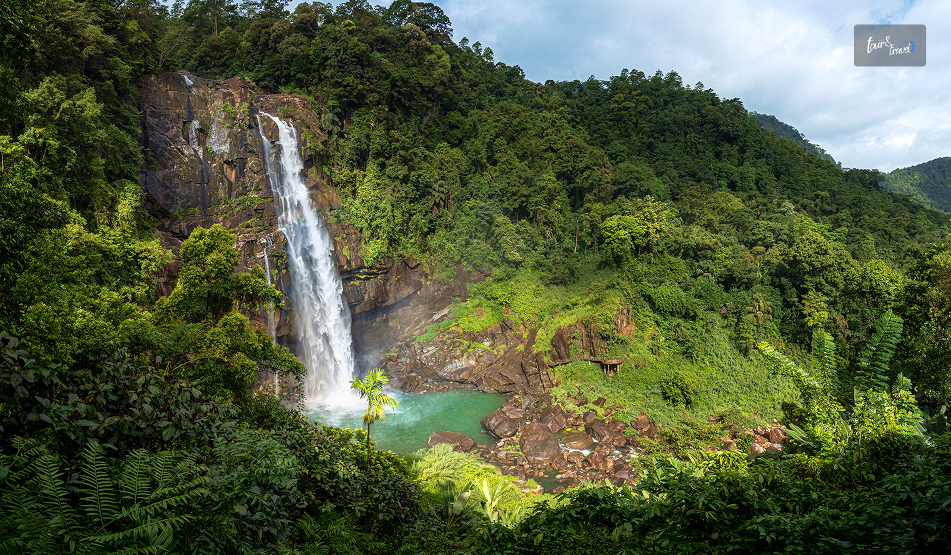
Just a walk through tea land above Ginigathena, the sound of water getting louder, and then a nearly 100-metre curtain dropping into a rock-walled pool! 

Here is my experience at this majestic waterfall and everything else you need to know to visit it.  

Quick Facts About Aberdeen Falls 

Quick Facts Details  
Height About 98 Meters  
Width Around 8 Meters  
River Kehelgamu Oya, a tributary of the Kelani River  
Location Near Ginigathena, Nuwara Eliya District, Central Province  
Rank 18th highest waterfall in Sri Lanka  
Access Short hike (roughly 1 km) from the road, and there is no formal entry fee.  
Swimming Not recommended as the pool is deep, and currents can be dangerous.  

Where Is Aberdeen Falls And How To Get There?

Aberdeen Falls: Sri Lanka’s Quietest Big Waterfall

Aberdeen Falls is on the Kehelgamu Oya, a major tributary of the Kelani River, near the town of Ginigathena in the Nuwara Eliya District.  

It is named, a little incongruously, after Aberdeen in Scotland. So, it is a nod to the British planters who once ran the tea estate here. 

From Ginigathena 

The most common approach starts in Ginigathena town.  

From there, follow Ambatale Road to a Buddha statue at the end of the road, where you will need to park.  

From that point, it is a walk of a little over a kilometre. Some guides list it as 800 meters to 1.2 kilometers depending on the exact route along a footpath through the estate and down toward the falls. 

From Colombo Or Kandy 

A common route from Colombo runs via Avissawella and Karawanella to Ginigathena. It is roughly 3 to 3.5 hours by car.  

From Kandy, it is a similar distance heading the opposite direction, passing through Kadugannawa and Ginigathena’s outskirts. 

On The Trail 

The path down is uneven in places and can get slippery after rain. 

So proper shoes matter more here than at the roadside falls further up the valley.  

It is not a technical hike, but it’s enough of a walk that you’ll want at least an hour round trip, more if you stop for photos. 

What Makes Aberdeen Falls Different

Aberdeen Falls: Sri Lanka’s Quietest Big Waterfall

Most of the well-known waterfalls in this part of the hill country, St. Clair’s, Devon, are effectively drive-by attractions. 

They are visible from a car window or a short stroll off the highway.  

Aberdeen isn’t.  

You have to commit to the walk, and that alone keeps the crowds thinner than at the more famous falls nearby. 

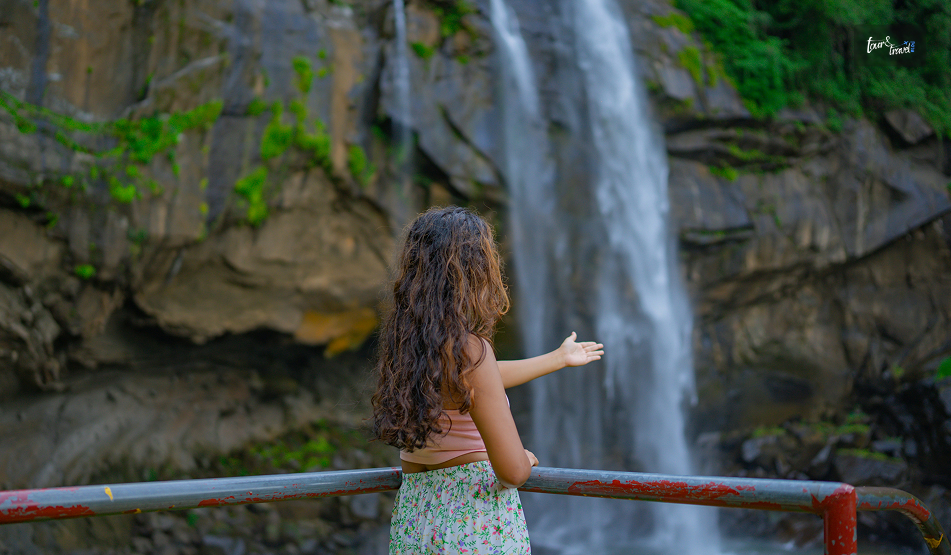
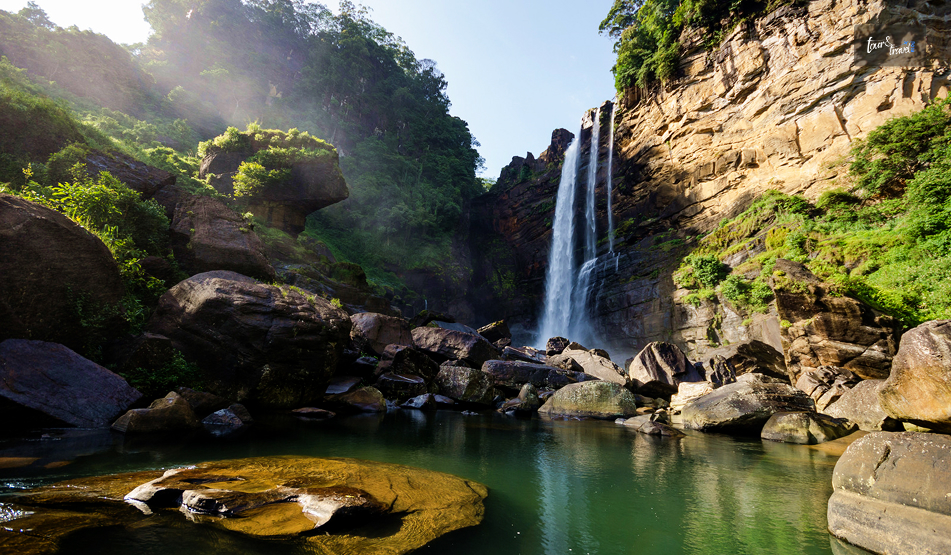
The reward is a narrow, forceful single drop into a pool framed by a large rock formation behind it, with dense forest closing in on both sides.  

Local legend holds that a tunnel connects Aberdeen Falls to Laxapana Falls further down the valley. 

There is no solid evidence for it. However, it is the kind of story that gets repeated at every viewpoint, and I’ll admit it added a bit of atmosphere while I stood there.  

Because Aberdeen and Laxapana both sit on rivers that feed hydroelectric schemes, water levels can vary noticeably depending on how much is being diverted upstream. 

So the falls look a little different every time. 

The Amphitheatre Of Stone And Mist 

What truly sets Aberdeen Falls apart once you clear the jungle trail is the sheer scale of its geological footprint.  

The water does not simply spill over a cliff. 

It thunders into a colossal, horseshoe-shaped rock amphitheatre.  

This towering crescent of dark, wet stone acts like a natural sounding board, trapping the roar of the Kehelgamu Oya and magnifying it until the air itself seems to vibrate. 

Because of the unique inward curve of the rock walls, a perpetual cloud of heavy mist hangs suspended over the plunge pool.  

This constant humidity has created a microclimate where vibrant green mosses, slick liverworts, and primitive ferns cling to every vertical fissure, contrasting sharply with the black obsidian-colored rock face. 

Standing at the edge of the basin, the view is framed by a dense canopy of endemic trees that lean over the water, blocking out the harsh midday sun.  

The result is a moody, isolated sanctuary that feels entirely cut off from the outside world.  

It is a visual drama you completely miss from a roadside viewpoint. So, it is a hidden world for those willing to track it down. 

What Is The Best Time To Visit Aberdeen Falls? 

Seasons Months  What to Expect  
Wet season May to September Strongest flow, but the trail is muddier, and swimming is more dangerous  
Dry season December to March Easier trail conditions, gentler flow, clearer photos  
Early morning Any season Cooler hiking temperatures and better light through the forest canopy  

Places To Visit Near Aberdeen Falls: Laxapana Falls And Kitulgala

Aberdeen Falls: Sri Lanka’s Quietest Big Waterfall

If you are already making the trip out to Ginigathena, it is worth extending the day.  

Laxapana Falls, tied to Aberdeen in local folklore, is a further drive down the valley. 

Also, Kitulgala, Sri Lanka’s main whitewater rafting hub, is roughly 30 to 40 minutes away. 

Thus, this stretch is a natural base for a nature-and-adventure day rather than a single quick stop. 

A One-Day Itinerary Around Aberdeen Falls 

Time Stop Notes 
8:00 AM Depart Ginigathena or Kitulgala Start early to avoid the midday heat on the walk.  
9:00 AM Hike to Aberdeen Falls About 1 km each way from the Ambatale Road parking point.  
10:30 AM Return to the road Allow extra time for photos and the uphill return walk.  
11:30 AM Drive to Kitulgala Roughly 30–40 minutes away.  
12:30 PM Lunch by the Kelani River Several riverside spots near the rafting operators.  
2:00 PM Optional: whitewater rafting or a river walk Kitulgala’s main draw if you have the afternoon free.  

Practical Tips For A Visit To Aberdeen Falls 

  • Wear proper hiking shoes as the trail has dirt and stone. Also, it can be slick after rain. 
  • Do not swim in the pool at the base because it is deep. There have been cases of drownings here. 
  • There is no ticket booth or formal infrastructure. So bring water and snacks with you. 
  • Moreover, hire a local guide or tuk-tuk driver in Ginigathena if you are unsure of the trailhead. You may not find a signpost everywhere.  
  • Climbing back up from Aberdeen Falls, sweating a little more than I expected to, I remember thinking it was worth every step.  

It does not have the roadside fame of St. Clair’s or Devon. That is exactly the point, as this is the waterfall you visit when you want to feel like you found it yourself.

Share on Social Media

Sibashree is a travel, culture, and leisure writer who has been writing since the age of 12 and professionally since 2014. With more than a decade of travel writing experience and journeys across India and several parts of the world, she brings a deeply personal and thoughtful perspective to her work. A student of English Literature and Mass Communication, Sibashree has always viewed travel as more than movement — for her, it has been a way of understanding people, cultures, and herself. Her passion for spiritual exploration has also led her to many unusual and meaningful destinations over the years. Outside of writing, Sibashree enjoys watching European cinema, reading about global politics, and reflecting on the stories hidden within everyday places.

Leave a Reply

Your email address will not be published. Required fields are marked *

title-img Related

READ MORE ratnapura

What Is Ratnapura Famous For? Know The Best Places To Visit In Ratnapura 

BY  Sibashree Jun 30, 2026

I wanted to begin this article with details about how the air in Ratnapura is different from the air in Colombo.  However, the recent news about the Ratnapura air quality index (AQI) made me stop for a while. The presence of the main air pollutant PM2.5 in the quantity of 11 µg/mÂł in the air is actually 2.5 times higher than the World Health Organization (WHO) standard.  When I read the news, I could not match it with the heavy air of Ratnapura, constantly laden with the scent of wet earth, crushed tea leaves, and the electric promise of an impending downpour. Also, when I first stepped off the bus onto the rain-slicked tarmac of this valley town, wrapped tight by the jagged peaks of the Sabaragamuwa Province, I felt an immediate shift in energy. So, my experience of Ratnapura will always remain soaked in wet soil and very intimate.  Ratnapura: The Story Behind The Name Ratnapura gets its name from the Sanskrit words Ratna (Gem) and Pura (Town). So, literally, the name of the town means the “City of Gems.” It is fascinating how the region has been unearthing unbelievable wealth out of the mud. These gemstones include: Cat’s Eyes Deep Cornflower Blue Ceylon Sapphires Fiery Rubies Alexandrites Still, the glitz of neon lights has not touched Ratnapura. Everywhere you go, you will notice the rugged humility typical of a working class community.  Also, as a traveler, getting my boots caked in mud was a way more rewarding experience for me than walking on a pristine resort floor.  In the next section, I will describe in detail why Ratnapura is so famous and the best places to visit in the City of Gem.  What Are The Best Places To Visit In Ratnapura?  Located in the Sabaragamuwa province, Ratnapura is not just the Gem Capital of Sri Lanka. It is a rich depository of the fossils of extinct elephants and rhinoceroses from the prehistoric age.  Furthermore, it is the gateway to Adam’s Peak, and it is home to the spiritually significant Maha Saman Devalaya.  It is the shrine of Lord Saman, the presiding deity of the region.  Moreover, as a high-rainfall wet zone of Sri Lanka, it is also famous for its waterfalls and ecotourism.  1. Sinharaja Forest Reserve As I entered the forest reserve, for the first 20 minutes, my boots were in the mud.  It is a UNESCO World Heritage Site and it is special as it is one of the last remaining virgin rainforests on Earth.  Even in mid-noon, you will experience the thrill of the emerald twilight in the forest reserve as the canopy grows very dense. The canopy swallows the midday Sun.  Nuwan, a local guide, accompanied me through the forest reserve.  Within an hour, he silently pointed into the dense brush where a purple-faced langur monkey sat watching us with an expression of mild amusement.  We spotted giant squirrels leaping across tree crests and listened to the distinct, symphonic calls of over 130 bird species.  Keep a bottle of saltwater or a stick of soap handy, though, because the forest floor crawls with overzealous leeches who consider trekkers a moving buffet. 2. Udawalawe National Park The Udawalawe National Park, with its sweeping grasslands and skeletal trees, offered a lot of drama.  All these create a stark contrast against the distant highlands. Furthermore, the park is as thrilling as the African savannah for wildlife viewing.  I was on an open-top jeep safari, and our driver had cut the engine near a large watering hole. Then, within minutes, I could spot a large herd of wild Sri Lankan elephants emerging from the scrub.  Those were moments of absolute silence as three matriarchs gently guided a tiny, clumsy calf into the water, spraying mud to shield its skin from the Sun. Along with the elephants, I could also see glimpses of water buffaloes tracking us with heavy gazes and water monitor lizards sliding into the reeds. And the most fascinating part? I could spot a solitary, brief shadow that our driver swore was a Sri Lankan leopard. 3. Bopath Ella Falls Bopath Ella Falls was a short drive from the city center in Kuruwita.  The water flows through a narrow gap at the top and cascades down a stepped rock face, widening out into a shape that perfectly mimics the sacred Bo leaf (Ficus religiosa)  Furthermore, a dense forest surrounds the pool at the bottom. I was a little tired, and I sat on a slick rock and sipped fresh king coconut water bought from a roadside vendor.  He shared a fascinating local folklore with me.  “The old people say the pool is haunted," he murmured, looking at the churning white water. "They believe a great ancient treasure trove lies buried underneath, guarded by spirits." 4. Adam’s Peak (Sri Pada) Climbing Adam’s Peak from the Ratnapura Side is a strenuous job, and the path is known as the “King’s Way.” It is an act of sheer endurance.  The northern route from Nallathanniya is shorter and more popular. However, you cannot deny the allure of this southern trail which climbs over 7,300 feet via thousands of uneven, ancient stone steps. I started climbing the Adam’s Peak under a blanket of stars, my calves burning instantly. The closer I got to the top, the trails got steeper.  Furthermore, as the Sun broke over the horizon, its rays cast a perfect, triangular shadow of the mountain across the misty lowlands below.  The overall ambiance was deeply spiritual, and from pilgrims to adventure lovers, everyone can experience the shift of energy here.  5. Kitulgala  If you want to complement the tranquil ambiance of Ratnapura with something more vibrant, you can head to Kitulgala.  This small tone is home to a wet-zone rainforest that sees two monsoons a year. It holds fame not only for its raw beauty but also as the filming location for the 1957 classic The Bridge on the River Kwai. Furthermore, Kitulgala is the adventure capital of the region. I threw myself into white-water rafting down the churning Kelani River, gripping the paddle tightly as our raft slammed through technical, white-capped rapids. Moreover, if you want to stay in the land, you can enjoy bird-watching, canyoning, and the rides of natural rock slides in the jungle.  6. Maha Saman Devalaya Stepping into the tranquil grounds of the Maha Saman Devalaya was a humbling experience.  It is the spiritual heart of Ratnapura, and Sumana Saman, the presiding deity here, watches over the sacred mountain and the surrounding gem valleys. Furthermore, according to a legend, a royal court minister built this temple after a successful gemming expedition.  Though it carries deep historical Hindu influences, it functions today primarily as a serene place of Buddhist worship, framed by beautiful white Kandyan-style arches. 7. Bambarakanda Waterfalls The Bambarakanda Waterfalls stand at an amazing height of 790 feet, and it is the tallest waterfall in Sri Lanka.  I reached this waterfall after a steep hike through whispering pine forests. So, I did not feel the humidity and heat of the lower valleys here.  The cliff face is regularly shrouded in thick, rolling mountain mist, giving the entire landscape an ethereal quality.  Standing at the rocky base of the falls, looking up as the water plummeted from the clouds, I let the cool spray drench my face. It was the perfect antidote to days of humid trekking. 8. The Gem Mines You cannot leave Ratnapura without visiting a gem mine. I bunked the commercial showrooms and walked out into the surrounding paddy fields to see a traditional, artisanal pit mine.  I saw the miners digging deep, narrow shafts into the mud, reinforcing the walls with logs and fern leaves. They haul up baskets of illam (gem-bearing gravel) using simple wooden pulleys, then wash the dirt away in nearby streams.  A seasoned miner let me watch over his shoulder as he swirled a woven basket in the water, revealing a translucent, rough pebble of purple-blue sapphire.  It was an unfiltered look at the hard, manual labor behind the world's most glamorous stones. 9. Batadombalena If you are a history enthusiast, Batadombalena is a must visit for you.  This ancient rock cave and archeological site, hidden deep within the foothills, contains evidence of the prehistoric Balangoda Man (Homo sapiens balangodensis), dating back over 30,000 years. I hiked up to the cave, walking through rubber plantations and dense thickets.  Furthermore, this cave has excavation trenches where stone tools and charred animal bones were uncovered.  10. National Museum Of Ratnapura The National Museum of Ratnapura is inside the Ehelepola Walauwa, which is a historic colonial mansion.  Here, I became familiar with the natural history of the valley. Also, I spent an hour marveling at prehistoric fossils of hippopotamuses, rhinoceroses, and elephants excavated directly from the local gem pits.  It also holds an incredible collection of traditional weapons, ancient jewelry, and an educational breakdown of the region's complex geology. My 3-Day Ratnapura Itinerary DaysThe Time of the DayActivities/Places to Visit Key Highlights and TipsDay 1MorningMaha Saman DevalayaStart early to beat the heat, enjoy the crisp air, and listen to peaceful morning chants.AfternoonBatadombalena Caves and Bopath Ella FallsHike up to explore prehistoric cave history, then enjoy a picnic lunch by the unique heart-shaped waterfall.EveningCentral Clock Tower Street MarketWander the central streets to watch local merchants rapidly trading rough gemstones right on the pavement.Day 2MorningSinharaja Forest ReserveEnter via Kudawa or Pitadeniya gates by 7:00 AM for the best chances of spotting active wildlife and rare birds. AfternoonUdawalawe National Park SafariHead south and hire a 4x4 jeep for a 3:00 PM safari to see elephants gathering by the water reservoirs.Day 3MorningActive Gem Mine TourCoordinate with a local guide to visit a working mine; remember to tip the miners generously for their time.AfternoonNational Museum of RatnapuraHead back into the city to view ancient fossils of extinct animals that once roamed the valley.EveningLocal Culinary DiningWind down at a local eatery with traditional red rice, jackfruit curry, pol sambol, and sweet kithul jaggery. Ratnapura: Muddy, Chaotic, And Magical  Ratnapura is not the place where you will find curated beauty. It can be wet, muddy, and chaotic.  However, if you don’t mind smelling the coffee, you will experience the magic it offers.  The magic of the smile of a miner hauling up mud and the primeval silence of Sinharaja!  Also, it is not the place where you will just pass through for the sapphires.  Moreover, I would love to come back for the wild, untamed spirit and mist of the waterfalls.  Read Also: Why Is Puttalam Sri Lanka Famous? What Are The Things To Do In Puttalam? What Is Batticaloa Famous For? Know The Best Things To Do In This Eastern Town Of Sri Lanka What Is The Yala National Park Safari Price? Why Is It One Of The Top Things To Do In Sri Lanka?

READ MORE Sinharaja Forest

Sinharaja Forest Reserve: Inside Sri Lanka’s Last Rainforest

BY  Sibashree Aug 29, 2026

I had been warned about the leeches before I ever booked a guide for Sinharaja.  Within twenty minutes of entering the forest, I understood why everyone mentions them first.   They are a minor, manageable nuisance. High socks and a quick check every so often took care of it.  However, they are also the forest’s way of telling you have left the manicured, dry-zone version of Sri Lanka behind.  Sinharaja is wet, dense, and alive in a way none of the country's safari parks are.  Also, it doesn't take long inside the canopy to understand why UNESCO calls it the island's last viable stretch of primary tropical rainforest.  The name means 'Lion Kingdom' in Sinhalese.   Also, the forest earned its UNESCO World Heritage status in 1988, a decade after it was declared a National Heritage Wilderness Area in 1978 in response to government-sanctioned clear-felling.   Conservationists and the March for Conservation movement pushed to stop the logging. What is left today, around 8,864 hectares in the country's south-west wet zone, is the reason Sri Lanka still has a rainforest at all.  Sinharaja Forest At A Glance  Location South-West Wet Zone Spanning Sabaragamuwa and Southern Provinces Area About 8,864 Hectares UNESCO Status World Heritage Site since 1988 Main Entrances Kudawa (North) Pitadeniya Deniyaya (South) Morningside Entry Fee Roughly LKR 2,700 (USD 15) Per Person Guide Charges Often Included in Tour Rates Best Time to Visit January to April August to September Known For 26 of Sri Lanka's Endemic Bird Species 60%+ Endemic Tree Cover Guide Required?  Yes, Mandatory in the Core Zone  Entry and guide fees are adjusted periodically. So, check current rates before you travel.  Two Ways In: Kudawa Or Deniyaya Sinharaja has several access points, and which one you choose shapes the whole trip.   Kudawa  Kudawa, on the northern side, is the most established entrance. It is home to the Rainforest Research Centre and the easiest place to arrange a local guide on short notice.  It is the default choice for most first-time visitors.   Deniyaya  It is on the southern side, sits closer to Galle and the south coast, making it the more convenient option if you are combining Sinharaja with a beach stay rather than approaching from the hill country.   There are also quieter entrances at Weddagala and Lankagama, better suited to serious birders who'd rather skip the more-visited trails entirely.  I went in through Kudawa, mainly because I was routing down from Ratnapura, and found it well organised.  A small visitor centre, a board of registered guides, and a clear sense that the rangers here take the guide requirement seriously.   That is not a formality to skip. The trail network inside the core zone isn't signposted, and entering without an assigned guide is not allowed.  Finding A Guide Worth Having  Arrive early by 6:30 or 7 AM if you can to get first pick of guides rather than waiting around mid-morning for whoever's free.   The good ones carry field notebooks, know individual bird calls from memory, and can tell you at a glance which species is endemic and which is not.  It matters a lot in a forest where a large share of what you are looking at exists nowhere else.   Tipping is customary and separate from the guide fee. A 500–1,000 LKR per person for a thorough half-day is a reasonable benchmark.  What You Will Actually See Sinharaja's reputation rests heavily on its birdlife, and for good reason.   Close to 20 of Sri Lanka's endemic bird species live here. The species include Sri Lanka blue magpie, red-faced malkoha, green-billed coucal, and ashy-headed laughingthrush.   The real spectacle is not a single rare sighting, but the mixed-species feeding flocks locals call 'bird waves.'   A sudden, chattering rush of a dozen or more species moving through the canopy together.   My guide seemed to time our walk around finding one, and when it happened, it was worth the wait.  Mammals   Mammals are a different story.   Leopards and Indian elephants both live in Sinharaja, along with the endemic purple-faced langur.  However, the dense canopy and thick undergrowth make sightings genuinely rare.  So, don't plan your visit around seeing one.   Endemic Plants   What you will see, reliably, is an extraordinary concentration of endemic plant life.  Over 60% of the tree species in the core zone exist nowhere else on Earth, alongside rare amphibians, reptiles, and insects that make Sinharaja one of the world's recognised biodiversity hotspots.  Streams and small waterfalls cut through the forest at several points, and they are some of the best rest stops on a longer walk.  Slippery rocks and mossy banks rather than anything manicured, but a welcome place to sit with the sound of water after an hour of humidity and undergrowth.  Not Untouched, But Genuinely Wild  It is worth knowing that Sinharaja is not pristine wilderness in the strictest sense.  Selective logging continued until the 1970s, and buffer zone villages still use parts of the surrounding land.   But the core zone has regenerated substantially, and walking into it, the canopy closes overhead within minutes in a way that immediately feels different from anywhere else I visited in Sri Lanka.   It is less a technicality than a reminder of how close the country came to losing this forest entirely.  That is why the conservation fight over it in the 1970s still shapes its management today.  Practical Tips For Visiting Sinharaja Forest Reserve Here are the things you need to keep in mind about what to carry, how to reach Sinharaja Forest Reserve, and the duration of your time here.   What To Wear And Bring  Bring leech socks (available cheaply near the entrances) or high boots tucked into trousers, a light rain jacket regardless of season, binoculars if birding is any part of your interest, and a reusable water bottle.   The humidity is constant, so pack lighter layers than you'd expect for a 'forest' hike.  How Long To Plan For  A guided walk typically runs two to five hours depending on your pace and chosen trail. A standard loop from Kudawa is often around three hours.   If you are serious about birding, build in a full morning. The best activity clusters between roughly 6:30 and 10 AM, after which the forest quiets down and the heat picks up.  Getting There  The nearest major towns are Ratnapura and Galle. Neither entrance has access to direct public transport.  So a hired vehicle or pre-arranged tour is the practical option.   Several south-coast-based tours run day trips from Galle, Bentota, and Hikkaduwa if you would rather not organise transport yourself.  Where This Fits In A Sri Lanka Itinerary  Sinharaja pairs naturally with a hill country or south coast loop. You can visit it either as a detour from Ratnapura's gem country or as a rainforest counterpoint to a beach-heavy stretch of the south.   It is a full-day commitment once you factor in travel, entry, and the walk itself. So, I would avoid trying to squeeze it in alongside another major activity on the same day.

READ MORE best beaches in thailand

What Are The Best Beaches In Thailand For Families? Here Are The Ones I Loved

BY  Sibashree Jun 18, 2026

As the names of the World’s 50 best beaches get declared, three beaches in Thailand get shoutouts. These are the Freedom Beach, Paradise Beach, and Donald Duck Bay.  Also, with popular hubs such as Pattaya and Phuket, beach tourism is a major driver of the blue economy and the GDP of the country.  However, beyond these facts and accolades, the best beaches in Thailand, for me, are important because of the “Feel.”  The clear water, soft sand, and the warm hospitality of the place make it one of a kind. Furthermore, the landscapes starlight out of a storybook offer the quintessential tropical charm.  However, while traveling with my kids, I decided to focus more on the best beaches in Thailand beyond the commercial hubs such as Phuket. I wanted to take them to smaller regions where they could relax and feel the intimacy.  So, in this article, I will talk about the best beaches in Thailand for families, with Ao Nang in focus. I have also included the names from Phuket and Koh Lanta.  Ao Nang In Focus: The Best Beaches In Thailand For Family  As I have mentioned, despite Phuket getting most of the attention, Ao Nang is more suitable for a family vacation.  It has calmer waters, dramatic scenery, and a more authentic, community-centric environment for children. No wonder that Ao Nang in Krabi Province has emerged as the most overlooked gem among the beaches in Thailand.  The overall experience here is more authentic, and it offers a community-centric environment for children.  And here are the best beaches in Ao Nang I visited and loved.  Pai Plong Beach: The Ultimate Jungle Adventure Pai Plong is one of the best beaches in Thailand for families because of the soft golden sand. Furthermore, reaching the Pai Plong Beach is an adventure in itself. Children especially will love it.  How To Reach The Pai Plong Beach Via The Monkey Trail?  To reach the hidden cover, we took a walk along the main Ao Nang beachfront until we reached the start of the famous Monkey Trail.  This hiking path passes through a lush and dense jungle. Walking was quite adventurous but convenient with elevated boardwalks and wooden steps.  Furthermore, my kids were thrilled to have such close encounters with local monkeys. So, the excitement built up even before hitting the ocean.  Scenery And Swimming Beauty At The Pai Plong Beach  The Pai Plong beach is smaller than the neighboring public bays. However, the visual punch was unmatched.  It has surreal limestone cliffs and a striking karst island sitting just off the coast.  Furthermore, it was a welcome relief from the world-famous and overcrowded Railay Beach. Also, as a mother, the best part was the texture of the beach. The sand was soft. So, I did not have to check frequently whether any of them had toppled over and gotten a cut or gotten hurt.  In addition, the water was crystal clear, and the sea floor was entirely free of painful sea urchins. So, the kids could splash around safely without heavy water footwear.  2. Phra Nang Cave Beach: A Crystal-Clear Paradise Phra Nang Cave is another world-class coastal destination when you are traveling through Krabi with your family.  Even if many people consider Railay Beach to be the ultimate spot in the area, Phra Nang is actually a clear winner by miles.  How To Reach The Phra Nang Cave Beach?  The journey to the Phra Nang Cave Beach is an exciting experience. We took a traditional Thai longtail boat from Ao Nang to the Railay peninsula. As we stepped off the boat, we had to walk for around 20 minutes through a scenic route.  The path meandered through quiet and quaint villages, and the entire route runs alongside a vertical and majestic limestone mountain.  Moreover, the road is well-shaded, and it is full of biodiversity. We got to see playful monkeys on the route.  However, I got a little scared seeing the giant monitor lizards.  What Are The Best On-beach Activities For Children On The Phra Nang Cave Beach? The ocean water is so clear that we could easily spot schools of tropical fish around our ankles. We did not even have to wear a snorkel mask.  Furthermore, kids love the rock climbing spectacles here as professional climbers scale the massive and overhanging limestone crags right on the edge of the sand.  Moreover, there is this secret sandbar walk. During some tide windows, we could spot a pristine and shallow sandbar. We walked right across the ocean on the sandbar to explore a nearby rocky island.  3. Noppharat Thara Beach: The Golden Shell-Collecting Haven Noppharat Thara Beach is an ideal place if your family prefers tranquility and wide-open spaces.  Away from crowds, this beach is more popular as the “Other Beach” in Ao Nang. It is also less commercialized.  We took a quick tuk-tuk ride to reach the beach from the town. You can even plan a walk for 20-30 minutes from the town.  Unending Golden Sand And Natural Cleanliness Guarded by giant karst limestones on both horizons, the Noppharat Thara Beach boasts a long stretch of golden-brown sand.  The beach was pristine in the truest sense, and it was a relief seeing no litter or discarded garbage on the shoreline.  This is so hard to find on the beaches of Southeast Asia.  Noppharat Thara Beach Has A Thriving Ecosystem For Little Explorers  Young kids and inquisitive toddlers will love the shoreline covered in thousands of intact, beautifully colored marine seashells. Even I could spend hours collecting and sorting those seashells. Furthermore, as the ocean water stays calm and shallow at a distance from the shore, the beach is safe for toddlers and youngsters to swim.  In addition, you can spot thousands of miniature crabs and tiny sea snails in the damp sand here. So, overall, the beach offers an interactive learning session for the kids.  Planning A Day Trip To Hong Island (Ko Hong) From Ao Nang After spending some time on the mainland, we decided to go for a day trip to Hong Island from the Ao Nang coast.  We chartered a private longtail boat from the boatman's collective located at the northern edge of Ao Nang Beach. Once the boat arrived at Hong Island, getting off it was a lot of fun. We had to disembark onto a floating pier and not directly on the sand.  It is a great move to protect the delicate shoreline. However, before you leave the dock, take a note of the specific boat number and ask the captain about the exact pick-up time in the afternoon.  We also went to the National Park. The entry fee for the national park was around 400 Thai Baht for adults, and for children, it was free admission.  Here are more attractions for travelers on Hong Island.  The Hidden Turquoise Lagoon A key highlight of visiting Ko Hong is journeying into its hidden inner lagoon. Most organized day tours include this stop.  Your boat captain will slowly pilot the vessel through a breathtakingly narrow opening in the towering rock walls.  Once inside, the water becomes beautifully shallow and shifts into a brilliant, glowing shade of turquoise.  The lagoon is entirely encircled by vertical, jungle-covered cliffs, creating an enchanting environment for kids.  Powder-White Sand And Protected Swimming Once you arrive on the main island, skip the exposed southern beach and head directly to the far northern tip.  Here, you will find a secondary lagoon that is completely shielded from the rough open ocean. This area offers perfectly calm, waveless water.  Hong Island easily rivals Railay Beach in raw beauty. While Railay features darker golden sand, Ko Hong boasts brilliant, blindingly white sand.  The sand texture is incredibly soft, feeling exactly like talcum powder underfoot. However, note that it sticks stubbornly to wet skin and clothes. Park signs and automated loudspeakers frequently remind visitors to wear life jackets while wading.  Additionally, the shallows contain jagged chunks of bleached coral reef and sharp, broken shells.  It is highly recommended to pack durable water shoes for the family to avoid cuts.  The Educational Tsunami Nature Trail As my kids were getting restless sitting on a beach towel, I took them on a 15-minute break to explore Hong Island’s interior nature trail.  The path features highly educational English interpretive signs.  These include profound historical accounts detailing exactly how the island was impacted by the devastating December 26, 2004, Indian Ocean tsunami.  While walking through the dense brush, keep a sharp eye out for the island's native residents: massive water monitor lizards.  These docile reptiles grow so large that children frequently mistake them for real Komodo Dragons. Overrated Icons: Why Railay And Ao Nang Main Beach Can Disappoint Families Railay Beach and the primary Ao Nang town beach are the two suggestions you will usually get when you search for the best beaches in the Krabi region.  However, there are practical reasons why I have not included them in my list of the best beaches in Thailand.  Railay Beach: The Longtail Boat Traffic Jam  The Railay Beach is visually stunning, and it has dramatic limestone peaks that jut straight out of the clear ocean water. Furthermore, the massive rock walls completely cut off the peninsula from the mainland. So, you can only reach it by boat.  This logistical setup creates the biggest problems for families.  Noise, Exhaust, And Crowds The constant presence of longtail boats is one of the major problems with Railay Beach.  Dozens of commercial transport boats gather right offshore and create a dense cluster in the center of the beach.  Furthermore, the boats have unmuffled and loud automotive engines. This process creates a near-constant roar, and it prompts strong fuel exhaust fumes across the sand. This ruins the peaceful tropical ambiance. Rocky Shallows And Missing Shells Thousands of tourists walk these sands daily during the high season. As a result, you will hardly find interesting pieces of coral or seashells for kids to collect.  Furthermore, the ocean floor here stays shallow and clean for a long distance. However, there is the presence of jagged and hidden rocks.  Moreover, you have to wear sturdy water shoes if you want to visit the beach for snorkeling and kayaking.  Ao Nang Main Beach: A Busy Transit Hub The main municipal beach running directly along the primary resort strip is noisy and has high traffic.  So, you can visit this as an important transportation hub, and it is not suitable for a swimming beach.  Furthermore, here are the following main problems with the Ao Nang Main Beach. Endless Rows Of Water Taxis  The water of the Ao Nang Main Beach has a continuous line of a massive row of longtail boats. These longboats wait to ferry tourists away to cleaner, offshore islands.  Pollution Concerns  Many sections of the beach have significant environmental issues.  One of the issues is the large municipal drainage pipes empty directly across the open sand into the surf line.  As a result, this can cause unpleasant odors near the runoff zones. Litter In The Sand  There is constant foot traffic from the shops and bars nearby. Furthermore, you will find a noticeable amount of garbage embedded in the sand. Furthermore, the garbage in the sand includes sharp metallic beer bottle caps. So, it is hazardous to walk barefoot in the sand here.  Comparing Alternatives: Phuket And Koh Lanta If you want to go beyond Krabi and explore more beaches in Thailand, you can visit Phuket and Koh Lanta.  Both islands have many beaches for the kids. However, these beaches are vastly different in their environments.  Phuket Beaches For Families  The beaches in Phuket are charming despite the dense crowd. Also, my kids especially loved the Bang Tao Beach.  I also loved Kamala Beach because of its long stretch of sand without rocks and seashells.  Kamala Beach  Kamala Beach has soft golden sand, and it allows an obstruction-free movement with a clear ocean floor and very little presence of rocks and seashells.  However, it is also a popular hub for parasailing and jet skiing. So, the waves can be huge sometimes, and you need to be watchful. Bang Tao Beach  With its long stretch of 8 km and unbroken beach, Bang Tao Beach was a delightful place to visit.  The southern part of the beach was quite busy, and as we headed north, we found a manmade ditch.  My kids immediately slid down the ditch and played happily for quite a long time.  Furthermore, the beach had many cool Thai food stands. So, we had a fun snacking time. Koh Lanta Beaches Khlong Dao Beach in Koh Lanta has a diverse marine life, white sand and gentle waves.  Furthermore, it is ideal for kid-friendly body surfing, and the sunset here was magical. Read Also: What Are The Things To Do In Santorini? A Complete Guide For Travelers Heard Of Patong Beach In Thailand? It Will Blow Your Mind! Bali vs Thailand: Which Place is Better?