




Skiplagged Review- Login, Services And Travel Experiences

May 16, 2023

Last Updated on: Sep 1, 2025

Travel Blog

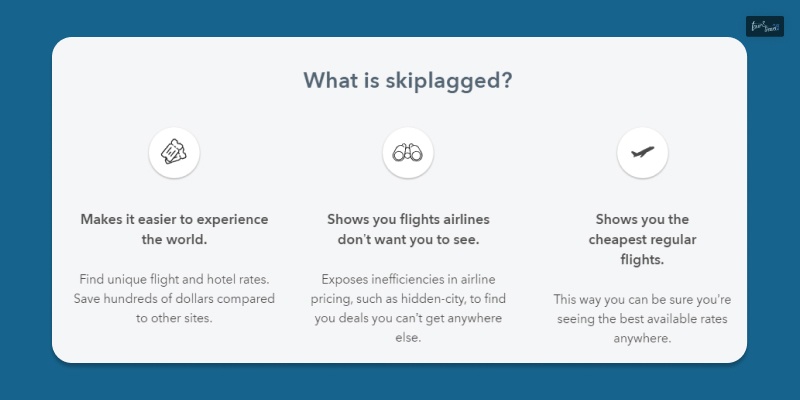
Skiplagged is a legitimate way to reduce the costs of flight bookings. By booking a hidden city ticket, a person can save hundreds of dollars off the price of a single ticket for a flight. Even though useful, it has its fair share of controversies as well.

Read this article to find out more information on skiplagged!

Get Familiarized With Skiplagging

Skiplagging refers to the general practice of booking a trip where the stopover is set as the destination where the traveler originally plans to travel. They use a “point A to point B” form of phrasing where a passenger would book a ticket that would take them from “point A to point C” instead, with a stopover at point B.

Whereas the actual destination of the passenger is point “B”, and they leave the airport as the plane land in point “B”, leaving their seat empty from point “B” to point “C” portion of the journey.

Tip: Is skiplagged legit? Well, it certainly is legit, but many airlines have opposed the services they provide and even tried to incorporate strict measures to counter them. It is just as good as Kiwi Flights.

One-Way Endeavour

skiplagged.com

It is very important to keep in mind that skiplagging won’t work if the traveler wants to travel with checked luggages. After all the checked luggage is tagged to go through to the final destination (point C).

If someone still tries it, then there would be severe consequences as the airline would then have to offload the checked baggage after coming to the realization that the boarding pass wasn’t scanned for the second half of the journey.

Additionally, this practice would actually work on a one-way flight. That is only because an airline would definitely cancel the return tickets for the traveler after it realizes that they never did complete the first portion of their journey.

Controversies

Airlines absolutely hate this practice of booking skiplagged flights and have also tried to shut it down. This is why the United Airlines and Orbitz teamed up to sue skiplagged back in 2014. After which, they lost their legal battle against Skiplagged. Then the airlines turned their attention to punishing the passengers for even engaging in this practice by certain rules and regulations.

Skiplagged Interface

To use their services, one can head over to their site skiplagged or even download the skiplagged app.

The tagline of their website states “ Ridiculous Travel Deals That You Won’t Find Anywhere Else”.

The interface of their website is very easy to navigate. One needs to create an account to get started with using their services. There are four options available to select from (situated at the top of their site) – skiplagged flight, Hotels, Rewards, and Cars.

They have also been featured in BBC, CNN, Buzzfeed, The New Yorker and many other famous publications.

Benefits Of Using Skiplagging

Here are a few loopholes that Skiplagged has uncovered and that can save travelers a significant amount of money.

1. Virtual Interlining Fares

The search engine of Skiplagged also shows the VI or Virtual Interline fares. These are the fares that are known to combine all the flights between the airlines that are known to not have a direct relationship.

For such instances, the traveler needs to check back in between the various carriers. While in some cases, especially for international flights, the savings could be of thousands of dollars.

2. Unique One-Way Flight Combos

Skiplagged has a very sophisticated and powerful flight search engine that is always searching for unique one-way combinations that travelers could use to book and get a great final price for a round-trip flight.

The other travel sites, either are not able to package these one-way flights together due to the limitations that are imposed on them from the airlines. Or it could be that these flights are using very old technology which are full of limitations.

3. Hidden-City Flights

Under this particular loophole, a user books a flight to the destination city that is actually the airline’s layover city. For instance, a user might try flying from Austin to Boston, and all of the flight prices would show as $500.

However, there could be an Austin to New York flight with a layover in Boston for $200.

In this case, the traveler can get out in Boston, saving themselves $300. It is to be noted, though, that one can’t check a bag.

Skiplagged Reviews

Here are a few skiplagged reviews left by people who have used their services:

Your site is easy for me to navigate and my history with “Skiplagged” has always been pleasant with the least bit of problems.

– Pierpont Geer

Skipped lagged just saved me 300$ on a trip that was originally 480… goddamn i didn’t believe it would be this crazy

– Jay Leyva

Just because you have money to spend doesn’t mean you have to. Skip lag is always help me find the best flights at the best prices! They are always my first go to.

– Shantael C.

Rates are way better than booking directly, even with added protection… easy booking process… just so simple!! Well Done Team Skiplagged!!

– Nik Bali

You guys are a reminder to me that it pays to check the availability and price of a flight several times. Also, your website and prompts couldn’t be clear, convenient or easy. Now, I’m going to book 2 more additional flights, and I hope it’s just as easy and reasonable. Thanks!

– Mike

To Wrap It Up!

If you are thinking of using their services, then by all means, go ahead, as they are 100% legit.

But you do need to keep in mind that the services they offer are opposed by most airlines. Hence, you would need to counter-check the guidelines of the airline that you are going to book at.

That was all for information regarding skiplagging and its benefits. Thank you for reading up till here. I hope you found the information useful. Let me know in the comments your thoughts on the same.

Read Also:

Share on Social Media

Sagnika Sinha is a content writer who is passionate about writing travel vlogs, entertainment and celebrity articles and literature-based pieces. With a 4 years experience in teaching, she loves reading books. A procrastinator by nature, she loves travelling, listening to music, planting and gardening.

Leave a Reply

Your email address will not be published. Required fields are marked *

title-img Related

READ MORE delta connection dl3543 emergency landing

Delta Connection DL3543 Emergency Landing: What Is It? When Did It Happen? 

BY  Sibashree Feb 20, 2026

Delta Connection DL3543 emergency landing happened on 7th July, 2025. A pressurization-related issue happened, and the flight returned to Minneapolis immediately after takeoff.  It was a safe landing as the crew took all the necessary precautions. Furthermore, there were no reports of injuries.  However, when the news of the Delta Connection DL3543 emergency landing surfaced, people were worried. It is obvious because any emergency landing or any technical fault in the air is unsettling.  In this context, we want an honest explanation and a realistic understanding of how aviation safety works. It is especially important for us, who are always on the move and have to take short and long flights.  Hi, in today’s blog, I will talk about the Delta Connection DL3543 emergency landing incident and explain what happened and why the crew had to make an emergency landing decision.  Moreover, I will have a thoughtful and clear discussion about what this emergency landing meant for passengers.  What Happened With The Delta Connection Flight DL3543? An in-flight emergency was declared on Delta Connection flight DL3543 on 7th July 2025, a little after takeoff.  So, it had to return to Minneapolis–St. Paul International Airport (MSP). The flight was flying to Chicago from Minneapolis. However, it returned immediately so that the aircraft could be inspected properly on the ground.  Fortunately, the passengers had a safe and usual disembarkation thanks to the planned, controlled, and precautionary landing. Moreover, there was never a loss of control.  Why Was The Delta Connection DL3543 Emergency Landing Declared?  As I have mentioned, pressurization-related issues were the reasons behind the landing of the DL3543 aircraft.  When a plane goes up, the aircraft's pressurization systems maintain or control the air pressure in the cabin.  Furthermore, there is a sensor to read the air pressure. When the sensor reads the air pressure outside the desired limits, it is a serious technical concern.  The plane can still fly smoothly under this condition. However, the pilot has to take immediate action based on the reading.  In other words, the pilot does not take unnecessary risks by flying the plane in this situation. Moreover, when the crew declares an emergency, it helps them to take the following safety measures.  Emergency Landing for Safe Disembarkation and Inspecting the Aircraft Emergency Handling from Air Traffic Control Having the Emergency Services as a Standby.  However, when pressurization-related issues occur and lead to an emergency landing, there is no need to panic.  An emergency landing is a part of the discipline and training of the aircraft crews.  What Does An Emergency Landing Mean?  An emergency landing is not as dramatic as we see in movies and series. An emergency landing in commercial aviation may indicate a lot of things. Those are: A Medical Issue Happening with a Passenger Any “Cabin System Alert” A Warning about Technical Faults that Need Inspection And, A Sensor Reading Outside the Limits.  In most cases, emergency landings happen as precautionary measures. In such situations, the aircraft is in full control.  However, the pilot and the crew members want to eliminate the uncertainty and get back to the ground as soon as possible as a safety measure.  This same process or discipline is followed for the landing of DL3543. Why Did The DL3543 Plane Return To Minneapolis?  Returning to the Minneapolis Airport was the most efficient and safest choice after some pressurization-related issues happened.  Also, when the plane returned, the Minneapolis Airport offered the following assistance. Readiness for Emergency Response Immediate Help from the Maintenance Teams Quick Passenger Assistance and Prompt Rebooking Familiar and Safe Runways with Adequate Ground Operations  The pilot and crew could avoid the complexity and risks related to the pressurization issues thanks to the emergency return and landing. Who Operated The Delta Connection DL3543? Endeavor Air operated the Delta Connection DL3543 flight. It is a subsidiary of Delta Air Lines.  As a regional subsidiary, it follows the same safety oversight, federal regulations, and training standards as Delta Airlines.  So, there is no deviation in the standards for passenger safety.  What Did The Passengers Experience On Board?  The passengers experienced calm and clear communication from the pilot and the crew. So, though a little panic was obvious, the situation was under control.  Furthermore, they had a shorter flight and a shorter descent than expected. Moreover, there was a brief waiting period before the inspection began.  All the actions were aligned with standard protocols, and they were well-rehearsed. What Happened After DL3543 Made A Safe Emergency Return?  When Delta Connection DL3543 made a safe and emergency return, it was no longer in service, and an immediate inspection took place.  Then, the maintenance teams checked the problematic system.  In such cases, the aircraft can only return to service if the maintenance teams issue clearance. It was the same with DL3543.  So, the passengers got the rebooking for the previous flight. Also, they got this priority service without additional charges, according to the policies of the airlines.  Overall, when an aircraft makes an emergency landing, aircraft safety and passenger care get the most importance.  Why Should The Incident Of Delta Connection DL3543 Emergency Landing Reassure Air Travelers?  You must not take the case of DL3543 Emergency Landing as a failure. It shows how the aviation industry is sincere about its safety culture.  Once the crew noticed a potential issue, they practiced precaution, clearly communicated the issue to the passengers, and planned an emergency landing.  This proactive measure ensured the safe disembarkation of the passengers.  Moreover, the proactive measures of the crew members show why commercial aviation is one of the best and safest modes of transport in the world. Delta Connection DL3543 Emergency Landing: Establishing The Practice Of Caution Over Convenience  Delta Connection DL3543 emergency landing is all about being confident about the safety measures of commercial aviation and getting rid of fear.  It also shows why prevention is always a smarter choice than reaction.  Furthermore, pilots have the training to land an aircraft as fast as possible, the moment they find anything wrong. It is a no-question-asked practice.  Moreover, this is the mindset that saves many passengers every day without making headlines.  Delta Connection DL3543 Emergency Landing: Frequently Asked Questions (FAQs) Here are the frequently asked questions and answers about the DL3543 emergency landing.  1. Was The DL3543 Emergency Landing Hazardous?  No, the DL3543 emergency landing was not hazardous. It had a safe landing thanks to the proactive measures taken by the pilot and crew members for an emergency landing. Also, all the passengers disembarked safely and got a rebooking of the next flight at the Minneapolis Airport.  2. Is Delta Connection Not As Safe As The Mainline Delta Flights?  No, Delta Connection is as safe as the Mainline Delta flights. As a subsidiary, Delta Connection follows the same aviation policies and safety guidelines. You can take the case of the DL3543 emergency landing as an example. No chance was taken to ensure a smooth emergency landing and safe disembarkation of passengers. 3. Does A Pressurization Issue Make The Plane Unsafe? No, a pressurization issue does not make the plane unsafe. Some alerts are related to the sensor, and they are minor issues. However, as part of the safety practice, a pilot usually plans an emergency landing to ensure the safety of the aircraft and the passengers. 4. Why Were Emergency Vehicles Present After The DL3543 Emergency Landing? The DL3543 aircraft had an emergency landing, and in such cases, emergency vehicles are automatically present for easy access. So, the presence of the emergency vehicles was part of the precautionary measures and standard practices. 5. Is A Detailed Public Report Issued On Emergency Landings?  There is no mandatory rule to issue a public report on an emergency landing. If the issue is severe and people are harmed, the airlines, of course, will issue a public report. However, in cases such as the DL3543 Emergency Landing, a public report on findings may not be released.  Read Also: Discount Codes Ttweakflight: How Can You Save A Few Dollars On Your Upcoming Air Trip? Do You Qualify For Cancelled Flight Compensation On Connecting Flights? 15 Airport Hacks Every Traveller Should Know Before Their Next Flight

READ MORE

Welcome To Biscayne National Park: Enjoy Kayaking and Canoeing At This Watery Wonder

BY  Sibashree Jul 10, 2024

If you are in Florida and want to give it all for your active pursuits, your path must lead to the Biscayne National Park. With the third longest coral reef, the watery wonderland is a beautiful coexistence of wildlife, water trails, hiking spots, and life under the water.   Also, did you know that as you visited Florida’s Biscayne National Park, you made a little contribution to the local and national economy? The National Park Service says,   “The South Florida national parks, comprised of Big Cypress National Preserve, Biscayne National Park, Dry Tortugas National Park, and Everglades National Park, were collectively visited by 2.9 million people who spent $242.5 million and supported over 3,250 jobs in South Florida. The cumulative benefit to the South Florida economy was over $352 million.”   So, is the allure palpable enough? Are you already invested in the wildlife, islands, water sports, and the urge to do a little good for the local community? Pack your bags and set in! Meanwhile, let me do all the legwork and make all the plans to join you at the park.   Things To Know About Biscayne National Park  Before I share the details about the kayaking and canoeing fun at the Biscayne National Park, I want to present a brief overview of the park.   A visit to this park is truly a one-of-a-kind experience, and it’s like a microcosm of the universe with the falling together of land and water ecosystems.   It’s time to know the park at a glance before you plan a visit.   Biscayne National Park (Things To Know)  Best Time to Visit  Late November to April  Address 9700 SW 328th Street, Sir Lancelot Jones Way, Homestead, FL 33033  Operating Hours  7:00 AM–5:30 PM, 7 days a week (except holidays) Size 172,971 acres Coral Reef Length  72,000 acres of the northernmost range of the Florida Reef Number of Visitors (in 2023) 571,242  Entrance Fee None Phone 305 230-1144 Alerts & Conditions  Updated regularly  Safety Concerns Mosquitoes and occasional storms Nearby Accommodation Facilities You can stay in tents and make the most of your camping experience. The camping spot is available on a first-come, first-served basis.  Otherwise, you can drive west for half an hour and find hotel chains in Homestead.  I know you can’t wait to have a slice of the national park ripe with outdoor adventure. So, let’s delve deeper into the water and have some kayaking fun and more!   Kayaking, Canoeing, And More! Exploring The Watery Wonderland Of The Biscayne National Park   95% of the Biscayne National Park has water. So, water activities and exploring the water ecosystem are the most amazing things about the place.   You can go canoeing on the open water across the coastal line and reach the stretches of mangroves. Further, you can explore the artificial islands by canoeing and kayaking.   However, to have the most amazing canoeing experience and paddle with the current, you must get a tide table for the visitor center first.   So, let’s start paddling and kayaking!  Jones Lagoon Eco-Adventure Clear Water Paddling  Fee: $109  Age Limit: 12+ for Shared Trips  Duration: 3.5 Hours  Get surrounded by the most amazing marine life during this clear water paddling trip. You will meet the sea turtles, Roseate Spoonbills, and baby sharks on your trip.   Kayakers also love the Jones Family Historic District and Lagoon because of its historic importance. It features on the National Register of Historic Places.  The Jones Family Historic District consists of Porgy Key and Totten Key. The Jones family stayed there during the 1800s and started growing limes and pineapples.   Also, in the early 20th century, they sold their property stretching over a whopping 277 acres and became millionaires. It was a rare incident then in this part of the world for an African American to have this fortune.   Debris Cleanups with Guided Jones Lagoon Paddle  Fee: $50  Age Limit: 12+  Duration: 6 Hours  How about enjoying the beauty and diversity of Biscayne National Park and contributing to its conservation simultaneously?   This debris cleanup and Jones Lagoon paddle trip involves cleaning the debris across the mangrove coastal line and enjoying a relaxing paddle through Jones Lagoon.  At the end of the trip, you will return to the Dante Fascell Visitor Center and unload the debris.   Kayak the Mangroves  Fee: $39  Age Limit: 6+ for Shared Trips  Duration: 1.5 Hours  The mangrove stretch at Biscayne National Park is home to many animals. It is also one of the longest bordering mangrove stretches on the left of the eastern shoreline of the United States.   So, it’s time to meet the tree crabs, fish, animals, and snakes residing in the mangroves. The best part of this tour is that it is partially guided.   The naturalist will guide you for the first half an hour, and from there, you can paddle on your own and take charge of how you want to enjoy the trip.   Sail, Paddle, And Snorkel At Biscayne National Park  Fee: $209  Age Limit: 8+ for Shared Trips  Duration: 6 Hours  This trip involves exploring through the mangrove forest, kayaking, and snorkeling. The trip starts from the Dante Fascell Visitor Center in Homestead.   Snorkel and Paddle  Fee: $209  Age Limit: 12+ for Shared Trips  Duration: 6 Hours  This snorkel and paddle trip at Biscayne National Park is the best to experience aquatic diversity. The rays, dolphins, and sea turtles  await to welcome you to their lives. Further, an encounter with the coral reef is going to be the best experience you can think of.   Also, if you are a birder, you cannot just miss the Roseate Spoonbills while padding. The mangrove forests stretching through the route once again speak of the biodiversity present in the park.  Your guide on the Captain of the National Park will explain the nature of the inhabitants, how they coexist, and the history of the place. It’s the best chef’s kiss you can expect on a trip.   Kayaking Through The Seagrasses of Stiltsville  Fee: $109  Age Limit: 12+  Duration: 3 Hours  Must-Have: Prior Kayaking Experience  As you paddle through the water, the Stiltsville houses on the seagrass banks will be your roadmap to history. This ride is also about the most delightful encounter with the wildlife at Biscayne National Park.   You will even learn why these seagrass banks are important for the ecosystem of the national park. Do you have this thing for everything quaint? The sunken barge on this route stands as a remarkable piece of eulogy.   For the trip, you will start from Coconut Grove and  kayak to the bay to start paddling.   You Can’t Miss The Third Longest Coral Reef At The Biscayne National Park Biscayne National Park promises you a kaleidoscopic experience with the third-longest coral reef in the world. The living coral reef, with its rhythmic movements and embrace of the pork fish and nurse sharks, presents an unforgettable visual experience. The soft corals in the reef dance to the current and create movements.   It’s mesmerizing to know how the polyps make the most beautiful structures by collecting calcium from seawater. In some parts, the coral reef looks like the most vivacious flowers, and in other parts, it will appear like elk antlers or mountains.   On and around the reef, you will also come across the following creatures:  Sea fans  Sea whips  Bright sponges  Christmas tree worms  Fish, shrimps, crabs (They visit to eat the algae gathered on the coral reef.)  Overall, it’s a rainbow of colors with red, purple, orange, and green dominating the spectrum.   How To Visit Biscayne National Park?  You can visit the Dante Fascell Visitor Center of the Biscayne National Park from the US Highway 1 (from north and south) or the Florida Turnpike (from north).   Reaching The Biscayne National Park From North  From Florida Turnpike  First, choose exit 6.  Then, reach the exit ramp and take a left turn to continue moving south to SW 328th Street.   Now, take a left turn on the 328th Street.  Further, drive for four miles to reach the end of the road.  Find the park entrance on your left.  From The US Highway 1  You have to drive south toward Homestead, take SW 137th Avenue, and turn left. You will reach SW 328th Street after a five-mile drive. From here, you will have to take a left turn and drive for four miles. Once you get to the end of the road, you will find the park entrance on your left.   Reaching The Biscayne National Park From South  You can reach the Biscayne National Park from US Highway 1 while traveling from the south.   Then, drive north and reach Homestead. There, you take a right turn on SW 344th Street. Further, continue for four miles until the road near the Homestead Speedway takes a northern turn.   Next, reach the SW 328th Street and head east. Now, you will have to drive for four miles to reach the end of the road. The entrance of the Biscayne National Park will be on your left.   Fun Facts About The Biscayne National Park   The series of sandy, low-lying, and small islands here are known as keys.  Eliott Key is the largest key or island in the Biscayne National Park.  Boca Chita Key is the most popular island here. Also, it is known for its 65-foot lighthouse constructed in the 1930s.   See You There!  Biscayne National Park is a destination that will spoil you with choices. The kayaking and canoeing activities are there, and you can also take a deep dive to have a one-on-one with the fascinating marine life.   If you want more outdoor pursuits in the water, you can try swimming and fishing.   Further, the park does not disappoint wildlife lovers and tourists who love exploring history. The Jones Family Historic District at the park features on the National Register of Historic Places.   Also, the dolphins, birds, turtles, and fish are there to offer you the most amazing wildlife experience.   And the list is endless! The things to do and see at the Biscayne National Park! So, let’s quickly wrap up my guide and plan a visit to the park. See you there soon!   Biscayne National Park FAQ  What Is Biscayne National Park?  Biscayne National Park in Florida is one of the most visited National Parks in America. It is known for its diverse ecosystem and historical importance. Further, it has the third-largest coral reef in the world.   How Do I Access Biscayne National Park?  You can reach Biscayne National Park through US Highway 1 or the Florida Turnpike if you are driving from the north. If you are traveling from the south, you will have to take US Highway 1.  What Activities Can I Do at Biscayne National Park?  At Biscayne National Park, your outdoor pursuits are going to be endless. You can enjoy the following activities.  Snorkeling  Diving   Kayaking  Paddling   Exploring the mangroves  Visiting coral reefs  The park also offers opportunities to experience the best marine life by observing manatees, sea turtles, and various marine creatures.  What Landmarks Can Be Found In Biscayne National Park?  Biscayne National Park has the following landmarks.  Maritime Heritage Trail  Stiltsville  Living Coral exhibit at the Dante Fascell Visitor Center  Is There Scuba Diving At Biscayne National Park?  Yes, you can do scuba diving in clear waters at Biscayne National Park. You will  encounter coral reefs, vibrant marine life, and shipwrecks while scuba diving.   When Did Biscayne National Park Become A National Park?  In 1968, Biscayne National Park was established as a national monument. Years later, in 1980, it got the designation of a National Park.   Also read Enjoy The Best Amusement Park In Cancun. The 4 Best Parks In Cancun You Have To Visit. From Hiking To Stargazing: The Top 10 National Parks In Utah!

READ MORE Rio de Janeiro Travel Guide

Rio de Janeiro Travel Guide: What Your Brazilian Real Gets You

BY  Sibashree Sep 20, 2025

Rio de Janeiro sweeps you up the moment you arrive. Golden beaches stretch for miles, samba rhythms spill from bars in Lapa, and cable cars glide up Sugarloaf Mountain for some of the best views on Earth.  Life here is colorful and fast-moving, and part of slipping into that rhythm is knowing how far your Brazilian real will take you - from a chair on Ipanema beach to a plate of feijoada in a neighborhood café. Before we go on, here is a quick Rio de Janeiro travel guide. Just a quick note: exchange rates and prices don’t stay still. At the moment, 1 US dollar equals about 5.4 Brazilian reais, but it’s best to check the latest rates and costs before you travel. Rio de Janeiro Travel Guide: What To Expect? Rio de Janeiro is one of the best cities you can explore. It is one of those few places that has a care-free energy and will make you feel alive. The beaches, food, and major attractions will draw you to it without even trying too hard. Here is a simple Rio de Janeiro travel guide. Beaches - Rio’s Living Rooms The beaches of Copacabana and Ipanema are more than postcards - they’re part of daily life. Locals jog along the promenade in the morning, families gather for a swim, and groups of friends set up for impromptu games of beach volleyball or footvolley. Tourists blend right in, renting chairs and umbrellas from vendors for around R$10-15 per piece. Snacks come to you. Vendors walk the sand offering everything from ice-cold coconuts (R$8-10) to grilled queijo coalho (cheese skewers) for about R$12. You can even try a caipirinha mixed fresh on the spot, usually for R$15-20. These are usually cash-only transactions, and the small notes feel like part of the ritual - bargaining isn’t common, but handing over a few reais feels easy and authentic. Spend an afternoon at Arpoador, the rocky point between Copacabana and Ipanema, and you’ll see why locals gather here at sunset. It doesn’t cost more than a bus ride (R$5) to get there, and yet it’s one of the richest experiences you’ll take home. Food: From Street Bites to Sit-Down Meals Rio has a huge range of food. Starting from some humble bakeries to some fancy rooftop restaurants, Rio has it all. Start with breakfast like a local: pão de queijo (cheese bread) and strong coffee, often no more than R$10-15.  Step into a juice bar and you’ll find tropical flavors like passion fruit, guava, or the ever-popular açaí bowl, usually under R$20 for a generous portion. At lunchtime, the prato feito is king. This “set plate” of rice, beans, salad, and a protein such as beef, chicken, or fish costs R$25-35 and will keep you full all day.  You will get various self-service buffets that charge by weight. You will get roasted meats, vegetables, and farofa, and you will have to pay around R$30-40. For dinner, you can choose what you prefer. You can try something casual or something fancy. If you prefer a mid-range seafood meal along with drinks, it will cost somewhere around R$80-100 per person.  However, a proper night out in Ipanema at a fancy fine-dining spot might cost around R$200-250.  You can even visit Churrascarias, which is a Brazilian steakhouse. It is an event in itself. They have endless skewers of grilled meats, side dishes, and salad bars. You can expect to pay somewhere around R$120-180 per person. However, this does not include drinks. All these places accept cards, but it is better to keep some cash handy for bakeries and street food. Attractions: Big Names And Hidden Gems There are various major icons in Rio, and those are actually worth it. You can take the Sugarloaf Mountain cable car for around R$150, and the ride itself is a major part of the thrill. The glass walls will give you a 360-degree view of the way from above the city. You can visit Christ the Redeemer, resting on Corcovado Mountain, for R$100. The moment you stand at its feet and see the city from there, you get an amazing view. You can carry cards as both attractions accept payment in cards. However, it is better to carry some cash for small vendors, tacos, or snacks. Rio is also filled with a lot of gems that you can see for free or for a low cost.  The Selarón Steps, covered in colorful tiles from around the world, cost nothing to climb. A stroll through Santa Teresa’s narrow streets will take you past murals, studios, and cafés where you can pause for a R$12 espresso. At night, head to Lapa to experience samba at its source. Entry to some clubs is around R$30-50, and drinks inside range from R$15-25. Smaller bars may only accept cash, especially if you’re outside the main tourist drag. Getting Around Rio is quite a big city, but it is not difficult once you understand the system. You can take the metro, it's quite safe and clean, and a single ride costs around R$5.  Moreover, if you have a rechargeable RioCard, it will save you a lot of time and work. You will be able to use it for different types of transport, including trains and buses.  You can take a bus, which goes almost to the city, and the fare is quite similar to the metro. Here, you can get taxis for around R$6, and cross-town trips generally range around R$40-60. Also, Uber and other apps like these are popular, and often offer rides at a cheaper rate than a taxi. If you want, you can pay in-app with the card, and that way, you will not have to use cash for payment.  For day-trips outside the city, you will get intercity buses. This will help you explore the outskirts within a budget. If you are planning to visit the historic mountain town, Petropolis, you can explore it for around R$40-50. Moreover, if you are planning to take a longer ride to Búzios, the beach town, you will be able to visit it for around R$70-80. You can get the bus tickets online or from the bus station as well.  How Much To Budget You need to prepare a budget for a trip. However, the budget depends on the kind of trip you want to have. Budget travel: It will cost you around R$200-250 for a day, including hostels, street food, public transport, and free attractions. Mid-range: It will cost you around R$600. You will get comfortable hotels, visit some of the major landmarks, and have some casual as well as sit-down meals. High comfort: This will cost you around R$1000 and above. You will get four-star hotels, fine dining, and guided tours at this range.  However, the prices in Rio rise during any carnival or New Year’s, and this also varies depending on the neighborhood.  Ipanema and Copacabana are some of the premium places that tourists visit, but there are some block islands that will offer the same charm but at a lower price range. Spend Smart In Rio Start your trip with at least a little Brazilian real in your wallet. It will cover your first taxi or ride-share, snacks, or that first fresh coconut without delay. From there, cards will carry most of your expenses, but having R$100-200 in cash each day is wise for small payments. Stick to ATMs inside banks or malls when you need to withdraw. They’re safer and usually give fair rates. Avoid exchanging money at the airport - the rates are often poor, and the fees stack up quickly. Think about how you balance cash and cards. Use your card for hotels, restaurants, and tours, and keep your reais for buses, bakeries, street snacks, and tips. It’s a system that works well in Rio and lets you move through the city without stress. Enjoy Your Journey Landing in Rio with a Rio de Janeiro travel guide and Brazilian real already in hand saves you time and makes the city easier to navigate. You’ll breeze through those first transactions - a cab, a snack, a metro ride - and step right into the energy of the city. Rio rewards travelers who embrace both the big icons and the small everyday moments. The real you spend on a chair at the beach, a cup of coffee, or a bus ride across town is more than just money - it’s your ticket into the rhythm of the city.  As mentioned before, exchange rates and prices may change, but the value of those moments never does.