

What Is Oshino Hakkai Famous For? How To Visit It And More 

Everyone knows that you cannot complete exploring Japan in a day. And I had no choice but to miss Oshino Hakkai on the first trip. 

However, on the next trip, I made sure to plan a visit. 

Of course, an image on Instagram was my major drive behind being so passionate about a trip to Oshino Hakkai. 

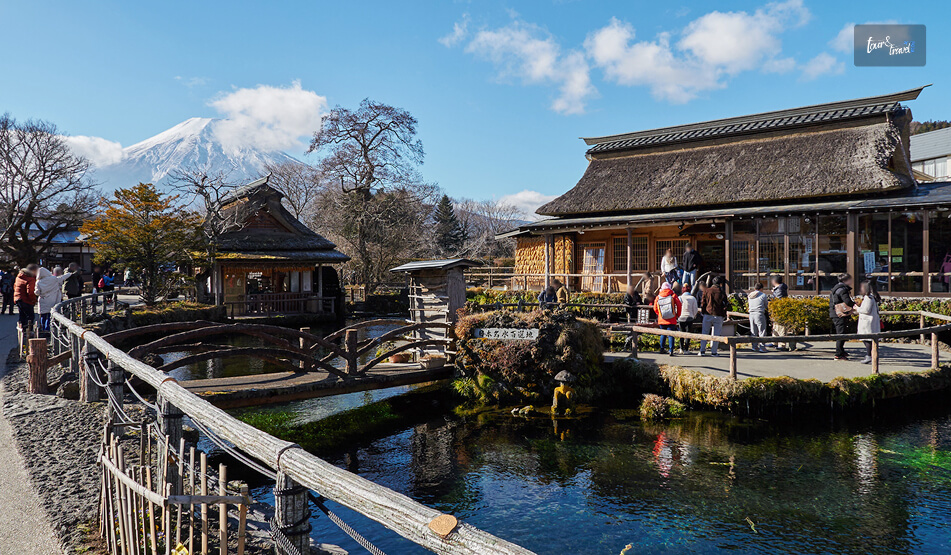
I saw a series of houses with thatched roofs along the shore of a pond. The magnificent and snow-covered Mount Fuji stood behind, strong and unshakable, as the eternal truth. 

Born and raised in the land of spirituality and the Himalayas, I had to visit Oshino Hakkai. 

However, as I have explained in my narrative from Tokyo to Mount Fuji day trip, you have to time your trip really well and have to be extremely lucky to see the snow-capped Mount Fuji. 

Also, if you are planning a trip in summer, you will only get to see Mount Fuji partially or fully covered by clouds. 

Nevertheless, as Mount Fuji continues to act elusive, here is why Oshino Hakkai will win your heart. 

Oshino Hakkai: Why Is Visiting The Eight Springs Of Oshino So Special? 

Oshino Hakkai Why Is Visiting The Eight Springs Of Oshino So Special

As I stood at the center of where both Lake Kawaguchiko and Lake Yamanakako meet in the small village of Oshino, I was able to look at the eight sacred ponds of Oshino Hakkai. 

These sparkling, clear water springs are all that is left from a long-lost sixth lake that existed hundreds of years ago. It’s as if time stood still when you visit these sacred areas.

When I looked into the water, I didn’t see just water, and I saw history. The springs were used by pilgrims (Fuji-ko) during Japan’s Edo period to cleanse their bodies and souls before climbing Mt. Fuji.

What a magical process the water goes through! 

From snow accumulation on the summit of Mt. Rainier, through melting and filtration through approximately 80 years’ worth of porous lava before it actually emerges at this location, its absolute perfection. 

Moreover, it was crystal clear and pure. 

Also, as I walked through the “Natural Monuments,” I had an intense feeling of appreciation for the many years of waiting, so that each would have such serenity.

How To Reach Oshino Hakkai?

How To Reach Oshino Hakkai

The journey to the stunning waters of Oshino Hakkai is as much a part of the experience as the location itself. 

Here’s my recommendation for how to get to Oshino Hakkai, depending on whether you want a more convenient (train) or an adventurous (rental car) way of doing so.

1. Reaching Oshino Hakkai From Tokyo

When travelling from Tokyo, you have several options available. 

Highway bus lines go to Oshino Hakkai directly. 

If you plan to take the train, either Fujisan Station (the nearest station) or Kawaguchiko on the Fuji Kyuko Line is your best option. 

Once at Fujisan or Kawaguchiko, catch a local bus to get to the village.

You may take the Fujikko-go (tourist buses), Mt. Fuji World Heritage Loop, or Uchino or Hirano routes via local bus from Fujisan Station. 

Generally, there are 1-2 buses/hour on these routes.

At Kawaguchiko Station, there are 11 Fuji-Q buses each day that leave for Lake Yamanaka Oriental side, and the 11 Fuji-Q buses that leave for Gotemba and also the Oshino springs.

Just watch out for the Oshino Hakkai or Oshino Hakkai-Iriguchi as their stops.

2. Driving And Village Logistics

I rented a car, and it is the most convenient way to visit the nearby Five Lakes region. 

Parking here is convenient, and there are many public and private parking spaces. 

After parking the car, you can explore the nearby villages. 

However, you will need 300 JPY to enter the Hannoki Bayashi Shiryokan Museum. 

You can visit the museum from 9 AM to 5 PM every day for a deep understanding of the local history. 

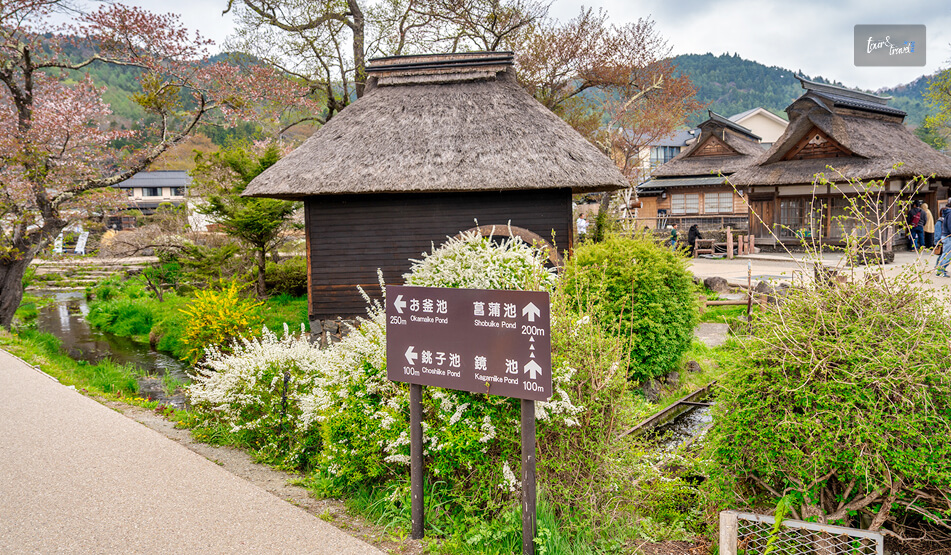
Moreover, you will find signage in Japanese and English for every pond.

My Trip To Oshino Hakkai

My Trip To Oshino Hakkai

I felt a bit out of place when I got to Oshino Hakkai. 

I thought it would be a nice, quiet area for reflection and meditation, free of other people. 

However, I found a busy and fully built-out village of people, shops selling food, and many shoppers and visitors to the area, as well as people engaging with local merchants about the items that were being sold. 

There were also a lot of people around Wakuike Pond, and they were excited to see how clear the water of the pond was and the fish that were swimming in the pond.

1. Finding Solitude And Peace Within The City

Although I typically search for the peace of solitude, I did not mind being in a populated environment. 

I became curious after wandering among the crowds to find out where my curiosity would take me. 

I found a quiet, undeveloped area just minutes from the main road, where I could hear the water from the pond, see ducks on the water, and watch an old man with two little boys quietly fishing right next to me.

2. Folklore And Galactic History

The folklore & Galactic history of the 8 springs were fascinating to explore.

Especially, that water from Wakuike Pond traveled on the Space Shuttle Challenger in 1983 for a snow-making experiment in space!

3. My Personal Highlight 

The highlight for me was the open-air museum at the Hanoki Bayashi Shiryokan. It was a true escape from contemporary living, immersing yourself in the cultural heritage of the area.

4. Hannoki Bayashi Shiryokan: The Main Attraction Of The Trip 

To tell the truth, I went to Oshino Hakkai because of Hannoki Bayashi Shiryokan. 

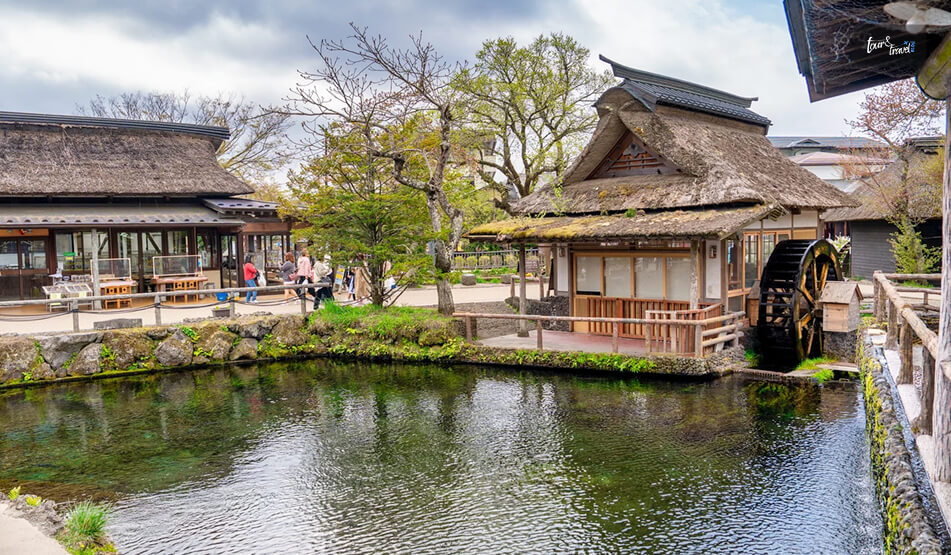
One of the most amazing sights I’ve seen in the Five Lakes region was the thatched-roof farmhouses against a colorful garden and the imposing backdrop of Mount Fuji.

I became engrossed in the displays of antique household items and rustic farming implements inside the traditional farmhouse. 

The tour was brief, but I stayed by the big pond long after I was done because of the subtle beauty of the architecture. 

I couldn’t resist making another lap because the landscaping was so welcoming.

Read Also:

Share on Social Media

Meet Sibashree Bhattacharya, a travel enthusiast who has a decade-long experience in transcending virtual barriers with her words! Her deep love for travel is apparent from her travel escapades to the mountain, often taking her readers on a journey, her words acting as Portkey! Fun fact: Sibashree loves to dive deep into the history of the places she is about to visit, making her travels even more wholesome. If you were wondering how her articles are not short of time travel, this answers it!

Leave a Reply

Your email address will not be published. Required fields are marked *

title-img Related

READ MORE Hiriketiya Beach

Hiriketiya Beach, Sri Lanka: Location, How To Reach, Things To Do And More 

BY  Sibashree Mar 23, 2026

Hiriketiya Beach is a place that can disrupt your travel plans completely.  You may arrive with plans for a two-night stay and end up spending 3 weeks developing a routine of mornings spent surfing, drinking coconut coffee, and watching the sun set down on the jungle.  This tucked-away cove in Sri Lanka’s southern coast, nicknamed by its community of surfers and digital nomads as "Hiri", is a textbook example of tropical aesthetics.  The cove is well-formed, with water that is surrounded by palm trees, and has a jungle so dense behind it that you will hear monkeys scurrying through the tree tops of your surfboard as they find their way there.  Hiri feels like a secret to be shared, but is just being revealed to people in the surrounding towns of Weligama and Mirissa.  Hiriketiya has developed to become a more sophisticated version of Weligama and Mirissa. The "vibe" of Hiriketiya is not just another phrase used by hipsters. It is the currency used by locals. Here is more about this beautiful coastal gem in Sri Lanka.  The Evolution Of Hiriketiya Beach: Why You Need To Go Now Hiriketiya has experienced an incredible transformation over the last few years.  Only a few years ago, this sleepy little fishing village had only a few guesthouses and one small roti shop. It is quite similar to the beaches in Jaffna in that way.  Now, it's become a vibrant hub, and even though it has lost some of its "untouched" charm. Moreover, this infusion of new energy has produced world-class specialty coffee shops, beautiful state-of-the-art Yoga studios, and a co-working scene. But despite these rapid changes, the spirit of this village remains.  The Surf At Hirikeya Beach: A Wave For Every Soul The horseshoe shape and the unique geography of the Hirikeya Beach make it ideal for every type of surfer.  Here is a quick breakdown. Surf LocationDetails The Beach Break (Right Side)- Beginner-Friendly- Sandy Bottom- Gentle WavesThe Middle- Ideal for Longboarders- Offers a Mellow RideThe Point Break (Left Side)- Ideal for Professionals- Shallow Reef Board rentals are standardized at 1000 LKR per hour.  If the Hirikeya Beach is very busy, you can go 3.5 km east and find Kudawella Beach.  Where Is Hirikeya Beach? How To Reach It?  Hiriketiya is located off the main highway along the coast, about one mile away from the town of Dickwella.  Since Hiriketiya is not on a major transit route, you will have to use Dickwella as your transit point. 1. Traveling To Hiriketiya Beach From Colombo The best way to get there is by taking the train from Colombo Fort to Matara, which takes approximately four hours.  From Matara, you can take a local bus to Dickwella or take a tuk-tuk taxi. You can also take a highway express bus from Colombo to Matara and arrive in about three hours. 2. Traveling To Hiriketiya Beach From Ella You can catch the #31 bus at the intersection of the Ella-Passara Road as you travel through tea country.  It is approximately four hours to the coast on a winding road. Just tell the conductor you want to go to Dickwella. 3. Traveling To Hiriketiya Beach From Arugam Bay If you are traveling from the East Coast surf to the surf in the South, there is a direct bus leaving from Pottuvil every day around 6:30 AM, arriving at Dickwella approximately six hours later. What Are The Things To Do At Hirikeya Beach? (Beyond Surfing) Hiri has just as much gravitational force to attract chill seekers. So, here are the things to do beyond surfing.  1. Walk To Blue Beach Island If you're looking for a little adventure, try the 2.5km (1.5-mile) walk to Nilwella.  You'll be walking through peaceful local neighborhoods when you find a beautiful natural sandbar that links the mainland with a small island.  Moreover, walking over a sandbar with breaking waves on both sides of you is something you will remember long after leaving Hiri.  Also, it is the best place to watch the sunset. 2. Sip In Style At Smoke And Bitters Believe it or not, one of the 50 Best Bars in Asia is hidden deep in a coconut grove.  Furthermore, the menu at Smoke and Bitters is based on the smokehouse method of cooking, using local Sri Lankan ingredients with cooking methods from around the globe.  Moreover, you must try the smoked harissa pumpkin and the pork ribs as they are WOW!!  Every cocktail created at Smoke and Bitters is a work of art. The price of a drink here, compared to what you would expect to pay in Sri Lanka, may seem high. However, when you want to treat yourself, there is no better place to go. 3. Become A Culinary Master With Rosie Rosie's cooking class experience is the ultimate rite of passage in Hiri.  While she prepares the dishes during your cooking class, you will also hear many personal stories of her life and how she made some special Sri Lankan spice combinations. Moreover, it costs 6000 LKR, and the 4-hour feast is the ultimate attraction.  The Digital Nomad And Yoga Scene At Hirikeya Beach  Hiriketiya has become a cornerstone of the "work-from-anywhere" lifestyle.  Places like Dots Bay House and Salty Pelican provide the infrastructure (and the caffeine) needed to hit deadlines. Moreover, when it comes to physical and mental well-being, Arise is unparalleled.  So, they provide a variety of classes to choose from, including Muay Thai, ecstatic dance, and Reiki, as well as many types of Vinyasa yoga.  Additionally, their Salt House location offers stunning rooftop yoga classes where you can do yoga while listening to the waves below. Where to Stay In Hiriketiya? Hiriketiya offers a versatile range of accommodation. Here are some places you can try.  1. Salt House  This upscale beach hotel has a boutique feel.  Located 5 minutes away from the beach, the hotel has spacious, minimalistic rooms opening directly to its central pool and open-air cafe.  Moreover, on-site yoga classes every day attract those interested in wellness. Room rates begin at about 21000 LKD per night. 2. Dots Bay House  Located next to the surfing area, 'Dots', the centre of Hiri's social scene, offers accommodation options ranging from dormitories to high-end private rooms.  Moreover, facilities include an on-site co-working space, swimming pool, and popular bar which features the best live music acts in town. Prices start at approximately 7000 LKD per night. 3. Hiriketiya White House  A charming, family-owned guesthouse hidden away in the jungle, offering an excellent option for visitors who want authentic experiences at affordable prices.  Also, the double rooms come with beautiful contemporary bathrooms and balconies where guests can enjoy watching monkeys play overhead. Moreover, the prices start from about 5500 LKD per night.  When To Visit Hiriketiya Beach? Due to offshore winds and consistent swell during the "High Season", November to April is the best time for surfers to be out on the ocean.  Moreover, December to February is the busiest time of year, with hot and dry weather as well as a lot of activity happening around town.  However, there are two downsides. The first is that accommodation prices rise significantly, and the second is that line-ups at the ocean can be extremely crowded. Where To Eat In Hiriketiya? As an enthusiast of TheLowDownUnder Travel and genuine experiences, I felt compelled to sample the local cuisine at Hirikeya. So, here are a few recommendations for places to check out. 1. Lemon Grass Café Considered the benchmark for rice and curry in Sri Lanka, this family-run establishment is modest yet impactful.  Moreover, for 1000 LKR, you’ll enjoy a generous array of at least four different vegetable curries, rice, and dessert, with unlimited refills. 2. Kingsley’s Kitchen Another gem in the area, Kingsley is a well-known figure in the village who serves outstanding home-cooked meals.  Dinner operates on a pre-order basis, so be sure to stop by during the day to reserve your meal.  Moreover, it’s one of the most budget-friendly spots in the bay, with a vegetarian curry priced at 750 LKR. 3. Dahami Situated at the Dickwella intersection, this is where the locals dine. Furthermore, it’s a straightforward buffet offering a mountain of rice and curry for just 450 LKR. Moreover, for those seeking specialty cafés and a beach atmosphere, options like Duni’s Hoppers Café, MOND Café, and La Playa are worth considering.

READ MORE Osaka food

Osaka Food: Know What To Eat In The Streets Of Osaka 

BY  Sibashree Mar 27, 2026

Osaka food is slowly and steadily surpassing Tokyo as the poster for Japanese cuisine.  Furthermore, it has been just a few days since La Cime in Osaka became the best restaurant in Japan in the Asia's 50 Best Restaurants list in 2026.   However, the soul of the Osaka food lies in the streets. The Dotonbori neighborhood was especially the best when I visited.  In fact, I was so much in love with the street food here that I chose to cancel the previous booking and chose a hotel in Dotonbori instead.  Also, the Dotonbori Market was the epicenter of my food exploration in Osaka.  Moreover, how can you ever forget what Anthony Bourdain had to say about food in Osaka? He said,  “I’m a big believer in winging it. I’m a big believer that you’re never going to find the perfect city travel experience or the perfect meal without a constant willingness to experience a bad one.  Letting the happy accident happen is what a lot of vacation itineraries miss, I think, and I’m always trying to push people to allow those things to happen rather than stick to some rigid itinerary.” So, let’s explore Osaka food at its best in Dotonbori. What Are The Best Osaka Food You Can Try On The Streets?  Osaka, despite its funky and vibrant appearance, has a history that goes back to the Edo Period in the 17th century.  Furthermore, it was a major trading hub during that period. Also, it was the same time when Osaka earned the nickname “Japan’s Kitchen.”  Moreover, Dotonbori extends across a canal that reaches out to the sea. So, you will always find fresh seafood in the local delicacies.  Ramen Udon Torikara Takoyaki These are some of the delicacies served by the local vendors in Osaka.  However, just mentioning these names does not justify the tangible experience of Osaka food.  I saw a big red octopus getting dressed and served, and the lobsters were irresistible.  Nonetheless, these are the best street foods you can try in Osaka.  1. Mitarashi-Dango Pocket-Pinch: 150 JPY  Mitarashi-Dango is the most comforting street food you will try in Osaka. Furthermore, these are great for budget-friendly travelers and backpackers like me.  These rice balls are sweet and chewy, and have a hint of burnt taste due to the unique browning process that takes place once the rice balls are boiled and cooled.  Furthermore, the glaze of the sweet soy sauce makes it perfect!  2. Okonomiyaki Pocket-Pinch: 400-450 JPY  Do you like frittata? Then, you will love these Japanese savory pancakes even more.  Okonomiyaki has all the flavors. However, you never feel heavy after having them. Furthermore, these pancakes are simple, as cabbage, flour, and eggs are the main ingredients.  However, the local street vendors add seafood and scallions to the dish for more flavor and color.  Also, they serve it with barbecue sauce.  3. Daifuku Mochi Pocket Pinch: 350-400 JPY Mochi, the round rice cake, is a staple Japanese delicacy.  It has the chewiness of Mitarashi-Dango. However, it has filling as the daifuku part of the name suggests.  I loved the ones with strawberry filling, and you can also try them with other fruits.  4. Torikara Pocket-Pinch: 300-400 JPY If the USA has its deep-fried chicken, Japan also has Torikara.  I loved them, and the fried potatoes and the variety of sauces will be the most amazing additions.  5. Takoyaki Pocket Pinch: 700-800 JPY  Takoyaki is probably the most famous street food of Osaka and Japan.  Japanese people love these octopus balls, and that’s why the Takoyaki stalls in Dotonbori are countless.  Furthermore, the scallions and flakes of dried fish sprinkled on top make the dish really amazing.  Moreover, the batter is gooey, and it will melt in your mouth.  6. Taiyaki Pocket Pinch: 300 JPY This is a fish-shaped pastry and my silent favorite among everything I tried in Osaka.  The smell is irresistible, and the main attraction is to see it getting ready in front of your eyes.  You can have this vanilla-flavored pastry with cheese, custard, and hamburger meat. However, the red bean paste is the ideal choice if you want to follow the grammar of East Asian cuisine. 7. Udon Pocket Pinch: 650 JPY The hot broth and noodles! I know that I have kept you waiting for the longest time to find this lethal combination on my list.  The noodles in Udon are thick, and with the right seasoning, their taste grows on you. That’s why you can eat udon every day and not get bored.  Furthermore, there are many variations of udon, such as the curry udon, yaki-udon, nabeyaki udon, and tempura udon.  8. Soba Pocket Pinch: 400 JPY Soba has buckwheat noodles in hot broth. Furthermore, these noodles are darker and thinner.  Furthermore, the simplicity of the dish and flavors make it a perfect palate cleanser.  I loved a bowl of soba with scallions.  9. Ramen Pocket Pinch: 700-800 JPY Ramen, of course, is the quintessential wheat noodles the whole world has been eating for quite some time now.  I tried different variations of ramen in Osaka. However, I loved the one with pork the best.  10. Yakitori Pocket Pinch: 1000-1100 JPY Yakitori is the Japanese take on grilled meat.  Furthermore, you will get many variations in the meat used here. You will get bone meat, chicken skin, seafood, and many other varieties here.  11. Sushi  Pocket Pinch: 1200 JPY If Sushi is an emotion, then it runs in the veins of Osaka.  From sea urchin to tuna, eel, and salmon, Osaka spoils you with choices in sushi.  Furthermore, the art of eating sushi is something that you need to understand. It is just not about gulping down some food.  It’s also about being a part of the Japanese culture.  12. Taiko Manju Pocket Pinch: 100-150 JPY You may think that Taiko Manju and Taiyaki are the same, but the origin and texture are very different.  Despite the use of the same ingredients, Taiko Manju is fluffier. Furthermore, their drum shape is inspired by the taiko drums, which are integral parts of Japanese festivals.  Read Also: What Are The Best Day Trips From Tokyo? Most Popular Ones You Will Love Cherry Blossom Kyoto Japan: 2026 Season And The Top Viewing Spots Is an Mt Fuji Day Trip From Tokyo Worth It? How To Plan It?

READ MORE Mt Fuji day trip from Tokyo

Is an Mt Fuji Day Trip From Tokyo Worth It? How To Plan It? 

BY  Sibashree Mar 26, 2026

Planning a day trip from Tokyo? Mount Fuji is the most obvious destination for such a trip.  But do you know how to travel for a Mt Fuji day trip from Tokyo and why it is so special?  Let’s find all the details in this blog.  Why Is A Mt Fuji Day Trip From Tokyo Special? Is It Overhyped? The volcanic mountain, Mount Fuji, is a UNESCO World Heritage Site. Furthermore, the Fuji Five Lakes area in Kawaguchiko offers amazing scenic views.  Though a rewarding day trip, these days it is often overhyped by Instagram and other social media platforms.  In most of the pictures, you will find a half-snowy Mount Fuji with its stunning landscape.  However, you have to remember that Mount Fuji is also called the “Shy Mountain.” True to its name, it is only visible around 70-80 days in a year.  That is why it is very important to plan the Mt Fuji day trip from Tokyo at the right time.  Do you think the summer months are the best for visiting Mount Fuji? You are making a mistake.  In fact, the summer months are the most humid and the rainiest in Japan.  So, clouds and mist make Mount Fuji rarely visible. Thus, winter months, which are also drier, are the best for a Mt Fuji day trip from Tokyo.  Climbing And Touring Mt Fuji: Which One Is Better?  If you are planning to climb Mount Fuji, you will need at least 2 days for the trip from Tokyo.  However, if you want to take a tour of the mountain from the surroundings, it can be completed comfortably in a day.  So, here is a comparison of climbing Mt Fuji vs. taking a tour of Mount Fuji.  1. Climbing Up Mount Fuji  A sunrise trek to Mount Fuji is very popular, and you will find multiple stations on the trek route.  Furthermore, climbing up the mountain is no easy task, and it takes 5 to 10 hours to complete this high-altitude trek.  Though the Yoshida Trail, among the four trails leading to the summit, is beginner-friendly, you still need training, proper gear, and preparation to complete the trek.  2. Taking A Tour Of Mount Fuji  This is the usual option for regular tourists. You will visit the Fuji Five Lakes and beautiful villages on the way.  Also, if the weather conditions are good, you will get a good view of Mount Fuji.  How To Travel For A Mt Fuji Day Trip From Tokyo?  Yes, you can take a car on rent for a Mt Fuji day trip from Tokyo. However, Japan is famous for its trains.  It also has a well-managed bus network.  So, for a local experience and budget-friendly travel, these are the best options you can opt for.  1. Mt Fuji Day Trip From Tokyo By Train Japan Railway (JR) has a limited express train service called the Fuji Excursion Train. The train runs between the Shinjuku Station and the Kawaguchiko stations and the Mount Fuji Station is between them. The Shinjuku Station is at a distance of about 5 km from Tokyo City.  The train ride takes about 1 hour and 54 minutes, and the ticket price is ¥600 for adults and 400 for children.  Check out the timings of trains from Shinjuku Station and Kawaguchiko, and when they reach the Mount Fuji Station.  I have enlisted the timings for the weekdays. Train timings differ on weekends and holidays (Source: Fujikyu Railway).  Table 1: Train From Shinjuku Railway Station To Mt Fuji  DepartureArrival 7:30 AM9:23 AM8:30 AM10:21 AM9:30 AM11:23 AM10:30 AM12:19 PM11:34 AM1:25 PM Table 2: Train From Kawaguchiko Railway Station To Mt Fuji DepartureArrival 2:08 PM2:16 PM2:58 PM3:06 PM3:39 PM3:47 PM4:48 PM4:56 PM5:41 PM5:49 PM You can directly book the train ticket from the online reservation service of the Japan East Railway. You can also buy a Japan Railway Pass for similar excursions.  Mt Fuji Day Trip From Tokyo By Bus You can also plan a Mt Fuji day trip from Tokyo by bus. Take the Mt. Fuji Highway Bus from the Shinjuku bus stop and get off at the Mount Fuji 5th Station.  Also, the travel time is about 2 hours and 25 minutes.  Furthermore, the ticket price is 3800 JPY for adults and 1900 JPY.  Moreover, you can book the ticket online from Highway-buses.jp.  How To Explore Mount Fuji? You can explore Mount Fuji in a car. However, it is super expensive and costs up to JPY 15000-20000 JPY a day.  Furthermore, if you are planning to drive in Japan, you will need a 1949 International Driving Permit (IDP) as an international tourist.  Overall, it is a lot of hassle.  So, you can choose the bus services available in Mount Fuji to travel in and around the area.  1. Fujikyu Or Omnibuses You can book the Fujikyu Omnibus sightseeing pass for 1 day or 2 days. The pass for 1 day costs 1500 JPY, and for two days, it costs 2000 JPY.  Moreover, these bus services operate in three lines: the Red Line, Blue Line, and Green Line.  So, check your itinerary first and the places you want to explore before boarding a bus.  2. Climbers Bus Are you planning to climb up Mount Fuji? Then, you can plan to take this bus service. However, many of these services are seasonal, and here are the details.  Moreover, these buses depart from the 5th Station and circle the mountain.  Climber Bus RouteLineSeasonal Availability Fuji Subaru Line 5th StationM-LineEverydaySubhasiri 5th Station Q-LineSummer SeasonGotemba New 5th StationZ-LineSummer SeasonFujinomiya 5th StationL-LineSummer Season 3. Bus-Boat Kaba This is a special bus service on water. You can board the bus-boat Kaba and cruise through Lake Yamanaka.  Furthermore, in usual seasons, the ticket price is 3800 JPY for adults, 1900 JPY for children, and 500 JPY for infants. Prices can further go up in the peak tourist season.  Moreover, on weekdays, the bus boat services will run from 11:30 AM, 1:10 PM, 14:00 PM, and 15:40 PM from 1st April, 2026.  On weekends, there are additional services (along with the usual times) at 9:50 AM, 12:20 PM, 2:50 PM, and 4:30 PM.  Moreover, from April to September, there is a bus service at 5:20 PM on weekends.  5. Local Route Bus  You will get buses departing from Mt Fuji and Kawaguchiko Stations to Fujinomiya, Shin-Fuji Station, Kofu, Isawa Onsen, Mishima, and Gotemba.  What Is The Best Time To Plan A Mt Fuji Day Trip From Tokyo? The winter months are ideal for visiting Mount Fuji. Dry weather conditions and a lack of humidity in the air make it ideal for visiting Mount Fuji. Furthermore, spring and autumn months are ideal for a Mt Fuji day trip from Tokyo. These months coincide with the cherry blossom season in Japan and the autumn foliage. Read Also: Tokyo To Hokkaido Distance: Know About Various Modes Of Transportation Are You Planning A Trip To Osaka? This Is Your Quintessential Guide Best Places To Travel Around The World And To See Flowers