
Kumana National Park Safari Price And Experience: Things I Encountered And Loved

Amidst the concerns of poaching and irregularities, Kumana National Park remains one of the hotspots for wildlife encounters in Sri Lanka. 

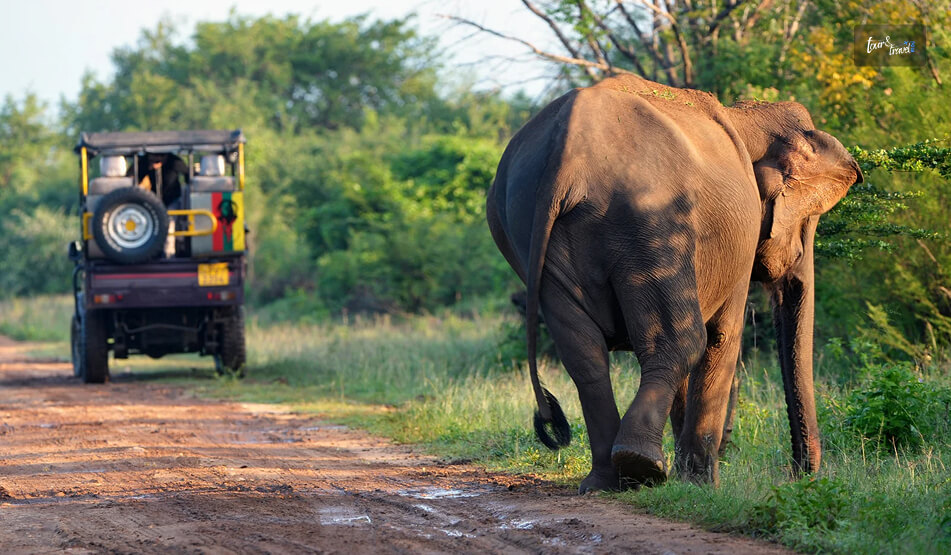
During my days in Sri Lanka, I had already done the Hurulu Eco Park Safari, a safari in the Kaudulla National Park, and the Kumana National Park was the third place I chose for a safari, where I had delightful encounters with elephants. 

Though the park offers various jeep safaris, wildlife tours, and birdwatching tours, I planned it in a different way. I opted for a wildlife ride from Arugam Bay to Kumana National Park instead of taking a safari tour inside. 

I took a DIY route and rented a scooter for a day, and started from Arugam Bay, which was just 50 minutes away. 

The rental charge was around LKR 2000, and I chose it to make my experience of meeting these amazing animals in their natural habitat more memorable. 

And in this article, I will share the adrenaline rush I had at Kumana National Park, the Kumana National Park safari prices, and more. 

However, let’s start with where the Kumana National Park is.

Where Is Kumana National Park?

Where Is Kumana National Park

The southeastern part of Sri Lanka has many gems, and Kumana National Park is surely one of them. 

Around 50 km away from Arugam Bay, it shares a contiguous border with the Yala National Park, and the beautiful Kumbukkan Oya river separates it. 

In addition, it is located at a distance of around 391 km from Colombo via Panama. 

Thanks to its location, the Kumana National Park is also known as Yala East. It offers a more peaceful safari experience than neighboring Yala and other destinations, as it gets fewer vehicles. 

Also, it has lagoons, dense mangrove forests, and the central Kumana Villu swamp. 

Moreover, along with elephants, deer, leopards, and crocodiles, the Kumana National Park also has birds of different species. 

In fact, it is a premier destination for bird watching with the presence of migratory waterfowl, painted storks, and black-necked storks.

My Experience Of The Kumana National Park Safari

My Experience Of The Kumana National Park Safari

Let me tell you, you will not be able to get inside the Kumana National Park on a scooter. If you want a proper safari inside the park, you will have to be a part of the jeep tours. 

The Ride

With my scooter plan sorted, I rode south of Arugam Nay and rode for ten kilometers, leading to the Kumana park entrance. 

It is an extension of the park, and it took around 1 hour to ride through the park stretch. 

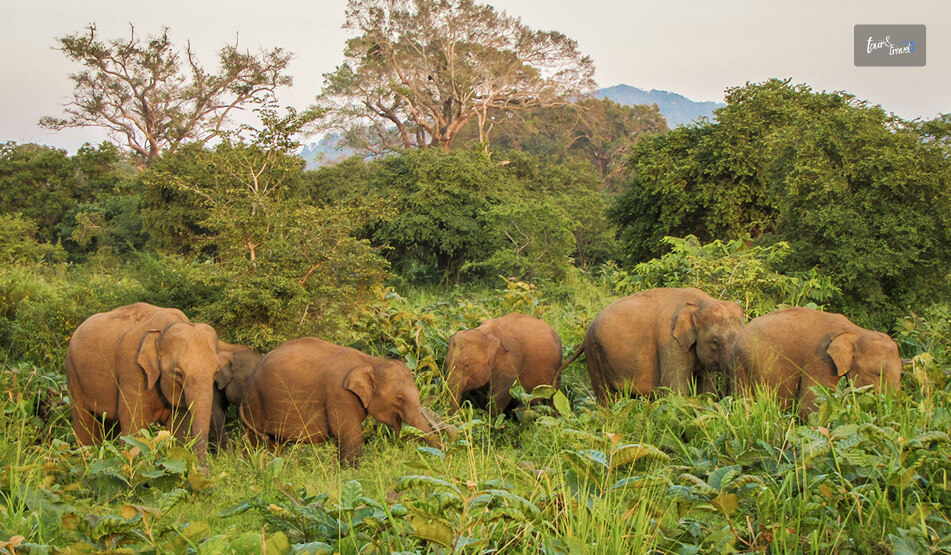
Now, as soon as I left Arugam Bay, I started noticing elephants, and there was a complete herd near the Elephant Rock. They were busy among themselves in an open field. 

However, the scooter ride became more adventurous after I passed through Panama. The dirt roads start from here, and you feel that you are away from the bustling surfing town of Arugama Bay. 

Then, the small roads took twists and turns, and they passed through wetlands and fields just outside the Kumana National Park. Here, I could spot many wildlife variations, including water buffalo and deer. 

The Visitor Center And The Kudumbigala Monastery

Next, I stopped at the visitor center at the park entrance and spent around 20 minutes there learning about the park and the wildlife there. 

I continued my journey to the nearby Kudumbigala Monastery, which was built in 246 BC and is a magnificent Buddhist hermitage spanning across 600 acres. 

King Devanampiyatissa, the first Buddhist king of Sri Lanka, built it. 

Kumana National Park Jeep Safaris

You have many options if you are planning a Kumana National Park jeep safari. Have a look at the table below to know the Kumana National Park jeep safari details. 

Types of Kumana National Park Jeep Safaris Kumana National Park Jeep Safari Price
Morning Jeep Safari $71 USD Onward
Afternoon Jeep Safari $71 USD Onward
Full-Day Kumana National Park Safari with Rice and Curry Lunch$97 USD Onward
Kumana National Park and Panama Village$76 USD Onward

What Is The Best Time For A Kumana National Park Safari? 

What Is The Best Time For A Kumana National Park Safari

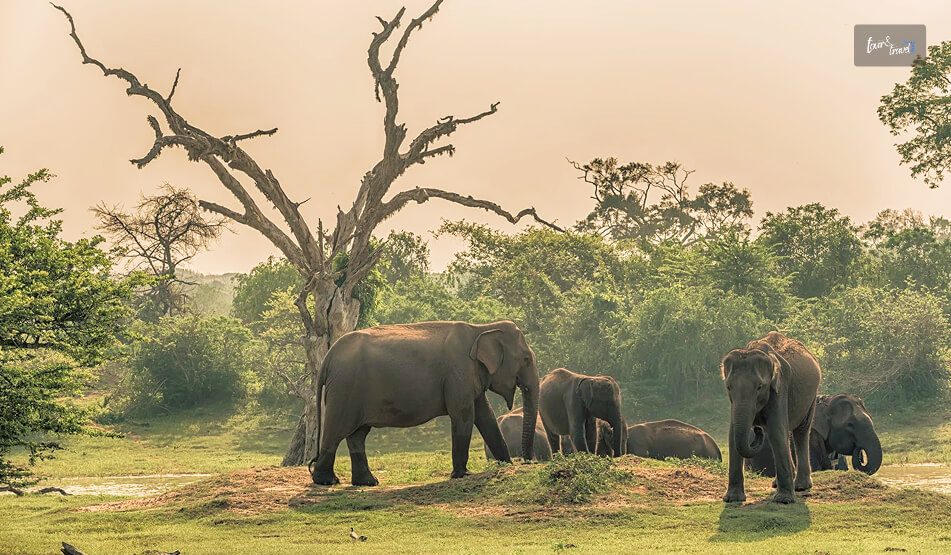
Late afternoon is the best time to spot an elephant at Kumana National Park. This is the time when these adorable animals gather near water. 

I also saw two crocodiles gliding into the water. 

I even had a very close encounter with an adult elephant, and honestly, I was scared a little. However, the mother elephant was unbothered, and she passed by showing her regal moves. 

And also, I saw a peacock with all its feathers spread out. It was a lifetime experience for me. 

Furthermore, seasonwise, April to June, or the dry season in the eastern region, is the best time for a Kumana National Park jeep safari. 

These months are also ideal for being the nesting season of the local and migratory waterbirds in the Kumana Villu swamp. 

So, in these months, you can spot egrets, herons, ibises, pelicans, and painted storks. 

Where To Stay Near The Kumana National Park? 

Panama is at a distance of 22 km. Arugam Bay. It is also located around 50 km away. So, these two are the best places to stay if you are planning a visit to the Kumana National Park. 

However, do you want the most immersive experience? You can plan a stay in the Kumana Mobile Tented Camp inside the Kumana National Park. 

Here, you will stay in simple canvas tents, and the amenities will be basic. You will get facilities such as a portable loo outside the camp and a fresh water supply for bathing. 

For me, the biggest attraction in the camp was the communal area. Everyone could sit there and have their food. Furthermore, here you can find the best collection of wildlife books. 

In addition, this camp offers excursions to hidden spots, pristine lagoons, and amazing viewpoints on a bicycle. 

I chose the camp location close to the ocean. Also, if you want, you can also find a camp closer to the jungle. 

However, this is quite an expensive affair, and the tariff was around $330 for a night.

Share on Social Media

Sibashree is a travel, culture, and leisure writer who has been writing since the age of 12 and professionally since 2014. With more than a decade of travel writing experience and journeys across India and several parts of the world, she brings a deeply personal and thoughtful perspective to her work. A student of English Literature and Mass Communication, Sibashree has always viewed travel as more than movement — for her, it has been a way of understanding people, cultures, and herself. Her passion for spiritual exploration has also led her to many unusual and meaningful destinations over the years. Outside of writing, Sibashree enjoys watching European cinema, reading about global politics, and reflecting on the stories hidden within everyday places.

Leave a Reply

Your email address will not be published. Required fields are marked *

title-img Related

READ MORE where to stay in yala national park

Where To Stay In Yala National Park? Know The Best Accommodations 

BY  Sibashree Jun 3, 2026

The Yala National Park is the ideal place for a dawn safari. As the first rays of golden light pierce through the canopy and the untamed bush comes to life, you will enjoy an acoustic and raw symphony.  You will listen to the rumble of wild elephants and the exotic birdcalls. Furthermore, you will spot crocodiles gliding into still lagoons.  You will also find monkeys scampering through the treetops, and if you are extremely lucky, you can even see a Sri Lankan leopard.  So, no wonder that Yala National Park is a bucket-list destination when you are on a trip to Sri Lanka.  However, finding the right accommodation, the ultimate sweet spot to explore the Yala National Park, can be a daunting task.  You can find a wide range of accommodations here, including the avant-garde ones and the bush camps.  Furthermore, there are some family-run guesthouses and luxurious canvas cocoons. So, in this guide, I will discuss where to stay in Yala National Park.  Where To Stay In Yala National Park? Pick The Zone Based On The Experience You Want  Before you choose an accommodation for yourself, you must decide on the area you want to stay in.  You need to especially understand the entry points of Yala National Park and the surrounding regions.  It is more so because the logistics of your safari will depend on the base and the entry point to the national park you are choosing.  1. Tissamaharama Or Tissa Tissa is just a distance of 20 minutes from the Palatupana Gate, or the main gate of the Yala National Park.  So, this historic lakeside town serves as the primary gateway to the park. Also, here, you will get to indulge in a sense of wilderness paired with civilization.  Moreover, the town has strong infrastructure, such as  Pharmacies Small Restaurants ATMs Cafes  Moreover, you may not find massive architectural buildings, but you will get boutique lakeside hotels offering easy evenings, proper amenities, and strolling along the water.  2. Kirinda And The Palatupana Coast The Palatupana coast is located to the south of Tissa. Also, it is the place where the jungle collides with the crashing waves of the Indian Ocean. The Palatupana Coast further stretches into Kirinda. Kirinda has the most opulent coastline, with elephants wandering down onto the sand.  Furthermore, here, you will find the ultra-luxurious and specially designed eco resorts.  Also, staying here means that you are very close to the national park.  3. Inside The Buffer Zone  If you want the most immersive experience in the Yala National Park, you can choose one of the high-end camps within the protected buffer zones of Yala.  You will stay in canvas tents here, and you will love the experiences such as open-air dining, lantern-lit pathways, and dawn wake-up calls from wild peacocks. Moreover, you can find many other wildlife roaming around your tents.  The cost of staying in these high-end tents can be on the higher side. However, the experience of sitting around a campfire while the unseen jungle hums around you is unforgettable. 4. Katagamuwa And Kataragama Katagamuwa is on the quieter northern perimeter of Yala. It is a culturally rich and slower alternative to other accommodation zones in Yala.  Furthermore, Katagamuwa backs onto a multi-religious pilgrimage site, rarely visited by Western tourists.  If you choose to stay here as a backpacker, you will enjoy the morning wildlife safaris with a visit to historic sites in the evening.  The camps in these sectors are smaller. However, it is run by locals who have endless tales to share. Also, the camps here offer a highly personalized experience.  So, the warmth and the thrill of knowing the unknown stories about the historic places, more than make up for the lack of luxury.  Where To Stay In Yala National Park?  I have divided the best places to stay in and around the Yala National Park into three categories.  Luxury Accommodations Mid-Range Accommodations Budget-Friendly Stays  The Best Luxury Accommodations In Yala  If you want a perfect safari country reimagined, you can plan a stay at any of the luxury accommodations in Yala.  Here, you will find copper bathtubs and canvas tents beneath wild palms.  These luxury accommodations will offer you unmatched luxury without breaking your connection to the world.  Wild Coast Tented Lodge The Wild Coast Tented Lodge is a definitive and flagship safari lodge in Sri Lanka. It is located at a place where the jungle kisses the ocean.  Furthermore, this tented lodge has an otherworldly feel. The copper-toned canvas "cocoons" are scattered amidst the scrubs.  So, when the Sun is up, these tents look like giant desert beetles.  Moreover, inside the tent, you will find a fusion of colonial and contemporary aesthetics. There are leather campaign chairs, teak floors, canvas walls, and freestanding copper bathtubs.  Best Mid-Range Accommodations In Yala It is okay if you do not want to bear the premium price tags of the accommodations in Yala. The mind-range accommodations in Yala offer you immersive nature experiences, beautiful swimming pools, and superb tracking options.  Cinnamon Wild, Yala Cinnamon Wild is an amazing mid-range accommodation in Yala. It is right inside the active buffer zone of Yala.  Furthermore, its location between a crocodile-frequented freshwater lagoon and the ocean makes it more fascinating.  Also, elephants here stroll through the grounds regularly, and the 68 rustic chalets raised on stilts offer simple timber interiors and comfortable bedding.  Moreover, the property has a rooftop bar that looks across the forest canopy. So, this is ideal for sundowners.  In addition, the restaurant here serves authentic lagoon crab curry.  The Best Budget-Friendly Accommodations In Yala  You don’t need to spend a fortune if you want to experience the magic of Yala Safari. You will get amazing hospitality, clean rooms, and authentic experiences at these budget-friendly accommodations in Yala.  Mahoora Yala You can experience the genuine thrill of a buffer zone in Mahoora Yala.  The glamping camps here come without the price markup.  Furthermore, the safari tents are practical and well-equipped, featuring king beds, fans, and private ensuite bathrooms. Moreover, the camp is directly on the boundary of the park. As a result, the safari trucks will get you deep into leopard territory early in the morning.  Thus, you will be able to avoid the heavy line of the day tourists in the town. Read Also: What Are The Places To Visit In Matara? A Southern Sri Lankan Commercial Hub With Dutch Colonial Heritage Where To Stay In Mirrissa, Sri Lanka In 2026? Know The Best Accommodation Options What Are The Best Sri Lanka Travel Tips? Things You Need To Know

READ MORE Is Japan expensive

Is Japan Expensive For Tourists? Why Is It Still Seeing A Boost In The Travel Booking? 

BY  Sibashree Sep 24, 2021

I have been to Japan many times, and the cultural richness and the sensory delights the country offers make the experience worth it!  However, these days, I see a lot of people asking, “Is Japan expensive to visit?”  Another question in this regard is why Japan is witnessing a major boost in travel booking.  Now, first, let me answer that Japan is not as expensive as people are projecting it. Be it the day trips from Tokyo or exploring the cherry blossom season in Kyoto, if you plan an itinerary and the modes of transport well, you can complete the trip within a decent budget.  Furthermore, thanks to smart tools such as the Japan Rail Pass, you can now make transport more convenient and flexible.  Also, whether Japan is expensive or not will depend on the country you are traveling from and how the currency of your country fares against the Japanese Yen.  On the other hand, Japan is enjoying a massive surge in popularity among Gen Z tourists due to many reasons. However, sushi, manga, and anime are the three major factors driving this rise.  While Japan can be managed on a moderate budget, and I have shared the three main reasons behind the rising popularity of Japan, let’s delve deeper into how much a trip to Japan costs and the other factors causing a rise in Japanese tourism.  Why Is Japan Expensive To Visit? Is It The Growing Craze?  Do you know that American Express Travel data shows a 1300% hike in the number of Americans visiting Japan since 2019?  Furthermore, Netflix has confirmed that Anime viewership has gone 3 times up in 2025.  Now, these pieces of information show how young Americans, especially the Gen Z travelers, are passionate about Japan.  The country is now a cultural superpower with its “Soft Power” that it has used to build the global landscape of entertainment, aesthetics, and ideas.  Joseph Nye, a political scientist at Harvard University, has highlighted the strength of Japan’s soft power.  Overall, Japan is not just a new country to visit for these young travelers. It is an escape to the land of rich culture, great food, and soaking in the spirit of slow tourism.  However, the rising craze among young travelers is not the reason behind Japan being labelled as an expensive destination.  In fact, it is amazing to see tourism in Japan growing despite the high travel expenses being  high.  Key Reasons For Japan Being An Expensive Destination To Visit  Japan is expensive as a destination primarily for three reasons. First of all, the Shinkansen bullet trains, extensively used for transportation, are very expensive.  Also, while I found Osaka food from the street stalls quite affordable, trying Sushi, Ramen, or other Japanese staples in a fine dining restaurant can be very expensive.  Furthermore, Japan almost entirely depends on imported energy.  Despite an improvement of 22.4% in the net energy import during the period of 2020 to 2024, the net energy import of Japan in 2024 was 87.4% of the total energy supply, according to the International Energy Agency (IEA).  Thus, the fuel cost is always high in Japan, impacting the transportation expenses, the cost of essential commodities, and every other sector in a direct or indirect manner. Is Japan Expensive To Visit? A Breakdown Of Tourist Costs  So, Japan is expensive to visit. However, what can be the overall expense tentatively?  What will be the expenses on food, transportation, and accommodation? Here is a detailed breakdown.  1. Tourist Accommodation Cost In Japan Japan is very sincere about the hospitality it offers. So, even if you are staying at a budget hotel or hostel, you will find good hygiene and the basic amenities.  Furthermore, along with hostels, Japan has unique accommodation provisions such as the capsule hotels.  These are basically sleeping pods, and the cost is similar to staying in hostels.  On the other hand, you will find a minshuku, which is like a Japanese version of homestays. You will get bed and breakfast facilities at these accommodations run by local families.  Nevertheless, have a look at the table below to understand the different types of accommodation for tourists in Japan and their average costs.  Types of Tourist Accommodation in JapanTentative Cost Hostels and Capsule Hotels2000-4500 JPYBudget Hotels5000-10000 JPYBread and Breakfast 5000-8500 JPYStandard Hotels10000 JPY Onward Moreover, if you’re looking to move to Japan after your trip there, check out reliable websites to know the best places for foreigners where you can call home. 2. The Cost Of General Public Transport In Japan  The Japanese Bullet Train or Shinkansen is the most preferred mode of transport in the country.  The Cost Of Traveling In A Bullet Train And The JR Pass However, the travel cost is very high if you are traveling by these bullet trains.  On average, and based on the departing station or the destination, the cost will be around 16000-20000 JPY per ride (the ticket price can go much higher).  For example, if you take a bullet train from Tokyo to Shin Amori, the price for a reserved seat will be 21340 JPY.  On the other hand, for the Green Seat and the GranClass Seats, the ticket prices will be 27410 JPY and 34410 JPY, respectively.  On the other hand, a Tokyo to Kyoto bullet train ticket starts from 16550 JPY.  Now, this is where a Japan Rail Pass becomes handy. As a tourist, you can buy a Japan Rail Pass for 7 days, and the cost starts from 50,000 JPY for an adult. For a child, it is 25000 JPY.  You can even buy passes for 14 days or 21 days. With this pass, you can enjoy unlimited rides during the validity period.  Moreover, if you want to focus on Tokyo and its nearby areas, the Regional Pass will be a more budget-friendly option.   Also, cabs are pretty expensive in Japan. For a ride of 1 to 2 kilometers, you will have to pay around 500 to 700 JPY.  After that, a fee of 80-100 JPY will be added for traveling every 250 to 300 meters.  3. The Cost Of Hiring A Tour Guide In Japan  The cost of hiring a tour guide in Japan is between 25000 and 60000 JPY per month. However, the cost of the travel guide will depend on the services you opt for.  You can choose a guide for a full day, and the cost can be up to 80000 JPY, and for a half day guide, it will be around 25000-47000 JPY.  Furthermore, if you are traveling in small groups or vans, the cost of hiring a guide will be around 24000 JPY.  So, hiring a personal travel guide is expensive in Japan. However, you can save the cost of hiring a guide by seeking help from the local tourist centers or the national tourist departments.  4. Food And Drink Cost In Japan Food is one of the most important factors for Gen Z travelers visiting Japan. A survey said that around 50% of the visitors planned a trip just because they wanted to visit a restaurant or try some specific food.  Also, food and drinks are available in various cost ranges. So if you are planning to take the authentic taste of sushi, you will get plenty of options available there.  From the expensive designer boutiques to Kaiten-zushi style shops everywhere, the multiple authentic sushi dishes are valuable.  You can select the place according to your requirements.  In the boutique’s style restaurant, you have to spend nearly 51000 JPY for sushi, but if you prefer the sushi in a low-cost range, you have to spend only 1593 JPY for sushi.  If you want to explore Japan on a budget. You can quickly shift your choices to Japanese cuisine and cut your travel budget by cutting the foreign food items. How To Plan Budget-Friendly Travel In Japan? Do you want to travel in Japan on a budget? Here are the tips you can follow.  1. Make A Tour Plan In The Off Season  Off-season tour plans are always budget-friendly. The Autumn season is an off-season to travel in Japan, and this time the tourist rush is not very high. 2. Take The Railroad  Take the railroad to explore the city and buy the railway card to see the tourist places in the country. 3. Focus On Local Cuisine  Focus on the local, authentic, fresh Japanese dishes. If you’re looking for cheap food in Japan, you can buy it in small restaurants, street food stalls, and even vending machine cafes.  However, if you stay in the country for an extended period, you can save money on your travel by preparing and cooking most of your meals from scratch. 4. Find An Accomodation Far From The Main Crowded Cities  Try to find accommodation that is a little bit far from the main crowded cities. Make sure to book your accommodation ahead of time to save a lot of money. Hostels and the local guest houses are also charming, clean places to stay. However, when planning a Japan tour, it is better to keep away from the expensive luxury boutique-type accommodations. 5. Look For Free Attractions  Look for free attractions and events to save money.  Whether you want to spend a fun day in a national park or visit a museum, there are incredible activities that allow you to enjoy Japan without paying anything.

READ MORE Tangalle Beach

What Are The Tangalle Beach Places To Visit? Is It Worth It? 

BY  Sibashree May 18, 2026

Tranquility, raw energy of nature, and the thrill of standing on the southernmost tip of Sri Lanka!  You get all of these when you are at Tangalle Beach. Also, with serenity and relaxation being two essential experiences here, you will get ample time to photograph the picture-perfect shoreline.  So, if you want to explore pristine beaches, have some fun spotting the turtles, and try some amazing local food, you must include a visit to Tangalle Beach in your Sri Lankan itinerary.  Why I Loved Tangalle Beach?  The quaint Tangalle Beach immediately impressed me with its stretches of golden beaches. Also, from the traditional fishing town of Ahangama to this small fishing village, it has been a lifetime experience for me to see how people here live in coexistence with nature.  Furthermore, the Rekawa Turtle Conservation Project was the biggest highlight of my Tangalle Beach visit.  Also, I could soak in the paradisiacal feel of this coastal town, unlike more prominent places such as the Hiriketiya Beach or the Kandy to Ella train, the crowd was way fewer.  That undertourism is a blessing in disguise, as in this way, the nature and wildlife of Tangalle Beach remain untouched.  Furthermore, I found a small but warm homestay on the east side. On the west, there are more high-end accommodations.  So, from backpackers to luxury travelers, everyone will enjoy Tangalle Beach, and you just need to place your feet on warm and golden sand. What Are The Things To Do In Tangalle Beach? Tangalle Beach offers a Bali vibe. As I have mentioned, it is the ultimate place to relax, and along with that, you can indulge in various adventure activities here.  You can even have a delightful wildlife experience here.  A Visit To The Udawalawe National Park At a distance of around 71 km from Tangalle Beach, the Udawalawe National Park is a must-visit.  Furthermore, as a home to around 400 elephants, it is one of the top attractions near Ella.  I loved the jeep safari here, and unlike many other national parks, spotting an elephant here on a jungle safari is almost guaranteed.  The entry fee to the national park is LKR 13,420, and the jeep safari charged me LKR 10000 during the last visit.  I was impressed with the entire conversation process, and it operated around the Elephant Transit Home (ETH).  The Department of Wildlife Conservation established it in 1995, and it runs on a strict 3-tier process.  Rescue Rehabilitate Release  This process ensures very little human interaction, and it works for the release of the orphaned elephants back into the wild.  Also, the conservation job does not end with the release of the elephants. The conservationalists keep monitoring the movement of the reintroduced elephants in the wild.  Watching Turtles At Tangalle Beach  Like Dalawella Beach, Mirissa Beach, and Mount Lavinia Beach, Tangalle is also a wonderful place for spotting endangered turtles.  The types of turtles you can see here are: Loggerheads Leatherbacks Hawksbills These turtles visit the beach when they want to lay eggs. Now, this is a huge advantage Tangalle enjoys as it is free from the impact of overtourism.  A Visit To The Rekawa Turtle Conservation Project Now, many tourists claim that if you visit the Rekawa Turtle Conservation Project between April and July, you can see the turtles hatching eggs.  However, this is not entirely true. There is no guarantee that you will see a turtle laying eggs or hatching.  There is an official announcement from the Rekawa Turtle Conservation Project. They have mentioned that there are high chances of seeing a turtle laying her eggs between 7:30 PM and 8:30 PM.  Furthermore, the conservation center offers a guided tour to the beach for spotting turtles between 7 PM and 6 AM.  Moreover, you cannot use flashlights or flash photography at this conservation center.  Whale Watching At Tangalle  During my stay in Tangalle, I booked an early morning tour that took me west to Mirissa Harbour.  We set sail at 6:30 AM into the calm Indian Ocean. About an hour out, the captain cut the engine.  Suddenly, a massive blue whale breached just seventy meters away, spraying a giant plume of water before diving and flashing its enormous tail flukes. It was breathtaking. While Tangalle itself lacks a major boat harbor, it serves as an excellent base. Most local operators provide seamless hotel pickups for the 60-to-90-minute drive to the boats. December to April is the best time for spotting whales and spinner dolphins at Tangalle Beach.  Also, if you are planning a whale watching tour, you must take sea-sickness pills before boarding.  A Visit To The Mulkiligara Raja Maha Vihara  Sri Lanka is the place where you will find the gems associated with Buddhism in every nook. The Mulgirigala or Mulkiligara Raja Maha Vihara is one such place.  It is an ancient Buddhist rock temple complex, and if you have loved the Dambulla Royal Cave Temple, you will also cherish this.  At a height of 205 meters, it also has the nickname of Little Sigiriya Rock or Punch Sigiriya.  Furthermore, this ancient rock temple complex is revered as an archaeological site. It harbors a religious history of around 2000 years.  King Saddhatissa of Anuradhapura built this Maha Vihara in the 3rd century BCE, and King Kawantissa and King Valagamba expanded it later.  Moreover, it is one of the designated temples in Anuradhapura to receive the Jaya Sri Maha Bodhi sapling.  After years of abandonment, it was finally reconstructed by King Keerthi Sri Rajasinghe in the 18th century.  Why I Loved Mulkiligara Raja Maha Vihara The temple complex spans across five different cave levels, and there are seven cave shrines.  The caves are home to brilliant frescoes, murals, and paintings depicting the stories of the Jataka, Lord Buddha, and other Hindu deities.  What is interesting here is that some of the artwork shows a prominent influence of the Dutch style.  Furthermore, after climbing 533 peaks, I reached the summit of the Stupa. At the summit, there is a small pagoda that houses sacred relics of Lord Buddha.  In addition, the unmarked dirt train behind the courtyard took me to a cliff ledge from where I enjoyed amazing views of the surrounding jungles and palm trees.