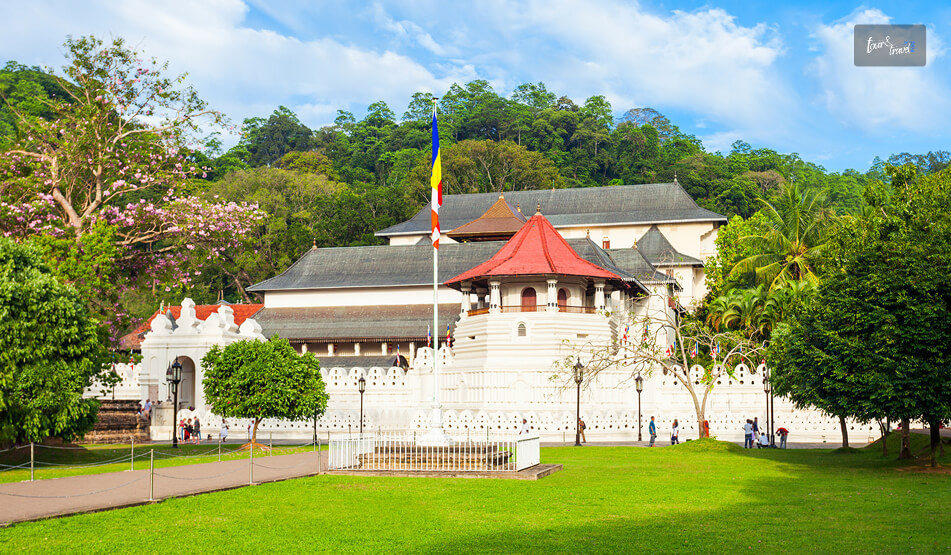
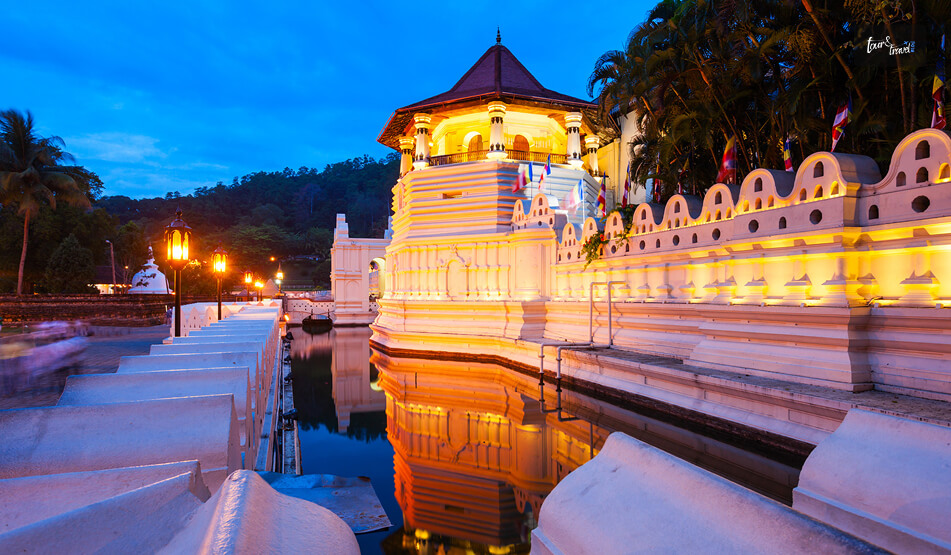
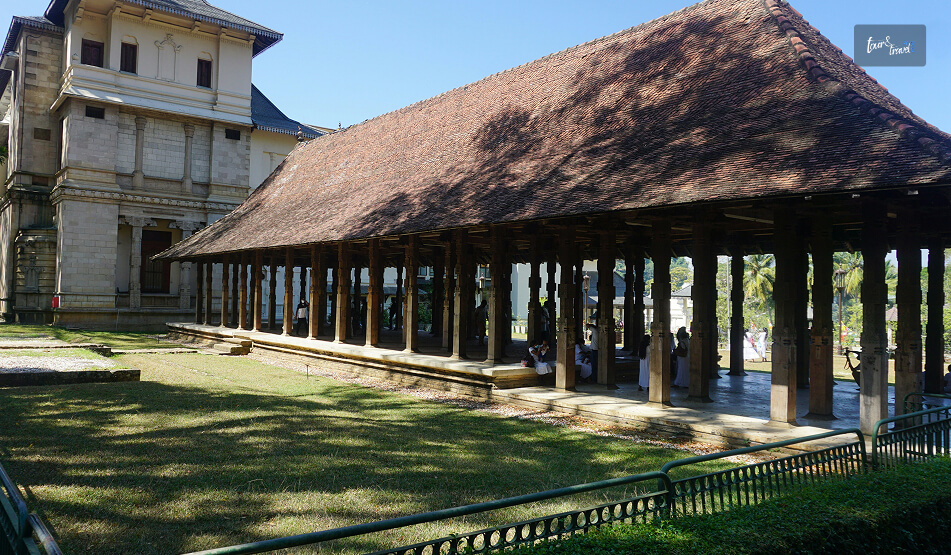
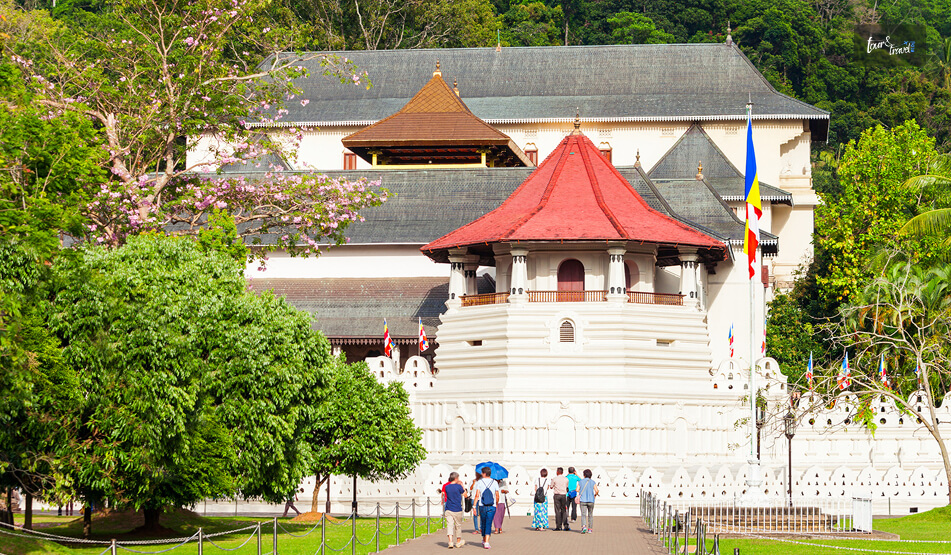

Almost every visitor notices the golden roof or moat around it when visiting the Temple of the Tooth, Kandy.
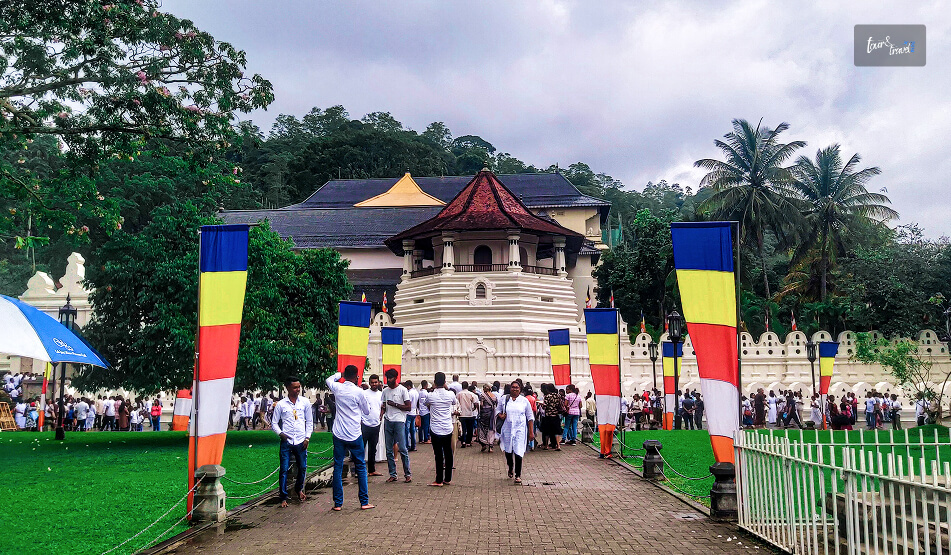
However, the first thing I noticed was the queue.
It was an ordinary Tuesday morning, around 9 AM.
I saw monks, schoolchildren in white, and visitors with cameras filling the same security screening.
However, I was not surprised to see the crowd at the Temple of the Tooth, or the Sri Dalada Maligawa.
Built around a single relic, it has shaped the island’s politics and identity for over 1,600 years.
Also, as the living spiritual centre of Sri Lankan Buddhism, it deserves all the attention.
In addition, the temple has been in the news more than once in the past two years.
In April 2025, a rare public exposition of the Tooth Relic drew an estimated 450,000 devotees in a single day.
The queues were long and stretched around 10 kilometers through Kandy.
Again, the temple hosted the ten-night Kandy Esala Perahera, running from 18 to 28 August, 2026.
While there is still time for the Kandy Esala Perahera Festival in 2027, you can plan a visit to the temple on a regular day to have a more immersive and detailed encounter with this iconic Sri Lankan landmark.
The Temple Of The Tooth, Kandy: At A Glance
Things to Know
Detail
Official Name
Sri Dalada Maligawa
Also Known as
Temple of the Sacred Tooth RelicTemple of the Tooth
Location
Palace Square, Kandy, Central Province, Sri Lanka
What it enshrines
The left canine tooth relic of the Buddha
UNESCO status
Part of the Sacred City of Kandy, a World Heritage Site since 1988
Present shrine built
1707–1739, under King Sri Veera Parakrama Narendrasinghe
Daily opening hours
5:30 AM – 8:00 PM, every day of the year
Daily puja (ritual) times
5:30–7:00 AM9:30–11:00 AM6:30–8:00 PM
Entrance fee (most foreign nationals)
LKR 3,000
Entrance fee (SAARC nations, Thailand, Myanmar)
LKR 2,500
Entrance fee (Sri Lankan citizens)
Free
Major annual festival
Kandy Esala Perahera (July/August)
Time needed
About 1 to1.5 hours for the temple and longer during puja or festival season
What Is The Story Behind The Temple Of The Tooth?
The tooth relic arrived in Sri Lanka around seventeen centuries ago, between 301 and 328 CE.
The temple has been rebuilt, burned down, and rebuilt again more times than we can think of.
How Did The Tooth Relic Come To India?
According to Buddhist tradition, after the Buddha’s parinirvana, his left canine tooth was preserved in the Kingdom of Kalinga.
The Kingdom of Kalinga is now the state of Odisha in India.
However, there was unrest during the reign of King Guhasiva.
So, Princess Hemamali and her husband, Prince Danta, took the tooth relic out of Kalinga. The relic was hidden inside the hair of the princess to ensure a safe passage.
They safely brought it to Sri Lanka during the reign of King Kithsiri Meghavanna, dated around 301 to 328 AD.
Since then, the relic has become inseparable from Sri Lankan kingship.
It was said that whichever king had it would have the right to rule.
Also, the relic was moved from capital to capital.
Then, it came to Kandy, the last of the royal capitals of Sri Lanka.
A Timeline Of Sri Dalada Maligawa
The building we see today is not the original structure.
It is the product of at least four rebuilds across two and a half centuries.
It was shaped by Portuguese raids, a Dutch fire, and later renovations by successive Kandyan kings.
Period
What happened
c. 301–328 AD
Tooth relic brought to Sri Lanka from Kalinga by Prince Danta and Princess Hemamali during the reign of King Kithsiri Meghavanna.
1592–1604
King Wimaladharmasuriya I built the first Dalada Maligawa in Kandy, later destroyed during Portuguese invasions.
1635–1687
King Rajasinghe II built a second shrine on the same site, and it was burned down by the Dutch.
1687
King Wimaladharmasuriya II constructs a three-storey Dalada Maligawa, which later decays.
1707–1739
King Sri Veera Parakrama Narendrasinghe builds the two-storey shrine that still stands today.
1747–1782
King Kirti Sri Rajasinha renovates and beautifies the temple to be close to its present appearance.
1798–1815
King Sri Wickrama Rajasinghe adds the octagonal Pattirippuwa pavilion.
1815
The Kandyan Kingdom falls to the British; daily rituals at the temple continue without a break.
1988
UNESCO inscribes the Sacred City of Kandy, including the temple, as a World Heritage Site.
25 January 1998
An LTTE suicide truck bombing damages the temple’s facade and the adjoining royal palace complex, killing more than a dozen people.
April 2025
A rare public exposition of the relic draws an estimated 450,000 devotees in a single day.
18–28 August 2026
The ten-night Kandy Esala Perahera, combining the Kumbal and Randoli processions, is held at the temple.
Surviving Invasions, War, And Time
Even after such a long history, the rituals at the site have never stopped.
The rituals have continued through Portuguese raids, Dutch fire, the British taking Kandy, and even after the 1998 bombing.
Today, Mahanayake theros of the Malwatta and Asgiriya monastic chapters and a lay custodian, Diyawadana Nilame, are the custodians of the daily rituals.
They also take care of the preservation of the relic.
Why Is The Temple Of Tooth So Important?
The Temple of Tooth is not just the most photographed temple in Sri Lanka.
For Sri Lankan Buddhists, it is the living head of state for the faith.
This explains why the atmosphere inside the relic feels very different from a typical heritage monument.
A Living Symbol Of Buddhist Sri Lanka
The possession of the tooth relic was the validation of a king’s right to rule the island.
So, it moved between capitals alongside the seat of government for centuries.
This symbolic weight has not disappeared with the monarchy.
Sri Lankan presidents and senior officials still make a point of visiting the temple during the Esala Perahera each year.
Thus, they continue a tradition of state association with the relic that predates colonial rule by well over a thousand years.
The Kandy Esala Perahera
The biggest annual event of Kandy is Esala Perahera.
It is a firelit procession of dancers, drummers, and elaborately dressed tusker elephants.
These festivities take us back to the 1600 year old tradition of the temple.
In 2026, the festival ran across ten nights from 18 to 28 August.
The five nights of the Kumbal Perahera were followed by five nights of the grand Randoli Perahera.
The festival closed with the Diya Kapeema water-cutting ceremony.
If your Sri Lanka trip lines up with late July or August, it is worth checking that year’s dates on the temple’s official website before booking.
The festival follows the lunar calendar and shifts annually.
Planning Your Visit: Timings, Fees, And Rules
In this section, I have highlighted the operating hours and fees for the Temple of the Tooth.
Opening Hours And Puja Times
Service
Timing
Daily opening hours
5:30 AM to 8:00 PM, every day (including Sundays and public holidays)
Early morning service (Thewawa)
5:30 AM to 7:00 AM
Midday service (Thewawa)
9:30 AM to 11:00 AM
Evening service (Thewawa)
6:30 PM to 8:00 PM
Nanumura Mangallaya (herbal bathing ritual)
Every Wednesday, 9:30 AM
Child-offering ceremony
Daily, 10:00 AM and 7:00 PM
Entrance Fees
Visitor category
Fee (LKR)
Sri Lankan citizens
Free
SAARC country nationals
2,500
Thailand and Myanmar nationals
2,500
All other foreign nationals
3,000
The ticket is a single entry that covers the Temple of the Tooth Relic, the Dalada Museum, the World Buddhist Museum, the Tusker Museum, and the Royal Elephant Stable.
So, budget a bit more time than “just the shrine” if you want to see all five.
The machines installed at the temple itself issue the tickets.
However, many outside individuals or agencies claim to sell the tickets to the temple. These are not valid.
Entry Guidelines
All visitors and their belongings go through screening at the entrance with scanning machines. So, leave bulky luggage behind.
Plastic and polythene, including for offerings, are discouraged inside the premises.
Pets are not permitted anywhere on the temple grounds.
Visitors with mobility needs can arrange transport from the main entrance and lift access by calling the temple’s administration office in advance.
What It Is Actually Like To Visit
Photos of the golden roof and the octagonal Pattirippuwa do not really prepare you for how the temple feels once you are inside.
It is smaller, quieter in some corners and far more crowded in others.
Also, every activity here happens around the ritual clock rather than tourist convenience.
Walking Through The Complex
After the security check, the path leads to a moat.
It also goes through the Mahawahalkada, the ornately carved main entrance, before opening into the temple courtyard.
The two-storey main shrine sits at the centre.
Also, its upper floor is carved from ivory.
The golden canopy and jewelled caskets surrounding the relic itself are visible only from a respectful distance.
The stonework, including the moonstone carving at the entrance and the Water Wall running along the moat, is stunning.
The holes hold oil lamps, and you can only focus on them if the crowd is a little less.
The Puja Ceremony
You must reach the temple at least 15-20 minutes before the puja ceremony.
This is when drummers play the traditional hewisi rhythms and the inner chamber doors open.
So, you will get the closest view most visitors will ever get of the golden reliquary.
The 9:30 AM service tends to be the most manageable for tourists in terms of crowd size and daylight for photography.
However, the temple authority does not allow flash photography near the shrine.
Beyond The Main Shrine
The Tusker Museum in particular houses the preserved remains of Raja, the legendary tusker who carried the relic casket in the Esala Perahera for over 50 years.
It is a detail most first-time visitors miss.
A Half-Day Itinerary Around The Temple
Time
Activity
9:00 AM
Arrive at Sri Dalada Maligawa, clear security, and buy your ticket.
9:15 AM
Explore the courtyard, moonstone carving, and Water Wall before the crowd builds.
9:30 AM
Attend the midday puja and hewisi drumming at the inner shrine.
10:15 AM
Visit the Dalada Museum and Tusker Museum (included in your ticket).
11:15 AM
Walk the perimeter of Kandy Lake, just south of the temple.
12:00 PM
Lunch at one of the cafés along Dalada Vidiya, the road facing the temple.
1:00 PM
Continue on to the Royal Palace complex or the National Museum of Kandy next door
Things You Probably Didn’t Know
There is no actual photograph of the tooth relic, and the temple authority does not display it publicly.
What they show twice daily is the outermost of several nested golden caskets that house it.
The temple survived a suicide truck bombing on 25 January 1998.
It was days before Sri Lanka’s 50th independence anniversary celebrations, with Kandy as the epicenter.
The attack damaged the facade. However, nothing happened to the relic, and daily rituals resumed within days.
The octagonal Pattirippuwa pavilion, one of the most photographed parts of the complex, was not part of the original design at all.
It was an addition between 1798 and 1815, under the island’s last king, Sri Wickrama Rajasinghe.
Newborns can be formally “offered” to the temple as part of a blessing ceremony at 10:00 AM and 7:00 PM daily.
The child has to be between three and six months old.
What Is The Best Time To Visit The Temple Of The Tooth?
The temple is open 365 days.
However, a few timing choices make a real difference to the temple visit experience.
You will enjoy the calmest ambiance in the temple at 5 AM when the temple opens. I visited the temple at 9 AM.
It was just before the temple opened. The crowd was large, but they were in a disciplined queue.
So, I got the chance to explore the temple and take the best photographs.
Moreover, if your dates allow, you can visit the temple during the Kandy Esala Perahera in July or August.
Also, the Poya (full moon) days and Wednesdays, when the Nanumura Mangallaya bathing ritual takes place, draw larger numbers of local devotees.
Sibashree is a travel, culture, and leisure writer who has been writing since the age of 12 and professionally since 2014. With more than a decade of travel writing experience and journeys across India and several parts of the world, she brings a deeply personal and thoughtful perspective to her work. A student of English Literature and Mass Communication, Sibashree has always viewed travel as more than movement — for her, it has been a way of understanding people, cultures, and herself. Her passion for spiritual exploration has also led her to many unusual and meaningful destinations over the years. Outside of writing, Sibashree enjoys watching European cinema, reading about global politics, and reflecting on the stories hidden within everyday places.
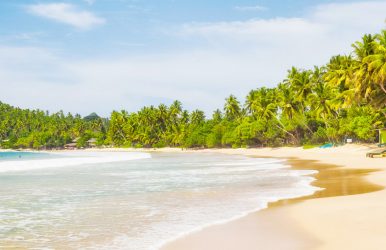
Very close to the Hiriketiya Beach, Kudawella Beach is a pristine, small, and beginner-friendly beach for surfers.
However, even if you are not a surfer, you can visit this hidden gem to find the turtle nests and the surrounding mangroves.
Also, at Kudawella Beach, you can enjoy the beauty of the Indian Ocean or just laze around on the sand.
Here is more about this beautiful, sickle-shaped beach on the southern coast of Sri Lanka.
Where Is Kudawella Beach? How To Reach Kudawella Beach
As I have mentioned, Kudawella Beach is on the southern coast of Sri Lanka, and it stretches from west to east.
Furthermore, the beach is around 10 km away from Dickwella, the closest major town to the beach.
Moreover, if you are already visiting the Hiriketiya Beach, you can just take a 10-minute tuk-tuk ride to reach the Kudawella Beach.
The most popular way to reach the Kudawella Beach is to take a direct car or taxi from Colombo, which is at a distance of around 160 km.
The journey by road will take close to 5 hours, and the taxi fare will be over 30000 LKR.
However, I was already in Ella and had a day after visiting the iconic Nine Arch Bridge and exploring all the other top attractions in Ella.
So, I took a bus from Ella to Galle. The bus #31 was moderately crowded, and I was enjoying the local experience.
That bus from Ella to Kudawella Beach took around 6 hours, and the ticket price was LKR 350.
What Are The Things To Do In Kudawella Beach?
Kudawella Beach is a place that offers you the ultimate flexibility.
Yes, there are a few hotspots when you are on the beach. However, you can spend your entire day without doing anything.
Moreover, it is a delightful place for amateur surfers.
Still, here are a few things to do in Kudawella Beach, along with surfing and chilling.
1. A Walk To The Hummanaya Blow Hole
I loved walking to the Hummanaya Blow Hole on the eastern side of the Kudawella Beach. However, to see the water shooting up, you have to reach the viewing point at the top of a cliff.
The cliff also has a safety barrier.
It is the only blowhole in Sri Lanka and the second-largest in the world, shooting the water at a height of 25-30 meters when the water forcibly enters a narrow cavern.
I saw the blowing taking place at least 5-6 times during the short moment I halted there. The water shoots up as the sea movement builds pressure in the tunnels in the rock.
2. A Walk To The Nilwella Beach
If you want even a more idyllic retreat, you can visit the Nilwella Beach from the Kudawella Beach.
This beach has blonde sand, and the waves here are gentle.
Moreover, I loved walking across the beach to reach a rocky island. The rocky island had many palm trees and pandanus trees.
There was also a hiking trail, and as I advanced, I found many little coves and unique geographical shapes.
3. Kayaking Around Mawella Lagoon
Mawella Lagoon was pretty, and the water was covered by beautiful lily flowers.
Furthermore, there are many hotel rooms and massage rooms near the lake where you can chill or enjoy a relaxing massage session.
However, just behind the Kudawella Beach, this lagoon is also ideal for kayaking around.
It cost me around 8000 LKR, and I spotted many birds such as storks, beeaters, and kingfishers there.
I heard that sometimes you can also spot crocodiles here.
Kudawella Beach: The Best Spot For Surfing For Beginners
As I have mentioned, Kudawella Beach is a beginner-friendly surfing spot.
Unlike Hiriketiya, you will not find outer waves here. You can only surf here at the beach break, which is further on the inside of the bay.
So, it is safer than Hiriketiya Beach.
In fact, even in the dry season from November to March, the waves seldom reach a height of more than 4 feet.
However, you have to be watchful of the few rocks in the water. Having said that, during the dry season or the peak surfing season, the water of the Indian Ocean is crystal clear.
So, you will be able to see the rocks clearly.
Moreover, on the Kudawella Beach, there are two surf rentals. However, when I visited, there was a longer queue in front of the Saranga at Kudawella Surf School, and its surfboard-shaped signboard also looked pretty cool.
What Is The Best Time To Visit Kudawella Beach?
November to March, or the dry season, is the best time to visit the Kudawella Beach.
Long hours of sunshine make these months ideal for beach activities. However, there can be sudden rainfalls. So, you have to carry your rain gear.
However, the wet season from March to August, despite having fewer crowds, is not ideal as there can be harsh storms and heavy rainfall.
Where To Stay Near The Kudawella Beach?
When I visited Kudawella Beach, it was still very pristine, and thus it is a quintessential beach on the southwestern coast of Sri Lanka.
You will find only a few hotels here.
Also, if you want to find an accommodation here, you can stay on the beachfront or in hotels near the lagoon.
Here are some of the places where you can stay.
Sisi Place
The Sisi Place is on the hilltop at the west end of the beach. It is the most budget-friendly option here with clean and comfy rooms.
Simply Peace
Choose Simply Peace if you are looking for a luxury accommodation near the lagoon.
It is a beautiful pool where you can relax. Furthermore, it has a garden where you can enjoy birdwatching.
Calma
I loved the pastries and coffee at the on-site cafe of Calma. With a sand front, it exudes a quintessential Balinese bungalow aesthetic.
Moreover, you can take a short tuk-tuk ride from Kudawella Beach to Hiriketiya Beach. There, you will find more diverse accommodation options, including Airbnbs.
I visited the Gal Oya National Park in 2022, and after a few months of being back in my country, I got a call from my friend in Sri Lanka.
It was December, and he shared the news published on the Daily Mirror Online, which mentioned the threats of illegal mining to the flora and fauna of the national park.
I felt numb, as this was not the Gal Oya National Park I visited. Even if Sri Lanka has icons such as the Yala National Park, for me Gal Oya offered the most remarkable encounters with elephants.
For the first time, I did a safari from a boat, drifting quietly across open water while a herd of elephants waded between islands ahead of us.
There was no engine noise to spook them, no queue of vehicles, just the reservoir, the herd, and the sound of water.
It felt more like a secret that Sri Lanka preserves so dearly, not a national park.
Gal Oya National Park At A Glance
DetailInformationLocationAmpara District, Eastern Province, Sri LankaEstablished1954AreaApproximately 25,900 HectaresCentrepieceSenanayake Samudraya, the Largest Reservoir in Sri LankaKnown forBoat Safaris and Elephants Swimming between IslandsWildlife32 Recorded Mammal Species, including Elephants, Leopards, and Sloth Bears150+ Bird SpeciesBest time to visitDry Season, Roughly May to SeptemberDistance from ColomboAround 300 KM, Roughly 6 Hours by Road
A Reservoir-Built Park With A History Tied To Irrigation
The history of the Gal Oya National Park goes back to 1954. It was built to protect the Senanayake Samudraya.
This newly constructed reservoir, the largest in Sri Lanka, was part of a major post-independence irrigation scheme in the dry zone of Sri Lanka.
The scale of the reservoir made my boat ride in the park all the more fascinating. It is just open water with forests around.
So, the jeeps on the dusty tracks are replaced by the boats on the serene water.
The landscape around the reservoir was more varied than I expected from a dry-zone park.
Forested Hills!
Savannah Grassland!
Also, there were rocky outcrops that locals call turtleback formations.
Moreover, low grasslands all sit within the park's boundaries, alongside historical sites like the Digha Vapi Dagoba and the Henebedde cave.
Wildlife And The Swimming Elephants
The most fascinating experience in Gal Oya was watching wild elephants swimming between the reservoir’s islands.
They were moving in search of fresh grazing as water levels dropped in the dry season.
Beyond elephants, the park has around 32 mammal species, including:
Leopards
Sloth Bears
Grey Langurs
Endemic Toque Macaque.
Also, the park, though not as fascinating as Bundala, has more than 150 species of birds. I could spot the following ones.
Painted Storks
Ospreys
Endemics like the red-faced Malkoha and Sri Lanka spurfowl.
I could also spot crocodiles and water monitors along the reservoir's edges.
How To Reach Gal Oya National Park?
You can take a drive from Colombo to reach Gal Oya National Park via Ampara. The distance is around 300 km, and the journey takes around 6 hours by road.
However, staying in Ampara Town as the base or finding a lodge close to the park’s boat safari jetty is a more reasonable move.
Also, Gal Oya National Park is a natural inland detour from the east-coast surf town, Arugam Bay, roughly 2 to 2.5 hours away.
Again, if you are traveling from Kandy, it is 4-5 hours by road via Mahiyangana. So, Gal Oya is a workable stop on a route heading toward the east coast.
Gal Oya Entrance And Boat Safari Costs (2026)
On top of the park entrance fee, the boat safari itself is typically arranged and priced separately, usually through your lodge or a licensed operator.
Remember that access to the reservoir's boats isn't managed the same way jeep permits are at other parks.
Also, the boat safari costs around LKR 6000 to LKR 8000.
CategoryApproximate Cost (2026)Foreign Adult (12+)USD 12Foreign Child (6–12 Years)USD 6Foreign Children under 6 Years FreeSAARC NationalsUSD 10 for AdultsUSD 5 for Children between 6 and 12 YearsFree for Children below 6 YearsLocals Adults: LKR 60Children from 6 to 12 Years: LKR 30Children below 6 Years: FreeStudents: LKR 20Boat SafariLKR 6000-8000
A One-Day Gal Oya Itinerary
A day at Gal Oya has a different rhythm from most Sri Lankan national parks because here the safari is on a boat and not a jeep.
Here is a structure that works well if you're based near Ampara or the park's eastern lodges.
TimeActivity5:30 - 6:30 AMEarly transfer to the boat jetty on Senanayake Samudraya6:30 - 9:30 AMMorning boat safari.It is the best window for elephant sightings near the shoreline. 9:30 - 10:30 AMReturn to lodge for breakfast.10:30 AM - 12:30 PMOptional short trek or visit to the Henebedde cave/Digha Vapi Dagoba area.12:30 - 2:30 PMLunch and rest during the hottest part of the day.4:00 - 6:30 PMEvening boat safari for a second wildlife window and sunset over the reservoir.
What Are The Practical Tips For Visiting The Gal Oya National Park?
Boats and slots are more limited than jeep availability at bigger parks.
Bring a hat, sunscreen, and a light waterproof layer.
Pack a zoom lens or good binoculars as elephant sightings are often across open water rather than at close range on a jeep track.
Stay two nights if you can, so you get both a morning and an evening boat safari rather than just one.
Combine with Arugam Bay or Ampara for a fuller east-coast itinerary.
What Is The Best Time To Visit Gal Oya National Park?
May to September, or the dry season, is the best time to visit Gal Oya National Park.
In the dry season, the water level of the reservoir drops. So, all the animals, especially the elephants, concentrate near the remaining islands and water.
Thus, the sight of swimming elephants is more common in this national park than anywhere else in Sri Lanka.
This season is also ideal for birdwatching in Sri Lanka, as migratory and resident species settle around the shrinking waterline.
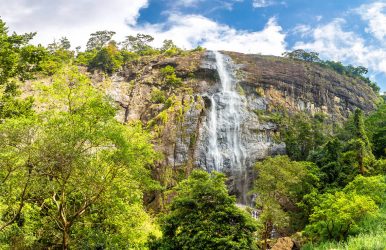
Aberdeen Falls makes you wait, and you have to work hard to get a view of this majestic waterfall.
Also, this waterfall in Sri Lanka's hill country was the one with the fewest other visitors when I got there.
There was no roadside pull-off here and no viewing platform right off the highway.
Just a walk through tea land above Ginigathena, the sound of water getting louder, and then a nearly 100-meter curtain dropping into a rock-walled pool!
Here is my experience at this majestic waterfall and everything else you need to know to visit it.
Quick Facts About Aberdeen Falls
Quick Facts Details Height About 98 Meters Width Around 8 Meters River Kehelgamu Oya, a tributary of the Kelani River Location Near Ginigathena, Nuwara Eliya District, Central Province Rank 18th highest waterfall in Sri Lanka Access Short hike (roughly 1 km) from the road, and there is no formal entry fee. Swimming Not recommended as the pool is deep, and currents can be dangerous.
Where Is Aberdeen Falls And How To Get There?
Aberdeen Falls is on the Kehelgamu Oya, a major tributary of the Kelani River, near the town of Ginigathena in the Nuwara Eliya District.
It is named, a little incongruously, after Aberdeen in Scotland.
So, it is a nod to the British planters who once ran the tea estate here.
From Ginigathena
The most common approach starts in Ginigathena town.
From there, follow Ambatale Road to a Buddha statue at the end of the road, where you will need to park.
From that point, it is a walk of a little over a kilometer.
Some guides list it as 800 meters to 1.2 kilometers depending on the exact route along a footpath through the estate and down toward the falls.
From Colombo Or Kandy
A common route from Colombo runs via Avissawella and Karawanella to Ginigathena. It is roughly 3 to 3.5 hours by car.
From Kandy, it is a similar distance heading the opposite direction, passing through Kadugannawa and Ginigathena's outskirts.
On The Trail
The path down is uneven in places and can get slippery after rain.
So proper shoes matter more here than at the roadside falls further up the valley.
It is not a technical hike, but it's enough of a walk that you'll want at least an hour round trip, more if you stop for photos.
What Makes Aberdeen Falls Different
Most of the well-known waterfalls in this part of the hill country, St. Clair's, Devon, are effectively drive-by attractions.
They are visible from a car window or a short stroll off the highway.
Aberdeen isn't.
You have to commit to the walk, and that alone keeps the crowds thinner than at the more famous falls nearby.
The reward is a narrow, forceful single drop into a pool framed by a large rock formation behind it, with dense forest closing in on both sides.
Local legend holds that a tunnel connects Aberdeen Falls to Laxapana Falls further down the valley.
There is no solid evidence for it.
However, it is the kind of story that gets repeated at every viewpoint, and I'll admit it added a bit of atmosphere while I stood there.
Because Aberdeen and Laxapana both sit on rivers that feed hydroelectric schemes, water levels can vary noticeably depending on how much is being diverted upstream.
So the falls look a little different every time.
The Amphitheater Of Stone And Mist
What truly sets Aberdeen Falls apart once you clear the jungle trail is the sheer scale of its geological footprint.
The water does not simply spill over a cliff.
It thunders into a colossal, horseshoe-shaped rock amphitheater.
This towering crescent of dark, wet stone acts like a natural sounding board, trapping the roar of the Kehelgamu Oya and magnifying it until the air itself seems to vibrate.
Because of the unique inward curve of the rock walls, a perpetual cloud of heavy mist hangs suspended over the plunge pool.
This constant humidity has created a microclimate where vibrant green mosses, slick liverworts, and primitive ferns cling to every vertical fissure, contrasting sharply with the black obsidian-colored rock face.
Standing at the edge of the basin, the view is framed by a dense canopy of endemic trees that lean over the water, blocking out the harsh midday sun.
The result is a moody, isolated sanctuary that feels entirely cut off from the outside world.
It is a visual drama you completely miss from a roadside viewpoint. So, it is a hidden world for those willing to track it down.
What Is The Best Time To Visit Aberdeen Falls?
Seasons Months What to Expect Wet season May to September Strongest flow, but the trail is muddier, and swimming is more dangerous Dry season December to March Easier trail conditions, gentler flow, clearer photos Early morning Any season Cooler hiking temperatures and better light through the forest canopy
Places To Visit Near Aberdeen Falls: Laxapana Falls And Kitulgala
If you are already making the trip out to Ginigathena, it is worth extending the day.
Laxapana Falls, tied to Aberdeen in local folklore, is a further drive down the valley.
Also, Kitulgala, Sri Lanka's main whitewater rafting hub, is roughly 30 to 40 minutes away.
Thus, this stretch is a natural base for a nature-and-adventure day rather than a single quick stop.
A One-Day Itinerary Around Aberdeen Falls
Time Stop Notes 8:00 AM Depart Ginigathena or Kitulgala Start early to avoid the midday heat on the walk. 9:00 AM Hike to Aberdeen Falls About 1 km each way from the Ambatale Road parking point. 10:30 AM Return to the road Allow extra time for photos and the uphill return walk. 11:30 AM Drive to Kitulgala Roughly 30–40 minutes away. 12:30 PM Lunch by the Kelani River Several riverside spots near the rafting operators. 2:00 PM Optional: whitewater rafting or a river walk Kitulgala's main draw if you have the afternoon free.
Practical Tips For A Visit To Aberdeen Falls
Wear proper hiking shoes as the trail has dirt and stone. Also, it can be slick after rain.
Do not swim in the pool at the base because it is deep. There have been cases of drownings here.
There is no ticket booth or formal infrastructure. So bring water and snacks with you.
Moreover, hire a local guide or tuk-tuk driver in Ginigathena if you are unsure of the trailhead. You may not find a signpost everywhere.
Climbing back up from Aberdeen Falls, sweating a little more than I expected to, I remember thinking it was worth every step.
It does not have the roadside fame of St. Clair's or Devon.
That is exactly the point, as this is the waterfall you visit when you want to feel like you found it yourself.