
Gal Vihara, Polonnaruwa: Sitting Before The Four Rock-Cut Buddhas And Vishnu (2026 Guide)

Gal Vihara drew me in for more than the massive rock-cut Buddhas. 

Some may argue that it was a deliberate attempt to showcase Hindu deities as subordinate to Buddha or Buddhist figures. 

However, I see this as an effort for political and religious integration. 

We know about Gongalegoda Banda, who put up a fight against the British in 1848, which was a decade before the first mass uprising in India in 1857 (The Sepoy Mutiny). 

He worshipped Vishnu, not Buddha, before he started the war against the British. 

Now, the Gal Vihara in Polonnaruwa is an important landmark where I could see this integration. 

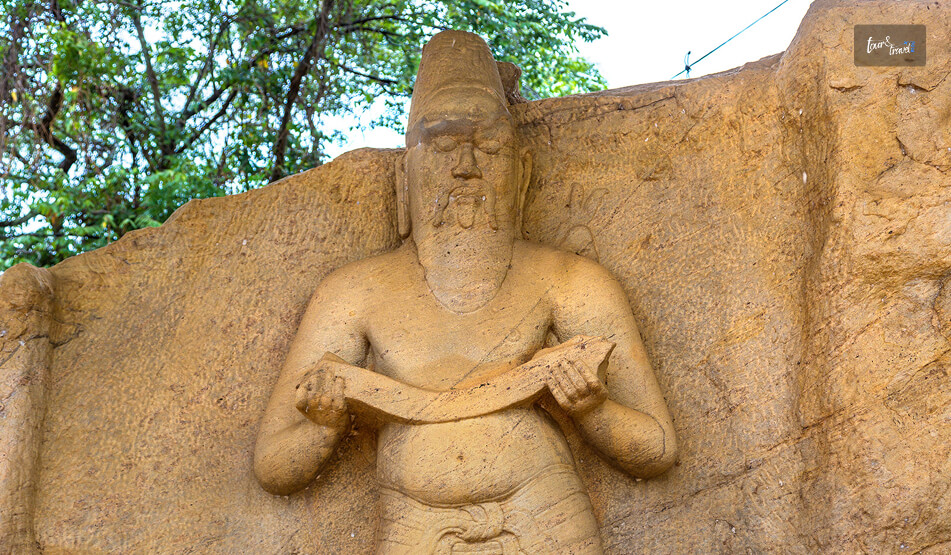
Very few notice that the Vijjadhara Guha, the semi-artificial cave for sorcerers, has Lord Vishnu and Lord Brahma as the attendants to Lord Buddha. 

In Hinduism, we see the exact opposite version of it, with some versions depicting Lord Buddha as one of the 10 avatars of Lord Vishnu. 

That can be a separate discussion. However, in this article, I will discuss what I saw at Gal Vihara, the history, and everything else you need to know. 

This is one of the reasons why Sri Lanka gets such a high footfall. For example, Financial Chronicle reported an arrival of 198,235 tourists from January to August 2025.

In 2026, the number was 1,535,122 for the same period, according to the Economic Times, LK. 

Gal Vihara At A Glance

DetailWhat to Know
Original nameUttararama, “the northern monastery.” 
Built byKing Parakramabahu I, who reigned 1153–1186 CE
LocationNorthern part of the ancient city of Polonnaruwa, North Central Province
The imagesFour Buddha images from one granite slab.Two seated, one standing, one reclining.
SizesReclining figure about 14 meters long, standing figure about 7 meters tall
TicketPart of the Polonnaruwa ticket.Free for locals and US$25 for a foreign adult.$12 for foreign children. 
Timing7 AM to 5 PM
Time needed1–2 hours here
Best timeEarly morning for softer light and fewer people

My Time Before The Four Buddhas

My Time Before The Four Buddhas

It was mid-morning when I reached the northern end of the ruins. 

I removed my shoes and started walking toward the rock face. 

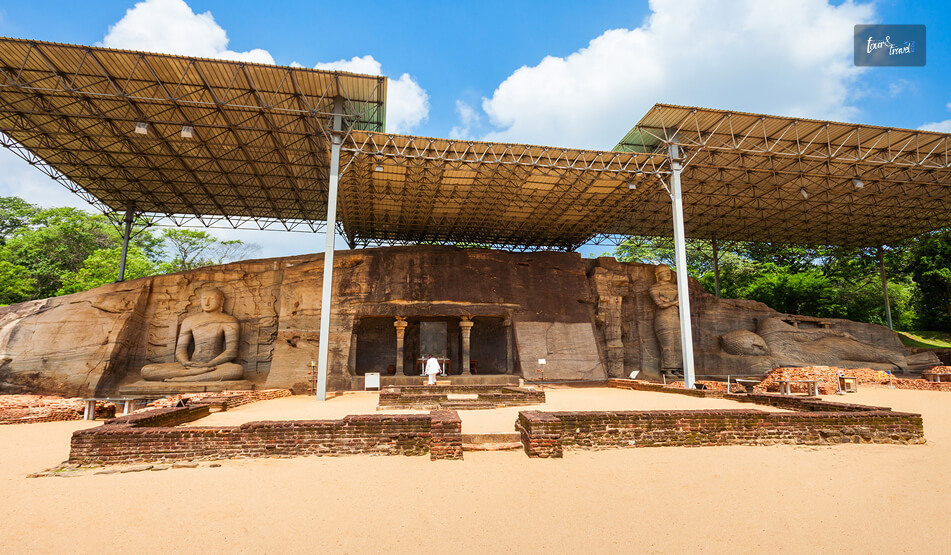
Then I spotted where the walls stood, from the figures that once had their own brick image house and the remains of the low stone foundations. 

Figuring out that outline helped me identify how enclosed and dim the images once were, before the walls fell and the sky opened above them.

The Seated Buddha

The Seated Buddha

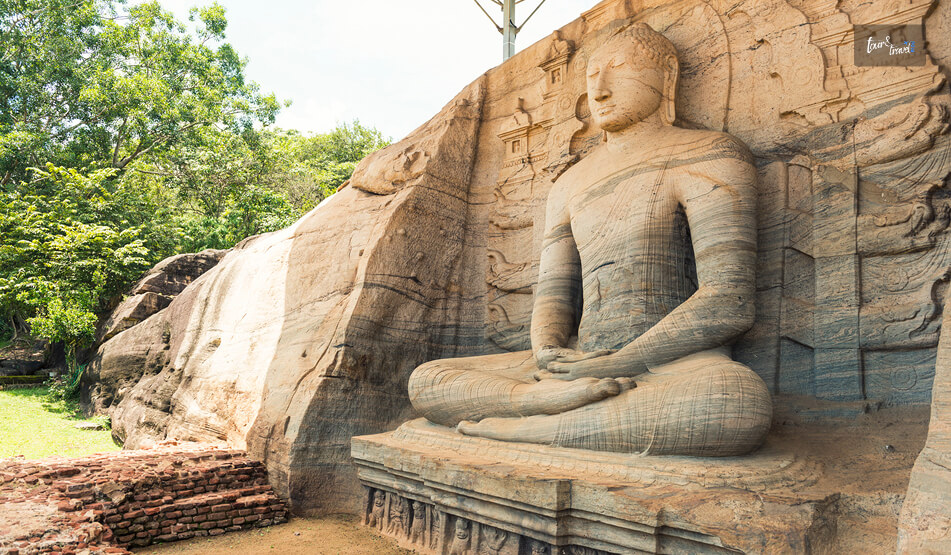
I saw the depiction of Lord Buddha in his meditating pose in the cave of the Vijjadharas. It is the leftmost cave among all. 

He is the Dharmadhatu or Vairocana, and in the Mahayana tradition, he is worshipped as the cosmic Buddha. 

Furthermore, there were four bas-relief Buddhas at the top of the statue and on the sides. 

The guide told me that these small statues represent the four directions of the world, and they are the embodiments of Dharmakaya, or the “all-encompassing body of law.” 

However, another version says that two of them are Lord Brahma and Lord Vishnu, present as guardian deities to Lord Buddha. 

The Excavated Cave And Seated Buddha

This cave on the right also has a rock-cut Buddha sculpture in a meditating pose. 

The sculpture is modest. However, you must not miss the stone inscription next to this shrine. 

It is a record of the religious reforms of King Parakramabahu. Later, he also asked them to draw up a code of conduct, which is recorded in this inscription. 

Uttararama is also where Parakramabahu I gathered monks to purify the Buddhist community.

The Reclining Buddha

The Reclining Buddha

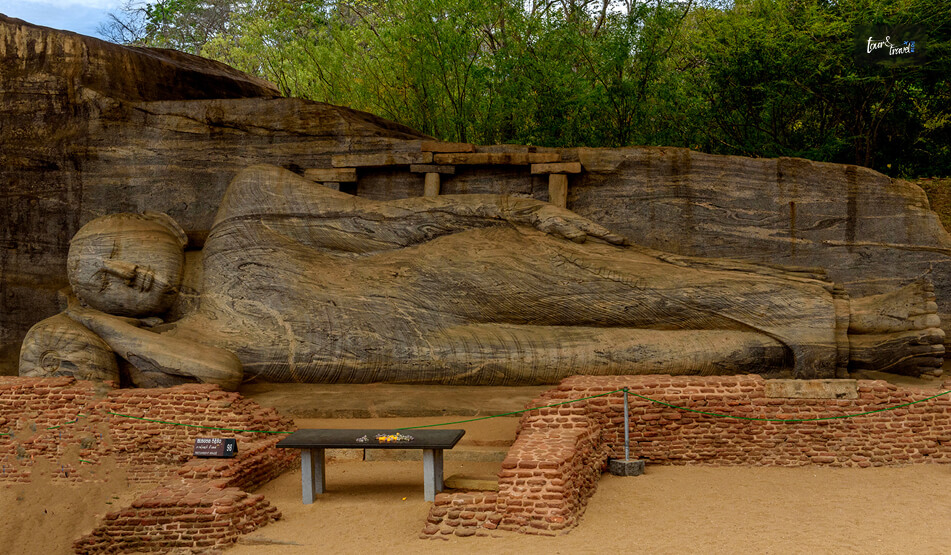
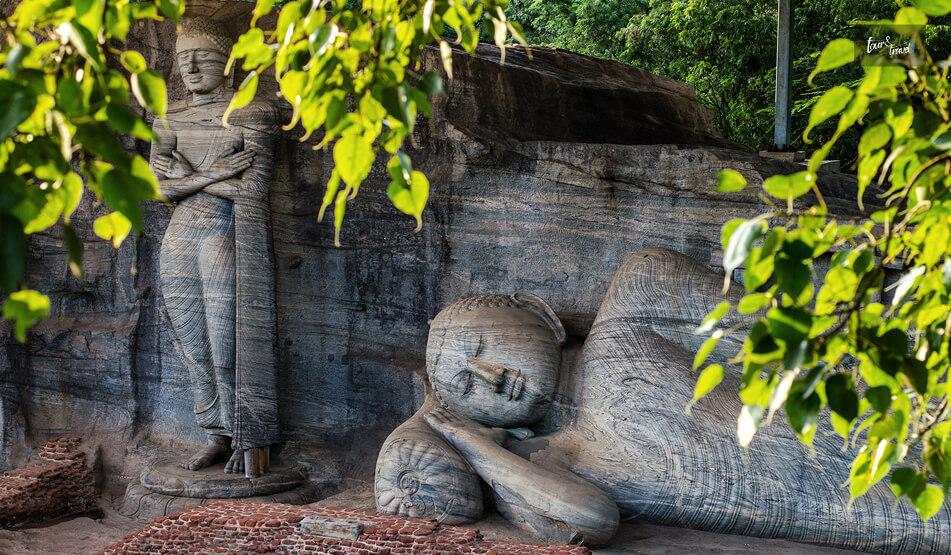
The reclining Buddha here depicts entering parinirvana. 

It is 14 meters in length, and the details here drew my attention. 

There is a gentle dip in the pillow beneath the head.

Also, there are lotus symbols on the pillow end and on the soles of the feet.

I was dumbstruck and had goosebumps at the same time, standing at the feet and then following the line of the body along the rock. 

It was so lively!

The Standing Figure And The Ananda Debate

The Standing Figure And The Ananda Debate

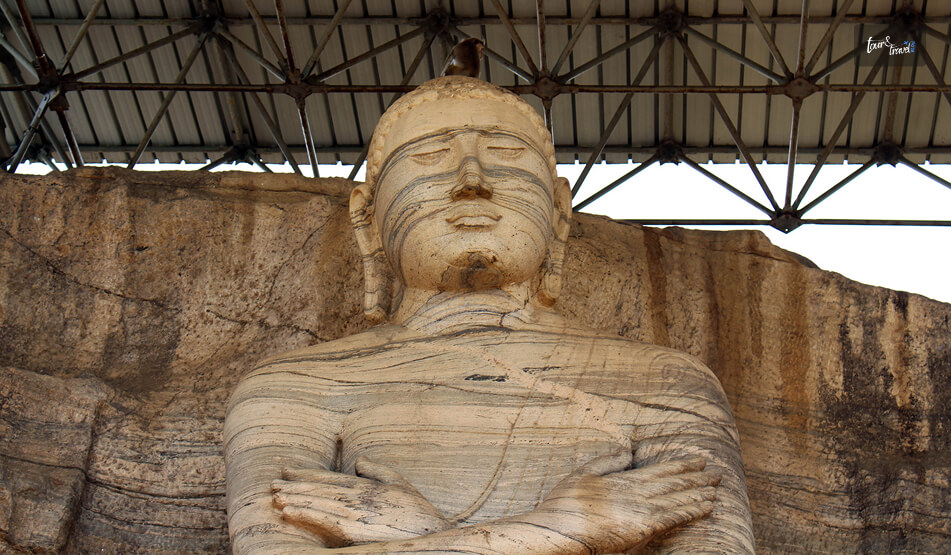
Next, I visited the standing Buddha statue where Buddha is standing with his arms crossed over his chest.

The facial expression of this 7-meter-tall figure is sorrowful. 

The most popular version is that it is the figure of Ananda, the disciple of Buddha. He was grieving as the lord entered parinirvana. 

However, another version completely rejects this idea and says that it is Lord Buddha himself. 

They find the expression of a subtle smile, and they say that here Lord Buddha is standing after two weeks of his enlightenment. 

The History: Parakramabahu I And The Northern Monastery

Parakramabahu I And The Northern Monastery

The Culavamsa chronicle credits King Parakramabahu for the construction of Gal Vihara. 

He built it to strengthen Theravada Buddhism and unify Sri Lanka. 

Natural Marbling As Part Of The Design

Carvers used the natural marbling in the granite to create the life-like effect of the sculptures. 

In the softer morning light, I could see how the veins in the stone follow the lines of the carving, which is another reason I would visit early.

Photography And Respect

Photography And Respect

You can take photographs here. However, it is a sign of disrespect to turn your back to the statues to take selfies. 

Furthermore, if you want to film Gal Vihara, you will need prior approval from the authority. 

Getting Around Polonnaruwa

You must take a cycle or a tuk-tuk between the ruins. 

Six to eight hours by bicycle covers the whole site. The charge will be around LKR 400 to LKR 1000 for the entire day. 

A Half-Day Itinerary Around Gal Vihara

TimeStopNotes
7:30 AMTicket office and Polonnaruwa MuseumKnow the context of the ancient city before the ruins.
8:30 AMRoyal Palace and QuadrangleVisit the central monuments while it is still cool. 
10:30 AMAlahana Pirivena areaVisit the monastic ruins near Gal Vihara.
11:30 AMGal ViharaAllow 1 to 2 hours to explore the vihara.
1:00 PMLunch and restAvoid peak midday heat.
4:30 PMParakrama Samudra shoreObserve the quieter light on the reservoir. 

Nearby Places To Combine With Gal Vihara

Nearby Places To Combine With Gal Vihara

Don’t miss the Polonnaruwa Museum, run by the CCF beside the Parakrama Samudra sluice gate.

It houses findings from the excavations at the site since 1981. 

Also, if you want a wildlife experience, you can consider Minneriya, which is also amazing for sunset views. 

Latest Updates For 2026 Visitors To Gal Vihara

The Thuparama Image House in Polonnaruwa, a 12th-century vaulted brick shrine, received US-funded conservation support, announced in January 2025.

Furthermore, the CCF now runs an eTicket portal for Sigiriya, Anuradhapura, Polonnaruwa, and other heritage sites.

You can purchase these tickets up to 90 days before the visit.

Share on Social Media

Sibashree is a travel, culture, and leisure writer who has been writing since the age of 12 and professionally since 2014. With more than a decade of travel writing experience and journeys across India and several parts of the world, she brings a deeply personal and thoughtful perspective to her work. A student of English Literature and Mass Communication, Sibashree has always viewed travel as more than movement — for her, it has been a way of understanding people, cultures, and herself. Her passion for spiritual exploration has also led her to many unusual and meaningful destinations over the years. Outside of writing, Sibashree enjoys watching European cinema, reading about global politics, and reflecting on the stories hidden within everyday places.

Leave a Reply

Your email address will not be published. Required fields are marked *

title-img Related

READ MORE Mannar

Mannar, Sri Lanka: The Island I Almost Skipped

BY  Sibashree Jul 10, 2026

Many unexpected things happened during my trip to Sri Lanka. For example, I did not expect what I felt at the Dambulla Royal Cave Temple.  Similarly, there are places like Puttalam. Puttalam stands out with its ancient history, wildlife, coconut plantation, and ideal ambiance for stargazing.  However, of course, Puttalam is not as celebrated as the cultural richness of Kandy or the thrill of a Kandy to Ella train ride. It is more like a hidden gem.  Now, talking about hidden gems, Mannar is another destination I almost missed.  I am glad that I did not ultimately, as in recent times, it has become the land where women are fighting for the protection of the bodies and land impacted by industrialization, bypassing their consent.  In this article, I will share my experience in Mannar, and of course, why women in this coastal village are putting up such a strong fight.  However, I will begin with why I almost missed it. This Is Why I Almost Missed Mannar Mannar is not a usual or bucket-list destination when planning a trip to Sri Lanka. So, it was not originally on my list even after multiple visits to the country.  For the first time, Jaffna and its Tamil culture were my priority.  Also, for the next time, it was quite a predictable loop with Ella for the hills, Kandy for the temples, and Mirissa for the beaches.  Again, while Mannar kept popping up as a suggestion, most forums described it as "connected by a causeway, has some baobab trees, not much else."  So, I never had Mannar on my mind.  However, when I visited Sri Lanka for the third time, my focus was more on historical exploration in the country that is so connected to the country I come from, India.  So, I was staying in Anuradhapura, and Adeesha, the guesthouse owner, told me about Mannar.  He said, “Mannar is where Sri Lanka forgets it's an island for a while. The wind never stops, and neither do the birds." This description stayed with me. And in three days, I took to the Medawachchiya-Talaimannar Highway for a road trip to Mannar.  The distance was around 119 km, and it took around 2 hours and 17 minutes.  Initially, I thought that it was a mistake as I saw the landscape flattening out into salt pans and scrub.  However, I had not!  Mannar Reminded Me Of Art Of Slow Travel: We All Know It But Often Forget  I planned a half-day detour and ended up staying two nights, and even that felt like less.  What I appreciated most was how little the island tried to perform for visitors. You don’t have a polished tour script to follow. Also, from the causeway moment to standing on the spot where two countries meet, you will not notice the crowd for photo ops.  And do you know what you have as your companions here?  Just baobabs older than most nations, donkeys that own the road, flamingos that don't care if you're watching, and a stretch of water that people once believed connected two entire countries! So, Mannar is more than worth being beyond an afterthought when you are planning a trip to Sri Lanka.  I certainly did not expect a forgotten causeway town to end up as one of my favorite stops in the entire country, but that's exactly what happened. Here are more details about my days in Mannar, from the causeway moment to visiting the historical fort.  1. The Causeway Moment There's a specific moment on the drive-in that I still think about.  I left the palm-fringed road of the mainland behind, and the land narrowed into a causeway with water pressing in on both sides.  I rolled the window down, and I instantly felt the gush of wind on my face.  My driver, Aslam, laughed and said I should get used to it.  Talaimannar, further west, is considered one of the windiest points in the country, which is exactly why it's become a magnet for kite-surfers. Crossing that causeway felt like flipping a switch. The dense, wet green of the rest of the island gave way to something drier, flatter, and quieter.  I hadn't expected Sri Lanka to have a landscape like this, and it was closer in spirit to the Deccan scrublands than to a tropical postcard. 2. First Impressions Of Mannar Town Mannar town itself is unhurried in a way that took me a day to appreciate.  My first afternoon, I wandered past fishing boats pulled up on the shore, nets drying in loose piles. I also spotted a handful of tea shops where conversations paused just long enough for someone to glance at the obvious outsider before returning to their card game.  Nobody tried to sell me anything. It was the first place in Sri Lanka where I felt like a guest rather than a customer. 3. Meeting The Giant Of Pallimunai I was not prepared for the first baobab tree I spotted in Mannar. Seeing it for real is a different experience than seeing the photos.  The barrel-shaped trunk was wider than a small room, and the branches moved upward.  Furthermore, it had a thick and wrinkled grey bark, which gave it the name of the “Elephant Tree” from the locals.  However, the most famous one among the baobab trees in Mannar is the one in the village of Pallimunai.  It has a history of 600 to 800 years.  Furthermore, it was fascinating to think that baobabs are native to Africa and Madagascar, not South Asia. Common sayings are that the Arab traders carried the seeds here centuries ago, possibly using the leaves as camel fodder during the long sea crossings. The seeds eventually took root in Mannar's dry soil. I sat under that tree for a good twenty minutes, and a local teenager on a bicycle stopped to chat, half in English and half in gestures.  He told me his grandfather used to tell him the tree was older than any building on the island. Looking up at it, I believed him completely. Things To Know About The Baobab Trees In Mannar Mannar has around thirty baobab trees scattered across the district.  All of them are not as gigantic as you expect them to be. However, even the smaller ones along back roads and behind houses will grab your attention with their unique silhouette.  4. The Donkeys Of Mannar The feral donkeys are a part of Mannar’s wildlife identity.  They come from the animals the Arab merchant brought generations ago.  When I reached Mannar, I spotted them wandering freely across the island. They were unbothered by traffic or tourists. Even I watched one calmly block an entire lane of road near the causeway, chewing grass with the unhurried confidence of something that knows it has the right of way. Aslam just waited it out, grinning. "This is Mannar traffic," he said. 5. Flamingos At Vankalai My visit to the Vankalai Sanctuary and the nearby wetland was one of the highlights of my trip to Mannar.  I spotted flamingos, and they looked unreal for the first few minutes. I have never been so up close to these majestic birds.  Furthermore, I spotted a flock lift off a shallow lagoon at dusk, and it was dusk. So, they were catching the last orange light for the day.  Everything around me paused for a while.  6. Adam's Bridge And Talaimannar: Standing Where Two Countries Almost Touch The furthest point of my trip was Talaimannar.  It was right at the western tip of the island, where a chain of limestone shoals, the Adam's Bridge, stretches out toward Rameswaram in India.  In Hindu tradition, this is the causeway said to have been built by Rama's army in the Ramayana. Furthermore, geologically, it is a natural formation due to sedimentation and shifting sea levels over thousands of years. The Moment… I was standing on the shoreline, and the wind hammered at my jacket.  I squinted toward the horizon and tried to make out India. Certainly, I could not.  Now, being from the land of spirituality, the myth was quite fascinating. However, the practical history seemed more tantalizing.  It was one of the busiest pearl-trading points in ancient times, and it was famous even in Rome.  7. The Fort That Changed Hands Three Times On the way back, I stopped at Mannar Fort, a low, weathered structure sitting near the causeway.  The Portuguese built it in 1560, and then the Dutch took over until they surrendered to the British. Compared to the grandeur of the Galle Fort or the Sigiriya Rock Fortress, it is a small, crumbling monument to how many empires passed through this one unassuming stretch of coastline.  There wasn't a ticket booth or a gift shop. The caretaker nodded me through, and I wandered the ramparts alone, looking out over the water as the light started to fade. My Two Days In Mannar: The Itinerary  Here is my two-day slow travel itinerary in Mannar. Day 1: Causeway, Town, And Giants Time ActivityMorningThe Road Trip to MannarLate MorningThe Causeway MomentEarly AfternoonCheck-in and Town ExplorationLate AfternoonThe Giant of PallimunaiEveningMannar "Traffic" and Dinner Day 2: Ancient Connections, Wildlife, And Heritage TimeActivityMorningJourney to TalaimannarMid-DayAdam's Bridge ExperienceAfternoonVisiting the Fort of Three EmpiresDuskSpotting Flamingos at Vankalai Sanctuary That’s it from my days in Mannar. However, I want to conclude with a brief discussion on how women in Mannar are fighting for their bodies and soil.  Konniyan Kudiyirippu: A Mannar Village Where Women Fight For Their Bodies And Soil  Konniyan Kudiyirippu is a small coastal village on the southern edge of Mannar. Here, the lives of the women revolve around the soil and palmyrah. However, the setting up of a windmill here without consent has ruined their lives by poisoning the water and flooding the land.  That is not all! A mining company is eyeing this village.  I was reading about this news on eathjournalism.net, and there, a 32-year-old woman and a kindergarten teacher from the village, Vashingtina, mentioned,  “We use everything from nature to earn an income.” So, due to the industrialization without consent, the village economy based on nature is about to get ruined.  The women of this village are putting up a fight against this and the violation of “the right to free, prior and informed consent.” So, come and visit Mannar to see how the women here are fighting one of the biggest battles of mankind, saving the environment vs. industrialization.

READ MORE places to visit in Matara

What Are The Places To Visit In Matara? A Southern Sri Lankan Commercial Hub With Dutch Colonial Heritage

BY  Sibashree May 4, 2026

Matara, the second-largest city in southern Sri Lanka, is an important gateway to Dickwella Beach, Hiriketiya Beach, or Talalla Beach.   However, beyond that, Matara is a place where the Dutch colonial heritage meets vibrant culture.  Now, talking about this part of Sri Lanka, places such as Mirissa or Galle get more prominence.  However, as I have also mentioned on my blog on Talalla Beach, Matara felt more intimate.  First of all, it was not tourist-heavy, and it is yet to get out of its shell of a hidden gem. Secondly, from beaches to historical landmarks and spiritual retreats, you will find everything in and around Matara.  So, in this blog, I will talk about the places to visit in Matara in detail.  What Are The Best Places To Visit In Matara?  Matara is now gearing up for the Sri Buddha Year 2570 State Vesak Festival on 27th May 2026.   It will take place at the Midellawala Ancient Temple premises at Thihagoda in Matara.  The program involves a week-long celebration and will continue till 2nd June, 2026.  From moral teaching to spiritual learning and sessions on environmental conservation, this week will be significant for the people of Matara and the followers of Buddhism in the country.  Nevertheless, if you are in Matara, do not forget to visit these places.  1. Polhena Beach: Swim, Snorkel, And Relax Polhena Beach impresses at first sight with its calm water. The water here is shallow, making it one of the most family-friendly beaches in Sri Lanka.  Furthermore, the protected coral reef here makes it ideal for snorkeling, even for beginners.  When you snorkel or swim here, you can find many species of reef fish. I could even spot a few sea turtles here as I walked a few meters from the shore.  Above all, Polhena Beach is a great place to unwind. Also, watching the sunset here was a wonderful experience, with the sky changing colors and those colors reflecting in the water.  2. Matara Fort: A Must-Visit For A History Buff  If you are fascinated by the colonial history of Sri Lanka, Matara Fort is a must-visit.  You know, the Galle Fort is iconic. However, the Matara Fort also has a history of Portuguese and Dutch colonialism in this part of the world.  The Portuguese built this fort, and later in the 17th century, the Dutch reinforced it.  Furthermore, the best part of the Matara Fort is how it still has an active presence in the daily life of the town.  There are schools, government offices, and shops inside the wall. Moreover, when I reached, I heard the noise of local boys who were playing cricket inside the fort.  I started talking to them, from Sangakkara to the rising P Nissanka, we covered a lot of players from the country in our discussion.  It was a fun interaction. Now, talking about cricket has been one of the most important things to do in Sri Lanka for me.  Again, as I walked through the fort, I visited the old Dutch church, which was built in 1706. Moreover, from the Matara Fort, I enjoyed amazing views of the Indian Ocean.  Being a public district, the fort does not have an entry fee, and you can enjoy a walk anytime you want.  3. Paravi Duwa Temple: One Of The Best Spiritual Places To Visit In Matara  The floating temple, or the Paravi Duwa Temple, is on a small island called Pigeon Island or Paravi Duwa.  You have to walk through the footbridge connecting the mainland and the island. If Matara Fort offers you an insight into the region’s history, this floating temple is all about serenity.  The temple has many stunning Buddha statues and a golden Stupa. However, the most fascinating thing is the replica of the footprint on Adam’s Peak.  Furthermore, here, you will enjoy a stunning coastal backdrop.   The temple remains open from 6 AM to 6 PM, and it is best if you walk through the bridge during the sunrise.  4. Weherahena Temple: A Proud Example Of Modern Buddhist Architecture  On the east side of Matara, the Weherahena Temple has the biggest seated Buddha Statue of Sri Lanka.  The statue is 39 meters tall, and here you will find an underground tunnel.  Now, walking through the tunnel was a fascinating experience. There, you will see more than 200 murals about the life of Lord Buddha.  Moreover, the tunnel remains open from 6 AM to 8 PM.  5. Star Fort: A Dutch Colonial Heritage  The Star Fort, close to the Matara Fort, originally went by the name of Redoute Van Eck.  It is a hidden gem in Matara, but the architecture here is equally fascinating.  Furthermore, the fort gets its name from its unique six-pointed star shape. Built in 1765, the fort had a strategic position to prevent attacks from the land.  The Matara Fort, however, was more instrumental in protecting against attacks from the sea.  Also, you must not miss a visit to the Star Fort museum, which offers insights into the Dutch colonial history of Sri Lanka.  The fort remains open from 9 AM to 4 PM, and I had to pay an entry fee of around ₹100.  6. Dondra Head Lighthouse: Sri Lanka’s Southernmost Part  I took a short tuk-tuk ride from Matara to Dondra, the southernmost part of Sri Lanka.  The Dondra Light House, with a height of 49 meters, is the tallest lighthouse in the country, and this 1889 fort offers an amazing view of the Indian Ocean.  However, they did not allow the visitors to climb up the lighthouse. So, instead, you can enjoy a coastal walk and take the best snaps for your socials.  7. Matara Local Markets: Offering Insights About Local Culture And Flavors  I always believe that to know a place, you have to explore its local markets. The Matara local market smells of handicrafts, tropical fruits, and spices.  Moreover, here, you will enjoy prawn fritters or isso wade and pol sambol, even kottu roti, the authentic delicacies of Sri Lanka.  Furthermore, despite the language barrier, the crowd there was so friendly and knowing I am from India, some of them even shared how they feel the solidarity.  So, the next time you are in Matara, don’t just treat it as a stopover for the popular southern Sri Lankan beaches.  Try to soak in the history, culture, and spiritual vibe of this beautiful coastal town.

READ MORE Jaffna beach guide

The Ultimate Jaffna Beach Guide: What Are The Best Beaches Near Jaffna, Sri Lanka? 

BY  Sibashree Jan 9, 2026

The northernmost major city of Sri Lanka is famous for its beautiful Hindu temples, such as the Nallur Kandaswamy Kovil and Naguleswaram Temple (Keerimalai). It also stands out with its unique sculptural scenario and great food.  However, very few people talk about the beautiful beaches of Jaffna, such as Kankesanthurai and Casuarina. During my trip to Jaffna, I loved the white sands, calm shallow waters, and Palmyra trees. Also, the Jaffna beaches are a paradigm shift from beach towns like Mirissa.  You will not get the vibrant nightlife or the maddening crowd. The vibe is pristine and slow. And with the Sri Lanka Tourism Development Authority (SLTDA) focusing on Jaffna now for the diversification of the country’s tourism profile, these beaches are going to play a vital role.  In this Jaffna beach guide, I will talk about the most prominent beaches, the amenities, expert tips, and more.  What Are The Best Beaches Near Jaffna Sri Lanka? The beaches in Jaffna show a contrasting vibe in comparison to the beaches near Colombo, such as Bentota or Unawatuna. The Colombo beaches are touristy and offer watersport activities such as parasailing, diving, and surfing.  On the other hand, the shallow water of Jaffna is ideal for swimming. Also, the golden sands of the Colombo beaches are replaced by the soft white sands.  Overall, the beaches in Jaffna focus more on tranquility and show the slow-paced vibe of the city. You know Jaffna Siesta is a real thing!  1. Casuarina Beach (Karainagar) Casuarina Beach Entrance Fee: 500 LKR (Foreigners), 50 LKR (Locals) Distance from Jaffna: 21 Kms As you reach the Casuarina Beach, a wide stretch of casuarina trees, creating a canopy over your head, welcomes you. The beach gets its name from these trees.  The stretches of the soft white sand of the beach are also surrounded by palm trees. Furthermore, the west-facing is known for beautiful sunset views.  What Are The Things To Do In Casuarina Beach?  Casuarina Beach is a place to relax. The shallow water here is ideal for swimming. You can go to the middle of the ocean, where you will find fishermen in action.  The fishermen ride in a raft-like boat. You can join them and have a conversation about their daily lives and how they survive the sea. For me, it was pretty much the “Riders to the Sea Moment.” Also, Kamban, a middle-aged fisherman of Jaffna, shared something about the impact of the Civil War here. He reminded me of a Reuters report published many years back. It talked about how the Puthumathalan beach, around 113 km from Jaffna, was filled with broken medicine bottles, pieces of clothes, and rusty cooking pots as the aftermath of the civil war.  Nevertheless, Kamban said, “You know, we did not have any food. We could not go out for fishing, and we never knew who would be the next to take a bullet.  We are now recovering and getting tourists. Still, we need more support, and the fear will remain among people of my generation and the next one.” Today, Casuarina Beach has some beach clubs and resorts offering water sports activities such as snorkeling and jet skiing.  Still, I feel, it’s a place to relax and ponder over how the locals are showing resilience to maintain the glory of a city devastated by the Sri Lankan Civil War.  Also, the Casuarina Beach is the place to try the authentic food of Jaffna. I loved the crabs and vadai here.  How To Reach Casuarina Beach From Jaffna?  The most convenient way to reach the Casuarina Beach is to take a private taxi to Jaffna. The cost will be around 1200 LKR.  2.  Kankesanthurai (KKS) Beach Entry Fee: Free Distance from Jaffna: 19 Km How to Reach: Take Tuk-Tuks from Jaffna The Kankesanthurai is a navy-maintained beach with sparkling blue water. It is also just 10 minutes away from the Keerimalai Freshwater Springs, one of the iconic landmarks in the spiritual and cultural landscape of Jaffna. Also, the nearby Thalsevana Resort is a place to relax and try authentic Jaffna cuisine while indulging in the beauty of the pristine beach.  You can swim in Kankesanthurai. However, you need to be careful about the current. However, this beach is more popular for the snorkeling activities and is famous for the Keerimalai to Kankesanthurai Walk.  Kankesanthurai (KKS) Beach Snorkeling  Kankesanthurai, with its shallow water and some marine life and corals visible, is a decent snorkeling site. I saw some sea turtles while swimming at Kankesanthurai beach.   The water here is warm, and the calm conditions make it beginner-friendly. May to September is the best time for snorkeling in Kankesanthurai.  However, there is no established snorkeling facility here. So, you need to bring your own gear, including fins and masks.  So, if you want a proper snorkeling experience, you can explore alternative locations in Sri Lanka, such as the Nilaveli Beach of Pigeon Island, which also has the Pigeon National Park.  The Coral Island of Trincomalee and the southern coastal spots such as Hikkaduwa & Mirissa are some of the best locations to try snorkeling in Jaffna.  Keerimalai To Kankesanthurai Walk The distance between Keerimalai and Kankesanthurai is just around 2 km. So, when you start from Keerimalai and walk north toward Kankesanthurai, you will reach your destination in 25-30 minutes.  There is no marked beach trail for the walk. However, as you proceed, you will experience amazing coastal views and fishing activities, especially near the pier and shorefront.  However, if you want to beat the heat, you can take a tuk-tuk to reach the beach from Keerimalai. Manalkadu Sand Dunes: The Hidden Gems Near Jaffna  Manalkadu sand dunes are the ideal location for an off-the-grid camping experience in Jaffna. Also, at times, I want absolute silence around me. Being an introvert, too many interactions and activities often drain me.  Stargazing in those moments works like a therapy for me. If you are also like me and want the world around you to “Shut Up,” you must try stargazing at Manalkadu.  The long chain of sanddunes here stretches to meet the sea, and this is a geologically striking feature. The desert-like setup and the sand dunes offer some “interesting perspectives” for photography, especially while watching the sunset.  And the best way to experience stargazing at Manalkadu? Try off-grid camping here.  Camping At Manalkadu And Stargazing  I set up my tent on the Manalkadu beach, and the wild, open area with almost no light pollution offered the best stargazing experience. Of course, it was not as vivid as stargazing in Great Barrier Island.  Still, the spontaneity and simplicity won me over. However, Manalkadu is not a formal camping or stargazing site. So, you will need to bring your tent, telescope, red light, water, and other essentials.  Also, we spotted some fishing huts on the beach. We sought their permission, and they happily agreed. In fact, they shared their meal with us, allowing me to spend more time stargazing and enjoying the silence. Things To Pack For Camping At Manalkadu  Manal Kadu means sand jungle in the Tamil Language. True to its name, it is a pristine place where desert, jungle, and the sea co-exist.  Also, it is called the “Swimming Pool of the North.” Nevertheless, since it has a primitive setup, you need to carry some essentials.  Tent Sand Anchors or Stakes Plenty of Food and Water Nearby Portable Stove Cooking Gear Headlamp or Lanterns First-Aid Kit Power Banks Trash Bags The Quiet Alternatives: Jaffna Beaches Do you want to enjoy a sunset stroll by the water with no one around? Visit the quieter alternatives such as the Charty Beach and Akkarai Beach. 1. Charty Beach The Charty Beach is on Velanai Island, and it is a 15 km drive from Jaffna City. You will reach the beach from the city within 30 minutes after a journey through the Jaffna–Pannai–Kayts Road.  The warm water here is ideal for swimming, and you can even try near-shore paddling. Changing Facility• Nearby Huts• Rest ShadesFood And Snacks• Local EateriesAccomodation• AC and Non-AC Rooms at Charty Beach ResortLifeguard• Not Available Ideal Season â€˘ May to SeptemberBest Time to Visit in a Day• Early Morning• Late Afternoon 2. Akkarai Beach  Take a drive for around 30-40 minutes to reach the Akkarai Beach in Thondamanaru. Lying along the Palk Strait, it stretches toward the Indian coastline.  It is very close to the Lord Murugan Temple and the Thondamanaru Bridge.  Parking FeeFreeResting AreasBenches and Shaded SpotsWashroomFreshwater Wash AreasSwimming ConditionNear-Shore Swimming with the Sandy Bottom Deepening GraduallyLifeguardsNot Available. So, Don’t Swim when the Current is Strong.  Best Months May to SeptemberBest Time to Visit in a Day• Early Morning• Late Afternoon Beach Amenities And Safety Guide Once again, the Jaffna beaches are not the luxury tropical getaways you are looking for. So, you must have a clear idea about what to expect at these pristine beaches.  Also, learn about the safety infrastructure before getting into the water.  1. Basic Beach Amenities  Casuarina Beach has paid changing rooms. However, other beaches have no makeshift provisions for changing and resting.  So, you must carry beach umbrellas and folding chairs if you don’t want to sit on the sand.  There is no official presence of a lifeguard or support on these beaches. Network coverage is decent. However, you can face connectivity issues if the weather deteriorates.  The beaches in Jaffna are accessible from Jaffna City by tuk-tuk and other vehicles. However, in Casuarina Beach, you will have to pay a small fee for entrance and parking your vehicle.  2. Safety And Norms Do not go very far into the ocean water, as there can be strong currents, and there is no formal lifeguard support.  Also, be careful while walking barefoot on the sand,d as there can be seashells and seaweeds.  In addition, dress modestly, shorts and T-shirts are fine! Also, do not leave trash behind.  Exploring The Jaffna Coastline: Know The Expert Tips  Want to explore the coastal beauty of Jaffna to the fullest? Follow these expert tips.  1. Go On Weekdays You will find local buses packed around the Casuarina Beach, and the noise of loud music can be an annoying factor.  Choose a Monday or Tuesday for your ocean visit to spend some moments of quietude. 2. Bring Reef Shoes The Charty and KKS beaches have sharp dead coral very close to the water's edge. So, your feet may get a cut if you don’t wear reef shoes.  3. Have Navy Food  When you are visiting the Kankesanthurai (KKS) beach, you don’t need to eat at a beach shack. You can walk into the Thalsevana Holiday Resort run by the military.  Enjoy a hygienic and tasty lunch and cold beer there while enjoying the ocean view. 4. Riding On Manalkadu? You Will Need A 4X4  You can drive a scooter to Manalkadu. However, you have to park it on the hard road. You cannot take it to ride onto the sand dunes, and the wheels will get stuck.  5. Morning Is The Best Time For The Beach Visit  You cannot visit a beach in Jaffna at noon. The Northern Sun is scorching. So, plan a visit between 7 AM and 8 AM or after 4 PM.  6. You Can Wade In Akkrai But Cannot Swim  The water at the Akkarai Beach is usually knee-deep. So, you can wade through the water of this beautiful beach.  However, swimming does not look like an ideal activity here.  7. Changing Rooms Are Basic The Casuarina Beach has changing rooms. However, these rooms are just concrete stalls with a bucket of water.  You will have to bring your towel and toilet paper.  8. Respect The Fishermen Most beaches in Jaffna are like a workspace for the fishermen. So, there will be fishing boats and nets on the shore.  You cannot step on or lie on them. Do not tamper with them.  9. Drink Thambili To Stay Hydrated  Jaffna beaches do not have places serving fancy cocktails. The best refreshment is to drink the King Coconut or Thambili water.  It replenishes the micronutrients, and it is a must-have when the Sun is scorching. What Are The Authority Voices On Jaffna Beaches And Coastline?  “Casuarina Beach is named after the shady trees that line it, offering a rare respite from the scorching Northern sun. It’s the closest Jaffna gets to a holiday vibe.” - The Lonely Planet.  “Don’t expect the polished tourism of the South. Jaffna’s beaches are raw, working coastlines where fishermen outnumber tourists—and that is their charm.” - Rough Guides.  Jaffna Beach Guide: Frequently Asked Questions (FAQs)  Here are the frequently asked questions and answers about the Jaffna beaches.  1. Can Foreigners Swim In Jaffna Beaches? Yes, foreigners can swim in Jaffna beaches. Casuarina and KKS beaches get many foreign visitors. The KKS beach offers free entry. However, for the Casuarina Beach, the entry fee is 50 LKR for locals and 500 LKR for foreigners. Also, the amenities at the Jaffna beaches are basic. So, a foreigner looking for a luxury beach experience or the resort vibe can feel disappointed.  2. Is It Safe To Wear A Bikini At Jaffna Beaches? There is no formal restriction regarding wearing bikinis at Jaffna beaches. However, the social setup of Jaffna is conservative. So, there can be stares, and you may feel out of place. So, wear shorts and T-shirts while swimming. 3. Are There Sharks In Jaffna?  You will rarely see sharks in the waters of Jaffna. However, you will find sea turtles and coral reefs in the waters here. The water here is very shallow.  4. Which Is The Cleanest Beach In Jaffna?  Kankesanthurai (KKS) is a navy-maintained beach, and it is the cleanest in Jaffna. It also has the Thalsevana Holiday Resort, run by the military. You can have food and drink here.  5. Can I Surf In Jaffna? No, you cannot surf in Jaffna. The water here is shallow and calm like a lagoon. If you want to surf in Jaffna, you can go to Arugam Bay on the East Coast.  6. Are There Hotels On The Beaches Of Jaffna?  Yes, though not frequently, there are some hotels on the beaches of Jaffna. For example, KKS has the Thalsevana Holiday Resort and the Charty Beach has the Tilko Charty Beach Resort. Furthermore, there are smaller guesthouses near the Casuarina beach.  7. What Is The Best Time Of Year To Visit Jaffna Beaches?  May to September is the ideal time for exploring the northeastern beaches of Jaffna. Jaffna has dry weather conditions in these months, and the calm water is ideal for swimming and snorkeling. Jaffna experiences heavy rainfall from October to December. So, avoid these months.