Saguaro National Park has a massive footfall every year thanks to its delightful trails, mountains, and endless species of cacti. Despite being a favorite of hikers and equestrians, this park is also a delightful destination for family trips.
Further, exuding the essence of the Sonoran Desert, Saguaro National Park in Arizona is also home to creatures like the Gila monster, mountain lions, desert dogs, and coatis.
So, are you planning a vacation between October and April? Pack your bags and visit the trails and desert land in Saguaro National Park.
Know The Best Trails In Saguaro National Park
The Saguaro National Park is divided into two sections, east and west. The east side has the more intriguing trails, whereas the trails in the west offer the most amazing scenic beauty.
Along with desert and mountain trails, you will also be able to go for short walks and explore the natural trails filled with cacti and saguaros.
So, let’s know the trails in the Rincon Mountain District in the east and Tucson Mountain District in the west.
Best Hikes In Saguaro National Park East (Rincon Mountain District)
If you want to experience the pristine beauty of Saguaro National Park, your road must lead to the east. This side of the park has fewer tourists and old vegetation of cacti and saguaros.
Also, are you an early bird? You can enjoy the best Sunrise view from the Saguaro Eastern trails.
Hope Camp and Ridgeview Trail
Distance: 2 miles
This trail is famous for the best views of the Rincon Peak and has an elevation of 400 feet. Toward the end of the trail, all your strain will be gone as you discover vibrant wildflowers and beautiful panoramic views.
As the trail ends at the top, the Box Canyon will appear before your eyes. If you are in the park during the wet season, the view of the waterfalls will give you the most fulfilling experience.
Freeman Homestead Trail
Distance: 1 mile
An old homestead foundation, large saguaros, and a desert wash are the highlights of Freeman Homestead Trail.
You can call this a “home in the desert,” and it is related to plant life and history. This Saguaro National Park East trail is one of the favorites of youngsters.
Loma Verde Loop
Distance: 3.8 miles
The Loma Verde Loop comes with a 60-feet elevation. The presence of mature mesquite trees along the trail gives the space a gothic vibe.
Here, you will cross a seasonal wash and climb onto bajada (Spanish), a gravel land at the mountain base.
Next, you will have to cross the Loma Verde Mine and continue through the Pink Hill Trail. Wait a while and keep hiking in a minor spur trail, offering a mesmerizing view of the cactus vegetation.
Further, take a right turn on the Pink Hill Trail and also take a right turn on the Squeeze Pen Trail. Finally, take a left on the Loma Verde Trail to head back to the trailhead.
As you can see, a lot of twists and turns await throughout the loop. So, keep a topographical map handy.
Garwood Dam and Wildhorse Tank
Distance: 6.4 miles
Garwood Trail is one of the best routes for you if you have come to the park to see cacti. As you take the steep section of the trail, you will visit Garwood Dam, built by Nelson Garwood.
Continue your journey through the switchbacks until you reach a ridge with the most amazing views.
Further, as you cross the ridge, you will find Wildhorse Trail. Turn right and take a steep of 0.3 miles to reach the Wildhorse Tank.
Tanque Verde Ridge Trail
Tanque Verde Ridge Trail is one of the most strenuous hiking routes in this National Park because the distance and elevation of the trail keep varying. The highest point in the trail is the Tanque Verde Peak, which is 7049 feet high.
However, as you advance through the route, you will get to see the most exciting views. Further, when you reach the top of the ridge, you will find many other ranges in the north, south, and west. The Tucson Basin also becomes visible from the ridge top.
In addition, don’t forget to take snaps of “the Dome,” a “crested saguaro,” and the unique views.
Best Trails In Saguaro National Park West (Tucson Mountain District)
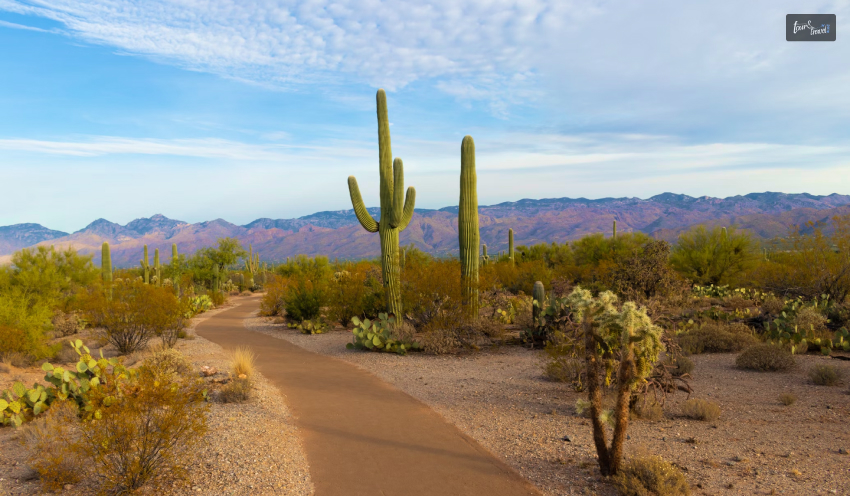
Tuscan Mountain District has the largest cacti in the USA. This large saguaro is acknowledged as the universal symbol of the American West.
Hike through the trails in the west to meet a variety of cacti and the most amazing Sunset views.
King Canyon Trail
Distance: 3.5 miles
The King Canyon Trail ascends to the Hugh Norris Trail. Watch out for the stair-step-like rock formations in the wash bottom.
Hugh Norris Trail
Distance: 4.9 miles
Hugh Norris Trail is the most delightful among other trails in the park. It leads to the Wasson Peak, the highest spot in the Saguaro National Park.
Along with scenic beauty, the rocks of various formations will grab your attention throughout the trail.
Sendero Esperanza Trail
Distance: 3.2 miles
Sendero Esperanza Trail hiking is a little arduous thanks to the constant ascends and descends. However, it is one of the most beautiful trails in the park.
Cam-Boh Trail
Distance: 2.7 miles
Cam-Boh Trail works as a connection between the eastern and western trails of Tucson Mountain District. Further, it is a favorite of hikers for its connectivity to many hiking loops.
You can also enjoy a horse ride through the trail.
Ringtail Trail
Distance: 1 mile
Ringtail Trail connects you to many other trails on the eastern side of the Tucson Mountain District. The trail can get moderately steep.
Sweetwater Trail
Distance: 3.4 miles
If you want to visit the Wasson Peak from the east of the Tucson Mountains, you will have to take the Sweetwater Trail.
The trail starts at El Camino del Cerro Road’s western end.
Cactus Wren Trail
Distance: 1.5 miles
This one-way trail stretches to the Signal Hill Picnic Area, a favorite of localities for family trips. You can start your journey from the “Sandario Road and Rudasill Road” corner.
You will see many desert washes on the trail.
Short Walks And Nature Trails In Tucson Mountain District
The short walks and nature trails of the national park will make you familiar with the local ecosystem. Get ready to explore the following trails replete with various cacti.
Cactus Garden Trail – 100 yards
Desert Discovery Trail – 0.5 miles
Valley View Overlook Trail – 0.8 miles
Signal Hill Petroglyphs Trail – 0.5 miles
Organpipe Cactus, Pink Hedgehog, and Claret Cup Cactus are some of the most popular cacti species found across these trails.
Final Words
Saguaro National Park had more than 1 million (1,010,906) visitors in 2023. The easy trails with the best scenic views and the diversity of cacti here consistently attract visitors to this park. In the last five years, the park has welcomed more than a million visitors three times.
Perri Spreiser, the district ranger for interpretation at Saguaro’s Rincon Mountain District, has rightly said, “We are no longer a small park.”
The increasing popularity of the park has left a positive impact on the local community. They are proud of the park and ensure that everything is quiet and serene in the park. The park owes much of its popularity to the pristineness of its beauty. The local community does not want to ruin it.
Do you want to explore beautiful desert trails, and are you a cacti-enthusiast? It’s time to pack your back and take a drive to the land of saguaros. Or have you already been to this wonderful national park that was designated in 1994? Don’t forget to share your experience with us.
Saguaro National Park FAQS
Is Saguaro National Park Worth Seeing?
Yes, Saguaro National Park is worth seeing, as you can see the most amazing cactus and saguaros here. The place has a distinct rugged charm with flat desert and rocky mountains.
You can hike through the trails and enjoy the most beautiful Sunset views in the park.
How Many Trails Are In Saguaro National Park?
Saguaro National Park has as many as 78 trails spreading across 200 miles. A combination of flat deserts and rocky mountains, Saguaro National Park, is a great place for hiking with family and beginners.
What Is The Most Scenic Trail In Saguaro National Park?
Hugh Norris trail leading to the Wasson Peak, the highest point of the Tucson Mountains District of Saguaro National Park, is the most scenic trail.
You have to travel through a dense forest, and as you advance toward the peak, you will find a rocky landscape. You can enjoy an expansive view of the Sonoran Desert as you explore through this trail.
Opuntia, echinocereus, and barrel cacti are the most amazing cactuses found on this trail.
What Is The Best Place To See Sunset In Saguaro National Park?
Saguaro National Park West is the best place to see the Sunset. You can enjoy the most beautiful view from Gates Pass, which is at the western end of Speedway Boulevard.
In Saguaro National Park East District, the Sunset looks most beautiful as you explore the Tanque Verde Ridge trail. Javelina Rocks pull-out is another great spot to watch Sunset in the East District.
How To Spend One Day In Saguaro National Park West?
A day in Saguaro National Park West will be filled with activities. Camping and hiking are the most adventurous activities here to explore.
The Tucson Mountain District is on the west side, and your trip to the west starts with the Red Hills Visitor Center. The west side of the national park has many cacti and large saguaros.
Sibashree is a travel, culture, and leisure writer who has been writing since the age of 12 and professionally since 2014. With more than a decade of travel writing experience and journeys across India and several parts of the world, she brings a deeply personal and thoughtful perspective to her work. A student of English Literature and Mass Communication, Sibashree has always viewed travel as more than movement — for her, it has been a way of understanding people, cultures, and herself. Her passion for spiritual exploration has also led her to many unusual and meaningful destinations over the years. Outside of writing, Sibashree enjoys watching European cinema, reading about global politics, and reflecting on the stories hidden within everyday places.
Taking a vacation by the ocean is a relaxing and rejuvenating experience. However, simply visiting the beach for a day leaves little opportunity to truly unwind.
Opting to stay at a beach hotel allows fully immersing in the coastal atmosphere. Quality accommodations near the surf provide an ideal home base for exploring the area.
Checkout Seven Prime Advantages Of Staying At A Beach Hotel
Here are 7 key advantages to booking a room right on the sand.
1. Ultimate Convenience And Access To The Water
Staying steps from the ocean at a beach hotel like Princess Bayside Beach Hotel ensures the greatest ease and flexibility. Waking up to stunning views and walking right outside to enjoy activities is unmatched. Guests can slip down to the shore whenever inspiration strikes without needing transport. Concierges also offer beach chairs, towels, and other amenities for maximum relaxation. Simply step out the door for a morning swim or easy sunset stroll.
2. All Inclusive Meals And Activities
Many beach hotels provide all-inclusive packages covering dining, drinks, and water sports. Options save guests money versus paying out of pocket each time. Families appreciate scheduled kids' programs too. All-day access means never having to leave for meals or miss storm-watching from cozy indoor areas. Some properties even hold cooking classes, live music, and cultural presentations enhancing the experience. Packages ensure making the most of every beach moment.
3. Exceptional Service And Amenities
High-end beachfront resorts understand vacationers desire premier customer service and nice touches. The attentive staff takes care of every need from laundry to beach equipment delivery. Most five-star properties offer top-tier dining, pools, spas, fitness centers, and entertainment. Special requests get addressed promptly. Luxurious beds, bath products, and indoor/outdoor spaces pamper guests relaxing in style right at the shoreline.
4. Picturesque Natural Surroundings
Spending days immersed in stunning ocean vistas and natural coastal beauty recharges the soul. Waking to the sunrise sparkling on waves or watching seabirds soar relaxes the mind. Exploring rock pools, dunes, and coastal trails offers adventures. Strolling along pristine sands offers unique seascapes, landscapes, and wildlife glimpses impossible anywhere else. Gentle ocean sounds lull guests to peaceful slumbers every night in these special environments.
5. Convenience For Beaches, Activities, And Local Exploration
Well-located beach hotels provide the perfect launch point for fun. Walking or short drives access many area attractions versus long commutes. Guests easily zip between surfing lessons, whale-watching trips, shopping, and sightseeing on a whim. Concierges offer area expertise too. Centrally situated properties allow leisurely days focusing on the beach or active touring at nearby parks, fishing charters, and cultural sites.
Related: A Guide To Traverse City Beach – 10 Best Beaches To Explore
6. Families Appreciate Kid-Friendly Amenities
Beach vacations with children require certain comforts. Top resorts meet needs with kids' pools, clubs, game rooms, and more. Parents rest easy knowing children stay busy and safe. Spacious suites let families spread out comfortably. All food service, babysitting, and activity coordination means relaxation even with young visitors. Being right on the sand also provides instant family entertainment together whenever schedules permit.
7. Romance And Celebrations
Couples and groups seeking an idyllic backdrop choose beach hotels for sentimental trips. Private in-room jets and whirlpool tubs coupled with stunning ocean panoramas set an intimate mood. Many feature top-rated restaurants perfect for romantic dinners overlooking the surf. Resorts also cater weddings, vow renewals, anniversaries, and other special occasions magnificently. Guests build lasting memories in these dream coastal settings.
Read Also:
The Best Hotels In Mexico City For A Frida Kahlo Pilgrimage
Best Beaches In Costa Rica For Family Vacation
10 Best Nude Beaches In The World
Every Indian has at least once visited the beautiful snowy hills of Shimla, located in the lap of Himachal Pradesh. If you are thinking of traveling to Shimla for your vacation, you can do that anytime you want. Ideally, there is no best time to visit Shimla, you can visit there anytime you want.
Welcome To Shimla!
Shimla, also known as Simla until the year 1972, is a city in Himachal Pradesh, in North India. Due to its scenic beauty, mountain landscape, and old English architecture, no doubt it is known as the Summer capital of British India.
The beautiful oak trees, colonial old English-style architecture, and an ancient feel are what attract visitors to Shimla. But if you are still wondering when to visit Shimla, then you need to keep on scrolling down the article.
Best Time To Visit Shimla
Even though you are traveling solo to Shimla or looking for the best time to visit Shimla for honeymoon, then keep on scrolling to know the best time to visit Shimla.
Oct - Feb ❄️Jul - Sept 🌧️Mar - Jun ☀️-7 to 10c10 - 20cc15 - 30c
1. March To June
The summer and spring months start from the month of March and continue till the month of June. After long and extreme winter months, the summer months are quite pleasant for tourists looking for the best time to visit Shimla.
The temperature around this time rotates around 16c to 30c. The days are quite warmer and rather enjoyable, with a wide range of greenery, colors of blooming flowers, and melting snow.
The roads here are clear and without any blockage and interruptions along the way. This way, you can enjoy every nook and cranny of the beautiful city of Shimla.
Even though you should carry warm clothes with you, it would be wiser to carry light clothes as well if your tolerance for colder weather is high.
2. July To September
Just like any other hill station here in India, the monsoon months are regarded as the offseason for tourists and visitors. With heavy rainfall, landslides, and roadblocks, the monsoon months may not be the best time to visit Shimla.
The average amount of rainfall that Shimla receives is more than 1400mm, and the temperature is around 14c to 20c. But the best deal for adventurers during the monsoon months is that since it is the offseason for tourism, huge discounts are given by hotels and lodgings.
But if you are willing to take the risk of visiting there during the monsoon months, then you should consider all the dangers ahead of time.
3. October To February
One of the best time to visit Shimla for snowfall is during the winter months. The winter months are what attract most of the tourism here in Shimla. The temperature during the winter months ranges from -6c to the highest at 8c.
The snow-covered mountain tops are a sight to see for the sore eyes, and if you are lucky enough,, you can also witness snowfall here. Winter months are just magical for the countryside as it is in the citylights here in Shimla.
You are definitely going to enjoy every cozy night with your friends, family, or partner, or adventure sports out in the snow.
Different Climates In Shimla
When you want to visit any hill station, it is very important that you have thorough knowledge about all the potential risks and dangers of the place.
1. Summer In Shimla
Summer months is the most enjoyable for tourists who are not too comfortable with the snow and cold climate. Other than going for adventure sports in the snow, there are many adventure sports available during the summer months as well.
Adventure sports such as paragliding, trekking, rafting, and camping. Even if you are not into all these activities, then during summer, the summer festival is the best entertainment experience that you want to experience.
Activities like folk dancing, musical performances, and flower shops go on for about five days. This festival first started in the early 60s, with thousands of visitors visiting each year.
2. Monsoon In Shimla
Since the monsoon is usually considered an offseason, there are not a lot of activities to do around this time of the year. But the Rhyali festival, or the monsoon festival, is one of the most attractive attractions during this time of the year.
The festival is celebrated in honor of the rain god to appease him in order to have a prosperous agricultural year. But during the monsoon, the water-washed hill station gives a fresh perspective to the landscape.
3. Winter In Shimla
The white fluffy snow-covered mountaintop of Shimla looks like a magical place indeed. With lots of adventure sports such as ice skating and skiing. One of the best places to travel to in Shimla is Mashobra, Kufri, and Narkanda.
If you are traveling to Shimla during the month of December, then you should definitely stay till Christmas and New Year in here. The hill station is beautifully decked up during this time, and it is possible that you will celebrate a white Christmas here in Shimla.
Frequently Asked Questions (FAQs)
If you have any more queries about the best time to visit Shimla, then here are a few questions you might find helpful.
1. In Which Month Snow Falls In Shimla? The months from October to February, this is the time of the year in Shimla when you are able to witness actual snowfall and a snow-covered hill station. 2. Is 2 Days Enough For Shimla? Traveling to Shimla during an optimal season would take about 3 days and 2 nights to witness the majesty of the whole hill station. Hiring a car or a bike to travel would help you a lot to travel the whole hilly region. 3. Is It A Good Time To Visit Shimla Now? If you want to experience summertime in Shimla, then the best time to visit Shimla is for the months of March to June. But if you want to witness the winter months, then you would want to visit here during the months of November to February.
Visit Now!
Shimla is one of the most naturally aesthetically pleasing hill stations in India. It is a must-visit place in India, but you need to know the best time to visit Shimla. So when you are backpacking to Shimla on your next vacation, then don’t forget to pack all the warm clothes.
Is your heart craving some natural beauty that will help you relax? Why don't you visit Fiji, situated in the middle of nowhere, not exactly nowhere! You will forget all your worries with the endless South Pacific around you. Want to know what are the things to do in Fiji?
A travel destination that is nothing short of heaven, Fiji is home to 333 tropical islands. It is in the middle of the South Pacific, with authentic flavors, enticing culture, and beautiful nature. Read the article to learn more about what to do when in Fiji!
There are a variety of activities that travelers can experience with the abundant collection of flora and fauna. There is also the tribal culture for you to experience unique and thrilling events.
You Won't Believe When I Say About The Best Things To Do In Fiji!
Fiji is more than just a travel destination. Instead, you will experience an authentic culture when you visit Fiji. If you are traveling from the US, you do not need a visa; your stay can be as long as four months.
You can book tickets on the 10 hours long direct flight from Los Angeles to Fiji. The destination in Fiji is Nadi International Airport; hence, if you live closer to Los Angeles, you are in luck. However, if you live elsewhere, you must travel to Los Angeles and then fly.
Fiji Airways and Air New Zealand are two airlines that operate in Fiji, and they both offer regular flights daily if you travel from the USA, Europe, or the UK. You could visit Fiji between May and September to experience clear blue skies.
You can go between October to April if you want to experience the rain. However, you do stand at the risk of experiencing a storm or cyclone. Some of the best resorts in Fiji are Sheraton Resort & Spa, situated on Tokoriki Island, InterContinental Fiji Golf Resort & Spa, Fiji Marriott Resort Momi Bay, and others.
1. Go For A Safari To The Sigatoka River!
The Sigatoka River Safari is very entertaining. It takes you around the Sigatoka River Valley, where you can visit villages, eat Fijian delicacies, drink Kava or Yaqona, a sedative and narcotic Figian drink, and dance. The drink is made with the crushed root of Yaqona and further strained with water.
The safari also includes coastal Inland Tours, including a river cruise, The Cannibals Cave Tour, or visiting a waterfall. The river safari lasts 4 hours, including the Kava ceremony in the local villages, where people drink from a big communal bowl.
A busy market is situated at the banks of the Sigatoka River across 4 km inland! You can visit this hub which gives glimpses of urban life in the provinces of Fiji. The market has small-scale shops creating a strong and bustling network of sellers and curry restaurants.
There is also the Sigatoka Sand Dunes National Park to visit if you want something exciting. The dunes are spread across 650 hectares while stretching across 3 km at the mouth of the river. You can have some fantastic views, especially when the dunes rise to 80m in some places.
2. Visit Kula Wild Adventure Park
One of the largest collections of native wildlife is boasted by Kula Eco Park, situated in a temperate forest. Tourists can use boardwalks to walk around and explore the wilderness. The collection of water birds, doves, patrons, and reptiles is to look for!
There are reptile enclosures, a reef fish aquarium, and aviary cages where the huge crested iguanas are the highlight considering they are only found in limited islands in Fiji such as Yasawa and Vanua Levu. Marine displays such as soft and hard corals, tropical fish, and ocean turtles exist.
3. Stroll Around The Garden Of The Sleeping Giant!
The Garden of the Sleeping Giant is 35 acres of rainforest that acts as an adventure park. There are zip wires which are used by travelers, mostly adventure junkies, who can fly across the jungle through these at a speed of 60 km per hour.
Also, there are ropes for swinging, pools for swimming, and you can also spot parrots. There are waterfalls to which you can walk around, or you can also get a 1 hour guided walk, a part of the package when you buy the entrance tickets.
The adventure park was founded by the actor Raymond Burr, also known as Perry Mason! A collection of flowering plants, orchids, and trees spread across the gentle trails across the landscape.
The park is situated just north of Nadi, so you can also take a guided tour to Nadi to experience the culture there. You can also take a dip in the thermal pools, which are pretty restorative!
4. Explore Nadi
One of the most authentic places to visit in Fiji is Nadi, a multicultural town with the perfect feel of the vibrant culture. You can enjoy the place, explore the shops, relish some authentic and native drinks, and eat delicious cuisine. So to answer, things to do in Nadi Fiji, read along!
A live tourism spot, Nadi creates opportunities for some of the most exciting things to do in Fiji. You can try the zip lining experience with Zip Fiji's newest ziplining expertise, which only lasts 35 minutes and creates a beautiful and exciting adventure.
There are 5 km of zip lines across the canyons, mountain tops, and caves. If you like speed, you will love this experience as they create a jaw-dropping experience where you can take in the breathtaking ocean views and the limestone cave exploration. What can be more exciting than experiencing 3 diverse ecosystems?
There is also the Tifajek Mud Pool & Hotspring and Sabeto Hot Spring Mud Pool and Tours for you to dip and relax! Further, you can explore the souvenir market, which is open-air, where you will find cannibal forks, hand-painted clothes, wooden kava bowls, and others.
5. Try Sea-Kayaking!
Sea-Kayaking is one of the best things to do in Fiji! Sea-Kayaks are available in every resort for the guests to experience the beautiful sea and are usually addressed as a complimentary activity.
It is important to inform someone of your attempting the activity and wear a life jacket because it is important that you are safe. A sudden squall storm or dangerous current might be a risk. Hence, informing your resort regarding your activities would be best.
One of the best experiences you can get for Kayaking is visiting the Lavena Coastline, situated on Taveuni within the Bouma National Heritage Park. You will need to make a half-day trip to the coastline.
You can also access packages inclusive of camping on the beaches, snorkeling at the lagoons, overnight visits at villages, and Kayaking offered by two companies Tamarillo Tropical Expeditions and South Sea Ventures. The packages will give you a wholesome experience, along with helping you save some money.
6. Enjoy A Stunning View After Hiking The Waya Island
If you are in Fiji for stunning views of nature, worry not! We have got you covered. Waya Island is one of the most beautiful locales to offer spectacular views with its photogenic views and amazing hiking trails. Hiking is one of the things to do in Fiji island.
You will find rock protrusions, fantastic collections of flora and fauna, and ridges with knife edges, creating a beautiful view of the island. These elements create a picture where it seems as if a giant is peering from the island, floating in the sea, and slanting back!
There is the Octopus Resort situated on the northwest coast, where you can start your walking trails along the hills with or without a guide exploring the interiors of the island.
There is also a beautiful, unguided coastal walk you can enjoy with your partner or family. It is completely safe and offers a wonderful experience.
7. Walk Through The Fijian Markets
Wondering what to do in Fiji? If you are a people person, you must visit the Fijians Market as it is a mesmerizing place with exotic seafood, vegetables, and fruit collection. Due to heavy import duties, you might not find fashion and expensive lifestyle products.
Isolation is another factor that might make you feel that there is a lack of fashion and design, yet you must visit the urban municipal markets. Filled up to the brim with local produce, designs, and native culture, you will experience a mix of character, authenticity, and exoticism.
If you are one of those travelers who love connecting with the place when you visit, the handicrafts and local produce will steal your heart and money! (wink)
8. Live At Savusavu
The significant tourist center in Vanua Levu, Suvasavu, is the place to be if you want to experience rolling hills, sunsets, and a chilling beer.
There is a perfect place for scuba diving in the Namena Lagoon while Yachts anchor around Savusavu, creating the ideal locale for experiencing a social hub.
Many bars and restaurants on the waterfront create a perfect place for a romantic dinner or family outing. so, it is one of the best places to visit in Fiji! You can also take a peaceful walk around the Savusavu hills. Good options for fishing in the bay can also be attempted.
9. Attempt Snorkeling!
Have you ever tried snorkeling? It is one of the best experiences to have if you are an adventure lover. With vibrant coral reefs across most of Fiji islands, you should try snorkeling and scuba diving to explore diverse fish species.
Diving is available the whole year. However, it is the best experience, especially during October and November. The corals across Fiji are world known, especially due to their nutrient-rich channels spread between the larger islands such as Beqa Lagoon, Viti Levu, Vanua Levu, Taveuni, and the rainbow reef.
10. Turn Up At The Fijian Meke Dance Night!
If you visit Fiji, you must attend the classic Figian night out, where the feast is complete with the underground oven-roasted pig. There is a song and traditional dance involved, which is called make. The tradition has been passed down through generations, thus, creating specific artistic expressions for Fijians.
The music that people enjoy on the dance night includes rhythmic clapping and chanting and the addition of Lali drum hits and bamboo sticks. Lali is a hollowed wood that is used in creating the rhythm. Recently, ukulele and guitar have also been introduced at dance nights.
Group dancing includes males or females; however, in recent times, the pakalolo dance has been introduced, where both males and females can dance together.
11. Take A Dive In Beqa Lagoon With The Sharks!
Do you want to check out tiger and bull sharks? Visit Beqa Island, situated south of Pacific Harbour, some 12 km away, and experience the shark-feeding dive-off. You will see some mean-looking sharks, such as Silvertips, sickle-fin lemon sharks, bull sharks, reef sharks, and tawny nurse sharks.
If you want one of the safest experiences, go with the Beqa Adventure Divers and Aqua Trek Beqa, as they claim the highest safety records. Apart from the sharks, you can also have a peaceful diving experience in the lagoons when Shark-feedoff is closed.
12. Try Skydiving!
Want to experience an adrenaline rush? Go and try skydiving in Fiji! Jump off the planes to ride the waves of the clouds and experience the beautiful view of Fiji from up above! Free fall and experience Fiji's sandy beaches, coral reefs, and turquoise waters, creating a grandiose visual experience.
It is a once-in-a-lifetime experience that you must not miss at any cost. You will be charged somewhere around $300, which can go up to $650. The Skydive Fiji was established in 2004, and its safety record is among the highest.
Have an exhilarating experience with supporting staff on the ground and in the air. There are licensed pilots and instructors who ensure that people have an understanding of a lifetime of collecting priceless memories.
13. Have A Go At Birdwatching!
Carry your binoculars and travel feet! Fiji has a collection of exotic bird species, including the red-throated lorikeet and rare collared lory. Some endangered bird species can also be found; hence, lovers of aviaries or bird enthusiasts, plan that trip and explore the thick Kula WILD Adventure Park!
Conclusion
Fiji is never disappointing! Do you think you can be bored with such a variety of things to do in Fiji? It is a haven for travelers, especially the ones who are easily inspired by nature, attracted to the sea, and in love with mountains.
I have often realized that places with diverse ecosystems are perfect for people who are wanderers by nature. Fiji embraces travelers with all its beauty and diverse culture, so do not miss out on it!
Start planning and comment below to let us know about your choice of thing to do in Fiji!
Read Also:
Top 12 National Parks In Florida That You Must Visit
Is Machu Picchu Closing In 2023? Know It All Here!
Best 10 National Parks In New Mexico To Visit





 Related