

Lisbon To Algarve Distance: Know The Best Ways To Travel And More

May 31, 2025

Last Updated on: Jun 10, 2026

Travel Guides

The Algarve tourism industry is an important contributor to the country’s overall economy.

It welcomed 5.2 million tourists in 2024, and its beautiful beaches and historical places attract a wide range of visitors from the United States, the United Kingdom, and Spain. 

Further, like the Lisbon to Porto journey, the Lisbon to Algarve journey also offers the best scenic views and the most comfortable journey. 

So, let’s plan a trip by road, train, flight, or bus! 

What Is The Lisbon to Algarve Distance? 

What Is The Lisbon to Algarve Distance

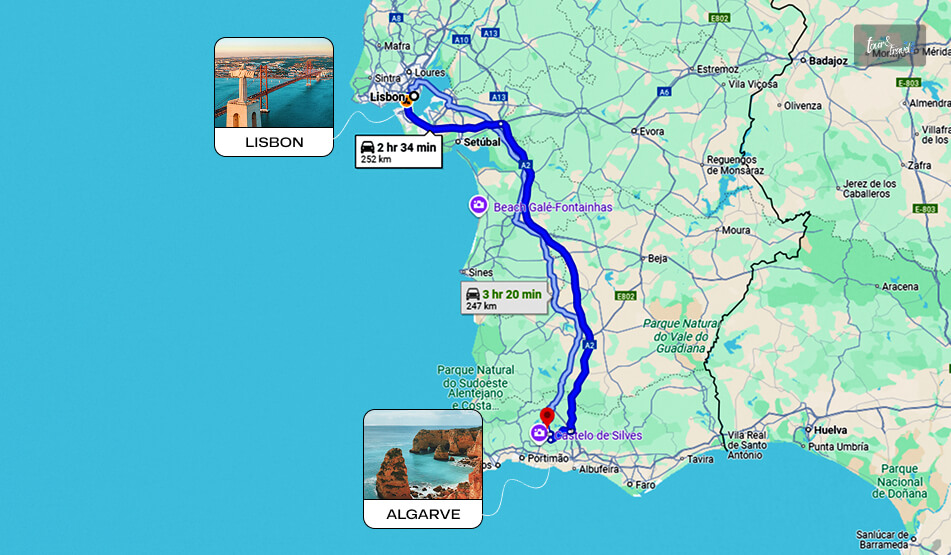
The Lisbon to Algarve distance is around 252 km. Based on the mode of transport, it will take around 3-5 hours to cover this distance.

What Is The Best Month To Visit Algarve From Lisbon? 

May to June and September to October are the best months to visit the Algarve from Lisbon. Pleasant weather conditions and fun-filled beach activities make these seasons ideal for a visit to the Algarve.

However, the weather conditions differ from one area in the Algarve to another. 

What Is The Best Way To Travel From Lisbon To The Algarve? 

What Is The Best Way To Travel From Lisbon To The Algarve

The best way to travel from Lisbon to the Algarve is by the Alfa-Pendular train. You can also take the Intercidades to enjoy a scenic train journey.

However, the other modes of transportation include buses, cars, and taxis. 

Is There A High-Speed Train From Lisbon To Algarve?

Yes, there is a high-speed train service from Lisbon to the Algarve. The high-speed Alfa-Pendular service runs from Braga to Lisbon and then to Faro in the Algarve.

The train stops at Albufeira and other major destinations on the way. 

  • How far is Algarve from Lisbon by train? 280 Kilometers 
  • How long is the train ride from Lisbon to the Algarve? 3 hours to 3 hours and 30 minutes
  • Lisbon to Algarve train cost: €22.15 to €31.40 

Alfa Pendular (AP) trains run from Lisbon’s Oriente Station, and Faro is the last stop in the Algarve.

Intercidades (IC) also run from Lisbon’s Oriente Station, and this station on Metro’s Red Line reaches Tunes, the first stop in the Algarve.

The next stops are Albufeira, Loulé, and Faro.

Two AP trains run from Lisbon to the Algarve. You can take the morning train or the one in the afternoon. The first-class tickets from Lisbon to Faro cost €31.40, and the regular or second-class tickets cost €23.50.

The Intercidades ticket prices are €28.95 for the first class and €22.15 for the second class. Visit the cp.pt website for booking the ticket online.

Insider Tips If You Are Traveling By Train 

When you reach the Algarve region by train, you can use any rideshare app, including Uber, to explore various regions. 

Furthermore, most Alfa Pendular trains offer amenities such as Wi-Fi and power sockets. 

Also, you will get comfortable seating, power outlets, wash facilities, and toilets. These are especially beneficial if you are traveling with kids. 

In addition, you will get trains from Entrecampos and Oriente to Faro Station in Algarve. You can choose the station according to your location. 

How Long Is The Bus Ride From Lisbon To The Algarve?

The Lisbon to Algarve bus ride is around 2-4 hours long, based on the destination you want to visit.

Furthermore, a dozen buses run every day from the Sete Rios bus terminal in the Algarve, and these buses are run by companies such as Eva-Mundial Turismo, Renex, and Rede Expressos.

The duration of the journey from Lisbon to the Algarve by these buses depends on the location you want to visit. 

Places to Visit in the Algarve Duration of the Bus Journey 
Sagres 4 hours 
Tavira 4 hours 
Faro 3-4 hours 
Lagos 3 hours 30 minutes to 4 hours 30 minutes 
Albufeira 2 hours 30 minutes to 3 hours 30 minutes 

You can also take a bus from the Oriente Station, which is run by FlixBus. These buses go to the following destinations. 

  • Faro 
  • Armação de Pêra 
  • Albufeira 
  • Portimão 
  • Lagos 

The bus ticket charges range between 5 and 20 Euros, and you can visit the FlixBus or Rede Expressos.pt website to book the bus tickets online. 

Insider Tips When Traveling In A Bus

If you are carrying a bag that is too large to fit into the overhead seat storage, you may have to pay extra charges. 

Also, sometimes the excess charge for the luggage can be higher than the ticket cost. 

Furthermore, if you are looking for the cheapest ticket, you can opt for the Flixbus ticket. Alsa and Rede Expressos have slightly more expensive tickets. 

However, they also offer amenities such as snacks on board, charging ports and WI-Fi connectivity. 

Lisbon To Algarve Plane Ride: 

The distance between Lisbon and the Algarve by air is close to 135 miles. The flight time is 45-50 minutes. 

However, a flight from the Lisbon airport will take around 3 to 3 and a half hours to reach the Faro Airport in the Algarve. 

The cost of a flight ticket from Lisbon to the Algarve will be around €80 to €450, based on the airlines you are flying with and the season of your visit. 

Insider Tips If You Are Traveling From Lisbon To Algarve By Plane 

The Lisbon Airport is a little far away from the Lisbon Center. It takes around 15 to 25 minutes to travel this distance of 7 km. 

Moreover, if you are traveling from the south of Lisbon, you will need one hour more to reach the Humberto Delgado Airport (LIS). 

Also, the flights from Lisbon to Algarve depart during the daytime.

Lisbon To Algarve Day Trip By Car: 

If you want to enjoy the local landscape, meet the people at the local fishing villages, or indulge in the local delicacies, a day trip from Lisbon to the Algarve by car will be the ideal choice.

However, the journey of 472.6 km between these two places will take around 5 hours and 50 minutes.

Also, if you don’t have a car, you will have to pay for the car rental, gas, etc. 

Do you want to know how much a taxi from Lisbon to the Algarve costs? Based on the location you are visiting, the charges will range from €300 to €550. 

Is Drive From Lisbon To Algarve Pretty?

Is Drive From Lisbon To Algarve Pretty

Yes, the drive from Lisbon to Algarve is very pretty. You can take a coastal route if you want to explore the dramatic cliffs, beaches, and quaint fishing villages.

On the other hand, you can take the inland routes that pass through beautiful towns, plains, and mountains.

If you ask me about my silent favorite, and what I have discussed with frequent travelers around Portugal, they all recommend taking the coastal routes. 

The Alentejo Coast is the biggest highlight of a coastal journey from Lisbon to the Algarve. Porto Covo and Nova de Milfontes are some of the most beautiful towns here. 

Moreover, you can visit coves and wild beaches here.

Peninsula Beaches and the cliffs along the Western Algarve are among the other attractions here. 

Insider Tips If You Are Traveling By Car 

Portugal has many toll roads. You cannot pay all the tolls with cash. So, you will need a card on hand. 

Furthermore, you can use a prepaid device so that you remain in the fast lane. 

Also, when you are taking a car on rent, the rental company can ask for two forms of your ID, and you may have to show the proof of your return ticket. 

Now, here is something you need to be very careful about. When you are renting a car, you have to ensure that the rental company takes note of all the dents and scratches. 

Otherwise, they may charge you for the dents or scratches you are not responsible for. 

In addition, choose a compact car for the journey for convenience while navigating the slim roads in the southern parts of Portugal. 

Some More Things You Need To Know About The Lisbon To Algarve Journey

Here are some additional information about the Lisbon to Algarve distance and modes of travel. 

Can You Do A Day Trip To Algarve from Lisbon?

Yes, you can do a day trip to the Algarve from Lisbon. However, the journey by train takes around 3 hours (one way).

Also, by car, it will take around 6 hours to reach the Algarve from Lisbon. 

Further, based on the location you want to visit in the Algarve, the travel time can be up to 8 hours. 

So, a day trip will be very hectic. 

Is 2 Days Enough In Algarve?

No, 2 days are not enough to explore the beauty and appeal of the Algarve. If you want to even touch the highlights of the place, you need at least 5-7 days. 

Coastal attractions such as Ponta da Piedade and Benagil Cave, and historical places like Silves and Faro are some must-visit places in the Algarve.

Is Lisbon More Expensive Than The Algarve?

Yes, Lisbon, the capital of Portugal, is more expensive than the Algarve. The services and leisure expenses are at least 20% higher in Lisbon compared to the Algarve. 

Furthermore, the cost of living is 40% higher in Lisbon than in the Algarve. Again, the housing cost in Lisbon is at least two times higher than in the Algarve. 

Is Food Expensive In The Algarve?

No, food is not expensive in the Algarve, unless you’re looking for a fine dining experience at a high-end restaurant. 

In fact, grocery shopping in the Algarve is cheaper compared to other Western European countries. 

Additionally, if you dine at a mid-range restaurant, the cost of a three-course meal for two will be approximately €50-60. 

The same cost will drop to around €11 if you eat at a budget restaurant. 

What Is The Best Way To Get From Lisbon To Algarve?

The best way to travel from Lisbon to the Algarve is by train. Alfa Pendular and other train services offer a scenic and comfortable train journey between these two places. 

The distance between these two places by train is around 302 km. Direct trains, such as the Alfa Pendular, cover the journey in 3 hours. 

On the other hand, Intercidade trains take close to 3.5 hours to travel from Lisbon to Algarve. 

What Is The Fastest Way To Get From Lisbon To El Algarve?

The fastest way to get from Lisbon to El Algarve is to take a flight to the Faro Airport. 

And then, you can take a train from the Faro Railway Station to explore the Algarve. In this context, you must know that Faro is the capital of El Algarve. 

What Is The Cheapest Way To Get From Lisbon to El Algarve?

The cheapest way to get from Lisbon to the Algarve is to take a bus. Companies such as Rede Expressos and FlixBus offer bus services between these two places. 

Furthermore, the cost of traveling from Lisbon to the Algarve is around 5 to 20 Euros. 

Is Algarve Worth Going To?

A charming Mediterranean climate, historical attractions, and beautiful beaches make Algarve an important place to visit in Portugal. 

Further, here, you can indulge in the best Portuguese cuisine and wine.

A Summary Of The Lisbon To Algarve Transport Modes 

Modes of TransportTravel TimeCostPerksCons
TrainAlfa-Pendular: 3 Hours
Intercidades: 3.5 Hours 
Alfa-Pendular: €23.50–€31.40
– Intercidades: €23.50–€31.40
– Most Comfortable and Scenic Way to Travel.
– AP Trains Offer Amenities like Wi-Fi, Power sockets, Comfortable Seating, and Toilets (Great for Kids).
– Direct Routes from Oriente and Entrecampos
You Need a Rideshare App to Travel to Any Place from the Railway Station. 
Bus2 to 4.5 Hours, Based on the Destination. – €5 to €20– Dozens of Daily Buses Available from Sete Rios and Oriente Terminals.
– Higher-End Operators (Alsa, Rede Expressos) Offer Wi-Fi, Charging Ports, and Onboard Snacks.
You Will Have to Pay Extra Charges When Traveling with Large Luggages. 
Car/taxiAround 5 Hours and 50 Minutes€300 to €550 for a Taxi (Plus Rental Fees, Gas, and Charging for Cars). 
Highly Customizable; Allows for Scenic Coastal or Inland Routes.Rental Companies Require Multiple IDs, Proof of a Return Ticket, and Strict Vehicle Scratch Inspections.
PlaneFlight Time: 45 to 50 Minutes
Overall Travel Duration: 3 to 3.5 Hours
€80 to €450, Based on the Airline– Fastest Travel Mode
– Daytime Flights
Overall Travel Time is Close to a Train Travel. 

Read Also:

Share on Social Media

Sibashree is a travel, culture, and leisure writer who has been writing since the age of 12 and professionally since 2014. With more than a decade of travel writing experience and journeys across India and several parts of the world, she brings a deeply personal and thoughtful perspective to her work. A student of English Literature and Mass Communication, Sibashree has always viewed travel as more than movement — for her, it has been a way of understanding people, cultures, and herself. Her passion for spiritual exploration has also led her to many unusual and meaningful destinations over the years. Outside of writing, Sibashree enjoys watching European cinema, reading about global politics, and reflecting on the stories hidden within everyday places.

Leave a Reply

Your email address will not be published. Required fields are marked *

title-img Related

READ MORE Authentic Travel Experiences

9 Tips For Authentic Travel Experiences

BY  Arnab Oct 27, 2023

Travel is more than just setting foot on unfamiliar terrain. It's a journey into the heart of a culture, a deep dive into local traditions, and an opportunity to immerse yourself in the essence of a place. Authentic travel experiences allow you to see, taste, and feel the true spirit of a destination. The era of tourist traps is fading. Today, travelers seek genuine interactions, unique tales, and opportunities to venture off the familiar path. So, how can you ensure your next trip is teeming with authentic experiences? Delve into these essential tips. 1. Embrace Language And Communication Mastering a few local phrases can significantly transform your travel. Imagine being in Japan and ordering your meal in Japanese instead of pointing at a menu. Before departing, consider enrolling in Japanese classes online. Doing this not only impresses the locals but also enriches your journey. Language serves as a bridge to deeper interactions and understanding. Dive into local media like films or podcasts. They offer a window into the nation's heartbeat, illuminating its culture, values, and everyday nuances. And keep in mind: patience and an open heart go a long way. Not all conversations will flow seamlessly, but your effort won't go unnoticed. Many appreciate your attempts to speak their language. 2. Opt For Local Accommodations Staying in local lodgings such as guesthouses, bed and breakfasts, or homestays can elevate your journey. In such accommodations, you can feel the warmth of local hospitality and perhaps form lifelong friendships. Often, these places are situated in less touristy areas, letting you explore authentic neighborhoods. Additionally, the owners usually have unmatched local insights and can suggest hidden treasures you won't find in guidebooks. More so, supporting these accommodations boosts sustainability. By backing local businesses, you contribute directly to the community, ensuring a rich experience for yourself and a boost for the local economy. 3. Eat Where The Locals Eat Food plays a central role in travel. Rather than dining at tourist-centric spots, find places where locals congregate. Street food vendors, local markets, and family-run diners often serve the most authentic and tantalizing dishes. Venturing into local culinary scenes also immerses you in a location's cultural and historical narrative. Food mirrors a country's past, influences, and rituals. So, while savoring different dishes, you taste myriad stories and traditions. Stay adventurous and be open to sampling new foods. Some might seem exotic, but they could be the highlights of your trip. Remember, travel isn't just about seeing new places; it's about tasting new flavors, too. 4. Participate In Local Traditions And Festivals Joining local traditions and festivals offers a profound cultural immersion. These events reflect the heartbeat of a community and its binding tales. Whether you're dancing at a festival in Bali or celebrating Carnival in Brazil, active participation profoundly connects you to the local culture. However, approach these events with respect. Stay aware of local customs and etiquette. For instance, if a festival requires a certain attire, respect that. Always ask before taking photos, especially during religious events. While these experiences are new to you, they're integral to many locals' lives. Your attitude can determine whether you're appreciating or appropriating. Respect ensures your experiences are memorable and positive. 5. Take Public Transport Using public transportation isn't just economical; it also offers a front-row seat to everyday life. Riding buses, trams, or trains lets you witness the mundane yet beautiful moments of daily life. Furthermore, public transport can introduce you to lesser-known parts of a city or town. These spots often provide a more authentic experience, whether it's a hidden café, a quiet park, or a lively market. Choosing public transport is also eco-friendly. It reduces your environmental impact, eases traffic, and supports the local economy. So, hop on local transportation during your next trip and discover unexpected treasures. 6. Choose Experience Over Sightseeing While landmarks are captivating, hands-on activities offer unparalleled authenticity. Rather than just sightseeing, dive into local activities. Enroll in a pottery workshop, learn the local dance moves, or whip up local dishes. Such activities immerse you in the details of local traditions. Plus, they often lead to lasting connections with residents. Engaging in a craft or skill provides avenues for rich interactions, leaving indelible memories. 7. Engage With Locals  Conversations with locals offer insights no guidebook can match. Interacting with a street vendor, a fellow commuter, or a café proprietor can deepen your understanding of local beliefs and aspirations. Always approach with genuine interest and respect. Not everyone may be in the mood to chat, but that's okay. When conversations do occur, you might be surprised by the hospitality and warmth. Often, these chats can lead to recommendations for off-the-radar attractions or experiences. Such insider info can redefine your journey, uncovering hidden spots and moments to cherish. Related: Prepping For Your Winter Trip To Salt Lake City 8. Embrace Sustainable Practices Integrating sustainable practices into your travels ensures that the destinations you love remain beautiful and vibrant for future generations. Consider eco-friendly accommodations or those that have sustainable certifications. These places often go the extra mile to reduce waste, conserve water, and support local communities. Another aspect of sustainable travel is conscious consumerism. Opt for handcrafted local products rather than mass-produced items when buying souvenirs or gifts.  This not only supports local artisans but also helps keep traditional crafts alive. Remember, every purchase you make has an impact, and as a traveler, you have the power to make it a positive one. 9. Travel Slowly In this fast-paced world, leisurely travel offers a distinct pleasure. Allowing yourself to explore slowly enables you to soak in the ambiance, sync with local rhythms, and form genuine bonds. Instead of rushing from one spot to another, meander through lanes, relax in parks, or savor extended meals. Slow travel emphasizes mindfulness, helping you appreciate nuances—the scent of fresh bread, the sound of laughter, or the art in local crafts. These moments often encapsulate a destination's essence. In Conclusion True travel goes beyond sightseeing—it's about immersion, comprehension, and connection. By diving into local languages, traditions, and activities, you not only elevate your travels but also leave a positive mark on the places you visit. Embracing these tips means every journey offers a chance to evolve. Here's to more authentic and unforgettable adventures. Safe travels! Read Also: Thailand Travel Guide: This Is The Best Time To Visit Stay Safe And Satisfied: Exploring Paraguay’s Culinary Delights With Travel Insurance In Mind A Newly Launched Tool ‘Skyscanner’ Inspires Travelers To Book Travel Destinations With Ease And Confidence

READ MORE What is the oldest country

What Is The Oldest Country In The World? Japanese And Other Civilizations Still Alive Today 

BY  Sibashree Apr 1, 2026

While Iran, one of the oldest countries in the world, is fighting back against the joint attack of the USA and Israel, it’s the correct moment to look back at the ancient civilizations of our world.  So, what is the oldest country in the world?  While some say it is Japan, some vouch for India, and China remains the oldest continuous civilization in the world.  Here, I have picked 10 countries that I can call the “Immortal Ten” because of the human resilience they have shown and how they have survived.  What Is The Oldest Country In The World?  The current geopolitical map, in fact, did not exist for a long time.  Most of the countries that are members of the United Nations came into being in the aftermath of 20th-century decolonization or the dissolution of Soviet-era empires.  But what lies under the modern borders and changing flags is a much deeper level of human history.  Although historians generally use continuous sovereignty to measure longevity.  However, a government can lose its sovereignty to an invader, but that does not necessarily mean the end of the culture.  The true measures of a lasting civilization are cultural continuity, the survival of language,  religion, social cohesion, and identity beyond the ruin of even the most magnificent palaces. So, each civilization that qualifies for this list has withstood conquest, colonization, or internal upheaval without losing its very foundation.  Here are the ten oldest civilizations that are still living today. 1. China, The Oldest Continuous Civilization In The World  China traces its origins back to the Shang Dynasty (c. 1600 BC) over 3,500 years ago.  The oracle bone script of the Shang did not simply get lost like the hieroglyphics of Egypt or the cuneiforms of Mesopotamia. Instead, it gradually transformed into the modern Chinese writing system in use today.  Furthermore, the "Imperial Logic" of China, a centralized bureaucracy under moral guidance by Confucianism, was the charter of the Han Dynasty. It continued to be the underpinning even through the rise and fall of the many dynasties.  Even when the country was dominated by foreign powers such as the Mongols (Yuan Dynasty) or the Manchus (Qing Dynasty), they did not "unmake" China.  Rather, the new rulers were "Sinicized, " taking on the Chinese ways of administration and language so as to stay in power.  The present-day People's Republic of China utilizes a model of central governance that is reflective of the bureaucratic mindset of the emperors who ruled the country some two millennia ago. 2. Egypt: The Tital Of Antiquity  Egyptian civilization rose to prominence around 3100 BC under Pharaoh Narmer, at least in theory.  For 3,000 years, it set the standard for administration, engineering, and art.  The native religion faded with Christianity, and later Islam, and Coptic was mostly replaced by Arabic.  Still, the Egyptian character stayed rooted in the Nile.  Foreign powers, such as the Persians, Romans, Ottomans, and British, could never fully erase that identity.  Furthermore, Cairo held a central role in Islamic thought for centuries.  Today, Egypt remains the most culturally influential nation in the Arab world. The people have outlasted every empire that tried to control them. 3. Iran: The Persian Resilience  Iran, once called Persia, ruled the world from 550 BC when Cyrus the Great built the Achaemenid Empire.  The culture soaked up new rulers instead of losing itself.  After Alexander took over, he started wearing Persian royal clothes.  When Islam came in the 7th century through Arab rule, Persians embraced the faith but kept their language and built a unique style of art and religion. Thus, eventually, the formation of Shi'a Islam happened.  Farsi stayed strong with its roots unchanged and gave rise to poetry that shaped global thought, in particular through Rumi and Hafez.  Now, Iran's Islamic Republic stands where the ancient emperors once did, same land, same heartland, 2,500 years later! 4. India: The Land Of Spirituality India's story starts with the Indus Valley Civilization (c 2500 BC).  After it faded, the Vedic traditions in the Ganges Valley shaped Hinduism.  Also, the thing is, India has always had this "Diversity in Unity. "  It survived Mughal rule and the British Raj without giving up its core values or spiritual roots.  Local languages, epics like the Mahabharata, and daily life structures held strong through centuries of outside control.  After its independence from British Rule in 1947, India became the world's largest democracy, built on an ancient foundation that still holds together today. 5. Greece: The Land Of Philosophy  Greek civilization had its beginnings in the Bronze Age with the Mycenaeans (c. 1100 BC). Furthermore, its most flourishing period was the 5th-century BC "Golden Age" of Athens.  After the Greek city-states were absorbed by Rome to some extent, Greek culture became the very foundation of the Roman Empire.  In the Byzantine Empire, Greek was the language of the state as well as the church, and it was through these that Classical knowledge was preserved through the Middle Ages.  Even under four centuries of Ottoman rule, Greeks maintained their identity through the Orthodox Church and the use of their ancient language.  Moreover, when modern Greece was liberated in 1830, in essence, it was not a matter of creating a new identity. It was about celebrating a nation and a culture that has been around for three thousand years. 6. Japan: The Land Of The Oldest Continuous Hereditary Monarchy Japan has the world's oldest continuous hereditary monarchy, beginning with a legendary founding in 660 BC and first documented records in the 6th century AD.  It modernized rapidly during the Meiji Restoration in 1868 without losing its traditional values.  Furthermore, unified by one language and Shinto and Buddhism, Japan was never colonized by a Western power.  Even after World War II destroyed much of its infrastructure, the imperial institution stayed intact as a symbol of continuity.  Probably more or less, Japan's blend of advanced industry and old social norms contributes to its stability.  Today, the nation remains one of the most enduring civilizations in history. 7. Ethiopia: The Highland Fortress Ethiopia stands as a symbol of African endurance.  Its origins go back to the Aksumite Empire (c. 100 AD), which was among the earliest nations to adopt Christianity in the 4th century.  For over seven hundred years, the Solomonic Dynasty, which asserted its lineage from the biblical King Solomon, ruled the country.  The challenging terrain of Ethiopia enabled it to be the only African country that was never colonized (although it was under an Italian occupation for a short time in the 1930s).  The Ethiopian Orthodox Church and the Ge'ez script were cultural foundations. It preserved national identity and sovereignty when the rest of the continent was carved up by Europe. 8. Jewish Civilization Starting in the kingdoms of Israel and Judah more than 3,000 years ago, Jewish civilization stands as the most remarkable example of cultural resilience in history.  After the Romans destroyed Jerusalem, the Jews spread out worldwide in a diaspora. Normally, a nation without a territory would lose its identity in a few generations.  However, Jewish civilization, through religious law (Halakha), the Hebrew script, and a strong tradition of education, was able to survive as a "portable nation".  The founding of the State of Israel in 1948 was the political expression of a cultural memory that had been kept alive for over 2,000 years. 9. Armenia: The First Christian State Armenia has been located in the Caucasus region for at least 3,000 years.  It was the first country to make Christianity its official religion in 301 AD.  Yes, the Armenian people had many influences. The Persian, Roman, Ottoman, and Soviet!   They still maintained their unique alphabet (created in the 5th century) and their national church.  Not even the atrocities of the 1915 genocide were able to sever the cultural connection of the modern Republic of Armenia with its ancient Bronze Age heritage. 10. Korea: The Hermit Continuity The Korean culture started with the kingdom of Gojoseon. Further, its cultural identity resulted in a unified nation by the 7th century.  Surrounded by a peninsula, Korea had its unique Hangul script and Confucian values. Thus, despite cultural influences from China and a very harsh period of Japanese colonization (1910-1945), it never lost its identity.  Even though North and South are separate nowadays, they both have the same original myths, language, and sense of ancestors' pride.

READ MORE things to do in manila

Read All About Things to Do in Manila! 

BY  Mashum Mar 29, 2025

With the beautiful Spanish culture spread across Manila, there are a lot of places to visit. There are a lot of things to do in Manila which I will highlight in this blog so that you can plan your trip accordingly.   Starting from contemporary museums to art scene, the place is the home of the oldest Chinatown across the world. Let me share with you several elements that will help you explore the place, both the old and the new.   I think Manila is one of the best places to visit in February especially because the weather is dry and pleasant. You can easily explore the city during this time.   Read All About Things to Do in Manila!   If you are wondering about the things to do in Manila, let me share with you some of the coolest places to visit. The nightlife is good here, but I am more of a museum and art scene girlie. It is the home of several parks and museums that will express history to you.   Several elements will make you feel that you have come to a previous era. Additionally, several places offer entertainment and fun to people of all ages.    Rizal Park   A beautiful park, open from Monday to Sunday. It is mostly open from 5 am to 10 am and 11 am to 8 pm. When you visit the park, entry is completely free. There are several gardens, laws, and other outdoor events organized across the 57-hectare park.   There is also a statue of hero Jose Rizal, commemorating him, and the name of the park is given. The hero has contributed to the wellbeing of the city hence, you get to see a lot of him and his commemoration in and around the city and places to visit.   There are a lot of places where you can go shopping once you explore the city. Henceforth, if you are traveling alone, carry the best travel credit card you possess.   Fort Santiago   It is a landmark in Manila which is open from Monday to Sunday, from 8 am to 11 pm. The place is a defensive fortress which has a museum exhibiting many arts and sculptures. The national hero, Jose Rizal is commemorated through the exhibits of the museum.   In 1571, the Spanish governor and navigator, Miguel Lopez de Legazpi built the castle or the citadel. The city of Manila was newly established by then and is currently one of the oldest fortifications.   National Museum of Fine Arts   A massive museum, the place is a collection of fine art, botany, natural history and archaeology related to Filipino culture. The museum is open from Sunday to Monday from 9 am to 6 pm.   As the home of 29 galleries and exhibitions in the hallway, it comprises national artists and Filipo masters of the 19th century.   San Agustin Church   A beautiful place to visit, this historic place was constructed in the 16th century. The San Agustin Church is open from Monday to Sunday from 8 am to 5 pm. The ceilings are vaulted while the church exhibits detailed frescoes.   It is a Roman Catholic church which is located in the intricate walled city of Intramuros in Manila. The church functions under the auspices of the Order of Saint Augustine. Furthermore, when you visit you get to see Baroque art in the church.   Manila Ocean Park   More of an aquarium if you ask me, the Manila Ocean Park is open from Sunday to Monday from 10 am to 6 pm. The theme park is owned by China Oceanis Philippines Inc. and it has evolved into the perfect holiday destination for tourists.   It is an aquatic theme park which you will have both fun and knowledge when you check it out. Additionally, it is a perfect place for you, if you are traveling with your kids. It is one of the best places to travel with kids.   It is also an educational facility that features live shows, an oceanarium, and hands-on activities. There are all-star Bird shows, Sea lion shows and many more giving you the perfect experience and offering you the thrill of the ocean.   Intramuros   The meaning of the term, Intramuros, is the “Walled City” which is the oldest district in Manila. It looks like a fortified city which was one of the most important places for Spanish governor during earlier times of colonial times.   If you are a lover of history, this is the place for you. The culture of the place has been heavily influenced by the colonial rule and the impact it has on ordinary people.    Paco Park   An urban park which offers you serenity when you visit it between 6 am to 5 pm from Monday to Sunday. The park has been developed on a cemetery site which is walled of course. There are shaded paths for people to walk along with areas dedicated for gardens.   The cemetery is under the maintenance of municipality, and it was built by the Dominicans. During the Spanish colonial period, it was built and filled within it are interred remains of city figures.   Ayala Museum   https://www.instagram.com/p/DGpqNWWTrLn/?img_index=4 Another amazing museum that you must visit if you are going on a trip to Manila is Ayala Museum. It is open from Sunday to Monday from 10 am to 6 pm. The museum has a modern touch exhibiting Filipino archeological exhibits.   Starting from history to modern and cultural artifacts and exhibits are available here. There is also a research library that is quite important for you if you are writing a research paper on the history of Spanish colonial period.   The place is run by the Ayala Foundation privately. It houses several ethnographic, archaeological and cultural exhibits and art. You will be fascinated to know that the place exhibits the Surigao treasure of the indigenous tribe?   Arroceros Forest Park   Another urban park that you must visit is Arroceros Forest Park as things to do in Manila. There are a wide variety of plants and trees in the park along with a riverside walkway and a fishpond! A perfect combination of nature and modern practices will enhance your overall experience.   The park is open for you to visit from Sunday to Monday from 8 am to 5 pm. The lush green forest is filled with greenery. Did you know this place is also known as “Last Lung of Manila”? Spread across 2.2 hectares, the park is a home of many flora and fauna species.   Casa Manila   The Casa Manila is a house that now serves as a museum which is open from Sunday to Monday from 9 am to 6 pm. The house was built in the 1850s and is not restored to exhibit art, architecture, and colonial furniture of the Spanish colonial rule.   It is often called the living museum which features the way a well to do affluent Filipino family will live. The lifestyle of this family is depicted through the arrangements of furniture, art and architecture.   The colonization had severely impacted Manila and this is how we can see when we enter the museum. It is a must-do list of things to do in Manila.   Wrapping Up!   In conclusion, now that you have gone through the things to do in Manila, I am sure you are already planning on what to do. When you visit the place, I am sure you will experience the ancient practices and instances of the Spanish colonization of the Philippines.   Comment below on which place is your favorite to visit when you to Manila. You also need to share with us if you think we have missed something on the things to-do list.  Also read Top 10 Most Popular Paraguay Food That You Must Try. Top 13+ Famous Wonders Of India That You Must Visit.