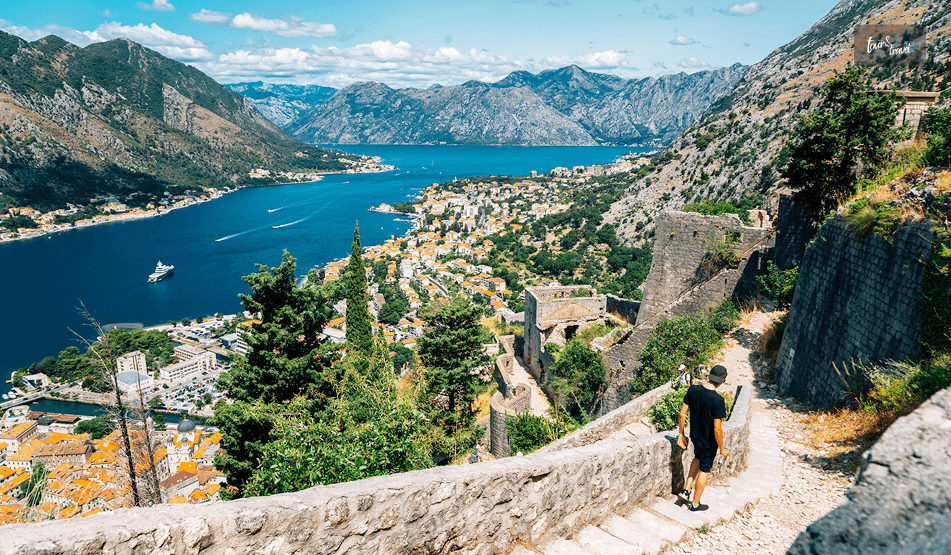
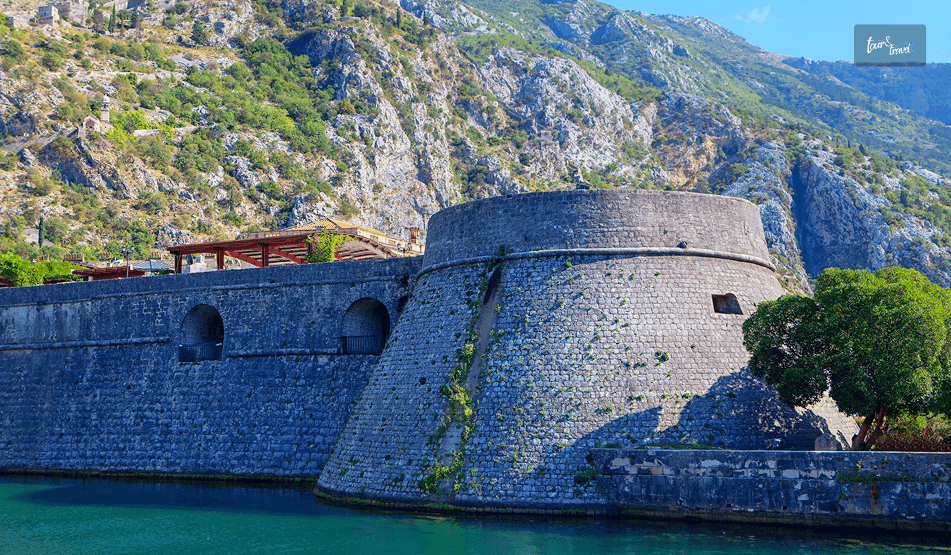
You can visit the Kotor Fort via the city entrance, which costs 15 Euros.
However, you can avoid this cost by taking the alternative route, which begins behind the Old Town of Kotor.
You can access this trekking route via Tabačina Street.
This route, beginning near the River Gate exit, is popular among locals for a free hike to the Kotor Fortress or the San Giovanni Fortress.
After walking for 20 to 30 minutes on the route with loose rocks and steep terrain, there is a place called “Window.”
Earlier, locals and tourists used to get into the fortress through this window.
However, the window is now blocked under strict vigilance from the fort authority.
So, you cannot reach the fort through this hiking route anymore. But hiking through this route itself is an experience.
Also, if you are looking for cheap eats in Kotor, Montenegro, that offer the most authentic experience, let me tell you that you will find the best cured ham here.
The hiking route leads to Njegusi, and it has some amazing family-run taverns.
Hiking The Fort Vrmac For Free
I did not know that so close to Kotor, Montenegro, I would find the ruins of an Austro-Hungarian Fort.
The hiking route is easy, and it passes through a quiet forest, offering multiple vantage points and amazing views.
The trailhead is just 15 minutes away from the Kotor Old Town and near the town of Muo.
Also, the stone path of 6.5 kilometers can be completed within 3 to 4 hours.
On my way, I came across pomegranate trees and spotted turtles with yellow and black spots.
The only difficulty I faced on this route was the lack of any clear direction.
The route was a bit random and can get confusing if you are hiking alone.
After I reached the top, I found an abandoned military outpost.
It was like a ghost town.
The ghost town and the Vrmac Fort of 1894, which suddenly emerged before my eyes like something surreal, seemed eerie to me.
I could hear the rifles firing.
The fort played a vital role in the World Wars and was later used by the Yugoslav army.
Expanding The Free Hike To Fort Vrmac
Once you are done exploring the fort, you will find many trails leading to different destinations from the top of the hill.
You can choose to continue your hike to Tivac or take an alternative and longer trek route to Kotor Town.
Hiking The Fort Gorazda For Free
Fort Gorazda is another Austro-Hungarian Fort, and it is a popular free hiking destination near the Old Town of Kotor.
This fort, built between 1884 and 1886, is located at an altitude of 452 meters.
Once you reach the hilltop, you must climb up the metal dome.
This armored metal dome was one of the main elements, offering a strategic advantage to the fort.
From the top of this dome, you will get a 360-degree view of Herceg Novi, Lustica Peninsula, and Tivat.
For a free hike, you must start at the Trg od Oruzja or the Main Square of Kotor.
Then, walk to the Old Town and make an exit at the Vrata od Kampa or North Gate.
Turn left and continue on the Jadranska magistrala or coastal road to find the signs for Skaljari.
Chill at the cafes and shops along the way and have some refreshment.
Then, walk for around 20 minutes to reach the Skaljari Village.
Walk straight, and on the right, you will find a steep path that takes you uphill.
At the end of this road, you will find Fort Gorazda.
The hike is moderately challenging, and a round trip will take around 5-7 hours.
An Alternative Route To Fort Gorazda
If you are short on time and don’t want to walk so much, I want to share some Kotor transport tips to reach Skaljari.
The bus ride will take around 10 minutes, and once you reach Skaljari, you can walk for 15 to 20 minutes to the route leading to the fort atop a hill.
This combination of bus ride and hike is also a budget-friendly option, considering the bus tickets only cost around 1 to 2 Euros.
2. Free Historical And Cultural Exploration
When you have the alleys of a UNESCO World Heritage Site to explore, you know that a rich cultural and historical experience awaits you.
It’s time to soak in the medieval atmosphere.
Walking The Old Town (Stari Grad): A Self-Guided Route
The Old Town, or Stari Grad of Kotor, allows you to get lost intentionally in the cobblestone mazes and alleys.
• Walk Starts At Gurdić Gate
Anyway, I started from the Gurdić Gate, or the southern entrance to Kotor.
From there, my walk continued through Craftsmen Street.
I met and talked with the carpenters, goldsmiths, blacksmiths, and shoemakers there.
I bought two model boats from a shop here as souvenirs.
• The Famous River Gate And Meeting The Cats Of The Town
Then, I reached the famous River Gate.
I crossed the bridge there and got an amazing view of San Giovanni’s Fortress.
Then, I came back to the town, and near the Leafy Square, I found many cats, the guardians of the city.
Also, St Mary’s Church, built in 1221, was one of the main attractions during my Strai Grad walk.
• St Lucas’ Square
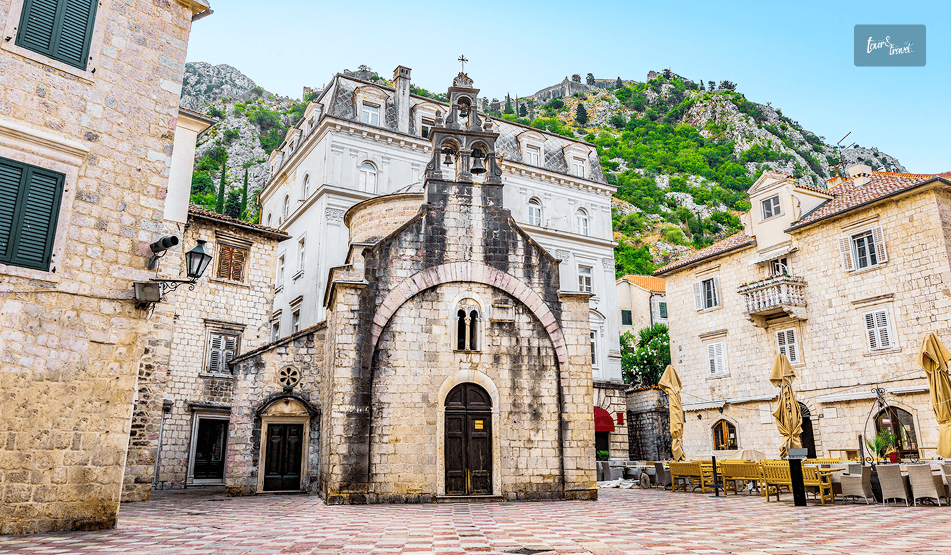
My next stop was St Lucas’ Square, home to the Orthodox Church of St Nicholas.
However, I found St Lucas’ Church here more interesting, with the history of this Byzantine church going back to 1195.
The St Lucas’ music school was opposite the church, and I could hear the sound of the piano and the full orchestra.
• Museum Square
I took the little lane to the Museum Square, and just before reaching the square, I found Karampana in a small courtyard on my right.
It is the oldest public well in Kotor.
On the left, there is the Gregorina Palace, home to the famous Maritime Museum of Kotor.
• St Tryphon’s Square
With beautiful mountain views and guarded by ramparts, St Tryphon’s Square is a place filled with many iconic landmarks of the Old Town.
In a clockwise direction, you will find the following places at St Tryphon’s Square.
The Old Town Hall
Drago Palace
Bishop’s Palace
St Tryphon’s Cathedral
Venetian traders brought some of the relics inside St Tryphon’s Cathedral from Constantinople to Kotor in 809.
There is also an altarpiece made by the goldsmiths of Kotor in the 15th century.
• Square Of Four
I took the road running between the Old Town Hall and the restaurant and reached the Square of Four.
Pima Palace and the Buča Palace are two important architectural and historical landmarks of the Square of Four.
• Square Of Arms
After I reached the Square of Arms, I visited Café Forza.
I had an amazing Dobrotska Torta and coffee here, while cherishing the view of the Bizanti Palace, Venetian Arsenal, the Prince’s Palace, and more.
Finally, I bid goodbye to the Old City and made an exit through the Sea Gate.
Which Churches Are Actually Free?
Kotor, Montenegro, has many churches, and they are often mentioned while discussing the Kotor Montenegro free activities.
However, not all the churches in Kotor offer free entry.
For example, you will need to pay 3 Euros for entry to the St. Tryphon Cathedral Church.
• St. Nicholas Church
The St. Nicholas Church in Kotor is one of the free churches to visit in Montenegro.
This Orthodox church, built in 1909, has a lavish interior.
You can buy candles from the small shops nearby for praying at the church.
• St. Tryphon Cathedral
St. Tryphon Cathedral, or Kotor Cathedral, built in 1166, does not offer free entry.
You have to pay 3 Euros for entry.
The church has the relics of St. Tryphon, the patron saint of the city, and a museum.
Its architectural style shows eclectic influences, including the Baroque, Renaissance, Byzantine, and Roman styles.
• St. Luke Church, Kotor
The best thing about this 1195 church is that it does not have a clear Catholic or Orthodox identity.
So, it was my favorite in Kotor. Anything that does not create differences in religion!
Furthermore, the church has one Catholic altar and an Orthodox altar.
It remains open to all and offers free entry during the summer season. However, it remains closed in the winter season.
• St. Claire’s Church, Kotor
Adjacent to the Franciscan Monastery, St. Claire Church, built in the 18th century, stands out with its grand altar and stunning interior.
Have a look at its wooden ceiling before leaving the church. It offers free entry.
The Hidden Gem: St. Clare’s Franciscan Monastery, Church & Library
Once again, let’s talk about St. Clare’s Church, Monastery, and Library, one of the few Catholic churches in Kotor, Montenegro, and a true hidden gem.
Made of brick and stone, the exterior of the church is humble.
However, once you enter the church, you see the main altar, made of red and white marbles and exuding a Baroque style.
This altar was made by Francesco Cabianca in 1708.
The side altars also have a Baroque style with paintings by Venetian artists.
Later, Špiro Đuranović, a local painter, added a picture of St. Clare and four evangelists.
Among the many other collectibles, ancient books and manuscripts preserved by the church and its library, the Ecce Homo painting by the Spanish painter Morales, or El Divino, is the most famous.
Walking The Lower City Walls & Kampana Tower
You can start this walk of the Kampana Tower and the lower city walls from the Sea Gate.
Enter the Old Town.
Walk toward the northwest corner of the city walls to find the Kampana Tower.
Enjoy the views of the Scurda River and the harbor.
Walk toward the North Gate.
3. Free Swimming Spots In Kotor Bay
The rocky shores of the Kotor Bay offer many free swimming spots.
Once you reach a beach, look for the public access areas for a free swim and go directly into the water.
Free Swimming Spots
Experiences
Dobrota Promenade
• Find the hidden spots for swimming from the rocky shores directly
Kotor Waterfront
• Choose a public access spot with small pebbles
Perast Waterfront
• Expect charming town views
Bajova Kula Beach
• Beautiful pebble beach • Clear water
4. Free Events And Festivals In Kotor
Have a look at the table below to learn about the free festivals and events of Kotor, their timing, and specialties.
Free Events and Festivals in Kotor
Timing
Free Elements
The Tripundanski Days or the Days of St. Tryphon
3rd February
Cultural exhibitions, parades, and concerts at Kotor Old Town
Kotor Carnival
February/March
• Masks • Parades • Free Street Parties
Boka Night Or Bokeljska Noć
August
• Boat Parade • Fireworks • Concerts in Old Town
Camellia Days
March to May
• Celebrating Camelia Flowers and Local Flavors • Free Cultural Activities
Kotor Festival of Theatre for Children
2nd to 10th July
• Street Performances • Festive Decor in the Streets of Kotor Bay
5. Free Activities That No One Talks About
You can go through the best lists about free activities in the “XYZ” place.
However, you will never know where the real magic lies until you visit the place.
• Watching Sunset At Mount Vrmac
People still talk about a hike to Mount Vrmac and Fort Vrmac.
However, only a local knows that the ideal time to start this hike is late in the afternoon.
Then, you will reach the Sveti Ilija Peak, the highest viewpoint, by sunset.
• The Gurdić Spring Or The Gurdić Bastion
This is a free attraction near the South Gate of the Old Town to learn about the resilient defense system of the city.
Here, water bubbles from underground and flows into a moat system.
• The River Gate
Built in the 16th century, the River Gate, or the North Gate, is an entrance to the Kotor Old Town, a UNESCO World Heritage Site.
The bridge crosses the Škurda River.
Thus, you can enjoy amazing views of the mountains, rivers, and the entire Kotor Bay from the bridge.
What Are The Cheap Activities To Do In Kotor, Montenegro?
Now comes the cheap activities in Kotor.
You can choose between short trips to nearby towns such as Perast and Budva, or exploring the former submarine tunnel entrance.
1. The Perast Bus Adventure
A Perast bus ride from Kotor will cost around 1.5 Euros.
You will come across stunning Baroque architecture, such as the Zmajević and Bujović palaces.
It is a part of the UNESCO World Heritage Site, and as a historic seafaring town, it has a rich maritime history.
2. A Bus Trip To The Budva Old Town
One of the oldest urban centers in the Adriatic, the Budva Old Town has a history of more than 2500 years.
It stands with its fortifications and Venetian walls.
Furthermore, it has iconic landmarks such as the Church of St. John the Baptist and the Holy Trinity Church of the 19th century.
3. Visiting The Former Submarine Tunnel Entrance
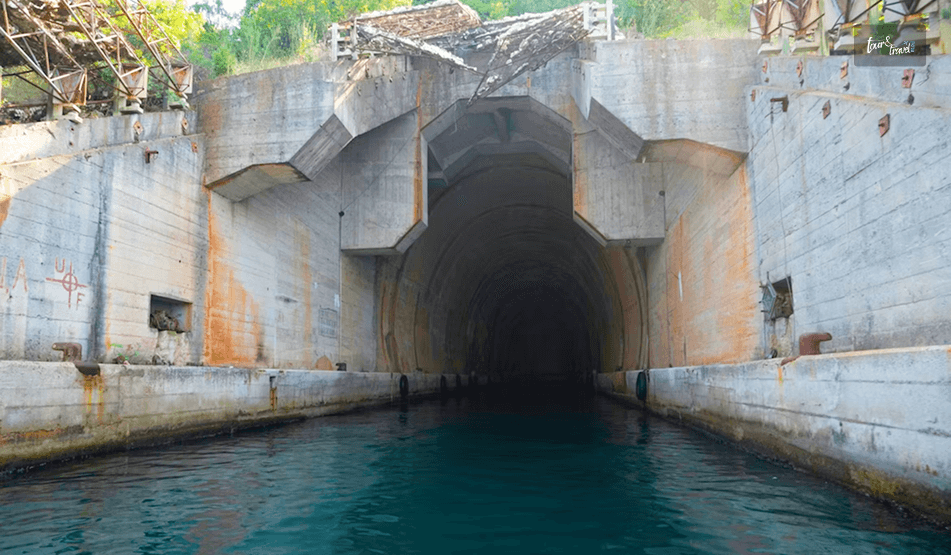
The former submarine tunnel entrance near Kotor is an abandoned historical spot.
It goes back to the Yugoslav era. The Yugoslav Navy used it as a secret military base for hiding submarines and boats.
From Kotor, you can take a bus to Kumbor and then follow the signs leading to the submarine tunnel entrance.
The bus ticket price from Kotor to Kumbor will be around 1 to 3 Euros.
Also, if your budget permits, you can combine a visit to the former submarine tunnel entrance with a private speedboat tour to Our Lady of the Rocks and the Blue Cave.
The ticket price will be around 35 to 50 Euros.
4. Exploring The Kotor Farmer’s Market
The open-air market just outside the Old Town walls of Kotor offers a delightful sensory experience.
It is the place where you will experience authentic Montenegrin life and the best local flavors.
Buy cheese, honey, and local produce from this market and cook your meal at your hostel or homestay kitchen to budget your food expenses.
How Can A Student Explore Kotor On A Budget? The Ultimate Hack For Kotor On A Shoestring
I can give you a five-point solution to survive in Kotor and explore the city as a student on a shoestring budget.
1. The €1 Museum Hack
Do you have an International Student Identity Card or a valid student identity card?
You will have to pay just 1 Euro, instead of 5 euros, for entry to the Maritime Museum of Kotor.
Also, an entry to the Kotor Cat Museum costs just 1 Euro for everyone.
You don’t just get a bed, but become a part of the social calendar.
The Old Town Hostel and Montenegro Hostel 4U are some of the most famous names, offering you free value-added services.
Furthermore, you can be a part of the Sunset BBQs and get rakija shots and food there for a small fee.
3. The €2.50 Lunch Strategy
I know it’s tempting.
However, a student or someone traveling on a budget has to miss the sit-down restaurants in the Old Town squares, including areas such as the Arms Square or the St. Tryphon Square.
Instead, you can visit the local bakeries, or Pekara.
Order a Burek there with a hearty meat filling and have it with yogurt.
This lunch combo under €2.50 will keep your tummy filled for hours.
4. Bus Discounts
When you are in Kotor, you can use your International Student Identity Card (ISIC) card or a valid card from any university to get 20–30% discounts on bus tickets.
Book tickets from platforms like BusTicket4.me to get the discounts.
5. Make The Most Of The Free WiFi Zones
The “Square of Arms” area and the area in Old Town just in front of the Sea Gate offer free public Wi-Fi facilities.
These are local municipal connections.
Furthermore, use platforms such as Coworker.com to locate coworking places near Budva or Tivat.
However, before you use any public Wi-Fi connection, you must have a VPN installed on your phone or computer.
What Are The Best Expert Tips For Free Things To Do In Kotor Montenegro?
Want to make the Montenegro free activities more fun? Give these expert and insider tips a good read.
1. Use The “Maps.me” App For Hiking
Kotor is a popular remote-working destination, and internet connectivity is overall stable and consistent.
Still, you may face connectivity issues while exploring the hiking trails or the nearby villages.
Also, trail routes such as the Ladder of Kotor or the Fort Vrmac do not have clear markings. So, it is always a better option to download an offline map from Maps.me.
It is a more trustworthy option than Google Maps for local trails.
2. Choose Park Slobode For Swimming
Take a left after the Port Authority building to find Park Slobode.
It is not as crowded as the main beach.
You can get into the water from these concrete steps for a free swim.
The water here is cleaner and suitable for swimming.
3. Visit The Markets Around The Closing Time
The Green Market outside the city walls is a wonderful free market to browse.
Furthermore, the vendors usually pack up between 1 and 2 PM.
Many vendors give away free fruits during these hours.
4. The View From Kampana Tower Can Beat Any Mountain View
If you are too lazy to climb the mountains for a wonderful view of the Kotor Bay, you can walk to the Kampana Tower at the northwest corner of the wall.
You can climb up the stairs to reach the top of this bastion for free.
From there, you will get wonderful photo opportunities.
5. Don’t Miss The Bokeljska Night
If you are visiting in late August, do not miss “Bokeljska Noć.”
It is a massive boat parade with fireworks. It is completely free to watch from the harbor wall.
6. Choose The “Mu” Walk
If you find the roads toward Dobrota very crowded, you can choose a quieter alternative, Muo.
Here, you will have to walk along the waterway through a flat and scenic route.
You will love the reflection of the city walls in the water.
7. Don’t Miss The St. Nicholas Liturgy On Sundays
Visit the St. Nicholas Church on Sundays to attend the Liturgy.
The most delightful element of this Liturgy is the Orthodox choral singing. You can listen to it completely free.
8. Avoid The Window Fines
Once again, you must not try to jump the turnstiles or force the blocked window at the fortress.
If a park ranger catches you crossing the barrier, you will be charged a fine.
Kotor Montenegro Free Activities: Frequently Asked Questions (FAQs)
Here are the frequently asked questions and answers about Kotor Montenegro free activities.
1. Is The Kotor Fortress Free Before 8 AM?
No, there is no official rule for free entry to the Kotor Fortress before 8 AM.
The trick is that in the winter and spring seasons, from November to March, the guards do not reach the fort before 8 AM.
So, you can try entering the fort for free.
However, guards reach earlier in the summer months.
So, if you get caught, you may have to pay 15 euros, and this is more of a trick or gamble.
2. Which Churches In Kotor Are Free To Enter?
The free churches to visit in Kotor are the Church of St. Nicholas, an Orthodox Church, the Romanesque Church of St. Luke, the Church of St. Mary or Our Lady of the Rocks, and the Church of St. Anne.
Furthermore, as you explore the Old Town Squares, you will find many small chapels, which are free to enter.
3. Are There Free Sandy Beaches In Kotor?
Kotor does not have sandy beaches.
The Kotor Beach in Dobrota, close to the Old Town, is filled with pebbles.
Galebova’s Rock, on the other hand, has a concrete beach.
However, if you want to visit a sandy beach, you will have to travel around 21 kms to reach Mogren Beach in Budva.
You can even visit the Island of Flowers or Ostrvo Cvijeca, around 11 kms away. It is in Tivat Bay.
4. Is The “Ladder Of Kotor” Hike Free?
Yes, the Ladder of Kotor hike, starting just behind the Old Town, is a free hike.
It has been an alternative to entering the fort with a fee.
After a walk for a few kilometers, there used to be a section or opening known as the Window.
People used to get into the castle through this window.
However, the window is now blocked. Still, you can hike through this route for a view of the fort and amazing sunset scenes.
5. Is Water Free In Kotor?
Yes, water is free in Kotor.
There is a historic well, Karampana Well, and there are taps around the city where water comes from the mountains.
This water is potable.
So, you must carry reusable bottles and fill them at the refill stations. Thus, you can save money and reduce plastic wastage.
6. Can I Walk The City Walls For Free?
You can walk around the lower perimeters of the city walls near the harbor and water for free.
However, you cannot walk the higher perimeter of the city walls for free.
Early morning or late evenings are the best times for a free walk around the city walls.
7. Is The Hike To Fort Vrmac Free?
Yes, a hike to Fort Vrmac is free. However, this Austro-Hungarian fort is in a dilapidated condition.
Also, I felt an eerie vibe there.
The hiking route to the fort ruins is easy and it is considered beginner-friendly.
So, it is popular among locals and travelers on a budget as an alternative to the Kotor Fortress hike.
8. When Is The Kotor Carnival?
Kotor has two main carnivals. The International Summer Carnival takes place in July-August.
Furthermore, the grand Winter Carnival takes place in February and March.
The Winter Carnival has Venetian mask dances, a grand parade with majorettes, grand feasts, the burning of an effigy symbolizing the troubles of the last year.
On the other hand, the Summer Carnival has colorful parades and street parties.
9. Is Parking Free In Kotor?
There are no designated free parking areas in Kotor, especially near the Old Town.
However, Dobrota, Škaljari, or other residential areas allow free parking on the streets.
You will have to walk for at least 1.5 kilometers to find these parking places.
10. Are There Free Toilets In Kotor Old Town?
No, there are no free toilets inside the Kotor Old Town.
You will have to pay around 0.6 to 1 Euro to use the public toilets.
However, you can use free facilities at the Shopping Center Kamelija near the North Gate or the restrooms at the Kotor Cable Car Station.
Sibashree is a travel, culture, and leisure writer who has been writing since the age of 12 and professionally since 2014. With more than a decade of travel writing experience and journeys across India and several parts of the world, she brings a deeply personal and thoughtful perspective to her work. A student of English Literature and Mass Communication, Sibashree has always viewed travel as more than movement — for her, it has been a way of understanding people, cultures, and herself. Her passion for spiritual exploration has also led her to many unusual and meaningful destinations over the years. Outside of writing, Sibashree enjoys watching European cinema, reading about global politics, and reflecting on the stories hidden within everyday places.
You think of the nature resorts, the famous wine tours, hiking, and birdwatching when we talk about exploring Tucumán. However, Tucumán has recently also emerged as an astrotourism hotspot.
The Ampimpa Astronomical Observatory in the Calchaquí Valleys of Tucumán is at the epicenter of this happening astrotourism scenario.
Now, this is an added feather to the crown of Tucumán, the smallest province of Argentina. It offers a vertical journey from the jungle to the desert in 50 kms.
Also, the nickname of Tucumán is not just a fancy phrase. It means a biological reality and refers to the historical event of Argentina’s independence from Spain in 1816.
Furthermore, El Jardín de la República, or the Garden of the Republic moniker, goes well with its subtropical climate and the lush landscape.
You guessed it right, as today, this Tucumán nature guide will take you to the Yungas Rainforest and the highlands of the Andes. Also, if you are planning a road trip, you must go through our Tucuman Argentina, itinerary.
The Yungas Rainforest (The Green Belt)
The Yungas Rainforest is known as the Green Belt, as it is an ecodiverse region. Home to a diverse flora and fauna, the Yungas Rainforest hosts a variety of bromeliads, orchids, and ferns.
Furthermore, among the animals here, you will find tapirs, wild cats, and panthers. You will even spot species such as Yungas Guan while birdwatching in Yungas, Argentina.
Also, it is home to the Campo Los Alisos in Tucumán, which helps to preserve the threatened ecosystem of the Yungas Rainforest region.
Moreover, containing around 50% of the biodiversity of Argentina, parts of the Yungas Rainforest are also marked as UNESCO Biosphere Reserves.
1. Parque Sierra De San Javier
View this post on Instagram A post shared by Parque Sierra de San Javier (@parquesierradesanjavierunt)
Parque Sierra de San Javier, or the San Javier Mountain Range Park, was established in 1974, and now the National University of Tucumán (UNT) maintains it. It is one of the top nature reserves in Tucumán, Argentina.
The home to various flora and fauna of Argentina, this park also functions as the green lung by cleaning the air, protecting the watersheds for the city, and regulating the climate.
This park, furthermore, has many beautiful trails. You can enjoy an easy 30-minute jungle walk through the Cascada del Río Noque trail. If you are seeking silence while hiking in San Javier, Tucumán, you can opt for the Sendero Anta Yacu trek.
It is around 25 km west of Tucumán. If you are a budget traveler like me, you can take the Bus No 340 to reach the park.
2. Reserva Experimental Horco Molle
View this post on Instagram A post shared by Asociación de Prestadores de Turismo Activo de Tucumán (@aptattucuman)
This small but compact nature park is ideal for families. It is home to the tapir and condor rescue projects. It covers 600 acres and is just 15 km from the capital.
Also, it has picnic areas, barbecue areas, and play areas for children.
3. Aconquija National Park: The Untouched Wilderness
View this post on Instagram A post shared by Parque Nacional Aconquija (@parquenacionalaconquija)
Aconquija National Park, with over 600 species of endemic animals and birds, is the jewel of North America.
Taruca deer, puma, and ocelot are some of the endemic animals living here. In addition, you will find several Incan ruins scattered through the park. The Incan Highway remains, and the “Ciudacita” ruins are part of the UNESCO World Sites.
The Campo de los Aliso near Alpachiri is the main Aconquija National Park entrance. Furthermore, Cochuna is the wilder southern entrance of the Aconquija National Park.
Furthermore, the Mythical Trek of La Ciudacita, the Inca Ruins at 4400 meters, is the main highlight of this national park.
The High Andes & Puna (Tafí del Valle & Beyond)
The harsh, cold conditions and a rich wildlife with the presence of vicuñas, flamingos are the highlighting features of the High Andes and Puna, at an altitude of 3000 meters.
This region has critical water resources that support livelihoods such as alpaca and llama. Let’s find out about the major nature reserves of this region.
1. Quebrada De Los Sosa Nature Reserve
Take a drive up through Route 307 to find the Quebrada De Los Sosa Nature Reserve, where the jungle meets the clouds.
It is a 30 km-long gorge carved by the Los Sosa River, and it is home to more than 100 bird species.
With a winding pathway, it is also home to the Tafí del Valle.
2. Los Núñorcos & Reserva La Angostura
Los Núñorcos, or the Cerro Núñorco mountain and Parque provincial Los Ñuñorcos are the prominent locations for hiking in Tucuman, Argentina.
As you explore the challenging trails here, you will enjoy a beautiful view of the Dique la Angostura lake and the Tafí del Valle.
Tafí del Valle also has the Bald Mountain, or the Cerro El Pelao. You can start the trek near the Tafí del Valle center. It is a 1.5-hour-long trek.
Wildlife Watching Calendar In Tucuman, Argentina
Tucuman in Argentina is ideal for wildlife sightings throughout the year. Tafí del Valle and areas around Route 307, especially the best areas for wildlife spotting in Tucumán.
Check out the wildlife watching calendar in Tucuman below.
Year-Round Sightings• Mammals: Capybaras, Some Foxes, and South American Sea Lions• Birds: Doves, Hummingbirds, and Toucans Spring (September to November) • Birds: Doves and Hummingbirds • Flowers: Pink Trumpets and Jacaranda treesSummer (December to February) • Mammals: Elephant Seals and Sea Lions• Birds: Penguins in Patagonia and Burrowing ParrotsAutumn (March to May)• Mammals: The Red Deer Rut• Birds: PigeonsWinter (June to August) • Reptiles: Yellow Anacondas• Birds: Waterfowl
What Are The Expert Tips For Hiking In Tucumán?
An entry to the Aconquija National Park is free. However, do you know that you have to register at the ranger station at least 48 hours in advance?
It is crucial for the safety of the hikers. For more such insider knowledge, these expert tips will be very handy.
1. Bus #118 Is Your Friend
You don’t have to hire a car to see the jungle and the nature reserves. You can take the 118 bus from San Miguel de Tucumán directly to the foot of the San Javier trails.
The ticket price is even less than $1.
2. Watch The Fog (Neblina)
The Fin del Mundo" statue area on route 307 is often the zero-visibility zone. There is dense fog in this area even at around 4 PM.
You have to drive the car carefully, and there must be low beams to defeat the fog.
3. Ticks Exist In The Yungas
The lush greenery of the Yungas is ideal for picnics and nature exploration. However, there are ticks. So, you must check your ankles after a hike or use a blanket.
4. Hire A Guide For "La Ciudadacita"
Are you planning a 4-day trek to La Ciudacita or the Inca Ruins? You must have a guide because the high altitude path, at an elevation of over 4000 meters, is unmarked.
You need technical assistance for the navigation. Moreover, you must contact the Asociación Argentina de Guías de Montaña to hire a guide.
5. The "El Indio" Stop
You will find the best dried meat or Charqui at the vendor stalls at the El Indio monument on Route 307. These stalls also have the best local honey.
Stop by these stalls and have the dried meat and honey for a great start to your hike.
6. The Waterfalls In Tucuman Are Seasonal
No Instagram reel will tell you that the waterfalls in Tucuman are seasonal. March to May, or the end of the rainy season, is ideal for visiting these waterfalls.
7. Beware Of The "Mala Mala"
Local folklore speaks of the "Mala Mala" spirit in the mountains. Whether you believe it or not, respecting silence in nature is a huge part of the local culture.
8. No Cell Signal
Once you pass the "El Indio" monument or enter Aconquija Park, your cell signal dies. Download offline maps (Maps.me or Google Maps) before leaving the city.
9. Condors Fly At Noon
If you want to spot Andean Condors, look up between 11 AM and 1 PM when the thermal currents are strongest. They rarely fly early in the morning.
Tucumán Nature Guide: Listen To The Authority Voices
Asociación Argentina de Guías de Montaña (AAGM):
The Aconquija range is "one of the most undervalued trekking destinations in Argentina," offering Himalayas-like isolation without the crowds.
Birding Ecotours (Global Operator)
Rio Los Sosa is a prime spot for seeing the "Torrent Duck" (Pato de Torrente), a bird that can swim upstream in raging rapids.
La Ruta Natural (Argentine Tourism Ministry)
"Ruta de las Yungas" is a key scenic drive, highlighting the importance of driving slowly to spot the crossing fauna like the Corzuela (small deer).
Tucumán Nature Guide: Frequently Asked Questions (FAQs)
Here are the frequently asked questions and answers about the Tucumán Nature Guide.
1. What Is The Best Time Of Year For Hiking In Tucumán? April to September, or the dry season, is ideal for hiking in Tucuman. The cool temperature is ideal for outdoor exploration. On the other hand, heavy summer rains make the trekking trails here dangerous and muddy. 2. Do I Need To Pay To Enter The Nature Reserves? The entry fee to the national parks depends on the specific administrative and management authority. For example, you don’t need to pay any entry fee for the Aconquija National Park. However, prior registration is crucial. Further, for Reserva Horco Molle, you will have to pay an entry fee of $2. 3. Is It Safe To Hike Alone? Yes, it is safe to hike alone on the well-marked trails of Tucuman, such as the Rio Noque or Funicular. However, if you are going to high-altitude summits or jungle treks, you will need a guide. It is more crucial because of the presence of the fog and the absence of signage. 4. Are There Snakes In The Yungas? Yes, the Yungas have pit vipers or Yarará. So, you wear long trousers and watch your steps. Furthermore, you must follow the trail marks properly to not disturb the habitats of the snakes or other wildlife. 5. How Do I Get To Aconquija National Park Without A car? It is difficult to reach the Aconquija National Park without a car. You have to first take a bus to Concepción and then a local bus to Alpachiri. From Alpachiri, it is another 10 km taxi ride to the park entrance. 6. Can I Camp In The Reserves Of Tucuman? Yes, Aconquija National Park has designated wild camping zones (like Puesto La Mesada). However, Sierra de San Javier does not allow camping. So, it is for day use only. 7. What Is The "Yungas"? The Yungas, or a cloud forest in Tucuman, Argentina, is a mountain rainforest. It functions as a connector between the Andes and the Amazon.It has ferns, moss, and high humidity. 8. Can I See Toucans In Tucuman? Yes, you can see toucans in Tucumán. In recent years, toucans have made a comeback in this region.You can spot them in the trees around San Javier and Horco Molle. 9. What Is Hiking Altitude In Tucuman? Hiking in Tucumán covers a wide altitude range, from the lows of San Javier (around 600 to 1200 meters) to the moderate Tafí del Valle (2000m). Furthermore, the Aconquija high summits reach more than 5000 meters. 10. Is The Water In The Streams Safe To Drink In Tucuman? No, the water in the Tucuman streams is not drinkable even with a clear view. Cattle graze in the higher areas and thus make the water unsuitable for drinking. So, you have to use purification tablets or a filter for purified drinking water.
Moving to a new country is an exciting adventure, but the logistics of an international move can be overwhelming. One of the crucial steps in this process is obtaining quotes from international movers. These quotes serve as a roadmap for understanding the costs and services involved in relocating your belongings across borders.
In this article, we will explore the significance of international moving quotes, and the factors influencing them. So, sit back and check out this article that provides tips on how to navigate this complex terrain.
The Importance Of International Movers' Quotes
A crucial aspect of moving internationally is getting reliable and accurate moving quotes. Whether you are moving in for the first time or just a seasoned veteran, understanding the significance of internal movers’ quotes is important. So, keep reading to know more.
Cost Transparency: International movers' quotes offer a transparent breakdown of the costs associated with the relocation. This transparency is vital for individuals and families to plan their budgets effectively and avoid unexpected expenses during the move.
Service Comparison: Each moving company may offer a unique set of services. Quotes allow you to compare these services, helping you choose a moving company that aligns with your specific needs. From packing and transportation to customs clearance, understanding what each quote includes is essential.
Customized Solutions: International moves are not one-size-fits-all. Quotes enable moving companies to tailor their services to your specific requirements. Whether you need special handling for fragile items or assistance with paperwork, a complete quote ensures that your needs are addressed.
Factors Influencing International Movers' Quotes
This is the time to finalize your moving date and look for perfect moving company quotes. It is crucial to hire the best company, and for doing so, you might need to consider a few factors.
Volume and Weight: The amount and weight of your belongings significantly impact the cost of the move. Movers will assess the volume or weight of your items and explore options such as Premier shipping containers AU to determine the size of the shipping container required and the associated moving globally expenses.
Distance and Destination: The distance to your destination and the specific country's regulations can influence the cost. Longer distances and complex customs procedures may result in higher quotes. Some countries have stricter import regulations, affecting the paperwork and associated costs.
Packing and Unpacking Services: If you opt for full packing and unpacking services, it will be present in the quote. Movers will consider the time and materials necessary to ensure your items are safely packed and unpacked at the destination.
Insurance Coverage: Insurance is a crucial aspect of international moves. Movers may offer various insurance options to protect your belongings during transit. The type and extent of coverage will impact the overall cost, and it's essential to understand the insurance terms in each quote.
Tips For Navigating International Movers' Quotes
Moving internationally is itself a big deal. Don’t make things go all wrong by choosing an imperfect internal movers’ quotes. Here are a few tips that will help you to find an ideal quote and ensure a smooth journey.
Get Multiple Quotes: Don't settle for the first quote you receive. Request quotes from multiple international moving companies to compare costs and services. This process will help you make an informed decision as well as potentially negotiate a better deal.
Understand Inclusions and Exclusions: Carefully review each quote to understand what is there in the list and what’s not. Be clear on what services you are getting and any additional fees that may apply. This will prevent surprises on moving day.
Ask Questions: If anything in the quote is unclear, don't hesitate to ask questions. Seek clarification on specific services, timelines, and potential extra charges. A reliable moving company will be transparent and willing to address your concerns.
Check Reviews and Credentials: Before finalizing a moving company, research its reputation and credentials. Read customer reviews, check their licensing and certifications, and ensure they have experience with international moves.
Inclusions In An International Moving Quote
Any reputed industry that provides door-to-door international moving quotes generally provides the following services:
Pre-Move Queries: It is the responsibility of the moving company to schedule an appointment, which helps them to assess the freight’s size and weight. Furthermore, it also determines any special requirements related to handling.
Crating and Packing: Secondly, thinking about professional crating and packing services ensures the protection of your belongings. They use only high-quality materials for packaging and specialized crating for expensive items.
Transporting Goods: The moving industry must handle every transportation aspect carefully. This includes everything from arranging the proper transportation mode to coordinating other logistics.
Insurance: Rarely, moving companies provide insurance coverage for your goodies. But if they do so, you know the company is worth investing in. An international movers’ quotes consist of all risk coverage as well as third-party liability insurance.
Difference Between A Quotation And An Estimate
A quotation and an estimate are very different when it comes to offering a cost estimate for international moving. Estimate refers to a cost calculation based on your move’s requirement. The final cost varies depending on the items and services you use. These are usually covered under the fixed costs.
On the other hand, a quotation refers to a firm's offer to provide specific services. The price is usually fixed, and it includes everything from the items and services necessary for the move. Moreover, the final cost does not have a lot of difference from the quoted price. They are much more desirable and offer a more precise cost estimate.
Conclusion
Obtaining quotes from international movers is a crucial step in the relocation process. It provides the transparency necessary to make informed decisions and ensures that the moving partner understands your specific needs. Moreover, they also help you plan your move efficiently.
By understanding the factors influencing these quotes and following tips for navigation, you can embark on your international adventure with confidence, knowing that your belongings are in capable hands. Now that you know these tips make sure to save this article and use it for later needs.
Read Also:
Moving To Paris – How To Start
The Most Beautiful Places In The World
Top 10 National Parks In Oregon That You Need To Explore In 2023!
Suva has the nickname of “The Green Heart of the Pacific,” and there is a reason behind that. It is more than government buildings and rich cultures.
It is a rainforest city. Also, the city has Naitasiri and Rew adventure zones in the surrounding.
Moreover, with an annual rainfall of 3000 millimeters, it has natural wonders such as the Colo-i-Suva Forest Park and urban places such as the Thurston Gardens and Albert Park.
In addition, the city is home to a “Healthy City” initiative. Newer and greener pedestrian paths, parklands, and improved waste management systems of the city are the major parts of this initiative.
Hi, in today’s blog, I will talk about the Suva nature guide. The topics discussed here are:
The best natural places to visit in Suva, Fiji
Suva nature guide tips from experts
Things to know to travel like a local
FAQs.
Suva Nature Guide: What Are The Best Natural Places To Visit In Suva?
Located on a hilly peninsula on the southeast coast of Viti Levu, Suva is incredibly blessed with lush greenery.
Also, starting from Colo-i-Suva Forest Park, to the hidden nature spots in Suva, Fiji, there are many places to explore.
1. The Crown Jewel: Colo-I-Suva Forest Park
Do you know how the locals of Suva pronounce Colo-I-Suva Forest Park? They call it tholo-ee-soo-va.
This rainforest has an area of 2.5 square kilometers. Also, this lush green forest oasis serves as the primary green lung of the city.
The Upper Vs. Lower Pools
The two pools, the upper and lower pools of Suva, are divided by the main road. On each side, you will have a distinct experience.
The Upper Pools
Nature lovers and hikers love the steep and well-maintained trails of the Upper Pools.
Also, here it is less about the splash of swimmers. The focus is more on the symphony of the forest.
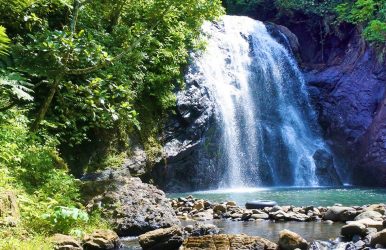
The Lower Pools
The Lower Pools have swimming holes and a rope swing that has seen decades of use. Daring travelers and local families love this area.
Also, these are the ideal places if you want to cool off after a humid trek.
Birdwatching Guide In Colo-I-Suva Forest Park
Suva's rainforests are a symphony of endemic species. Keep your binoculars ready for the scarlet robin and pink-billed parrotfinch.
You must not miss the dawn chorus as it is the best birdwatching experience you can have in Suva.
Safety And Practical Tips For Colo-I-Suva Forest Park
While the park is beautiful, it requires common sense. Security guards are usually stationed at the main pools and trailheads.
It is wise to stick to the populated trails and avoid hiking alone late in the afternoon. Slippery paths are a guarantee, and Suva's high rainfall means the clay-heavy soil is perpetually slick.
Wear shoes with aggressive tread, not flip-flops.
2. Hidden Waterfalls And Swimming Holes (Within 20 Mins)
If you find that Colo-i-Suva is very curated, you can choose a more local or secret experience and know the rugged side of Fiji.
Here are the best waterfalls and swimming holes of Suva. These are just 20 minutes away from the city.
Korolailai Waterfall (Wailoku)
The Korolailai Waterfall in Wailoku is a favorite of the locals. Use the Sikh Temple in Wailoku as your landmark, and the trail starts from here.
The trail passes through local farms and secondary forest.
Also, the main fall features a flat rock ledge directly behind the curtain of water. You can sit there and let the weight of the waterfall pound your shoulders. It’s the best free spa treatment in the Central Division.
Navakavu Blue Hole
Take a short drive toward the Lami side of the bay to reach the Navakavu coastline.
A short drive toward the Lami side of the bay brings you to the Navakavu coastline. This area is a protected tabu (sacred/restricted) site under the local Iqoliqoli (customary fishing grounds).
So, you have to check with the village headman or local guides before entering the village.
Moreover, "Blue Hole" is a stunning turquoise indentation in the reef flats, perfect for snorkeling during high tide.
3. Hiking Suva: From Peaks To Reserves
Are you looking for some elevation and solitude? Do you have the fitness to explore heights? Hike these peaks and explore these reserves.
• Mount Korobaba Summit Hike
It is the best Suva hike experience you can have. Mount Korobaba rises above the Lami harbor, and from the mountain, you can enjoy a panoramic view of the Suva peninsula and Laucala Bay.
This trekking trail starts behind the Lami Cement Factory. So, the start is humble, but it is worth the grand view.
However, the hike is strenuous, and a return trip will take at least 2 to 3 hours. Also, here, you have to be very careful about the mud warning.
If it rains, the trail will become muddy and act like a vertical natural slide. Nevertheless, there are ropes in some sections to help you haul yourself up.
• Savura Forest Reserve
Savura Forest Reserve is like a hidden gem, and it is a quiet academic zone that you would love to explore. It is a vital area for the water supply of Suva.
Furthermore, because it has fewer tourists, the biodiversity of the place remains almost intact. Overall, the condition is meditative and peaceful.
4. Coastal And Island Nature
To cherish the coastal beauty and Island nature of Suva, you must visit the Nukulau Island and My Suva Park & The Seawall.
At these places, you will understand the relationship of Suva with its marine landscape. So, leave the mainland and walk the southern edge.
• Nukulau Island
The Nukalau Island is small, but it has a long history. It has served as a quarantine station and a prison. However, ironically, today, it is not a dark tourism site anymore.
In fact, it is now a peaceful place for a picnic.
Sandbank, And The History Of Nukulau Island
When there is a low tide, you will notice a massive stretch of sandbank here. The sandbank is ideal for wading.
You will also find here the remnants of many old structures. Thus, you can blend history with a beach day.
Nukulau Island Boat Logistics
The boats in the Nukulau Island leave from the Suva Wharf or the Vatuwaqa area. Charter a long boat and enjoy a breezy ride across the lagoon for 20 minutes.
A longboat is a fiverglass boat with an outboard motor.
• My Suva Park And The Seawall
You don’t always need a boat to see the coastal beauty of Suva. You can visit My Suva Picnic Park and explore the rehabilitated mangrove walkways.
Here, you will find the most intricate root systems that protect the shoreline from decay.
On the other hand, the Suva Seawall is the social hub of Suva City. Here, you will enjoy the sunset views over the peaks of Joske’s Thumb.
Also, don’t miss the view of Mount Korobaba in the distance.
During the sunset, the sky has the most fiery shade of violet, and looking at that, you can end a day of exploration on a perfect note.
5. Urban Greenery: Thurston Gardens
Suva Botanical Gardens, or the Thurston Gardens, is an urban green space. The place got its name in 1976 after Sir John Bates Thurston, the founder of this botanical garden and the fifth governor of the city.
You can see diverse fauna in this botanical garden. It has water lilies, colorful gingers, ferns, and palms. It is also home to a prominent bat colony. In this context, you must know that bats are the only native mammals of Suva.
Currently, the Fiji Museum maintains this urban park, and other historical landmarks in the park are the bandstand and the Clock Tower.
These were built to commemorate the first mayor of the city.
Suva Nature Guide And Tips From Experts
Now, only the locals and taxi drivers know that Mt. Korobaba, "Pacific Cement Limited" factory in Lami, is better than the "Korobaba trailhead."
You can start your hike behind the factory fence. Now, this is what makes all the difference. The local and expert tips always help to enhance your Suva travel itinerary.
Do you want to know more such tips? Follow the details here.
1. Avoid Heavy Rain Days
The weather in Suva is either wet or very wet. So, while it’s not practical to wait for a sunny morning and you must embrace the rainforest bath, you cannot trade the day of or after a heavy rainfall.
When it rains, the trails and forest tracks of Suva become natural and dangerous mudslides.
2. Take The Bus To Colo-i-Suva If You Are Traveling On A Budget
You don’t need to take a taxi for $15 if you are traveling to Colo-i-Suva from the city.
As a budget traveler, you can take the Sawani Bus from the main bus station and ask the driver to drop you at the park gate.
The ticket price will be just $2.
3. Suva Keeps It Quiet On Sundays
Sundays are great for exploring the natural spots of Suva. These places are less crowded on Sundays.
Quite a surprise compared to the Western standards.
However, there is a catch! Public transport options are very limited on Sundays. So, you must pre-book a taxi for a smooth experience.
4. Follow The Sulu Rule
Suva is very particular about its customs and traditions.
Suppose you are visiting a secluded nature spot and you have to walk through a village, such as Korolailai, to reach that place.
Then, you will have to cover your legs with a sarong as a gesture of respect for the local community.
5. Be Aware Of Leptospirosis
The pools and natural swimming places in Suva have tropical water. So, you cannot swim in them if you have open cuts.
Tropical water carries bacteria, and if you swim in the water with open injuries, you may have Leptospirosis.
6. Use Your Skills To Negotiate
You cannot just agree to whatever the boat owner asks you to pay for a ride to Nukulau. You must negotiate the boat fee at the Suva Carrier Stand, which is near the Suva Market.
If you are taking a private fiberglass boat, a return trip will cost you around $80-$100 FJD.
7. Wear Mosquito Repellent
My Suva Park in Suva, or the mangrove areas and rainforest, has mosquitoes. Also, Dengue is a serious concern here.
So, you have to wear mosquito repellent, and you need to spray to get rid of the mosquitoes.
8. Stay Hydrated
The humidity percentage in Suva Rainforest is more than 90%. So, when you are hiking, sweating will be profuse.
If you are hiking for 1 hour or more, you need to carry around 2 liters of water.
Things To Know In Suva, Fiji, If You Want To Travel Like A Local
You have to embrace Suva, Fiji, as it is, if you want to travel like a local. Also, there are some stories, or rather facts, that only locals know.
For example, the Dakua trees are native to this place. However, the Mahogany Trees were later introduced to stabilize the soil.
Here is more about the reality checks, about the weather quirks, and the food of Suva if you soak in the true spirit.
1. The Reality Of The Rain Capital
The precipitation of around 3000 millimeters in a year, or a wet tropical climate, makes Suva the rain capital of Fiji.
In Fiji, it rains for more than 200 days a year.
So, if you want to explore Suva, you cannot wait for the Sun to shine bright. You have to embrace the rainforest swimming.
It means that you can get wet while it rains while exploring the rainforest, and do not waste time waiting for the Sun.
2. Picnic Like A Local In Suva, Fiji
If you are on a Suva food tour and want to indulge in the real flavors, you will have to picnic like a local.
Once you are tired after a long swimming session, you must buy a Bhuja or a spicy mix and have it with a long loaf as a snack.
Quirks And Cultural Hidden Gems Of Suva, Fiji
Talking about the cultural hidden gems of Suva, Fiji, the first story that comes to my mind is about the Liuliu.
Liulius are the guardians of the waterfalls.
So, when you visit these waterfalls, you must not shout or scream.
The guardians can be angry, and they can curse you if you shout and disturb them.
Along with this myth about the Liuliu or guardians, Suva is also known for its Lami vibe. It is at the base of the Mt Korobaba. It is the town that has the perfect fusion of a silent natural retreat and an industrial town.
In addition, the dark past of Nukulau is very intriguing in Suva, Fiji. It was once a quarantine island and later became a prison for coup leaders.
Moreover, this place has a stark contrast between the beautiful sandy beaches and a turbulent past. Thus, it has all the potential of becoming a dark tourism destination.
Do you want to learn more about the culture of this Fijian capital? Read my Suva cultural guide.
Discovering The Real Suva
The primal beauty of Viti Levu, the amber pools of Colo-i-Suva, the mud-slicked trails of Mt. Korobaba, and finding peace in the hidden Korolailai basin!
Also, the Fijian capital asks you to be a little dirty. So, wear your reef shoes, pack your mosquito repellent, and step off the pavement.
Moreover, allow the trees to embrace you and show you the real Suva.
Suva Nature Guide: Frequently Asked Questions And Answers (FAQs)
Here are the frequently asked questions and answers about the Suva nature guide.
1. Is It Safe To Swim In Colo-i-Suva? Yes, you can swim safely in the freshwater pools of the Colo-i-Suva Forest Park. The pools here are in an inland rainforest, and they are not connected to the ocean. So, there will be no saltwater hazards.However, like other natural pools, these pools also vary in depth, and the surfaces can be rocky or slippery. So, you have to exercise caution when swimming in the natural pools here. 2. How Long Is The Mt. Korobaba Hike? The Mt. Korobaba hike is around 6 Kilometers or 3.7 miles long. It is a challenging hike, and the elevation gain is around 404 meters. Furthermore, the red clay path is challenging, and the clay route often gets muddy. Also, based on your pace, you will be able to complete the trek in 2 to 3 hours. 3. Are There Crocodiles In Suva’s Rivers? Unlike many other islands of the Pacific Ocean, the rivers of Suva do not have crocodiles. However, you can spot saltwater crocodiles in Suva, and these crocodiles come from the nearby Solomon Islands or Papua New Guinea. They visit the region due to the strong oceanic currents. However, their sightings are very rare. 4. Do I Need A Guide For The Hikes In Suva? No, it is not mandatory to have a guide if you're hiking in the Colo-I-Suva forest or areas near Suva. However, the trails can be slippery, and the presence of wildlife in Suva is abundant. Also, often the major trails are linked to minor trails, and staying on the right tracks becomes difficult. So, it is better to have a local guide for safety purposes, and they will also guide you about the flora and fauna. 5. How Much Is The Entry Fee For Colo-I-Suva? The entry fee for Colo-I-Suva is around $1 FJD for the local adults and $0.50 FJD for children. However, if you are a foreign visitor, you will have to pay $5 FJD for adults and $1 FJD for children. 6. Can I Camp On Nukulau Island? Yes, you can camp on Nukulau Island, but you need a permit from the Department of Environment in Suva City beforehand. The permit will cost you around $2 for 24 hours. Also, the island has a shade for camping. However, you will have to bring your own tent, food, and water. 7. What Wildlife Will I See In Suva, Fiji? Suva is rich in wildlife. Places such as the Suva Botanical Gardens and Colo-i-Suva Forest Park are ideal for watching the birds, mammals, and amphibians. Birds to see in Suva are the Collared Lory (Kula), masked shining parrots, Fiji Goshawk, and blue-crested Broadbill. You will also find amphibians such as the Pacific Boa, Fiji Tree Frog, and Fiji Banded Iguana. Furthermore, while bats are the only native mammals of Suva, you will also find the Samoan Flying Fox, the Fijian Monkey-faced Bat, and the Mongoose. Moreover, Spinner & Bottlenose Dolphins, Banded Sea Krait, Spinner & Bottlenose Dolphins and Reef Sharks are the prominent marine animals found in Suva, Fiji. 8. Is Korolailai Waterfall Free? Yes, the Korolailai Waterfall is free to visit. However, there is a border of a settlement around the waterfall. You can pay a small donation of around $2-5 as a polite gesture. Also, you will have to pay a taxi fee of FJ$15–FJ$25 to reach the Korolailai Waterfall from Suva City. 9. What Is The Best Time For Birdwatching In Suva? Early morning is the best time of day for birdwatching in Suva. If you start birdwatching between 5 and 5:30 AM, you will find birds such as the Slaty Monarch, Fiji White-eye, and fruit dove. Season-wise, May to October is the best time for birdwatching. Especially, mid-August 10. Where Can I See Mangroves In Suva? You will find the mangrove trees along the coastal areas of Suva. The easiest zone to access from the city is, of course, the Suva Seawall & Queen Elizabeth Drive. Another easy zone is the Rewa River Delta. It is around 25 km from Suva. It has an extensive stretch of mangroves. You can take a boat ride from Nausori to explore the area. Furthermore, Kalokolevu Village is a local community that proactively conserves the mangroves and is very particular about the restoration efforts. Moreover, the areas near the University of the South Pacific campus have mangroves. Low tide is the best time of the day to explore the mangrove forests. This is the best time for noticing the intricate root systems and the wildlife in the mangrove zone.






 Related