

Isurumuniya Temple, Anuradhapura: A Guide To Sri Lanka’s Rock-Carved Temple Of Legends

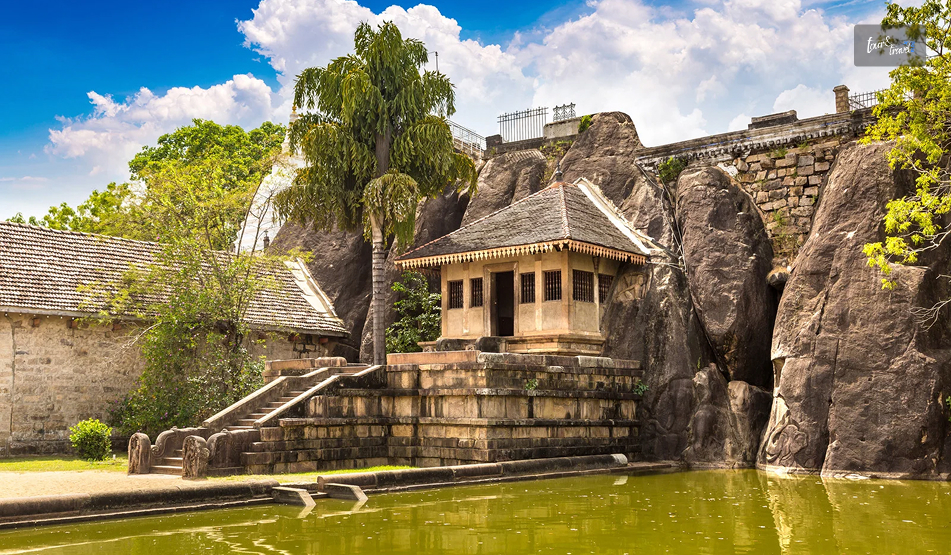
Have you seen the reclining Buddha inside Isurumuniya Vihara, a modest rock temple wedged between two granite boulders on the edge of Tissa Wewa? 

I have been to Dambulla Royal Cave Temple and seen the massive reclining Buddha statues there.  

However, the one in Isurumuniya felt intimate. It can be a very personal thing, but here I feel at home.  

Also, even after multiple visits to the Isurumuniya Temple, each time, the carvings, the pond, or the small museum behind the stupa surprised me with something new.  

In this guide, I have talked about my experience at the temple along with its history, legends, and other practical details you need to know.  

Isurumuniya Temple: At A Glance  

Quick Facts Details 
Location East bank of Tissa Wewa, Anuradhapura, North Central Province 
Built by King Devanampiya Tissa (307–267 BCE) 
Renovated by King Kasyapa I (473–491 CE) 
Famous for Isurumuniya Lovers Bathing Elephants Man and Horse Royal Family Carvings 
UNESCO Status Part of the Sacred City of Anuradhapura, Inscribed in 1982 
Typical Visit Length 45 Minutes to 1.5 Hours 

The History Behind Isurumuniya’s Two Boulders

Isurumuniya Temple, Anuradhapura: A Guide To Sri Lanka’s Rock-Carved Temple Of Legends

The story of Isurumuniya started in the 3rd century BCE.  

It was not long after Buddhism arrived on the island. Since then, it has been reshaped by royal hands more than once. 

A Monastery Built For 500 Royal Novices 

King Devanampiya Tissa, the same ruler who welcomed the Buddhist missionary Mahinda to Sri Lanka, founded Isurumuniya. 

However, Isurumuniya was then known as Meghagiri Vihara.  

Furthermore, the temple history records say that five-hundred children of high-caste families used to stay here during their training.  

I was standing in the small courtyard with the rock hemming it on three sides.  

I could picture how contained and disciplined that original community must have felt. 

King Kasyapa I’s Renovation 

After centuries, King Kasyapa I, who is more famous for building the Sigiriya Rock Fortress, renovated Isurumuniya. 

He renamed it Boupulvan, Kasubgiri Radmaha Vehera. 

The name was a combination of his own name with those of his two daughters.  

The Carvings That Make Isurumuniya Worth The Detour 

Isurumuniya is small. 

However, four carvings here specifically get all the attention.  

Also, if we delve into the art history of Sri Lanka, these are some of the most reproduced images.  

I spent longer looking at these than at anything else in Anuradhapura. 

The Isurumuniya Lovers 

I saw the Isurumuniya Lovers, or the Lovers of Isurumuniya sculpture, in the museum. 

It depicts a man and woman sitting closely together.  

According to local legends, the lovers are Prince Saliya, son of King Dutugemunu, and Asokamala, a woman of lower caste for whom he is said to have given up his claim to the throne.  

However, there is another version about the sculpture, and this one is favored by past Archaeological Commissioner Senarat Paranavitana. 

This version identifies the pair as the mythic king Kuvera Vaisrawana and his queen Kuni. 

Nevertheless, the granite relief dates between the 4th and 8th centuries CE.  

Also, it has prominent Gupta influence, and it is very similar to Indian sculptures in that era.  

The Bathing Elephants 

I saw this carving low into the rock beside the pond.  

Because of this position beside the pond, it looked like the elephants were wading in from the water itself.  

Art historian D.T. Devendra noted that the animals are rendered inconsistently, some frontal, and some in profile. 

This has led scholars to suggest two sculptors worked on them at different times.  

They are the first thing you see on entering, and are reflected in the pond at the right angle. 

The Man And The Horse 

This carving is probably the most debated at the site, and it has had multiple interpretations for a century.  

Paranavitana read it as Parjanya, a Vedic rain deity, with his horse standing in for Agni, fire, together heralding the monsoon.  

Devendra proposed a very different subject. 

He interpreted it as Alexander the Great and his horse Bucephalus, carved in the 7th century CE.  

I find the ambiguity part of the appeal, and nobody working at the site could give me a definitive answer either. 

The Royal Family Carving 

A granite plaque showing five human figures, generally read as a royal household, rounds out Isurumuniya’s core sculptures.  

It gets far less attention than the Lovers, and I would argue that is a reason to slow down and look at it properly rather than rushing past. 

Walking The Temple Grounds

Isurumuniya Temple, Anuradhapura: A Guide To Sri Lanka’s Rock-Carved Temple Of Legends

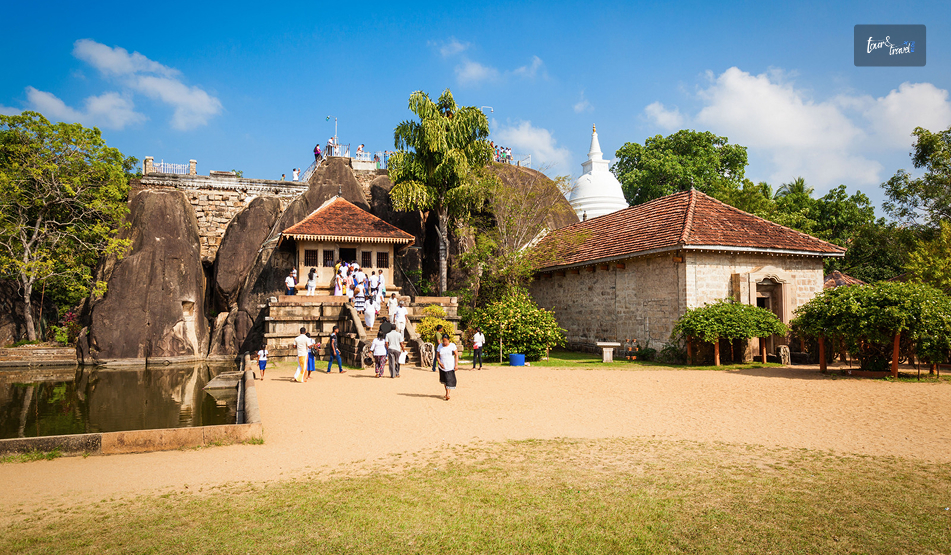
Isurumuniya is compact enough to see in under an hour. 

However, for me, it was a slow, deliberate walk rather than a quick loop. 

The Lotus Pond And Rock-Cut Shrine 

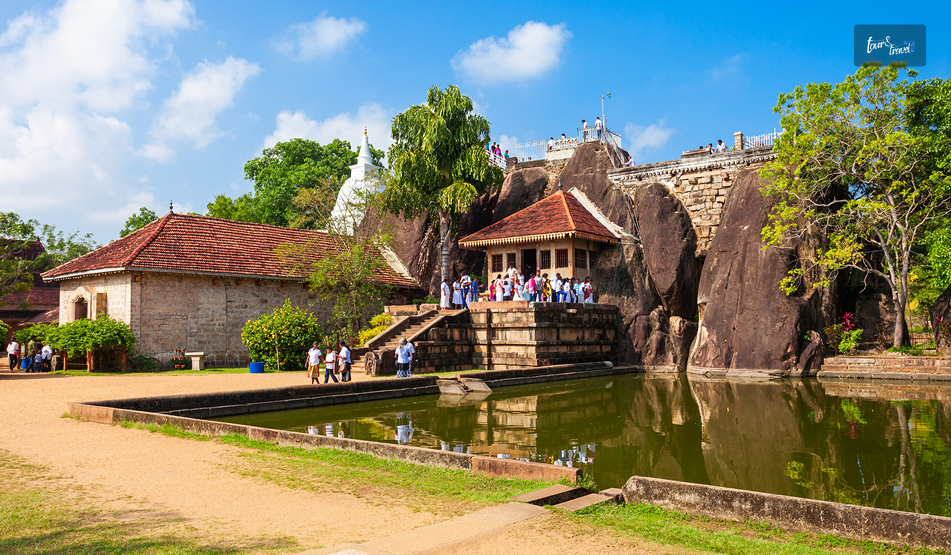
You enter past a square pond fed by Tissa Wewa, with the Bathing Elephants carved into the rock face above it.  

The Irish writer and archaeologist John Still called this corner “the most picturesque” spot in all of Anuradhapura. 

Also, having stood there at both midday and closer to sunset, I would agree the light matters. 

Visit it in the late afternoon if you can.  

Steps guarded by two carved muragal (guardstones) lead up to the old shrine room, cut directly into one of the two boulders, where a seated Buddha statue sits inside the original rock-cut sanctum.  

A separate, more modern shrine building nearby holds a large reclining Buddha and a Bo tree said to be grown from a sapling of the sacred Sri Maha Bodhi. 

The Museum With The Original Lovers Carving 

Behind the main shrine, a small on-site museum houses the original Isurumuniya Lovers relief along with other artifacts recovered from the site.  

It is easy to miss if you only walk the outdoor courtyard, and I nearly did on my first visit.  

Ask a temple attendant if you are unsure where the entrance is. 

It was not signposted clearly from the pond area. 

Isurumuniya Practical Guide: Tickets, Timings, And Best Time To Visit

Isurumuniya Temple, Anuradhapura: A Guide To Sri Lanka’s Rock-Carved Temple Of Legends

Isurumuniya sits inside the Sacred City of Anuradhapura. 

However, you need to buy a separate ticket.  

This is something many first-time visitors miss.  

Entrance Fees 

There is no entry fee to the Isurumuniya Temple for locals.  

However, SAARC visitors and other foreign tourists above 10 years of age need to pay an entry fee of LKR 500.  

The ticket counter opens at 7 AM.  

Opening Hours And Best Time To Visit 

Isurumuniya Temple is open from 7 AM to 5:30 PM.  

However, the heat is scorching at midday.  

So, an early morning visit before 8 AM or a late afternoon visit around 3:30 to 4 PM will be the ideal time.  

Also, Poson Poya (the June full moon, marking the arrival of Buddhism in Sri Lanka) is the most sacred date on the Anuradhapura calendar. 

It draws large crowds across the sacred city, Isurumuniya included.  

This festival also falls within the comfortable window of May to September, or the dry season.  

From October, the northeast monsoon sets in and November brings the heaviest rain. 

A Half-Day Itinerary Around Isurumuniya 

Time Stop What to Expect 
7:30 AM Isurumuniya Temple Arrive early for soft light on the Bathing Elephants and a quieter courtyard. 
8:15 AM Isurumuniya Museum See the original Lovers carving up close. 
9:00 AM Vessagiriya Short walk or tuk-tuk ride to the cave-hermitage ruins nearby. 
10:00 AM Sri Maha Bodhi Pay respects at the sacred fig tree in Mahamevnawa Garden. 
11:00 AM Ruwanwelisaya Circle the great white stupa before the midday heat sets in. 

Continuing Your Anuradhapura Journey 

Isurumuniya works best as one stop in a longer day around the sacred city rather than a standalone visit.  

If you’re building out a full itinerary, it pairs naturally with Ruwanwelisaya, Jetavanaramaya, and Abhayagiri. 

Also, if you want to extend your trip, do not miss Mihintale, the place where Buddhism first reached Sri Lanka.

Share on Social Media

Sibashree is a travel, culture, and leisure writer who has been writing since the age of 12 and professionally since 2014. With more than a decade of travel writing experience and journeys across India and several parts of the world, she brings a deeply personal and thoughtful perspective to her work. A student of English Literature and Mass Communication, Sibashree has always viewed travel as more than movement — for her, it has been a way of understanding people, cultures, and herself. Her passion for spiritual exploration has also led her to many unusual and meaningful destinations over the years. Outside of writing, Sibashree enjoys watching European cinema, reading about global politics, and reflecting on the stories hidden within everyday places.

Leave a Reply

Your email address will not be published. Required fields are marked *

title-img Related

READ MORE Kudawella Beach

Where Is Kudawella Beach? What To Do In Kudawella Beach For Beginners?

BY  Sibashree May 5, 2026

Very close to the Hiriketiya Beach, Kudawella Beach is a pristine, small, and beginner-friendly beach for surfers.  However, even if you are not a surfer, you can visit this hidden gem to find the turtle nests and the surrounding mangroves.  Also, at Kudawella Beach, you can enjoy the beauty of the Indian Ocean or just laze around on the sand.  Here is more about this beautiful, sickle-shaped beach on the southern coast of Sri Lanka.  Where Is Kudawella Beach? How To Reach Kudawella Beach As I have mentioned, Kudawella Beach is on the southern coast of Sri Lanka, and it stretches from west to east.  Furthermore, the beach is around 10 km away from Dickwella, the closest major town to the beach.  Moreover, if you are already visiting the Hiriketiya Beach, you can just take a 10-minute tuk-tuk ride to reach the Kudawella Beach.  The most popular way to reach the Kudawella Beach is to take a direct car or taxi from Colombo, which is at a distance of around 160 km.  The journey by road will take close to 5 hours, and the taxi fare will be over 30000 LKR.  However, I was already in Ella and had a day after visiting the iconic Nine Arch Bridge and exploring all the other top attractions in Ella.  So, I took a bus from Ella to Galle. The bus #31 was moderately crowded, and I was enjoying the local experience.  That bus from Ella to Kudawella Beach took around 6 hours, and the ticket price was LKR 350.  What Are The Things To Do In Kudawella Beach?  Kudawella Beach is a place that offers you the ultimate flexibility.  Yes, there are a few hotspots when you are on the beach. However, you can spend your entire day without doing anything.  Moreover, it is a delightful place for amateur surfers.  Still, here are a few things to do in Kudawella Beach, along with surfing and chilling.  1. A Walk To The Hummanaya Blow Hole I loved walking to the Hummanaya Blow Hole on the eastern side of the Kudawella Beach. However, to see the water shooting up, you have to reach the viewing point at the top of a cliff.  The cliff also has a safety barrier.  It is the only blowhole in Sri Lanka and the second-largest in the world, shooting the water at a height of 25-30 meters when the water forcibly enters a narrow cavern.  I saw the blowing taking place at least 5-6 times during the short moment I halted there. The water shoots up as the sea movement builds pressure in the tunnels in the rock.  2. A Walk To The Nilwella Beach If you want even a more idyllic retreat, you can visit the Nilwella Beach from the Kudawella Beach.  This beach has blonde sand, and the waves here are gentle.  Moreover, I loved walking across the beach to reach a rocky island. The rocky island had many palm trees and pandanus trees.  There was also a hiking trail, and as I advanced, I found many little coves and unique geographical shapes.  3. Kayaking Around Mawella Lagoon Mawella Lagoon was pretty, and the water was covered by beautiful lily flowers.  Furthermore, there are many hotel rooms and massage rooms near the lake where you can chill or enjoy a relaxing massage session.  However, just behind the Kudawella Beach, this lagoon is also ideal for kayaking around.  It cost me around 8000 LKR, and I spotted many birds such as storks, beeaters, and kingfishers there.  I heard that sometimes you can also spot crocodiles here.  Kudawella Beach: The Best Spot For Surfing For Beginners  As I have mentioned, Kudawella Beach is a beginner-friendly surfing spot.  Unlike Hiriketiya, you will not find outer waves here. You can only surf here at the beach break, which is further on the inside of the bay.  So, it is safer than Hiriketiya Beach.  In fact, even in the dry season from November to March, the waves seldom reach a height of more than 4 feet.  However, you have to be watchful of the few rocks in the water. Having said that, during the dry season or the peak surfing season, the water of the Indian Ocean is crystal clear.  So, you will be able to see the rocks clearly.  Moreover, on the Kudawella Beach, there are two surf rentals. However, when I visited, there was a longer queue in front of the Saranga at Kudawella Surf School, and its surfboard-shaped signboard also looked pretty cool.  What Is The Best Time To Visit Kudawella Beach?  November to March, or the dry season, is the best time to visit the Kudawella Beach.  Long hours of sunshine make these months ideal for beach activities. However, there can be sudden rainfalls. So, you have to carry your rain gear.  However, the wet season from March to August, despite having fewer crowds, is not ideal as there can be harsh storms and heavy rainfall.  Where To Stay Near The Kudawella Beach?  When I visited Kudawella Beach, it was still very pristine, and thus it is a quintessential beach on the southwestern coast of Sri Lanka.  You will find only a few hotels here.  Also, if you want to find an accommodation here, you can stay on the beachfront or in hotels near the lagoon.  Here are some of the places where you can stay.  Sisi Place The Sisi Place is on the hilltop at the west end of the beach. It is the most budget-friendly option here with clean and comfy rooms.  Simply Peace  Choose Simply Peace if you are looking for a luxury accommodation near the lagoon.  It is a beautiful pool where you can relax. Furthermore, it has a garden where you can enjoy birdwatching.  Calma I loved the pastries and coffee at the on-site cafe of Calma. With a sand front, it exudes a quintessential Balinese bungalow aesthetic.  Moreover, you can take a short tuk-tuk ride from Kudawella Beach to Hiriketiya Beach. There, you will find more diverse accommodation options, including Airbnbs.
READ MORE

Where To Stay In Kandy With Family? A Practical Guide For Accommodation In Kandy

BY  Sibashree Jun 1, 2026

Kandy is the City of Kings in Sri Lanka, and it is undisputedly the cultural capital of Sri Lanka.  It has amazing green hills, and the vibrant destination here serves as the spiritual heart of the island.  Furthermore, it is home to the Temple of the Sacred Tooth Relic, the most revered Buddhist shrine in Sri Lanka. It has a sacred tooth portion of Lord Buddha.  Along with this cultural richness and its spiritual vibe, Kandy also stands out with a sensory experience of delightful chaos.  It has bustling markets, aromatic local eateries, and historical colonial architecture, and of course, the picturesque Kandy Lake.  So, naturally, Kandy was a major stop on my trip to Sri Lanka. Finding the right accommodation here is crucial to enjoying the endless things to do in Kandy.  The right accommodation helps you to soak in the tranquil beauty of the hill country and the high energy of the city together.  So, here is a guide on where to stay in Kandy.  Where To Stay In Kandy? An Overview Of Kandy Hotel  Before I discuss the specific neighborhoods to stay in Kandy, let me share a quick overview of the best accommodation options. CategoryAccommodation ChoiceBest Luxury StayW15 Hanthana EstateBest Mid-Range StayHeritage Boutique Best Budget StayHelga’s FollyHow to Get AroundWalking and Local Tuk-TuksBest Time to Visit KandyJanuary to April (Dry Season) What Are The Best Places To Stay In Kandy? (Know The Best Areas) Kandy has a mountainous terrain and winding roads. The accommodations here are spread across distinct zones.  So, you have to choose a locality that will help in shaping your experience.  Downtown Kandy Area If you want to immerse yourself in the authentic pulse of Kandy, you must find an accommodation in Downtown Kandy.  You can listen to the cacophony of sights and sounds. It has British colonial facades mixed with bustling commercial markets.  Pros and cons of finding a place to stay in Downtown Kandy.  ProsCons- Kandy allows you to explore the Tooth Relic, Kandy Lake, and traditional Kandyan dance halls.- Furthermore, the central train and bus stations in Kandy make exploring various parts of the country enjoyable. - Loud- Congested- Hectic The best place to stay in Kandy is Heritage Boutique.  The Kandy Hills  High above the valley floor, the Kandy Hills offer an escape from the chaos of Kandy Downtown.  It has misty mornings, sweeping forest views, and cool breezes. Furthermore, it has the most premium boutique hotels.  ProsCons- Quiet- Peaceful- Scenic- Perfect for Unwinding- Steep Terrain- Dependency on Tuk-Tuks for Transit  W15 Hanthana Estate, Helga’s Folly, 36 Bed & Breakfast are the best recommendations for accommodations in the Kandy Hill area.  Kandy Lake Area Kandy Lake is an ideal middle ground in Kandy. It offers a peaceful buffer zone with quick access to the historic core of the cultural hub of Kandy.  ProsCons- Scenic Walking Paths- Close to the Central Sights and Major Shrines. - Properties Close to the Lake Get Filled up Quickly.  The Ru Boutique Hotel is one of the best places to stay in the Kandy Lake area.  Northern Kandy Area Northern Kandy stretches toward the banks of the Mahaweli River.  The Mahaweli River is the longest waterway of Sri Lanka, and Northern Kandy is an affluent and sprawling neighborhood of Kandy.  Moreover, here are the pros and cons of finding an accommodation in Northern Kandy.  ProsCons- Home to expansive, high-end resorts.- It offers you insights into the way of slow living in Kandy. - Visually Isolated from the Town.  Taru Villas Kandy and Mahaweli Reach are some of the best accommodations in Northern Kandy.  What Are The Best Places To Stay In Kandy? (Know The Accommodations)  Here are some of the best places to stay in Kandy when you are visiting with your family.  1. Helga’s Folly: The Most Budget-Friendly Accommodation Helga’s Folly won my heart instantly with its whimsical Sri Lankan artwork. It has been the childhood home of high-society owner Helga de Silva Blow Perera.  Furthermore, it has hosted the names such as Mahatma Gandhi and Gregory Peck.  The garden here looks like a dreamscape. However, the actual amazement awaits in the interior.  It has 35 rooms where you will find family portraits, vivid murals, and dripping candles.  Overall, this accommodation is intriguing, and I loved it for its aesthetics and its unhinged nature.  W15 Hanthana Estate Kandy: The Best Luxury Accommodation In Kandy W15 Hanthana Estate is on a historic tea plantation in the Hanthana Hills. It has nine bedrooms and unmatched colonial luxury.  Furthermore, the meticulous restoration work here has also made the accommodation score quite high on amenities.  Also, if you choose to stay here, you will get a personal butler to attend to your requirements.  Moreover, it has perfectly manicured lawns, and from here, you can enjoy amazing views of the Knuckles Range.  In addition, it offers the ultimate vintage experience in which you can enjoy a ride in an open-top vintage Land Rover Defender and explore the rugged hillside.  Heritage Boutique: The Best Mid-Range Stay In Kandy  You can take a short walk from the Temple of the Sacred Tooth Relic to reach Heritage Boutique.  It has four stately and royally themed rooms. Furthermore, this accommodation focuses highly on personalized experiences.  So, it is the ultimate accommodation in urban areas.  Practical Tips For Your Trip To Kandy If you want to make the most of your time in Kandy, the cultural capital of Sri Lanka, keep these practical things in mind.  The most beautiful mode of transport from Colombo Fort to Kandy is via train.  Once you reach the city, you can take a tuk-tuk or use local ride-hailing apps to explore different areas.  Furthermore, cover your shoulders and knees when visiting the Temple of the Tooth Relic. You will also need to remove your shoes before entering the temple complex. Overall, be respectful to the cultural heritage and Buddhist traditions of Kandy to enjoy a seamless experience.

READ MORE world's end sri lanka

World’s End, Sri Lanka: Chasing the View Before the Clouds Roll In

BY  Sibashree Aug 31, 2026

Nobody tells you how early a '5 AM start' actually feels until you are standing in the dark outside your Nuwara Eliya guesthouse, breakfast pack in hand, waiting for a tuk-tuk.   But that is the deal with World's End.  The view is clear from about 9 AM to 10 AM.  After that, clouds roll in off the valley and swallow the whole thing whole.   I had heard this enough times before arriving that I did not question the alarm. And I am glad I did not.  By the time I reached the escarpment, the drop in front of me was still clear enough to see the coast, some 80 kilometres away.  World's End is a sheer escarpment inside Horton Plains National Park, in Sri Lanka's central highlands.   You have to take a circular hiking trail to reach it, and the same route also takes you to Baker's Falls and a smaller companion viewpoint called Mini World's End.  It has become one of the most-hiked routes in the country precisely because the effort-to-reward ratio is so favourable.  It is a manageable walk for a view most people only expect to earn after a serious trek.  World’s End, Sri Lanka: At A Glance  Location Horton Plains National Park, central highlands  Elevation at start About 2,100 metres  Drop at World's End Approximately 870–880 metres  Circular trail distance 9–9.5 km (Red Bridge → Mini World's End → World's End → Baker's Falls → back)  Typical hike duration 2.5–4 Hours  Park hours 6 AM to 6 PM  Best time to visit January to March (Driest Months). You must arrive by 6 AM regardless of season.  Nearest base Nuwara Eliya   Why The Early Start Actually Matters This is not exaggerated marketing. World's End genuinely clouds over by mid-morning most days, often as early as 9 AM.  The park opens at 6 AM, and the guidance from pretty much every guide, driver, and fellow hiker I spoke to was the same.  Get there at opening, start walking immediately, and don't dawdle at Mini World's End if clear skies at the main viewpoint are your priority.   I reached World's End a little under an hour and a half after setting off and had maybe twenty clear minutes before the first wisps of cloud started drifting up from the valley below.  There is no public transport directly to Horton Plains from Nuwara Eliya.  So you are looking at a hired tuk-tuk, car, or a pre-booked tour.  The PickMe app works if you would rather arrange it yourself the night before.   Whatever you choose, the pre-dawn logistics are worth planning a day ahead, since most hotels won't have breakfast ready at 4:30 AM and will instead hand you a packed breakfast to eat on the trail.  The Hike Itself The full loop runs roughly 9 to 9.5 kilometres and is considered moderate rather than difficult.  It is mostly flat with some gentle inclines.   It is well-marked, and it is notably the only national park in Sri Lanka where you are allowed to walk the trail without a mandatory guide.   From the Red Bridge entrance, it is about 2 kilometres to Mini World's End.  Then on to the main viewpoint, before the trail loops back via Baker's Falls, one of the widest waterfalls in the country, and a good spot to slow down once the pressure of beating the clouds is behind you.  Along the way, expect sambar deer grazing close to the trail.  They are genuinely unbothered by hikers here.  I also spotted purple-faced langurs, giant squirrels, and a decent range of highland birdlife.   Leopards are present in the wider Horton Plains area, but sightings are rare enough that I would not build any expectations around it.  Mini World's End Vs. The Main Event  It is easy to treat Mini World's End as a warm-up and rush past it.  However, it is worth a few minutes on its own terms.  A smaller drop, fewer people at that hour, and in some ways a calmer view than the more crowded main viewpoint!  Some hikers reverse the usual direction of the loop specifically to hit World's End last rather than first.  Either way works, but going clockwise from Red Bridge (Mini World's End, then World's End, then Baker's Falls) is the standard and the one most guides default to.  Planning Your Visit World's End earns its reputation honestly.  It is one of the few views in Sri Lanka that lives up to the hype, provided you respect the clock.   The hike itself is forgiving enough for most fitness levels.  Also, the wildlife along the way is a pleasant bonus, and the payoff at the escarpment, on a clear morning, is the kind of view that makes the 5 AM alarm feel like a fair trade.  Entry Fees  Expect to pay in the region of USD 20–25 per foreign adult visitor. Also, you will have to pay a separate vehicle fee if you are driving or being driven in.  The total for a couple with a hired tuk-tuk can run well over what the headline entry fee alone suggests. Fees are collected in USD or LKR at the park entrance.  What To Pack  Pack layers as it is cold enough at 2,100 metres before dawn to want a proper jacket. However, you will likely be down to a T-shirt by mid-hike.   Add sturdy shoes, water, the breakfast pack, and a hat for once the sun burns through.   The terrain does not demand technical gear, but the temperature swing from predawn to midday catches people out.  Best Time Of Year  January to March is generally the driest and most reliable stretch for clear views.  However, the daily mist pattern matters more than the season.  Even in the driest months, arriving after 9 AM risks losing the view entirely. An early start in a wetter month can still pay off.  Where This Fits In A Sri Lanka Itinerary  World's End is a natural pairing with a Nuwara Eliya stay. It is often combined with tea estate visits, Adam's Peak, or the train journey onward to Ella.   Given the early start and 3–4-hour round trip, I would treat it as a dedicated half-day rather than trying to combine it with much else that same morning.  By the time you are back at the entrance, most of the day's clear-view window has already closed anyway.