
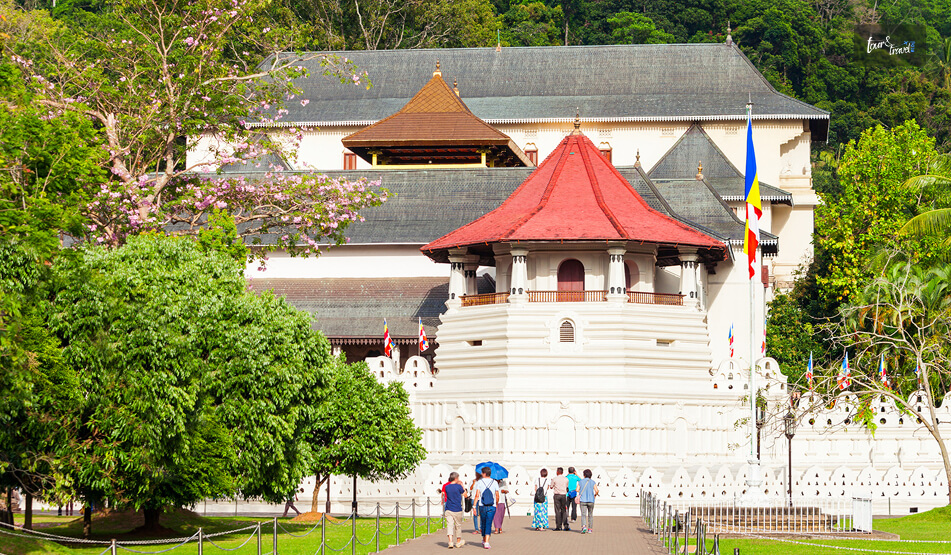

The Temple Of The Tooth, Kandy: History, Significance, And A Complete Visitor’s Guide

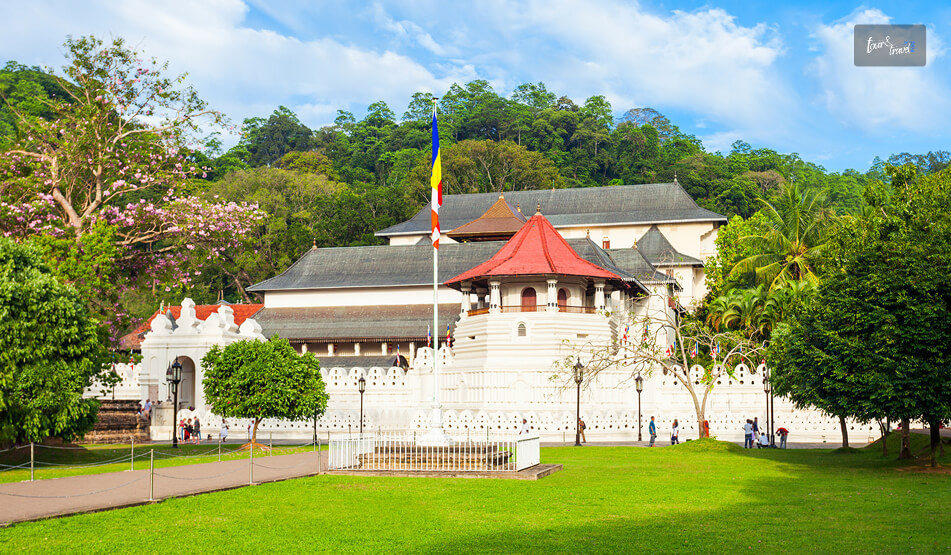
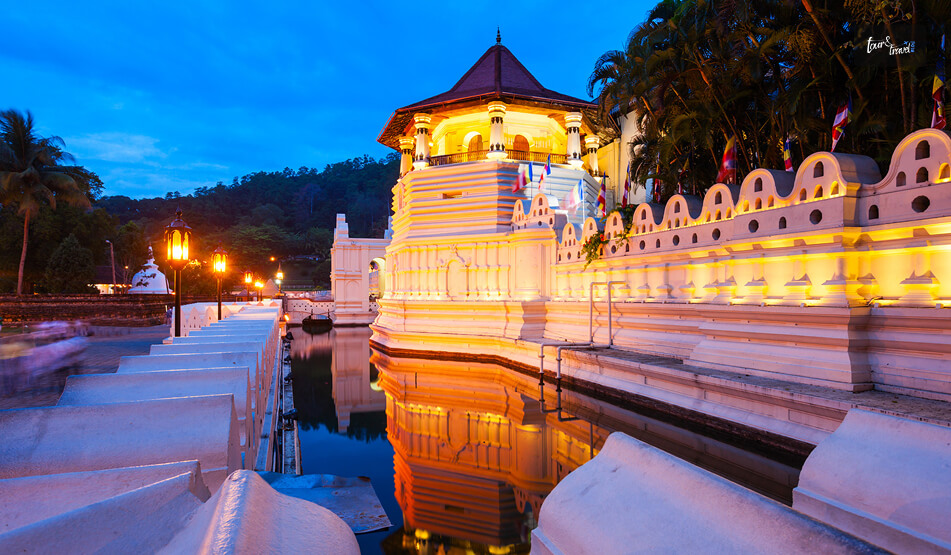
Almost every visitor notices the golden roof or moat around it when visiting the Temple of the Tooth, Kandy. 

However, the first thing I noticed was the queue. 

It was an ordinary Tuesday morning, around 9 AM. 

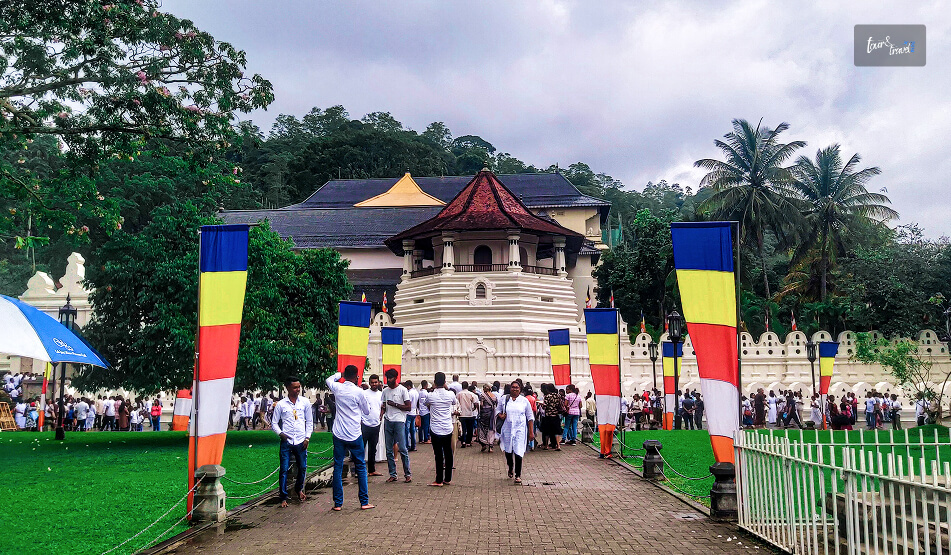
I saw monks, schoolchildren in white, and visitors with cameras filling the same security screening. 

However, I was not surprised to see the crowd at the Temple of the Tooth, or the Sri Dalada Maligawa.

Built around a single relic, it has shaped the island’s politics and identity for over 1,600 years.

Also, as the living spiritual centre of Sri Lankan Buddhism, it deserves all the attention. 

In addition, the temple has been in the news more than once in the past two years. 

In April 2025, a rare public exposition of the Tooth Relic drew an estimated 450,000 devotees in a single day.

The queues were long and stretched around 10 kilometers through Kandy. 

Again, the temple hosted the ten-night Kandy Esala Perahera, running from 18 to 28 August, 2026. 

While there is still time for the Kandy Esala Perahera Festival in 2027, you can plan a visit to the temple on a regular day to have a more immersive and detailed encounter with this iconic Sri Lankan landmark. 

The Temple Of The Tooth, Kandy: At A Glance

Things to KnowDetail
Official NameSri Dalada Maligawa
Also Known asTemple of the Sacred Tooth RelicTemple of the Tooth
LocationPalace Square, Kandy, Central Province, Sri Lanka
What it enshrinesThe left canine tooth relic of the Buddha
UNESCO statusPart of the Sacred City of Kandy, a World Heritage Site since 1988
Present shrine built1707–1739, under King Sri Veera Parakrama Narendrasinghe
Daily opening hours5:30 AM – 8:00 PM, every day of the year
Daily puja (ritual) times5:30–7:00 AM9:30–11:00 AM6:30–8:00 PM
Entrance fee (most foreign nationals)LKR 3,000
Entrance fee (SAARC nations, Thailand, Myanmar)LKR 2,500
Entrance fee (Sri Lankan citizens)Free
Major annual festivalKandy Esala Perahera (July/August)
Time neededAbout 1 to1.5 hours for the temple and longer during puja or festival season

What Is The Story Behind The Temple Of The Tooth?

The tooth relic arrived in Sri Lanka around seventeen centuries ago, between 301 and 328 CE. 

The temple has been rebuilt, burned down, and rebuilt again more times than we can think of. 

How Did The Tooth Relic Come To India?

According to Buddhist tradition, after the Buddha’s parinirvana, his left canine tooth was preserved in the Kingdom of Kalinga. 

The Kingdom of Kalinga is now the state of Odisha in India. 

However, there was unrest during the reign of King Guhasiva.

So, Princess Hemamali and her husband, Prince Danta, took the tooth relic out of Kalinga. The relic was hidden inside the hair of the princess to ensure a safe passage. 

They safely brought it to Sri Lanka during the reign of King Kithsiri Meghavanna, dated around 301 to 328 AD. 

Since then, the relic has become inseparable from Sri Lankan kingship. 

It was said that whichever king had it would have the right to rule. 

Also, the relic was moved from capital to capital. 

It came through Anuradhapura, Polonnaruwa, Dambadeniya, Yapahuwa, Kurunegala, Gampola, and finally reached Kotte. 

Then, it came to Kandy, the last of the royal capitals of Sri Lanka. 

A Timeline Of Sri Dalada Maligawa

The building we see today is not the original structure.

It is the product of at least four rebuilds across two and a half centuries.

It was shaped by Portuguese raids, a Dutch fire, and later renovations by successive Kandyan kings.

PeriodWhat happened
c. 301–328 ADTooth relic brought to Sri Lanka from Kalinga by Prince Danta and Princess Hemamali during the reign of King Kithsiri Meghavanna.
1592–1604King Wimaladharmasuriya I built the first Dalada Maligawa in Kandy, later destroyed during Portuguese invasions.
1635–1687King Rajasinghe II built a second shrine on the same site, and it was burned down by the Dutch.
1687King Wimaladharmasuriya II constructs a three-storey Dalada Maligawa, which later decays.
1707–1739King Sri Veera Parakrama Narendrasinghe builds the two-storey shrine that still stands today.
1747–1782King Kirti Sri Rajasinha renovates and beautifies the temple to be close to its present appearance.
1798–1815King Sri Wickrama Rajasinghe adds the octagonal Pattirippuwa pavilion.
1815The Kandyan Kingdom falls to the British; daily rituals at the temple continue without a break.
1988UNESCO inscribes the Sacred City of Kandy, including the temple, as a World Heritage Site.
25 January 1998An LTTE suicide truck bombing damages the temple’s facade and the adjoining royal palace complex, killing more than a dozen people.
April 2025A rare public exposition of the relic draws an estimated 450,000 devotees in a single day.
18–28 August 2026The ten-night Kandy Esala Perahera, combining the Kumbal and Randoli processions, is held at the temple.

Surviving Invasions, War, And Time

Even after such a long history, the rituals at the site have never stopped. 

The rituals have continued through Portuguese raids, Dutch fire, the British taking Kandy, and even after the 1998 bombing. 

Today, Mahanayake theros of the Malwatta and Asgiriya monastic chapters and a lay custodian, Diyawadana Nilame, are the custodians of the daily rituals. 

They also take care of the preservation of the relic. 

Why Is The Temple Of Tooth So Important? 

Why Is The Temple Of Tooth So Important

The Temple of Tooth is not just the most photographed temple in Sri Lanka. 

For Sri Lankan Buddhists, it is the living head of state for the faith. 

This explains why the atmosphere inside the relic feels very different from a typical heritage monument. 

A Living Symbol Of Buddhist Sri Lanka

The possession of the tooth relic was the validation of a king’s right to rule the island.

So, it moved between capitals alongside the seat of government for centuries. 

This symbolic weight has not disappeared with the monarchy. 

Sri Lankan presidents and senior officials still make a point of visiting the temple during the Esala Perahera each year.

Thus, they continue a tradition of state association with the relic that predates colonial rule by well over a thousand years.

The Kandy Esala Perahera

The biggest annual event of Kandy is Esala Perahera. 

It is a firelit procession of dancers, drummers, and elaborately dressed tusker elephants. 

These festivities take us back to the 1600 year old tradition of the temple. 

In 2026, the festival ran across ten nights from 18 to 28 August.

The five nights of the Kumbal Perahera were followed by five nights of the grand Randoli Perahera.

The festival closed with the Diya Kapeema water-cutting ceremony. 

If your Sri Lanka trip lines up with late July or August, it is worth checking that year’s dates on the temple’s official website before booking.

The festival follows the lunar calendar and shifts annually.

Planning Your Visit: Timings, Fees, And Rules

Planning Your Visit Timings Fees And Rules

In this section, I have highlighted the operating hours and fees for the Temple of the Tooth. 

Opening Hours And Puja Times

ServiceTiming
Daily opening hours5:30 AM to 8:00 PM, every day (including Sundays and public holidays)
Early morning service (Thewawa)5:30 AM to 7:00 AM
Midday service (Thewawa)9:30 AM to 11:00 AM
Evening service (Thewawa)6:30 PM to 8:00 PM
Nanumura Mangallaya (herbal bathing ritual)Every Wednesday, 9:30 AM
Child-offering ceremonyDaily, 10:00 AM and 7:00 PM

Entrance Fees

Visitor categoryFee (LKR)
Sri Lankan citizensFree
SAARC country nationals2,500
Thailand and Myanmar nationals2,500
All other foreign nationals3,000

The ticket is a single entry that covers the Temple of the Tooth Relic, the Dalada Museum, the World Buddhist Museum, the Tusker Museum, and the Royal Elephant Stable.

So, budget a bit more time than “just the shrine” if you want to see all five. 

The machines installed at the temple itself issue the tickets. 

However, many outside individuals or agencies claim to sell the tickets to the temple. These are not valid. 

Entry Guidelines

  • All visitors and their belongings go through screening at the entrance with scanning machines. So, leave bulky luggage behind.
  • Plastic and polythene, including for offerings, are discouraged inside the premises.
  • Pets are not permitted anywhere on the temple grounds.
  • Visitors with mobility needs can arrange transport from the main entrance and lift access by calling the temple’s administration office in advance.

What It Is Actually Like To Visit

What It Is Actually Like To Visit

Photos of the golden roof and the octagonal Pattirippuwa do not really prepare you for how the temple feels once you are inside.

It is smaller, quieter in some corners and far more crowded in others.

Also, every activity here happens around the ritual clock rather than tourist convenience.

Walking Through The Complex

After the security check, the path leads to a moat.

It also goes through the Mahawahalkada, the ornately carved main entrance, before opening into the temple courtyard. 

The two-storey main shrine sits at the centre.

Also, its upper floor is carved from ivory.

The golden canopy and jewelled caskets surrounding the relic itself are visible only from a respectful distance. 

The stonework, including the moonstone carving at the entrance and the Water Wall running along the moat, is stunning. 

The holes hold oil lamps, and you can only focus on them if the crowd is a little less. 

The Puja Ceremony

You must reach the temple at least 15-20 minutes before the puja ceremony. 

This is when drummers play the traditional hewisi rhythms and the inner chamber doors open.

So, you will get the closest view most visitors will ever get of the golden reliquary. 

The 9:30 AM service tends to be the most manageable for tourists in terms of crowd size and daylight for photography.

However, the temple authority does not allow flash photography near the shrine.

Beyond The Main Shrine

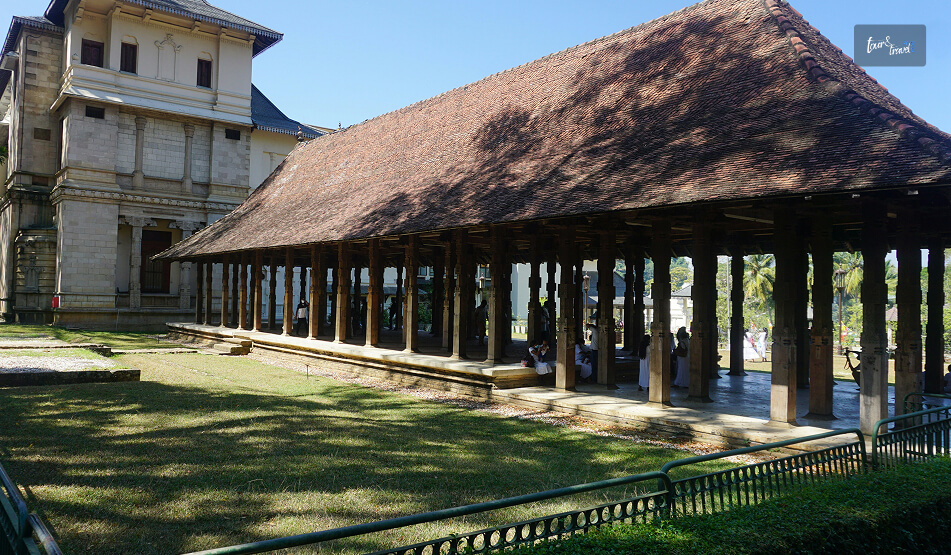
The Tusker Museum in particular houses the preserved remains of Raja, the legendary tusker who carried the relic casket in the Esala Perahera for over 50 years.

It is a detail most first-time visitors miss.

A Half-Day Itinerary Around The Temple

A Half-Day Itinerary Around The Temple
TimeActivity
9:00 AMArrive at Sri Dalada Maligawa, clear security, and buy your ticket.
9:15 AMExplore the courtyard, moonstone carving, and Water Wall before the crowd builds.
9:30 AMAttend the midday puja and hewisi drumming at the inner shrine.
10:15 AMVisit the Dalada Museum and Tusker Museum (included in your ticket).
11:15 AMWalk the perimeter of Kandy Lake, just south of the temple.
12:00 PMLunch at one of the cafés along Dalada Vidiya, the road facing the temple.
1:00 PMContinue on to the Royal Palace complex or the National Museum of Kandy next door

Things You Probably Didn’t Know

Things You Probably Didn't Know
  • There is no actual photograph of the tooth relic, and the temple authority does not display it publicly. 

What they show twice daily is the outermost of several nested golden caskets that house it.

  • The temple survived a suicide truck bombing on 25 January 1998.

It was days before Sri Lanka’s 50th independence anniversary celebrations, with Kandy as the epicenter. 

The attack damaged the facade. However,  nothing happened to the relic, and daily rituals resumed within days.

  • The octagonal Pattirippuwa pavilion, one of the most photographed parts of the complex, was not part of the original design at all.

It was an addition between 1798 and 1815, under the island’s last king, Sri Wickrama Rajasinghe.

  • Newborns can be formally “offered” to the temple as part of a blessing ceremony at 10:00 AM and 7:00 PM daily.

The child has to be between three and six months old.

What Is The Best Time To Visit The Temple Of The Tooth? 

The temple is open 365 days.

However, a few timing choices make a real difference to the temple visit experience. 

You will enjoy the calmest ambiance in the temple at 5 AM when the temple opens. I visited the temple at 9 AM. 

It was just before the temple opened. The crowd was large, but they were in a disciplined queue. 

So, I got the chance to explore the temple and take the best photographs. 

Moreover, if your dates allow, you can visit the temple during the Kandy Esala Perahera in July or August.

Also, the Poya (full moon) days and Wednesdays, when the Nanumura Mangallaya bathing ritual takes place, draw larger numbers of local devotees.

Share on Social Media

Sibashree is a travel, culture, and leisure writer who has been writing since the age of 12 and professionally since 2014. With more than a decade of travel writing experience and journeys across India and several parts of the world, she brings a deeply personal and thoughtful perspective to her work. A student of English Literature and Mass Communication, Sibashree has always viewed travel as more than movement — for her, it has been a way of understanding people, cultures, and herself. Her passion for spiritual exploration has also led her to many unusual and meaningful destinations over the years. Outside of writing, Sibashree enjoys watching European cinema, reading about global politics, and reflecting on the stories hidden within everyday places.

Leave a Reply

Your email address will not be published. Required fields are marked *

title-img Related

READ MORE maduru oya

Maduru Oya National Park: A Quiet Corner Of Wild Sri Lanka

BY  Sibashree Aug 29, 2026

Everyone mentions elephants when talking about Maduru Oya. However, for me, it was different, though they were everywhere around me.   It was the silence that grabbed my attention first.   The week with crowded safari queues at Minneriya and Kaudulla was hectic. So, when I reached the Maduru Oya National Park, it felt like stepping into an empty room from a busy street.   There was no convoy of jeeps kicking up dust or radio chatter between drivers racing to the same sighting.  Just tall grass, a wide blue reservoir, and the low rumble of our jeep's engine!  Maduru Oya is in the dry zone of Sri Lanka, and it is around 314 kilometers from Colombo. Furthermore, it stretches over Polonnaruwa, Badulla, and Ampara districts.  It became a national park in 1983 as part of the Mahaweli Development Programme.   The Programme aimed to protect the catchment area of the Maduru Oya reservoir and four other tanks that feed the region's irrigation network.  However, you do not remember all these details once you are inside the national park. You have your eyes set on a herd of elephants wading through the shallows with the reservoir stretching out behind them.  Maduru Oya At A Glance  Location Polonnaruwa, Badulla and Ampara districts, dry zone  Distance from Colombo About 314 km (roughly 5–6 hours by road)  Area 58,850 hectares  Declared a national park 9 November 1983  Best time to visit March to September (dry season, better water-point sightings)  Known for Elephant herds, Vedda heritage, ancient Buddhist ruins  Nearest hub Kuda Sigiriya / Mahiyanganaya area  Hours 6 AM to 6 PM (The Ticket Counter Gets Closed at 4 PM.)   Why Maduru Oya Doesn't Feel Like Sri Lanka's Other Parks Fifteen percent of Maduru Oya is water, and 85% is landmass. This ratio shapes the characteristics of the park.   The reservoir and its surrounding wetlands draw the following birds and animals.  Grey Pelicans  Sea Eagles  Painted Storks  Elephants  Also, the mix of open grassland, scrub, and water made every drive here feel more layered than the flatter areas.   Furthermore, you will notice patches of tall secondary grass across the park due to the shifting of cultivation over the decades.   Our guide kept reminding us that these are the places where elephants like to disappear. It happened twice or thrice!  We spotted an entire herd of six or seven animals, and suddenly they were gone.    The park's boundaries lie in the low hills stretching from the Lunugala ridges.  Also, to the southwest, a rocky mountain range spreads across roughly eight kilometres, giving the drive some visual relief from the flat dry-zone plains most visitors associate with Sri Lanka's east.  Wildlife: Elephants First, Everything Else After  Maduru Oya is famous for its elephant population. Herds of elephants here are really large, and once you pass the tall grass, you will get long and easy-to-watch stretches without the sight of another vehicle.   Along with elephants, you will also find the following wildlife here.  Leopards  Sloth Bears  Sambar  Spotted Deer  Wild Boar  Wild Buffalo  Toque Macaques  Purple-Faced Leaf Monkeys  Moreover, if you are on a night-adjacent drive, you can spot nocturnal slender loris here.   Reptile sightings are common too, with water monitors and the occasional mugger crocodile sunning near the reservoir's edge.  A Delight For Birders   Birders have plenty to work with here, as close to a hundred species of birds call it home. Some species commonly spotted here are:  Woolly-Necked Stork  Openbill  Painted Stork  Racket-Tailed Drongo  Sri Lanka Junglefowl  Yellow-Fronted Barbet  Spurfowl  My trip has been mammal-heavy so far. So, Maduru Oya was a good place to slow down and let the birdlife catch up.  Ruins The Safari Jeep Doesn't Usually Stop For  Maduru Oya also surprised me with the amount of history it stores inside.   It has a scattering of ancient Buddhist ruins, shrines, hermitages, statues, and dagobas concentrated around areas like Henanigala, Kudawella, Gurukumbura, Uluketangoda, and Weerapokuna.  Some of the Brahmi rock inscriptions here date back to the 1st to 3rd centuries BC.  Also, an ancient sluice gate uncovered during construction of the Maduru Oya Dam is believed to date to around the 6th century BC.   Most standard safari drives skim past these.  If ruins interest you, mention it to your guide or driver before you set out, since a slightly different route can take you closer to them.  The Vedda Community   The park also sits within Vedda country.   Sri Lanka's indigenous Vedda community, believed by tradition to descend from King Vijaya and Queen Kuweni, live in and around the reserve.  Some tours can arrange a respectful visit to learn about their way of life. I would treat this the way I would treat any community visit.  Go through a reputable operator, and let the encounter be led by the community rather than treated as a photo stop.  Planning Your Visit To Maduru Oya Mahiyanganaya, Polonnaruwa, or the Kuda Sigiriya area are the common base areas for a visit to Maduru Oya.   So, the park can easily fit into your itinerary as a side trip if you are already covering the Cultural Triangle.   There is no public transport into the park itself. So, you will need a hired vehicle or a pre-arranged safari jeep.  Most tour operators based in Habarana, Sigiriya, or Polonnaruwa can put together a half- or full-day excursion.  Safaris And Costs  A half-day safari jeep, roughly four hours, typically runs somewhere in the LKR 7,500–10,000 range.  However, this varies by operator and season and rarely includes the park's own entrance fee, which you pay separately at the gate.   It is worth booking your jeep a day or two ahead during the dry season, when demand picks up.   I would also second the advice I heard from more than one local guide.  Go with a small group. Maduru Oya rewards patience and quiet, and a crowded jeep makes both harder to come by.  Entry Fee  Entry Fee and Charges to the Park How Much To Pay  Local Adults   LKR 60  Local Children (6-12 years)  LKR 30 Local Student  LKR 20 Local Children (below 6 years)  Free Local Group Fee (per vehicle)  LKR 400 Foreign Adults  USD 12 Foreign Children (6-12 years)  USD 6  Adults from Foreign SAARC Countries    USD 10  Children from Foreign SAARC Countries (6-12 years) USD 5 SAARC Country Children (below 6 years)  Free of Cost Foreign SAARC Visitor Group Fee (per vehicle)   USD 10   Taxes on Total Cost  18%  Entrance Fee per vehicle LKR 300  What Is The Best Time To Visit Maduru Oya National Park? March through September is the sweet spot to visit Maduru Oya National Park.   It is the dry season when wildlife concentrates around the designated water points of the park. So, sightings are more predictable.   Early morning drives are cooler and calmer, and as with most Sri Lankan parks, the animals are noticeably more active before the heat of midday sets in.  Where Does Maduru Oya National Park Fit In A Sri Lanka Itinerary? Maduru Oya is not a park I would build an entire trip around.  However, it is an excellent addition if you are already in the Cultural Triangle and want a safari experience without the crowds of Yala or Minneriya.   Pair it with Polonnaruwa's ruins in the morning and a Maduru Oya drive in the late afternoon, or use it as a quiet counterpoint after the more chaotic parks further south.
READ MORE Habarana

Why Is Habarana Beyond Just A Gateway To The Cultural Triangle Of Sri Lanka?

BY  Sibashree Apr 27, 2026

Search for Habarana on Google, and in 9 out of 10 cases, it will show that Habarana in North-Central Sri Lanka is the base for visiting the cultural triangle of Sri Lanka.  However, Habarana in the district of Anuradhapura in itself is a perfect blend of adventure, culture, and nature.  So, if you want to set your cultural itinerary in Sri Lanka right, Habarana will be at the epicenter. In this article, I will talk about the things to do in Sri Lanka from Habarana. I will also discuss the top attractions in this beautiful tourist town with a population of 5000.  Where Is Habarana?  Habarana in Anuradhapura District is around 180 km away from Colombo, the capital of Sri Lanka.  Located in the north-east of Colombo, it is also just 30 minutes away by road from the Sigiriya Rock Fortress, a UNESCO World Heritage Site, and its neighbor, Pidurangala Rock.  How To Reach Habarana?  The most convenient way to reach Habarna is to take a bus or train from Trincomalee.  I, of course, as always, opted for a train ride after a visit to the Uppuveli Beach and exploring the other things to do in Trincomalee.  Getting To Habarana On A Train  The Habarana Railway Station is on the Colombo to Trincomalee Railway Line. I took a night train from Trincomalee (Night Mail, Trincomalee → Colombo Fort).  This train runs daily and departs the Trincomalee Station at 7 PM and reaches Habarana at 9:30 PM.  I bought a second-class ticket, and it cost me 800 LKR. The third-class tickets will cost around LKR 600.  Getting To Habarana On A Bus  From Trincomalee to Habarana, it is a bus ride of little over 2 hours. The ticket price was INR 300 when I last enquired.  You will get different buses run by the Sri Lanka Transport Board and many private buses.  However, considering the scorching Sun of Sri Lanka, a bus ride is difficult in the daytime, and the Trincomalee to Habarana route remains crowded. Why Is Habarana The Base For A Cultural Exploration In Sri Lanka?  Habarana has a beautiful lake by the name of Habarana Lake. It is a tranquil water body with lush greenery around.  It is a beautiful place for birdwatching. Furthermore, you can also spot monkeys and elephants here.  When you are in Habarana, you can start your day with a stroll along the lake. Then, you can plan a day trip to the following places.  1. The Sacred City Of Anuradhapura  Distance from Habarana: 59 Kms The Sacred City of Anuradhapura is a UNESCO World Heritage Site. It was the religious and cultural capital of Sri Lanka for 1300 years.  However, it was massively impacted due to the invasion in 993 AD.  The main stupas in this sacred complex are the Abhayagiri Vihara Stupa, Jethawanaramaya Stupa, the third-largest man-made structure, and the most sacred Ruwanwelisaya Stupa.  2. Kaudulla National Park  Distance from Habarana: 28 Kms If you want to spot elephants in Sri Lanka, you have to visit the Kaudulla National Park.  However, the Kaudulla National Park is not just about the safaris or spotting the wildlife. During my visit, I found it truly living up to its reputation for animal welfare.  It is one of the places I visited where elephants are not chained.  3. Hurulu Eco Park  Distance from Habarana: 3.4 Kms The Hurulu Eco Park is the closest destination to visit from Habarana if you want to experience the wildlife of Sri Lanka.  Elephants passing between the Minneriya National Park and the Kaudulla National Park use Hurulu Eco Park as an important corridor.  Moreover, the topography of the Hurulu Eco Park is a good mix of plains, rocks, and evergreen jungle.  4. Dambulla Royal Cave Temple Distance from Habarana: 25 Kms The Dambulla Royal Cave Temples are fascinating, and being a two-million-year-old place of Buddhist worship is something extraordinary.  The more amazing thing is that the temples are well-preserved, and people still worship Lord Buddha in these temples.  Spanning an area of 2100 square meters, these cave temples have 157 statues of Lord Buddha and other important figures of Buddhism.  However, among all these statues, the reclining statue of Lord Buddha in the 1st cave will remain etched in my memory forever.  5. Ritigala Forest Monastery Distance from Habarana: 21 Kms The Ritigala Forest Monastery has its historical roots in the 1st century BCE. During that time, Buddhist monks settled here.  Over time, this monastery became an important site for the powerful Pansukulika Sect, which enjoyed the highest form of glory during the 9th to 11th centuries.  However, it was destroyed by Chola invasions in the 10th-12th centuries.  The Ritigala Forest Monastery has a long history of discovery and restoration, too. Moreover, it has a connection with the great Hindu epic, the Ramayana.  In addition, the Ritigala Mountain is home to more than 417 species of medicinal plants and a rich biodiversity. 6. Sigiriya Rock Fortress  Distance from Habarana: 30 Kms The Sigiriya Rock, a UNESCO World Heritage Site, is primarily a site of a Buddhist monastery from the 3rd to 1st century BCE. However, there are also legends about this rock fortress being the Golden Palace of Ravana.  Nevertheless, the Buddhist monastery in the Sigiriya Rock rose to importance when Anuradhapura became the capital of Sri Lanka. 7. Pidurangala Rock Distance from Habarana: 30 Kms Many tourists make the mistake of considering Pidurangala Rock as a trekking point that offers a better view of the Sigiriya Rock.  However, along with being a neighbor of Sigiriya Rock, it also has a history of Buddhism associated with it, and the history is 2 millennia old.  After Kashyapa made the Sigiriya Rock the center of power, the monks shifted from there and started residing in the Pidurangala Rock.  It also received royal patronage for its development and for making adequate accommodations for the monks here.  8. The Ruins Of Polonnaruwa Distance from Habarana: 47.5 Kms The ruins of Polonnaruwa are a part of the cultural triangle of Sri Lanka. Polonnaruwa was a growing religious and commercial center of Sri Lanka for over 800 years.  During the Sinhalese and Chola kingdoms and for three centuries, it was the capital of the country.  Today, the Ancient City of Polonnaruwa has the ruins of the Royal Palace, the Sacred Quadrangle, the central dagoba, Shiva Devale, Pabalu Vehera, Rankot Vihara, the dagaba Kiri Vihara, and many other ruins and architecture.  Also, the Buddha sculptures in different dagobas or stupas of the complex were mesmerizing.  9. Minneriya National Park  Distance from Habarana: 5.8 Kms Minneriya National Park has a lush landscape, and along with elephants, it is also home to diverse wildlife such as sloth bears, leopards, and different bird species.  The annual gathering of elephants is the most fascinating incident of the Minneriya National Park. It indicates an event where hundreds of elephants have a meeting, or they gather around the Minneriya Tank.  Habarana: Beyond The Gateway To The Cultural Triangle Of Sri Lanka   Although most people think of Habarana as being nothing more than a bus stop for those heading to Sigiriya or Polonnaruwa, it actually turned out to be the best surprise during my trip to Sri Lanka.  The only reason to stay in Habarana is how convenient the location is.  However, staying there provided me with an experience that you couldn’t reproduce in the more touristy areas of the island, which is the natural beauty of the area. A Place For The Gentle Giants The highlight of my time spent in Habarana was the fact that I was so close to Minneriya and Kaudulla National Parks.  I didn’t just see elephants. I witnessed what is known as the "Gathering."  Also, I observed hundreds of wild elephants gathered around one of the ancient reservoirs while driving around in an open-top jeep.  This is due to it being located in the middle of these two migratory areas.  While we still had wildlife encounters in the more touristy areas, they didn’t have the same natural feel or take the same amount of effort as they did while driving around in Habarana. Authentic Village Immersion In addition to going on safari, I spent a morning enjoying the lifestyle of the people living on the shores of a local lake.  I took a traditional horse-drawn carriage to the lake and paddled across the lake in a canoe.  I shared a meal of rice and spicy sambol with a family in their mud hut that was about as authentic as you could get.  This was far more than just a stopping point, and it was an example of the hospitality of the Sri Lankan people and the slow lifestyle that became my takeaways. Where To Stay In Habarana?  If you're looking for accommodations in Habarana, you're sure to find something that meets your budget, with options ranging from "basic backpacker" to "boujie boutique" accommodations.  For a "calm little oasis," Dudley's Nature Resort is a great option, and it is located 15 minutes away from the main strip of Habarana. Furthermore, the resort is set in a lush jungle environment and includes a pool and breakfast served in the garden.  Moreover, if you are looking to be in a social environment, Roy's Villa Hostel is close by and has an incredible communal atmosphere. Where To Eat In Habarana?  For authentic local flavors, Dewata Villa is a must-visit for its legendary "Rice & Curry" spread.  If you're looking for a quick, budget-friendly bite, Cinnamon Lodge offers great snacks, while the main street is lined with "Short Eat" bakeries for spicy pastries.  For a more social evening, head to Roy’s Villa nearby for delicious communal dinners and great vibes.

READ MORE Kudawella Beach

Where Is Kudawella Beach? What To Do In Kudawella Beach For Beginners?

BY  Sibashree May 5, 2026

Very close to the Hiriketiya Beach, Kudawella Beach is a pristine, small, and beginner-friendly beach for surfers.  However, even if you are not a surfer, you can visit this hidden gem to find the turtle nests and the surrounding mangroves.  Also, at Kudawella Beach, you can enjoy the beauty of the Indian Ocean or just laze around on the sand.  Here is more about this beautiful, sickle-shaped beach on the southern coast of Sri Lanka.  Where Is Kudawella Beach? How To Reach Kudawella Beach As I have mentioned, Kudawella Beach is on the southern coast of Sri Lanka, and it stretches from west to east.  Furthermore, the beach is around 10 km away from Dickwella, the closest major town to the beach.  Moreover, if you are already visiting the Hiriketiya Beach, you can just take a 10-minute tuk-tuk ride to reach the Kudawella Beach.  The most popular way to reach the Kudawella Beach is to take a direct car or taxi from Colombo, which is at a distance of around 160 km.  The journey by road will take close to 5 hours, and the taxi fare will be over 30000 LKR.  However, I was already in Ella and had a day after visiting the iconic Nine Arch Bridge and exploring all the other top attractions in Ella.  So, I took a bus from Ella to Galle. The bus #31 was moderately crowded, and I was enjoying the local experience.  That bus from Ella to Kudawella Beach took around 6 hours, and the ticket price was LKR 350.  What Are The Things To Do In Kudawella Beach?  Kudawella Beach is a place that offers you the ultimate flexibility.  Yes, there are a few hotspots when you are on the beach. However, you can spend your entire day without doing anything.  Moreover, it is a delightful place for amateur surfers.  Still, here are a few things to do in Kudawella Beach, along with surfing and chilling.  1. A Walk To The Hummanaya Blow Hole I loved walking to the Hummanaya Blow Hole on the eastern side of the Kudawella Beach. However, to see the water shooting up, you have to reach the viewing point at the top of a cliff.  The cliff also has a safety barrier.  It is the only blowhole in Sri Lanka and the second-largest in the world, shooting the water at a height of 25-30 meters when the water forcibly enters a narrow cavern.  I saw the blowing taking place at least 5-6 times during the short moment I halted there. The water shoots up as the sea movement builds pressure in the tunnels in the rock.  2. A Walk To The Nilwella Beach If you want even a more idyllic retreat, you can visit the Nilwella Beach from the Kudawella Beach.  This beach has blonde sand, and the waves here are gentle.  Moreover, I loved walking across the beach to reach a rocky island. The rocky island had many palm trees and pandanus trees.  There was also a hiking trail, and as I advanced, I found many little coves and unique geographical shapes.  3. Kayaking Around Mawella Lagoon Mawella Lagoon was pretty, and the water was covered by beautiful lily flowers.  Furthermore, there are many hotel rooms and massage rooms near the lake where you can chill or enjoy a relaxing massage session.  However, just behind the Kudawella Beach, this lagoon is also ideal for kayaking around.  It cost me around 8000 LKR, and I spotted many birds such as storks, beeaters, and kingfishers there.  I heard that sometimes you can also spot crocodiles here.  Kudawella Beach: The Best Spot For Surfing For Beginners  As I have mentioned, Kudawella Beach is a beginner-friendly surfing spot.  Unlike Hiriketiya, you will not find outer waves here. You can only surf here at the beach break, which is further on the inside of the bay.  So, it is safer than Hiriketiya Beach.  In fact, even in the dry season from November to March, the waves seldom reach a height of more than 4 feet.  However, you have to be watchful of the few rocks in the water. Having said that, during the dry season or the peak surfing season, the water of the Indian Ocean is crystal clear.  So, you will be able to see the rocks clearly.  Moreover, on the Kudawella Beach, there are two surf rentals. However, when I visited, there was a longer queue in front of the Saranga at Kudawella Surf School, and its surfboard-shaped signboard also looked pretty cool.  What Is The Best Time To Visit Kudawella Beach?  November to March, or the dry season, is the best time to visit the Kudawella Beach.  Long hours of sunshine make these months ideal for beach activities. However, there can be sudden rainfalls. So, you have to carry your rain gear.  However, the wet season from March to August, despite having fewer crowds, is not ideal as there can be harsh storms and heavy rainfall.  Where To Stay Near The Kudawella Beach?  When I visited Kudawella Beach, it was still very pristine, and thus it is a quintessential beach on the southwestern coast of Sri Lanka.  You will find only a few hotels here.  Also, if you want to find an accommodation here, you can stay on the beachfront or in hotels near the lagoon.  Here are some of the places where you can stay.  Sisi Place The Sisi Place is on the hilltop at the west end of the beach. It is the most budget-friendly option here with clean and comfy rooms.  Simply Peace  Choose Simply Peace if you are looking for a luxury accommodation near the lagoon.  It is a beautiful pool where you can relax. Furthermore, it has a garden where you can enjoy birdwatching.  Calma I loved the pastries and coffee at the on-site cafe of Calma. With a sand front, it exudes a quintessential Balinese bungalow aesthetic.  Moreover, you can take a short tuk-tuk ride from Kudawella Beach to Hiriketiya Beach. There, you will find more diverse accommodation options, including Airbnbs.