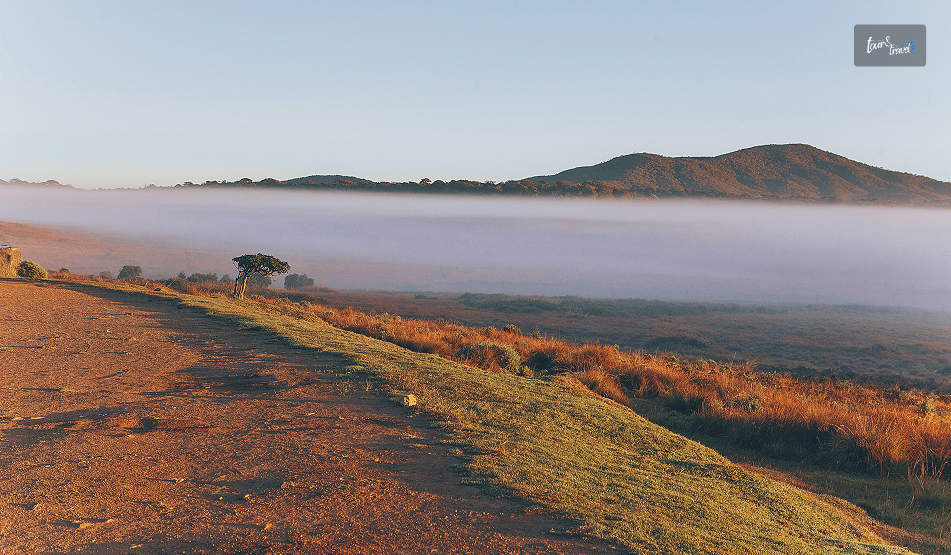
It was still pitch dark when I left Nuwara Eliya. I was wrapped in every layer I had.
It was a bit weird, and I felt overpacked considering Sri Lanka spends most of the year in a state of tropical sweat.
After an hour and a half, I was standing at the entrance gate of Horton Plains National Park.
My breath was fogging, and I realized that it was actually Cold and not the Sri Lankan cold you would usually expect.
On a high plateau in the Central Highlands, the Horton Plains National Park sits at an elevation of more than 2100 meters.
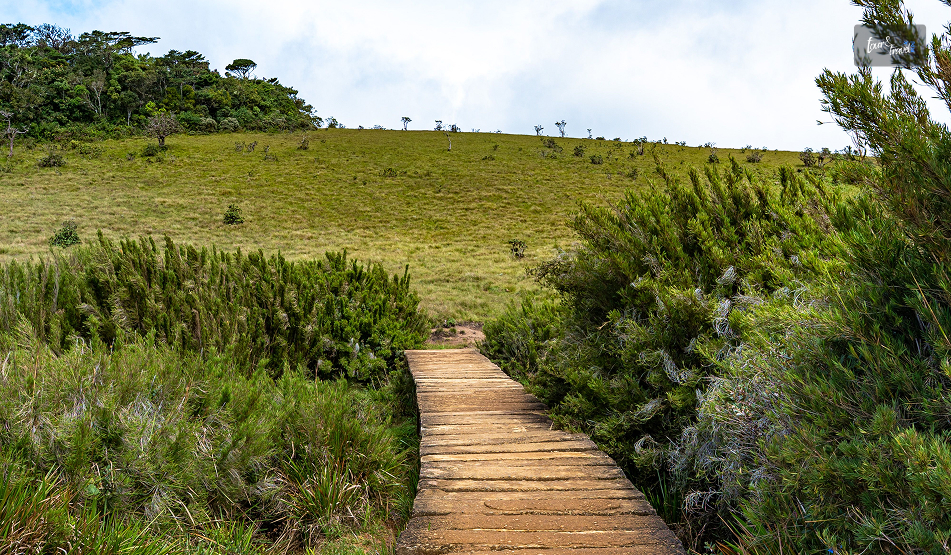
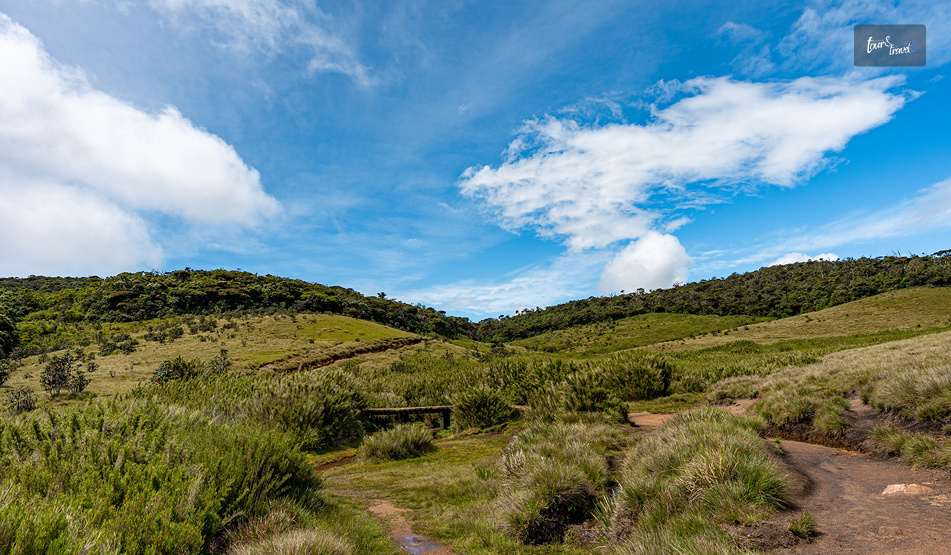
Unlike most of the Sri Lankan landscape, the Horton Plains National Park does not have rice paddies, palm trees, and the lowland heat haze.
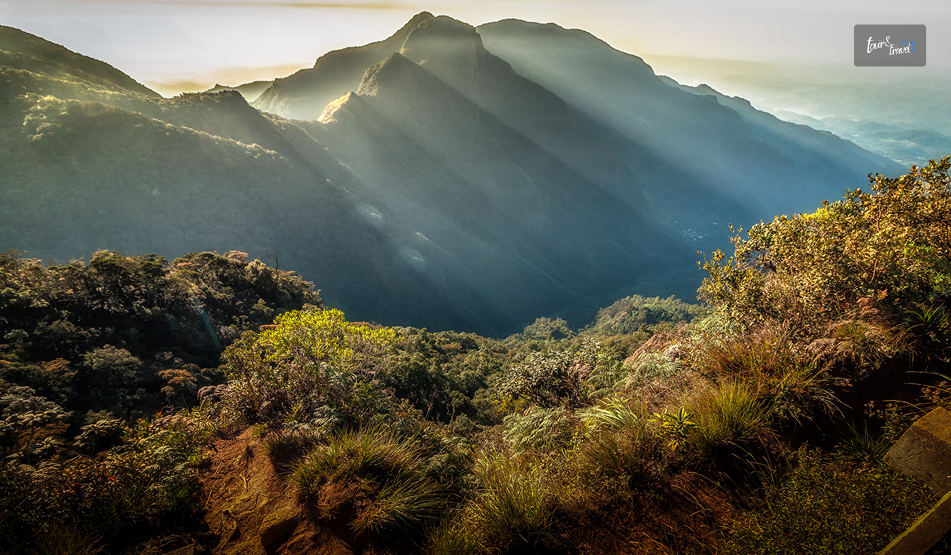
In fact, it looked like the Scottish Highlands with gnarled cloud forest, windswept grassland, and silence broken by birdsong.
So, overall, it looked like a contradiction in the middle of a tropical island country.
Horton Plains: A Plateau With A History
Horton Plains stands out with an ecological and historical weight.
This weight is more than the windswept image it has.
Long before it became a popular hiking destination, it was famous as a colonial retreat.
Furthermore, in July 2010, it became a UNESCO-listed ecosystem as part of the Central Highlands of Sri Lanka.
From Maha Eliya Thenna To National Park
Horton Plains was earlier known as Maha Eliya Thenna before it became a national park.
Maha Eliya Thenna means “The Great Open Plain.” During British Rule, it was renamed after Sir Robert Wilmot-Horton.
He was a governor of Ceylon.
Also, during that time, the highlands became a retreat for planters escaping the heat of the lowlands.
Until 1969, the Horton Plains were not formally protected.
Then, it became a wildlife sanctuary.
Finally, in 1988, it got the full designation as a national park.
Then came 2010.
Horton Plains got the UNESCO designation along with the Peak Wilderness Protected Area (home to Adam’s Peak) and the Knuckles Mountain Range.
Together, these three protected areas form what conservationists describe as one of the island’s most important biodiversity hotspots.
These shelter species found nowhere else on Earth.
Why The Ecosystem Matters
Sri Lanka, being a party to the Convention on Biological Diversity, submitted the “Sixth Annual Report” in 2019.
I am quoting the content of the report as highlighted by the Daily Mirror Online here.
“The Peak Wilderness Sanctuary, Horton Plains, and the surrounding protected and unprotected areas containing small wet-zone forests possess the highest levels of endemic plant and animal diversity in Sri Lanka.”
The Horton Plains National Park is also the source of the three major rivers in Sri Lanka.
Mahawell
Kelani
Walawe.
Moreover, as an important ecological region, it was the first national park in the island country to ban single-use plastics.
So, when you are about to enter the national park, the rangers check the bags at the entrance.
You have to leave the water bottles (if you are carrying water in single-use plastic ones) and snack packets before entering it.
The Walk Itself
Recently, there have been talks about the reopening of the Nonpareil Estate and Nagrak to Horton Plains route.
After failed attempts in 2015 and 2020, this recent request in August 2026 has been submitted by the tourism hotel operators.
The Development Committee meeting has also discussed this matter.
Also, Gayani Renuka, the Divisional Secretary of Imbulpe, has presented it to Dr. Dhammika Patabendi, the Minister of Environment.
However, there are uncertainties about reopening this route for better accessibility.
It is because of environmental concerns and the pristine nature of the Horton Plains.
So, if you go for a trek now, you have to pass through three distinct moments strung along one loop trail.
Each loop has a distinct character.
The Main Loop
The distance of the main trail is around 9 to 9.5 kilometers.
At an easy, photo-stopping pace, you can cover the loop in 3 to 4 hours.
There is no steep elevation gain.
So, technically, it is not a difficult trek to complete.
Also, the route is well-maintained and well-marked.
However, the elevation adds to the challenges of trekking.
Add to that the cold, unfamiliar to most parts of Sri Lanka!
You can complete the loop clockwise like most hikers.
Thus, you will reach Little World’s End first and then World’s End.
Next, you will find the Baker’s Falls on the return leg.
Walking it this way means you catch the two main viewpoints while the sky still has a chance of being clear.
Little World’s End
About 3.5 kilometres in, this is the warm-up act.
The Little World’s End is a cliff edge with a drop of around 270 metres.
It is less dramatic than what comes next, but on a clear morning you can see the patchwork of tea estates and village rooftops laid out far below.
It is often far less crowded than its famous neighbour.
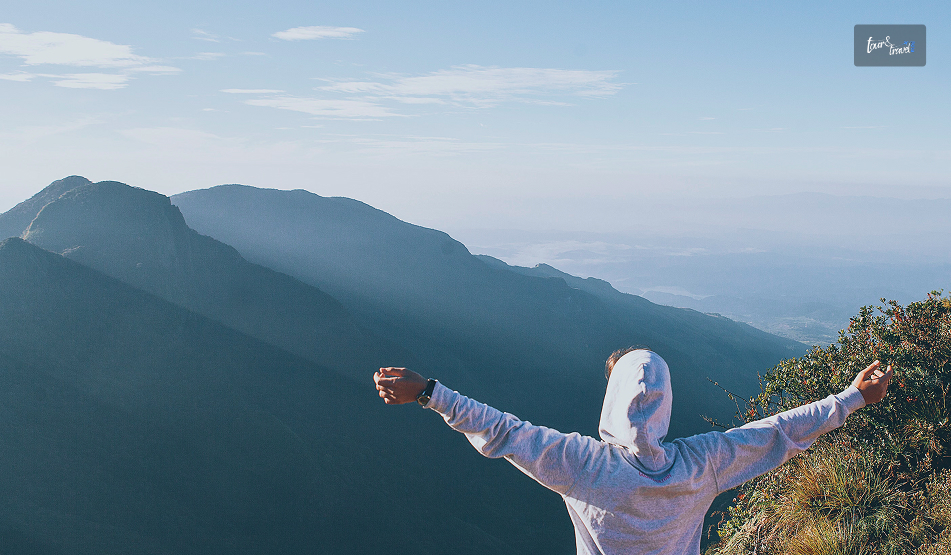
World’s End
Roughly 4 kilometres from the start, this is the reason everyone makes the pre-dawn drive.
It is a sheer escarpment that drops somewhere between 870 and 880 metres, depending on which source you believe.
Also, there is genuinely nothing gentle about it.
A low metal railing marks the edge in places, but a fair stretch of it has nothing but exposed rock and open air.
So it is worth keeping a firm grip on children and a healthy respect for the drop yourself.
On a clear day, the view stretches all the way to the south coast, nearly 100 kilometres away.
The feeling, standing at nearly 2,000 metres above sea level, is inexplicable.
I got lucky with about ten clear minutes before the mist rolled back in.
It was enough to understand why people set their alarms for 3 AM to be here.
Baker’s Falls
Baker’s Falls is an important landmark on the way back, and you will find it after completing a hike of 7.5 kilometers.
The waterfall is modest, but its beauty is unmatched.
Moss-covered boulders and cloud forest thick with ferns frame this 20-meter waterfall.
I wanted a closer look at this beautiful fall.
So, I took a short flight of stone steps leading down to the base.
Longer Routes For The Ambitious
If you have more time and stamina, longer routes branch off toward Kirigalpotta, Sri Lanka’s second-highest peak.
It also takes you to Thotupola Kanda, the third-highest, along with a section of the long-distance Pekoe Trail that now runs through part of the park.
These require permits and, in most cases, a guide, but they are a genuine option if the main loop leaves you wanting more.
When To Visit The Horton Plains National Park?
The gates of the Horton Plains National Park open at 6 AM.
By 9:30 or 10 AM, the mist in the national park rolls in and swallows the views.
I came across one highland lodge owner online. He runs a “Highland Trek” experience out of Nuwara Eliya.
He said, “It is not just the sunrise if you reach the Horton Plains National Park by 6 AM.
Reaching early also helps you to beat the cloud that builds through the morning.”
The park stretch is the driest and clearest during these months.
However, being the best time, this window also brings heavy crowds on weekends and local holidays.
April through September brings more mist and drizzle, and while the views become less reliable, the trail is also quieter.
Several travellers I found comparing notes online argued that a misty, moody Horton Plains has its own appeal.
It is just a different trip than the postcard version.
Wildlife, Without The Big Cat Guarantee
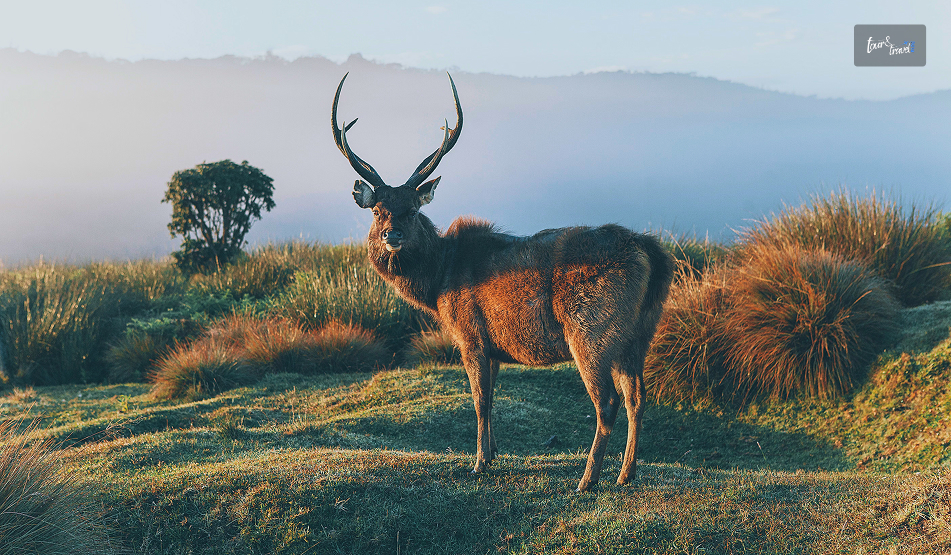
The Sambar Deer is the poster animal of the Horton Plains National Park.
I could spot them easily.
If you especially visit the park early in the morning, you will find these adorable creatures grazing in the open grassland.
Furthermore, if you are a bird-watcher, you will find endemics like the Sri Lanka whistling thrush and the yellow-eared bulbul.
Other birds you will find here are:
Scaly-Breasted Munia
Sri Lanka Whistling Thrush
Sri Lanka Spurfowl
Horton Plains is also, on paper, a leopard territory with the Sri Lankan leopard as the apex predator here.
However, sightings are exceptionally rare, and I would not build a trip around the hope of one.
Most guides are refreshingly honest about this rather than overselling it.
Instead, expect wildlife such as Fishing Cat, Grizzled Giant Squirrel, and Wild Boar here.
If you are here to spot reptiles, watch out for the black-cheek lizard, Boie’s rough-sided snake, and the horned lizard.
The Nelu Bloom: A Once-In-A-Generation Sight
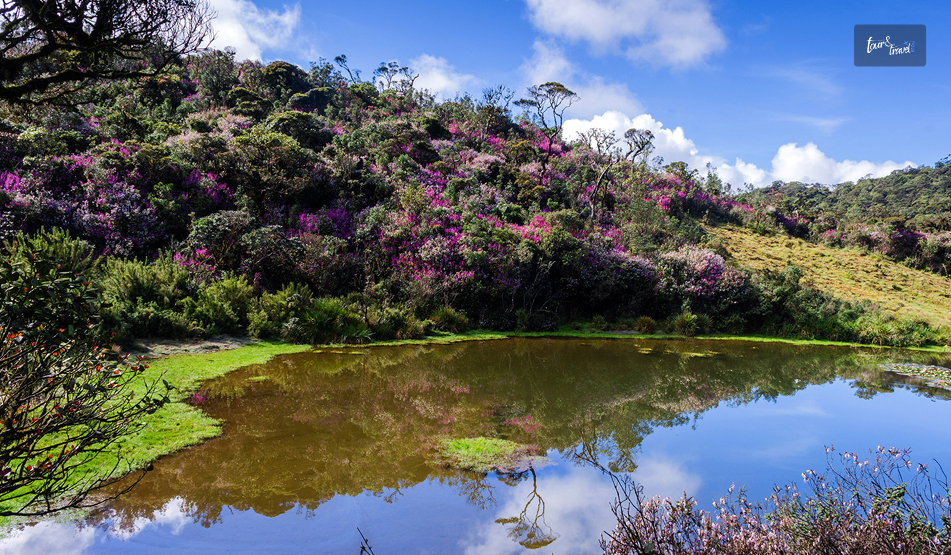
The flowering of the Nelu is one of the main highlights of the Horton Plains National Park.
This flower of a genus of shrubs in the highlands does not bloom every year.
In fact, these flowers bloom once every 12 years.
When these flowers bloom, the entire hillsides turn a soft purple-blue almost overnight.
You must have seen these photographs on Instagram.
Sample Itinerary
Most visitors do Horton Plains as a single early-morning excursion.
However, there are a few ways to structure the day depending on your fitness, time, and onward travel plans.
Half-Day Trip From Nuwara Eliya To Horton Plains National Park
Time
Activity
3:30–4:00 AM
Wake up, dress in layers, depart Nuwara Eliya.
5:00–5:30 AM
Arrive at Horton Plains entrance, buy tickets, bag check.
6:00 AM
Gate opens, begin the loop (clockwise).
6:00–7:00 AM
Walk to Little World’s End (3.5 km).
7:00–7:45 AM
Reach World’s End, main viewpoint stop.
7:45–9:00 AM
Continue on the loop to Baker’s Falls, a short detour to the base.
9:00–10:00 AM
Finish the loop back to the car park.
10:00–11:30 AM
Drive back to Nuwara Eliya and have breakfast en route or in town,
Extended Day Trip (With Kirigalpotta Or Thotupola Kanda)
Time
Activity
3:30–4:00 AM
Depart Nuwara Eliya.
5:30–6:00 AM
Arrive and buy extended tickets and permits for an extended trail if required.
6:00–10:00 AM
Main Loop Little World’s EndWorld’s EndBaker’s Falls.
10:00 AM–1:00 PM
Extended Trail Kirigalpotta or Thotupola Kanda with a guide.
1:00–2:00 PM
Return to car parkDrive back
3:00 PM onward
Late lunch in Nuwara Eliya and relax
Moreover, instead of making a return to Nuwara Eliya, you can continue your journey to beautiful Ella.
Tentative Cost Breakdown
Costs vary depending on how you get there and whether you hire a guide.
However, here is a realistic breakdown to budget against.
Entrance Fees
Item
Approximate Cost
Foreign adult, day visit
USD 25 per person
Foreign child
USD 12
Sri Lankan national, day visit
•LKR 150 for Adults •LKR 75 for Children •LKR 20 for Local Students with Valid ID
Vehicle entry
LKR 250-1000 for VehiclesDrive/Guide Fee:
Overnight/extended permit (for longer trails)
Around LKR 2400 for a Campsite of 12 People.
Tickets are generally sold only at the entrance, not online. So budget extra queueing time in peak season (December–March, weekends).
Transport From Nuwara Eliya
Option
Approximate Cost
Private car, round trip with 3-hour wait
LKR 5000 to LKR 13000
Tuk-tuk, round trip
LKR 1500-2000
Organised half-day tour (driver + guide)
LKR 6000 Per Person
Full-day customisable tuk-tuk/car tour (Horton Plains + extras)
LKR 10000 for the vehicle/group
Other Costs To Budget For
Item
Approximate Cost
Local guide (optional, for main loop)
LKR 600
Guide for extended trails (Kirigalpotta/Thotupola)
LKR 700
Breakfast/snacks in Nuwara Eliya after the hike
LKR 300-400 Per Person
Tips for driver (customary but not obligatory)
Around LKR 200
Rough Total, Per Person
For a solo or paired traveler doing the standard half-day loop with a shared private car, all-in costs typically start from around LKR 15000.
What People Are Actually Saying About The Horton Plains National Park
Beyond the official descriptions, recent traveller reviews and hiking forums paint a fuller, more candid picture of what to actually expect.
The Praise
I have checked the recent traveler reviews and hiking forums for recent updates on the Horton Plains trek.
I wanted updates as it has been almost 2 years since I have been there.
I have got a pretty consistent and useful picture of the park beyond the marketing photos.
People consistently describe the loop as peaceful, scenic, and surprisingly quiet once you are past the entrance area.
Also, many travelers have remarked that they barely saw another hiker on the trail itself despite a busy car park.
The cool climate and the drama of World’s End come up again and again as the highlight.
More than one reviewer said the steep entrance fee for foreign visitors was worth it for the experience alone.
The Complaints
The complaints cluster around two things.
First, Value For Money At The Gate
Several visitors felt the facilities, particularly the restrooms, didn’t match what they were paying.
They especially compared the facilities with well-maintained remote parks elsewhere in the world.
Second, Logistics
Getting to the park without a private vehicle or organised transport is genuinely difficult.
A few forum threads mention drivers or ticket-side “tips” being expected in ways that caught first-time visitors off guard.
My own advice, echoing what I saw repeated often:
Agree on a return fare with your driver before you set off.
Keep small notes handy at the gate.
Treat the fee as the cost of one of the more unusual landscapes in South Asia rather than comparing it to lowland attraction pricing.
Also, there are concerns about the vulnerability of the Horton Plains National Park.
It is disappointing that I did not find many travelers talking about it.
The Vulnerabilities
“Many visitors to the Horton Plains NP come here when they are on holiday in Nuwara Eliya and that is the loud and boisterous behaviour they bring here as well, creating much havoc in this sensitive area.”
These are the words of Sankha Wanniatchi, an author, photographer and leopard researcher.
He shared his views with The Sunday Times regarding the “Clarion Call to Protect Vulnerable Horton Plains NP.”
The researcher has also urged the Sri Lankan authorities to refer to Yellowstone National Park for implementing strict regulations in the Horton Plains National Park.
His suggestions include relocating the entry gate to the national park.
It is because the stretch between the Pattipola Railway Station and the entry gate is ripe with wildlife activity.
An overspeeding car killing a young sambar in the stretch has strengthened his claim.
Moreover, there are suspicions of poaching activities, with loud sounds of gunshots being heard outside the boundary lines.
Practical Notes For Your Own Visit
A short checklist of the logistics worth locking down before you leave your hotel.
Getting There
Horton Plains is roughly 32 kilometres, about 1.5 hours by road, from Nuwara Eliya, which is the most common base.
A hired car or tuk-tuk with waiting time is the standard arrangement.
Public transport options are limited and awkward for the early departure time you will want.
What To Bring
Carry layers, a light rain jacket, sturdy closed shoes, and cash for the entrance and any incidentals.
There is no phone signal inside the park, which, once you adjust to it, becomes part of the appeal.
Was It Worth The 3 AM Alarm?
Genuinely, yes.
Horton Plains is not trying to be the rest of Sri Lanka.
That is exactly what makes it worth the detour from the hill country’s tea estates and waterfalls.
It is cold, it is a little inconvenient to reach, and the view you are chasing is entirely at the mercy of the weather.
However, standing at the edge of an 880-metre drop with the whole southern half of the island somewhere beneath the mist is an experience.
Set the alarm.
Bring the jacket you think you won’t need. It is worth it.
Sibashree is a travel, culture, and leisure writer who has been writing since the age of 12 and professionally since 2014. With more than a decade of travel writing experience and journeys across India and several parts of the world, she brings a deeply personal and thoughtful perspective to her work. A student of English Literature and Mass Communication, Sibashree has always viewed travel as more than movement — for her, it has been a way of understanding people, cultures, and herself. Her passion for spiritual exploration has also led her to many unusual and meaningful destinations over the years. Outside of writing, Sibashree enjoys watching European cinema, reading about global politics, and reflecting on the stories hidden within everyday places.
Everyone knows that you cannot complete exploring Japan in a day. And I had no choice but to miss Oshino Hakkai on the first trip.
However, on the next trip, I made sure to plan a visit.
Of course, an image on Instagram was my major drive behind being so passionate about a trip to Oshino Hakkai.
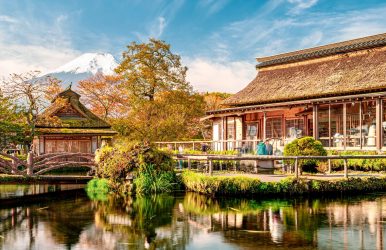
I saw a series of houses with thatched roofs along the shore of a pond. The magnificent and snow-covered Mount Fuji stood behind, strong and unshakable, as the eternal truth.
Born and raised in the land of spirituality and the Himalayas, I had to visit Oshino Hakkai.
However, as I have explained in my narrative from Tokyo to Mount Fuji day trip, you have to time your trip really well and have to be extremely lucky to see the snow-capped Mount Fuji.
Also, if you are planning a trip in summer, you will only get to see Mount Fuji partially or fully covered by clouds.
Nevertheless, as Mount Fuji continues to act elusive, here is why Oshino Hakkai will win your heart.
Oshino Hakkai: Why Is Visiting The Eight Springs Of Oshino So Special?
As I stood at the center of where both Lake Kawaguchiko and Lake Yamanakako meet in the small village of Oshino, I was able to look at the eight sacred ponds of Oshino Hakkai.
These sparkling, clear water springs are all that is left from a long-lost sixth lake that existed hundreds of years ago. It's as if time stood still when you visit these sacred areas.
When I looked into the water, I didn't see just water, and I saw history. The springs were used by pilgrims (Fuji-ko) during Japan's Edo period to cleanse their bodies and souls before climbing Mt. Fuji.
What a magical process the water goes through!
From snow accumulation on the summit of Mt. Rainier, through melting and filtration through approximately 80 years' worth of porous lava before it actually emerges at this location, its absolute perfection.
Moreover, it was crystal clear and pure.
Also, as I walked through the "Natural Monuments," I had an intense feeling of appreciation for the many years of waiting, so that each would have such serenity.
How To Reach Oshino Hakkai?
The journey to the stunning waters of Oshino Hakkai is as much a part of the experience as the location itself.
Here’s my recommendation for how to get to Oshino Hakkai, depending on whether you want a more convenient (train) or an adventurous (rental car) way of doing so.
1. Reaching Oshino Hakkai From Tokyo
When travelling from Tokyo, you have several options available.
Highway bus lines go to Oshino Hakkai directly.
If you plan to take the train, either Fujisan Station (the nearest station) or Kawaguchiko on the Fuji Kyuko Line is your best option.
Once at Fujisan or Kawaguchiko, catch a local bus to get to the village.
You may take the Fujikko-go (tourist buses), Mt. Fuji World Heritage Loop, or Uchino or Hirano routes via local bus from Fujisan Station.
Generally, there are 1-2 buses/hour on these routes.
At Kawaguchiko Station, there are 11 Fuji-Q buses each day that leave for Lake Yamanaka Oriental side, and the 11 Fuji-Q buses that leave for Gotemba and also the Oshino springs.
Just watch out for the Oshino Hakkai or Oshino Hakkai-Iriguchi as their stops.
2. Driving And Village Logistics
I rented a car, and it is the most convenient way to visit the nearby Five Lakes region.
Parking here is convenient, and there are many public and private parking spaces.
After parking the car, you can explore the nearby villages.
However, you will need 300 JPY to enter the Hannoki Bayashi Shiryokan Museum.
You can visit the museum from 9 AM to 5 PM every day for a deep understanding of the local history.
Moreover, you will find signage in Japanese and English for every pond.
My Trip To Oshino Hakkai
I felt a bit out of place when I got to Oshino Hakkai.
I thought it would be a nice, quiet area for reflection and meditation, free of other people.
However, I found a busy and fully built-out village of people, shops selling food, and many shoppers and visitors to the area, as well as people engaging with local merchants about the items that were being sold.
There were also a lot of people around Wakuike Pond, and they were excited to see how clear the water of the pond was and the fish that were swimming in the pond.
1. Finding Solitude And Peace Within The City
Although I typically search for the peace of solitude, I did not mind being in a populated environment.
I became curious after wandering among the crowds to find out where my curiosity would take me.
I found a quiet, undeveloped area just minutes from the main road, where I could hear the water from the pond, see ducks on the water, and watch an old man with two little boys quietly fishing right next to me.
2. Folklore And Galactic History
The folklore & Galactic history of the 8 springs were fascinating to explore.
Especially, that water from Wakuike Pond traveled on the Space Shuttle Challenger in 1983 for a snow-making experiment in space!
3. My Personal Highlight
The highlight for me was the open-air museum at the Hanoki Bayashi Shiryokan. It was a true escape from contemporary living, immersing yourself in the cultural heritage of the area.
4. Hannoki Bayashi Shiryokan: The Main Attraction Of The Trip
To tell the truth, I went to Oshino Hakkai because of Hannoki Bayashi Shiryokan.
One of the most amazing sights I've seen in the Five Lakes region was the thatched-roof farmhouses against a colorful garden and the imposing backdrop of Mount Fuji.
I became engrossed in the displays of antique household items and rustic farming implements inside the traditional farmhouse.
The tour was brief, but I stayed by the big pond long after I was done because of the subtle beauty of the architecture.
I couldn't resist making another lap because the landscaping was so welcoming.
Read Also:
What Are The Things To Do In Jimbocho Book Town? Visit The Best Book Stores And Cafes
Cherry Blossom Kyoto Japan: 2026 Season And The Top Viewing Spots
Osaka Food: Know What To Eat In The Streets Of Osaka
Before I reached the Wasgamuwa National Park, I had already completed the classic Sri Lankan safari.
In Yala National Park, the jeeps were queued, and when a leopard was spotted, all the vehicles were boxed around it.
The chaos was such that I almost forgot I was in the wilderness.
However, Wasgamuwa was the antidote I did not know I needed.
Our jeep drove in through the Handungamuwa entrance on a grey, humid morning, half-expecting another crowded circuit, and instead spent four hours without seeing another jeep.
That is Wasgamuwa's whole pitch!
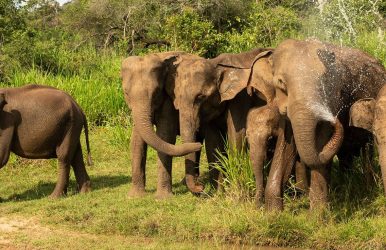
You will find the same elephants, sloth bears, and dry-zone forest you would find in Sri Lanka's headline parks, minus the traffic jam.
Quick Facts: Wasgamuwa National Park
Detail Information Location Matale and Polonnaruwa Districts, Central/North Central Sri Lanka Distance from Colombo 225 km (via Kandy–Hasalaka–Wilgamuwa Route) Area 37,062 Hectares Declared 7 August 1984 (Strict Nature Reserve since 1938) Main Entrances Handungamuwa Gate Kalundawa Gate Park Hours 6:00 AM to 6:00 PM Daily Ticket Counter Hours 6:00 AM to 4:00 PM Known for Wild Elephant Herds Sri Lanka's Densest Sloth Bear Population Nearest Towns Polonnaruwa (10 Km) Hasalaka Wilgamuwa
How To Reach The Wasgamuwa National Park?
The location of Wasgamuwa National Park is a little reclusive, for lack of a better word.
It is neither part of the hill country nor is it included in the cultural triangle. So, often, it is left out of usual Sri Lanka trip itineraries.
However, this national park is accessible from Colombo, Kandy, Sigiriya, Dambulla and Polonnaruwa.
So, you can plan a cultural trip combined with a wildlife experience by including the Wasgamuwa National Park in your bucket list.
From Colombo
The most straightforward route runs via Kandy on the A1, then the A26 towards Mahiyangana.
At Hasalaka, you turn off onto the Wilgamuwa road and follow it through to the park.
Budget five to six hours for the roughly 225 km drive, longer if you get stuck in Kandy's town traffic, which you almost certainly will around midday.
From Kandy, Sigiriya, And Dambulla
If you are already based in the Cultural Triangle, Wasgamuwa is a far more manageable side trip.
From Kandy, it is about 50 km northeast via Hasalaka and Wilgamuwa. So, it is just around a 90-minute drive from the Colombo slog.
On the other hand, Sigiriya Rock and the Dambulla Royal Cave Temple are around two hours away by road, and the route passes through Naula and Elahera.
So, as I did, you can tack a Wasgamuwa morning safari onto a Sigiriya stay rather than treating it as its own base.
The Expenses
A private car rental or taxi fare from Colombo to the Wasgamuwa National Park will cost you LKR 15000 onward.
So, the best option is to travel from Colombo to Kandy, stay there, and travel to the Wasgamuwa National Park from there.
To know more details about how to travel from Colombo to Kandy, you can check my guide.
From Sigiriya or the Dambulla Royal Cave, a public vehicle to this national park will cost you around LKR 10000.
From Polonnaruwa
Polonnaruwa is the closest major town, just 10 km from the park's northern boundary.
The Wilgamuwa "Japan Bridge" gives easy access from the Mahaweli System C area.
Despite the short distance, the taxi fare from Polonnaruwa to Wasgamuwa is quite high. It will be around LKR 7000.
Also, for the jeep safari inside the national park, the cost will be around LKR 7500 to LKR 10000.
Entrance Fees And Permits
Category Approximate Cost (2026) Foreign Adult (12+) USD 12 Foreign Child (6–12 Years) USD 6 Foreign Children under 6 Years Free SAARC Nationals USD 10 for Adults USD 5 for Children between 6 and 12 Years Free for Children below 6 Years Locals Adults: LKR 60 Children from 6 to 12 Years: LKR 30 Children below 6 Years: Free Students: LKR 20 Vehicle Entry Ticket LKR 300 Foreign Group Fee Per Vehicle USD 10
What Is The Best Time To Visit Wasgamuwa National Park?
You will have to decide the best time to visit the park based on the kind of experience you want.
For Elephant Herds
Wasgamuwa has a different timing for spotting the elephants than Minneriya.
During the dry months (roughly June to September), much of Wasgamuwa's elephant population actually migrates north toward Minneriya and Kaudulla in search of water, which is where you will find those spectacular 200-strong herds.
So, if you want to spot the elephants, November to May is when more of them stay resident within Wasgamuwa itself, following the Mahaweli River corridor that forms the park's eastern boundary.
Weather And General Visiting
The dry season from June to September offers comfortable safari conditions.
The thinner vegetation makes it easy to spot sloth bears and leopards.
October to January brings the northeast monsoon, when the park can turn muddy, and some interior tracks become difficult to navigate.
What To See Inside The Park?
The park offers the most wonderful fusion of wildlife and history.
Wildlife
Wasgamuwa gets all the hype for its elephants. However, it also has sloth bears and leopards.
In fact, many surveys suggest that sloth bear density in this park is highest in Sri Lanka.
Also, some accounts suggest the park's own name derives from "walas" (sloth bear) and "gamuwa" (wood). So, it is literally the forest of the sloth bears.
Along with these three, you can even spot purple-faced langurs, wild boar, sambar, spotted deer, and water buffalo here.
Moreover, in the park's pools and waterways reside water monitors, mugger and estuarine crocodiles, and pythons.
Birdlife is understated but real. I counted painted storks, white ibis, and several raptors circling over the grasslands in a single morning.
Ancient Ruins Within The Park
Long before it was a protected area, this land carried Anuradhapura- and Polonnaruwa-era settlement.
I saw dagobas, an ancient canal system, and reservoir remains scattered through the jungle, well away from the standard vehicle tracks.
Moreover, the area between the park and the Mahaweli River has a link to a battlefield from the Dutugemunu–Elara conflict of the 2nd century BCE.
However, I could not visit most of the sites because I did not have the required special permission. Also, these are not part of the regular safari visits.
Safari Timings And Practicalities
Feature Half-Day Morning Half-Day Evening Full-Day Safari Timing 5:30 AM – 6:30 AM Start 2:30 PM / 3:00 PM – 6:00 PM Full day (split by picnic break) Duration 3 – 4 hours 3 – 4 hours All day Coverage Area Main tracks near Handungamuwa Gate Main tracks near Handungamuwa Gate Mahaweli riverbank sections Jeep Cost (LKR) 7,500 – 10,000 7,500 – 10,000 15,000 – 20,000 Wildlife Focus General park wildlife General park wildlife Reliable elephant sightings Hotel Pickup 30–60 mins early (if less than 5 km from gate) Varies by hotel proximity 30–60 mins early (if less than 5 km from gate)
A Sample One-Day Wasgamuwa Itinerary
Time Activity 5:00 AM Depart accommodation (Kandy base) 6:00–6:30 AM Arrive at Handungamuwa Gate, complete entry formalities 6:30–10:00 AM Morning Safari including Riverine Forest and Grassland Tracks 10:00–10:30 AM Picnic/Tea Break Near Mahaweli Riverbank 10:30–11:30 AM Continue Safari toward Interior Water Holes 11:30 AM Exit Park and Return to Base 3:00–6:00 PM Evening Safari Session with a Separate Entry
Wasgamuwa does not have the wall-to-wall wildlife density of Yala or the spectacle of Minneriya's Gathering.
However, you will get a quiet forest to explore for several hours. Also, the elephants and sloth bears here are never performing for the tourists or camera lenses.
So, I would pair it with a Cultural Triangle any day for the best value safari experience in the country.
Kurunegala has recently been in the news due to infrastructure development.
The cabinet meeting approved the construction of stage 1 of phase 4 of the Central Expressway Project.
It will connect Kurunegala and Dambulla, which is famous for the iconic Dambulla Royal Cave Temple.
The Road Development Authority (RDA) has further confirmed that the extension work will start in November 2026.
However, Kurunegala has always been a melting pot for the cultural hub of Kandy, Puttalam, Negombo, and the country’s capital, Colombo.
Also, as the capital of the northwestern province, it holds massive strategic and political importance.
Where Is Kurunegala?
Kurunegala is in the northwestern interior of Sri Lanka.
As the capital of the Kurunegala District and the North-Western Province, it also functions as a major transportation hub.
Furthermore, it is around 94 kilometers northeast of the country’s capital, Colombo.
In addition, the distance between Kandy and Kurunegala is just 42 km.
How To Reach Kurunegala?
While traveling from Colombo, Kandy is the gateway to reach Kurunegala.
I took a bus from the Kandy Goods Shed Bus Stand.
Buses run regularly from Kandy to Kurunegala, or route 602, and the journey via Katugastota-Kurunegala Road (A10) takes around 1.5 to 2 hours.
I traveled in a regular bus, and the ticket price was LKR 200.
Semi-luxury, luxury, and super-luxury bus options are also available on this route, and the ticket prices will be between LKR 350 and LKR 600.
Why Is Kurunegala Famous?
Ancient Royal History!
Majestic Geology!
An Agricultural Powerhouse!
These are the three main reasons behind Kurunegala’s prominent position in the tourism landscape of Sri Lanka.
The Capital Of Ancient Kingdoms
From the late 13th to the early 14th century, Kurunegala was the royal Capital of Sri Lanka.
It was known as Hasthishaila-pura earlier.
Under the rule of kings like Buwanekabahu II and Parakramabahu IV, it safeguarded the Sacred Tooth Relic of the Buddha.
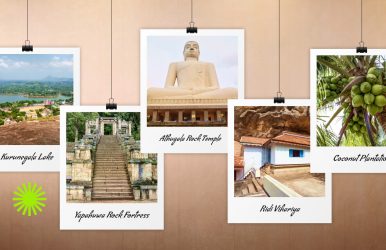
Also, it has the Yapahuwa rock fortress.
Other historic ruins and citadels include the silver cave temple of Ridi Viharaya and the ancient ruins of Panduwasnuwara.
The City Of Animal Rocks
A ring of eight massive ancient granite outcrops encircles Kurunegala.
These granite outcrops, suddenly rising from the plains, look surreal.
Furthermore, my guide told me a fascinating folklore about these outcrops.
“Kurunegala once faced a severe drought. Then, a witch turned water-guzzling animals into stone.
In fact, some of these rocks are famously named after the animals their silhouettes resemble.”
For example, Athugala looks like an elephant, Ibbagala looks like the back of a tortoise, and Andagala resembles an eel.
The Heart Of The Coconut Triangle
Kurunegala, like Kalutara, is famous for rubber estates.
It also has endless coconut plantations.
In fact, it is located inside the “Coconut Triangle" of Sri Lanka.
So, overall, it is a prominent commercial hub for agricultural production.
Moreover, it is the cradle of Selyn, Sri Lanka’s only fair-trade-guaranteed handloom company.
So, it is also a critical center for preserving the island's traditional textile heritage.
What Are The Places To Visit In Kurunegala?
Kurunegala offers the ultimate off-the-beaten-path experience in Sri Lanka.
For me, the most fascinating places to visit here are the ancient rocks and the spiritual landmarks.
While these connect you to history, the scenic waterways and modern sanctuaries allow you to unwind and soak in the local vibe.
1. Athugala Rock Temple
Athugala dominates the skyline of Kurunegala.
This outcrop has a height of 325 meters, and it gets its name from its uncanny resemblance to a giant, crouching elephant
Atha means elephant and Gala means rock.
Furthermore, once I reached the summit, I found a magnificent Buddha statue of 88 feet in height.
You can take a car ride to reach the summit.
However, I preferred a trek through the stone steps.
Fortunately, I reached the summit at sunset. So, the experience was magical.
2. Ridi Vihariya Or The Silver Temple
Ridi Viharaya connects us to the 2nd century BCE.
This ancient cave temple is around 20 kilometers away from the main town in Rideegama.
King Dutugemunu discovered a rich vein of silver ore here.
Then he used the silver ore to finance the construction of the famous Ruwanweli Maha Seya in Anuradhapura.
Furthermore, Ridi Vihariya is hidden by rocky cliffs and forest cover.
Also, it is home to a magnificent reclining Buddha statue, Kandyan-era frescoes, and ivory carvings.
3. Yapahuwa Rock Fortress
The Yapahuwa Rock Fortress is often compared to the Sigiriya Rock Fortress.
Yapahuwa was the capital of Sri Lanka under King Bhuvanekabahu I in the late 13th century.
Furthermore, the temple is constructed against a sheer, 200-meter-high granite rock that juts dramatically out of the surrounding jungle.
Moreover, it has a highly ornamental staircase.
Stone lions and intricate carvings adorn the path.
What is more fascinating than these steps, which once led to the royal palace and the Temple of the Sacred Tooth Relic?
4. Panduwasnuwara Ancient City
Panduwasnuwara, which served as a temporary capital in the 12th century, is a dramatic ruin site.
It has a well-defined citadel surrounded by protective moats and thick ramparts.
Furthermore, inside the citadel, there are the foundations of a two-tiered royal palace.
The palace is complete with ancient latrines and footings for wooden pillars.
However, the Ektem Maligaya, or the perfectly circular tower, was the most fascinating feature of the Panduwasnuwara ancient city.
Local folklore links it to romantic legends of hidden princesses.
Also, historians believe it was used by King Parakramabahu for swearing-in allegiance rituals.
5. Kurunegala Lake (Rantalia Tank)
Kurunegala Lake is the ultimate place to unwind after a busy day.
It is at the foot of the animal rocks.
I loved walking along the well-paved path hugging the banks.
You can also do a pedal-boat ride on the lake.
Furthermore, you can just relax sitting in the nearby restaurants and trying authentic Sri Lankan cuisine.
6. Arankele Forest Hermitage
Arankele is a meditation retreat.
It was originally built for austere Buddhist monks, and with untouched jungle, it still exudes a strong spiritual vibe.
As I walked through the stone-paved paths, I came across the ancient Padhanagharas, or meditation halls,
I also saw sun-dappled ponds, cave dwellings, and Jantagharas, or the houses for hot water baths.
The hermitage is covered by a dense canopy, keeping it quiet and cool.
Here, you will only listen to distant bird calls and the rustle of leaves.
Where To Stay In Kurunegala?
Kurunegala offers accommodation options that cater perfectly to both city-center conveniences and quiet countryside getaways.
In Kurunegala, you can choose your accommodation based on the kind of experience you want.
Here, you will find options that cater perfectly to both city-center conveniences and quiet countryside getaways.
City Hotels And Business Stays
If you want to stay close to the city, Kandyan Reach Hotel is an excellent option.
It has comfortable rooms, an outdoor swimming pool, and proximity to major transport lines.
Also, it is a mid-range choice for travelers exploring the downtown rocks.
Nature Resorts And Luxury Estates
If you love tranquility, you can choose the eco-lodges in the surrounding districts or the heritage properties inside the coconut plantations.
For example, the Coco Forest Resort offers an excellent farm-stay experience.





 Related