
My Day At National Railway Museum, Kadugannawa: Timings, Entry Fee, Exhibits And More

I forgot to mention one thing when I shared my experience of a train ride in the Demodara railway loop. This is a lesser-known loop, and I got to know about it from the National Railway Museum, Kadugannawa. 

This museum is at a distance of just 15.1 km from Kandy. Today, it has many old machines, carriages, equipment, and locomotives. 

Though everyone will have a visit to the National Railway Museum, Kadugannawa, in their itinerary of the things to do in Sri Lanka, I enjoyed my day there. 

So, in this blog, I will talk about my experience at the National Railway Museum, Kadugannawan, its entry fee, timings, exhibits, and how it was opened at an opportune moment. 

National Railway Museum, Kadugannawa: Quick Facts

Opening Date27th December, 2014 
Opening Hours 9 AM to 4 PM (Only closed on Poya Day)
Ticket Price – For Sri Lankan Adults: Rs. 50
– Foreign Adults: Rs. 500
– Children: Rs. 20
– Children in School Uniform: Rs. 10 

Why Was The National Railway Museum, Kadugannawa, Opened? 

The National Railway Museum, Kadugannawa, was opened on 27th December, 2014, on the occasion of the 150th year of railway operations in Sri Lanka. 

The first train of the Ceylon Railway ran from Colombo Terminus station to Ambepussa. The Duke of Brabant of Belgium was a passenger on this train. 

On the occasion of the museum inauguration, a Memorial Stamp was also released. Furthermore, as souvenirs, there were a memorial DVD and a coffee table book. 

Moreover, a Replica Steam Train ran from Colombo Fort to Kadugannawa, and it had special invitees as passengers. 

It was a thoughtful move to commemorate the first train operation 150 years ago. 

How To Reach The National Railway Museum, Kadugannawa?

How To Reach The National Railway Museum, Kadugannawa

You can reach the National Railway Museum, Kadugannawa, with a short train ride from Kandy. 

However, if you miss the train, you can also take a bus. However, I don’t recommend a bus ride from Kandy to Kadugannawa because the bus ride through the Royal Botanic Gardens takes around 45 minutes to 1 hour. 

Also, the bus is very crowded, and you will find every type of food vendor there. 

Nevertheless, if you still want a bus ride, the ticket price will be 120 LKR (Around 36 Rs.) for a person. 

Kandy To Kadugannawa Train Ride 

I love train rides, and even if the queue for the third-class ticket was long, I enjoyed the entire experience. 

Nevertheless, I took the Kandy to Polgahawela train that departed from the Kandy Station at 2:15 PM and reached the Kadugannawa Station at 2:55 PM. 

The train halts at the Kadugannawa station for 1 minute. So, stand near the gate and be a little fast when alighting from the train. 

I got a 3rd class ticket, and the ticket price was Rs. 40.

What Are The Things To See At The National Railway Museum, Kadugannawa? 

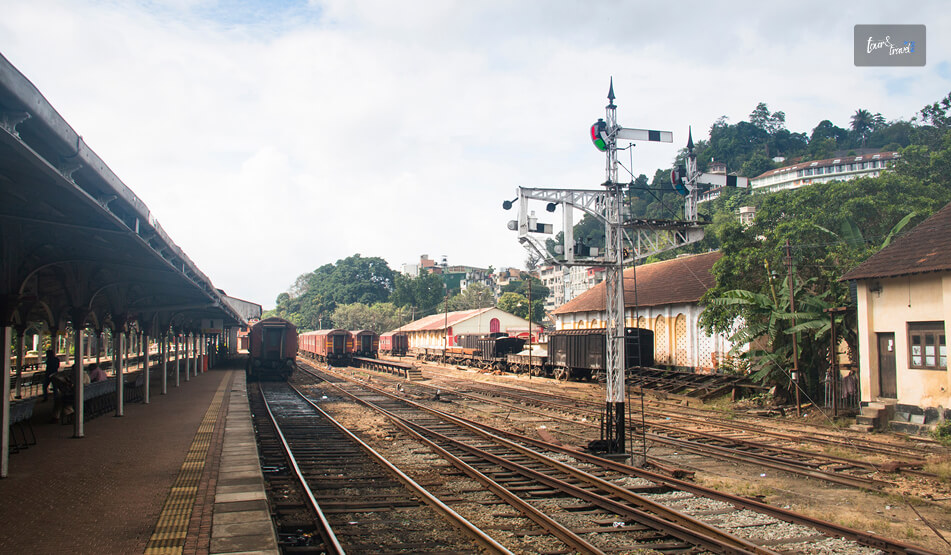
The Kadugannawa Railway Museum is very close to the Kadugannawa Railway Station. It is a small space, and it includes a platform and 2 outside areas. 

Furthermore, it is spread over a train shed. 

I sat in a vintage train carriage at the museum, and it cost me around Rs. 296. The carriage also had an attendant who showed me the museum.

The Exhibits And Demonstrations I Loved 

I especially loved the demonstration of the efficient token system that ensures that trains do not run into each other on the single-track mountain railway lines of Sri Lanka. 

Furthermore, I found a massive model railway inside the museum. It shows the entire Sri Lankan railway network. 

It was fascinating, and it highlighted the Nine Arch Bridge and how the train covers the spiral Demodara loop

I also had a lot of fun getting in and out of the steam locomotives, carriages, and old engines at the museum. 

Moreover, I saw a 10-minute-long video describing the railway network of Sri Lanka. 

Overall, I spent around an hour at the museum and ended my time there with a cup of coffee at the in-house coffee shop. The coffee shop itself is inside a carriage. 

The best things about the National Railway Museum, Kadugannawa, were that very few visitors were there. 

So, as a curious soul and someone very fascinated by trains (my home is very close to a railway track), I had a gala time. 

What Are The Other Places To Visit In Kadugannawa? 

Kadugannawa, a short distance away from Kandy, is a serene place with many historical and cultural attractions. 

So, once you have completed exploring the top attractions in Kandy and the National Railway Museum, Kadugannawa, you can visit these places. 

1. Balana Fort 

Balana Fort is located between Kadugannawa and Kandy. 

Also, close to the Alagalla Mountain Range, its strategic position helped to protect the kingdom of Kandy from external attacks. 

2. Captain Dawson Tower 

The Captain Dawson Tower is at Kadugannawa Pass, and it is very close to the first modern expressway of Sri Lanka, the Colombo Kandy Road. 

The construction of this expressway began under the supervision of Captain William Francis Dawson in 1820. So, this tower remembers and respects the contribution of Captain William Francis Dawson.

Moreover, it was built in 1832. 

3. Lion’s Mouth Rock, Kadugannawa

It is an overhanging rock that you can find between the Balana and Kadugannawa railway stations. 

The natural formation of the rock resembles a lion’s mouth. 

Furthermore, when the train passes through the bend, there is a steep descent. So, the feeling of a drop makes the experience all the more thrilling. 

4. Kadugannawa Rock View 

If you are traveling from Colombo to Kandy or exploring the best attractions in Kadugannawa, the Kadugannawa Rock View is a place to relax. 

The place is serene, and it offers amazing views of the lush surroundings. Furthermore, there are a few small shops on the way. 

You can buy some souvenirs from these shops, and you will spot a lot of monkeys here. 

Moreover, it was sunset time when I reached this viewpoint, and the experience was surreal.

Share on Social Media

Meet Sibashree Bhattacharya, a travel enthusiast who has a decade-long experience in transcending virtual barriers with her words! Her deep love for travel is apparent from her travel escapades to the mountain, often taking her readers on a journey, her words acting as Portkey! Fun fact: Sibashree loves to dive deep into the history of the places she is about to visit, making her travels even more wholesome. If you were wondering how her articles are not short of time travel, this answers it!

Leave a Reply

Your email address will not be published. Required fields are marked *

title-img Related

READ MORE Is Japan Rail Pass worth it

Is The Japan Rail Pass Worth It In 2026? Should I Buy Or Avoid It As A Conscious Tourist? 

BY  Sibashree Mar 25, 2026

The Shinkansen, or the Japanese Bullet Train, brought a revolution in the transportation system in the 1960s.  It was the need of the hour, considering the rapid growth in the economy. Also, it is an icon of the technological prowess and wealth of Japan.  These days, we have Vande Bharat in India, and no doubt the services and punctuality of these trains are spotless.  However, contrary to popular beliefs, they are never the same.  Why so?  To understand this, you need to take a ride in the Japanese Bullet Train.  However, is Japan Rail Pass worth it for the short and long rides in the Japanese Bullet Train?  In today’s blog, I will discuss its benefits and disadvantages in detail.  Is Japan Rail Pass Worth It?  Japan Rail Pass is a physical pass for train rides. It is only for tourists.  With this pass, you can enjoy unlimited train rides across Japan. Also, these passes include bullet train rides for a specific time span.  Japan Rail Pass Cost Check out the table below to understand the validity period and prices of the Japan Rail Pass.  Japan Rail Pass ValidityOrdinary Japan Rail Pass Cost Green Japan Rail Pass Cost7 Days PassAdult: 70,000 YENChildren: 35,000 YENAdult: 50,000 YENChildren: 25,000 YEN14 Days PassAdult: 110000 YENChildren: 55000 YENAdult: 80000 YENChildren: 40000 YEN21 Days PassAdult: 140000 YENChildren: 70000 YENAdult: 100000 YENChildren: 50000 YEN All ticket prices are sourced from the Japanrailpass.net. Also, remember that children mean kids below 12 years old.  From 12 years onward, they are considered adults.  Is The Japan Rail Pass Worth It? (Considering The Cost)  If you think that buying a Japan Rail Pass would hurt your wallet, you are making a mistake.  Yes, the Japan Rail Pass is expensive, especially if you are buying a Green Japan Rail Pass.  Still, if you want to try individual rides, the cost will be even higher. For example, a single trip to Nara from Tokyo costs 14500 YEN.  A really smart way to decide whether the Japan Rail Pass is worth it or not is to use a Japan Rail Pass Calculator.  Enter the departure and arrival points, check the ticket price for individual rides, and add them. Then, compare the total Japan Rail Pass cost to decide whether you need to buy it or not.  Also, consider the flexibility the Japan Rail Pass offers.  With a Rail Pass, you can complete as many rides as you want within the validity period. Also, there is no rush to buy a ticket every time you board a train.  Is Japan Rail Pass Worth It For Every Train?  The Japan Rail Pass does not cover every train service in Japan. However, it covers most train services.  Check out the details in the box.  Services Covered by Japan Rail PassServices That Japan Rail Pass Does Not Cover - Most Bullet Trains- Express Trains- Local Trains- The Narita Express, Running to Tokyo City from Narita Airport- Tokyo Monorail to and From the Haneda Airport - Joyful Trains in Japan- Bullet Trains Except Mizuho and Nozomi- The Metro Service in Tokyo and Other Cities- The Ferry Service Of Yakushima Where To Buy A Japan Rail Pass From?  You can buy the Japan Rail Pass from an authorized agent based in your country. Sometimes, these passes are available at the Osaka or Tokyo Railway stations or Haneda and Narita airports.  However, these passes are available for a limited time, and they charge around 10-20% extra charges.  Furthermore, upon reaching Japan, you can even buy the pass online at JRailPass.com. You can expect a delivery of the physical pass within 3-5 business days based on your location.  How To Take The First Ride With The Japan Rail Pass?  You have to get your Japan Rail Pass stamped before using it. You have to choose the JR Counter entry at any local and bullet railway station to pass through and board the train.  The JR Officer will check your passport and the JR Pass before stamping it.  From the next ride onward, you just need to show your JR Pass.  Activating your JR Pass at the railway station is always a better idea, as you can activate it only when you need it.  Usually, when you activate the pass at the airport, a day or two is wasted from the validity period, as the city metro services do not accept those passes.  Is Japan Rail Pass Worth It? Frequently Asked Questions (FAQs)  Here are the frequently asked questions and answers about whether the Japan Railway Pass is worth it or not.  1. Which Rail Pass Is The Best For Japan? The best Rail Pass for Japan will depend on your itinerary in Japan. For example, if you need to travel nationwide, you can choose a National Rail Pass for 7 to 21 days.On the other hand, Regional JR Passes are the best if you are focusing on specific regions such as Hokkaido or Kansai. 2. Can I Buy Japan Rail Pass From India? Yes, you can buy a Japan Rail Pass from India. In fact, it is a smart move to buy your Japan Rail Pass from an authorized agent in your country before starting the trip. At the Japanese Airports, buying the JR Pass can cost you 20-30% more. TBi Travels and Klook are some of the authorized services from which you can purchase the JR Pass online. When you buy the pass online from an authorized agent, you will receive an exchange order or a voucher via courier. You have to exchange that at the airport to collect the physical pass.  3. Can I Get Bento Boxes On The Trains In Japan? You can get Bento boxes at any railway station in Japan before boarding the train. You will also find vegan-friendly options for the bento boxes. However, you have to be very mindful about how you dispose of those bento boxes. You can throw them in the trash bins in the train, or after alighting from the train, you can dispose of them in the waste box at the station. You will not find trash cans frequently in Japan. So, you may have to carry them home if you do not dispose of them in time.  Read Also: Are You Planning A Trip To Osaka? This Is Your Quintessential Guide Festivals Of Light And Color: Experiencing Japan’s Vibrant Matsuri Is Japan Really An Expensive Place? Have A look

READ MORE Midigama Beach

Where Is Midigama Beach? What Are Best Surfing Spots And Other Things To Do?

BY  Sibashree May 4, 2026

Once you cross the massive bay of Weligama, you will find many hidden beaches and coves on the south-western coast.  There is a stretch that goes through small inlets and has beautiful golden sands. These inlets with coconut palms are called Midigama collectively.  While Midigama will win your heart with its quaint beauty at first glance, it is more popular as a surfing spot for intermediates.  It is no less than a treasure hunt with unexplored reefs and secret waves.  Moreover, the surf spots of the Midigama Beach, such as Lazy Left or Ahangama, are diverse and unique in the experience they offer.  However, a local professional surfer confided that the Coconuts are the best surfing spot if you already have some skills.  Hi, are you planning a trip to Midigama Beach anytime soon? Read this blog to know about the location, surfing sports, and more about this beautiful beach.  Where Is Midigama Beach?  The cluster of beaches, known as the Midigama Beach, is between Weligama and Ahangama, a popular beach town and surfing spot.  Furthermore, the beach spans an area of 6 kilometers, including the clusters of inlets.  The best and most budget-friendly way to reach Midigama. It is a train ride of around 3 hours and 15 minutes, and the ticket cost me around Rs. 240.  I took the train from Colombo Fort at 6:15 PM and reached Midigama at 9:25 PM, and the ticket price was Rs 550 for the second class.  Where To Surf On Midigama Beach? I have already shared that the surfing spots in Midigama are diverse. So, the size, the type of breaks, and the surfing style will be different from one surfing location to another.   So, here are the surfing spots everyone loves.  1. Ahangama Ahangama, on the northwest of Midigama, has been a popular surfing hub for the last few years.  It has many surf camps and bars, and its reef breaks are excellent for beginners and mid-level surfers.  Kabalana Beach is the best place to start your surfing expedition here.  2. Ram’s Right  Ram’s Right is the toughest surf break in the region, and you really need to make a quick surfing start.  Furthermore, the barrel sections make it fascinating. Also, you really need to look out for sea urchins here.  3. The Combination Of Lazy Right And Lazy Left  These two offer secure reef brakes, and Lazy Left is slightly harder to surf than Lazy Right.  So, Lazy Right is more suitable for beginners. Here, a surfer can enjoy cruisy rides where the surf breaks over a deep reef.  4. Plantations  It is very close to Weligama, and it is an ideal surfing spot for intermediates.  The entry point is an opening in the rock by the Plantation Surf Inn.  Furthermore, the reef here is deep, and surfing usually continues in the right direction and a few lefts.  5. Coconuts  Coconuts is the place where you will enjoy the classic Sri Lankan reef surfing experience.  Here, you can surf right and left, and the breaks are on both ends of the beach.  However, the east end of the beach is choppier.  6. Weligama Once you are done surfing at Coconuts, you can take a short tuk-tuk ride to Weligama.  Furthermore, with a sandy bottom, it is an ideal surfing destination for beginners.  What Are The Places To Visit Near Midigama Beach?  If you are done surfing, you can explore the historic Galle Fort and the hedonistic Mirissa Beach.  1. Mirissa Beach Mirissa Beach turns into the most Hedonistic place in Sri Lanka in the evening.  The bars here offer amazing happy hour offers. So, you will find the cheapest chilled beer in Sri Lanka here.  2. Galle Fort Galle Fort, a UNESCO World Heritage Site, is just 25 km away from Midigama Beach.  It is one of the best examples of a European fortified city in South and South-East Asia.  Enjoy climbing up the rampart and having a walk from one corner to another, admire the architecture, and enjoy the 360-degree view of Galle.  Watching the sunset from the top of the fort is also a magical experience.  What Is The Best Time For Surfing In Midigama Beach?  Like all other beaches on the southern coast of Sri Lanka, November to April is the best time to visit Midigama Beach.  Regular storms and high rainfall are the main forces hitting the beach in this season.  Furthermore, when you are planning to surf in Midigama beach, pick early morning or late evening as the time as the winds pick up speed later in the day.  Where To Eat In Midigama Beach?  The main beach of Midigama and the place near the Coconuts have many cool eating places.  Contrary to Ahangama, the Midigama Beach exudes a hipster energy.  If you are looking for a local experience where you will also get some cultural insights, you can visit Sandaru Restaurant.  It is a family-run restaurant, and here you can eat kottu, rice, curry, and other local delicacies.  Another excellent place for trying local delicacies here is the Shirani Home Made Rice & Curry near the Coconut Beach.  Here, you will find the best rice-vegetable combos.  Where To Stay For Surfing At Midigama Beach?  You can stay at the really cool hostels near the Lazy Left if you want to surf at Midigama Beach.  However, if you are traveling with family and you are looking for comfort, Naomi Beach Hotel, the best surfing hotel in Sri Lanka, will be your ideal choice.  It has a stunning infinity pool, and the on-site bar is perfect for chilling after a surfing session.  Moreover, it is close to the Coconuts, for me, the best surfing spot in Midigama Beach.  Also, Surfing Wombats is another place to stay in Midigama for surfing. I can stay here simply because of the pizza they serve.  Furthermore, it is a short walk from the Lazy Left and Lazy Right surfing spots.  Also, if you want to be a part of the surfing camps in Midigama Beach, you must take a tuk-tuk to Weligama, and you will find many reputable surfing camps there.

READ MORE things to do in japan

What Are The Things To Do In Japan? Know Why Gen Z Travelers Love Japan The Most  

BY  Sibashree Apr 7, 2026

Japan is now approaching Golden Week, and everyone will have their own list of things to do in Japan.  From 29th April to 6th May, Japan will have the most colorful parades and horse races. This Golden Week celebration is important to hail the rich culture of Japan. And it is this rich culture and a distinct sensory experience that make Japan a favorite among young people, especially Gen Z travelers.  Also, on the Berkshire Hathaway Travel Protection list, Japan has been consecutively securing the 9th position as the safest country in the world for the last 2 years.  Nevertheless, as I was saying, the things to do in Japan that make the country a favorite place to visit are not the same as the run-of-the-mill lists you see on the internet.  So, here, I have tried to keep it honest, based on the places I have visited and tried to decode in respect to those places why Japan is the France of the 21st century.  What Are The Things To Do In Japan?  Japan slowly grows on you. It’s not nuclear power; it has one of the largest domestic energy products (around 40% according to the International Energy Agency).  On the contrary, as Joseph Nye, a political scientist at Harvard, has pointed out, it is the soft power that has helped Japan to emerge as an idea, mode of entertainment, or aesthetics.  Can you call a sushi just Japanese these days? Or, a bowl of ramen? All these are very much present in our daily lives.  So, while exploring authentic local cuisine remains one of the best things to do in Japan, here are more activities you cannot miss.  Also, you can check whether Japan is expensive to visit or not, and the entire cost breakdown. 1. Visiting The Japanese Shrines The Japanese shrines practice the local Shinto religion of Japan. Furthermore, these shrines are places for worshipping Kami, the spirit of nature.  These shrines can be easily identified by the Torii gates. Furthermore, once you enter the Torii gates, you will find the worship hall and the inner sanctum.  Moreover, the most popular Japanese shrines are the Fushimi Inari Shrine in Kyoto, Meiji Shrine in Tokyo, Toshogu Shrine in Nikko, and Itsukushima Shrine in Miyajima.  2. Exploring The Japanese Temples Buddhism and the rise and fall of various sects across centuries have shaped the famous Japanese temples.  Furthermore, these temples are defined by architectural features such as pagodas, lecture halls, bellfries, and cemeteries.  While Todai-ji Temple in Nara remains the most popular temple to visit in Japan, the other temples to visit in Japan are the Senso-Ji Temple in Kyoto, Sanbutsu-Ji Temple in Misasa, Daisho-In Temple in Miyajima, etc.  3. Experiencing Shinjuku Shinjuku was very different from the other parts of Japan I visited. It offered an eclectic fusion of retro vibes and high-tech experiences.  Especially, thanks to the Godzilla Road, exploring Shinjuku is one of the best things to do in Japan if you are traveling with kids.  Along with the roar of Godzilla at the Godzilla Road, the Shinjuku 3D Cat near the Shinjuku Station East Exit is another major attraction for kids here.  Read more about what to do in Shinjuku.  4.  Enjoying The Ultimate Dark Academia Fan Moment At Jimbocho Book Town Uttered with an equal respect as the “Kaifeng and China book towns,” the Jimbocho Book Town is the ultimate place to visit for Dark Academia fans in Japan.  This town started booming when many law schools were established here in the late 19th century and early 20th century.  Today, it has more than 400 book stores, selling vernacular and foreign-language books.  Furthermore, every year, this book town holds the Aozora Kohon Ichiba or the Kanda Used Book Festival from Late October to early November. It is an attraction for book lovers around the globe. 5. Enjoying The Cherry Blossom Season In Kyoto If you want to experience romance in Japan, you have to be present during the cherry blossom season in Kyoto.  The Philosopher’s Walk is the most popular place to experience the cherry blossom scene here. If you are done soaking in the meditative vibe here, you can next head to the Shimbashi Street.  It is the most beautiful street in Asia.  The Kiyomizu-Dera Temple and Maruyama Park are other amazing places to see cherry blossoms in Kyoto.  6. Trying Osaka Food Osaka Food now represents Japanese cuisine worldwide, and it has left Tokyo behind in this regard. Thus, it fully justifies its nickname of “Japan’s Kitchen.”  Furthermore, Dotonbori is the epicenter of the best Osaka food and street stalls.  Takoyaki, Daifuku Mochi, Okonomiyaki, and the staples, Sushi and Ramen, are some of the must-try items here.  7. Visiting Oshino Hakkai Sensory seeking is one of the biggest reasons why young travelers seek Japan, and there has been a 1300% surge in the bookings of young and Gen Z travelers from 2019, according to a report by American Express.  Furthermore, the Instagrammable places in Japan, such as Oshino Hakkai, have played a major role in satisfying this sensory quest.  Now, as I have mentioned in my Oshino Hakkai guide, it is a place I got to know about from Instagram.  You can see the snow-capped peaks of Mount Fuji from Oshino Hakkai, and the eight sacred ponds here were the highlights of my Tokyo to Mount Fuji day trip.  Furthermore, the Wakuike Pond is one of these eight ponds, and its water was carried to space in the Space Shuttle Challenger in 1983 to conduct an experiment on snowmaking in space.  8. Planning A Two-Day Trip To Nara Do you know why Japan attracts anxious young travelers? It kind of strikes a balance. How?  When places in Japan feel like the future, think of Tokyo or the speed of the bullet trains. Some parts of the country bring back the order of the past.  One such place is Nara, the first permanent capital of Japan and home to 8 UNESCO World Heritage Sites. The Todai-ji Temple is the most famous among them.  Before Kyoto became the country’s capital in 794 AD, it served as the seat of power.  Along with the Todai-Ji Temple, you must also visit Kasuga Taisha, Mt. Wakakusa, and the Heijo Palace in Nara.  Read my complete guide on things to do in Nara to understand why you cannot miss a 2-day trip here.  9. Visiting Hokkaido Beach And Sapporo The Hokkaido Beach is in Western Japan, and it looks straight out from the works of Hakura Murakami.  It’s surreal to see the coexistence of the snow-capped peaks and dunes, and it’s only possible in Hokkaido.  Along with the Hokkaido Beach, Sapporo, the capital of Hokkaido, also stands out with its green parks and shrines like the Sapporo Suitengu Shrine.  So, when you are next in Japan, plan a Tokyo to Hokkaido trip.  10. Visiting Hakone  The things to do in Hakone are all about soaking in the quiet moments that are most powerful.  I am glad that I did not follow the usual loop, including the train, cable car, and ship circuit.  If the Open Air Art Museum with 100 sculptures is the highlight of my Hakone visit, the Choan-ji Shrine, with small stone statues of monks, is what will stay with me forever.  Also, another fun part here was washing my money at the Fukazawa Zeniaria Benzaiten Shrine.  I have not got a bigger return yet, but there is no harm in believing in a custom that locals have been following for so many years.  Moreover, if you are in Hakone, don’t forget to take a bath in the Onsen or hot springs. Furthermore, you can relive history by taking a ride on the Hakone Tozan Railway here. So, it is no wonder that visiting Hakone is one of the best day trips from Tokyo you can plan.