
Dambulla Royal Cave Temple: History, Entrance Fee, And More About This UNESCO Heritage Site 

The Dambulla Royal Cave Temple is gearing up for the much-acclaimed “Walk for Peace” which will start from 21st April, 2026. 

Respected Paññakāra Thero and 12 other monks from the Maha Sangha will lead the walk. 

Furthermore, this walk, originating in the United States, will spread the teachings of Lord Buddha, “Caratha bhikkhave carikam bahujana hitaya bahujana sukhaya lokanukampaya.

It can be roughly translated as a monk should always wander forth out of their compassion for the world and for the happiness and well-being of many. 

After the inauguration of the event at Anuradhapura and special observations at Ruwanweliseya premises, the walk will start from the Dambulla Royal Cave Temple, and then it will slowly proceed to Kandy to continue the walk. 

Now, it is no wonder that the Rangiri Dambulla Cave Temple has been chosen as the starting point for the walk. 

With a history that goes back to the 3rd century BCE, and home to the Buddhist mural paintings and 157 statues, it remains one of the most important Buddhist landmarks in Sri Lanka. 

Here is a detailed guide on my experience at Dambulla Royal Cave Temple, its significance, history, entry fee, and more! 

The Dambulla Royal Cave Temple: Quick Facts 

The Dambulla Royal Cave Temple Quick Facts

Dambulla is an important shrine in the Buddhist religion in Sri Lanka, remarkable for its association with the long-standing and wide-spread tradition of living Buddhist ritual practices and pilgrimage for more than two millennia.

UNESCO World Heritage Convention. 

Here are some quick facts about the most well-preserved and largest cave-temple complex in Sri Lanka.

Number of Sanctuaries 5
Buddhist Mural PaintingsAcross an Area of 2,100 m2
Number of Statues157
HistorySince the 3rd Century BCE
The Current Interior FormsBuilt in the 18th Century
Type of SculpturesPolychrome
Ownership The Asgiriya Chapter of Buddhist monks
Monument Protection Protected Monument under the legal protection of the Department of Archaeology of the Government of Sri Lanka, which administers the Antiquities Ordinance of 1940 (rev. 1998) at the national level.
Entry Fee2000 LKR
Hours Open7 AM to 7 PM (The Ticket Counter Closes at 5 PM)
Steps 300
Average Climbing Time20 Minutes 

Where Is The Dambulla Royal Cave Temple? (Along With Some Nearby Attractions)

The Dambulla Royal Cave Temple is in Dambulla Town. Now, Dambulla itself is the gateway to many places to visit in Sri Lanka. 

For example, the Hurulu Eco Park is just a distance of 45 minutes from Dambulla. On the other hand, it is just 52 minutes away from the Kaudulla National Park

Furthermore, the distance between Dambulla and Kandy is around 73 km. So, many people include a visit to the Dambulla Royal Cave Temple in their itinerary of the things to do in Kandy

Moreover, Sigiriya is just 17 km away. So, you can plan a combined trip of a visit to the Royal Cave Temple with a hike to the  Sigiriya Rock and Pidurangala Rock

In addition, you will have a similar experience of exploring an ancient Buddhist monastery and its remains at the Ritigala Forest Monastery, at a distance of 35 km. 

Also, if you are a cricket buff like me, don’t miss a visit to the Dambulla International Cricket Ground. 

How To Reach The Dambulla Royal Cave Temple?

How To Reach The Dambulla Royal Cave Temple

Even if you are not staying in Dambulla, Habarana, or Sigiriya can be your base. 

Habarana is just 22 km away from Dambulla, and Sigiriya is just 17 km away. 

From both locations, you can take a private taxi or tuk-tuk ride to reach Dambulla Town, which has the Dambulla Royal Cave Temple in the heartland. 

Furthermore, from Habarana, you will get Sri Lanka Transport Board – SLTB ICT buses to Dambulla. 

Nevertheless, I took a tuk-tuk from Sigiriya to Dambulla, and it cost me around 2500 LKR. 

What Is The History Of The Dambulla Royal Cave Temple?

As I have mentioned, the history of the Dambulla Royal Cave Temple goes back to the 3rd Century BCE. 

Buddhist monks started living here, and these natural caves started functioning as monasteries. 

Furthermore, in 100 BCE, King Vattagamani Abhaya (Valagamba) fled his capital and took refuge here for 15 years. 

Then, out of his gratitude, he built this majestic Dambulla Royal Cave Temple. 

However, most of its constructions, including the sculptures and murals, are from the Anuradhapura and Polonnaruwa periods. 

Also, the current interior we see is the outcome of the renovation in the 18th century. In addition, it was designated as a UNESCO World Heritage Site in 1991.

Today, it is a part of the prestigious Cultural Triangle of Sri Lanka, along with Anuradhapura, Polonnaruwa, and Sigiriya Rock Fortress. 

My Experience Of Visiting The Dambulla Royal Cave Temple (Things To See And Top Attractions)

My Experience Of Visiting The Dambulla Royal Cave Temple (Things To See And Top Attractions)

Before I get into the details of my experience at the Dambulla Royal Cave Temple, I want to give you a clear idea about the five main caves. 

The Caves of The Dambulla Royal Cave TempleNamesMain Attractions 
Cave 1Devaraja LenaIt is the Temple of the King of Gods. 
The reclining Buddha statue here is mesmerizing.
Cave 2 Maharaja LenaThis one is the largest among all caves, and it has 56 statues. 
Moreover, it is the Temple of the Great Kings, and don’t miss the sacred pot with the dripping water here. 
Cave 3Maha Alut ViharayaThe Maha Alut Viharaya is a wonderful example of 18th-century art. 
Furthermore, as the Great New Temple, it is home to 18th-century Kandyan-style paintings and statues.  
Cave 4Paschima ViharayaIt is the western temple. 
Cave 5Devana Alut ViharayaIt is the second new temple in the temple complex. 

However, to see these caves, you have to take 300 steps. You will not feel the fatigue anyway, as you will love the views and spotting the groups of macaques jumping through branches. 

Also, once you reach the top, you will need to take off your shoes and further walk to the cave. 

Here are some of the highlights of my visit to the Dambulla Royal Cave Temple. 

1. Before Entering The Caves 

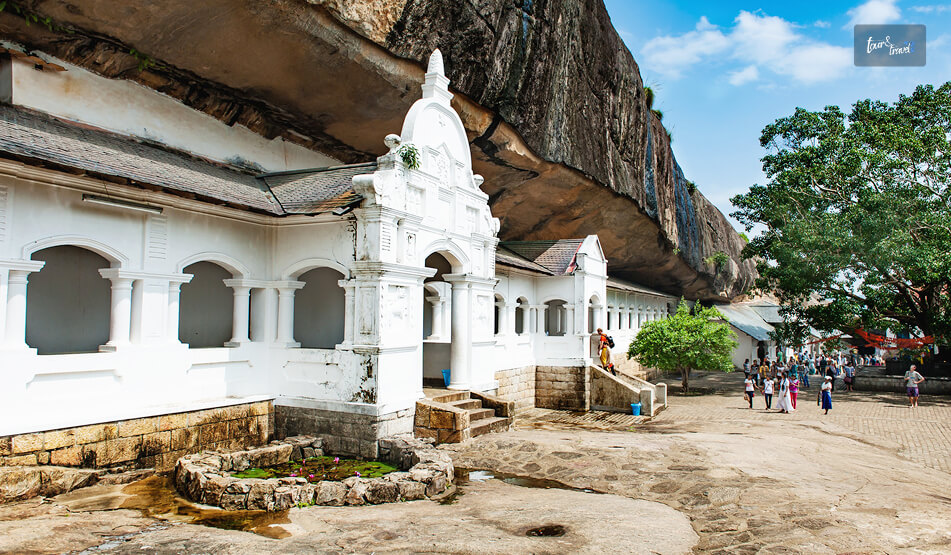
I entered the cave temple complex, and a massive courtyard opened before my eyes. On one side of the courtyard, there was the shrine and the Bodhi Tree. 

Furthermore, on the other side, there is the rock and the cave temples. 

The Engraving Of Kirti Nissankamalla

I found the engraving of the Kirti Nissankamalla before entering the first cave. Dated to the 12th century, it narrates the contributions of King Nissankamalla to Buddhism. 

The engraving, however, is in ancient Sinhalese. So, you can ask a local guide or a local person to help you understand the details. 

Or, you can read the translation of the engraving next to it. 

2. The Caves 

I have already introduced the caves to you. However, everywhere you look, you will find Buddhist murals, depicting the important figures and myths of Buddhism. 

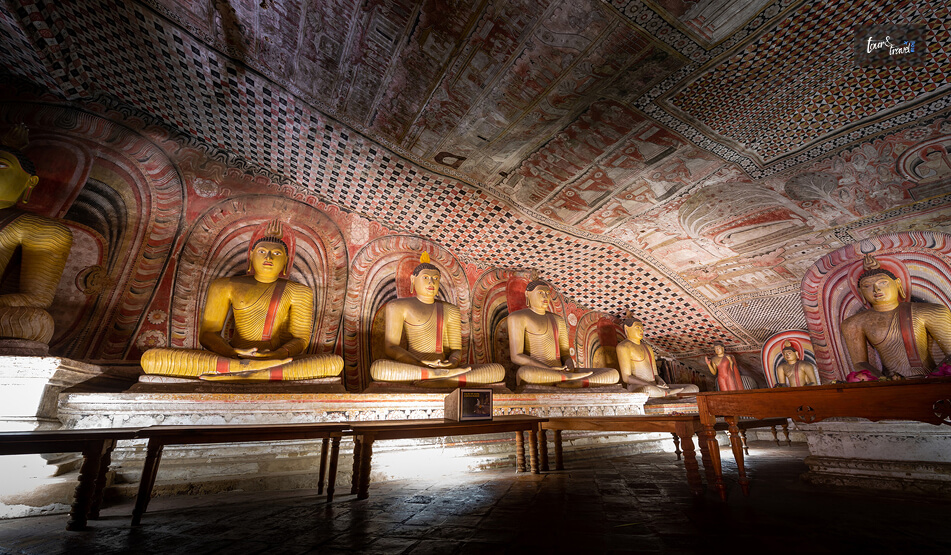
Furthermore, there are golden statues of Lord Buddha along the walls, and the lifelike paintings of Buddha-like figures evoke awe. 

Moreover, with repeating patterns, the ceilings look kaleidoscopic. 

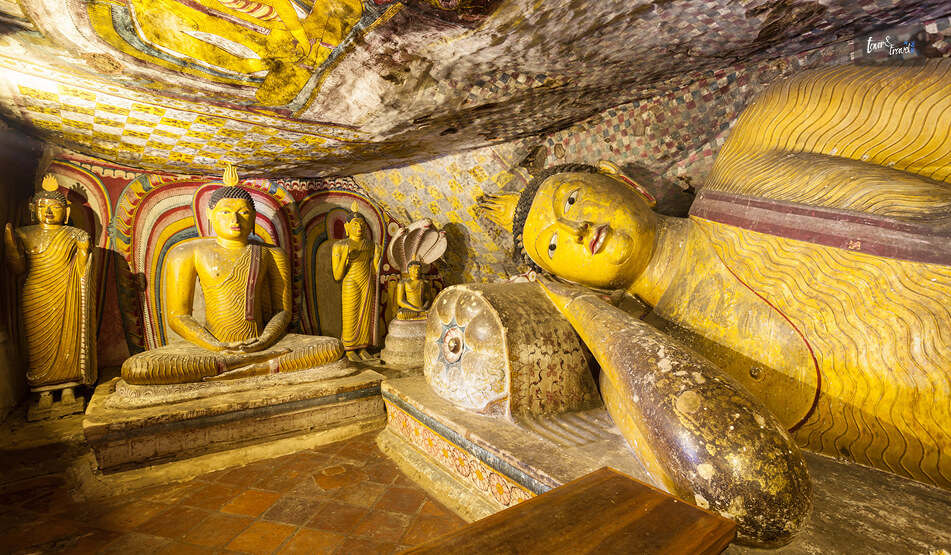
However, the first time I experienced magnificence in these caves was when I saw the reclining Buddha statue. 

The Reclining Buddha Statue (1st Cave)

The reclining Buddha statue inside the first cave of the complex reminded me of the Lord Vishnu idol of Sree Padmanabhaswamy Temple in Kerala, India. 

In fact, in some traditions of the Hindu religion, Buddha is the ninth of the ten Avatars or incarnations of Lord Vishnu. Here, the connection felt real. 

The serene expression of Lord Buddha with his head resting on a pillow made me feel peaceful. I offered some fresh lily flowers that I bought on the way up the steps. 

Furthermore, the lotus flowers drawn on Lord Buddha’s feet or Buddhapada symbolize spiritual awakening, and these are among the 108 holy marks that represent the holy journey of Buddha on the earth. 

The Natural Spring (The Second Cave)

It was amazing to find a natural spring in the second cave, and even in the dry season, it has water. 

The water of the spring drips through the ceiling, and the drops are collected in a vessel. 

Furthermore, it has 56 Buddha statues, and it is the most aesthetic with stunning murals and paintings. 

The Series Of Buddha Statues (The Second Cave)

Again, inside Cave 2, I found a series of similar Buddha statues in a seated position, and the next one was always a bit bigger than the previous one. 

However, instead of the Dhyana mudra or the meditation gesture, the statues here were seated in a Bhumisparsha mudra or as the earth witness. Thus, these statues stare directly into your eyes. 

These statues looked more vibrant, and with an earthy tone, they complemented the overall aesthetics of the cave temples. 

Also, don’t miss the little lily pond just outside cave 2. 

The Stupa Inside The Cave (The Second Cave)

The second cave has an entire Stupa built inside it. 

Furthermore, the stupa is adorned with an orange robe. Various statues of Lord Buddha in a seated position surround the stupa, and these are accompanied by nagas. 

These nagas or snakes play the role of a protector or guardian when Lord Buddha is meditating. Moreover, they symbolize the subjugation of worldly desires and spiritual awakening. 

The 3rd cave also has many statues, and the fourth one is smaller with a stupa inside. After exploring the 3rd, 4th, and 5th caves, I finally approached the end of the cave. 

You know what stayed with me, that the temples are still alive and they have made people from a different millennium, with humans of today in the same row with the thread of devotion, peace, and love. 

Once again, with non-violence and peace having so much power, the current geopolitical situations only look like futility. 

3. The Viewpoint 

As I got out of the caves, I found a quaint viewpoint behind the entry counter. I saw many young tourists flocking there, and the views from there were simply amazing. 

I stopped and took some snaps. 

4. The Golden Buddha Statue 

I consciously chose a different route while getting down from the caves. I found many aesthetic lampposts along the way. 

However, I did not follow the lamp posts and took the left to walk down, and the road was quite steep. 

However, the reward I got at the end of the road was absolutely worth it. 

There was a magnificent golden Buddha statue on the elaborately designed building of the museum complex. 

I could not explore the museum due to a time crunch, and I did not want to dilute what I saw and how I felt at the cave temples.

What Is The Best Time To Visit The Dambulla Royal Cave Temple?

In a day, early mornings, from 7 AM to 9 AM, or late afternoons, after 4 PM, are the best hours for visiting the Dambulla Royal Cave. 

Furthermore, December to February are the best months for visiting these cave temples due to dry and pleasant weather conditions.

Share on Social Media

Meet Sibashree Bhattacharya, a travel enthusiast who has a decade-long experience in transcending virtual barriers with her words! Her deep love for travel is apparent from her travel escapades to the mountain, often taking her readers on a journey, her words acting as Portkey! Fun fact: Sibashree loves to dive deep into the history of the places she is about to visit, making her travels even more wholesome. If you were wondering how her articles are not short of time travel, this answers it!

Leave a Reply

Your email address will not be published. Required fields are marked *

title-img Related

READ MORE places to visit in Matara

What Are The Places To Visit In Matara? A Southern Sri Lankan Commercial Hub With Dutch Colonial Heritage

BY  Sibashree May 4, 2026

Matara, the second-largest city in southern Sri Lanka, is an important gateway to Dickwella Beach, Hiriketiya Beach, or Talalla Beach.   However, beyond that, Matara is a place where the Dutch colonial heritage meets vibrant culture.  Now, talking about this part of Sri Lanka, places such as Mirissa or Galle get more prominence.  However, as I have also mentioned on my blog on Talalla Beach, Matara felt more intimate.  First of all, it was not tourist-heavy, and it is yet to get out of its shell of a hidden gem. Secondly, from beaches to historical landmarks and spiritual retreats, you will find everything in and around Matara.  So, in this blog, I will talk about the places to visit in Matara in detail.  What Are The Best Places To Visit In Matara?  Matara is now gearing up for the Sri Buddha Year 2570 State Vesak Festival on 27th May 2026.   It will take place at the Midellawala Ancient Temple premises at Thihagoda in Matara.  The program involves a week-long celebration and will continue till 2nd June, 2026.  From moral teaching to spiritual learning and sessions on environmental conservation, this week will be significant for the people of Matara and the followers of Buddhism in the country.  Nevertheless, if you are in Matara, do not forget to visit these places.  1. Polhena Beach: Swim, Snorkel, And Relax Polhena Beach impresses at first sight with its calm water. The water here is shallow, making it one of the most family-friendly beaches in Sri Lanka.  Furthermore, the protected coral reef here makes it ideal for snorkeling, even for beginners.  When you snorkel or swim here, you can find many species of reef fish. I could even spot a few sea turtles here as I walked a few meters from the shore.  Above all, Polhena Beach is a great place to unwind. Also, watching the sunset here was a wonderful experience, with the sky changing colors and those colors reflecting in the water.  2. Matara Fort: A Must-Visit For A History Buff  If you are fascinated by the colonial history of Sri Lanka, Matara Fort is a must-visit.  You know, the Galle Fort is iconic. However, the Matara Fort also has a history of Portuguese and Dutch colonialism in this part of the world.  The Portuguese built this fort, and later in the 17th century, the Dutch reinforced it.  Furthermore, the best part of the Matara Fort is how it still has an active presence in the daily life of the town.  There are schools, government offices, and shops inside the wall. Moreover, when I reached, I heard the noise of local boys who were playing cricket inside the fort.  I started talking to them, from Sangakkara to the rising P Nissanka, we covered a lot of players from the country in our discussion.  It was a fun interaction. Now, talking about cricket has been one of the most important things to do in Sri Lanka for me.  Again, as I walked through the fort, I visited the old Dutch church, which was built in 1706. Moreover, from the Matara Fort, I enjoyed amazing views of the Indian Ocean.  Being a public district, the fort does not have an entry fee, and you can enjoy a walk anytime you want.  3. Paravi Duwa Temple: One Of The Best Spiritual Places To Visit In Matara  The floating temple, or the Paravi Duwa Temple, is on a small island called Pigeon Island or Paravi Duwa.  You have to walk through the footbridge connecting the mainland and the island. If Matara Fort offers you an insight into the region’s history, this floating temple is all about serenity.  The temple has many stunning Buddha statues and a golden Stupa. However, the most fascinating thing is the replica of the footprint on Adam’s Peak.  Furthermore, here, you will enjoy a stunning coastal backdrop.   The temple remains open from 6 AM to 6 PM, and it is best if you walk through the bridge during the sunrise.  4. Weherahena Temple: A Proud Example Of Modern Buddhist Architecture  On the east side of Matara, the Weherahena Temple has the biggest seated Buddha Statue of Sri Lanka.  The statue is 39 meters tall, and here you will find an underground tunnel.  Now, walking through the tunnel was a fascinating experience. There, you will see more than 200 murals about the life of Lord Buddha.  Moreover, the tunnel remains open from 6 AM to 8 PM.  5. Star Fort: A Dutch Colonial Heritage  The Star Fort, close to the Matara Fort, originally went by the name of Redoute Van Eck.  It is a hidden gem in Matara, but the architecture here is equally fascinating.  Furthermore, the fort gets its name from its unique six-pointed star shape. Built in 1765, the fort had a strategic position to prevent attacks from the land.  The Matara Fort, however, was more instrumental in protecting against attacks from the sea.  Also, you must not miss a visit to the Star Fort museum, which offers insights into the Dutch colonial history of Sri Lanka.  The fort remains open from 9 AM to 4 PM, and I had to pay an entry fee of around ₹100.  6. Dondra Head Lighthouse: Sri Lanka’s Southernmost Part  I took a short tuk-tuk ride from Matara to Dondra, the southernmost part of Sri Lanka.  The Dondra Light House, with a height of 49 meters, is the tallest lighthouse in the country, and this 1889 fort offers an amazing view of the Indian Ocean.  However, they did not allow the visitors to climb up the lighthouse. So, instead, you can enjoy a coastal walk and take the best snaps for your socials.  7. Matara Local Markets: Offering Insights About Local Culture And Flavors  I always believe that to know a place, you have to explore its local markets. The Matara local market smells of handicrafts, tropical fruits, and spices.  Moreover, here, you will enjoy prawn fritters or isso wade and pol sambol, even kottu roti, the authentic delicacies of Sri Lanka.  Furthermore, despite the language barrier, the crowd there was so friendly and knowing I am from India, some of them even shared how they feel the solidarity.  So, the next time you are in Matara, don’t just treat it as a stopover for the popular southern Sri Lankan beaches.  Try to soak in the history, culture, and spiritual vibe of this beautiful coastal town.

READ MORE Dehiwala Zoo

Dehiwala Zoo In Sri Lanka: A Favorite Spot For Animal Lovers Since 1936 

BY  Sibashree Mar 16, 2026

The National Zoological Gardens of Sri Lanka, or Dehiwala Zoo, is one of the first zoos in Asia.  So, if you have enjoyed the Kaudulla National Park safari, you will also love a visit to the Dehiwala Zoo.  This zoo has an area of 26 acres, and it is home to more than 2000 animals. Furthermore, you will find fountains, orchids, and peaceful lakes here. Moreover, it offers a unique Night Safari experience. On this night safari, you can spot the mysterious nocturnal animals.  In addition, you can join the educational workshops here to learn about wildlife conservation.  So, come and have a thrilling wildlife experience at Dehiwala Zoo. However, before I talk about its location, how to travel, things to do, and the best time to travel, here is a quick look at the essential details.  Dehiwala Zoo In Colombo: Quick Info  Address120 Galvihara Road, Dehiwala-Mount Lavinia, Sri LankaTimings8:30 AM to 6 PMTicket- LKR 100 for Local Adults- LKR 2,500 for ForeignersFacilities- Souvenir Shops- Restaurants- Boat Rides- Icecream Stalls- Zoo Aquarium- Butterfly Garden Pony Rides- Elephant Rides- Flowers- Fountains How To Reach Dehiwala Zoo?  Dehiwala Zoo is well accessible by air, train, bus, taxi, and ride-hailing apps. While the easiest option is to take a taxi or private car, traveling by bus is the cheapest way.  1. By Air Dehiwala Zoo is just 40 km away from the Bandaranaike International Airport.  Furthermore, you will easily get a ride-hailing service or a taxi to reach the Dehiwala Zoo within 45 minutes.  2. By Train The Dehiwala Railway Station is the closest to the zoo. So, if you are traveling from the north, you have to take a train from Colombo Fort Station to Dehiwala Railway Station.  Also, if you are traveling from the south, you can stop at Mount Lavinia Railway Station. The beautiful Mount Lavinia Beach is just 1.4 km away from the railway station.  Tuk-tuks are available from both these railway stations, and the train ticket price will be between 40 and 100 LKR.  3. By Taxis Or Ride-Hailing Apps The easiest way to reach Dehiwala Zoo is to take a ride-hailing service or a taxi. Uber and PickMe are the main ride-hailing services here.  You can book vans, tuk-tuks, or cabs using these apps.  Furthermore, the travel cost in this way is between 1700 and 2400 LKR.  4. By Bus  You will get buses to Dehiwala Zoo throughout the day. You can take bus 176, 100, and 101.  Furthermore, the ticket prices are between 30 and 50 LKR.  What Are The Best Things To Do At Dehiwala Zoo?  From watching the elephant performance to taking a ride in the zoo train, the activities in the zoo are diverse and ideal for tourists of all age groups.  However, for me, the most delightful part was watching the elephants in action. Here is more about the things to do at Dehiwala Zoo.  1. Watching The Animal Shows  Located on the Anagarika Dharmapala Mawatha, Dehiwala Zoo has monkeys, animals, fish, birds, reptiles, and other animals.  The zoo further hosts animal shows.  So, you will love seeing an elephant dancing or a seal playing with a ball.  2. A Walk Through The Zoo The zoological garden has a reptile house, aviary, aquarium, and butterfly garden. So, you can take a walk through the garden.  The zoological garden area also has a dedicated botanical garden.  However, if you don’t want to walk much, you can take a ride on the zoo train.  3. Learn About The Flora And Fauna Present Here  If you want to know about the animals and plants here, you have to take a guided tour. Furthermore, you can learn about the flora and fauna and the rich history of the zoo from the Educational Center.  Moreover, the zoological garden has an animal hospital. You will find veterinary doctors and caregivers at work there.  4. Take A Part In The Night Safari  The zoo has a dedicated Leopard Trail for night safaris. You can watch the nocturnal animals in action during the safari.  Furthermore, you can arrange a picnic or explore the local Dehiwala Market. Furthermore, if you want a spiritual experience, visit the Bellanwila Rajamaha Viharaya.  If you want to explore more Buddhist places of importance in Sri Lanka, you can visit the Ritigala Forest Monastery and Sigiriya Rock.  What is the Best Time to Visit Dehiwala Zoo In Sri Lanka? December to April is the best time to visit Dehiwala Zoo. This is the dry season and hence is ideal for outdoor exploration and wildlife spotting.  However, it is also the peak season. So, plan a visit early in the day and avoid weekends.  Furthermore, May to November is the wet season in the garden, and the zoo looks lush and green. However, the animals can be less active in these months.  Things To Keep In Mind For Visiting The Dehiwala Zoo In Sri Lanka Irrespective of the season of your visit, you have to keep the following things in mind.  You have to wear comfortable footwear with a good grip as you have to walk a lot through the zoo.  Furthermore, you have to be respectful to the animals and follow the rules of the zoo. Is A Trip To Dehiwala Zoo Worth The Experience?  Yes, Dehiwala Zoo is a place worth visiting because you don’t just spot animals here, but learn about their livelihood and nature.  Furthermore, this is one of the oldest zoos in Asia and was built in 1936.  However, the zoo authority must be more focused on the preservation of the zoo, as the last time I visited, certain things drew my attention.  Seeing the animals here, the night safari, and the performances by animals have become more like a curriculum, and they show a lack of infrastructure.  So, you may feel sometimes disappointed if you are planning to visit the zoo to see a performance of the animals.  Still, many people visit this zoo because of its heritage. 

READ MORE things to do in nara

What Are The Things To Do In Nara? How To Plan A Two-Day Trip?

BY  Sibashree Mar 31, 2026

A trip to Nara was long overdue, and as the first permanent capital of the country, it is a must-visit.  Furthermore, this Japanese capital, before 794 AD (then Kyoto became the capital), has many UNESCO World Heritage Sites.  The Todai-ji Temple is the most famous among these 8 UNESCO World Heritage Sites. You will find one of the largest Buddha statues in the country here, and the statue is made of bronze.  Of course, the deer roaming in the city are beautiful, and you feel like getting transported to a bygone era.  It reminded me of one of the most famous literary works in our country, Shakuntalam Abhigyan, an immortal love story between King Dushyanta and Shakuntala, written by Kalidasa in Sanskrit.  Also, this is a place that will ask you to come back, and most people plan a day trip to experience its historical charm and natural beauty.  But, smitten by its beauty, I chose a 2-day trip, and here is the list of things to do in Nara. Also, I will discuss how I can get to Nara.  How To Reach Nara?  Nara is easily accessible from Kyoto, which is also famous for its history and cherry blossom season.  You can also visit Nara from the Osaka prefecture. So, overall, a visit to Nara can fit well into your itinerary of visiting the Kansai region of Japan.   Also, the robust railway system of Japan makes it easy and budget-friendly to visit Nara. A Japan Railway Regional Pass will be the best for traveling across Nara, Kyoto, Osaka, and Kobe, and the entire Kansai Region.  Also, when in Osaka, don’t forget to explore the street food stalls and have the best Osaka food, including Mochis and seafood delicacies.  Here is how you can travel from Kyoto to Nara. 1. Traveling From Kyoto To Nara Through The JR Nara Line You will get an express train or a local train from Kyoto to Nara every hour.  Furthermore, if you opt for the Miyakoji Rapid Service on this line, you will reach Nara within 45 minutes, and the ticket price will be 720 JPY.  Also, the local train services, with the same ticket price, will take about 70 minutes.  Once you reach the JR Nara station, you will get buses to the Nara Park and other top attractions in Nara.  2. Take The Kintetsu Railway To Reach Nara From Kyoto This is the most convenient way to reach Nara from Kintetsu Railway Station.  The train journey is the fastest, and the journey takes about 35 minutes by the express trains, and the ticket price is 1280 JPY.  Also, the regular trains take about 45 minutes to complete the journey. The ticket price is 760 JPY.  What Are The Things To Do In Nara?  From a visit to the Nara Park to exploring Heijo Palace and the temples, there are many things to do in Nara.  Here are the things I did during my 2-day stay.  1. Day 1 In Nara: Exploring The Nara Park  With deer passing by, Nara Park, the home to the main attractions in Nara, is a place you cannot simply miss.  The park is free to enter, and it remains open for 24 hours.  However, many attractions in the park close after 5 PM. So, you have to be early when visiting it.  Also, here are the attractions you will come across in the Nara Park, along with the deer passing by.  • Kasuga Taisha One of the UNESCO World Heritage Sites in Nara, Kasuga Taisha, takes us back to the Nara Period from 710 to 794 AD.  It is the most revered shrine among the Fujiwara clan as the tutelary shrine.  Furthermore, the main attraction of the shrine is the “Hall of Lanterns.” There, I saw many bronze lanterns illuminating the darkness.  During the special festivals, Setsubun Mantoro in February and Chugen Mantoro in August, all these lanterns are lit.  Moreover, you will find a cider tree in the inner shrine, and it is 1000 years old.  • Mt. Wakakusa I took the back road from Kasuga Taisha on the way to the Todai-Ji temple.  I came across many small shrines there. However, the highlight was Mt. Wakakusa.  This hill between the two shrines has a height of 350 meters. Also, on the 4th Saturday of January, it becomes the venue for the Wakakusa Yamayaki celebration.  People burn dead grass on the slopes, and this is a ritual that has been celebrated since the 18th century.  • Todai-Ji Todai-Ji is another UNESCO World Heritage Site, and one of the “Historic Monuments of Ancient Nara.” It was built in 752 AD, and it was the head of all the temples in the province. It even had a strong influence on the royal family.  In fact, with Todai-Ji being the seat of control even in the royal decisions, the emperor decided to move the capital to Nagaoka in 784 AD.  However, the main attraction of the Todai-Ji Temple is the massive Buddha statue, or Daibutsu.   A depiction of Dainichi Nyorai,  it represents the primordial Buddha in the orthodox East Asian Buddhist philosophy.  You will also find two similarly sized Bodhisattva statues here.  However, the temple and statues you see today were burned down, and they were rebuilt during the Edo period (1603–1868).  2. Things To Do In Nara: Day 2 I visited the Heijo Palace and many other temples of Nara on day 2.  • Visiting The Heijo Palace  When Nara was the capital, the Heijo Palace was the seat of power for the chrysanthemum throne.  It had a dimension of 1 kilometer, considering the other palaces and architecture of that time.  However, the remains of this UNESCO World Heritage Site in Nara are now at the Toshodai-ji Temple, nearby.  However, since the 1950s, archaeologists have been studying the remains of the Heijo Palace, and this has evoked further public interest.  That is why you can now see many placards there and read about the history and legacy of the site.  Moreover, the audience hall and two other parts of the palace were rebuilt. The restoration of the largest part, the audience hall, happened in 2010.  It was an ode to the 1300th anniversary of Nara as the capital of Japan.  • Toshodai-Ji As I have mentioned, the Toshodai-ji Temple has the remains of the Heijo Palace.  This temple dates back at least a millennium. Ganji, a Chinese monk, built this temple in 759 AD.  Monk Ganji brought Buddhism to Japan, and the Toshodai-Ji today is a UNESCO World Heritage Site.  • Yakushi-Ji It is a UNESCO World Heritage Site, and people here worship Lord Buddha as Yakushi Nyorai or the Medicine Buddha.  The dual main halls here have unique architecture, and each has a dedicated 3-story pagoda.  • Horyu-ji  Horyu-Ji is older than most temples in the Nara region, and Prince Shotoku founded it in 607.  Furthermore, this UNESCO World Heritage Site stands out with its wooden edifices, which are some of the oldest in Japan. This time, I missed many attractions such as Asuka, Omiwa Shrine, and Mount Yoshino. Some day for sure!  And till then, Sayōnara, guys!