
Hurulu Eco Park Safari: Exploring The Wilder Side Of Sri Lanka

After Kaudulla National Park and Dehiwala Zoo, the Hurulu Eco Park was another destination for me to explore Sri Lanka’s wildlife. 

If places such as Jaffna in northern Sri Lanka and Kandy in Central Sri Lanka have been the cultural hubs of the country, these parks have shown how people have lived here since eternity in collaboration with nature and wildlife. 

The Hurulu Eco Park is especially very close to Habarana, the epicenter of cultural and historical landmarks such as the Sigiriya Rock Fortress, Pidurangala Rock, Ritigala Forest Monastery, and Ritigala Forest Reserve. 

The distance between Habarana and the Hurulu Eco Park, at the edge of the Hurulu Forest Reserve, is just around 3 to 4 kilometers. However, despite the short distance, this eco park is quiet and understated. 

Also, you know what makes Hurulu Eco Park different? Here, you relish the art of slow traveling and the scent of wet soil after a fresh spell of rain. 

Furthermore, elephants are the heart of this eco park, and watching them grazing through the golden light is a delight. 

Here is more about this beautiful eco park in Sri Lanka. 

Hurulu Eco Park, Sri Lanka: Quick Details 

Hours Open7 AM to 6 PM
Last Time to Enter5 PM
Park Entrance Fee– $15-25 for an Adult
– $5 for Children above 6 Years
– Free for Children below 6 Years
Safari Cost$65 Onward
Safari DurationAround 3 Hours
Best Time to VisitDecember to June

Where Is Hurulu Eco Park And How To Reach? 

Where Is Hurulu Eco Park And How To Reach

In Sri Lanka’s North Central Province, Hurulu Eco Park is between the landmarks such as Polonnaruwa (1 hour and 15 minutes), Anuradhapura (1 hour and 50 minutes), Dambulla (45 minutes), and Sigiriya (45 minutes). 

So, often there is a safari add-on to explore these ancient cities and the cultural landmarks. 

Furthermore, as mentioned, it is closest to Habarana. So, ideally, it should be your base. 

Habarana also has many budget, mid-budget, and luxury accommodations. Moreover, most hotels in Habarana, Dambulla, and Sigiriya offer door-to-door safari facilities. 

You can expect a pick up around one hour before the safari time. 

Moreover, you can take a train from Trincomalee, Kandy, or Colombo to reach Habarana Junction. From there, you can take a 10-minute tuk-tuk ride to reach the eco park. 

However, online booking for these train tickets may not work most of the time. 

The Landscape Of Hurulu Eco Park 

The Landscape Of Hurulu Eco Park

Hurulu Eco Park is a mix of open plains, rock, and jungle. 

Furthermore, as a part of the dry evergreen forest area of Sri Lanka, it functions as an important corridor for elephants roaming between Minneriya and Kaudulla National Parks. 

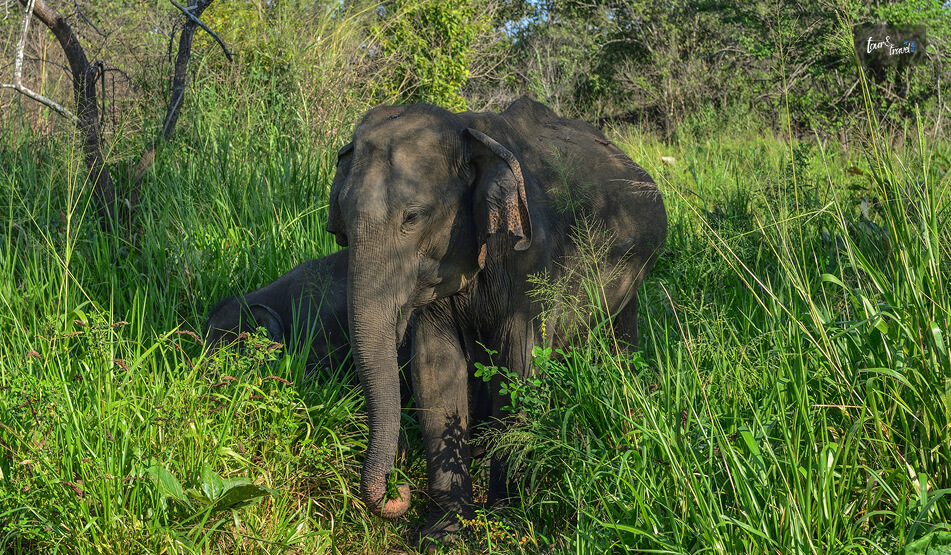
So, you can easily spot Sri Lankan elephants here, especially the mothers and babies making small groups and moving. 

Along with elephants, you can also spot peacocks, spotted deer, macaques, langurs, and many birds here. 

What I Saw At Hurulu Eco Park 

I was initially disappointed the day I had to visit the Hurulu Eco Park. I thought that the tropical rain would mess up my safari experience. 

However, I opted for an afternoon safari, and by the time I reached Hurulu, except for the heavy dampness in the air, everything was fine. 

Also, the mud on the track was not a problem to start the safari in full swing. 

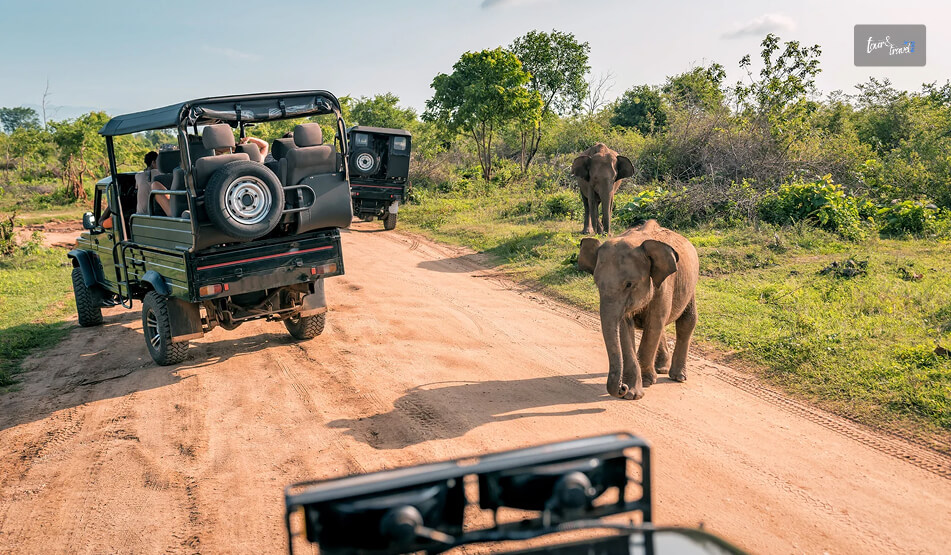
After a few turns in the park, I could spot a herd of elephants, and they were winding up leaves and fruits with their trunks. Moreover, they were flapping their ears. 

Then, after waiting for 15 minutes, the herd passed by and we continued our safari. 

We passed through rocks, canopies, and bushes. I spotted a peacock and monkeys before reaching an open land. And that was the moment of the entire safari. 

At least 25 elephants were grazing, and the younger ones were rolling in the mud.  

Finally, the air became cooler, and the sky started getting red. So, our jeep driver planned a return. 

How To Plan A Safari In The Hurulu Eco Park? 

Safaris in Hurulu Eco Park include a guide, a jeep, park entry, and a pickup and drop off from Hurulu Eco Park. 

Morning safaris are the best, ideally starting from 7 AM. Furthermore, like me, you can also opt for an afternoon safari at 1 PM. 

Furthermore, each jeep carries about 6 tourists. Also, you must carry some water, wear sunscreen, and a hat.

What Is The Best Time To Visit Hurulu Eco Park?

The best time to visit Hurulu Rco Park is between December and June. Especially, February to April is the ideal time to see the lush landscapes and the biggest elephant herds. 

Furthermore, the number of jeeps is quite low in these months. 

Again, from May onward, the conditions become drier, and the elephants start moving from the Kaudulla National Park to the Minneriya National Park. So, in Hurulu Eco Park, you will notice smaller herds of elephants. 

Moreover, from October to January is the wet season, and the jungle becomes the most vivid. So, these months are the best for photographers. 

Photography Tips For Hurulu Eco Park 

You will find a mix of open plains, forest shades, and red earth in Hurulu Eco Park. So, the landscape is challenging yet interesting for photographers. 

Furthermore, for photography, you must bring a 70-200 mm lens. It is ideal to capture wildlife, and the wider lens is the best to frame the color and scale of Hurulu Eco Park during the golden hour. 

Moreover, after the rain, the conditions become more ideal for photography. Grey elephants, red dust, and the green foliage create wonderful frames. 

Again, the light filters through the tree branches becomes low in the late afternoon. So, you can capture the texture and warmth of the Hurulu Eco Park.

Things To Keep In Mind For A Visit To Hurulu Eco Park 

Do not use single-use plastic bottles during the safari to minimize the impact on the environment, wildlife, and marine life. 

Furthermore, keep the water use to a minimum level to reduce the pressure on water resources. 

Moreover, collect your souvenirs from the local shops and eat at the local eateries to help the economy of the community.

Share on Social Media

Meet Sibashree Bhattacharya, a travel enthusiast who has a decade-long experience in transcending virtual barriers with her words! Her deep love for travel is apparent from her travel escapades to the mountain, often taking her readers on a journey, her words acting as Portkey! Fun fact: Sibashree loves to dive deep into the history of the places she is about to visit, making her travels even more wholesome. If you were wondering how her articles are not short of time travel, this answers it!

Leave a Reply

Your email address will not be published. Required fields are marked *

title-img Related

READ MORE things to do in japan

What Are The Things To Do In Japan? Know Why Gen Z Travelers Love Japan The Most  

BY  Sibashree Apr 7, 2026

Japan is now approaching Golden Week, and everyone will have their own list of things to do in Japan.  From 29th April to 6th May, Japan will have the most colorful parades and horse races. This Golden Week celebration is important to hail the rich culture of Japan. And it is this rich culture and a distinct sensory experience that make Japan a favorite among young people, especially Gen Z travelers.  Also, on the Berkshire Hathaway Travel Protection list, Japan has been consecutively securing the 9th position as the safest country in the world for the last 2 years.  Nevertheless, as I was saying, the things to do in Japan that make the country a favorite place to visit are not the same as the run-of-the-mill lists you see on the internet.  So, here, I have tried to keep it honest, based on the places I have visited and tried to decode in respect to those places why Japan is the France of the 21st century.  What Are The Things To Do In Japan?  Japan slowly grows on you. It’s not nuclear power; it has one of the largest domestic energy products (around 40% according to the International Energy Agency).  On the contrary, as Joseph Nye, a political scientist at Harvard, has pointed out, it is the soft power that has helped Japan to emerge as an idea, mode of entertainment, or aesthetics.  Can you call a sushi just Japanese these days? Or, a bowl of ramen? All these are very much present in our daily lives.  So, while exploring authentic local cuisine remains one of the best things to do in Japan, here are more activities you cannot miss.  Also, you can check whether Japan is expensive to visit or not, and the entire cost breakdown. 1. Visiting The Japanese Shrines The Japanese shrines practice the local Shinto religion of Japan. Furthermore, these shrines are places for worshipping Kami, the spirit of nature.  These shrines can be easily identified by the Torii gates. Furthermore, once you enter the Torii gates, you will find the worship hall and the inner sanctum.  Moreover, the most popular Japanese shrines are the Fushimi Inari Shrine in Kyoto, Meiji Shrine in Tokyo, Toshogu Shrine in Nikko, and Itsukushima Shrine in Miyajima.  2. Exploring The Japanese Temples Buddhism and the rise and fall of various sects across centuries have shaped the famous Japanese temples.  Furthermore, these temples are defined by architectural features such as pagodas, lecture halls, bellfries, and cemeteries.  While Todai-ji Temple in Nara remains the most popular temple to visit in Japan, the other temples to visit in Japan are the Senso-Ji Temple in Kyoto, Sanbutsu-Ji Temple in Misasa, Daisho-In Temple in Miyajima, etc.  3. Experiencing Shinjuku Shinjuku was very different from the other parts of Japan I visited. It offered an eclectic fusion of retro vibes and high-tech experiences.  Especially, thanks to the Godzilla Road, exploring Shinjuku is one of the best things to do in Japan if you are traveling with kids.  Along with the roar of Godzilla at the Godzilla Road, the Shinjuku 3D Cat near the Shinjuku Station East Exit is another major attraction for kids here.  Read more about what to do in Shinjuku.  4.  Enjoying The Ultimate Dark Academia Fan Moment At Jimbocho Book Town Uttered with an equal respect as the “Kaifeng and China book towns,” the Jimbocho Book Town is the ultimate place to visit for Dark Academia fans in Japan.  This town started booming when many law schools were established here in the late 19th century and early 20th century.  Today, it has more than 400 book stores, selling vernacular and foreign-language books.  Furthermore, every year, this book town holds the Aozora Kohon Ichiba or the Kanda Used Book Festival from Late October to early November. It is an attraction for book lovers around the globe. 5. Enjoying The Cherry Blossom Season In Kyoto If you want to experience romance in Japan, you have to be present during the cherry blossom season in Kyoto.  The Philosopher’s Walk is the most popular place to experience the cherry blossom scene here. If you are done soaking in the meditative vibe here, you can next head to the Shimbashi Street.  It is the most beautiful street in Asia.  The Kiyomizu-Dera Temple and Maruyama Park are other amazing places to see cherry blossoms in Kyoto.  6. Trying Osaka Food Osaka Food now represents Japanese cuisine worldwide, and it has left Tokyo behind in this regard. Thus, it fully justifies its nickname of “Japan’s Kitchen.”  Furthermore, Dotonbori is the epicenter of the best Osaka food and street stalls.  Takoyaki, Daifuku Mochi, Okonomiyaki, and the staples, Sushi and Ramen, are some of the must-try items here.  7. Visiting Oshino Hakkai Sensory seeking is one of the biggest reasons why young travelers seek Japan, and there has been a 1300% surge in the bookings of young and Gen Z travelers from 2019, according to a report by American Express.  Furthermore, the Instagrammable places in Japan, such as Oshino Hakkai, have played a major role in satisfying this sensory quest.  Now, as I have mentioned in my Oshino Hakkai guide, it is a place I got to know about from Instagram.  You can see the snow-capped peaks of Mount Fuji from Oshino Hakkai, and the eight sacred ponds here were the highlights of my Tokyo to Mount Fuji day trip.  Furthermore, the Wakuike Pond is one of these eight ponds, and its water was carried to space in the Space Shuttle Challenger in 1983 to conduct an experiment on snowmaking in space.  8. Planning A Two-Day Trip To Nara Do you know why Japan attracts anxious young travelers? It kind of strikes a balance. How?  When places in Japan feel like the future, think of Tokyo or the speed of the bullet trains. Some parts of the country bring back the order of the past.  One such place is Nara, the first permanent capital of Japan and home to 8 UNESCO World Heritage Sites. The Todai-ji Temple is the most famous among them.  Before Kyoto became the country’s capital in 794 AD, it served as the seat of power.  Along with the Todai-Ji Temple, you must also visit Kasuga Taisha, Mt. Wakakusa, and the Heijo Palace in Nara.  Read my complete guide on things to do in Nara to understand why you cannot miss a 2-day trip here.  9. Visiting Hokkaido Beach And Sapporo The Hokkaido Beach is in Western Japan, and it looks straight out from the works of Hakura Murakami.  It’s surreal to see the coexistence of the snow-capped peaks and dunes, and it’s only possible in Hokkaido.  Along with the Hokkaido Beach, Sapporo, the capital of Hokkaido, also stands out with its green parks and shrines like the Sapporo Suitengu Shrine.  So, when you are next in Japan, plan a Tokyo to Hokkaido trip.  10. Visiting Hakone  The things to do in Hakone are all about soaking in the quiet moments that are most powerful.  I am glad that I did not follow the usual loop, including the train, cable car, and ship circuit.  If the Open Air Art Museum with 100 sculptures is the highlight of my Hakone visit, the Choan-ji Shrine, with small stone statues of monks, is what will stay with me forever.  Also, another fun part here was washing my money at the Fukazawa Zeniaria Benzaiten Shrine.  I have not got a bigger return yet, but there is no harm in believing in a custom that locals have been following for so many years.  Moreover, if you are in Hakone, don’t forget to take a bath in the Onsen or hot springs. Furthermore, you can relive history by taking a ride on the Hakone Tozan Railway here. So, it is no wonder that visiting Hakone is one of the best day trips from Tokyo you can plan.

READ MORE Habarana

Why Is Habarana Beyond Just A Gateway To The Cultural Triangle Of Sri Lanka?

BY  Sibashree Apr 27, 2026

Search for Habarana on Google, and in 9 out of 10 cases, it will show that Habarana in North-Central Sri Lanka is the base for visiting the cultural triangle of Sri Lanka.  However, Habarana in the district of Anuradhapura in itself is a perfect blend of adventure, culture, and nature.  So, if you want to set your cultural itinerary in Sri Lanka right, Habarana will be at the epicenter. In this article, I will talk about the things to do in Sri Lanka from Habarana. I will also discuss the top attractions in this beautiful tourist town with a population of 5000.  Where Is Habarana?  Habarana in Anuradhapura District is around 180 km away from Colombo, the capital of Sri Lanka.  Located in the north-east of Colombo, it is also just 30 minutes away by road from the Sigiriya Rock Fortress, a UNESCO World Heritage Site, and its neighbor, Pidurangala Rock.  How To Reach Habarana?  The most convenient way to reach Habarna is to take a bus or train from Trincomalee.  I, of course, as always, opted for a train ride after a visit to the Uppuveli Beach and exploring the other things to do in Trincomalee.  Getting To Habarana On A Train  The Habarana Railway Station is on the Colombo to Trincomalee Railway Line. I took a night train from Trincomalee (Night Mail, Trincomalee → Colombo Fort).  This train runs daily and departs the Trincomalee Station at 7 PM and reaches Habarana at 9:30 PM.  I bought a second-class ticket, and it cost me 800 LKR. The third-class tickets will cost around LKR 600.  Getting To Habarana On A Bus  From Trincomalee to Habarana, it is a bus ride of little over 2 hours. The ticket price was INR 300 when I last enquired.  You will get different buses run by the Sri Lanka Transport Board and many private buses.  However, considering the scorching Sun of Sri Lanka, a bus ride is difficult in the daytime, and the Trincomalee to Habarana route remains crowded. Why Is Habarana The Base For A Cultural Exploration In Sri Lanka?  Habarana has a beautiful lake by the name of Habarana Lake. It is a tranquil water body with lush greenery around.  It is a beautiful place for birdwatching. Furthermore, you can also spot monkeys and elephants here.  When you are in Habarana, you can start your day with a stroll along the lake. Then, you can plan a day trip to the following places.  1. The Sacred City Of Anuradhapura  Distance from Habarana: 59 Kms The Sacred City of Anuradhapura is a UNESCO World Heritage Site. It was the religious and cultural capital of Sri Lanka for 1300 years.  However, it was massively impacted due to the invasion in 993 AD.  The main stupas in this sacred complex are the Abhayagiri Vihara Stupa, Jethawanaramaya Stupa, the third-largest man-made structure, and the most sacred Ruwanwelisaya Stupa.  2. Kaudulla National Park  Distance from Habarana: 28 Kms If you want to spot elephants in Sri Lanka, you have to visit the Kaudulla National Park.  However, the Kaudulla National Park is not just about the safaris or spotting the wildlife. During my visit, I found it truly living up to its reputation for animal welfare.  It is one of the places I visited where elephants are not chained.  3. Hurulu Eco Park  Distance from Habarana: 3.4 Kms The Hurulu Eco Park is the closest destination to visit from Habarana if you want to experience the wildlife of Sri Lanka.  Elephants passing between the Minneriya National Park and the Kaudulla National Park use Hurulu Eco Park as an important corridor.  Moreover, the topography of the Hurulu Eco Park is a good mix of plains, rocks, and evergreen jungle.  4. Dambulla Royal Cave Temple Distance from Habarana: 25 Kms The Dambulla Royal Cave Temples are fascinating, and being a two-million-year-old place of Buddhist worship is something extraordinary.  The more amazing thing is that the temples are well-preserved, and people still worship Lord Buddha in these temples.  Spanning an area of 2100 square meters, these cave temples have 157 statues of Lord Buddha and other important figures of Buddhism.  However, among all these statues, the reclining statue of Lord Buddha in the 1st cave will remain etched in my memory forever.  5. Ritigala Forest Monastery Distance from Habarana: 21 Kms The Ritigala Forest Monastery has its historical roots in the 1st century BCE. During that time, Buddhist monks settled here.  Over time, this monastery became an important site for the powerful Pansukulika Sect, which enjoyed the highest form of glory during the 9th to 11th centuries.  However, it was destroyed by Chola invasions in the 10th-12th centuries.  The Ritigala Forest Monastery has a long history of discovery and restoration, too. Moreover, it has a connection with the great Hindu epic, the Ramayana.  In addition, the Ritigala Mountain is home to more than 417 species of medicinal plants and a rich biodiversity. 6. Sigiriya Rock Fortress  Distance from Habarana: 30 Kms The Sigiriya Rock, a UNESCO World Heritage Site, is primarily a site of a Buddhist monastery from the 3rd to 1st century BCE. However, there are also legends about this rock fortress being the Golden Palace of Ravana.  Nevertheless, the Buddhist monastery in the Sigiriya Rock rose to importance when Anuradhapura became the capital of Sri Lanka. 7. Pidurangala Rock Distance from Habarana: 30 Kms Many tourists make the mistake of considering Pidurangala Rock as a trekking point that offers a better view of the Sigiriya Rock.  However, along with being a neighbor of Sigiriya Rock, it also has a history of Buddhism associated with it, and the history is 2 millennia old.  After Kashyapa made the Sigiriya Rock the center of power, the monks shifted from there and started residing in the Pidurangala Rock.  It also received royal patronage for its development and for making adequate accommodations for the monks here.  8. The Ruins Of Polonnaruwa Distance from Habarana: 47.5 Kms The ruins of Polonnaruwa are a part of the cultural triangle of Sri Lanka. Polonnaruwa was a growing religious and commercial center of Sri Lanka for over 800 years.  During the Sinhalese and Chola kingdoms and for three centuries, it was the capital of the country.  Today, the Ancient City of Polonnaruwa has the ruins of the Royal Palace, the Sacred Quadrangle, the central dagoba, Shiva Devale, Pabalu Vehera, Rankot Vihara, the dagaba Kiri Vihara, and many other ruins and architecture.  Also, the Buddha sculptures in different dagobas or stupas of the complex were mesmerizing.  9. Minneriya National Park  Distance from Habarana: 5.8 Kms Minneriya National Park has a lush landscape, and along with elephants, it is also home to diverse wildlife such as sloth bears, leopards, and different bird species.  The annual gathering of elephants is the most fascinating incident of the Minneriya National Park. It indicates an event where hundreds of elephants have a meeting, or they gather around the Minneriya Tank.  Habarana: Beyond The Gateway To The Cultural Triangle Of Sri Lanka   Although most people think of Habarana as being nothing more than a bus stop for those heading to Sigiriya or Polonnaruwa, it actually turned out to be the best surprise during my trip to Sri Lanka.  The only reason to stay in Habarana is how convenient the location is.  However, staying there provided me with an experience that you couldn’t reproduce in the more touristy areas of the island, which is the natural beauty of the area. A Place For The Gentle Giants The highlight of my time spent in Habarana was the fact that I was so close to Minneriya and Kaudulla National Parks.  I didn’t just see elephants. I witnessed what is known as the "Gathering."  Also, I observed hundreds of wild elephants gathered around one of the ancient reservoirs while driving around in an open-top jeep.  This is due to it being located in the middle of these two migratory areas.  While we still had wildlife encounters in the more touristy areas, they didn’t have the same natural feel or take the same amount of effort as they did while driving around in Habarana. Authentic Village Immersion In addition to going on safari, I spent a morning enjoying the lifestyle of the people living on the shores of a local lake.  I took a traditional horse-drawn carriage to the lake and paddled across the lake in a canoe.  I shared a meal of rice and spicy sambol with a family in their mud hut that was about as authentic as you could get.  This was far more than just a stopping point, and it was an example of the hospitality of the Sri Lankan people and the slow lifestyle that became my takeaways. Where To Stay In Habarana?  If you're looking for accommodations in Habarana, you're sure to find something that meets your budget, with options ranging from "basic backpacker" to "boujie boutique" accommodations.  For a "calm little oasis," Dudley's Nature Resort is a great option, and it is located 15 minutes away from the main strip of Habarana. Furthermore, the resort is set in a lush jungle environment and includes a pool and breakfast served in the garden.  Moreover, if you are looking to be in a social environment, Roy's Villa Hostel is close by and has an incredible communal atmosphere. Where To Eat In Habarana?  For authentic local flavors, Dewata Villa is a must-visit for its legendary "Rice & Curry" spread.  If you're looking for a quick, budget-friendly bite, Cinnamon Lodge offers great snacks, while the main street is lined with "Short Eat" bakeries for spicy pastries.  For a more social evening, head to Roy’s Villa nearby for delicious communal dinners and great vibes.

READ MORE Uppuveli Beach

Where Is Uppuveli Beach, Trincomalee? What Are The Best Things About The Beach?

BY  Sibashree Mar 24, 2026

After spending time in the northern city of Jaffna exploring everything it has to offer, I was looking forward to relaxing.  Jaffna has some beautiful temples, and despite being a slow travel destination, the rich Tamil culture and history offered a fulfilling experience.  However, I needed a place where I could relax and soak in the memories I have collected there. I intended to enjoy just those "beachy" times when I arrived at Trincomalee, and that is exactly what I found on the Uppuveli Beach.  This was the ultimate "holiday within my backpacking trip," and completely different from the beaches in Jaffna. Where Is The Uppuveli Beach? Uppuveli Beach is in Trincomalee. On the northeastern coast of Sri Lanka, it is further the epicenter if you are exploring the things to do in Trincomalee.  The distance between the Uppuveli Beach and the Trincomalee city center is just 6 kilometers. So, you can reach within a drive of just 15 minutes.  Moreover, it is famous for the beauty of the Bay of Bengal, and from here you can explore nearby attractions such as the Pigeon Island Marine National Park and Swami Rock. How To Reach Uppuveli Beach From Trincomalee? The Blue Bus Experience? You can travel from Jaffna to Trincomalee by bus like me. Trincomalee, anyway, is a major transport hub.  Furthermore, it is well-connected to Colombo, Kandy, and even Habarana, which is the major gateway to many other things to see in Sri Lanka, such as the Hurulu Eco Park, Sigiriya Rock, the Pidurangala Rock, and the Kaudulla National Park.  I reached Trincomalee from Jaffna by bus within 4 hours and 50 minutes. However, our driver, Ahoy, said that on days of dense traffic, it can take up to 5 hours and 30 minutes.  Travel From Jaffna To Trincomalee By Bus The blue buses from Jaffna to Trincomalee are the cheapest mode of transport. The ticket cost roughly 1100 LKR.  From Trincomalee To Uppuveli Beach  From the Trincomalee Bus Station, I took a tuk-tuk to the Uppuveli Beach. The tuk-tuk driver charged me 500 LKR.  The Experience At Uppuveli Beach  Uppuveli Beach is the place that offers you simplicity, and here, you will forget keeping track of your time.  You can swim, sunbathe, or just soak in the beauty of the golden hour, or just soak in the beauty of golden hour or count the waves like me.  The Golden Hour See a sunset on the beach while it’s still dark out.  Uppuveli faces the east, and it offers an amazing view of the Bay of Bengal when the sun rises.  The sky looks like it’s on fire with shades of pink and gold lighting up the clouds.  The Waves The waves were huge when I was there in July. The waves here rise really high above your head and can definitely knock you over if you don’t pay attention to them when swimming.  If you can catch the waves just right, they are also great for body surfing. As always, be respectful of the Indian Ocean.  What Are The Things To Do At Uppuveli Beach? Uppuveli offers a serene alternative to the more crowded southern beaches.  Boasting breathtaking turquoise waters and palm trees swaying in harmony with one another, Uppuveli is a welcoming community that exudes a sense of calm. 1. Marine Adventures At Pigeon Island Marine National Park The number one attraction in Uppuveli is Pigeon Island Marine National Park.  A 20-minute boat ride from the beach will take you to Pigeon Island, a protected sanctuary surrounded by colorful and lively coral reefs.  Pigeon Island is famous as one of the three places in the world where you can see black-tip reef sharks and giant sea turtles in the shallow waters (up to 12 feet).  You may also dive deeper by visiting several local dive shops that operate daily excursions to the Uppuveli Pinnacles and the famous shipwrecks in and around Uppuveli.  Local dive shops also provide excursions between March and September to boat watch for blue whales and pods of spinning dolphins. 2. Visit The Cultural Landmarks Of Swami Rock You may take a short tuk-tuk ride to the Swami Rock Temple located in Trincomalee town.  Swami Rock is perched on a cliff and provides some of the best views of the ocean as you look towards the Koneswaram Hindu Temple, which is located in the middle of the cliff and overlooks Trincomalee Harbor. The temple is dedicated to Shiva and is a great example of intricate Dravidian-style architecture.  In addition to the temple at Swami Rock, you will also see Lover’s Leap, which is nearby and steeped in local folklore. 3. Visit Fort Frederick And Find Spotted Deer On your way to the Koneswaram Temple, be sure to visit Fort Frederick. It is a 17th-century fortress built by the Portuguese.  Fort Frederick today is a peaceful area. It has many spotted deer, and you can see them roaming freely between colonial buildings and massive banyan trees. 4. Kanniya Hot Water Springs For something unique, head inland to the Kanniya Hot Water Springs.  There are seven stone wells here, each producing water at a slightly different temperature.  It’s a traditional site for ritual bathing. Also, people believe that water here has healing properties. Moreover, at Uppuveli Beach, you can have the best dining and drinking experience thanks to places such as Fernando’s Bar, Rice 'n' Curry, and Cafe on the 18th. Also, you will find Wanderers Hostel and other budget-friendly places to stay near the Uppuveli Beach.  When Is The Best Time To Visit Uppuveli Beach?  The best time to visit Uppuveli Beach is between February and August, and July is the peak month.  From August, the ocean starts getting a little rougher.  Moreover, as I have mentioned, it is best to hit the beach when it is still dark. Thus, you can enjoy the magic of the sunrise.  Also, if you want a drink by the sea, 3:30 PM to 4 PM will be the best. As you gulp down some cold Lion Lager, the Sun prepares to go to rest for the day.