
Ravana Falls, Ella: Location, How To Reach, Things To Do, Practical Tips And More

I met Ravana Falls on the way from Ella to Wellaway. 

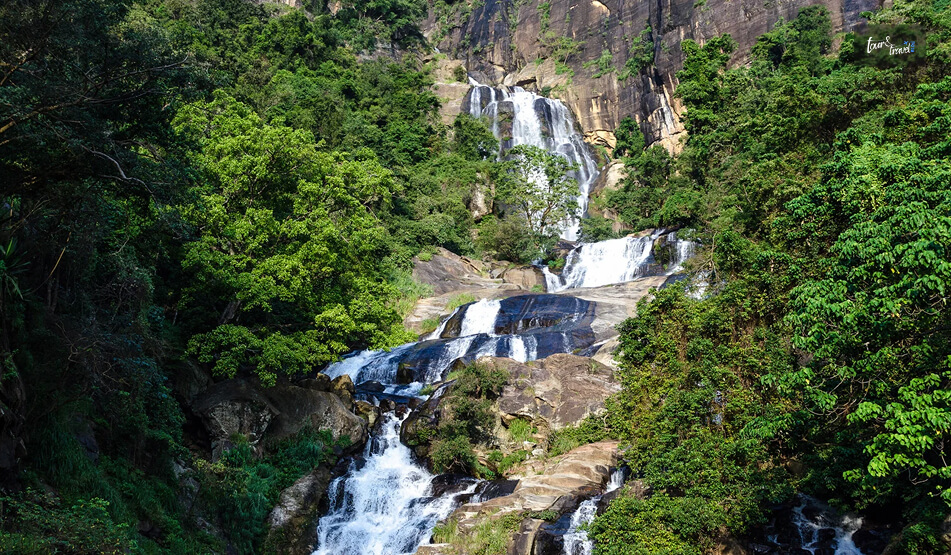
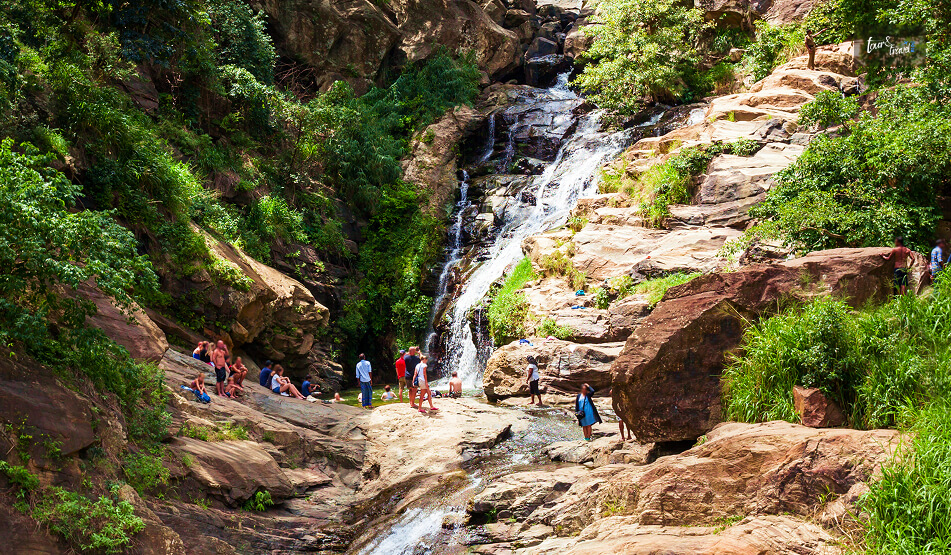
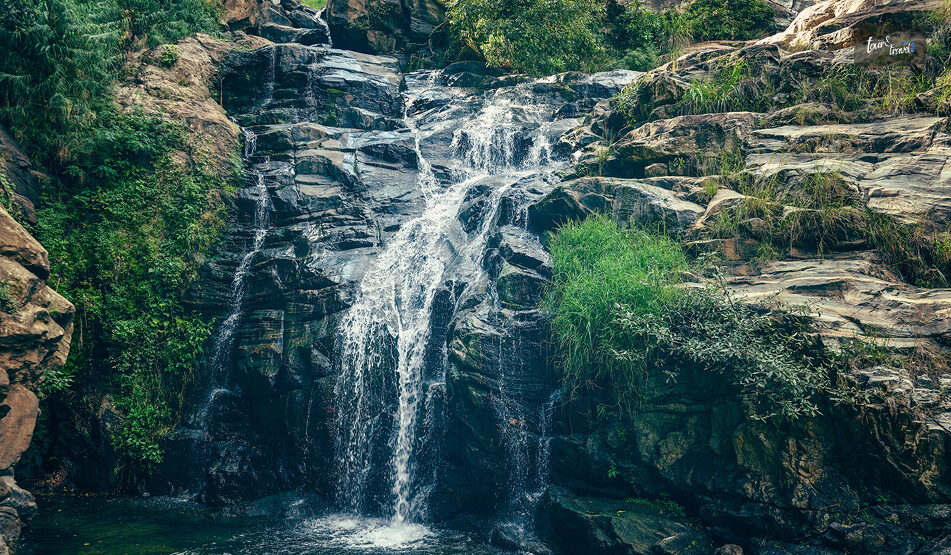
I pulled up on a tuk-tuk and found a wide and tiered curtain of water falling down on an oval rock face. 

Ravana Falls is not the tallest or most powerful waterfall you will see in Sri Lanka. However, the mythological significance and its easy accessibility from Ella make it a must-visit. 

Some Quick Facts About Ravana Falls, Ella

FactsDetails
Official NameRavana Falls (Ravana Ella)
LocationElla, Badulla District, Central Highlands, Sri Lanka
Height25 Meters
Waterfall TypeA Three-Tier Cascade
Water SourceKirindi Oya (River System)
Mythological LinkThe Ramayana
AccessibilityRoadside Viewpoint with No Trekking Required
Best Time to VisitOctober to January for Maximum Water Volume
Entry FeeFree

Where Is Ravana Falls Located? 

Where Is Ravana Falls Located

The Ravana Falls shows its prowess along the Ella–Wellawaya road (the A23). It is around 6 to 8 km south of the beautiful Ella Town

Also, it is close to the 12th–13th mile markers in the Badulla District.

At an elevation of around 1050 meters, this waterfall drops around 25 meters, and it is one of the widest in Sri Lanka. 

Furthermore, this waterfall within the compact Ella Wildlife Sanctuary is at the epicenter of an ecosystem with birds and small mammals.

Overall, it is amidst a landscape typical of the mid-elevation forests of Sri Lanka. 

How To Reach Ravana Falls

A tuk-tuk ride from central Ella to Ravana Falls takes around 10-15 minutes. You can also take a taxi ride. 

As you proceed toward Wellawaya along A23, you will see this waterfall from the roadside. 

Public buses also run along this route, and drivers are used to being asked for a drop-off here.

Moreover, you can reach the Ravana Falls from Bandarawela.

You can reach the waterfall by traveling around 10 km toward Wellawaya from Kubalwela Junction on the Badulla–Bandarawela road.

Ravana Falls And The Legend Of King Ravana 

Ravana Falls And The Legend Of King Ravana

The most intriguing thing about the legend of Ravana Falls is that every guide will give you a different version. 

However, the most popular is that King Ravana, the demon king from the Ramayana, hid Goddess Sita in a cave behind this waterfall after abducting her and bringing her back to Lanka. 

The waterfall is also close to the Ravana Ella Cave, which is perched on a cliff face about 11 km from Bandarawela.

The archaeological evidence in the area has proven the presence of older human habitation. So, myth aside, it has been an important location for human habitation for a long time. 

What To Do At Ravana Falls?

What To Do At Ravana Falls

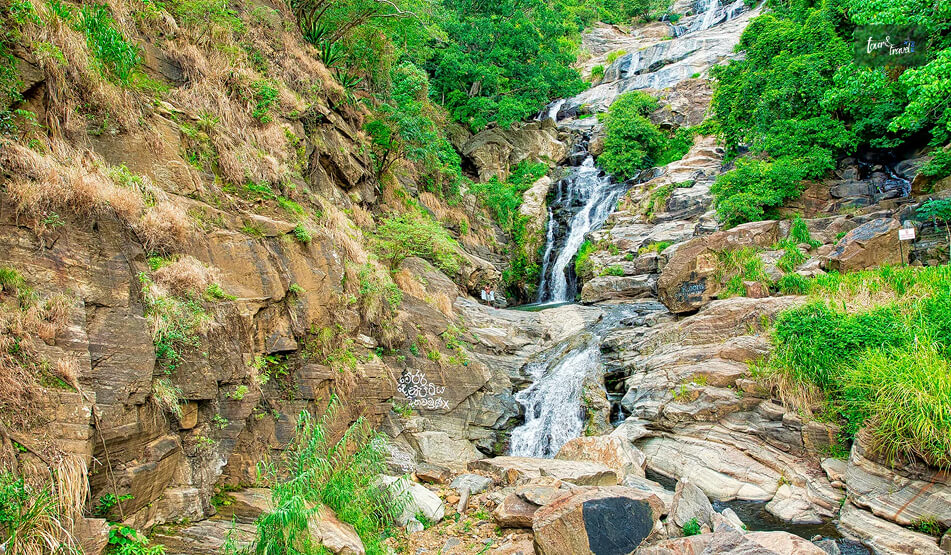
The best vantage point for this waterfall is the road and the small bridge nearby. If you want to go closer to the base, you will have to walk down a little. 

As you reach the base, you can climb over some of the rocks. 

Here, you have to be very careful as these rocks are very slippery irrespective of the season. 

Furthermore, for a proper look at the multi-tier cascade, I waded in the lower pools. 

However, I could not climb higher up the falls toward the upper cascades as that route is now restricted due to past accidents. 

So, I had to stick to the lower areas. 

Moreover, I spotted many troops of wild monkeys near the waterfall. So, be careful about what you carry and be respectful to them. 

Other Nearby Places You Can Visit With Ravana Falls 

Visit With Ravana Falls

After exploring Ravana Falls, you can come back to Ella and find some of the photographed attractions in Sri Lanka.

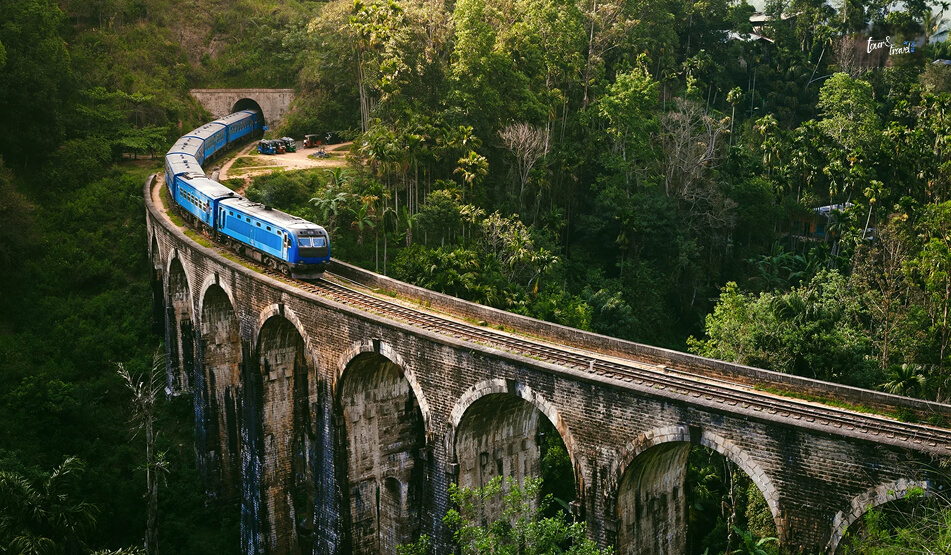
Visit the Nine Arch Bridge, Ella Rock, and Little Adam’s Peak.

Once again, due to the proximity to Ella, Ravana Falls fits naturally into a half-day loop rather than requiring a dedicated trip.

Moreover, just two hours away, the Horton Plains National Park awaits with a completely different high-altitude landscape. 

Practical Travel Tips For Visiting Ravana Falls

Practical Travel Tips For Visiting Ravana Falls

Ravana Falls is one of the best places to visit in Sri Lanka for budget travelers as it offers free entry. 

You must wear shoes with good grip if you have plans of climbing over the rocks near the base. Once again, avoid the temptation to go beyond the marked and accessible sections. 

A Quick Note On Safety

Follow the restrictions seriously, and there is no need to push barriers for a better photo, risking your safety. 

Like the other waterfalls in Sri Lanka, Ravana Falls should also be visited with prior local advice. 

Only a local guide will be able to help you find out the safer pool. 

Where To Stay Near Ravana Falls?

Ella town is the obvious base, and it is small enough that nowhere is more than a short tuk-tuk ride from the falls. 

Guesthouses and small boutique hotels line the roads toward Passara and Wellawaya.

Many of these guesthouses offer valley or mountain views.

Also, the range of options runs from simple backpacker stays to higher-end villas overlooking the tea country. 

Photography Tips

The falls face a direction that catches strong midday light. 

That light tends to wash out the detail in the water and flatten the surrounding greenery, so early morning or late afternoon visits give noticeably better results. 

A polarizing filter helps cut glare off the wet rock if you are shooting with a proper camera, and a slower shutter speed, even just a fraction of a second, brings out the silky texture the falls are known for during wetter months. 

Because the waterfall is visible and photographable straight from the road, it’s also one of the easier hill-country shots to get without carrying gear down a long trail.

Best Time To Visit Ravana Falls

Ravana Falls changes character dramatically with the seasons. 

During the wetter months, the water is said to resemble an areca flower with drooping petals as it spreads across the rock face.

It is genuinely one of the more striking waterfall shapes I have seen in Sri Lanka. 

In the dry season, the flow drops off considerably, and the falls can look thin by comparison. 

December to April tends to bring more reliable water levels alongside decent weather for the rest of an Ella itinerary.

So it is a reasonable window if you want to see the falls at something close to their best.

Share on Social Media

Sibashree is a travel, culture, and leisure writer who has been writing since the age of 12 and professionally since 2014. With more than a decade of travel writing experience and journeys across India and several parts of the world, she brings a deeply personal and thoughtful perspective to her work. A student of English Literature and Mass Communication, Sibashree has always viewed travel as more than movement — for her, it has been a way of understanding people, cultures, and herself. Her passion for spiritual exploration has also led her to many unusual and meaningful destinations over the years. Outside of writing, Sibashree enjoys watching European cinema, reading about global politics, and reflecting on the stories hidden within everyday places.

Leave a Reply

Your email address will not be published. Required fields are marked *

title-img Related

READ MORE National Railway Museum, Kadugannawa

My Day At National Railway Museum, Kadugannawa: Timings, Entry Fee, Exhibits And More

BY  Sibashree May 5, 2026

I forgot to mention one thing when I shared my experience of a train ride in the Demodara railway loop. This is a lesser-known loop, and I got to know about it from the National Railway Museum, Kadugannawa.  This museum is at a distance of just 15.1 km from Kandy. Today, it has many old machines, carriages, equipment, and locomotives.  Though everyone will have a visit to the National Railway Museum, Kadugannawa, in their itinerary of the things to do in Sri Lanka, I enjoyed my day there.  So, in this blog, I will talk about my experience at the National Railway Museum, Kadugannawan, its entry fee, timings, exhibits, and how it was opened at an opportune moment.  National Railway Museum, Kadugannawa: Quick Facts Opening Date27th December, 2014 Opening Hours 9 AM to 4 PM (Only closed on Poya Day)Ticket Price - For Sri Lankan Adults: Rs. 50- Foreign Adults: Rs. 500- Children: Rs. 20- Children in School Uniform: Rs. 10  Why Was The National Railway Museum, Kadugannawa, Opened?  The National Railway Museum, Kadugannawa, was opened on 27th December, 2014, on the occasion of the 150th year of railway operations in Sri Lanka.  The first train of the Ceylon Railway ran from Colombo Terminus station to Ambepussa. The Duke of Brabant of Belgium was a passenger on this train.  On the occasion of the museum inauguration, a Memorial Stamp was also released. Furthermore, as souvenirs, there were a memorial DVD and a coffee table book.  Moreover, a Replica Steam Train ran from Colombo Fort to Kadugannawa, and it had special invitees as passengers.  It was a thoughtful move to commemorate the first train operation 150 years ago.  How To Reach The National Railway Museum, Kadugannawa? You can reach the National Railway Museum, Kadugannawa, with a short train ride from Kandy.  However, if you miss the train, you can also take a bus. However, I don’t recommend a bus ride from Kandy to Kadugannawa because the bus ride through the Royal Botanic Gardens takes around 45 minutes to 1 hour.  Also, the bus is very crowded, and you will find every type of food vendor there.  Nevertheless, if you still want a bus ride, the ticket price will be 120 LKR (Around 36 Rs.) for a person.  Kandy To Kadugannawa Train Ride  I love train rides, and even if the queue for the third-class ticket was long, I enjoyed the entire experience.  Nevertheless, I took the Kandy to Polgahawela train that departed from the Kandy Station at 2:15 PM and reached the Kadugannawa Station at 2:55 PM.  The train halts at the Kadugannawa station for 1 minute. So, stand near the gate and be a little fast when alighting from the train.  I got a 3rd class ticket, and the ticket price was Rs. 40. What Are The Things To See At The National Railway Museum, Kadugannawa?  The Kadugannawa Railway Museum is very close to the Kadugannawa Railway Station. It is a small space, and it includes a platform and 2 outside areas.  Furthermore, it is spread over a train shed.  I sat in a vintage train carriage at the museum, and it cost me around Rs. 296. The carriage also had an attendant who showed me the museum. The Exhibits And Demonstrations I Loved  I especially loved the demonstration of the efficient token system that ensures that trains do not run into each other on the single-track mountain railway lines of Sri Lanka.  Furthermore, I found a massive model railway inside the museum. It shows the entire Sri Lankan railway network.  It was fascinating, and it highlighted the Nine Arch Bridge and how the train covers the spiral Demodara loop.  I also had a lot of fun getting in and out of the steam locomotives, carriages, and old engines at the museum.  Moreover, I saw a 10-minute-long video describing the railway network of Sri Lanka.  Overall, I spent around an hour at the museum and ended my time there with a cup of coffee at the in-house coffee shop. The coffee shop itself is inside a carriage.  The best things about the National Railway Museum, Kadugannawa, were that very few visitors were there.  So, as a curious soul and someone very fascinated by trains (my home is very close to a railway track), I had a gala time.  What Are The Other Places To Visit In Kadugannawa?  Kadugannawa, a short distance away from Kandy, is a serene place with many historical and cultural attractions.  So, once you have completed exploring the top attractions in Kandy and the National Railway Museum, Kadugannawa, you can visit these places.  1. Balana Fort  Balana Fort is located between Kadugannawa and Kandy.  Also, close to the Alagalla Mountain Range, its strategic position helped to protect the kingdom of Kandy from external attacks.  2. Captain Dawson Tower  The Captain Dawson Tower is at Kadugannawa Pass, and it is very close to the first modern expressway of Sri Lanka, the Colombo Kandy Road.  The construction of this expressway began under the supervision of Captain William Francis Dawson in 1820. So, this tower remembers and respects the contribution of Captain William Francis Dawson. Moreover, it was built in 1832.  3. Lion’s Mouth Rock, Kadugannawa It is an overhanging rock that you can find between the Balana and Kadugannawa railway stations.  The natural formation of the rock resembles a lion’s mouth.  Furthermore, when the train passes through the bend, there is a steep descent. So, the feeling of a drop makes the experience all the more thrilling.  4. Kadugannawa Rock View  If you are traveling from Colombo to Kandy or exploring the best attractions in Kadugannawa, the Kadugannawa Rock View is a place to relax.  The place is serene, and it offers amazing views of the lush surroundings. Furthermore, there are a few small shops on the way.  You can buy some souvenirs from these shops, and you will spot a lot of monkeys here.  Moreover, it was sunset time when I reached this viewpoint, and the experience was surreal.

READ MORE Anuradhapura

What Are The Best Places To See In The Sacred City Of Anuradhapura, Sri Lanka? 

BY  Sibashree Apr 21, 2026

Anuradhapura is a part of the Golden Triangle of Sri Lanka along with the Dambulla Royal Cave Enclave, Polonnaruwa, and Sigiriya Rock Fortress.  Furthermore, the Sacred City of Anuradhapura, a UNESCO World Heritage Site, was built from the “cutting of a Bodhi Tree” or the “Tree of Enlightenment.”  Before 993, when it was abandoned due to an invasion, it was the political and religious capital of Ceylon, the previous name for Sri Lanka.  Also, if Jaffna attracted me with its Tamil Culture and Hindu Temples, Anuradhapura was a great calling because it was the first place to adopt Buddhism outside India, the country I belong to.  Moreover, Jetavanaramaya, the early 4th-century BCE Stupa, was once the “third-largest man-made building in the world,” with an original height of 122 meters.  However, while the Jetavanaramaya Stupa continues to evoke awe with its grandeur and mystery, the other ruins and remains of Anuradhapura also wait to tell you the history and cultural richness of the region.  So, here is a brief discussion on the places I visited in Anuradhapura.  What Are The Places To Visit In Anuradhapura?  I was staying in a guest house near the Sacred City of Anuradhapura. I rented a bicycle from my guest house for LKR 500, and I took the back route as the staff in the guesthouse guided me.  Off the main road, the cycling experience was beautiful, and I loved spotting the roaming peacocks and little children waving at me.  Beyond the charming views and ambiance, I noticed one more thing. In Anuradhapura, the past and the present walk side by side.  There have been no evictions of the locals in the name of preserving or promoting the ancient ruins and remains in a UNESCO World Heritage Site.  Nevertheless, after talking to the local children for a while, I reached the entrance of the Anuradhapura Sacred City. The entry fee was around 9500 LKR or INR 2800.  However, remember that the ticket includes archaeological sites such as Jetavanaramaya, Abhayagiriya, Ruwanwelisaya, and Thuparamaya. So, if you want to explore other sites such as the Isurumuniya Viharaya, you will need to pay separate fees.  Nevertheless, these are the places I visited in Anuradhapura.  “This sacred city was established around a cutting from the 'tree of enlightenment', the Buddha's fig tree, brought there in the 3rd century B.C. by Sanghamitta, the founder of an order of Buddhist nuns.  Anuradhapura, a Ceylonese political and religious capital that flourished for 1,300 years, was abandoned after an invasion in 993.  Hidden away in dense jungle for many years, the splendid site, with its palaces, monasteries, and monuments, is now accessible once again.” - UNESCO World Heritage Convention.  1. Abhayagiri Vihara Stupa Complex The Abhayagiri Vihara Gargantuan Stupa is magnificent, and the brick stupa creates a contrast against the bright blue sky and the lush greenery of Anuradhapura.  King Vattagamani Abhaya or Valagamba founded this Stupa in the first century BCE. This prominent center of Mahayana Buddhism remains an active place of worship.  Also known as the Northern Monastery or Uttara Vihara, it changed the course of Buddhism in Sri Lanka by deviating from the monolithic tradition of Theravada Buddhism.  Moreover, the Abhayagiri Vihara Stupa is the first Stupa in Sri Lanka to house the tooth relic of Buddha.  Also, the Abhayagiri Dagoba or Stupa at the epicenter of the Abhayagiri Vihara Complex is one of the largest stupas in Sri Lanka.  The Structure And Architecture Of The Abhayagiri Vihara Apart from the Stupa or Dagoba, most parts of the Abhayagiri Vihara are in ruins. There were living houses for the monks and students, libraries, dinner halls, and meeting halls surrounding the Stupa.  Here is a detailed overview of the structures as I saw them. However, the heat will be scorching, and you will find langur monkeys roaming around.  So, try to be there by 6 AM, when the gates open, or after 4 PM. The Sacred City remains open till 8 PM. However, it will take you around an entire day if you want to explore the major ruins of the Anuradhapura Sacred City. The Dagoba Or The Stupa  The Stupa or Dagoba in the Abhayagiri Vihara is in a well-preserved condition. The massive bell-shaped structure of the stupa has a height of around 120 meters, and at its widest, the circumference is close to 350 meters.  The dome, made of brick and lime mortar, has four entrances, and you will find a Devatakotuva or a cylindrical spire and Hataraskotuva or a square-shaped structure as the crowns of the Stupa.  Image Houses, Refectories, And Sub Shrines  I saw the remains of various refectories, image houses, living complexes, and sub-shrines around the stupa.  Among the smaller stupas, the Indikatu Seya and Silasobbhakandaka Cetiya are the most common.  Meeting Halls The remains of the meeting halls or Uposathagharas have been found in the complex.  These Uposathagharas were multi-storied, and Ratnaprasadaya or the jewel mansion was most prominent among them.  Congregation Hall The Sannipatasala, or the congregation hall near the southern entrance of the stupa, is the largest hall in the complex.  The image of Nagaraja, or the king of snakes, or Virupaksha, the protector of the Western Direction, was found in this congregation hall, which is now in ruins.  You can see this image at the Abhayagiri Museum.  Abhisheka Mandapa Or Anointing Pavilion The Abhisheka Mandapa had a stepped entrance, and people believe it to be the place where the statues of Lord Buddha and other Bodhisattvas were consecrated.  Some even consider this the bathing house or Snanghara.  Stone Slabs  Many stone slabs with inscriptions in Nagari Script have been found in this site.  Again, there are two moon stones in Anuradhapura, and one was found at the Queen’s Pavilion and the other at Mahasena’s Palace.  These moon stones are significant features of Buddhist stupas or shrines, as these semi-circular stone structures depict the Buddhist Samasara.  The Dining Room The dining room or hall of the Abhayagiri Vihara has a stone-clad trough, and it is ideal for storing or serving rice that could feed 5000 monks.  Furthermore, there was a dining area, hearths, underground channels, grinding stones, and a sundial in the site Faxian or Fa-Hien described as the dining hall.  The dining hall also has two courtyards.  The Bodhi Tree Shrine The Bodhi Tree Shrine, or the Bodhighara is a subsidiary shrine of the Abhayagiri Stupa. As a token of Buddha’s enlightenment, Sanghamitta, a Buddhist nun from India, brought saplings of the Bodhi Tree.  She planted the saplings in Abhayagiri, and many patrons built small aediculae-like shrines around these trees.  These sub-shrines had images of Lord Buddha in a meditative or Samadhi posture and his footprints.  Moreover, excavation of Buddha statues took place in the Bodhighara sites, and one of them is from the 3rd century BCE, and these resemble the sculptures of the great Gupta dynasty in India.  You can visit the Anuradhapura Archaeological Museum if you want to see these Buddha statues. The Ponds  The tanks and reservoirs near the living quarters were the main sources of water for the complex.  However, water in these reservoirs or tanks came from the Kuttam Pokana or Twin Ponds to the far east of the Stupa.  Moreover, these rectangular ponds were built by Aggabodhi I in the 6th or 7th century CE, and they have shallow ridges, and the inner walls are made of polished stone.  However, for me, the most fascinating thing was the stone slab with the motif of a hooded cobra.  Also, this hooded cobra or Naga establishes a deep connection with India, as Nagas and water have deep connections in Indian mythology.  As I walked further, I came across the Elephant Pond or Eth Pokuna. It is the largest artificial tank in Sri Lanka, and it is the main water supply for all the tanks and reservoirs in the Vihara Complex.  Here also, I noticed a depiction of a hooded cobra on a stone slab.  At the end of exploring the Abhayagiri Vihara Stupa Complex, I must tell you that you must read a little about the place before a visit.  Otherwise, it will be difficult for you to catch up when the guide shares the details.  2. Jethawanaramaya Stupa You will also find the Jetavanaramaya Stupa in the Sacred City of Anuradhapura. It was one of the largest man-made structures in the world, and it ranked only after the Great Pyramids of Giza.  The original height of this structure was 122 meters, and after restoration, the height is now 71 meters.  The stupa, built by King Mahasena in the 3rd Century AD, is a part of a large Jetavana Vihara complex that used to house around 200 monks. Also, like the Abhayagiri Vihara, it has a brick architecture.  This once again indicates how ancient Anuradhapura was a hub of brick production. In fact, Ruwanwelisaya, the most sacred stupa of the country inside the Anuradhapura Sacred City Complex, also had a brick architecture.  However, for the recent restoration, they used cement in the outer layer of the stupa.  Moreover, massive excavation works have taken place in the Sacred City of Anuradhapura, and the gold panels showing the imagery of the Bodhisattva and the partial inscriptions of the Prajñāpāramitā Sutra.  Now, Prajñāpāramitā Sutra is the foundational text of Mahayana Buddhism. This shows how the Jethawanaramaya Stupa was the hub of different Buddhist thoughts and schools. However, you can see these gold panels now at the Colombo Museum.  Also, I came to know about another fascinating thing from a monk here, that the stupa used to have a diamond in the crown. It used to turn aside lightning during the monsoon season.  3. The Gleaming White Ruwanwelisaya Stupa  The Ruwanwelisaya Stupa is most famous among the locals and followers of Buddhism.  Now, unlike the Ritigala Forest Monastery, the Ruwanwelisaya Stupa or the other stupas in the complex are live hubs of Buddhist practices.  Also, the Ruwanwelisaya Stupa is especially famous for housing the remains of Lord Buddha.  Originally, the Ruwanwelisaya Stupa was much smaller than the Jethawanaramaya Stupa. However, thanks to continuous maintenance, it now stands at a height of 100 meters.  Now, this was my experience in the ancient ruins of Anuradhapura. If you want to explore more, you can visit the Kaudulla National Park, at a distance of less than 2 hours, and the Hurulu Eco Park, at a distance of 1 hour and 50 minutes.   Location And How To Reach Anuradhapura?  Anuradhapura City is located on the banks of the Malwathu Oya. It is the capital of the central-west region of Sri Lanka and the district of Anuradhapura.  Anuradhapura is a 4-hour journey from Colombo and Kandy.  Once I explored the top attractions in Kandy, I took a minivan, which cost me LKR 1600. Now, you will also get private and public buses.  However, I had luggage and wanted to keep the schedule flexible. So, I chose the minivan.  Things To Remember For A Trip To Anuradhapura The Sun is merciless in Anuradhapura, even if you visit the Sacred City in winter. It becomes unbearable past 11 AM.  So, you have to really start early.  Also, carry water and wear full-sleeve clothes to maintain the dignity of the place and protect your skin from the Sun.  Moreover, as I have mentioned, visiting a place like Anuradhapura demands preparation. So, study well and have basic ideas about these stupas beforehand. 

READ MORE things to do in galle

What Are The Things To Do In Galle Fort, Sri Lanka? Exploring A UNESCO Heritage Site

BY  Sibashree Mar 24, 2026

Galle has been my ideal dreamy, sepia-toned travel destination located on the southwestern coast of Sri Lanka.  Moreover, the city’s stunningly beautiful old fortified peninsula reaches defiantly out into the Indian Ocean and boasts many crumbling colonial-style buildings, narrow cobblestone streets, and swaying palm trees.  However, the true magic of Galle comes from taking it slowly.  Hi, in today’s blog, I will talk about the things to do in Galle Fort. However, I will begin with why a visit to the Galle Fort is worth it and how to get there.  Why Visit Galle Fort? A UNESCO World Heritage Site And The Fortress That Defied Time “Founded in the 16th century by the Portuguese, Galle reached the height of its development in the 18th century, before the arrival of the British.  It is the best example of a fortified city built by Europeans in South and South-East Asia, showing the interaction between European architectural styles and South Asian traditions.” • UNESCO World Heritage Convention.  The trading post was once impenetrable, and the rampart walls kept the invaders at bay.  However, centuries later, during the 2004 Tsunami, the same stone walls that stood against cannons also protected the people from the ocean.  Thus, the Galle Fort remained intact even though the surrounding coastline was devastated. Today, it stands as a UNESCO World Heritage Site for being a unique example of a fortified city.  How To Reach The Galle Fort? You can easily reach the Galle Fort from Colombo or down the coast.  From Colombo  You can take a train from Colombo Fort, and after a three-hour journey and amazing ocean views, you will reach Galle.  However, currently, this route is being reconstructed. So, you can take a Highway AC bus from the Makumbura Station.  Furthermore, it is a 2-hour journey through the Expressway.  From Mirissa Or Weligama If you’re already beach-hopping the south coast, you can just hop on any local bus headed toward Matara or Galle.  It’s cheap, frequent, and gives you a real taste of local life, and that’s amazing as a follower of TheLowDownUnder Travel philosophy.  Also, from my days in Jaffna to the things to do in Kandy, I have always ditched comfort and the obvious for a more authentic experience.  What Are The Things To Do In Galle Fort, Sri Lanka?  When talking about the things to do in Galle Fort, you have to think beyond the tourist checklist.  Furthermore, Galle is a place of contrasts! You have the rugged, salt-sprayed stone of the ramparts on one hand, and on the other hand, you have the most polished boutique shops.  So, Galle is beyond your usual Instagram photo op.  And one of the best things to do in Galle is to understand how the fortress and the neighborhood have survived empires and natural disasters.  Moreover, in Galle, you become a part of the history as you watch the sunset from an ancient bastion or sip cold beer at a wine bar on a cobblestone street.  Also, you will see an extension of all these in my detailed account of two days in Galle Fort.  Day 1: Getting Lost In The Living Museum Walks, exploring the architecture, culture, and the much hyped sunset experience! These were the things to do in Galle Fort on day one.  Morning: The Rampart Walk Walking is the best way to begin your exploration of Galle Fort. It is small and, therefore, a great destination for pedestrians.  In the morning, I climbed to the top of the stone ramparts and walked the entire way around the edge of the Fort, obtaining a 360-degree view of Galle. I saw the sparkling, turquoise ocean to one side and the red tiled roofs of the original buildings of the town on the other. On your walking tour, look for the famous Galle Clock Tower and the historic Galle Lighthouse, which is probably the most photographed place in all of Sri Lanka.  The whitewashed lighthouse is stunning against the clear blue sky, but I found that the late afternoon light gives it that soft, golden color that makes the palm tree shadows cast perfectly across the grass. Afternoon: Culture And Architecture After you’ve finished exploring the upper level of the walls, it’s time to explore the narrow alleyways of the city.  Throughout the streets, you are going to notice something extremely wonderful. You will see the cultural and ethnic diversity and the same inclusive culture of Sri Lanka, prominent through the iconic Ambuluwawa Tower in Colombo.   In just a matter of blocks, I was able to visit the Dutch Reform Church, All Saints Anglican Church, Meeran Mosque, and Sri Sudharmalaya Buddhist Temple.  All these places serve as a testament to the many different people who have influenced the development of Sri Lanka over many hundreds of years. If the heat of the sun becomes unbearable, I recommend that you check out either the Historical Mansion Museum or the Maritime Museum.  Both of these museums are in beautifully restored colonial structures and provide visitors with great artifacts dating back to Sri Lanka’s colonial period. Evening: The Sunset Ritual When the sun is going down, I suggest that you make your way to the western walls of the fort.  At Flag Rock Bastion, you will find the locals performing their “cliff jumping” tourism attraction.  You will have the opportunity to see how far they will go into the crashing waves.  If you would rather have a quieter spot to watch the sunset, I would recommend that you go to Triton Bastion.  I spent an hour there on the grassy ramparts watching as the sky slowly burned with bright oranges. What a way to see Mother Nature's fireworks show. Day 2: Boutiques, Buffets, And Beaches Day 2 was more relaxed as I shopped, gorged on grand feasts, and explored the beaches.  Morning: The Shopping Mecca Galle is now Sri Lanka's shopping capital. Pedlar Street is the epicenter of the boutique shops, from where you can collect elegant souvenirs.  A few of my personal favorites are in the table below.  Places to Visit for ShoppingThings to BuyStick No BillsVintage-Style PostersThe Tea Room by Evergreen GroupBuy Tea in BulkOld Dutch HospitalThis former colonial hospital is now a chic shopping and dining precinct. It’s the perfect place to grab a coffee and browse. Lunch: A Local Feast After the spicy food in Jaffna, the food in Gelle was comforting. So, trying the Coconut Sambal is one of the best things to do in Galle.  You will get the curries with chicken and vegan-friendly options here. Also, to beat the midday Sun, have some homemade ginger beer or treat yourself to a scoop at Isle of Gelato.  Moreover, don’t forget to try the cashew caramel at Isle of Gelato.  Afternoon: Beyond The Walls As the Sun starts getting softer, you can explore the surrounding coast. Also, if you want to extend your coastal hunt, head to Dewata Beach.  Here, you will find many beginners and professionals surfing the waves.  Furthermore, if you want to just relax, take a tuk-tuk ride to the Jungle Beach in Unawatuna. It is a small sandy cove with lush greenery.