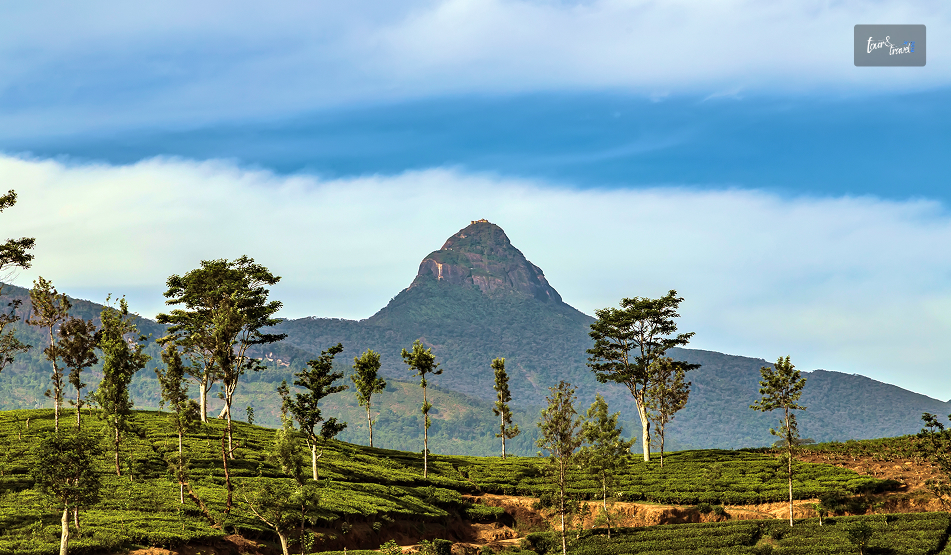

Adam’s Peak (Sri Pada): Climbing Sri Lanka’s Sacred Mountain

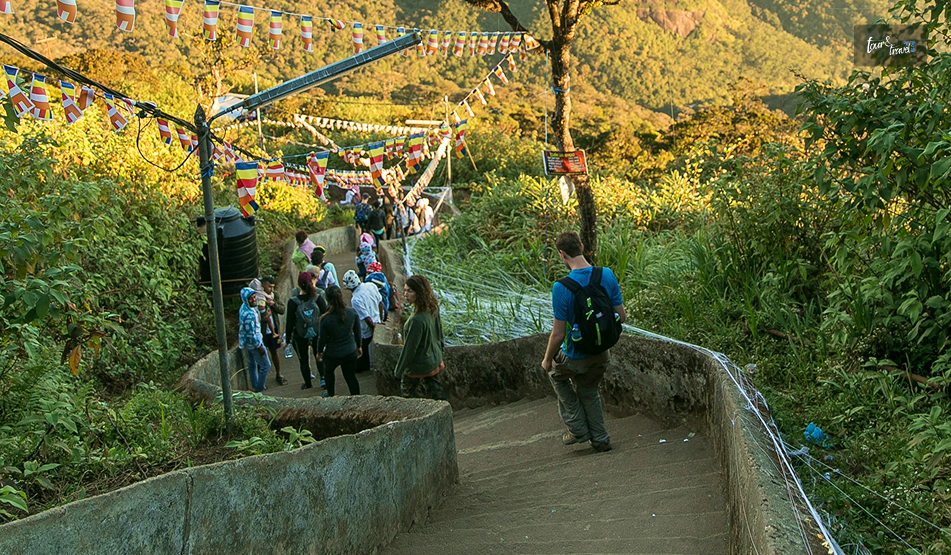
It was two in the morning, and I started climbing Adam’s Peak. I was in a line of pilgrims, and the line stretched as far as I could see with my torchlight.

All the guides about climbing up this sacred mountain tell you about climbing the 5500 steps. However, nothing prepares you for the experience you will have in conquering them in pitch darkness. 

Furthermore, the crowd itself was a reflection of how inclusive Sri Lanka is in its religious practice. It was a gathering of people from four different religious beliefs. 

The reasons for everyone’s climb were not the same. However, that did not quite clash with each other. 

That is the beauty of the Indian Subcontinent, and Sri Lanka sets an example each time I visit it.  

Nevertheless, in this guide, I will talk about my experience of reaching the summit of Adam’s Peak and all the details you need to know. 

Adam’s Peak: Some Quick Facts You Need To Know

AttributeDetails
LocationInside Peak Wilderness Protected Area, Central Highlands, Sri Lanka
Elevation2,243 Metres (7,359 Feet)
Local NameSri Pada (“Sacred Footprint”) or Sivanolipaathamalai
Religious SignificanceSacred to 
BuddhistsHindusMuslims Christians
Total StepsRoughly 5,500 Stairs via the Popular Hatton Route
Average Hike Time3 to 5 Hours for the Ascent1.5 to 2 Hours for the Descent
Pilgrimage SeasonDecember (Unduvap Poya) to May (Vesak Poya)
Best Months to ClimbJanuary to March for Dry Weather and Clear Sunrise Views
CostFree (No Entry Fee or Permit Requirements)

What Makes Adam’s Peak Sacred

Adam’s Peak (Sri Pada): Climbing Sri Lanka’s Sacred Mountain

Mount Pedro is the tallest mountain in Sri Lanka. However, Adam’s Peak has the highest spiritual significance. 

The local name for the peak, Sri Pada, or “Sacred Footprint,” itself sets your expectations high. 

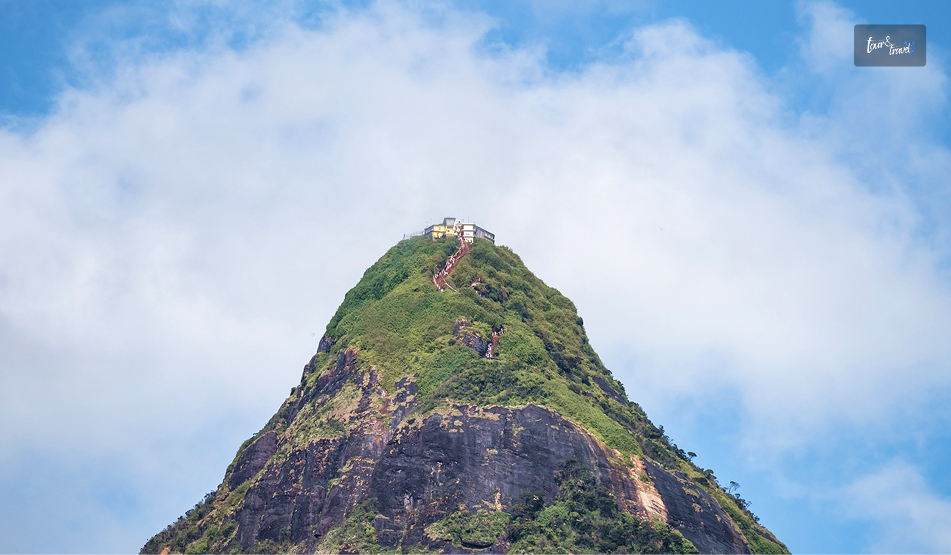
Rising 2243 meters in the Central Highlands of Sri Lanka, Adam’s Peak has a rock formation at the summit resembling a large footprint, which is claimed by four separate religions.

The Mystery Of The Footprint At The Adam’s Peak Summit

The Buddhists believe that the sacred footprint at the summit is of Lord Buddha. On the other hand, Hindus believe that the footprint is of Lord Shiva. 

Some Christians think the footprint is of Adam. He set his first footprint here after falling from the Garden of Eden.

Muslims also believe Adam, the first prophet in their religion, has left this footprint. 

Furthermore, there is a different Christian belief that the footprint belongs to St. Thomas. 

Again, the locals call it the “Mountain of Saman,” as they think the mountain is associated with Saman, a significant figure of worship in local traditions. 

Irrespective of the religious significance of Adam’s Peak, pilgrimage to the summit has continued for over a thousand years.

A Brief History Of The Pilgrimage

Some of the earliest recorded efforts to conquer Adam’s Peak go back to the reign of King Vijayabahu I in the eleventh century.

He built wayside rest houses along the route.

Later, various rulers expanded the mountaintop shrine, built roads, and installed the iron chains that still assist climbers on the steepest sections near the summit.

Another fascinating local belief is that the chains in the steep sections of the route belonged to Alexander the Great.

Also, you will find a mention of Adam’s Peak in the writings of the Chinese traveler Ma Huan. He described Adam’s Peak as a place rich with precious stones.

Along with the religious significance, the richness of gems is another reason why this peak has drawn visitors from far beyond Sri Lanka.

Where Is Adam’s Peak Located?

https://maps.app.goo.gl/CZeW7kGZ8rTZG2Xc8

The sacred mountain is in the southwestern part of the Central Range in Sri Lanka. It is at a distance of around 40 km from Ratnapura. 

However, the more popular trekking route is through Hatton, which is just at a distance of 32 km. 

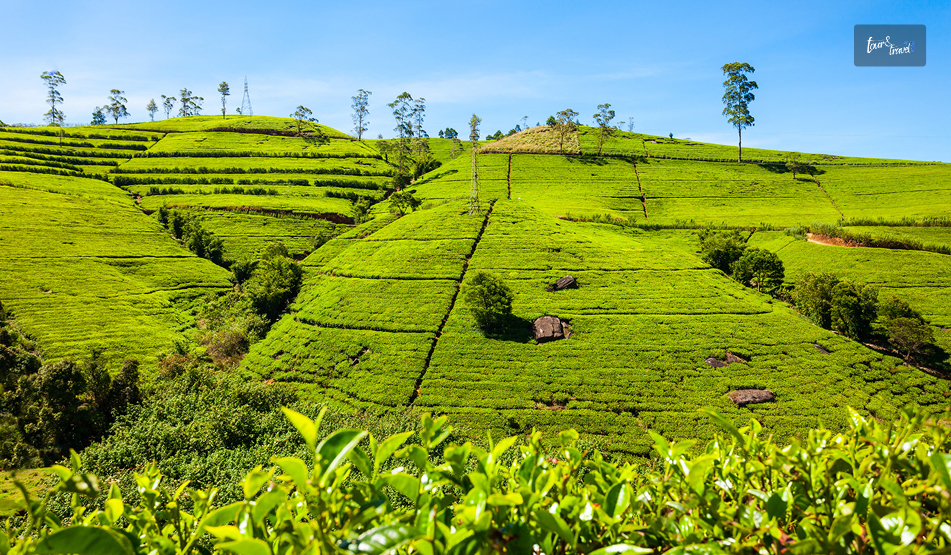
The landscape surrounding the mountain is delightful and quintessential of the Sri Lankan Central Highlands. You will see tea plantations and rainforest. 

Moreover, Dalhousie, or Nallathanniya, is the village at the base of this mountain. Most trekkers start their journey from this village itself. 

It is an easy base to reach from Hatton, Maskeliya, or Ratnapura, depending on which direction you’re coming from.

Getting To The Trailhead

Hatton is the main transport hub for this side of the mountain.

It is well connected by train on Sri Lanka’s scenic hill-country line as well as by bus from Kandy, Nuwara Eliya, and Colombo. 

From Hatton, local buses and shared taxis run the remaining stretch to Nallathanniya.

During peak pilgrimage season, you will get extra buses heading to the base. 

If you are driving yourself, the roads narrow considerably in the final approach to Dalhousie, and parking fills up quickly on weekends and full moon nights.

Choosing Your Route To Adam’s Peak

Adam’s Peak (Sri Pada): Climbing Sri Lanka’s Sacred Mountain

Just as pilgrims of four different religions want to conquer Adam’s Peak, there are six trails that lead to Adam’s Peak. 

However, as I have mentioned, the Hatton route via Nallathanniya is popular with travelers. It is also the easiest. 

The route is around 5 km one-way, and the staircase on this route is well-maintained for a safe ascent. 

The Kuruwita-Erathna, Ihala-Maliboda, and Ratnapura routes are longer, less developed, and used mainly by more experienced or locally guided hikers rather than casual visitors.

The Night Climb

Most pilgrims start the climb to the summit at around 2 to 3 AM. This reminded me of the walk and the queue for visiting the Tirupati Balaji Temple and Aruanchalam Temple in India, as both of these are located at hilltops. 

Nevertheless, with the ascent starting at 2 AM to 3 AM, you can reach the summit before sunrise at around 6 to 6:15 AM. 

Depending on your fitness level and the number of stops you are taking at the tea shops along the way, the total duration to complete the ascent will change. 

Also, very few people talk about the descent, which is actually way harder, and my knees had a hard time. 

The reward of all this hardwork is the sacred “Shadow of Sri Pada” on a clear morning. 

Difficulty And Fitness Considerations

The climb to Adam’s Peak is moderate to hard. There is no technical scrambling. 

However, the stone stairs are relentless, and they test different muscles than a usual hiking trail. So, basic fitness is important, and only reasonably fit adults can complete the ascent in three to four hours.

Having said that, mental endurance is most important here. 

I passed pilgrims well into their seventies moving slower but steadily upward alongside groups of teenagers. 

The descent deserves just as much respect as the climb. The repetitive downward impact on knees and quads catches many first-timers off guard, and rushing it is a common way to end up sore for days afterward.

What Is The Best Time To Climb Adam’s Peak

Adam’s Peak (Sri Pada): Climbing Sri Lanka’s Sacred Mountain

From the Unduwap Poya (full moon) in December to the Vesak Poya in May is the official pilgrimage season for climbing Adam’s Peak. 

It is the dry season in Sri Lanka. 

The entire route gets decked up during this season. The strings of lights, the tea stalls, and rest huts open all night make the ambience festive. 

However, if you want to avoid the crowd, you can plan a climb between June and November. 

Skip the monsoon months and slippery stone steps. 

Crowds And Timing Within The Season

If you want to join the pilgrims in the peak season, you must avoid the following days.

  • Full Moon Days
  • Weekends
  • The Week Around the Sinhala New Year in Mid-April.

Also, the months of January and February remain the busiest. 

So, if you are planning a quieter climb in the festive season, aim for a weekday in early December or late April instead.

What To Pack And Expect

Comfortable, broken-in walking shoes matter more here than technical hiking gear, since the trail has no scrambling but plenty of relentless stairs. 

Nights on the mountain get cold, particularly in December and January.

So, a warm layer is worth the extra weight in your bag. 

The entry is free, though donations are welcomed at the temple near the base.

Moreover, you must carry cash for tea, snacks, and simple meals from the stalls lining the route during the season.

Nearby Places To Combine With Your Visit

Adam’s Peak (Sri Pada): Climbing Sri Lanka’s Sacred Mountain

Hatton and the surrounding tea country make a natural base before or after the climb.

You can combine Adam’s Peak with a trip through Nuwara Eliya or onward toward Ella via Sri Lanka’s scenic hill-country rail line. 

If you have a rest day built in, the tea estates around Maskeliya and Dalhousie are worth exploring at a slower pace once your legs have recovered from the descent.

Guides And Group Climbs To Adam’s Peak

Hiring a guide is not necessary on the main Hatton route, since the path is obvious and well-populated during the season.

However, having a guide can add real value for first-time climbers who want context on the mountain’s history and the shrines passed along the way. 

Many guesthouses in Nallathanniya and Hatton can arrange a local guide on short notice. 

Also, joining a small group climb is a good option for solo travelers who would rather not do the pre-dawn ascent entirely alone.

Share on Social Media

Sibashree is a travel, culture, and leisure writer who has been writing since the age of 12 and professionally since 2014. With more than a decade of travel writing experience and journeys across India and several parts of the world, she brings a deeply personal and thoughtful perspective to her work. A student of English Literature and Mass Communication, Sibashree has always viewed travel as more than movement — for her, it has been a way of understanding people, cultures, and herself. Her passion for spiritual exploration has also led her to many unusual and meaningful destinations over the years. Outside of writing, Sibashree enjoys watching European cinema, reading about global politics, and reflecting on the stories hidden within everyday places.

Leave a Reply

Your email address will not be published. Required fields are marked *

title-img Related

READ MORE Hiriketiya Beach

Hiriketiya Beach, Sri Lanka: Location, How To Reach, Things To Do And More 

BY  Sibashree Mar 23, 2026

Hiriketiya Beach is a place that can disrupt your travel plans completely.  You may arrive with plans for a two-night stay and end up spending 3 weeks developing a routine of mornings spent surfing, drinking coconut coffee, and watching the sun set down on the jungle.  This tucked-away cove in Sri Lanka’s southern coast, nicknamed by its community of surfers and digital nomads as "Hiri", is a textbook example of tropical aesthetics.  The cove is well-formed, with water that is surrounded by palm trees, and has a jungle so dense behind it that you will hear monkeys scurrying through the tree tops of your surfboard as they find their way there.  Hiri feels like a secret to be shared, but is just being revealed to people in the surrounding towns of Weligama and Mirissa.  Hiriketiya has developed to become a more sophisticated version of Weligama and Mirissa. The "vibe" of Hiriketiya is not just another phrase used by hipsters. It is the currency used by locals. Here is more about this beautiful coastal gem in Sri Lanka.  The Evolution Of Hiriketiya Beach: Why You Need To Go Now Hiriketiya has experienced an incredible transformation over the last few years.  Only a few years ago, this sleepy little fishing village had only a few guesthouses and one small roti shop. It is quite similar to the beaches in Jaffna in that way.  Now, it's become a vibrant hub, and even though it has lost some of its "untouched" charm. Moreover, this infusion of new energy has produced world-class specialty coffee shops, beautiful state-of-the-art Yoga studios, and a co-working scene. But despite these rapid changes, the spirit of this village remains.  The Surf At Hirikeya Beach: A Wave For Every Soul The horseshoe shape and the unique geography of the Hirikeya Beach make it ideal for every type of surfer.  Here is a quick breakdown. Surf LocationDetails The Beach Break (Right Side)- Beginner-Friendly- Sandy Bottom- Gentle WavesThe Middle- Ideal for Longboarders- Offers a Mellow RideThe Point Break (Left Side)- Ideal for Professionals- Shallow Reef Board rentals are standardized at 1000 LKR per hour.  If the Hirikeya Beach is very busy, you can go 3.5 km east and find Kudawella Beach.  Where Is Hirikeya Beach? How To Reach It?  Hiriketiya is located off the main highway along the coast, about one mile away from the town of Dickwella.  Since Hiriketiya is not on a major transit route, you will have to use Dickwella as your transit point. 1. Traveling To Hiriketiya Beach From Colombo The best way to get there is by taking the train from Colombo Fort to Matara, which takes approximately four hours.  From Matara, you can take a local bus to Dickwella or take a tuk-tuk taxi. You can also take a highway express bus from Colombo to Matara and arrive in about three hours. 2. Traveling To Hiriketiya Beach From Ella You can catch the #31 bus at the intersection of the Ella-Passara Road as you travel through tea country.  It is approximately four hours to the coast on a winding road. Just tell the conductor you want to go to Dickwella. 3. Traveling To Hiriketiya Beach From Arugam Bay If you are traveling from the East Coast surf to the surf in the South, there is a direct bus leaving from Pottuvil every day around 6:30 AM, arriving at Dickwella approximately six hours later. What Are The Things To Do At Hirikeya Beach? (Beyond Surfing) Hiri has just as much gravitational force to attract chill seekers. So, here are the things to do beyond surfing.  1. Walk To Blue Beach Island If you're looking for a little adventure, try the 2.5km (1.5-mile) walk to Nilwella.  You'll be walking through peaceful local neighborhoods when you find a beautiful natural sandbar that links the mainland with a small island.  Moreover, walking over a sandbar with breaking waves on both sides of you is something you will remember long after leaving Hiri.  Also, it is the best place to watch the sunset. 2. Sip In Style At Smoke And Bitters Believe it or not, one of the 50 Best Bars in Asia is hidden deep in a coconut grove.  Furthermore, the menu at Smoke and Bitters is based on the smokehouse method of cooking, using local Sri Lankan ingredients with cooking methods from around the globe.  Moreover, you must try the smoked harissa pumpkin and the pork ribs as they are WOW!!  Every cocktail created at Smoke and Bitters is a work of art. The price of a drink here, compared to what you would expect to pay in Sri Lanka, may seem high. However, when you want to treat yourself, there is no better place to go. 3. Become A Culinary Master With Rosie Rosie's cooking class experience is the ultimate rite of passage in Hiri.  While she prepares the dishes during your cooking class, you will also hear many personal stories of her life and how she made some special Sri Lankan spice combinations. Moreover, it costs 6000 LKR, and the 4-hour feast is the ultimate attraction.  The Digital Nomad And Yoga Scene At Hirikeya Beach  Hiriketiya has become a cornerstone of the "work-from-anywhere" lifestyle.  Places like Dots Bay House and Salty Pelican provide the infrastructure (and the caffeine) needed to hit deadlines. Moreover, when it comes to physical and mental well-being, Arise is unparalleled.  So, they provide a variety of classes to choose from, including Muay Thai, ecstatic dance, and Reiki, as well as many types of Vinyasa yoga.  Additionally, their Salt House location offers stunning rooftop yoga classes where you can do yoga while listening to the waves below. Where to Stay In Hiriketiya? Hiriketiya offers a versatile range of accommodation. Here are some places you can try.  1. Salt House  This upscale beach hotel has a boutique feel.  Located 5 minutes away from the beach, the hotel has spacious, minimalistic rooms opening directly to its central pool and open-air cafe.  Moreover, on-site yoga classes every day attract those interested in wellness. Room rates begin at about 21000 LKD per night. 2. Dots Bay House  Located next to the surfing area, 'Dots', the centre of Hiri's social scene, offers accommodation options ranging from dormitories to high-end private rooms.  Moreover, facilities include an on-site co-working space, swimming pool, and popular bar which features the best live music acts in town. Prices start at approximately 7000 LKD per night. 3. Hiriketiya White House  A charming, family-owned guesthouse hidden away in the jungle, offering an excellent option for visitors who want authentic experiences at affordable prices.  Also, the double rooms come with beautiful contemporary bathrooms and balconies where guests can enjoy watching monkeys play overhead. Moreover, the prices start from about 5500 LKD per night.  When To Visit Hiriketiya Beach? Due to offshore winds and consistent swell during the "High Season", November to April is the best time for surfers to be out on the ocean.  Moreover, December to February is the busiest time of year, with hot and dry weather as well as a lot of activity happening around town.  However, there are two downsides. The first is that accommodation prices rise significantly, and the second is that line-ups at the ocean can be extremely crowded. Where To Eat In Hiriketiya? As an enthusiast of TheLowDownUnder Travel and genuine experiences, I felt compelled to sample the local cuisine at Hirikeya. So, here are a few recommendations for places to check out. 1. Lemon Grass Café Considered the benchmark for rice and curry in Sri Lanka, this family-run establishment is modest yet impactful.  Moreover, for 1000 LKR, you’ll enjoy a generous array of at least four different vegetable curries, rice, and dessert, with unlimited refills. 2. Kingsley’s Kitchen Another gem in the area, Kingsley is a well-known figure in the village who serves outstanding home-cooked meals.  Dinner operates on a pre-order basis, so be sure to stop by during the day to reserve your meal.  Moreover, it’s one of the most budget-friendly spots in the bay, with a vegetarian curry priced at 750 LKR. 3. Dahami Situated at the Dickwella intersection, this is where the locals dine. Furthermore, it’s a straightforward buffet offering a mountain of rice and curry for just 450 LKR. Moreover, for those seeking specialty cafés and a beach atmosphere, options like Duni’s Hoppers Café, MOND Café, and La Playa are worth considering.

READ MORE things to do in nara

What Are The Things To Do In Nara? How To Plan A Two-Day Trip?

BY  Sibashree Mar 31, 2026

A trip to Nara was long overdue, and as the first permanent capital of the country, it is a must-visit.  Furthermore, this Japanese capital, before 794 AD (then Kyoto became the capital), has many UNESCO World Heritage Sites.  The Todai-ji Temple is the most famous among these 8 UNESCO World Heritage Sites. You will find one of the largest Buddha statues in the country here, and the statue is made of bronze.  Of course, the deer roaming in the city are beautiful, and you feel like getting transported to a bygone era.  It reminded me of one of the most famous literary works in our country, Shakuntalam Abhigyan, an immortal love story between King Dushyanta and Shakuntala, written by Kalidasa in Sanskrit.  Also, this is a place that will ask you to come back, and most people plan a day trip to experience its historical charm and natural beauty.  But, smitten by its beauty, I chose a 2-day trip, and here is the list of things to do in Nara. Also, I will discuss how I can get to Nara.  How To Reach Nara?  Nara is easily accessible from Kyoto, which is also famous for its history and cherry blossom season.  You can also visit Nara from the Osaka prefecture. So, overall, a visit to Nara can fit well into your itinerary of visiting the Kansai region of Japan.   Also, the robust railway system of Japan makes it easy and budget-friendly to visit Nara. A Japan Railway Regional Pass will be the best for traveling across Nara, Kyoto, Osaka, and Kobe, and the entire Kansai Region.  Also, when in Osaka, don’t forget to explore the street food stalls and have the best Osaka food, including Mochis and seafood delicacies.  Here is how you can travel from Kyoto to Nara. 1. Traveling From Kyoto To Nara Through The JR Nara Line You will get an express train or a local train from Kyoto to Nara every hour.  Furthermore, if you opt for the Miyakoji Rapid Service on this line, you will reach Nara within 45 minutes, and the ticket price will be 720 JPY.  Also, the local train services, with the same ticket price, will take about 70 minutes.  Once you reach the JR Nara station, you will get buses to the Nara Park and other top attractions in Nara.  2. Take The Kintetsu Railway To Reach Nara From Kyoto This is the most convenient way to reach Nara from Kintetsu Railway Station.  The train journey is the fastest, and the journey takes about 35 minutes by the express trains, and the ticket price is 1280 JPY.  Also, the regular trains take about 45 minutes to complete the journey. The ticket price is 760 JPY.  What Are The Things To Do In Nara?  From a visit to the Nara Park to exploring Heijo Palace and the temples, there are many things to do in Nara.  Here are the things I did during my 2-day stay.  1. Day 1 In Nara: Exploring The Nara Park  With deer passing by, Nara Park, the home to the main attractions in Nara, is a place you cannot simply miss.  The park is free to enter, and it remains open for 24 hours.  However, many attractions in the park close after 5 PM. So, you have to be early when visiting it.  Also, here are the attractions you will come across in the Nara Park, along with the deer passing by.  • Kasuga Taisha One of the UNESCO World Heritage Sites in Nara, Kasuga Taisha, takes us back to the Nara Period from 710 to 794 AD.  It is the most revered shrine among the Fujiwara clan as the tutelary shrine.  Furthermore, the main attraction of the shrine is the “Hall of Lanterns.” There, I saw many bronze lanterns illuminating the darkness.  During the special festivals, Setsubun Mantoro in February and Chugen Mantoro in August, all these lanterns are lit.  Moreover, you will find a cider tree in the inner shrine, and it is 1000 years old.  • Mt. Wakakusa I took the back road from Kasuga Taisha on the way to the Todai-Ji temple.  I came across many small shrines there. However, the highlight was Mt. Wakakusa.  This hill between the two shrines has a height of 350 meters. Also, on the 4th Saturday of January, it becomes the venue for the Wakakusa Yamayaki celebration.  People burn dead grass on the slopes, and this is a ritual that has been celebrated since the 18th century.  • Todai-Ji Todai-Ji is another UNESCO World Heritage Site, and one of the “Historic Monuments of Ancient Nara.” It was built in 752 AD, and it was the head of all the temples in the province. It even had a strong influence on the royal family.  In fact, with Todai-Ji being the seat of control even in the royal decisions, the emperor decided to move the capital to Nagaoka in 784 AD.  However, the main attraction of the Todai-Ji Temple is the massive Buddha statue, or Daibutsu.   A depiction of Dainichi Nyorai,  it represents the primordial Buddha in the orthodox East Asian Buddhist philosophy.  You will also find two similarly sized Bodhisattva statues here.  However, the temple and statues you see today were burned down, and they were rebuilt during the Edo period (1603–1868).  2. Things To Do In Nara: Day 2 I visited the Heijo Palace and many other temples of Nara on day 2.  • Visiting The Heijo Palace  When Nara was the capital, the Heijo Palace was the seat of power for the chrysanthemum throne.  It had a dimension of 1 kilometer, considering the other palaces and architecture of that time.  However, the remains of this UNESCO World Heritage Site in Nara are now at the Toshodai-ji Temple, nearby.  However, since the 1950s, archaeologists have been studying the remains of the Heijo Palace, and this has evoked further public interest.  That is why you can now see many placards there and read about the history and legacy of the site.  Moreover, the audience hall and two other parts of the palace were rebuilt. The restoration of the largest part, the audience hall, happened in 2010.  It was an ode to the 1300th anniversary of Nara as the capital of Japan.  • Toshodai-Ji As I have mentioned, the Toshodai-ji Temple has the remains of the Heijo Palace.  This temple dates back at least a millennium. Ganji, a Chinese monk, built this temple in 759 AD.  Monk Ganji brought Buddhism to Japan, and the Toshodai-Ji today is a UNESCO World Heritage Site.  • Yakushi-Ji It is a UNESCO World Heritage Site, and people here worship Lord Buddha as Yakushi Nyorai or the Medicine Buddha.  The dual main halls here have unique architecture, and each has a dedicated 3-story pagoda.  • Horyu-ji  Horyu-Ji is older than most temples in the Nara region, and Prince Shotoku founded it in 607.  Furthermore, this UNESCO World Heritage Site stands out with its wooden edifices, which are some of the oldest in Japan. This time, I missed many attractions such as Asuka, Omiwa Shrine, and Mount Yoshino. Some day for sure!  And till then, Sayōnara, guys!

READ MORE things to do in galle

What Are The Things To Do In Galle Fort, Sri Lanka? Exploring A UNESCO Heritage Site

BY  Sibashree Mar 24, 2026

Galle has been my ideal dreamy, sepia-toned travel destination located on the southwestern coast of Sri Lanka.  Moreover, the city’s stunningly beautiful old fortified peninsula reaches defiantly out into the Indian Ocean and boasts many crumbling colonial-style buildings, narrow cobblestone streets, and swaying palm trees.  However, the true magic of Galle comes from taking it slowly.  Hi, in today’s blog, I will talk about the things to do in Galle Fort. However, I will begin with why a visit to the Galle Fort is worth it and how to get there.  Why Visit Galle Fort? A UNESCO World Heritage Site And The Fortress That Defied Time “Founded in the 16th century by the Portuguese, Galle reached the height of its development in the 18th century, before the arrival of the British.  It is the best example of a fortified city built by Europeans in South and South-East Asia, showing the interaction between European architectural styles and South Asian traditions.” • UNESCO World Heritage Convention.  The trading post was once impenetrable, and the rampart walls kept the invaders at bay.  However, centuries later, during the 2004 Tsunami, the same stone walls that stood against cannons also protected the people from the ocean.  Thus, the Galle Fort remained intact even though the surrounding coastline was devastated. Today, it stands as a UNESCO World Heritage Site for being a unique example of a fortified city.  How To Reach The Galle Fort? You can easily reach the Galle Fort from Colombo or down the coast.  From Colombo  You can take a train from Colombo Fort, and after a three-hour journey and amazing ocean views, you will reach Galle.  However, currently, this route is being reconstructed. So, you can take a Highway AC bus from the Makumbura Station.  Furthermore, it is a 2-hour journey through the Expressway.  From Mirissa Or Weligama If you’re already beach-hopping the south coast, you can just hop on any local bus headed toward Matara or Galle.  It’s cheap, frequent, and gives you a real taste of local life, and that’s amazing as a follower of TheLowDownUnder Travel philosophy.  Also, from my days in Jaffna to the things to do in Kandy, I have always ditched comfort and the obvious for a more authentic experience.  What Are The Things To Do In Galle Fort, Sri Lanka?  When talking about the things to do in Galle Fort, you have to think beyond the tourist checklist.  Furthermore, Galle is a place of contrasts! You have the rugged, salt-sprayed stone of the ramparts on one hand, and on the other hand, you have the most polished boutique shops.  So, Galle is beyond your usual Instagram photo op.  And one of the best things to do in Galle is to understand how the fortress and the neighborhood have survived empires and natural disasters.  Moreover, in Galle, you become a part of the history as you watch the sunset from an ancient bastion or sip cold beer at a wine bar on a cobblestone street.  Also, you will see an extension of all these in my detailed account of two days in Galle Fort.  Day 1: Getting Lost In The Living Museum Walks, exploring the architecture, culture, and the much hyped sunset experience! These were the things to do in Galle Fort on day one.  Morning: The Rampart Walk Walking is the best way to begin your exploration of Galle Fort. It is small and, therefore, a great destination for pedestrians.  In the morning, I climbed to the top of the stone ramparts and walked the entire way around the edge of the Fort, obtaining a 360-degree view of Galle. I saw the sparkling, turquoise ocean to one side and the red tiled roofs of the original buildings of the town on the other. On your walking tour, look for the famous Galle Clock Tower and the historic Galle Lighthouse, which is probably the most photographed place in all of Sri Lanka.  The whitewashed lighthouse is stunning against the clear blue sky, but I found that the late afternoon light gives it that soft, golden color that makes the palm tree shadows cast perfectly across the grass. Afternoon: Culture And Architecture After you’ve finished exploring the upper level of the walls, it’s time to explore the narrow alleyways of the city.  Throughout the streets, you are going to notice something extremely wonderful. You will see the cultural and ethnic diversity and the same inclusive culture of Sri Lanka, prominent through the iconic Ambuluwawa Tower in Colombo.   In just a matter of blocks, I was able to visit the Dutch Reform Church, All Saints Anglican Church, Meeran Mosque, and Sri Sudharmalaya Buddhist Temple.  All these places serve as a testament to the many different people who have influenced the development of Sri Lanka over many hundreds of years. If the heat of the sun becomes unbearable, I recommend that you check out either the Historical Mansion Museum or the Maritime Museum.  Both of these museums are in beautifully restored colonial structures and provide visitors with great artifacts dating back to Sri Lanka’s colonial period. Evening: The Sunset Ritual When the sun is going down, I suggest that you make your way to the western walls of the fort.  At Flag Rock Bastion, you will find the locals performing their “cliff jumping” tourism attraction.  You will have the opportunity to see how far they will go into the crashing waves.  If you would rather have a quieter spot to watch the sunset, I would recommend that you go to Triton Bastion.  I spent an hour there on the grassy ramparts watching as the sky slowly burned with bright oranges. What a way to see Mother Nature's fireworks show. Day 2: Boutiques, Buffets, And Beaches Day 2 was more relaxed as I shopped, gorged on grand feasts, and explored the beaches.  Morning: The Shopping Mecca Galle is now Sri Lanka's shopping capital. Pedlar Street is the epicenter of the boutique shops, from where you can collect elegant souvenirs.  A few of my personal favorites are in the table below.  Places to Visit for ShoppingThings to BuyStick No BillsVintage-Style PostersThe Tea Room by Evergreen GroupBuy Tea in BulkOld Dutch HospitalThis former colonial hospital is now a chic shopping and dining precinct. It’s the perfect place to grab a coffee and browse. Lunch: A Local Feast After the spicy food in Jaffna, the food in Gelle was comforting. So, trying the Coconut Sambal is one of the best things to do in Galle.  You will get the curries with chicken and vegan-friendly options here. Also, to beat the midday Sun, have some homemade ginger beer or treat yourself to a scoop at Isle of Gelato.  Moreover, don’t forget to try the cashew caramel at Isle of Gelato.  Afternoon: Beyond The Walls As the Sun starts getting softer, you can explore the surrounding coast. Also, if you want to extend your coastal hunt, head to Dewata Beach.  Here, you will find many beginners and professionals surfing the waves.  Furthermore, if you want to just relax, take a tuk-tuk ride to the Jungle Beach in Unawatuna. It is a small sandy cove with lush greenery.