
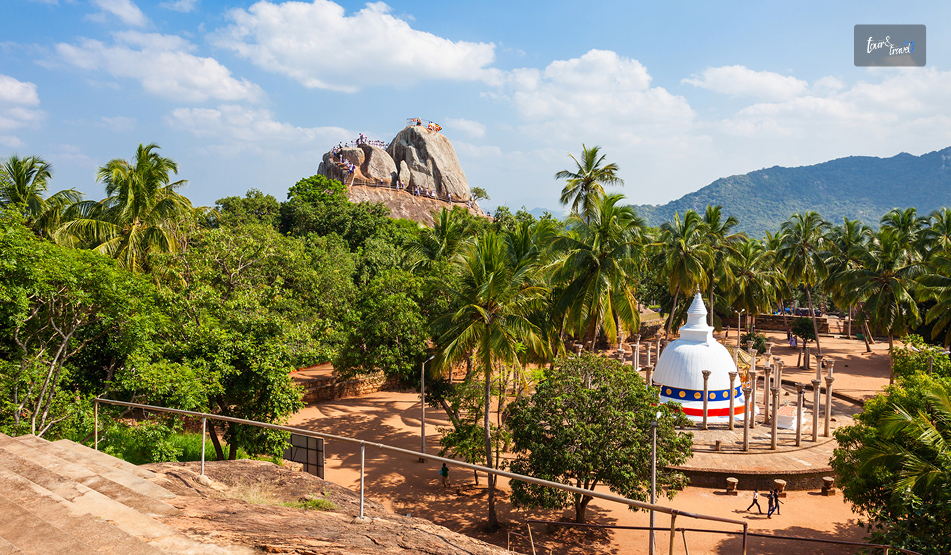


Climbing Mihintale: My Morning At The Birthplace Of Sri Lankan Buddhism

I reached Mihintale before 7 AM.  

The stone steps were still cool, and the mist was not yet off the fields.  

You can call it bad timing, as everyone told me to visit Mihintale at sunrise or never at all. However, I chose a different time on purpose.  

The reward? I found Mihintale at its quietest.  

Sigiriya, an hour south, got all the crowds and queues.  

On the other hand, Mihintale, the place where Buddhism actually arrived in Sri Lanka, is humble, with a handful of monks.  

Also, there were a few pilgrims in white attire.  

Surprisingly, I even came across some confused tourists checking a map.  

That struck me more, and it once again reminded me that it is one of the most underrated stops in the Cultural Triangle.  

Mihintale At A Glance 

Detail Information 
Location 13 km east of Anuradhapura, North Central Province 
Significance Site of the 3rd-century BCE meeting between Arahat Mahinda and King Devanampiyatissa, traditionally marking the introduction of Buddhism to Sri Lanka 
Opening hours 6 AM to 6:00 PM (Remains Open for longer hours on Poson Poya.) 
Foreign visitor entry fee Around US$3 per person (paid in LKR at the day’s rate). It is separate from the Anuradhapura Sacred City ticket. 
Visitor entry fee for locals Free 
Steps to the summit About 1,840 stone steps from the base car park to Mihintale Rock. 
Best time to visit Early morning (6–8 AM) or late afternoon; June’s Poson Poya for the full pilgrimage experience 
Nearest base town Anuradhapura (20–30 minute drive or tuktuk ride) 

The Story Behind The 1840 Steps

Climbing Mihintale: My Morning At The Birthplace Of Sri Lankan Buddhism

The significance of climbing up the 1840 steps at Mihintale is not about the 1840 steps.  

The hill is modest if you compare it to the Sigiriya Rock Fortress.  

However, it is the spot where the entire religious character of the island changed.  

Monk Arahat Mahinda, Emperor Ashoka’s eldest son, met King Devanampiyatissa. 

The king was hunting, and after his exchange with Arahat Mahinda, he converted to Buddhism.  

He also declared Buddhism the state religion. Thus, Mihintale is the birthplace of Buddhism in Sri Lanka.  

Ambasthala Dagoba, a small stupa, marks the exact spot of that meeting.  

So, in significance, this place outranks the more photogenic ruins in local devotion. 

It is not built for tourists. It is also not a restored monument.  

In fact, it is a working pilgrimage site that Sri Lankan Buddhists have kept returning to for over two thousand years. 

Why Poson Poya Turns Mihintale Into A Sea Of White

Climbing Mihintale: My Morning At The Birthplace Of Sri Lankan Buddhism

Mihintale becomes the spiritual center of the country every June.  

Poson Poya, or the full moon day in Jun,e is the biggest festival here.  

In 2026, Mihintale celebrated Poson Poya on 29th June and, like every year, more than ten thousand devotees attended the event.  

The pilgrims dressed in white climbed through the night with lanterns to reach the summit stupas by dawn.  

Climbing Mihintale: What The 1,840 Steps Actually Feel Like

Climbing Mihintale: My Morning At The Birthplace Of Sri Lankan Buddhism

The climb to Mihintale has different stages.  

Also, each stage evokes different feelings with its distinct ambiance.  

The Base: Kantaka Chetiya And The Monastery Ruins 

From the main car park, the first wide stone stairway leads past the ruins of what was once a large monastic complex. 

The complex had refectories, meditation halls, and stone urinals carved with such intricate patterns that early archaeologists initially mistook them for decorative slabs rather than plumbing.  

I took a short detour off the main steps to reach Kantaka Chetiya. 

It is a partially preserved stupa ringed with carved friezes that are older. 

I found them more delicate than anything at the summit.  

Almost nobody stops here, which is exactly why I did. 

The Middle Climb: Widening Views And The Naga Pokuna 

The steps get shallower and more shaded as you climb. 

Also, I came across the famous Naga Pokuna here.  

Naga Pokuna means the pond guarded by a five-headed cobra.  

Once I reached Naga Pokuna, I could see the dagobas of Anuradhapura in the distance.  

They looked like pale domes above the tree line.  

I stood there for a good 10 minutes to admire the view of the dagobas and catch my breath.  

Ambasthala Terrace And The Sacred Meeting Point 

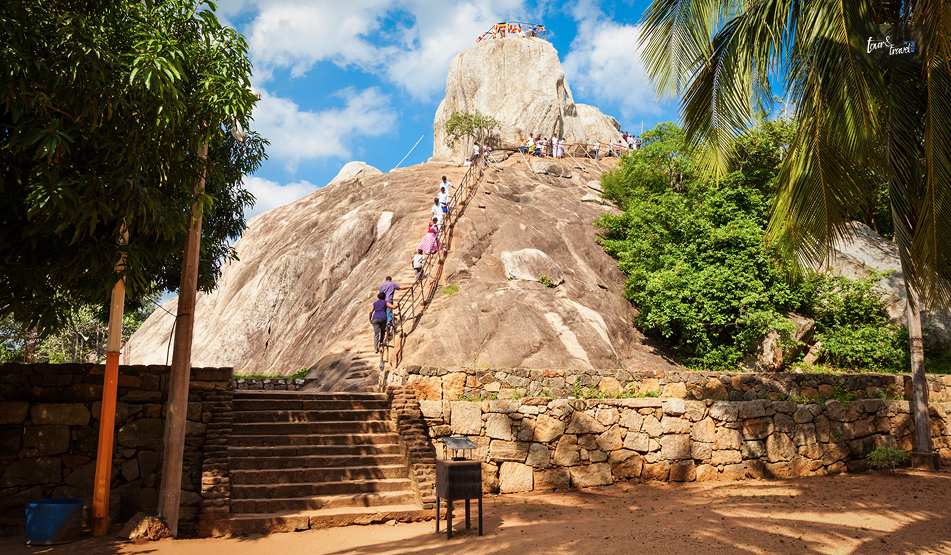
After crossing Naga Pokona, the steps opened onto a broad, sandy plateau. 

It is the Ambasthala Terrace with frangipani trees all around. These trees reminded me of my home.  

Furthermore, the Ambasthala Dagoba sits in the center of the terrace.  

As I mentioned, it is the place where Monk Mahinda met the king and brought the religious transformation of the island country.  

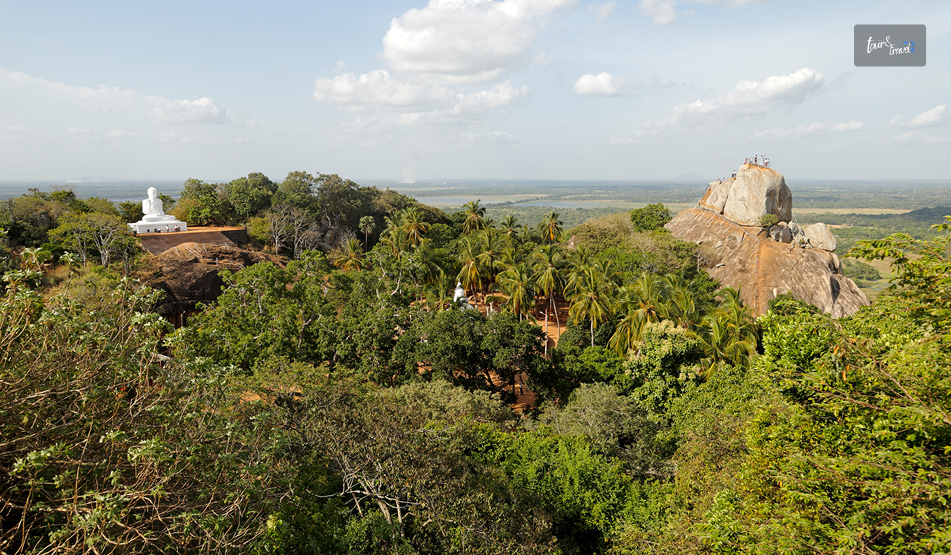
A large seated Buddha statue watches over the terrace, and this is where I saw the most devotees. 

I knelt, lit oil lamps, and then sat in the shade.  

You have to take off your shoes and hat here.  

The sandstone here can be uncomfortably hot by mid-morning. So, visiting Mihintale early is a must.  

The Final Push To Mihintale Rock 

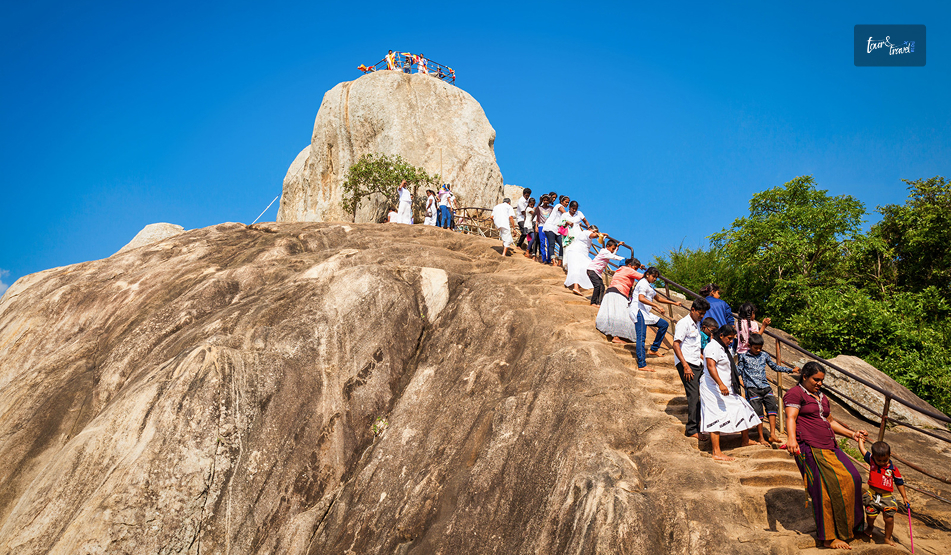
From Ambasthala, a short but steep set of steps, carved directly into the granite, with only a thin iron handrail, leads to the summit. 

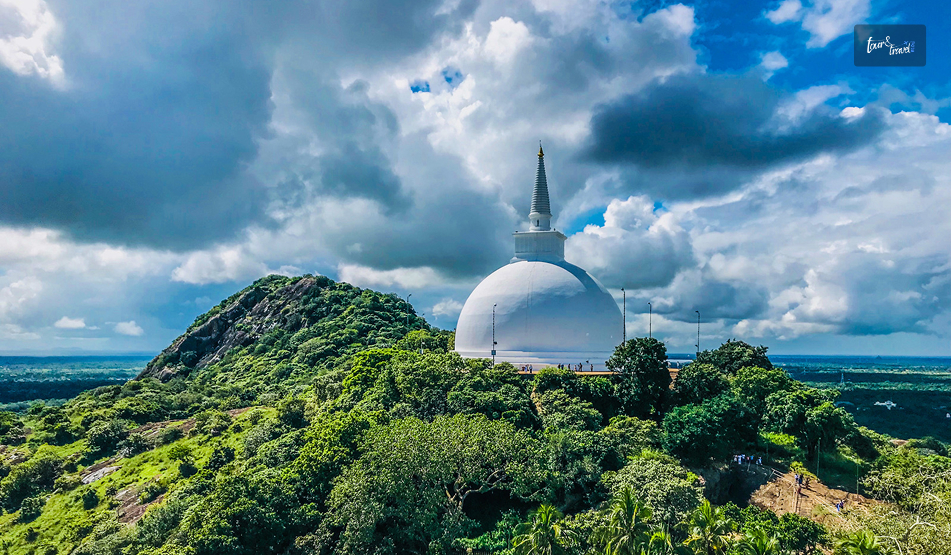
You will find the small Mahaseya Dagoba here. 

It is a genuinely exposed scramble in a couple of places, and I saw more than one visitor turn back here.  

If you make it, the payoff is a 360-degree view over the Anuradhapura plains. 

I completed the climb in an hour.  

So, if you factor in around 2 hours for climbing and descending, you will need at least 2 hours to explore the stupas and soak in the spiritual vibe here.  

Entry Tickets And Costs 

Mihintale has its own ticket, separate from the Anuradhapura Sacred City ticket that covers Ruwanwelisaya, Jetavanaramaya, and Abhayagiri.  

Ticket type Approx. price (2026 reporting) 
Mihintale foreign adult ticket $3 (paid in LKR) 
Mihintale child ticket (under 12) $1.5 to 2.5 
Anuradhapura Sacred City ticket (separate) $25–30 
Combined Ticket of Cultural Triangle tour $50 (Sigiriya, Dambulla, Polonnaruwa, Anuradhapura) 

How To Visit Mihintale From Anuradhapura?

Climbing Mihintale: My Morning At The Birthplace Of Sri Lankan Buddhism

Mihintale is around 13 km east of Anuradhapura’s New Town. 

Also, it is roughly a 20–30 minute drive or tuktuk ride along a well-paved road. When I visited, the tuktuk charged me LKR 1500.  

Most visitors combine it with an Anuradhapura day as an early-morning add-on before the sacred city gets busy. 

You can also visit it as a late-afternoon stop on the way toward Trincomalee or Habarana.  

What Is The Best Time Of Day And Year To Climb Mihintale?

Climbing Mihintale: My Morning At The Birthplace Of Sri Lankan Buddhism

6:30 AM to 7 AM is the best time of the day to beat both the heat and the tour buses. 

Also, if you are looking for the best season, May to September is the best window with dry weather conditions.  

However, if you want to experience the festive fervor around the temple, Poson Poya or June Full Moon is the best. 

A Half-Day Mihintale And Anuradhapura Itinerary 

Time Stop Notes 
6:00 AM Depart Anuradhapura Take a tuk-tuk or car and reach within 25 minutes. 
6:30 AM Mihintale Base and Kantaka Chetiya Climb the cool steps. Explore the monastery ruins with no crowds. 
7:30 AM Ambasthala Terrace and Mihintale Rock Enjoy the sunrise light and a quieter summit.  
9:00 AM Return to Anuradhapura Have your breakfast. Return to the Sacred City. 
9:30 AM to 1:00 PM Ruwanwelisaya, Sri Maha Bodhi, Jetavanaramaya Core Anuradhapura sites before midday heat. 

Why Mihintale Is Worth The Detour 

Most Cultural Triangle itineraries treat Mihintale as an optional half-day tacked onto Anuradhapura. 

It is obvious, as Anuradhapura gets more attention due to its scale, and Sigiriya is marketed well.  

However, Mihintale is the only site in the region I visited that still felt primarily like a place of worship rather than a monument being managed for visitors.  

If you only have time for one Buddhist pilgrimage site in the Cultural Triangle beyond the big-name ruins, it is the place you should be.

Share on Social Media

Sibashree is a travel, culture, and leisure writer who has been writing since the age of 12 and professionally since 2014. With more than a decade of travel writing experience and journeys across India and several parts of the world, she brings a deeply personal and thoughtful perspective to her work. A student of English Literature and Mass Communication, Sibashree has always viewed travel as more than movement — for her, it has been a way of understanding people, cultures, and herself. Her passion for spiritual exploration has also led her to many unusual and meaningful destinations over the years. Outside of writing, Sibashree enjoys watching European cinema, reading about global politics, and reflecting on the stories hidden within everyday places.

Leave a Reply

Your email address will not be published. Required fields are marked *

title-img Related

READ MORE how many miles is 20000 steps

How Many Miles Is 20000 Steps? An Easy Pace Calculator And Guide

BY  Sibashree Feb 10, 2026

How Many Miles Is 20000 Steps? Key Takeaways: Are you an adult? Taking 20000 steps is equal to walking 8-10 miles. However, this exact calculation depends on many factors, such as the walking pace, stride length, and height of a person. Furthermore, men often cover more distance in miles in 20000 steps, as their average stride length (2.5 feet) is longer than that of women (2.2 feet). The “miles-to-step ratio” depends on your walking speed. For example, if your walking speed is 2 mph, you will need to take more steps each mile than anyone walking at a speed of 4 mph. If you are on a fitness journey, as part of your everyday regimen or for your next trek expedition, you must divide your 20000 steps into various sessions. Thus, your goal becomes achievable, and you can enjoy more health benefits. You can use SOLE Treadmills or similar fitness equipment for perfect distance tracking. Moreover, it comes with joint-protective technology. Thus, it helps maintain safety during high-volume walking to reach 20000 steps in a day. What Is The Significance Of 20000 Steps For Your Fitness Goal? For the longest time, taking 10000 steps has been considered the Gold Standard for regular fitness activities. However, if you want to push your boundaries as a fitness enthusiast, you can double it and make it 20,000 steps. Do you know what this ambitious goal of taking 20000 steps means for the distance covered? The calculation or the process of converting steps to miles is not as easy as it looks. As a fitness enthusiast or mountaineer working on your fitness goals, you have to understand this conversion. It is important to set realistic expectations and avoid injuries. For many people, taking 20000 steps, equivalent to walking 8-10 miles daily, is a major fitness commitment.  It’s like exploring Manhattan on foot in a day with plenty of zigzagging walks through the neighborhoods. Overall, walking 20000 steps means dedicating 3-4 hours of your time to walking on a daily basis. Once again, the distance in miles covered in 20000 steps will depend on your gender, walking pace, and height. Moreover, the terrain you are walking on will determine how many miles you will be covering. Your 20k Steps Calculator: A Quick Guide  How many miles is 20000 steps?  Well, you can choose conversion estimates to get some basic ideas. However, individual or specific stride length is a more dependable factor for accurate calculations. Do you want a quick reference? Refer to these general guides to know how much distance you are covering in 20000 steps. Height Stride Length (Average)Miles (Approx) You Will Cover in 20000 StepsLess than 5'3" 2.0 feet 7.5-7.6 Miles 5'3" to 5'7" 2.3 feet 8.2-8.3 Miles 5'8" to 6'0" 2.5 feet 9.5 Miles More than 6'0" 2.7 feet 10.2 Miles  The calculation process is simple. First, multiply 20000 by your stride length.  Then, divide the result by 5280. However, remember that this calculation is done considering you have an average walking pace of 3 miles per hour. So, the actual distance will be different if you are walking at a slower pace through any crowded street or market, or if you are walking briskly. You can use a fitness tracker to calculate the miles covered with your 20000 steps in a day by adjusting your walking speed. Naturally, the result will be more accurate. For Men: How Far Is 20,000 Steps?  If a man and a woman have the same height, the stride length of the man will be longer. So, a man will walk a longer distance with the same number of steps he takes. On average, a man has around 2.5 feet of stride length when he is walking at his usual pace. Thus, for a man of average height, 20000 steps means covering around 9.5 miles. Also, for men, height plays an important role in deciding the stride length. If you are a man and have a height of 5'6", you will have a stride length of around 2.2 feet. So, when you take 20000 steps, you will cover around 8.3 miles of distance. At the same time, if your height is 6'2", your stride length will be at least 2.8 feet. So, in 20000 steps, you will cover around 10.6 miles. Moreover, your stride length is impacted by your walking speed. Suppose you are walking briskly at a speed of 4 mph. your stride length will go up by around 10-15%. So, if you usually cover a distance of 9.5 miles with 20000 steps, when you are walking briskly, you will cover around 11 miles in 20000 steps. How Many Miles Is 20000 Steps For Women?  I have already mentioned that women have a shorter stride length than men, even if the height is the same. So, when a woman of average height is walking at a normal speed, the stride length will be 2.2 feet per step. Thus, we get an average calculation of 20000 steps for a woman, and that is 8.3 miles. Now, you have to understand this difference, especially if you have a walking partner of a different gender.  The goals will be different for both of you. Understanding Walking Pace: How Long Does It Take To Complete 20K Steps?  Of course, your walking pace will determine how much time you will need to complete 20000 steps. Know the approximate distance covered when you are walking at slow, average, or brisk speed. Time To Complete 20k Steps During Slow Walking If you are walking at a leisurely pace and your speed is around 2 mph, your stride length becomes shorter. So, the number of steps you take to cover a mile will be more. Someone of average height can cover a mile in around 2400 steps. If you follow this pace, you will complete walking close to 8.3 miles in a day. Also, the overall time will be close to four hours and ten minutes. Walking at a slow pace is usual when you are walking with your children or elderly parents.  Or, the pace becomes slow when you are shopping or walking through an overcrowded space. Also, injury and mobility issues are major reasons for slow walking. However, slow walking also has health benefits. You may take more time to gather the steps, but it will help you. It is especially important if you are recovering from mobility issues or injury, or you have just begun your fitness journey. How Much Time Is Taken To Complete 20K Steps At An Average Walking Speed(3 MPH)  The average walking speed of an adult during a purposeful walk is around 3 mph. At this pace, you will have to take 2000-2200 steps to complete walking a mile. Thus, you will walk close to 9-10 miles at the end of 20000 steps.  Overall, it will take 3 hours to complete the walk. So, on an everyday basis, you will have to devote a significant amount of your time to completing 20000 steps. It may seem difficult. However, you can easily adjust this time in your daily routine. You can even combine your regular walking sessions with other active choices to complete the count in a day. Complete 20k Steps Faster With Brisk Walking  Suppose you are walking at a pace of 4 mph. This is the speed of power walking and brisk walking. Your strides will become naturally longer at this pace. So, you will take fewer steps to complete 20000 steps. The number of steps taken will be close to 1800 or 1900. Furthermore, at this pace, you will complete 10.5-11 miles, and the total time required will be 2 hours and 40 minutes. Brisk walking reduces the daily time commitment to complete 20000 steps. At the same time, it has major health benefits such as better muscle engagement, faster calorie burn, and improved cardiovascular health. Jogging Vs. Walking: How These Impact Your Journey Of Completing 20K Steps? You can combine jogging with your daily walk to change your “Steps-to-Miles Ratio” dramatically. If you are jogging at five to six miles per hour, your stride length will go up massively. So, when you are jogging, you are usually completing 1400 to 1500 steps per mile. Thus, at this pace, you will cover around 14 miles at the end of walking 20000 steps. However, be realistic and consider your fitness level when combining jogging with walking.  It’s all right that you will cover more distance in a shorter time this way. Still, if you get injured or have a sprain, the recovery time will be longer. Having said that, many experts and fitness enthusiasts follow a mixed approach of walking and jogging for high-volume training. Thus, the entire process becomes more sustainable. How Many Miles Is 20000 Steps: Frequently Asked Questions (FAQs)  Here are the frequently asked questions and answers about how many miles to complete in 20000 steps. 1. Does Walking 20000 Steps Mean Running 10 Miles? Yes, walking 20000 steps can be similar to running 10 miles in terms of the distance covered. However, they are not the same in terms of cardiovascular benefits or calories burned.Also, running 10 miles may not always mean completing 20000 steps. When we run, our stride length becomes longer, and the pace is higher. So, when running, we can cover the distance of 10 miles (achievable after a walk of 20000 steps) in 15000 steps. Going by this calculation, we will cover around 17-20 miles of distance after 20000 steps of running.  2. How Many Calories Can I Burn Walking 20000 Steps? The amount of calories burned after completing 20000 steps will depend on many factors. The major determining factors are your walking speed, the terrain, and your body weight. For example, your weight is 160 pounds, and you are walking on a flat terrain at an average speed.Then, you will be able to burn 800-1000 calories after completing 20000 steps. With all the other factors unchanged, a person weighing 200 pounds will lose close to 1400 calories after a walk of 20000 steps.Moreover, calorie burning will be 20-30% more if you are doing brisk walking or climbing uphill. 3. Can I Divide My 20,000 Steps Into Different Sessions In A Day?  Yes, you can divide your 20000 steps into many sessions in a day. Thus, you have a practical and flexible fitness regimen, and it is more beneficial for your health.For example, you can take 5k steps in the morning, during your lunch hours, and after dinner. Thus, you are completing 15k steps in three sessions. You can complete the remaining 5k steps through intentional movements or activities. 4. What Will Happen If I Walk 20K Steps Every Day For A Month?  If you walk 20k steps every day for a month, you will notice amazing mental and physical transformations. If you are on a healthy diet, the first thing you will notice is the weight loss. You can lose up to 8 pounds of weight with this habit. Furthermore, your cardiovascular health will improve, and your leg muscles will be more defined. Your endurance level will also go up. Moreover, the mental benefits of completing 20k steps are lower stress levels, better sleep quality, improved mood, and a boost in energy level. Read Also: Minus 40°C Or Minus 40°F: What To Know Before Planning Your Next Mountain Escapade? The Iberian Dilemma: Comparing Spain Vs Portugal For Your Next European Adventure What Are The Unique Things To Do In Thailand, Phuket? The Ultimate Guide
READ MORE mountains in washington

The Best Mountain Getaways in Washington: Where to Stay, What to Do, and How to Relax

BY  Abdul Aziz Feb 17, 2024

Washington State's mountains are renowned for their splendor. Washington has some of the tallest mountains in the lower 48 states and some of the most breathtaking. The Cascade Mountains are the most well-known mountain range in Washington. The Cascade Mountains include Mount Rainier, Washington's tallest and most famous mountain. Because some of the Washington mountains are so high up, hiking and climbing them is not always simple. However, the vistas from the snow-covered peaks are just breathtaking. Tallest Mountains in Washington If you are looking for the tallest climbs around Washington, the state will not disappoint. The vantage points, as well as the natural grandeur of the mountains in Washington, are simply mesmerizing. Here are all the mountains in Washington that you must check out. Mount Rainier Glacier Peak Mount Adams Bonanza Peak Mount Stuart Mount Fernow Goode Mountain Mount Shuksan Buckner Mountain Mount Baker Mountains In Washington Several of the tallest mountains in Washington map are in the Cascade Mountain Range. You may have heard of them before. The others will be instantly recognizable from pictures you may have seen in books or on the internet. Despite your familiarity with their name or their looks, a trip to these inclines will give you something to remember for a lifetime. Here are the top mountains in Washington. Mount Rainier Among the most well-known mountains in the US is Mount Rainier. Standing at one of the most breathtaking locations in the nation, this active volcano dominates the surrounding landscape. Situated at the center of Mount Rainier State Park, the park offers year-round outdoor activities such as hiking, trail running, and camping that are truly amazing. There are many hiking trails but few paved roads because the park was not intended to be visited by large numbers of people. Nonetheless, there is something for everyone, as many of the trails are suitable for beginning hikers. Climbing to the peak of Mount Rainier presents a distinct experience. Mount Rainier is the highest peak in Washington and has the steepest incline of all the mountains. Those who wish to try to reach the summit will have to hike more than ten miles, with a significant portion of that distance being nearly vertical ascent. Hikers must be in excellent physical shape. They will also require rock climbing abilities as well as an understanding of glacial rope safety. Before attempting to hike to the summit of Mount Rainier, it is a good idea to get some experience at lower elevations. Mount St. Helens Another active volcano is Mount St. Helens. In 1980, Mount St. Helens erupted with a massive explosion that resulted in the largest landslide in American history, making it the most famous eruption of all time. Although experts warn that such a massive and deadly eruption could occur, it has never happened before. The United States' most active volcano is still Mount St. Helens. At Mount St. Helens, a sizable Visitor's Center serves as the entrance to the mountain itself. There is a ton of information about the volcano at the Visitor's Center. Moreover, children adore viewing the interactive exhibits about the volcano's eruption. Convenience stores, trail maps, as well as camping and hiking supplies are available on the premises. Any licenses or permits required for activities like hiking, fishing, camping, as well as other pursuits are also available. Numerous trails wind around the mountain, beginning at the Visitor's Center. There is something for everyone on these trails, which range in difficulty from beginner to expert. However, hiking to the summit should only be attempted by the most skilled hikers. Mount Adams While part of Mount Adams is on the Yakima Indian Reservation, the majority of the mountain is located in the Gifford Pinchot National Forest. Among the Cascade Mountains' older peaks is Mount Adams. On Mount Adams, volcanic activity is thought to have started more than 900,000 years ago. Mount Adams is an outdoor enthusiast's paradise in the surrounding protected area. In addition to many other activities, visitors can ride 4-wheelers and ATVs, hike, camp, ride horses, swim, kayak, fish, and much more. The Mount Adams South Climb trail is an option if you have the courage to try hiking to the summit of Mount Adams. You need to be at least an intermediate hiker to tackle this difficult trail. But after you finish this 13-mile hike, the views from the summit will astound you. Mount Baker Mount Baker is a volcano, just like most of the Cascade Mountains in Washington, albeit relatively young in geology. Its glacier cover is also the second-heaviest. Snow is what makes Mount Baker truly famous. It has a massive amount of snow. Moreover, it's among the world's snowiest locations. When the Mount Baker Ski Area received nearly 100 feet of snow in a single season in 1999, it broke the previous record for snowfall. Winter sports, skiing, and skating are the main reasons visitors come to Mount Baker. However, Mount Baker can also be hiked thanks to its hiking trails and brave hikers who are well-versed in snow as well as cold weather conditions. A few hikers use Mount Baker as a practice run for the Alaskan mountains covered in snow. Alternatively, they use Mount Baker's winter hiking to hone their extreme weather hiking and rock climbing techniques. Even if Mount Baker is a steep mountain, it does not snow here all the time. In addition to hiking the challenging paths in the summer, visitors can enjoy other local attractions, like dining at the well-known Heather Meadows Café, which is located at the foot of Mount Baker and offers breathtaking views. Read More: Top 9 Edition: Exploring The Wonders Of Washington’s National Parks Glacier Peak The most remote peak in Washington's Cascade Mountains is Glacier Peak. There aren't any facilities like in other well-known mountains. However, the experience at Glacier Peak is well worth the journey if you decide to go there. Discover intriguing geological artifacts and ancient lava deposits if you can climb to the summit. The views from the summit of Glacier Peak are also quite amazing. However, as with other mountains in this range, climbing to the summit can be difficult. The name "Glacier Peak" comes from the more than thirty glacial peaks that encircle the summit. To complete this trek, you must have prior experience hiking on glaciers and enduring the cold and snow. There are over 19 trails in the lower portions of the mountain that are rated for hikers of all skill levels, so even if climbing to the summit isn't your thing, you can still enjoy the breathtaking natural beauty of the area. All year long, you can go horseback riding, biking, camping, hiking, and running in the stunning Glacier Peak Wilderness Area. Mount Storm King One of the hardest mountains in Washington state for hiking is Mount Storm King. It's still a difficult climb even though it's not as high as some of the Cascade Mountains. The trail to the summit is almost entirely on a steep incline. Actually, after completing the ascent from the base, you'll need to use a number of ropes to pull yourself up to the summit. Don’t skip leg day if you want to try this hike. To get the last few feet to the summit, you'll need strong legs. A short stroll from the Storm King Ranger Station will get you started on the summit trail. There is a detour leading to Marymere Falls. It's a good warm-up before attempting the summit ascent, and it's a mile loop. The summit trail's final three miles are an almost straight incline, but the first two miles are not too tough. You will be climbing and rock scrambling almost the entire way. You'll be rewarded with a breathtaking view of Crescent Lake below if you can reach the summit. Wrapping Up This was a list of some of the most incredible hiking trails and mountains in Washington, D.C. for the outdoor enthusiast. Climbing these picturesque mountains offers the opportunity to take in even more picturesque vistas. There is a variety of trails, most of which are easy. Pack our bags, plan your trip to Washington, and set out to explore the natural beauty of the nation's capital. If you have thoughts to share or questions to ask, please leave a comment below. We would love to hear from you! Read Also: This Is The Best Time To Visit The Seven Magic Mountains In Vegas! 7 Fun Things To Do In The Great Smoky Mountains National Park Explore The Beauty Of The Mountains Of Kenya!

READ MORE card-img

Amazing Things To Do At Yosemite National Park | Action Tour Guide

BY  Sibashree Oct 28, 2024

Yosemite National Park comes with great news for the explorers. The park has ended its reservation season early in 2024. So, for the rest of the year, you can enjoy a drive through the park without reservation.  In a social media post, Yosemite National Park authority has mentioned “ending the 2024 reservation season after this weekend (October 13)."  With no stress about getting a reservation, Yosemite National Park will surely be the destination for trekkers and wildlife lovers. However, before you plan a trip to the park, you must have a detailed idea of what to do there.  Best Things To Do At Yosemite National Park Yosemite National Park allows you to explore many activities, from camping to hiking. Therefore, setting the itinerary right can be a little taxing, with many options available.  So, here, I will discuss the outdoor pursuits in the park, with special emphasis on hiking, wildlife exploration, and stargazing.  Yosemite National Park is a UNESCO World Heritage Site, inscribed in 1984.  Hiking In Yosemite National Park This park has more than 750 miles of hiking trails. Further, if you want to explore the park’s ecology, wildlife, and geological formations closely, hiking is the best way out.  So, you can try these most popular hiking trails in Yosemite National Park.  Upper Yosemite Falls Trail Trekking Length: More than 10 Kms Difficulty Level: Hard Pet Friendly: No Time Of Trekking: Around 6 Hours  How about exploring a hiking trail that takes you to the top of the tallest waterfall in America?  You will also love the best views from Columbia Rock as you advance in your expedition.   Mirror Lake Loop Trekking Length: 8 Km Difficulty Level: Easy Pet Friendly: Yes  Time Of Trekking: 2 Hours The beautiful trekking route takes you to Mirror Lake and Tenaya Creek. Further, the calm water of the lake shows the most beautiful reflections of the surrounding cliffs.  However, often, the lake does not have adequate water, and then it looks like a meadow with sandy areas and grasses. So, it is also known as Mirror Meadow.  Nevada Fall Via The Mist Trail Trekking Length: Around 10 Km Difficulty Level: Hard Pet Friendly: No Time Of Trekking: 4 Hours   Nevada Fall Via The Mist Trail is a signature hike, allowing you to explore many spectacular views scattered around it.  Located on the Merced River, the water in the fall has a misty appearance. Further, falling from a height, the water of the cascade looks like an avalanche.  Lower Yosemite Falls Trail  Trekking Length: 2 Km Difficulty Level: Easy Pet Friendly: Yes Time Of Trekking: 30 Minutes   A deafening sound of water will fill your ears as you complete the Lower Yosemite Falls Trail trek and stand on the footbridge. This hiking trail is the best for enjoying beautiful views of Yosemite Falls and creeks. Further, throughout the trek, you will learn about the park’s culture and history.  Exploring Wildlife At Yosemite National Park “Approximately 95% of the park is designated wilderness. The entire park is surrounded by four national forests, several adjacent portions of which are designated wilderness areas, thereby providing connectivity with the larger landscape.” - UNESCO World Heritage Convention. Surrounded by forests and extensive wilderness, Yosemite National Park is home to around 90 mammal species. Further, this park has many amphibians, reptiles, birds, insects, and fish. I will talk about the birds and fish in detail shortly. So, here is a brief overview of the mammals, amphibians, reptiles, and insects found here.  Mammals Black BearsBighorn SheepPacific FisherRed FoxBatsMountain LionsDeerGrizzly BearAmphibians Sierra NewtPacific TreefrogCalifornia Red-Legged FrogYosemite ToadsReptilesSierra Fence LizardSierra Alligator LizardsWestern Pond TurtleSierra GartersnakeSierra Mountain KingsnakeNorthern Pacific Rattlesnake (It is the only venomous snake out of the 13 species of snakes found here.)InsectsElderberry Longhorn BeetleCaddisfliesGrasshoppersBristletails Among the species found here, grizzly bears, foothill yellow-legged frogs, and California red-legged frogs are the ones on the verge of extinction. Fragmentation of habitat, air pollution, and the invasion of non-native species are the primary reasons behind this process of eradication.  Stargazing In Yosemite National Park  The minimal light pollution and extensive wilderness make Yosemite National Park a great space for stargazing. Further, from July to October, this park is a great space to observe the Milky Way.  In addition, there are multiple hotspots in the park for stargazing. So, check out the table below to know where to enjoy the starry affair the most. Stargazing Location In The ParkBest Spots Yosemite ValleyEl Capitan MeadowCook's MeadowSwinging BridgeTunnel ViewGlacier PointGlacier Point OverlookWashburn PointTioga RoadTenaya LakeOlmsted Point Wawona is another popular stargazing location in the park, and it offers a peaceful experience.  Stargazing Experiences You Cannot Miss As you set out to stargaze in Yosemite National Park, you will encounter many unique sights. However, watching the moonbows or climber’s headlamps are the two most common stargazing experiences in the park.  Climber’s Headlamps During spring and fall, many climbers spend their nights on the cliffs of Yosemite Park. As they notice the first star coming out, they turn on their headlamps.  Moonbows April to June is the waterfall season in the park. On full moon nights in that season, the moonlight creates a rainbow in the mist of Yosemite Falls.  Even if your eyes cannot catch the colors, your camera surely will.  Birdwatching In Yosemite National Park  This national park is a favorite of birders, considering the presence of 262 species. Among them, 165 are habitat and migratory species, while the remaining one are transient species.  Further, the elevation of the park ranges between 2000 to 13000 feet. So, you will notice massive changes in the behaviors and features of the birds found here.  Yosemite Conservancy birdwatching outing and Christmas Bird Count are some of the programs that you can join if you want to locate the local, migratory, and transient ones.  Some common species of birds found here are the Great gray owl, American dipper, spotted owl, and Western tanagers.  A park-wide census of willow flycatchers has been conducted in the park. The report shows that these species do not breed in the park anymore.  Rock Climbing In Yosemite National Park  Yosemite National Park is a hub of rock climbers. Rock climbing here is beyond big wall climbs or conquering the cliffs. Further, almost every big wall in the park has a distinct ecosystem for you to explore.  Some popular rock climbing spots in the park are Merced River Canyon and Tuolumne Meadows. However, climbing the El Capitan is the most adventurous outdoor pursuit you can try in the park. The Oscar-winning movie Free Solo has further put this rock-climbing destination under the spotlight.  Water Activities At Yosemite National Park  Swimming, boating, rafting, and fishing are the best water activities in Yosemite National Park.  Swimming You can swim in almost any water body in the park. However, swimming is prohibited in the following water bodies. Dana Fork of the Tuolumne River Lake Eleanor Reservoir Wawona Domestic Water Intake Hetch Hetchy Reservoir Emerald Pool  Silver Apron Further, for the best cooling-off experience, you can try swimming in the Merced River.  Boating And Rafting  The best locations for boating and rafting in Yosemite National Park are Merced River, South Fork Merced River, and Tenaya Lake.  Rafting in the Merced River is a popular summer activity in the park. So, you can rent a raft or try kayaking here.  Further, you must wear a personal floatation device for kayaking and rafting in the South Fork Merced River or Tenaya Lake.  Fishing In Yosemite National Park  Are you over 16? Then, you will need a California fishing license to fish in the park. Further, you must abide by the California and Yosemite Park regulations about fishing.  Nevertheless, the best places for fishing in the park are: Merced River South Fork Merced River  Frog Creek Adair Lake Hanging Basket Lake Sacramento pikeminnow, California roach, and riffle sculpin are some native fish species in the national park. Furthermore, trout is the most common non-native species in the region.  Yosemite National Park At A Glance Location: California, United States Highest Point: Mount Lyell (3,997 Meters) Area: Around 1,200 Square Miles Operating Hours: 24*7 Origin of Name: Uzumate, meaning Grizzly Bear Visitor Centers: Yosemite Valley Welcome Center, Yosemite Exploration Center, Valley Wilderness Center, etc. How To Reach: Visit the park from the west through Highways 41, 140, and 120. However, to reach the park easily, you will have to take Highway 120. Further, please note that the Tioga Pass Entrance remains closed from November to May or June.  Best Time to Visit: May to June Also read Why Include Whale Watching In Your LA Itinerary. Travelling On A Budget: Tips For Affordable Adventures. From Cocktails To Kickflips: Must-Try Activities In San Diego.