


How Far Is Orlando From Miami? How To Travel By Road, Train And Air? 

Are you planning a Florida trip to see all the beaches in Miami? 

Florida definitely has the best beaches in the world and the best cuisine. Furthermore, with year-long sunshine, it boasts a vibrant culture, happening nightlife, and endless outdoor activities. 

Orlando, on the other hand, has Disney World, and it is the theme park capital. 

However, this time, I will not ask you to choose between the beach holidays and theme park adventures

You can easily travel from Miami to Orlando and experience the best of both worlds. 

So, in today’s blog, I will talk about how far is Orlando from Miami and how to travel the distance. 

Also, if you are planning a trip from Tampa to Orlando, you can read my guide. 

How Far Is Orlando From Miami?

How Far Is Orlando From Miami

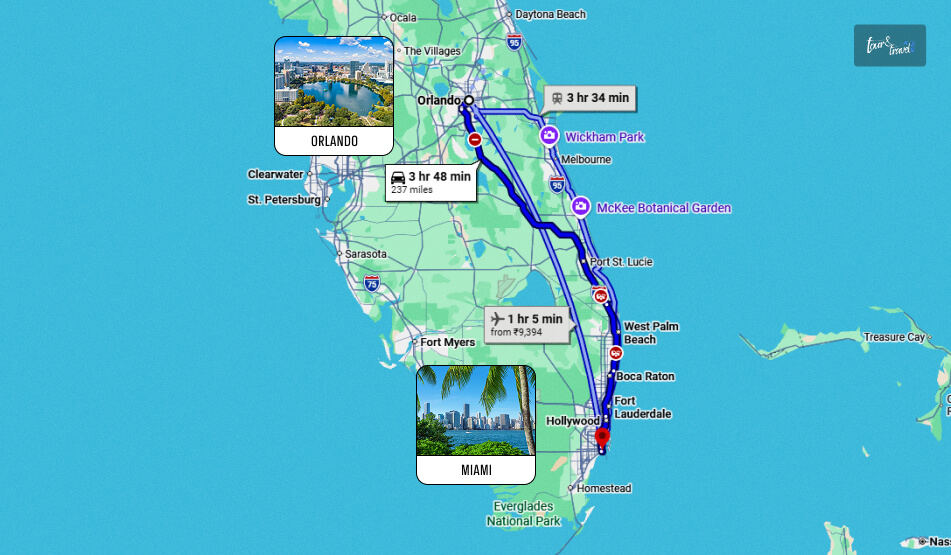
The distance between Orlando and Miami is around 236 miles or 380 kms. Furthermore, the travel time between Orlando and Miami is between 3.5 and 4.5 hours. 

However, the travel time will depend on the mode of transport you choose. So, here is a quick summary. 

Different Modes of Transport From Orlando to MiamiTravel Time
By Car3.5 to 4.5 Hours
By Train3 Hours and 30 Minutes to 7+ Hours
By BusAround 4 to 6 Hours
By Air About 1 Hour

Furthermore, Miami is served by the Miami International Airport, which is around 10 miles away from Miami. 

Moreover, the Orlando International Airport is at a distance of 12 miles. 

So, consider the travel time to and from the airports, which is around 1 hour, including both sides. 

How To Travel To Orlando From Miami? 

How To Travel To Orlando From Miami

The fastest way to travel from Orlando to Miami is by taking a flight. However, you can also travel by train, bus, and car. 

Here are the details. 

1. How Far Is Orlando From Miami By Train?

The travel time between Orlando and Miami by train will depend on the service you take. 

For example, if you take the Brightline Train service, you will travel the distance in about 3 hours and 30 minutes. 

Furthermore, the ticket price will range between $79 and $300 for a one-way ticket. You can also take the shuttle service offered by Brightline to explore the Miami Area. 

Take The Amtrak Trains For The Most Budget-Friendly Travel 

The ticket price for Amtrak Trains is about $35 to $102. Also, private room services are available at $288. 

Check out the departure and arrival timings of the Amtrak train. 

DepartureArrival
7:05 AM12:22 PM
11:05 AM6:34 PM

2. How To Travel From Miami To Orlando By Bus?

RedCoach USA is the main bus service between Miami and Orlando. The travel time between these places is between 3 hours and 40 minutes and 4 hours and 5 minutes. 

Furthermore, the ticket price for this bus ride depends on the day of the week you are traveling. Ticket prices are higher on weekends. 

Moreover, the ticket price ranges between $39.99 and $107.99. 

3. How To Travel From Miami To Orlando By Car?

The car rental price for a one-way journey from Orlando to Miami is between $60 and $110. Furthermore, the leading car rental services on this route are Sixt and Alamo. 

Furthermore, you can take an Uber from Miami to Orlando. The rental cost starts from $317. 

4. Traveling From Miami To Orlando By Air

As I have mentioned, the Miami International Airport, at a distance of around 10 miles, and the Orlando International Airport, 12 miles away, are the two gateways. 

Moreover, American Airlines, Delta, and JetBlue are the main airline services on this route. 

Furthermore, the travel time by flight is around 1 hour, and the ticket price is about $250 to $300. 

How Far Is Orlando From Miami? Frequently Asked Questions (FAQs)

Here are the frequently asked questions and answers about the Orlando to Miami distance. 

1. Is It Better To Drive Or Fly From Orlando To Miami?

The choice of a drive or a flight from Orlando to Miami depends on the kind of experience you want. 
For example, if you are traveling with family and want to keep the itinerary flexible, you can go for a drive. It is also way cheaper than a flight. 
On the other hand, if you want to travel very fast, take a flight, which completes the journey within 1 hour. 

2. What Is The Cheapest Way To Get From Miami To Orlando?

Amtrak train and RedCoach USA buses are the cheapest modes of transportation between Miami and Orlando. 
In both these services, the ticket price starts from around $34-$35.

3. How Much Is Uber From Orlando To Miami?

The price for an Uber ride from Orlando to Miami depends on the type of service you are opting for.
For example, the UberX service costs $317, the Uber Black service costs $671, and the UberXL services are available at $571. 

4. How Far is Orlando To Miami By Plane? 

The Orlando to Miami distance by plane is about an hour. So, if you want to travel quickly, you can take a flight from the Miami International Airport to the Orlando International Airport. 
Furthermore, American Airlines, Delta, and JetBlue offer services on this route, and the ticket price will be about $250. 

5. What Is The Best Time To Travel From Orlando To Miami? 

December to March or the winter season, and March to May or the spring season are the best seasons for a trip from Orlando to Miami. 
Furthermore, 8 AM to 10 AM or 3 PM to 6 PM are the peak hours on this route. So, travel outside these hours. 
Also, mid-week and weekends are the ideal times for a Miami to Orlando journey. 
Moreover, June to November is the Hurricane season. Especially mid-August to mid-September is the most difficult time for a drive from Miami to Orlando. 
In addition, car rental prices are higher on weekends and during peak seasons. So, if you want to save on car rental, choose the mid-week days. 

Share on Social Media

Meet Sibashree Bhattacharya, a travel enthusiast who has a decade-long experience in transcending virtual barriers with her words! Her deep love for travel is apparent from her travel escapades to the mountain, often taking her readers on a journey, her words acting as Portkey! Fun fact: Sibashree loves to dive deep into the history of the places she is about to visit, making her travels even more wholesome. If you were wondering how her articles are not short of time travel, this answers it!

Leave a Reply

Your email address will not be published. Required fields are marked *

title-img Related

READ MORE El Salvadore Beaches

Why Are El Salvadore Beaches So Famous? 

BY  sagnika Apr 3, 2024

Do you want to visit somewhere beachy? Are you planning to go somewhere natural and beautiful? Here, I am creating a list of some of the popular beaches and the benefits of these beaches. Read about El Salvador beaches and how fun they are! I will share the importance of beach tourism and the economy in this article. If you plan to read about some of these beaches of El Salvadore, you can read this article. You will have great fun, especially with diverse activities such as surfing, boating, etc. Furthermore, you can read about black sand beaches in El Salvadore and how they benefit tourism. Why Are El Salvadore Beaches So Famous? Why is El Salvador so famous? Here, I am sharing with you why these beaches are so popular. One of the major reasons they are well known is the black sand beaches! The black sand beaches have turquoise water, which creates a beautiful vibe for visitors. If you are ready for some amazing adventures, read this article to learn more about the beaches of El Salvador. You can also learn about the benefits and drawbacks of visiting the beaches. Read in detail the stunning visuals that take your breath away! Pack your bag, and let's visit the beautiful beaches of El Salvador. You will experience the tastiest of seafood and lovely locales, and you will see the best waves! Popular Beaches In El Salvador Beaches! El Salvador is called the Land of Volcanoes! The beaches are the best because of the volcanic activities of El Salvador. The beaches have massive waves and rick black sand, creating perfect picturesque palms. Playa El Tunco If you visit El Tunco beach, be careful of the rocks as they are not the best for swimming. However, it is beautiful, with an amazing sunset view and delicious food and drinks from restaurants in the fun little village. The black sand on the beach sparkles in the sun, creating a perfect visual! The food and transportation are quite affordable! The place could be more public, so you can enjoy the beautiful environment as even the locals come during the weekend. Playa El Sunzal If you are planning to surf, this beach is the perfect option! Filled with adventure activities, this place is magic. The place gives you good vibes along with smiling faces. You can go out with your partner or your friends to enjoy delicious food. The place is safe, and you will not experience any threats. The locals will give you the sweetest behavior and share positive energy, making visitors comfortable. Playa El Zonte Are you someone who visits beaches to experience the party scenes? However, apart from a party, are you someone who is looking for a chill atmosphere? Here, we are to share why Playa El Zonte is the perfect place for you. Let's not forget about the black sand. There are sea caves; imagine the adventure! The beach is perfect for surfing, with several shops and accommodation nearby. You will get amazing Salvadorian food with rice, beans, fried plantains, bread, cheese and eggs. Playa El Cuco The beach El Cuco sports a few bars that offer beautiful experiences to visitors. It is an eco-resort which caters to all nationalities and has a diverse budget. At times, the beach is mostly deserted. Hence, swimming will give you a relaxing experience. Benefits Of El Salvador Beaches So, are you someone who lists all the benefits you will experience when visiting a place? I'd like to know about some of the best aspects of El Salvador beaches, and I will share them all. These beaches are significant tourism revenue earners that lead to job opportunities. During high downpours, you can go through surfing programs from beaches such as La Libertad, El Tunco, and others. When you visit these beaches, you will see that the environment around the beaches is beautiful, and people are encouraged to forest conservation. You can take the trails for hiking! Even the authorities and the public are putting efforts into protecting these beaches. When you visit these beaches, you can experience local traditions! There is a cultural exchange as they promote the local traditions accordingly with all tourists. Events and festivals such as Balls of Fire Festival and Fiestas Agostinas help cultural exchange and bonding. If you visit these beaches, do not worry about your health and well-being! Medical tourism is well-developed as it creates a personalized care system for all visitors. Both domestic and international tourists can access hospitals and clinics for treatment! Challenges And Solutions There are a few challenges when traveling to El Salvador to visit the beautiful beaches, which you must consider! This is important because there are a few concerns, such as the security and well-being of the visitors, infrastructure, and waste management. On the Pacific coast of El Salvador, there are some dangerous conditions, such as strong currents and undertows, which can be difficult for swimmers, even for experienced individuals. The search and rescue capabilities are restricted because El Salvador has no lifeguards. Pollution And Waste Management With the increasing number of beach visitors, pollution is a common aspect that must be treated daily. Suppose the government of El Salvador needs to maintain waste management effectively. Even locals are involved in the cleanliness program! The quality of life is improved with the integration of safe tourism. The nation is poverty-stricken and is struggling to approach a better future. It can only happen when gang culture is completely diminished!  Infrastructure Development The U.N. has announced the risks related to El Salvador's infrastructure! The government is working hard to create an infrastructure that will be supportive and developmental in the future. As an authority, El Salvador is working hard as the country's leader; President Nayib Bukele is trying to decrease gang violence. Apart from this, he is also trying to promote surf tourism in El Salvador. Therefore, 200 businesses and 50,000 jobs were created. Hence, it helps individuals come out of gang life! Safety And Security El Salvator is an active gang-violence area. Hence, young children are often influenced by gangs! With 23% of the population of Salvador living in poverty, a lot of individuals choose gang life, thus following gang traditions and sadistic rules and rites of passage. There is a possibility of visitors being attacked by gang members, especially teenagers. At a very young age, these individuals are influenced by the gang, and thus, there are risks! Finishing Off...   El Salvador beaches are a beauty of this world; however, visiting them can be difficult because of the risks. El Salvador is popular because of the black sand beaches, so why don't you decide to see the beautiful locales? Tourism is one of the significant ways of earning money; thus, the economy of the place is dependent on it. The economy of surf tourism supports the local culture and community. Comment on when you plan to visit the El Salvador beaches and your itinerary! You May Also Like: Top 10 Best Beaches In Florida 10 Best Nude Beaches In The World

READ MORE Essential Safety Supplies To Pack On Your Backpacking Trip

Essential Safety Supplies To Pack On Your Backpacking Trip

BY  Nabamita Feb 3, 2024

Embarking on a backpacking trip can be an exhilarating experience, immersing yourself in nature's beauty and embracing the wilderness. However, safety should always remain a top priority amidst the excitement of exploration. Whether you're a seasoned backpacker or a novice venturing into the great outdoors, the injury lawyers in Chicago note that packing the right safety supplies for any situation can make all the difference in ensuring a smooth and secure journey. If you are wondering what the essentials that should be in your travel backpack are, we have you covered! Here's a comprehensive guide to essential safety supplies that should be in your backpack before hitting the trails. Backpacking TripPack Rightly: Things You Must Include In Your Backpacking Trip Ready to explore the sky-pointing peaks? Make sure to pack all the essential items, or you can ruin your entire journey. Given below are a few essential things you must never forget on your travel backpack. Check them out: First Aid Kit A well-stocked first aid kit is non-negotiable for any backpacking excursion. It should include bandages, adhesive tape, gauze pads, antiseptic wipes, tweezers, scissors, pain relievers, blister treatment, and any personal medications you may need. It is recommended that your kit be based on the length and location of your trip, ensuring you're prepared to handle common injuries and ailments that may arise on the trail. Navigation Tools Getting lost in the wilderness can quickly turn a thrilling adventure into a nightmare. Always carry reliable navigation tools such as a map, compass, or GPS device, and make sure you know how to use them effectively. Familiarize yourself with the terrain and plan your route to minimize the risk of getting off track. Emergency Shelter Unforeseen circumstances like sudden changes in weather or unexpected delays can leave you stranded outdoors. Pack lightweight emergency shelter options such as a tent footprint, emergency bivvy, or space blanket to provide protection from the elements and retain body heat in case you need to spend an unexpected night in the wilderness. Fire Starter Kit Fire can be a lifesaving resource in survival situations, providing warmth, light, and a means to cook food. Pack waterproof matches, a lighter, or a fire starter tool to ensure you can easily ignite a flame even in damp conditions. Additionally, carry some fire accelerants like cotton balls soaked in petroleum jelly for reliable fire starting. Water Purification System Access to clean water is vital for staying hydrated and healthy during your backpacking trip. Invest in a reliable water purification system such as a portable water filter, water purification tablets, or a UV water purifier to treat water from natural sources like streams and lakes safely. Avoid drinking untreated water to prevent waterborne illnesses. Multi-Tool A multi-tool is a versatile gadget that combines several essential tools into one compact package. Opt for a quality multi-tool that includes features like a knife, scissors, screwdriver, pliers, and bottle opener. Products like the Microtech Ultratech knives can come in handy for various tasks, from preparing food to hard use. Therefore, these qualities automatically make such a tool an indispensable item for any backpacker. Emergency Communication Device In remote wilderness areas, cell phone reception may need to be more reliable and present, making it challenging to call for help in case of an emergency. Carry an emergency communication device such as a satellite phone, personal locator beacon (PLB), or two-way radio to summon assistance if you encounter a serious injury or other life-threatening situations. Sun Protection For Your Backpacking Trip Exposure to the sun's harmful rays can lead to sunburn, heat exhaustion, and dehydration, particularly at higher altitudes. Do not forget to carry some essential sun protection products like sunscreen that carries a high SPF rating, sunglasses with UV protection, a broadly-brimmed hat, and lightweight clothing that covers your skin to shield yourself from the sun's intense glare. Insect Repellent Insect bites and stings can not only be irritating but also carry the risk of transmitting diseases such as Lyme disease or West Nile virus. Apply insect repellent containing DEET or picaridin to exposed skin and clothing to ward off mosquitoes, ticks, flies, and other pesky bugs that inhabit outdoor environments. Emergency Whistle In situations where verbal communication may be difficult or impossible, an emergency whistle can serve as a simple yet effective signaling device to attract attention and alert others to your presence. Keep it easily accessible on your backpack or person, and use short bursts to signal for help if needed. Read Also: The Ultimate Guide To Hassle-Free Sightseeing In Rome How To Choose The Right Backpack For Your Trip? When it comes to choosing the right backpacking trip, two things have to be considered. First is its fit, and second is its volume. I know you got the least idea when I said this. That’s why here is a brief idea about how to pick the right backpack: Fit As functional as a backpack should be, it must be comfortable, too. And it all begins with a proper fit. Various packs come in either two or three sizes, thus indicating the pack’s length. Do not forget to visit your local store and enquire about the different fit they are providing. Volume  Secondly, your backpack’s volume should be large enough so that it can hold everything you carry. However, don’t buy something extravagant and carry unnecessary weight. Backpacking carryons are usually measured in terms of liters, so be sure to pack something only in the range of 40-70 liters. Parting Thoughts While the allure of the wilderness beckons with its promise of adventure and exploration, it's essential to prioritize safety when venturing into the great outdoors. By packing these essential safety supplies on your backpacking trip, you'll be better prepared to handle emergencies, navigate challenging terrain, and enjoy a memorable outdoor experience with peace of mind. Remember, preparation is key, so take the time to plan and pack accordingly before setting out on your next backpacking adventure. That was all about packing the important supplies for your backpacking trip and ensuring a seamless journey. Comment your thoughts below and tell us what you think about it. Thank you for reading! Read More: How to Choose A Backpack 10 Best Places To Visit In Europe Top 3-Week Itineraries For A Perfect Tour Of Europe

READ MORE Tucumán nature guide

Tucumán Nature Guide: Exploring The Yungas Rainforest And High Andes

BY  Sibashree Jan 14, 2026

You think of the nature resorts, the famous wine tours, hiking, and birdwatching when we talk about exploring Tucumán. However, Tucumán has recently also emerged as an astrotourism hotspot.  The Ampimpa Astronomical Observatory in the Calchaquí Valleys of Tucumán is at the epicenter of this happening astrotourism scenario.  Now, this is an added feather to the crown of Tucumán, the smallest province of Argentina. It offers a vertical journey from the jungle to the desert in 50 kms.  Also, the nickname of Tucumán is not just a fancy phrase. It means a biological reality and refers to the historical event of Argentina’s independence from Spain in 1816.  Furthermore, El Jardín de la República, or the Garden of the Republic moniker, goes well with its subtropical climate and the lush landscape.   You guessed it right, as today, this Tucumán nature guide will take you to the Yungas Rainforest and the highlands of the Andes. Also, if you are planning a road trip, you must go through our Tucuman Argentina, itinerary. The Yungas Rainforest (The Green Belt) The Yungas Rainforest is known as the Green Belt, as it is an ecodiverse region. Home to a diverse flora and fauna, the Yungas Rainforest hosts a variety of bromeliads, orchids, and ferns.  Furthermore, among the animals here, you will find tapirs, wild cats, and panthers. You will even spot species such as Yungas Guan while birdwatching in Yungas, Argentina.  Also, it is home to the Campo Los Alisos in Tucumán, which helps to preserve the threatened ecosystem of the Yungas Rainforest region.  Moreover, containing around 50% of the biodiversity of Argentina, parts of the Yungas Rainforest are also marked as UNESCO Biosphere Reserves.  1. Parque Sierra De San Javier View this post on Instagram A post shared by Parque Sierra de San Javier (@parquesierradesanjavierunt) Parque Sierra de San Javier, or the San Javier Mountain Range Park, was established in 1974, and now the National University of Tucumán (UNT) maintains it.  It is one of the top nature reserves in Tucumán, Argentina.  The home to various flora and fauna of Argentina, this park also functions as the green lung by cleaning the air, protecting the watersheds for the city, and regulating the climate.  This park, furthermore, has many beautiful trails. You can enjoy an easy 30-minute jungle walk through the Cascada del Río Noque trail. If you are seeking silence while hiking in San Javier, Tucumán, you can opt for the Sendero Anta Yacu trek.  It is around 25 km west of Tucumán. If you are a budget traveler like me, you can take the Bus No 340 to reach the park.  2. Reserva Experimental Horco Molle View this post on Instagram A post shared by Asociación de Prestadores de Turismo Activo de Tucumán (@aptattucuman) This small but compact nature park is ideal for families. It is home to the tapir and condor rescue projects. It covers 600 acres and is just 15 km from the capital.  Also, it has picnic areas, barbecue areas, and play areas for children.  3. Aconquija National Park: The Untouched Wilderness View this post on Instagram A post shared by Parque Nacional Aconquija (@parquenacionalaconquija) Aconquija National Park, with over 600 species of endemic animals and birds, is the jewel of North America.  Taruca deer, puma, and ocelot are some of the endemic animals living here. In addition, you will find several Incan ruins scattered through the park. The Incan Highway remains, and the “Ciudacita” ruins are part of the UNESCO World Sites.  The Campo de los Aliso near Alpachiri is the main Aconquija National Park entrance. Furthermore, Cochuna is the wilder southern entrance of the Aconquija National Park.  Furthermore, the Mythical Trek of La Ciudacita, the Inca Ruins at 4400 meters, is the main highlight of this national park.   The High Andes & Puna (Tafí del Valle & Beyond) The harsh, cold conditions and a rich wildlife with the presence of vicuñas, flamingos are the highlighting features of the High Andes and Puna, at an altitude of 3000 meters.  This region has critical water resources that support livelihoods such as alpaca and llama. Let’s find out about the major nature reserves of this region.  1. Quebrada De Los Sosa Nature Reserve Take a drive up through Route 307 to find the Quebrada De Los Sosa Nature Reserve, where the jungle meets the clouds.  It is a 30 km-long gorge carved by the Los Sosa River, and it is home to more than 100 bird species.  With a winding pathway, it is also home to the Tafí del Valle. 2. Los Núñorcos & Reserva La Angostura Los Núñorcos, or the Cerro Núñorco mountain and Parque provincial Los Ñuñorcos are the prominent locations for hiking in Tucuman, Argentina.  As you explore the challenging trails here, you will enjoy a beautiful view of the Dique la Angostura lake and the Tafí del Valle. Tafí del Valle also has the Bald Mountain, or the Cerro El Pelao. You can start the trek near the Tafí del Valle center. It is a 1.5-hour-long trek.    Wildlife Watching Calendar In Tucuman, Argentina  Tucuman in Argentina is ideal for wildlife sightings throughout the year. Tafí del Valle and areas around Route 307, especially the best areas for wildlife spotting in Tucumán.  Check out the wildlife watching calendar in Tucuman below. Year-Round Sightings• Mammals: Capybaras, Some Foxes, and South American Sea Lions• Birds: Doves, Hummingbirds, and Toucans Spring (September to November) • Birds: Doves and Hummingbirds • Flowers: Pink Trumpets and Jacaranda treesSummer (December to February) • Mammals: Elephant Seals and Sea Lions• Birds: Penguins in Patagonia and Burrowing ParrotsAutumn (March to May)• Mammals: The Red Deer Rut• Birds: PigeonsWinter (June to August) • Reptiles: Yellow Anacondas• Birds: Waterfowl  What Are The Expert Tips For Hiking In Tucumán?  An entry to the Aconquija National Park is free. However, do you know that you have to register at the ranger station at least 48 hours in advance? It is crucial for the safety of the hikers. For more such insider knowledge, these expert tips will be very handy. 1. Bus #118 Is Your Friend  You don’t have to hire a car to see the jungle and the nature reserves. You can take the 118 bus from San Miguel de Tucumán directly to the foot of the San Javier trails.  The ticket price is even less than $1.  2. Watch The Fog (Neblina) The Fin del Mundo" statue area on route 307 is often the zero-visibility zone. There is dense fog in this area even at around 4 PM. You have to drive the car carefully, and there must be low beams to defeat the fog.  3. Ticks Exist In The Yungas  The lush greenery of the Yungas is ideal for picnics and nature exploration. However, there are ticks. So, you must check your ankles after a hike or use a blanket.  4. Hire A Guide For "La Ciudadacita" Are you planning a 4-day trek to La Ciudacita or the Inca Ruins? You must have a guide because the high altitude path, at an elevation of over 4000 meters, is unmarked. You need technical assistance for the navigation. Moreover, you must contact the Asociación Argentina de Guías de Montaña to hire a guide.  5. The "El Indio" Stop You will find the best dried meat or Charqui at the vendor stalls at the El Indio monument on Route 307. These stalls also have the best local honey.  Stop by these stalls and have the dried meat and honey for a great start to your hike.  6. The Waterfalls In Tucuman Are Seasonal  No Instagram reel will tell you that the waterfalls in Tucuman are seasonal. March to May, or the end of the rainy season, is ideal for visiting these waterfalls.  7. Beware Of The "Mala Mala" Local folklore speaks of the "Mala Mala" spirit in the mountains. Whether you believe it or not, respecting silence in nature is a huge part of the local culture. 8. No Cell Signal Once you pass the "El Indio" monument or enter Aconquija Park, your cell signal dies. Download offline maps (Maps.me or Google Maps) before leaving the city. 9. Condors Fly At Noon If you want to spot Andean Condors, look up between 11 AM and 1 PM when the thermal currents are strongest. They rarely fly early in the morning. Tucumán Nature Guide: Listen To The Authority Voices  Asociación Argentina de Guías de Montaña (AAGM): The Aconquija range is "one of the most undervalued trekking destinations in Argentina," offering Himalayas-like isolation without the crowds. Birding Ecotours (Global Operator) Rio Los Sosa is a prime spot for seeing the "Torrent Duck" (Pato de Torrente), a bird that can swim upstream in raging rapids. La Ruta Natural (Argentine Tourism Ministry) "Ruta de las Yungas" is a key scenic drive, highlighting the importance of driving slowly to spot the crossing fauna like the Corzuela (small deer). Tucumán Nature Guide: Frequently Asked Questions (FAQs) Here are the frequently asked questions and answers about the Tucumán Nature Guide.  1. What Is The Best Time Of Year For Hiking In Tucumán? April to September, or the dry season, is ideal for hiking in Tucuman. The cool temperature is ideal for outdoor exploration. On the other hand, heavy summer rains make the trekking trails here dangerous and muddy.  2. Do I Need To Pay To Enter The Nature Reserves? The entry fee to the national parks depends on the specific administrative and management authority. For example, you don’t need to pay any entry fee for the Aconquija National Park. However, prior registration is crucial. Further, for Reserva Horco Molle, you will have to pay an entry fee of $2.  3. Is It Safe To Hike Alone? Yes, it is safe to hike alone on the well-marked trails of Tucuman, such as the Rio Noque or Funicular. However, if you are going to high-altitude summits or jungle treks, you will need a guide. It is more crucial because of the presence of the fog and the absence of signage.  4. Are There Snakes In The Yungas? Yes, the Yungas have pit vipers or Yarará. So, you wear long trousers and watch your steps. Furthermore, you must follow the trail marks properly to not disturb the habitats of the snakes or other wildlife.  5. How Do I Get To Aconquija National Park Without A car? It is difficult to reach the Aconquija National Park without a car. You have to first take a bus to Concepción and then a local bus to Alpachiri. From Alpachiri, it is another 10 km taxi ride to the park entrance.  6. Can I Camp In The Reserves Of Tucuman? Yes, Aconquija National Park has designated wild camping zones (like Puesto La Mesada). However, Sierra de San Javier does not allow camping. So, it is for day use only. 7. What Is The "Yungas"? The Yungas, or a cloud forest in Tucuman, Argentina, is a mountain rainforest. It functions as a connector between the Andes and the Amazon.It has ferns, moss, and high humidity.  8. Can I See Toucans In Tucuman? Yes, you can see toucans in Tucumán. In recent years, toucans have made a comeback in this region.You can spot them in the trees around San Javier and Horco Molle. 9. What Is Hiking Altitude In Tucuman?  Hiking in Tucumán covers a wide altitude range, from the lows of San Javier (around 600 to 1200 meters) to the moderate Tafí del Valle (2000m). Furthermore, the Aconquija high summits reach more than 5000 meters. 10. Is The Water In The Streams Safe To Drink In Tucuman? No, the water in the Tucuman streams is not drinkable even with a clear view. Cattle graze in the higher areas and thus make the water unsuitable for drinking. So, you have to use purification tablets or a filter for purified drinking water.