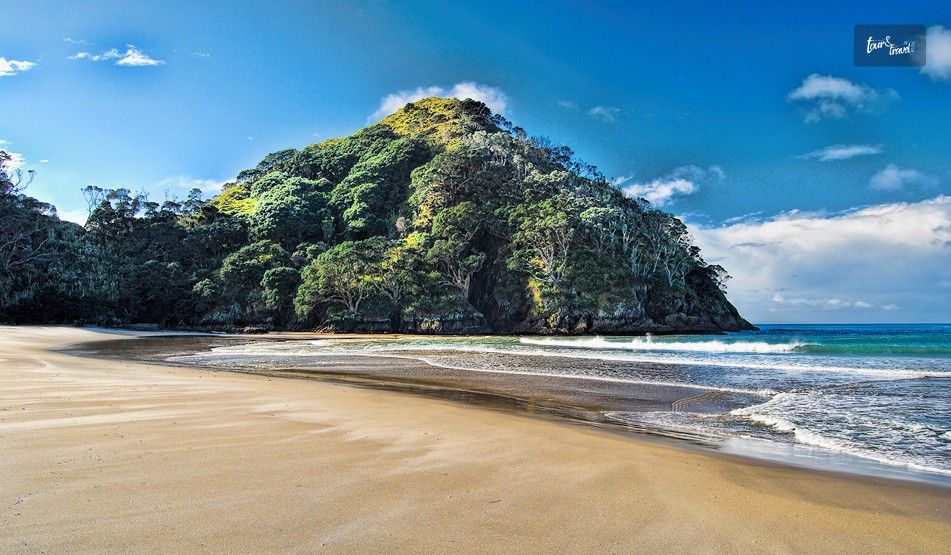
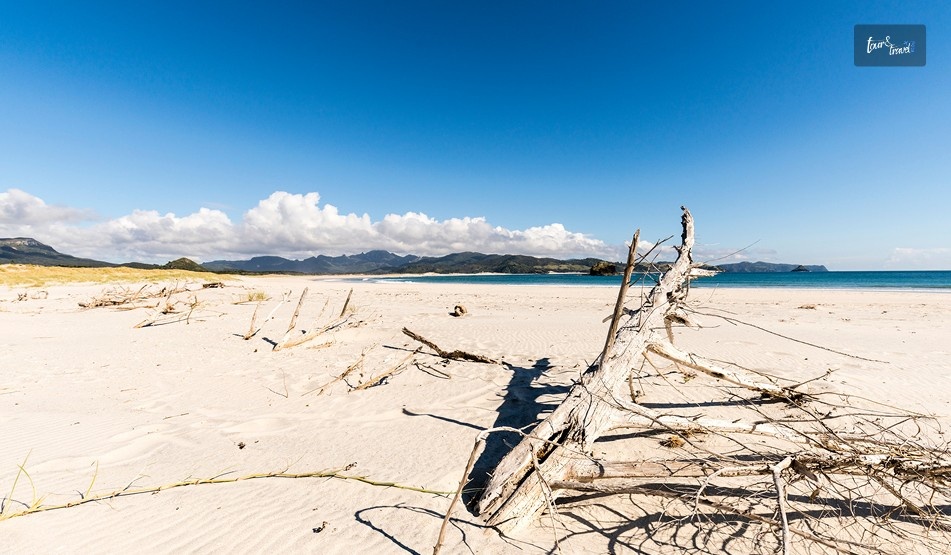
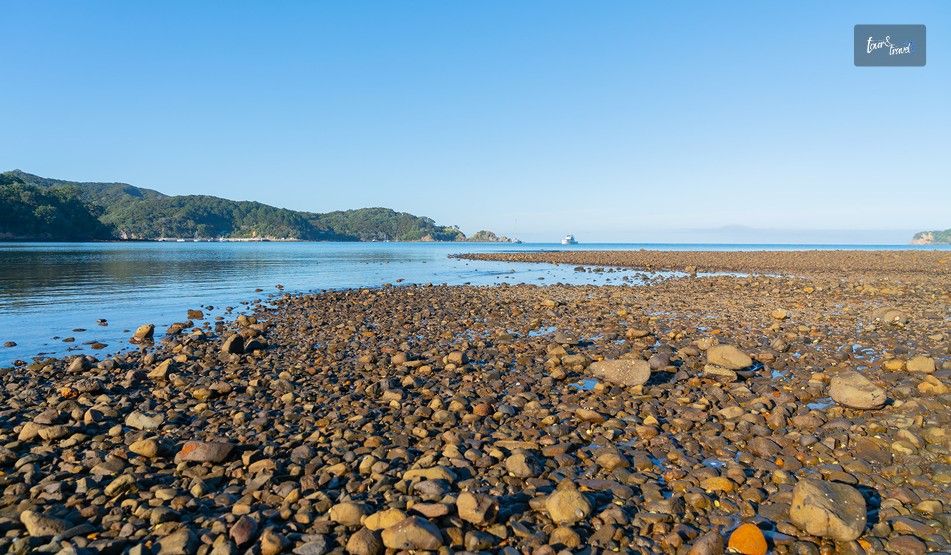
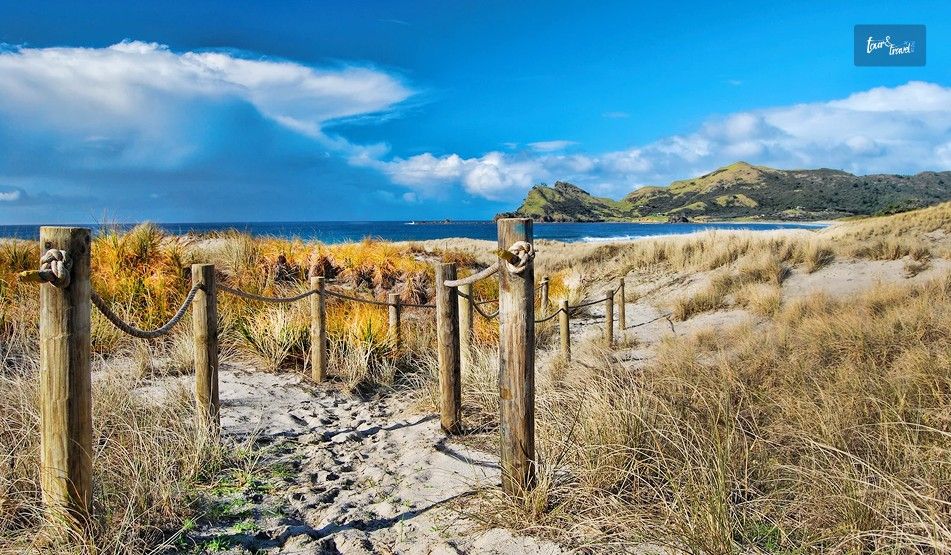
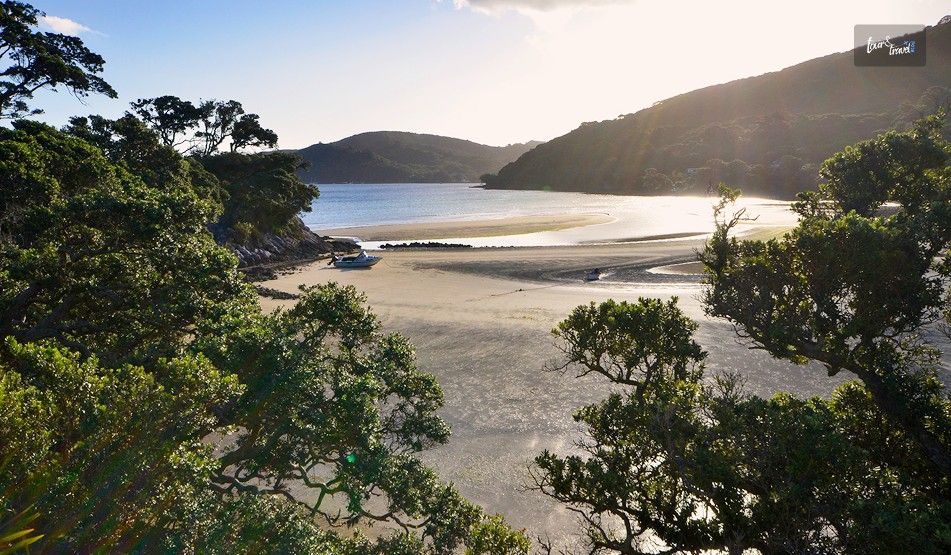
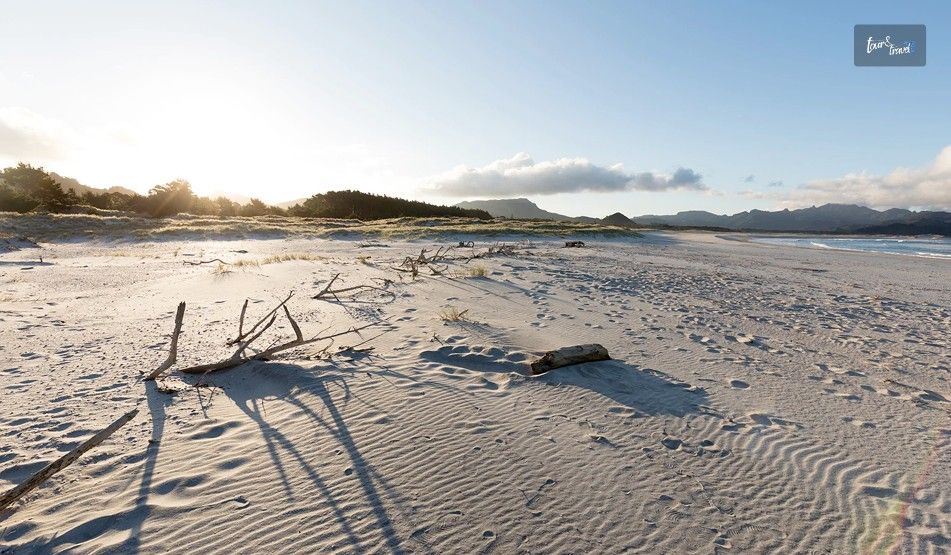


The beaches add to the laid-back vibe and off-the-grid living of the Great Barrier Island, New Zealand. Surfing breaks, boating, canoeing, or just relaxing by the sea, the beaches are ideal for families, surfers, couples, nature seekers, and solo travelers.
Furthermore, it is the largest island of the Hauraki Gulf in the Auckland region, and it has protected the Auckland Harbour from the rampage of the Pacific Ocean and storms. It is now a Dark Sky Sanctuary and a boating paradise.
Also, while exploring the beaches of the Great Barrier Island, I saw a remarkable difference between the eastern and western beaches. The beaches on the eastern side have long white surf beaches and high cliffs. On the other hand, the beaches on the western side are way calmer and have deep, sheltered harbors.
Tryphena, on the southwestern side of the Great Barrier Island, is the largest settlement. The calmer and picturesque beaches of Tryphena are ideal for families. These are also ideal for spotting dolphins.
Whangaparapara Harbour, on the southeastern side, is another important beach location on the Great Barrier Island. I was fortunate enough to meet Tony & Carol Litherland, who have been living on a catamaran here since October 1979.
So, the top beaches to visit on Great Barrier Island, New Zealand, are beyond water and sand. They are the telltales of human history and home to distinct ecosystems.
In this article, I will share the Great Barrier Island beach guide, which will include the top beaches to visit on Great Barrier Island, including hidden gems, pet-friendly spots, and insider tips.
What Are The Top Beaches To Visit On The Great Barrier Island?
The beaches of the Great Barrier Island get transformed into a planetarium after sundown. Being a dark sky sanctuary, it allows us to see the luminous arch of the Milky Way and the constellations.
While Medlands, Awana, and Kaitoke draw the crowds, the secluded beaches are the best for soaking in the real vibe of this nature-first island.
Nevertheless, let’s slip into a kayak and explore secluded coves, surfing beaches, and spot the most fascinating wildlife.
1. Medlands Beach
Medlands Beach is also called Oruawharo Beach, named after the early settler family. It is ideal for surfers, and the Medlands Beach campground is one of the best camping spots on the Great Barrier Island. This campground is maintained by the Department of Conservation (DoC).
It is also home to Oyster catchers and Dotterels. The Medlands ecovision community group works hard to preserve the nesting community of birds here.
Furthermore, I saw many pet parents taking their dogs for a walk along Medlands Beach. The dogs are allowed off-leash at 100 meters south of the Lane Walkway. However, they have to stop at 100 meters north of the creek.
However, for me, the biggest attraction of the Medlands Beach has been the Good Heavens Dark Sky. In my Great Barrier Island travel tips, I have mentioned how the sunset moments were magical, adding to our anticipation for the stargazing moments.
2. Awana Beach
The Awana Beach, on the eastern coast of the Great Barrier Island, is a popular surfing destination. The DoC campground on the northern end is a favorite spot for watching wetland birds.
On our way from Auckland to the Great Barrier Island, we met the long sandy stretch of Kaitoke Beach. Our flight overlooked the Kaitoke beach on its way to the runway.
It is a popular spot for watching hammerhead sharks and sting rays.
4. Whangapoua Beach
Whangapoua Beach is a popular surfing spot, and it stands out thanks to the wonderful views of Rakitu Island and Hirakimata. Furthermore, the Whangapoua DOC campground, on the southern end of the beach, is a favorite of fishing and surfing enthusiasts.
In addition, the Northern end of the beach has the SS Wairaapa grave walkway. The grave has a white picket fence. Another major attraction of the beach is the Whangapoua to Harataonga coastal walkway.
You can reach the beach after a walk through the DoC campground. However, camping here is a little difficult, considering the gravel road leading to the campsite is quite bumpy for RVs and campervans.
6. Blind Bay
Blind Bay, located on the western coast of the Great Barrier Island, is a lot calmer, and it is ideal for family vacations. Located in Okupu, this bay looks beautiful with the presence of magnificent pohutukawa trees.
What I loved the most about Blind Bay was how the dolphins came to the shore of the Okupu. You just need to get into a kayak and take a ride to spot the dolphins.
Furthermore, September to March is the ideal time for spotting Dotterel nests along the shoreline. Dogs are allowed on the Blind Bay. However, you have to keep them on the leash and ensure they only stick to the marked routes.
7. Gooseberry Flat & Pa Beach
The Gooseberry Flat Beach is in the heart of the Great Barrier Island. It is around the corner from the Stonewall Village and the Pa Beach, below the Stonewall Village, is an ideal destination for a quaint boat ride.
However, the headland between these two beaches, featuring the most unique purple stone, is the highlight of this Gooseberry Flat & Pa Beach exploration.
Another fascinating thing on the beach is how sandbars have formed warm pools of water. Kids love to splash around these pools when the tide goes away.
From here, you can go to the southern end and take the walkway over to Mulberry Grove.
8. Mulberry Grove Beach
The Mulberry Grove Beach on the Tryphena harbour is easily accessible. It is ideal for snorkeling, swimming, and boat launching.
Furthermore, the Mulberry Grove store behind the beach, a playground for young children, and the half pipe for skaters are some of the popular attractions of Mulberry Grove Beach.
You can also spot nesting native birds here. Moreover, indulging in an ice cream or fish and chips and watching the Sun go down with your family will be the most delightful moments on the Mulberry Grove Beach.
Camping And Eco Stays Near These Popular Camping Sites In Great Barrier Island, New Zealand
The DoC campsites and eco-friendly lodges are the best options for staying near these beaches.
What Are The Best Beaches For Photography And Drone Footage?
Kaitoke Beach is the ideal destination for sunrise photography. The beaches suitable for sunset photography are Blind Bay, Tryphena Bay, and Medlands Beach.
For drone photography during golden hours, use ND filters. Also, respect the privacy of the designated zones and ensure that flying birds are not harmed by flying drones.
What Is The Family-Friendly Beach Guide?
Harataonga and Gooseberry Flat are the best options if you are on holiday on the Great Barrier Island with your family. These have shared areas, picnic tables, and toilets.
When exploring the family-friendly beaches of the Great Barrier Island, you will have to bring reef shoes, especially for hiking in the rocky areas. Moreover, determine the child safety zones by monitoring the tides.
What Are The Hidden Beaches And Local Secrets Of The Great Barrier Island?
Yes, Kaitoke, Medlands, and Awana are the best crowd pullers of the Great Barrier Island. However, as I talked to the locals, they suggested some really cool hidden gems. These, with their unkempt beauty, helped us connect to the wild spirit of Aotea.
1. Puriri Bay
North of the Tryphena Harbour, Puriri Bay is a quiet beach with a rocky shoreline. The low tide makes pockets of dark sand on the shore.
Puriri Bay is also famous for spotting dolphins in the summer season.
2. Schooner Bay
Schooner Bay is another hidden gem near Tryphena. Visiting Schooner Bay is a bit of adventure and fun at the same time. You have to pass through a winding road to reach this spot.
It is a favorite for stargazers and couples, and with a cliffside landscape, it is one of the quietest beaches in the Great Barrier Island, New Zealand. The silence here is so powerful that the experience is almost spiritual.
3. Nagle’s Cove
Nagle’s Cove is on the Northwest coast near Orama and Kawa. Framed by native bush and volcanic ridges, it exudes a remote and pristine vibe. You have to access it via a kayak or a boat, as there is no marked trail.
In addition, Motairehe Marae, affiliated with Ngātiwai Ki Aotea, is an important community center for weddings, social celebrations, and funerals.
Why These Hidden Beaches Are The Attractions You Must Not Miss?
The hidden beaches of Great Barrier Island are beyond scenic. As cultural treasures or cultural taonga of the Great Barrier Island, New Zealand, they stand for the off-the-grid lifestyle.
They are also the telltale signs of the Māori heritage, and community spirit. To respect the local heritage and culture, you must stick to the following practices.
Avoiding Nesting Bird Zones
Leaving No Trace
Staying on the Marked Path
Cooperating with Biosecurity Measures
How To Explore These Hidden Beaches On The Great Barrier Island?
Renting an electric bike or a 4WD is the best way to explore the hidden beaches on the Great Barrier Island. Also, as always, it is best to take suggestions from the locals and cafe owners.
They can guide you to the best unnamed spots and directions where Google Maps fails or the network is unavailable.
Also, it’s unfortunate that we could not meet Benny Bellerby during our trip. But, he is like a wizard of the conservation process and stargazing on the Great Barrier Island. He is the adventure operator of Star Treks and is the most passionate about protecting the cultural and natural heritage of the island.
In addition, I have already mentioned Tony & Carol Litherland, who live on a catamaran on the Whangaparapara Harbour, epitomizing the signature hospitality of Great Barrier Island, New Zealand.
What Are The Adventure Add-Ons Near These Beaches Of The Great Barrier Island?
Glenfern Sanctuary, Windy Canyon, and the Kaitoke Hot Spring are the attractions near the beaches of the Great Barrier Island.
1. Glenfern Sanctuary
Glenfern Sanctuary opens your door to the Kotuku Peninsula. It is located in the northwest of Great Barrier Island, and it takes us through nearby walking tracks such as the Cooper’s Castle Track. Aotea Track and Old Lady Track.
Furthermore, it is a must-visit to experience how biosecurity and the endeavors to protect the endangered plants, animals, and birds are essential for the Great Barrier Island.
2. Windy Canyon
Windy Canyon and the Palmers Track, which continued from there, is one of the most picturesque hiking routes on the Great Barrier Island.
Along with being the route to Mount Hobson, it is also home to many rare species, such as black petrel and tomtit. Moreover, North Island robins are being reintroduced on this route. So, it is a wholesome hiking and birdwatching experience.
3. Kaitoke Hot Springs
The walk to the sulphurous Kaitoke Hot Springs continues along the edge of the Kaitoke Swamp. It is one of the most accessible tracks with pushchairs, and the walk through the ancient shoreline continues through the Kaitoke wetlands and kānuka forest.
Furthermore, the umbrella fern and orchids near the creek keep the path filled with colors. Also, a nature soak after a long beach day feels very refreshing.
What Are The Best Conservation And Safety Tips?
Aotea is not just a scenic destination. It’s a culturally rich and ecologically sensitive island with deep Māori heritage and a close-knit community. Respecting local customs and beach etiquette is essential for a positive experience and responsible tourism.
1. Respecting The Maori Heritage And Sacred Sites
Avoid trespassing on private land or areas marked as tapu (sacred).
Do not touch or move carvings, stones, or natural markers, as they may hold spiritual significance.
Ask before photographing people or cultural sites, especially near marae (Māori meeting grounds).
Learn basic greetings like “Kia ora” and show appreciation for local stories and traditions.
2. Being Mindful With Pets
There are designated on-leash and off-leash areas on the Great Barrier Island, New Zealand. Furthermore, walking with the pets through the bird nesting areas, especially in the breeding season, is an absolute No-No.
Furthermore, after hiking, you have to clean your pet to stop soil transfer and prevent the resurgence of the Kauri Dieback disease. Proper disposal of the pets is also very important.
Moreover, you must be aware of the conservation and pet policies of the ferries and accommodations before taking them as your companions.
3. Leaving No Trace
The Great Barrier Island does not have strategically placed dustbins. So, you will have to pack and carry all the biodegradable items, food scraps, and rubbish, especially when you are hiking and camping.
There is a dumping ground at Claris Landfill PDS at 70 Gray Road for cleaning the campervans and caravans. In addition, you cannot use detergent or soap when swimming on the beaches, as the practice can impact the marine life.
Moreover, staying on the marked trails while hiking is necessary to ensure protection of the flora and fauna from the Kauri Dieback Disease.
4. Respecting The Peace And Privacy
If you are staying in eco lodges or near the residential areas, you have to keep your noise level in check, and you cannot play loud music. You have to be more mindful, especially when camping on the beaches.
In addition, be careful when using drones near the sacred sites and wildlife of the Great Barrier Island. You may need permission from local authorities for the same.
5. Being Safe During Swimming And Other Water Activities
We could rarely find a lifeguard on the beaches of Aotea. Still, the western beaches of the Great Barrier Island are calmer and suitable for swimming. Also, you have to ensure that you are not blocking the surfing zones.
Stingrays and Jellyfish are common in the shallow waters of the Tryphena Harbour. So, be careful when swimming.
6. Supporting Local Sustainability Efforts
We can support the local economy of the Great Barrier Island by shopping at the shops and businesses owned by the Island. Furthermore, you can protect marine life by wearing a reef-safe sunscreen.
Also, participate in beach cleanups and local cleanup activities. In addition, stick to the water conservation rules of the Great Barrier Island, as the supply of fresh drinking water is limited on the island.
7. Ask, Listen, And Learn
You cannot know the Great Barrier Island unless you are talking to the locals. The island is the cradle of the incredible Maori heritage, and it is them who told us about Kupe, the mythical navigator and one of the first people to arrive on the Great Barrier Island.
The Okupu settlement or Ō-Kupe-Mai-Tawhiti is named after him.
8. Transport Tips
Take a Barrier Air flight from Auckland to reach the Great Barrier Island in New Zealand. You can even take a SeaLink ferry and reach the Great Barrier Island from Auckland in 4.5 hours.
Also, once you reach the Great Barrier Island, you will have to rent a car, e-bike, or scooter to move across the rugged landscape of the island.
9. Embracing Local Culture
Off-the-grid living is the essence of the Aotea Great Barrier Island, New Zealand. So, you will not find any banks or ATMs on the island.
You will have to pay by EFTPOS or credit card. However, sometimes the local businesses may refuse to take cards. So, carry enough cash to support your stay and other expenses on the Great Barrier Island.
Why The Beaches Of The Great Barrier Island Will Be On Your Bucket List?
Are you chasing waves, or are you seeking solitude and moments of introspection by the waters? The beaches of Great Barrier Island are ideal for both types of experiences. Add to that the rugged landscape and rich flora and fauna of the Great Barrier Island.
Before you plan your trip, you can read this Great Barrier Island beach guide to experience the magic of Aotea.
Meet Sibashree Bhattacharya, a travel enthusiast who has a decade-long experience in transcending virtual barriers with her words! Her deep love for travel is apparent from her travel escapades to the mountain, often taking her readers on a journey, her words acting as Portkey! Fun fact: Sibashree loves to dive deep into the history of the places she is about to visit, making her travels even more wholesome. If you were wondering how her articles are not short of time travel, this answers it!
Houston provides its visitors with a refined assortment of places to unwind after a busy day of sightseeing, regardless of whether they are in the city for business or pleasure. And may we offer location as a tried-and-true starting point if you're unsure of even where to start your search?
These hotels, which provide amenities and experiences to enhance your stay, have shaped the distinct personalities of each area of The Space City. Read on for our list of the best hotels in Houston, which includes the trendiest new hotels in downtown, accommodations close to the Astros stadium, and hip neighborhoods like Montrose.
Best Hotels In Houston
Here are some of the best hotels in Houston that you simple can't miss:
Four Seasons
Entering the Four Seasons is akin to entering a private club that has been in existence for a very long time. The interior, which is entirely composed of marble and mahogany, successfully blends traditional and contemporary Texas design elements. The hotel is incredibly kid-friendly, offering activities like mommy-and-me yoga, movies by the pool, and pizza-making classes.
The recently renovated gym is open 24 hours a day. The Four Seasons is the best hotel in The Bayou City with regards to staff, amenities, and accommodations, so it makes sense that business travelers frequent this prime downtown location that is only a short distance from the convention center.
Post Oak Hotel
Billionaire and businessman Tilman Fertitta of Houston put his heart and soul into creating the 250-room Post Oak Hotel. He filled it with hundreds of original artworks and meticulously crafted each element, down to the custom chocolates served at turndown and the flip-flops at the pool with the hotel's logo emblazoned on them. A few people exclaimed, "It is by far the most beautiful hotel I've visited," and "the finest in luxury living."
Nevertheless, readers gave the "first-class" service the most appreciation. One person remarked, "You are treated like a VIP guest from the moment you walk in." One more person described a "unforgettable experience" that can only be had with five-star accommodations: “They upgraded my room at no additional charge — and service was above and beyond my expectations.”
Lancaster Hotel
The famed Lancaster Hotel in Houston is redefining contemporary hospitality. The Lancaster emanates a cozy, classic elegance, from its collection of more than 200 pieces by well-known contemporary Texans to its prime location in the center of the city's renowned Theater District. The historic boutique hotel from the 1920s era was recently voted Houston's best hotel by Conde Nast Readers.
It has a rich history of serving a diverse and illustrious clientele that includes writers, poets, actors, musicians, dancers, business and leisure travelers, newlyweds, circus and rodeo performers, and even a horse. The Lancaster Hotel would be delighted to have the chance to treat you to our special brand of hospitality and service.
Hotel ZaZa
Nestled near the Houston Museum of Fine Art, Hotel ZaZa is an elegant and seductive venue that seamlessly blends business and pleasure. One of ZaZa's so-called Concept Suites, the Houston We Have a Problem suite, goes all out with a moon-inspired couch and a life-size astronaut statue dominating one corner. The room is enormous—it is over 1,000 square feet—and has a large executive-style table that can accommodate up to eight people.
ZaSpa's Have No Mercy deep-tissue massage is to die for, and the fitness machines have individual TVs (hallelujah); an extensive poolside menu offers adult popsicles and drinks by the pitcher. Meanwhile, the restaurant's terrace offers good views of the Mecom Foundation and the Museum of Fine Arts, drawing a mix of locals and hotel guests.
St. Regis
The opulent St. Regis, which is sandwiched between The Galleria and the affluent River Oaks neighborhood, resembles a glitzy high-rise condominium. Junior suites feature floor to ceiling windows overlooking River Oaks and the pool, as well as a separate sleeping area. No, this isn't your normal Houston hotel; the bathrooms are appointed with marble and granite, and the king-size beds have pillow tops. Observe that The St. Regis, wherever it may be, has a long-standing tradition of serving afternoon tea.
JW Marriott
Situated in one of Houston's most popular business districts, the JW Marriott draws a discerning clientele of business travelers looking for first-rate amenities and service without the fuss that boutique hotels sometimes bring. The rooms are remarkably modern and roomy, with free wifi, an iPad for booking spa treatments or ordering room service, and Nespresso machines as amenities. The Spa by JW provides a variety of intriguing treatments, such as massages, facials, and foot soaks.
How Hotels Are Judged?
Readers are asked to rank their favorite hotels, resorts, cities, islands, cruise ships, spas, airlines, and more. The 2023 survey was completed by nearly 165,000 readers, a nearly 25% increase over pre-pandemic voting levels. Across more than 8,500 distinct properties (hotels, cities, cruise lines, etc.), more than 685,000 votes were cast.
Based on their location and amenities, hotels were categorized as either safari lodges, city hotels, or resort hotels. They were also evaluated according to the following criteria:
Rooms/facilities
Location
Service
Food
Value
Respondents could select an option for excellent, above average, average, below average, or poor for each characteristic. These responses are averaged to determine the final scores.
Wrapping Up
Located in the center of Houston, Texas, and only a short distance from Discovery Green Park and the George R. Brown Convention Center, the Marriott Marquis boasts an outdoor pool that is open year-round and a lazy river shaped like a Texas. The hotel has a 24-hour fitness center, a full-service spa, and six restaurants on the premises.
A flat-screen TV with premium channels and cable is provided in every room. There is a refrigerator, coffee maker, and ironing facilities available. A hair dryer and complimentary toiletries are provided in the private bathroom. A few rooms offer views of Discovery Green Park or the lazy river.
Diners can choose to eat at Biggio's, which serves American cuisine, or at Xochi, which serves Mexican food and drinks under the direction of award-winning chef Hugo Ortega. Around 200 varieties of wine and tapas are served at Cueva Wine Bar. Walker Street Kitchen and Texas T Coffee House both serve breakfast.
The Marriott Marquis Houston is only 250 meters from Minute Maid Park, which is home to the Houston Astros baseball team. It takes five minutes to walk to Toyota Center and BBVA Compass Stadium. William P. Hobby International Airport is the closest airport, located 15 kilometers away.
Read Also:
Luxe Living: The Best Hotels In Dallas
Sin City Stays: Here Are The Best Hotels In Vegas!
Taste Of Houston: A Culinary Adventure In Diversity
Pigeon Forge is a scenic refuge that effortlessly blends natural tranquility with vibrant entertainment. This charming Tennessee town is an ideal spot for a weekend getaway. The ease of access and well-maintained roads ensure your journey is as pleasurable as your stay.
Pigeon Forge is jam-packed with weekend activities like exhilarating rides at Dollywood, serene trails in the neighboring Great Smoky Mountains National Park, and luxury shopping at The Island. The town extends a warm invitation to you to pause from the every day and smell the fresh mountain air. Arrange your itinerary with these things to do in Pigeon Forge for thrills and an outstanding weekend escapade!
Arriving In Pigeon Forge
Journeying through Pigeon Forge is a visual treat. As you navigate the winding roads, each turn reveals the Smoky Mountains' grandeur. The lush greenery and the soft murmur of the Little Pigeon River escort you through a rustic expedition. The appearance of quaint cabins in the morning mist signals your arrival into this enchanting town.
Pigeon Forge truly extends itself when it comes to lodging options that are ready to cater to your varied preferences and budgets. Seeking a cozy retreat? Visit Hearthside Cabin Rentals for rustic cabins that blend modern comfort with a charming old-world ambiance. On the flip side, if you are looking for a touch of luxury, Pigeon Forge doesn't disappoint. Luxurious resorts like Oak Haven Resort & Spa offer plush accommodations and indulgent amenities. From rejuvenating spas to gourmet dining, they ensure a lavish and comforting stay.
Day One: Immerse In Natural Beauty
As dawn breaks, Pigeon Forge's alarm is the sweet tune of nature. Begin your morning at a local eatery, where the scents of fresh coffee complement the hearty offerings of a Tennessee traditional breakfast. The friendly chatter of locals at spots like Reagan's House of Pancakes or the Old Mill Restaurant adds a warm touch to your hearty meal. French toast, sizzling bacon, and fluffy biscuits are ready to fuel your adventure!
Next, prepare to hit the trails of the Great Smoky Mountains. The nearby Great Smoky Mountains National Park opens up a world of tranquil hiking trails and nature walks. Every step along these paths brings you more in tune with nature. The sounds of bird songs, rustling leaves, and bubbling brooks are a gentle reminder of the world outside the urban hustle.
The afternoon provides a chance for a scenic picnic. Places like Cades Cove offer stunning panoramic views for a leisurely meal. As you lay out your picnic blanket, the vast expanse of rolling hills creates a surreal setting. The hours gently roll by with each moment spent in the unspoiled beauty of the hills and meadows near Pigeon Forge.
As dusk arrives, head to the neighboring town of Gatlinburg for a satisfying meal at a cozy mountain-side diner. Restaurants like the Cliff Top Grill at Anakeesta offer a menu as attractive as the panoramic views from your table. Post dinner, enjoy watching the sunset from places like the Gatlinburg Space Needle or Gatlinburg SkyLift Park. The setting sun painting the sky and sinking behind the endless ridges is the perfect way to end your day.
Day Two: Adventure And Entertainment
Day two promises even more Pigeon Forge adventures. Start the morning at a famed local bakery, like The Donut Friar, where the aroma of fresh croissants and cinnamon twists sets a cheerful tone for the day. After some donuts and a hot cup of coffee, you're fueled up for a heart-pounding adventure at Dollywood. This iconic amusement park symbolizes the spirit of Pigeon Forge. The exhilarating rides and the echoing laughter are infectious. If you fancy a different kind of amusement park, venture out to the Rocky Top Mountain Coaster or Rowdy Bear Mountain in Pigeon Forge. Both are guaranteed to add excitement to your day.
Afternoon Shopping And Exploration
How about a leisurely stroll in the warm glow of the afternoon sun? The Island in Pigeon Forge offers a captivating blend of retail, dining, and entertainment. The water fountains and the moving crowd provide a lively backdrop as you pop into quaint boutiques and specialty shops.
Make your next stop at The Village Shops in Gatlinburg. This "European hamlet" is a charming reconstruction of an old-world village. Its cobbled walkways lead you to a collection of unique shops where you'll find hand-crafted gifts, local artwork, and delightful souvenirs.
Evening Of Leisure
Once the daylight transitions to a soft evening glow, it's time to satisfy your appetite with a heartwarming dinner at one of the local eateries. Many of them offer live music. You could also attend one of the famed dinner shows like Dolly Parton's Stampede. The blend of music, food, and theatrical performances is an exhilarating yet satisfying way to close out your day.
Day Three: Relax And Reflect
Enjoy a relaxing day of reflection in Pigeon Forge as your weekend comes to an end. Begin with a late morning brunch at the Local Goat, where the freshest ingredients, international wine selection, and large HDTVs bring the whole family together.
After brunch, visit a local spa or wellness center. The Spa at RiverStone Resort comes highly recommended. The gentle aroma of essential oils and the skilled hands of massage therapists work together to melt away any stress and rejuvenate your spirit.
In the evening, find a secluded location along Little Pigeon River and listen to the gentle hum of the water flowing over the rocks. The soft rustle of leaves and the occasional chirp of birds create a delightful serenade that will drift in your memory for many nights to come.
In Conclusion
Each day in Pigeon Forge reads like a new chapter, whether it's the peaceful nature walks, the heart-pounding amusement parks, or the wellness retreats. The blend of beauty and excitement creates memories that stay with you long after you depart. The weekend may have whisked by, but the thrill of new discoveries urges you to plan your next Pigeon Forge getaway. So, if you seek a simple break from the daily grind, Pigeon Forge invites you to create lasting memories in the backdrop of the Smoky Mountains.
Read Also:
10 Best Things To Do In San Diego (USA)
Cooking In Dublin: 7 Restaurants To Dine In With Your Family
The Ultimate Guide To Travelling When You Have No Money
Make Your Honeymoon A Truly Memorable Affair: Here’s How
High in the mountains, Grand Teton National Park in Wyoming harbors a great ecosystem for wildlife viewing. It is just south of Yellowstone, another great destination for exploring diverse wildlife.
Further, as you indulge in the exotic beauty of the Teton Mountain Range and the Snake River, you will meet bison, bears, mountain lions, red squirrels, and even wolves. It is also home to the most colorful western tanager, bald eagles, and many other adorable birds.
Are you charmed by the stealthy nature of reptiles and vipers? You can find garter snakes and rubber boa snakes here.
Fascinating! Isn’t it? Let me share a complete overview of wildlife at Grand Teton National Park.
Don’t Miss Your “Spot” To Watch The Grand Teton National Park Animals
You may not be a fan of Sheldon Cooper (from Big Bang Theory) and his obsession with his favorite spot. At Grand Teton National Park, you must know about the right spots for wildlife viewing.
Here, I have curated the best spots within the park where you can meet wildlife without causing any disturbance in the space wild creatures demand.
Oxbow Bend
Oxbow Bend is one of the most beautiful vistas of the Grand Teton National Park. You often see a grizzly mother bear (grizzly No. 399) taking a stroll with her cubs. Further, the wetlands are mooses.
Oxbow Bend also attracts thousands of colorful birds and reptiles who graze around or visit to drink water here.
Moose Wilson Road
The Moose Wilson Road stretches between the Craig Thomas Discovery & Visitor Center and the entrance of Granite Canyon Park.
It is hard to resist taking adorable snaps of bears indulging in berries here. You will also find moose in the wetlands.
National Elk Refuge
Spanning 25,000 acres, the National Elk Refuge has 7,000 elk. The best time to visit the National Elk Refuge is between mid-December and early April. Take a horse-driven sleigh ride to meet Elks from a close distance.
The National Elk Refuge also has bison, mountain lions, bald eagles, and bears. Moreover, if you are lucky enough, you can meet wolves here.
Kelly Loop and Antelope Flats
Kelly Loop and Antelope Flats are like a hidden gem in Grand Teton National Park. Look at the sagebrush to find a pronghorn or bison passing by.
Grand Teton National Park Animals (Mammals, Birds, Reptiles, Unusual Ones And More)
Grand Teton National Park is a perfect coexistence of various species and a wonderful depiction of dependence in the food chain. Let’s find out who has made a home in this beautiful wilderness.
Mammals At Grand Teton National Park
As you explore the Grand Teton National Park, a small or big mammal will always be around you. Grizzly and black bears are the most prominent animals in the park, and you will also meet bison, moose, bighorn sheep, or elks.
Also, this park has wolves, wolverines, and mountain lions. Small mammals in the park include red squirrels, chipmunks, Uinta ground squirrels, and long-tailed weasels.
Further, yellow-bellied marmots and squirrels will be your companion as you hike through the trails in the park.
Are you looking for mammals in the water? You will find the adorable muskrats, river otters, and beavers swimming around.
Do you know that moose is the largest antlered animal in the world? A moose can store 100 pounds of food in their stomach.A male moose can weigh as much as 1400 pounds.
Birds At Grand Teton National Park
https://www.instagram.com/p/CgNiUMRMfpW/
The vibrant feathers of the western tanagers here are a treat to the eyes. Further, you will meet the calliope hummingbird, trumpeter swans, bald eagles, ospreys, and sage grouse in the park.
Do you know that Grand Teton National Park is the home to The calliope hummingbird? It is the smallest bird in North America and weighs even less than 1/10th ounce. Also, the largest waterfowl in North America, The trumpeter swan, lives here near spots like Swan Lake, Oxbow Bend, National Elk Refuge, and Flat Creek.
Do you want to watch birds romancing with their mates? Find out trumpeter swans moving in pair with their mate for life and sage grouses displaying their courtship in the sagebrush.
Reptiles At Grand Teton National Park
https://www.instagram.com/p/CDlzaa-oYU5/
This nation is home to snakes such as rubber boa, valley garter snake, and wandering garter snake. These reptiles are found near the waterbodies in the park.
You will also find the northern sagebrush lizard here. It is the only lizard species living in the park.
Amphibians At Grand Teton National Park
Despite a high elevation, cold temperature, and a dry climate, this national park has five species of amphibians. These are:
Columbia spotted frogs
Western tiger salamanders
Western toads
Bullfrogs
Boreal chorus frogs
Northern leopard frogs were found earlier in this area but have become extinct. If you want to spot these amphibians, you must visit Taggart Lake or String Lake.
Native Fish At Grand Teton National Park
https://www.instagram.com/p/CgnT_ImrdGZ/?img_index=1
The native and non-native fish at Grand Teton National Park are vivid. Some (for example, mountain suckers) survive on mountain algae, while others (for example, cutthroat trouts) eat small fish and insects.
For many animals and birds, like bald eagles, fish is the primary food source in the park. Further, fish is a secondary food source for the local inhabitants. In addition, by eating insects and algae, a fish keeps the spread of these elements in check.
Native Fish At Grand Teton National ParkUtah suckerFine spotted cutthroat trout of Snake RiverMountain suckerSpeckled daceUtah chubBluehead suckerNon-Native Fish At Grand Teton National ParkRainbow troutBrown troutLake troutGuppiesGoldfishGreen swordtail
You will also find many aquarium species at Grand Teton National Park.
Species At Risk At Grand Teton National Park
Grand Teton National Park is home to many species at risk and species of concern. Further, it has whitebark pine trees, which are up for listing.
Whitebark Pine Trees: Up For Listing
The invasive disease of blister rust and mountain pine beetles greatly harms these trees.
Alarmingly, an NPS Survey (2018) says that 57% of the trees were affected by blister rust, while the beetles harmed 30%. In addition, 40% of the total vegetation died.
Only 15% of the trees were able to produce cones. The pine nuts and seeds are an important food source for grizzly bears, squirrels, nutcrackers, black bears, and other animals in the area. Further, these trees play a crucial role in trapping and retaining snow, as well as in preventing the melting of snow.
Thus, they prevent the erosion of steep slopes in the park.
Do you know that grizzly bears eat whitebark pine nuts during hyperphagia? Hyperphagia refers to overeating before going into hibernation. These nuts are rich in protein and fat.
Species Of Concern
After a magical recovery, Grand Teton National Park’s bald eagles are no longer endangered. However, these birds still fall into the category of the species of concern.
Other species of concern in the national park are greater sage grouse and grey wolves.
You will find the bald eagles near the Gros Ventre and Snake Rivers. They love eating fish and sometimes prey on carrion, waterfowl, and other small mammals.
Greater sage grouse here are known for the most poetic display of their mating in the spring season every year. You will find them in spaces in the sagebrush.
Species At Risk
As a part of the Greater Yellow Ecosystem, Grand Teton National Park is home to around 800 grizzly bears. It has made a recovery from the list of endangered species after a long conservation endeavor and is now a species at threat or risk.
Other species at risk at this national park are:
Canada lynx
Yellow-billed Cuckoo
Western glacier stonefly
The park gets filled with the knocking call of the yellow-billed cuckoo in the spring.
Small Creatures At Grand Teton National Park
Insects play a very crucial role in the food chain system. They help pollinate flowers, function as nutrient recyclers, and feed many animals. So, when you see a violet lupine in Grand Teton National Park, you must know bees are around.
Along with bees, Grand Teton National Park also has small and mighty ones, such as the Army Cutworm Moth (the food of grizzly bears during the fall season), Bark Beetles, carrion beetles, etc.
Beetles are very important for the ecosystem of Grand Teton National Park. They break down woody plants and help return the nutrients to the soil. Further, carrion beetles recycle the minerals found in the corpse of an animal. Thus, these insects help with the decomposition and recycling of essential nutrients.
Over three million people visit Grand Teton National Park every year. Along with wildlife viewing, you can enjoy hiking, biking, fishing, climbing and mountaineering, and backcountry camping here. So, gear up for the best experience in the wilderness.
Also read
Top 10 Most Popular Paraguay Food That You Must Try.
Top 13 Famous Wonders Of India That You Must Visit! [Updated 2024]
Top Tips For Motorbike Rental In Phuket – A Guide To Exploring The Island On Two Wheels.