
Dikwella, Sri Lanka: The South Coast Town That Asks You To Slow Down 

On the bus route hugging Sri Lanka’s south coast, Dikwella sat as a shadow to two more prominent names in Sri Lankan Tourism, Tangalle and Mirissa. 

Mirissa stood out with its whale-watching boats and rooftop bars. Tangalle, on the other hand, showed its glossy resort strips. 

However, Dikwella waited quietly with just a busy street, a fish market, and a few guesthouses. 

Furthermore, the stretch of coastline of Dikwella unfolded quietly on either side of town. 

I was looking for that quietness exactly, and that is why I ended up spending three nights there. 

In this article, I will share my experience in Dikwella Beach, how to reach there, the things to do, and more!

Where Is Dikwella? How To Reach It? 

Where Is Dikwella How To Reach It

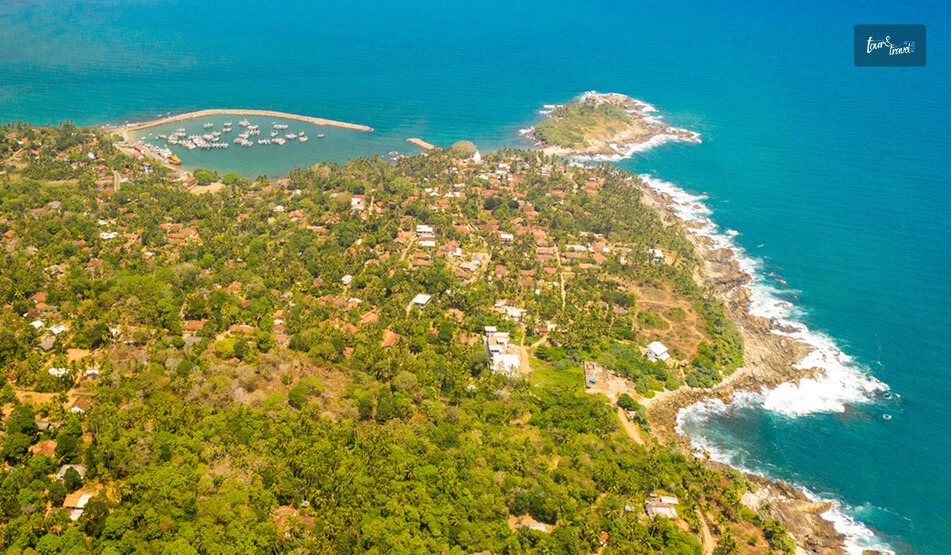
Dikwella or Dickwella is in the southern province of Sri Lanka. 

Between Tangalle and Matara, this coastal town is also closer to the Galle–Mirissa corridor. So, Dikwella is accessible. 

However, the thing is that it is usually far enough off the main tourist script.

So, to me, Dikwella felt like a place where locals lived and not a backdrop built for visitors.

If you are already exploring the south coast, Dikwella is a short hop from nearby towns.

It is just about twenty minutes from Matara, fifteen from Mirissa, and only ten minutes or so from Tangalle. 

Local buses run this route constantly, and the ticket prices are very low, though a tuk-tuk is more comfortable if you’re carrying luggage.

If you are traveling from Colombo, you will have to drive for around three and a half to four hours down the Southern Expressway to reach Dikwella. 

The road exits near Matara and continues along the coastal road. 

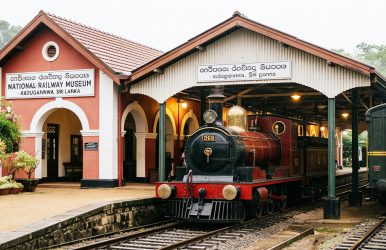
However, I took the Colombo Fort to Matara train and then a short tuk-tuk ride to Dikwella. 

The train takes longer. However, the time you spend on the train journey here is more than worth it as it is one of the most beautiful railway routes in Sri Lanka. 

It hugs the coastline for long stretches south of Galle. 

Colombo Fort To Matara Train 

There are many daily and weekly trains running between the Colombo Fort and Matara railway stations. 

I took the 8050 Express train. It runs daily. 

It departed the Colombo Fort Station at 6:50 AM, and I reached Matara at 10:15 AM. I was traveling in a 3rd class compartment, and the ticket price was LKR 300. 

The second class tickets cost LKR 600. 

From Matara, I took a tuk-tuk that charged me LKR 2500. 

Getting Around Dikwella 

You can hire a tuk-tuk to explore Dikwella and visit the nearby attractions such as the temple and the blowhole. 

The rental cost is around LKR 3000 to LKR 4000. 

However, I rented a scooter. It was more affordable, costing me LKR 1000 a day, and it gave me more flexibility to explore the smaller lanes and beaches nearby.

What Are The Things To Do In Dikwella (The Best Is That You Do Nothing)

Dikwella is the place that allows you to enjoy the joy of just existing. 

So, even if you are an introvert like me, you will find the place comfortable for getting knocked over by a wave or simply waiting for the water to wash your feet. 

Nevertheless, exploring the Blue Beach, a visit to Hiriketiya, a ride to the Hoo-maniya Blowhole, and a visit to the Wewurukannala Vihara are the to-do things in Dikwella.

Being At The Blue Beach And The Double Bay 

Being At The Blue Beach And The Double Bay

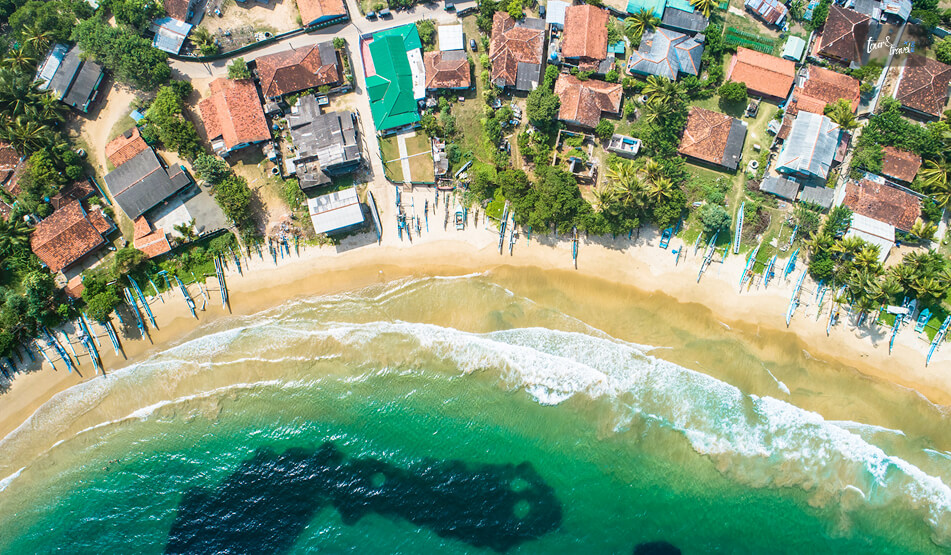
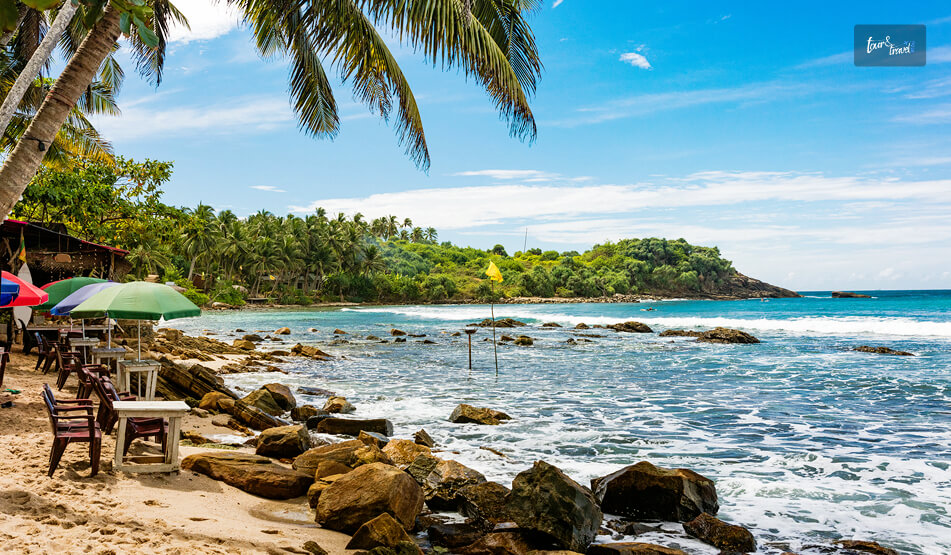
Dikwella Beach or Dickwella Beach has become the Blue Beach thanks to the locals and the nearby hotel owners. 

It is a double bay formation just west of town, where two curved stretches of sand meet at a narrow rocky point.

Due to the shape of the bay, the open-ocean swell gets broken up. So, the water inside remains calmer than most beaches along this stretch of coast.

So, if you are visiting alone or with family, this is a more comfortable space for swimming. 

I saw palm trees leaning out over the sand at angles that look almost too deliberate, like a photograph.

Furthermore, in the late afternoon, the light turned the water somewhere between turquoise and navy. 

I spent one whole evening doing nothing but sitting on the sand with a king coconut, watching fishermen haul in nets a little further down the beach.

It was not a dramatic sunset by postcard standards. It was better, honestly, because there were maybe a dozen other people on the entire beach to share it with.

2. A Visit To Hiriketiya

A Visit To Hiriketiya

After soaking in the silence of Dikwella, Hiriketiya was my next stop to feel the pulse of the area. 

Technically part of the greater Dikwella area, Hiriketiya has become one of the fastest-growing spots on Sri Lanka’s south coast in recent years.

It is a near-perfect horseshoe-shaped bay that has turned into a magnet for surfers, yoga retreats, and a rotating cast of digital nomads working from beachfront cafés.

The bay itself is small. While the small bay offers intimacy, a lack of space can also make it feel very crowded with a surge in the number of visitors. 

I rented a board for a couple of hours one morning, and it cost me LKR 500. Even as an amateur, the gentle, consistent waves here made it one of the friendlier places I have tried to learn surfing. 

The scenario, however, entirely changed by the evening. The beanbags outside the restaurants were occupied, and people were busy gorging on the best seafood and wood-fired pizza. 

It felt like a stark contrast to how quiet Dikwella felt. 

3. A Visit To The Hoo-Maniya Blowhole

A Visit To The Hoo-Maniya Blowhole

I took a scooter ride toward Kudawella and reached Hummanaya, or Hoo-maniya blowhole. 

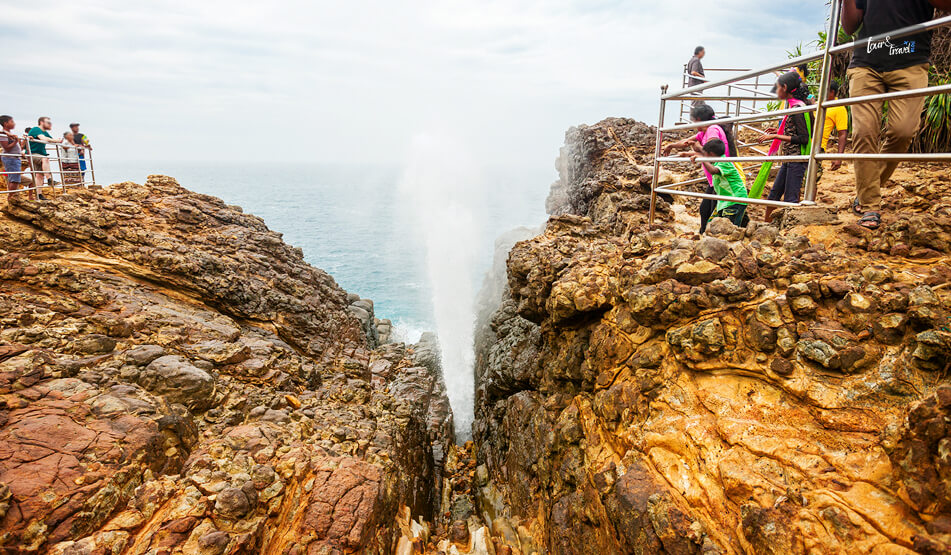
It was like a narrow rock chimney with incoming waves getting forced up through a submerged cavern and bursting out at the top in a sudden plume of spray. 

The water here makes a low rumbling sound that gives the blowhole its onomatopoeic name.

Despite being the only natural blowhole in Sri Lanka and one of the largest in the world, the Hoo-Maniya Blowhole is unpredictable. 

Some eruptions are a modest fizzle, others send spray shooting dramatically into the air, and the difference comes down entirely to the sea conditions that day.

The locals told me that the blowhole is the most powerful during the southwest monsoon. 

During the monsoon months, rougher seas force water through the cavern with more pressure.

As a foreign visitor, I had to pay 500 LKR as the entry fee. For locals, however, the entry fee was 50 LKR for adults and LKR 20 for children. 

The parking charges were LKR 50 to LKR 100. 

There is a proper viewing platform from which you can cherish the unique geology of the place. 

4. Visiting The Wewurukannala Vihara And Its Giant Buddha

Visiting The Wewurukannala Vihara And Its Giant Buddha

I took a scooty ride for about twenty minutes inland from Dikwella, and on the road toward Beliatta, I found a Buddhist temple appearing over the treeline. 

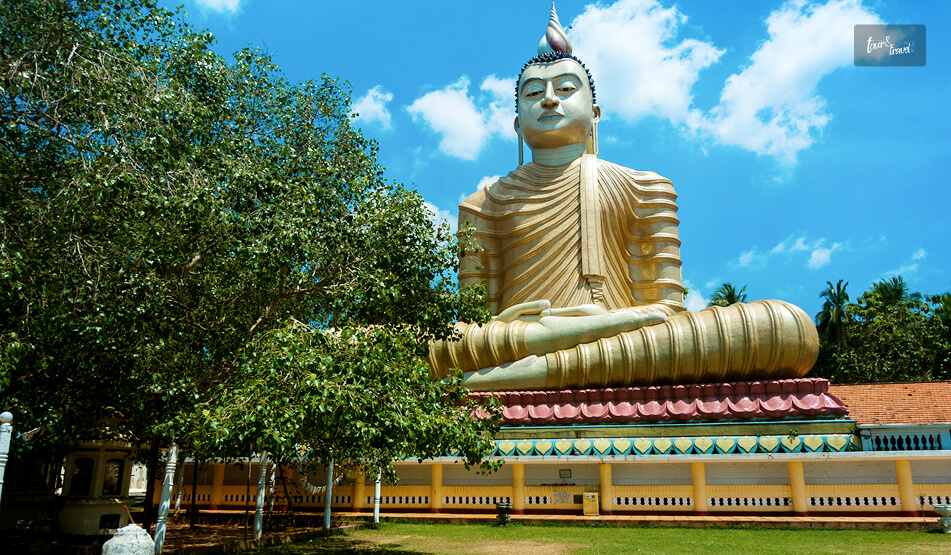
It was Wewurukannala Vihara, home to the largest seated Buddha statue in Sri Lanka. 

The statue rose around 50 meters, dominating the skyline of an otherwise low, palm-covered landscape.

The temple complex itself is older and more layered than the giant statue suggests at first glance. 

Parts of it date back to the 18th century, built during the reign of King Rajadhi Rajasinha, with a smaller, more traditional Buddha image worked into the original structure.

Walking through the complex, I passed from that older, quieter section into the base of the giant statue. 

Along the way, most visitors passed through a strange, slightly unsettling tunnel of painted dioramas depicting Buddhist concepts of karma and consequence. 

Where To Stay In Dikwella? 

You can decide where to stay in Dikwella based on the experience you want. 

Close to the town center and the Budget, there is a good mix of budget guesthouses and a couple of larger beachfront resorts.

While the budget guesthouses were more suitable for me, the larger beachfront resorts were for travelers who wanted easy beach access without the buzz.

However, if you want a little buzz and the pulse of the area, Hiriketiya will be a more suitable choice. 

The prices of guest houses here are higher. Also, the energy shifts toward boutique guesthouses, surf hostels, and design-forward small hotels aimed at the surf-and-yoga crowd.

I split my stay between the two, a couple of nights in a simple guesthouse near Blue Beach for the quiet mornings, then a night in Hiriketiya just to experience the contrast.

The stays near Blue Beach cost me LKR 1800 per night, and in Hiriketiya, it was around LKR 6000 per night.

What To Eat In Dikwella? 

Dikwella does not promise a huge restaurant scene. It has not come out of its shell of a working fishing town yet. 

The daily catch showed up on almost every dish I had. 

Some of my best meals were the simplest, including grilled fish, coconut sambal, and rice and curry from small local spots along the main road.

Furthermore, the cost of food in Dikwella was a fraction of similar meals’ cost in Mirissa or Unawatuna.

For a livelier and more elaborate food scene, you can visit Hiriketiya. It has cafés and restaurants aimed squarely at the international crowd.

So, there you will find smoothie bowls, wood-fired pizza, and fresh pasta alongside Sri Lankan staples.

Overall, I cherished the contrast of eating a rustic curry in Dikwella town one night and a plate of pasta overlooking the surf in Hiriketiya the next.

Things To Remember If You Are Visiting Dikwella 

December to April, or the dry season, is the best time to visit Dikwella. 

You will enjoy the calmest ambiance and nature for swimming in these months. 

However, if you specifically want to see the Hoo-maniya blowhole at its most dramatic, aim for the southwest monsoon months instead, around May to September.

Also, two to three days are enough if you want to experience the best of Dikwella. You can visit the Blue Beach and the Vihara in one day. 

On the next day, you can visit Hiriketiya and the blowhole and try surfing.

Then, leave a spare day if you just want to do nothing.

So, Is Dikwella Worth Visiting?

During my trip to Sri Lanka, especially when exploring the southern coast, Dikwella was my favorite spot as it allowed me to slow down and be myself. 

Dikwella does not have an ancient fortress or a famous surf competition. It does not have a five-star strip or a world-class resort. 

In fact, it is still very much a working fishing town that has not been built around tourism. 

Dickwella Beach is beautiful because it is not overrun. Also, the nearby attractions such as the booming blowhole and a giant Buddha allow you to spend a couple of unhurried days.

So, if your south coast itinerary has room for one detour off the Mirissa–Tangalle highlight reel, make it this one.

Share on Social Media

Sibashree is a travel, culture, and leisure writer who has been writing since the age of 12 and professionally since 2014. With more than a decade of travel writing experience and journeys across India and several parts of the world, she brings a deeply personal and thoughtful perspective to her work. A student of English Literature and Mass Communication, Sibashree has always viewed travel as more than movement — for her, it has been a way of understanding people, cultures, and herself. Her passion for spiritual exploration has also led her to many unusual and meaningful destinations over the years. Outside of writing, Sibashree enjoys watching European cinema, reading about global politics, and reflecting on the stories hidden within everyday places.

Leave a Reply

Your email address will not be published. Required fields are marked *

title-img Related

READ MORE Kumana National Park Safari

Kumana National Park Safari Price And Experience: Things I Encountered And Loved

BY  Sibashree Jun 15, 2026

Amidst the concerns of poaching and irregularities, Kumana National Park remains one of the hotspots for wildlife encounters in Sri Lanka.  During my days in Sri Lanka, I had already done the Hurulu Eco Park Safari, a safari in the Kaudulla National Park, and the Kumana National Park was the third place I chose for a safari, where I had delightful encounters with elephants.  Though the park offers various jeep safaris, wildlife tours, and birdwatching tours, I planned it in a different way. I opted for a wildlife ride from Arugam Bay to Kumana National Park instead of taking a safari tour inside.  I took a DIY route and rented a scooter for a day, and started from Arugam Bay, which was just 50 minutes away.  The rental charge was around LKR 2000, and I chose it to make my experience of meeting these amazing animals in their natural habitat more memorable.  And in this article, I will share the adrenaline rush I had at Kumana National Park, the Kumana National Park safari prices, and more.  However, let’s start with where the Kumana National Park is. Where Is Kumana National Park? The southeastern part of Sri Lanka has many gems, and Kumana National Park is surely one of them.  Around 50 km away from Arugam Bay, it shares a contiguous border with the Yala National Park, and the beautiful Kumbukkan Oya river separates it.  In addition, it is located at a distance of around 391 km from Colombo via Panama.  Thanks to its location, the Kumana National Park is also known as Yala East. It offers a more peaceful safari experience than neighboring Yala and other destinations, as it gets fewer vehicles.  Also, it has lagoons, dense mangrove forests, and the central Kumana Villu swamp.  Moreover, along with elephants, deer, leopards, and crocodiles, the Kumana National Park also has birds of different species.  In fact, it is a premier destination for bird watching with the presence of migratory waterfowl, painted storks, and black-necked storks. My Experience Of The Kumana National Park Safari Let me tell you, you will not be able to get inside the Kumana National Park on a scooter. If you want a proper safari inside the park, you will have to be a part of the jeep tours.  The Ride With my scooter plan sorted, I rode south of Arugam Nay and rode for ten kilometers, leading to the Kumana park entrance.  It is an extension of the park, and it took around 1 hour to ride through the park stretch.  Now, as soon as I left Arugam Bay, I started noticing elephants, and there was a complete herd near the Elephant Rock. They were busy among themselves in an open field.  However, the scooter ride became more adventurous after I passed through Panama. The dirt roads start from here, and you feel that you are away from the bustling surfing town of Arugama Bay.  Then, the small roads took twists and turns, and they passed through wetlands and fields just outside the Kumana National Park. Here, I could spot many wildlife variations, including water buffalo and deer.  The Visitor Center And The Kudumbigala Monastery Next, I stopped at the visitor center at the park entrance and spent around 20 minutes there learning about the park and the wildlife there.  I continued my journey to the nearby Kudumbigala Monastery, which was built in 246 BC and is a magnificent Buddhist hermitage spanning across 600 acres.  King Devanampiyatissa, the first Buddhist king of Sri Lanka, built it.  Kumana National Park Jeep Safaris You have many options if you are planning a Kumana National Park jeep safari. Have a look at the table below to know the Kumana National Park jeep safari details.  Types of Kumana National Park Jeep Safaris Kumana National Park Jeep Safari PriceMorning Jeep Safari $71 USD OnwardAfternoon Jeep Safari $71 USD OnwardFull-Day Kumana National Park Safari with Rice and Curry Lunch$97 USD OnwardKumana National Park and Panama Village$76 USD Onward What Is The Best Time For A Kumana National Park Safari?  Late afternoon is the best time to spot an elephant at Kumana National Park. This is the time when these adorable animals gather near water.  I also saw two crocodiles gliding into the water.  I even had a very close encounter with an adult elephant, and honestly, I was scared a little. However, the mother elephant was unbothered, and she passed by showing her regal moves.  And also, I saw a peacock with all its feathers spread out. It was a lifetime experience for me.  Furthermore, seasonwise, April to June, or the dry season in the eastern region, is the best time for a Kumana National Park jeep safari.  These months are also ideal for being the nesting season of the local and migratory waterbirds in the Kumana Villu swamp.  So, in these months, you can spot egrets, herons, ibises, pelicans, and painted storks.  Where To Stay Near The Kumana National Park?  Panama is at a distance of 22 km. Arugam Bay. It is also located around 50 km away. So, these two are the best places to stay if you are planning a visit to the Kumana National Park.  However, do you want the most immersive experience? You can plan a stay in the Kumana Mobile Tented Camp inside the Kumana National Park.  Here, you will stay in simple canvas tents, and the amenities will be basic. You will get facilities such as a portable loo outside the camp and a fresh water supply for bathing.  For me, the biggest attraction in the camp was the communal area. Everyone could sit there and have their food. Furthermore, here you can find the best collection of wildlife books.  In addition, this camp offers excursions to hidden spots, pristine lagoons, and amazing viewpoints on a bicycle.  I chose the camp location close to the ocean. Also, if you want, you can also find a camp closer to the jungle.  However, this is quite an expensive affair, and the tariff was around $330 for a night.

READ MORE things to do in unawatuna

What Are The Things To Do In Unawatuna With Family? Know Why You Will Love Unawatuna

BY  Sibashree Jun 1, 2026

The southern coast of Sri Lanka is the perfect relaxing getaway with golden sands, a vibrant local life, and a rich colonial heritage.  Be it the surfing paradise of the Hiriketiya Beach or the whale-watching hotspot, Mirissa, the southern coast is the most happening.  You can add to that the world-class culinary scene, the palm-fringed shorelines, and a laid-back bohemian energy.  Also, if you are looking for the combination of all these in a single spot, Unawatuna is the place to visit.  It has beginner-friendly waves, a deep colonial history, and a beachfront with a swinging rope.  In this article, I will discuss the best things to do in Unawatuna, top accommodation recommendations, and practical logistics to help you maximize your time in this tropical haven. Where To Stay In Unawatuna?  Unawatuna, being one of the premier beach destinations in Sri Lanka, has an excellent range of accommodations.  The accommodations here range from rustic, budget-friendly hostels to high-end luxury boutiques. Epic Unawatuna Epic Unawatuna, with its beautiful rustic charm, shows a heavy influence of the Dutch colonial architecture.  Furthermore, it offers air-conditioned rooms and exceptionally friendly staff.  Also, it is very close to the beach. Kingfisher Unawatuna It is an amazing beachfront hotel that has spacious rooms and large beds. Furthermore, it is on a quiet beachfront ideal for swimming.  Furthermore, it has an excellent in-house restaurant that is famous for serving top-notch, fresh seafood. What Are The Things To Do In Unawatuna With Family?  The Unawatuna Beach is at the epicenter of the attractions in Unawatuna. From exploring this beach to a day trip to Galle Fort, a lot of activities await you here.  1. Unwinding At Unawatuna Beach  Unawatuna Beach, with its golden sand, is one of the most popular beaches in Sri Lanka.  Furthermore, thanks to the protection of the offshore reef, the water here remains safe and calm. So, swimming here is safe throughout the year.  Moreover, in the daytime, you can rent a sunbed here, enjoy fresh coconut water, and enjoy the view.  At night, the beach gets transformed into a happening zone. The social scene here allows you to enjoy music, fresh seafood barbecues, and sunset cocktails right on the water's edge. 2. Dining At Bedspace Kitchen  After spending the evening at the beach, you can dine at Bedspace Kitchen. Which is in a tranquil garden oasis very close to the main road. It serves the best fusion cuisine, and it sources organic and fresh ingredients from local producers. So, by dining here, you can support the local community.  You must try the black pork curry and the gourmet burger. Its other specialties include fragrant coconut lemongrass soup and pumpkin gnocchi.  However, it has limited seats and remains quite crowded. So, you must book a table here in advance.  3. Witness The Iconic Stilt Fishermen Of Koggala At a distance of 10 minutes from Unawatuna Beach, along the coastal road toward Mirissa Beach, you will find Koggala.  South of Unawatuna, Koggala is the place to see one of the most striking cultural traditions of Sri Lanka, Stilt Fishing.  Here, fishermen use a traditional method to catch the fish. They balance atop a crossbar tied to a wooden pole driven deep into the reef, patiently waiting to catch small fish. The 2004 tsunami has altered the shoreline and made traditional fishing very difficult. However, the fishermen are still following this practice.  Many locals now rent their family stilts to men who pose for photographers to earn a livelihood. For visiting the Koggala Beach from Unawatuna and photography, the pocket pinch will be around 500 LKR.  4. Fall In Love With Dalawella Beach  Dalawella Beach, very close to Unawatuna, has low-bending coconut trees, dramatic rock formations, and a beautiful shoreline.  The rope swing here is a rage on Instagram, and it is one of the most popular photo spots along with the Nine Arch Railway Bridge in Sri Lanka.  Moreover, it is less crowded than Unawatuna.  5. Support Conservation At The Habaraduwa Sea Turtle Hatchery Sea turtles are frequent in the coastal waters of Sri Lanka. At the Habaraduwa Sea Turtle Hatchery, you will find rare species such as: Green Turtles Hawksbill Loggerhead Olive Ridley Leatherback Turtles. The hatchery is a non-profit organization that works toward protecting these majestic creatures.  The volunteers here rescue injured turtles caught in fishing nets and treat them. They also purchase eggs from local poachers to ensure they can hatch safely away from predators.  Moreover, once hatched, the baby turtles are nurtured for up to four days before being safely released into the ocean water. 6. Take A Day Trip To Galle Fort Galle Fort is just a tuk-tuk ride of 15 minutes from Unawatuna. It is designated as a UNESCO World Heritage Site. The Portuguese constructed it originally, and then extensive fortification happened in 1663 by the Dutch.  So, when you step here, it feels like traveling back to the Colonial Era.  Moreover, the fort here is an architectural marvel.  It has centuries-old Dutch villas, grand churches, and narrow cobblestone streets lined with trendy contemporary boutiques, art galleries, and upscale cafes. Moreover, the fort is an architectural marvel, featuring centuries-old Dutch villas, grand churches, and narrow cobblestone streets lined with trendy contemporary boutiques, art galleries, and upscale cafes. Also, the must-see attractions here are: The Galle Lighthouse Dutch Reformed Church Outer Stone Ramparts.  7. Learn To Surf At Bona Vista Bay While the Weligama Beach, Arugam Bay, and Mirissa Beach are more famous for world-class breaks, Bona Vista Bay is suitable for beginners.  It is a sheltered cove between Unawatuna and Galle. The waves here are gentle, and you will find many local surf schools on the beachfront offering certified instructors and affordable board rentals. Moreover, the surf lesson cost here is 2000-3000 LKR, and the board rental cost is between 300 and 500 LKR per hour.  What Is The Best Time To Visit Unawatuna? October to April, or the local dry season, is the best time to visit Unawatuna. However, February to April is the peak tourist season here.  During these months, the sea is calm, and the clear skies here make the time ideal for exploring.  From May to September, Unawatuna faces high rainfall and rough seas. Also, many businesses remain closed temporarily in these months.  How To Reach Unawatuna?  You can reach the southwestern coast of Unawatuna via different modes of transportation.  By Train A train ride through the southwestern coast offers the most affordable and scenic train ride. It is well connected by the Colombo Fort to Matara Railway Station, and Galle Fort Station is where you need to get down.  Also, from Galle Fort, you can take a tuk-tuk ride for 15 minutes, and it will cost around LKR 320.  By Bus  You can hop on a local coastal bus to reach Unawatuna from nearby beach towns such as Mirissa or Hikkaduwa.  Moreover, the bus ticket price is around 50 LKR, and a bus ride offers the most authentic cultural experience.  You will also get a bus from the Maharagama Bus Station, which is just 15 km south of Colombo City Center.  Here, the bus ride will take around 2 hours, and you will love the highway journey in a luxury AC bus.

READ MORE Is Japan expensive

Is Japan Expensive For Tourists? Why Is It Still Seeing A Boost In The Travel Booking? 

BY  Sibashree Sep 24, 2021

I have been to Japan many times, and the cultural richness and the sensory delights the country offers make the experience worth it!  However, these days, I see a lot of people asking, “Is Japan expensive to visit?”  Another question in this regard is why Japan is witnessing a major boost in travel booking.  Now, first, let me answer that Japan is not as expensive as people are projecting it. Be it the day trips from Tokyo or exploring the cherry blossom season in Kyoto, if you plan an itinerary and the modes of transport well, you can complete the trip within a decent budget.  Furthermore, thanks to smart tools such as the Japan Rail Pass, you can now make transport more convenient and flexible.  Also, whether Japan is expensive or not will depend on the country you are traveling from and how the currency of your country fares against the Japanese Yen.  On the other hand, Japan is enjoying a massive surge in popularity among Gen Z tourists due to many reasons. However, sushi, manga, and anime are the three major factors driving this rise.  While Japan can be managed on a moderate budget, and I have shared the three main reasons behind the rising popularity of Japan, let’s delve deeper into how much a trip to Japan costs and the other factors causing a rise in Japanese tourism.  Why Is Japan Expensive To Visit? Is It The Growing Craze?  Do you know that American Express Travel data shows a 1300% hike in the number of Americans visiting Japan since 2019?  Furthermore, Netflix has confirmed that Anime viewership has gone 3 times up in 2025.  Now, these pieces of information show how young Americans, especially the Gen Z travelers, are passionate about Japan.  The country is now a cultural superpower with its “Soft Power” that it has used to build the global landscape of entertainment, aesthetics, and ideas.  Joseph Nye, a political scientist at Harvard University, has highlighted the strength of Japan’s soft power.  Overall, Japan is not just a new country to visit for these young travelers. It is an escape to the land of rich culture, great food, and soaking in the spirit of slow tourism.  However, the rising craze among young travelers is not the reason behind Japan being labelled as an expensive destination.  In fact, it is amazing to see tourism in Japan growing despite the high travel expenses being  high.  Key Reasons For Japan Being An Expensive Destination To Visit  Japan is expensive as a destination primarily for three reasons. First of all, the Shinkansen bullet trains, extensively used for transportation, are very expensive.  Also, while I found Osaka food from the street stalls quite affordable, trying Sushi, Ramen, or other Japanese staples in a fine dining restaurant can be very expensive.  Furthermore, Japan almost entirely depends on imported energy.  Despite an improvement of 22.4% in the net energy import during the period of 2020 to 2024, the net energy import of Japan in 2024 was 87.4% of the total energy supply, according to the International Energy Agency (IEA).  Thus, the fuel cost is always high in Japan, impacting the transportation expenses, the cost of essential commodities, and every other sector in a direct or indirect manner. Is Japan Expensive To Visit? A Breakdown Of Tourist Costs  So, Japan is expensive to visit. However, what can be the overall expense tentatively?  What will be the expenses on food, transportation, and accommodation? Here is a detailed breakdown.  1. Tourist Accommodation Cost In Japan Japan is very sincere about the hospitality it offers. So, even if you are staying at a budget hotel or hostel, you will find good hygiene and the basic amenities.  Furthermore, along with hostels, Japan has unique accommodation provisions such as the capsule hotels.  These are basically sleeping pods, and the cost is similar to staying in hostels.  On the other hand, you will find a minshuku, which is like a Japanese version of homestays. You will get bed and breakfast facilities at these accommodations run by local families.  Nevertheless, have a look at the table below to understand the different types of accommodation for tourists in Japan and their average costs.  Types of Tourist Accommodation in JapanTentative Cost Hostels and Capsule Hotels2000-4500 JPYBudget Hotels5000-10000 JPYBread and Breakfast 5000-8500 JPYStandard Hotels10000 JPY Onward Moreover, if you’re looking to move to Japan after your trip there, check out reliable websites to know the best places for foreigners where you can call home. 2. The Cost Of General Public Transport In Japan  The Japanese Bullet Train or Shinkansen is the most preferred mode of transport in the country.  The Cost Of Traveling In A Bullet Train And The JR Pass However, the travel cost is very high if you are traveling by these bullet trains.  On average, and based on the departing station or the destination, the cost will be around 16000-20000 JPY per ride (the ticket price can go much higher).  For example, if you take a bullet train from Tokyo to Shin Amori, the price for a reserved seat will be 21340 JPY.  On the other hand, for the Green Seat and the GranClass Seats, the ticket prices will be 27410 JPY and 34410 JPY, respectively.  On the other hand, a Tokyo to Kyoto bullet train ticket starts from 16550 JPY.  Now, this is where a Japan Rail Pass becomes handy. As a tourist, you can buy a Japan Rail Pass for 7 days, and the cost starts from 50,000 JPY for an adult. For a child, it is 25000 JPY.  You can even buy passes for 14 days or 21 days. With this pass, you can enjoy unlimited rides during the validity period.  Moreover, if you want to focus on Tokyo and its nearby areas, the Regional Pass will be a more budget-friendly option.   Also, cabs are pretty expensive in Japan. For a ride of 1 to 2 kilometers, you will have to pay around 500 to 700 JPY.  After that, a fee of 80-100 JPY will be added for traveling every 250 to 300 meters.  3. The Cost Of Hiring A Tour Guide In Japan  The cost of hiring a tour guide in Japan is between 25000 and 60000 JPY per month. However, the cost of the travel guide will depend on the services you opt for.  You can choose a guide for a full day, and the cost can be up to 80000 JPY, and for a half day guide, it will be around 25000-47000 JPY.  Furthermore, if you are traveling in small groups or vans, the cost of hiring a guide will be around 24000 JPY.  So, hiring a personal travel guide is expensive in Japan. However, you can save the cost of hiring a guide by seeking help from the local tourist centers or the national tourist departments.  4. Food And Drink Cost In Japan Food is one of the most important factors for Gen Z travelers visiting Japan. A survey said that around 50% of the visitors planned a trip just because they wanted to visit a restaurant or try some specific food.  Also, food and drinks are available in various cost ranges. So if you are planning to take the authentic taste of sushi, you will get plenty of options available there.  From the expensive designer boutiques to Kaiten-zushi style shops everywhere, the multiple authentic sushi dishes are valuable.  You can select the place according to your requirements.  In the boutique’s style restaurant, you have to spend nearly 51000 JPY for sushi, but if you prefer the sushi in a low-cost range, you have to spend only 1593 JPY for sushi.  If you want to explore Japan on a budget. You can quickly shift your choices to Japanese cuisine and cut your travel budget by cutting the foreign food items. How To Plan Budget-Friendly Travel In Japan? Do you want to travel in Japan on a budget? Here are the tips you can follow.  1. Make A Tour Plan In The Off Season  Off-season tour plans are always budget-friendly. The Autumn season is an off-season to travel in Japan, and this time the tourist rush is not very high. 2. Take The Railroad  Take the railroad to explore the city and buy the railway card to see the tourist places in the country. 3. Focus On Local Cuisine  Focus on the local, authentic, fresh Japanese dishes. If you’re looking for cheap food in Japan, you can buy it in small restaurants, street food stalls, and even vending machine cafes.  However, if you stay in the country for an extended period, you can save money on your travel by preparing and cooking most of your meals from scratch. 4. Find An Accomodation Far From The Main Crowded Cities  Try to find accommodation that is a little bit far from the main crowded cities. Make sure to book your accommodation ahead of time to save a lot of money. Hostels and the local guest houses are also charming, clean places to stay. However, when planning a Japan tour, it is better to keep away from the expensive luxury boutique-type accommodations. 5. Look For Free Attractions  Look for free attractions and events to save money.  Whether you want to spend a fun day in a national park or visit a museum, there are incredible activities that allow you to enjoy Japan without paying anything.