



 Related
Ruwanwelisaya: Standing Beneath Anuradhapura’s Great White Stupa
BY Sibashree Sep 18, 2026
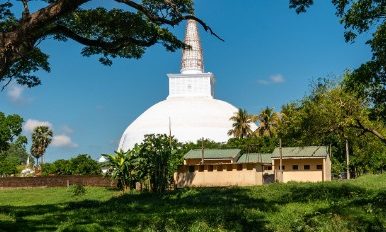
Ruwanwelisaya, or Ruwanmeli Maha Seya, won me over with its height from a distance of 100 meters. From there also, I could not fit it into a single frame. Also, the most astonishing feature was the frieze of stone elephant heads running the entire base of the stupa. It took me around 10 minutes just to walk the perimeter counting them. I counted up to two hundred and then lost a count of the elephant heads. Then, I saw the marble courtyard where white-clad pilgrims were circling clockwise. Also, the heat radiating off the stone by mid-morning reminded me of an old saying frequently uttered by my grandmother, Thamma, She used to say in Bengali, “Kosto na korle kesto mele na.” Roughly means, to receive the blessings of the divine, you have to put some hard efforts. Ruwanwelisaya At A Glance Detail Information Other Names Ruwanweli Maha Seya Maha Thupa Swarnamali Chaitya Built by King Dutugemunu. He begun the construction around 140 BC and then his brother,, King Saddhatissa completed it. Height 103 meters Circumference 290 meters Status One of the Atamasthana (8 sacred sites) and Solosmasthana (16 sacred sites) of Sri Lankan Buddhism UNESCO status Part of the Sacred City of Anuradhapura, inscribed 1982 Access Included in the Anuradhapura Sacred City ticket (foreign visitors) Dress code Pilgrims wear white clothes. Also, shoulders and knees must be covered, and you need to remove your shoes and hats. King Dutugemunu: The King Who Never Saw His Stupa Finished You cannot separate the story of King Dutugemunu from the Ruwanwelisaya stupa. He unified Sri Lanka in the 2nd century BC after defeating the Chola ruler Elara. According to the chapters 22 to 32 of Mahavamsa, or the Great Chronicle, Dutugemunu began construction of the stupa around 140 BC. It was an act of religious devotion meant to enshrine one-eighth of the sacred body relics of Lord Gautam Buddha. However, he died before the work was complete. King Saddhatissa, his brother was the successor. The younger brother, had the unfinished structure wrapped in white cloth so the dying king could see it appear complete. This part of the history is seen as a later embellishment as many historians, though. Still, when the local guide told me story, it touched me. The Completion Of The Stupa And Later Renovations Saddhatissa finished the stupa. Then, the subsequent kings renovated it. King Nissanka Malla in the 12th century is one of those kings to undertake this renovation after Saddhatissa. However, by 19th century, the stupa was in ruins. Again, a restoration campaign started in 1893 by the monk Naranvita Sumanasara Thera. The renovation was public funded and the Ruwanweli Seya Restoration Society took the charge of it. So, what we see today is the restored form in 1893 and later, in June 1940, the stupa got its new pinnacle. Why Is It Called The 'Great Stupa'? Ruwanwelisaya, or the Maha Thupa, literally means 'the Great Stupa.' It is among the Atamasthana, meaning the eight sacred places of Anuradhapura. It is even the most significant of these eight sites. The stupa is within the Mahamevnawa Park, close enough to the Sri Maha Bodhi and the ruins of the Lovamahapaya. So, I completed all three in the same walk without quite planning to. Walking The Site: What To Expect As I said, the imposing scale of the stupa was the first thing I noticed. The second thing I saw was the elephant wall. Here is a brief highlight on what made awestruck in the stipa complex. The Elephant Wall A retaining wall rings the base of the stupa. It has hundreds of elephant heads and forequarters. The distance between the heads are very less. So, from a distance it reads as a single continuous herd holding the dome up. A local guard told me that the exact count was 344. However, as I mentioned, I could not finish the counting after 200. The Marble Courtyard And Vahalkadas The stupa has a wide, pale courtyard and vahalkadas ring the stupa at four cardinal points. Vahalkadas are carved stone frontispieces with figures of elephants, horses, lions, and dwarfs. Walking barefoot across the marble was a difficult task, especially in the late morning of the dry season. However, I managed it hopping between the shaded patches. The Evening Atmosphere The stupa had a great impact on me, and I could not help but come back for a visit in the evening. It was looking more divine with its floodlights creating a sheer contrast against the sky. The stupa complex was busier in the evening, and the devotees were circling the stupa clockwise while chanting quietly. Tickets And What They Cover Ruwanwelisaya does not need a separate ticket. It is part of the Anuradhapura Sacred City ticket that foreign visitors need to enter the main archaeological zone. As of 2026, pricing for that combined ticket runs from roughly US$25 to US$30 per adult. The ticket covers Ruwanwelisaya alongside Jetavanaramaya, Thuparamaya, Abhayagiri, Lovamahapaya, and the twin ponds. It does not cover Isurumuniya, the Sri Maha Bodhi enclosure, or Mihintale, each of which has its own separate ticket. Ticket Approximate price (As of September 2026) Covers Ruwanwelisaya? Anuradhapura Sacred City ticket US$25–30 Yes Combined Cultural Triangle ticket US$50 Yes (Along with Sigiriya Rock Fortress, Dambulla Royal Cave Temple and Polonnaruwa) Isurumuniya (separate) 500 LKR No Sri Maha Bodhi enclosure Offers a free entry. However, you can offer a small donation. No Opening Hours And Best Time To Visit The main archaeological sites, Ruwanwelisaya included, are generally open from around 7:00 AM to 6:00 PM daily. Early morning is quietest and coolest for the walk around the courtyard and elephant wall. Poya (full moon) days, especially June's Poson Poya, bring the largest crowds of pilgrims and the most atmospheric evening lighting. Dry season, from May to September, offers the most comfortable conditions for the barefoot courtyard walk. How To Reach Ruwanwelisaya? Ruwanwelisaya is inside Anuradhapura's Sacred City zone. It is about a 1 km walk from the Eastern Gate car park and close to the Sri Maha Bodhi. You can explore the zone by rented bicycle (roughly LKR 200–300 per day). It is also the most practical way to cover the site because the individual monuments are at a distance from each other. I underestimated the distances on foot and regretted it by early afternoon. A Simple Half-Day Route Around Ruwanwelisaya Time Stop Notes 7:00 AM Sri Maha Bodhi Quietest at dawn, most devotional atmosphere. 8:00 AM Ruwanwelisaya Elephant wall, courtyard, main stupa. 9:30 AM Thuparamaya Smaller, older stupa nearby. 10:30 AM Jetavanaramaya Once the tallest stupa in the ancient world. Evening Return to Ruwanwelisaya Floodlit and busiest with local devotees after dark. What Ruwanwelisaya Represents Today More than two thousand years after Dutugemunu started the construction, Ruwanwelisaya is still an active place of worship. It is not a museum. The restoration endeavors of the elephant wall and dome go on. Also, pilgrims keep circling it in white on every Poya day of the year. Of everything I saw across Anuradhapura, it is the site that made the clearest case for why this ancient capital is still called sacred rather than simply historic.