
Ravana Falls, Ella: Location, How To Reach, Things To Do, Practical Tips And More

I met Ravana Falls on the way from Ella to Wellaway. 

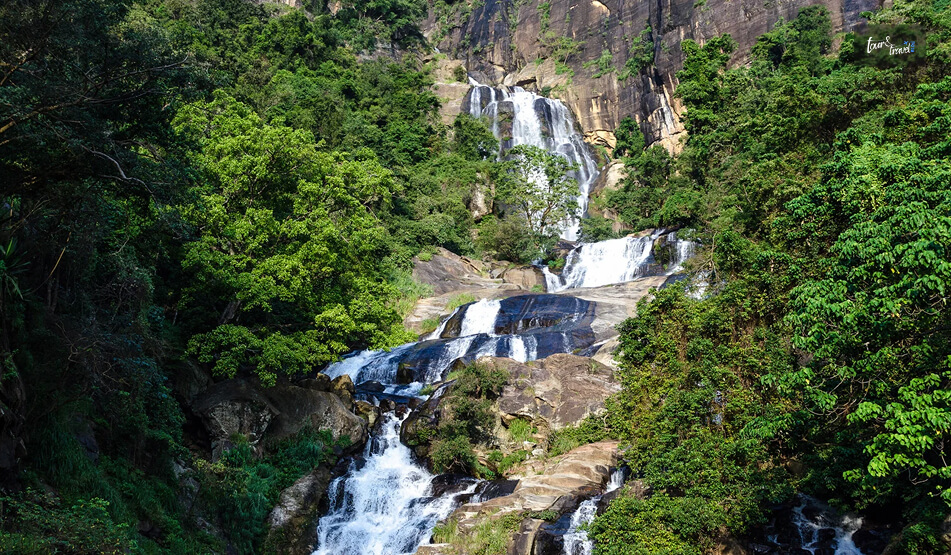
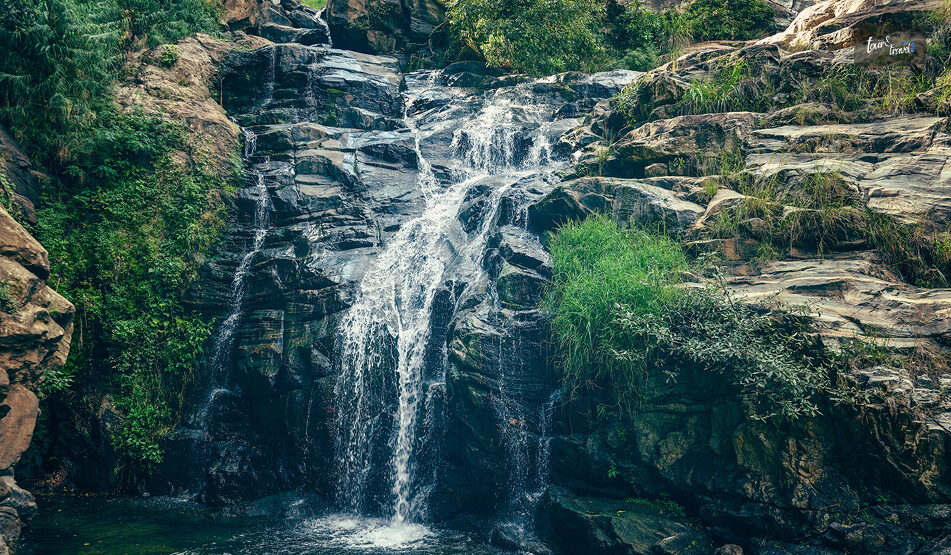
I pulled up on a tuk-tuk and found a wide and tiered curtain of water falling down on an oval rock face. 

Ravana Falls is not the tallest or most powerful waterfall you will see in Sri Lanka. However, the mythological significance and its easy accessibility from Ella make it a must-visit. 

Some Quick Facts About Ravana Falls, Ella

FactsDetails
Official NameRavana Falls (Ravana Ella)
LocationElla, Badulla District, Central Highlands, Sri Lanka
Height25 Meters
Waterfall TypeA Three-Tier Cascade
Water SourceKirindi Oya (River System)
Mythological LinkThe Ramayana
AccessibilityRoadside Viewpoint with No Trekking Required
Best Time to VisitOctober to January for Maximum Water Volume
Entry FeeFree

Where Is Ravana Falls Located? 

Where Is Ravana Falls Located

The Ravana Falls shows its prowess along the Ella–Wellawaya road (the A23). It is around 6 to 8 km south of the beautiful Ella Town

Also, it is close to the 12th–13th mile markers in the Badulla District.

At an elevation of around 1050 meters, this waterfall drops around 25 meters, and it is one of the widest in Sri Lanka. 

Furthermore, this waterfall within the compact Ella Wildlife Sanctuary is at the epicenter of an ecosystem with birds and small mammals.

Overall, it is amidst a landscape typical of the mid-elevation forests of Sri Lanka. 

How To Reach Ravana Falls

A tuk-tuk ride from central Ella to Ravana Falls takes around 10-15 minutes. You can also take a taxi ride. 

As you proceed toward Wellawaya along A23, you will see this waterfall from the roadside. 

Public buses also run along this route, and drivers are used to being asked for a drop-off here.

Moreover, you can reach the Ravana Falls from Bandarawela.

You can reach the waterfall by traveling around 10 km toward Wellawaya from Kubalwela Junction on the Badulla–Bandarawela road.

Ravana Falls And The Legend Of King Ravana 

Ravana Falls And The Legend Of King Ravana

The most intriguing thing about the legend of Ravana Falls is that every guide will give you a different version. 

However, the most popular is that King Ravana, the demon king from the Ramayana, hid Goddess Sita in a cave behind this waterfall after abducting her and bringing her back to Lanka. 

The waterfall is also close to the Ravana Ella Cave, which is perched on a cliff face about 11 km from Bandarawela.

The archaeological evidence in the area has proven the presence of older human habitation. So, myth aside, it has been an important location for human habitation for a long time. 

What To Do At Ravana Falls?

What To Do At Ravana Falls

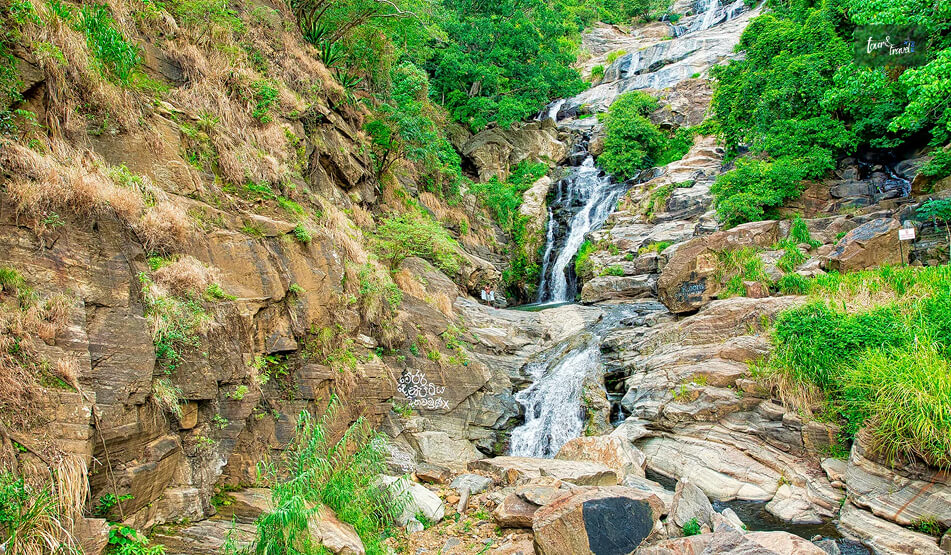
The best vantage point for this waterfall is the road and the small bridge nearby. If you want to go closer to the base, you will have to walk down a little. 

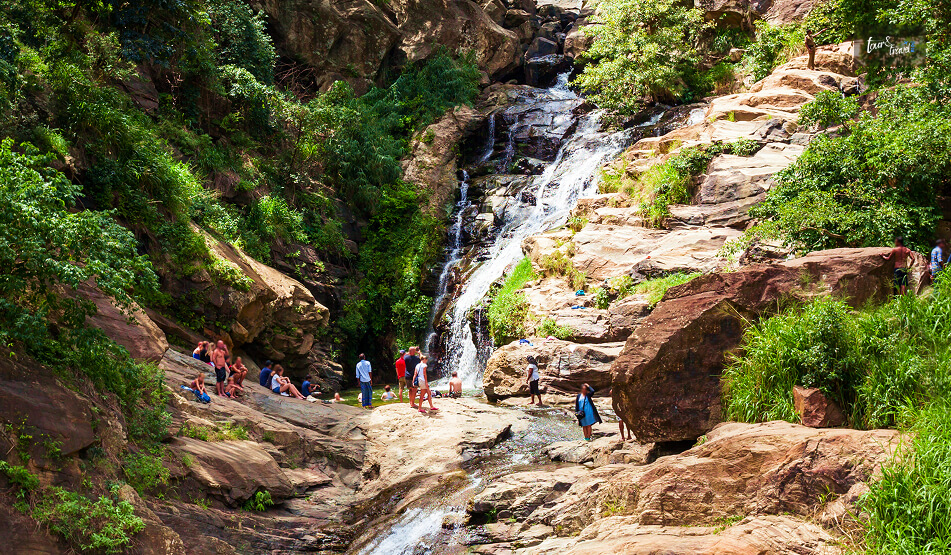
As you reach the base, you can climb over some of the rocks. 

Here, you have to be very careful as these rocks are very slippery irrespective of the season. 

Furthermore, for a proper look at the multi-tier cascade, I waded in the lower pools. 

However, I could not climb higher up the falls toward the upper cascades as that route is now restricted due to past accidents. 

So, I had to stick to the lower areas. 

Moreover, I spotted many troops of wild monkeys near the waterfall. So, be careful about what you carry and be respectful to them. 

Other Nearby Places You Can Visit With Ravana Falls 

Visit With Ravana Falls

After exploring Ravana Falls, you can come back to Ella and find some of the photographed attractions in Sri Lanka.

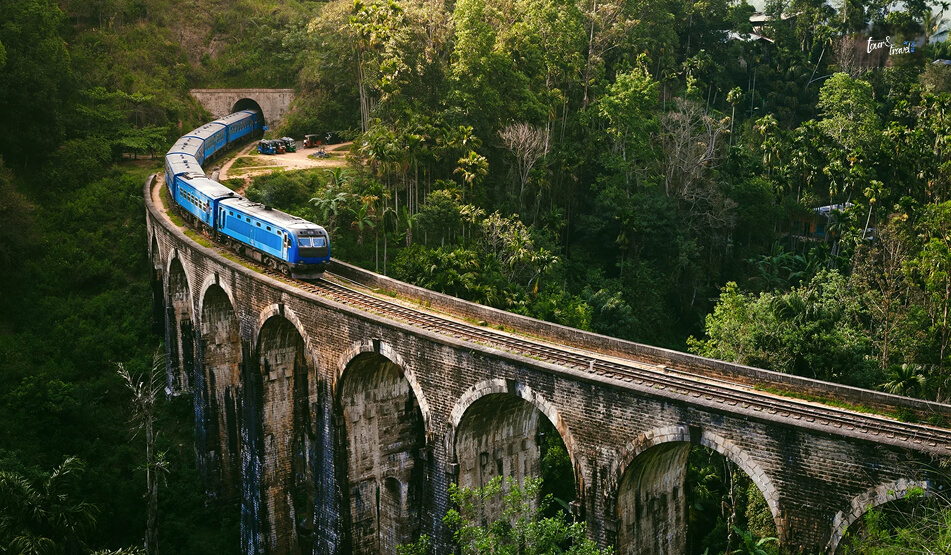
Visit the Nine Arch Bridge, Ella Rock, and Little Adam’s Peak.

Once again, due to the proximity to Ella, Ravana Falls fits naturally into a half-day loop rather than requiring a dedicated trip.

Moreover, just two hours away, the Horton Plains National Park awaits with a completely different high-altitude landscape. 

Practical Travel Tips For Visiting Ravana Falls

Practical Travel Tips For Visiting Ravana Falls

Ravana Falls is one of the best places to visit in Sri Lanka for budget travelers as it offers free entry. 

You must wear shoes with good grip if you have plans of climbing over the rocks near the base. Once again, avoid the temptation to go beyond the marked and accessible sections. 

A Quick Note On Safety

Follow the restrictions seriously, and there is no need to push barriers for a better photo, risking your safety. 

Like the other waterfalls in Sri Lanka, Ravana Falls should also be visited with prior local advice. 

Only a local guide will be able to help you find out the safer pool. 

Where To Stay Near Ravana Falls?

Ella town is the obvious base, and it is small enough that nowhere is more than a short tuk-tuk ride from the falls. 

Guesthouses and small boutique hotels line the roads toward Passara and Wellawaya.

Many of these guesthouses offer valley or mountain views.

Also, the range of options runs from simple backpacker stays to higher-end villas overlooking the tea country. 

Photography Tips

The falls face a direction that catches strong midday light. 

That light tends to wash out the detail in the water and flatten the surrounding greenery, so early morning or late afternoon visits give noticeably better results. 

A polarizing filter helps cut glare off the wet rock if you are shooting with a proper camera, and a slower shutter speed, even just a fraction of a second, brings out the silky texture the falls are known for during wetter months. 

Because the waterfall is visible and photographable straight from the road, it’s also one of the easier hill-country shots to get without carrying gear down a long trail.

Best Time To Visit Ravana Falls

Ravana Falls changes character dramatically with the seasons. 

During the wetter months, the water is said to resemble an areca flower with drooping petals as it spreads across the rock face.

It is genuinely one of the more striking waterfall shapes I have seen in Sri Lanka. 

In the dry season, the flow drops off considerably, and the falls can look thin by comparison. 

December to April tends to bring more reliable water levels alongside decent weather for the rest of an Ella itinerary.

So it is a reasonable window if you want to see the falls at something close to their best.

Share on Social Media

Sibashree is a travel, culture, and leisure writer who has been writing since the age of 12 and professionally since 2014. With more than a decade of travel writing experience and journeys across India and several parts of the world, she brings a deeply personal and thoughtful perspective to her work. A student of English Literature and Mass Communication, Sibashree has always viewed travel as more than movement — for her, it has been a way of understanding people, cultures, and herself. Her passion for spiritual exploration has also led her to many unusual and meaningful destinations over the years. Outside of writing, Sibashree enjoys watching European cinema, reading about global politics, and reflecting on the stories hidden within everyday places.

Leave a Reply

Your email address will not be published. Required fields are marked *

title-img Related

READ MORE Kalpitiya

Kalpitiya, Sri Lanka: The Sandbar Where The Wind Runs The Show

BY  Sibashree Jul 22, 2026

Mullaitivu left me quiet with the heavy history of the Sri Lankan Civil War.  And Kalpitiya was another surprise during my trip to Sri Lanka. Kalpitiya is a kitesurfing town, and in fact, Kalpitiya has been an important spot to boost tourism in Sri Lanka for the last 15 years with its kitesurfing adventures.  Furthermore, in September 2025, Kalpitiya saw its longest kitesurfing adventure, “a nearly 200-kilometre journey from Anawasala point in Kalpitiya to Talaimannar.”  Surfers from Sri Lanka, Italy and Germany took part in this surfing adventure. Also, Sara Johanna Berg, while speaking to The Sunday Times, said,  “This water sport is spectacular, not only to practice but also to watch. However, it requires proper training and guidance.” Sara also mentioned that with this event, she expected more participation from the Sri Lankan surfers.  Nevertheless, Kalpitiya was more than a wind-scoured sandbar with a fort. It is also home to a distinct fishing culture. And yes, you will see many dolphins, probably the calmest in Kalpitiya.  Here is what I did during my three days in Kalpitiya. This stretch of the northwest coast deserves more than a footnote in a Sri Lanka itinerary. Kalpitiya Took Me By Surprise From The Moment The Journey Started Kalpitiya is around 165 to 170 kilometers north of Colombo. A drive takes around three and a half hours.  It is a peninsula in the Puttalam District and is located around 50 kilometers north of Puttalam Town.  Furthermore, squeezed between the Puttalam Lagoon and the open Indian Ocean, Kalpitiya is a place famous for wind, kites, and dolphins.  However, the journey from Colombo to Kalpitiya was no less “interesting.”  Past Puttalam, the road narrowed, and the land on either side turned into salt pans, catching the light in long silver-white sheets. My driver this time was Nimal, and he slowed down so I could photograph a row of old windmills turning lazily near the salterns. Every detail on the way felt more like rural Netherlands than tropical Sri Lanka. Nimal said,  "This whole peninsula used to belong to traders.” Then, he pointed toward the lagoon side and said, "Arabs, then the Portuguese, then the Dutch. Everyone wanted this exact strip of sand." The Places To Visit In Kalpitiya  What Nimal said made more sense to me when I reached Kalpitiya Fort, the main historical attraction in Kalpitiya.  It was a fort that guarded a Cinnamon route. Here are more details about the fort.  Kalpitiya Fort: Embodying The Portuguese And Dutch History The Portuguese had laid the foundations of the Kalpitiya Fort earlier, and the Dutch built the fort on it between 1667 and 1676.  It sits on the narrow point where the Puttalam Lagoon meets the sea.  The walls of the fort are around four meters in height, and these are made of coral and limestone quarried from the surrounding coast. Also, the single entrance to the fort faces the lagoon. Furthermore, the belfry and the pediment topping the entrance make it look like a church.   However, this resemblance is not an accident. The local accounts say that the Dutch built the entrance in that style to placate the Kandyan king who had granted them the land. It was at a time when the fort's real purpose was military and commercial rather than religious.  A Guard To The Puttalam Lagoon The Kalpitiya Fort guarded the entrance to Puttalam Lagoon. The Dutch used the lagoon as a corridor to move cinnamon, areca nuts, and pearls toward Colombo. They had even dug a canal through Negombo for the purpose. However, today, the fort functions as the navy base of Sri Lanka. If you want to visit this fort, you will have to carry your original passport as it is still an active military site.  A young naval officer volunteered to show me around, and as I walked the bastions, the fort looked out over the lagoon on one side and the ocean on the other. The two bodies of water were separated by a strip of land I could have walked across in under ten minutes. Kudawa Beach: The Line Between Two Seas From the fort, I took a short ride to Kudawa Beach.  It is the main stretch of sand in Kalpitiya, and here a narrow sandbar visibly divides the turquoise ocean from the murkier, nutrient-rich lagoon.  I arrived at the beach close to sunset, and without exaggerating a bit, it was the single sundowner spot I found anywhere on this Sri Lanka trip.  There were no large resorts crowding the shorelines. However, there are around 30 kitesurfing schools around the coastlines and lagoons.  Also, there are small eco-resorts, and a handful of fishing huts with nets strung out to dry.  At the beach, a fisherman mending his net nearby told me, half in English and half through gestures, that the wind here "never really stops between May and October."  I had to agree with him, as even if I stood still, my shirt kept snapping against my back.  What Are The Things To Do In Kalpitiya?  I had a wonderful time chasing the dolphins and trying to learn kitesurfing. Here is more about the best things to do in Kalpitiya.  1. Chasing Dolphins Before Sunrise Dolphin watching is the best experience to have in Kalpitiya.  Our boat left from the lagoon, and it charged LKR 4000 per head.  It was just after sunrise. So, the sea was at its calmest. The boat headed out toward the Bar Reef area, where we spotted the spinner dolphins. I tried to keep a count, and it was close to sixty.  Our guide told me that spinner dolphins are regular in this region between November and April. He mentioned spotting the "super-pods" of over a thousand dolphins during peak months.  The dolphins did not perform tricks for us, and they simply existed around the boat. They spun, leaped, and occasionally arrowed straight toward the hull before diving under at the last second. Our boat operator mentioned that between December and April, this area also has sperm whales and sometimes migrating blue whales.  Each time a pod appeared, our boat operator cut the engine. Thus, the boat drifted rather than chasing them.  He said it was a “standard practice” among the more responsible operators working the Bar Reef, one of Sri Lanka's largest reef systems at roughly 307 square kilometers. 2. Learning To Kitesurf (I Failed At It) Kalpitiya's lagoon side is shallow and flat almost by design, which is exactly why it has built its reputation as one of the best beginner-friendly kitesurfing spots in Asia.  However, I was not a natural.  My instructor, a wiry local guy named Dinesh who has been teaching on this lagoon for years, kept the lesson simple. "Control the kite first. The board comes later," he said, which is probably decent life advice too. However, I barely made it. So, you must not trust the term “beginner-friendly” completely.  What Is The Best Season For Kitesurfing In Kalpitiya?  Kalpitiya has two kitesurfing seasons.  The southwest monsoon, from May to October, brings strong, consistent wind for most of the day. So, it is for professionals and veterans.  On the other hand, the northeast monsoon, from December to March, is gentler and generally considered the better window for first-timers. I went in the second season. Still, I spent most of the first hour eating sand.  3. Exploring The Places Near Kalpitiya  Wilpattu National Park, the largest national park in Sri Lanka, is close to Kalpitiya. It is a drive of about 2 hours.  The Wilpattu National Park is also famous for having a dense population of leopards. If you want to stretch the trip a little, you can visit the national park and plan a day safari.  Moreover, the peninsula itself is scattered with fourteen small islands, some inhabited by fishing families, some given over entirely to mangroves and birdlife. You can even explore these islands for a meaningful cultural experience. How I Spent Three Days In Kalpitiya: The Itinerary  DaysTimeActivityDay 1MorningDrive from Colombo via Puttalam, Salt Pans and WindmillsAfternoonVisiting the Kalpitiya Dutch FortEveningSunset at Kudawa BeachDay 2Early Morning Dolphin Watching Boat Trip Near Bar ReefAfternoonRelaxing by the LagoonEveningTrying Fresh Seafood by the BeachDay 3Early MorningKitesurfing LessonLate MorningDay trip toward Wilpattu National ParkAfternoon Island-hopping by Boat, Mangroves and Birdlife Kalpitiya: A Coastline That Is Still Deciding What It Wants To Be  Kalpitiya never tries to be Galle or Mirissa Beach. This is where it wins hearts.  With its patchy hot water, basic rooms, and winds, it is as unpolished as Nimal warned me to be.  But between a 350-year-old fort, a reef full of dolphins, and a lagoon that has quietly become one of the best kitesurfing classrooms in Asia, Kalpitiya gave me more range in three days than most single-purpose beach towns manage in a week. If you are the kind of traveler who wants your itinerary to include a little bit of history, a little bit of wildlife, and a lot of wind in your hair, I would put this stretch of the northwest coast near the top of your list.

READ MORE Kumana National Park Safari

Kumana National Park Safari Price And Experience: Things I Encountered And Loved

BY  Sibashree Jun 15, 2026

Amidst the concerns of poaching and irregularities, Kumana National Park remains one of the hotspots for wildlife encounters in Sri Lanka.  During my days in Sri Lanka, I had already done the Hurulu Eco Park Safari, a safari in the Kaudulla National Park, and the Kumana National Park was the third place I chose for a safari, where I had delightful encounters with elephants.  Though the park offers various jeep safaris, wildlife tours, and birdwatching tours, I planned it in a different way. I opted for a wildlife ride from Arugam Bay to Kumana National Park instead of taking a safari tour inside.  I took a DIY route and rented a scooter for a day, and started from Arugam Bay, which was just 50 minutes away.  The rental charge was around LKR 2000, and I chose it to make my experience of meeting these amazing animals in their natural habitat more memorable.  And in this article, I will share the adrenaline rush I had at Kumana National Park, the Kumana National Park safari prices, and more.  However, let’s start with where the Kumana National Park is. Where Is Kumana National Park? The southeastern part of Sri Lanka has many gems, and Kumana National Park is surely one of them.  Around 50 km away from Arugam Bay, it shares a contiguous border with the Yala National Park, and the beautiful Kumbukkan Oya river separates it.  In addition, it is located at a distance of around 391 km from Colombo via Panama.  Thanks to its location, the Kumana National Park is also known as Yala East. It offers a more peaceful safari experience than neighboring Yala and other destinations, as it gets fewer vehicles.  Also, it has lagoons, dense mangrove forests, and the central Kumana Villu swamp.  Moreover, along with elephants, deer, leopards, and crocodiles, the Kumana National Park also has birds of different species.  In fact, it is a premier destination for bird watching with the presence of migratory waterfowl, painted storks, and black-necked storks. My Experience Of The Kumana National Park Safari Let me tell you, you will not be able to get inside the Kumana National Park on a scooter. If you want a proper safari inside the park, you will have to be a part of the jeep tours.  The Ride With my scooter plan sorted, I rode south of Arugam Nay and rode for ten kilometers, leading to the Kumana park entrance.  It is an extension of the park, and it took around 1 hour to ride through the park stretch.  Now, as soon as I left Arugam Bay, I started noticing elephants, and there was a complete herd near the Elephant Rock. They were busy among themselves in an open field.  However, the scooter ride became more adventurous after I passed through Panama. The dirt roads start from here, and you feel that you are away from the bustling surfing town of Arugama Bay.  Then, the small roads took twists and turns, and they passed through wetlands and fields just outside the Kumana National Park. Here, I could spot many wildlife variations, including water buffalo and deer.  The Visitor Center And The Kudumbigala Monastery Next, I stopped at the visitor center at the park entrance and spent around 20 minutes there learning about the park and the wildlife there.  I continued my journey to the nearby Kudumbigala Monastery, which was built in 246 BC and is a magnificent Buddhist hermitage spanning across 600 acres.  King Devanampiyatissa, the first Buddhist king of Sri Lanka, built it.  Kumana National Park Jeep Safaris You have many options if you are planning a Kumana National Park jeep safari. Have a look at the table below to know the Kumana National Park jeep safari details.  Types of Kumana National Park Jeep Safaris Kumana National Park Jeep Safari PriceMorning Jeep Safari $71 USD OnwardAfternoon Jeep Safari $71 USD OnwardFull-Day Kumana National Park Safari with Rice and Curry Lunch$97 USD OnwardKumana National Park and Panama Village$76 USD Onward What Is The Best Time For A Kumana National Park Safari?  Late afternoon is the best time to spot an elephant at Kumana National Park. This is the time when these adorable animals gather near water.  I also saw two crocodiles gliding into the water.  I even had a very close encounter with an adult elephant, and honestly, I was scared a little. However, the mother elephant was unbothered, and she passed by showing her regal moves.  And also, I saw a peacock with all its feathers spread out. It was a lifetime experience for me.  Furthermore, seasonwise, April to June, or the dry season in the eastern region, is the best time for a Kumana National Park jeep safari.  These months are also ideal for being the nesting season of the local and migratory waterbirds in the Kumana Villu swamp.  So, in these months, you can spot egrets, herons, ibises, pelicans, and painted storks.  Where To Stay Near The Kumana National Park?  Panama is at a distance of 22 km. Arugam Bay. It is also located around 50 km away. So, these two are the best places to stay if you are planning a visit to the Kumana National Park.  However, do you want the most immersive experience? You can plan a stay in the Kumana Mobile Tented Camp inside the Kumana National Park.  Here, you will stay in simple canvas tents, and the amenities will be basic. You will get facilities such as a portable loo outside the camp and a fresh water supply for bathing.  For me, the biggest attraction in the camp was the communal area. Everyone could sit there and have their food. Furthermore, here you can find the best collection of wildlife books.  In addition, this camp offers excursions to hidden spots, pristine lagoons, and amazing viewpoints on a bicycle.  I chose the camp location close to the ocean. Also, if you want, you can also find a camp closer to the jungle.  However, this is quite an expensive affair, and the tariff was around $330 for a night.

READ MORE dikwella

Dikwella, Sri Lanka: The South Coast Town That Asks You To Slow Down 

BY  Sibashree Jul 28, 2026

On the bus route hugging Sri Lanka's south coast, Dikwella sat as a shadow to two more prominent names in Sri Lankan Tourism, Tangalle and Mirissa.  Mirissa stood out with its whale-watching boats and rooftop bars. Tangalle, on the other hand, showed its glossy resort strips.  However, Dikwella waited quietly with just a busy street, a fish market, and a few guesthouses.  Furthermore, the stretch of coastline of Dikwella unfolded quietly on either side of town.  I was looking for that quietness exactly, and that is why I ended up spending three nights there.  In this article, I will share my experience in Dikwella Beach, how to reach there, the things to do, and more! Where Is Dikwella? How To Reach It?  Dikwella or Dickwella is in the southern province of Sri Lanka.  Between Tangalle and Matara, this coastal town is also closer to the Galle–Mirissa corridor. So, Dikwella is accessible.  However, the thing is that it is usually far enough off the main tourist script. So, to me, Dikwella felt like a place where locals lived and not a backdrop built for visitors. If you are already exploring the south coast, Dikwella is a short hop from nearby towns. It is just about twenty minutes from Matara, fifteen from Mirissa, and only ten minutes or so from Tangalle.  Local buses run this route constantly, and the ticket prices are very low, though a tuk-tuk is more comfortable if you're carrying luggage. If you are traveling from Colombo, you will have to drive for around three and a half to four hours down the Southern Expressway to reach Dikwella.  The road exits near Matara and continues along the coastal road.  However, I took the Colombo Fort to Matara train and then a short tuk-tuk ride to Dikwella.  The train takes longer. However, the time you spend on the train journey here is more than worth it as it is one of the most beautiful railway routes in Sri Lanka.  It hugs the coastline for long stretches south of Galle.  Colombo Fort To Matara Train  There are many daily and weekly trains running between the Colombo Fort and Matara railway stations.  I took the 8050 Express train. It runs daily.  It departed the Colombo Fort Station at 6:50 AM, and I reached Matara at 10:15 AM. I was traveling in a 3rd class compartment, and the ticket price was LKR 300.  The second class tickets cost LKR 600.  From Matara, I took a tuk-tuk that charged me LKR 2500.  Getting Around Dikwella  You can hire a tuk-tuk to explore Dikwella and visit the nearby attractions such as the temple and the blowhole.  The rental cost is around LKR 3000 to LKR 4000.  However, I rented a scooter. It was more affordable, costing me LKR 1000 a day, and it gave me more flexibility to explore the smaller lanes and beaches nearby. What Are The Things To Do In Dikwella (The Best Is That You Do Nothing) Dikwella is the place that allows you to enjoy the joy of just existing.  So, even if you are an introvert like me, you will find the place comfortable for getting knocked over by a wave or simply waiting for the water to wash your feet.  Nevertheless, exploring the Blue Beach, a visit to Hiriketiya, a ride to the Hoo-maniya Blowhole, and a visit to the Wewurukannala Vihara are the to-do things in Dikwella. Being At The Blue Beach And The Double Bay  Dikwella Beach or Dickwella Beach has become the Blue Beach thanks to the locals and the nearby hotel owners.  It is a double bay formation just west of town, where two curved stretches of sand meet at a narrow rocky point. Due to the shape of the bay, the open-ocean swell gets broken up. So, the water inside remains calmer than most beaches along this stretch of coast. So, if you are visiting alone or with family, this is a more comfortable space for swimming.  I saw palm trees leaning out over the sand at angles that look almost too deliberate, like a photograph. Furthermore, in the late afternoon, the light turned the water somewhere between turquoise and navy.  I spent one whole evening doing nothing but sitting on the sand with a king coconut, watching fishermen haul in nets a little further down the beach. It was not a dramatic sunset by postcard standards. It was better, honestly, because there were maybe a dozen other people on the entire beach to share it with. 2. A Visit To Hiriketiya After soaking in the silence of Dikwella, Hiriketiya was my next stop to feel the pulse of the area.  Technically part of the greater Dikwella area, Hiriketiya has become one of the fastest-growing spots on Sri Lanka's south coast in recent years. It is a near-perfect horseshoe-shaped bay that has turned into a magnet for surfers, yoga retreats, and a rotating cast of digital nomads working from beachfront cafĂ©s. The bay itself is small. While the small bay offers intimacy, a lack of space can also make it feel very crowded with a surge in the number of visitors.  I rented a board for a couple of hours one morning, and it cost me LKR 500. Even as an amateur, the gentle, consistent waves here made it one of the friendlier places I have tried to learn surfing.  The scenario, however, entirely changed by the evening. The beanbags outside the restaurants were occupied, and people were busy gorging on the best seafood and wood-fired pizza.  It felt like a stark contrast to how quiet Dikwella felt.  3. A Visit To The Hoo-Maniya Blowhole I took a scooter ride toward Kudawella and reached Hummanaya, or Hoo-maniya blowhole.  It was like a narrow rock chimney with incoming waves getting forced up through a submerged cavern and bursting out at the top in a sudden plume of spray.  The water here makes a low rumbling sound that gives the blowhole its onomatopoeic name. Despite being the only natural blowhole in Sri Lanka and one of the largest in the world, the Hoo-Maniya Blowhole is unpredictable.  Some eruptions are a modest fizzle, others send spray shooting dramatically into the air, and the difference comes down entirely to the sea conditions that day. The locals told me that the blowhole is the most powerful during the southwest monsoon.  During the monsoon months, rougher seas force water through the cavern with more pressure. As a foreign visitor, I had to pay 500 LKR as the entry fee. For locals, however, the entry fee was 50 LKR for adults and LKR 20 for children.  The parking charges were LKR 50 to LKR 100.  There is a proper viewing platform from which you can cherish the unique geology of the place.  4. Visiting The Wewurukannala Vihara And Its Giant Buddha I took a scooty ride for about twenty minutes inland from Dikwella, and on the road toward Beliatta, I found a Buddhist temple appearing over the treeline.  It was Wewurukannala Vihara, home to the largest seated Buddha statue in Sri Lanka.  The statue rose around 50 meters, dominating the skyline of an otherwise low, palm-covered landscape. The temple complex itself is older and more layered than the giant statue suggests at first glance.  Parts of it date back to the 18th century, built during the reign of King Rajadhi Rajasinha, with a smaller, more traditional Buddha image worked into the original structure. Walking through the complex, I passed from that older, quieter section into the base of the giant statue.  Along the way, most visitors passed through a strange, slightly unsettling tunnel of painted dioramas depicting Buddhist concepts of karma and consequence.  Where To Stay In Dikwella?  You can decide where to stay in Dikwella based on the experience you want.  Close to the town center and the Budget, there is a good mix of budget guesthouses and a couple of larger beachfront resorts. While the budget guesthouses were more suitable for me, the larger beachfront resorts were for travelers who wanted easy beach access without the buzz. However, if you want a little buzz and the pulse of the area, Hiriketiya will be a more suitable choice.  The prices of guest houses here are higher. Also, the energy shifts toward boutique guesthouses, surf hostels, and design-forward small hotels aimed at the surf-and-yoga crowd. I split my stay between the two, a couple of nights in a simple guesthouse near Blue Beach for the quiet mornings, then a night in Hiriketiya just to experience the contrast. The stays near Blue Beach cost me LKR 1800 per night, and in Hiriketiya, it was around LKR 6000 per night. What To Eat In Dikwella?  Dikwella does not promise a huge restaurant scene. It has not come out of its shell of a working fishing town yet.  The daily catch showed up on almost every dish I had.  Some of my best meals were the simplest, including grilled fish, coconut sambal, and rice and curry from small local spots along the main road. Furthermore, the cost of food in Dikwella was a fraction of similar meals' cost in Mirissa or Unawatuna. For a livelier and more elaborate food scene, you can visit Hiriketiya. It has cafĂ©s and restaurants aimed squarely at the international crowd. So, there you will find smoothie bowls, wood-fired pizza, and fresh pasta alongside Sri Lankan staples. Overall, I cherished the contrast of eating a rustic curry in Dikwella town one night and a plate of pasta overlooking the surf in Hiriketiya the next. Things To Remember If You Are Visiting Dikwella  December to April, or the dry season, is the best time to visit Dikwella.  You will enjoy the calmest ambiance and nature for swimming in these months.  However, if you specifically want to see the Hoo-maniya blowhole at its most dramatic, aim for the southwest monsoon months instead, around May to September. Also, two to three days are enough if you want to experience the best of Dikwella. You can visit the Blue Beach and the Vihara in one day.  On the next day, you can visit Hiriketiya and the blowhole and try surfing. Then, leave a spare day if you just want to do nothing. So, Is Dikwella Worth Visiting? During my trip to Sri Lanka, especially when exploring the southern coast, Dikwella was my favorite spot as it allowed me to slow down and be myself.  Dikwella does not have an ancient fortress or a famous surf competition. It does not have a five-star strip or a world-class resort.  In fact, it is still very much a working fishing town that has not been built around tourism.  Dickwella Beach is beautiful because it is not overrun. Also, the nearby attractions such as the booming blowhole and a giant Buddha allow you to spend a couple of unhurried days. So, if your south coast itinerary has room for one detour off the Mirissa–Tangalle highlight reel, make it this one.