
Is Hello Kitty Shinkansen Discontinued? Looking Back At Everything This Iconic Bullet Train Offered

Yes, Hello Kitty Shinkansen is going to get discontinued in Japan. Now, during my last trip to Japan, a ride in this themed bullet train was surely my pookie moment. 

It was an experience of a lifetime when I tried the best Osaka food and boarded the Hello Kitty Shinkansen train for a day trip to Kobe, Himeji, Okayama, Kurashiki, and Hiroshima. 

However, JR West has decided to stop the operations of the Hello Kitty Shinkansen from 17th May 2026. 

Now, it’s sad for everyone who loves Japanese culture. If the Japanese shrines and temples are the telltale of its history, religion, and society, the Hello Kitty Shinkansen has been a poster of the pop culture. 

So, in this article, I will discuss how the beautiful 8-year-old journey of the Hello Kitty Shinkansen is going to come to an end, and what you can expect in the few days left until the last date of operation. 

Hello Kitty Shinkansen: An Iconic Symbol Of Japanese Railway Branding 

Hello Kitty Shinkansen An Iconic Symbol Of Japanese Railway Branding

Hello Kitty Shinkasen started running on the Sanyō Shinkansen line on 30th June, 2018. It used to run from Shin-Osaka to Hakata (Fukuoka). 

Furthermore, during this 8-year run, this themed bullet train has successfully served its purpose of reviving tourism in Japan. 

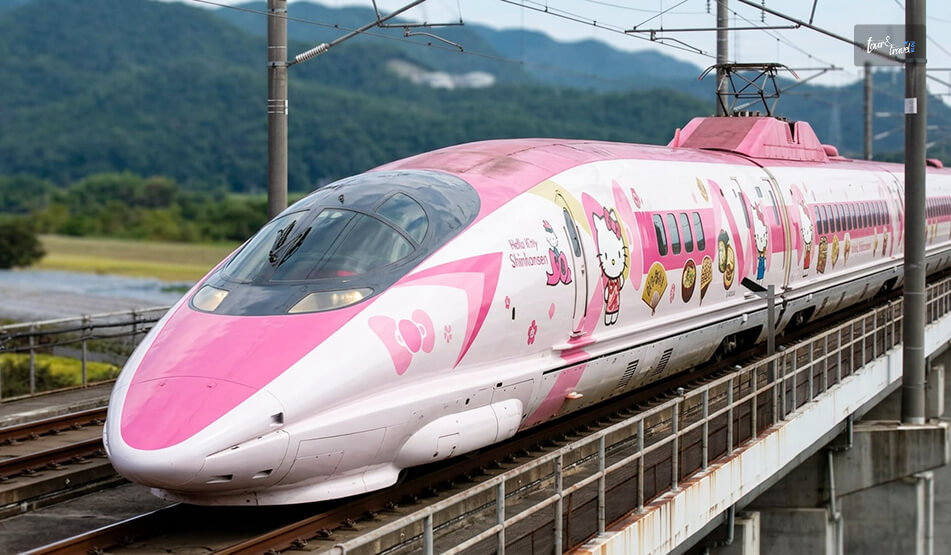
Moreover, the Hello Kitty Shinkasen used 500-series bullet trains and featured the signature white-and-pink colors. 

Also, the exterior was adorned with bows, the signature of Hello Kitty. 

However, for the train, the bow represented a link between the cities on the route covered. 

The Decor Which Made The Hello Kitty Shinkansen So Special

Out of eight cars of the Hello Kitty Shinkansen, the decor of the first two cars was based on the theme. 

Furthermore, the Hello Plaza in Car 1 was dedicated to exhibitions. It had exhibits dedicated to the cities crossed on the route. 

Moreover, you could shop for souvenirs at the Hello Plaza. 

Again, the second carriage, “KAWAII! ROOM,” was decorated in the style of Hello Kitty. The chairs, the wall art, and the ceiling were done accordingly. 

Moreover, there was a photo area. 

The rest of the carriage was like a normal bullet train, with subtle hints of the Hello Kitty theme. 

Also, a unique melody was used for the announcement. 

How Is The Farewell Event Of Hello Kitty Shinkansen Being Planned? 

JR West is going to plan a series of commemorative events to bid farewell to this iconic bullet train. 

As a passenger, you can leave a message on the board reserved for sharing memories. Furthermore, you can get stickers and limited edition souvenirs in the memory of the train. 

Moreover, you can collect special merchandise from the Kyoto Railway Museum and specific JR West Stores. You will even find them online. 

Having said that, there is still a month left for the Hello Kitty Shinkansen to get discontinued. So, let’s have a quick look at the operation days, timetable, and passes. 

Hello Kitty Shinkansen Passes And Tickets

You can ride the Hello Kitty Shinkansen with the Japan Rail Pass and other tickets. So, check out some of the pass options here. 

1. JR-WEST All Area Pass

You can buy this single pass to explore Sanyo, Hokuriku, Hakata, and other unexplored parts of western Japan. 

Furthermore, it has a validity of 7 days. 

Also, the pass price for adults is 26000 Yen, and for children, it is 1300 Yen. Moreover, it is free for children from 1 to 5 years. 

This is the most recommended pass for riding the Hello Kitty Shinkansen. 

2. Kansai – Hiroshima Area Pass

With this Kansai to Hiroshima Pass, you can enjoy unlimited rides between these two locations. 

It will also include a ride on the JR West Miyajima Ferry to Miyajima Island. 

Moreover, the 5-day pass for Kansai – Hiroshima will cost 17000 Yen for adults and 8500 Yen for children. 

3. Hiroshima-Yamaguchi Area Pass

With this pass, you can enjoy an unlimited ride between Fukuoka and Yamaguchi. This pass is valid for 5 days, and for adults, it costs 15000 Yen, and for children, it is 7500 Yen. 

Moreover, there are the Kansai-Wide Area Pass, Kansai-Hokuriku Area Pass, SANYO-SHINKANSEN One-way Ticket, and Okayama-Hiroshima-Yamaguchi Area Pass. 

Hello Kitty Shinkansen Days Of Operation And Timetable 

Hello Kitty Shikashen will now run every day. You can book the trains from https://www.klook.com/japan-rail/ or the West Japan Railway Company’s website

Also, there are two trains, Kodama No. 942 and Kodama No. 949, running from Hakata to Shin-Osaka and Shin-Osaka to Hakata, respectively. 

1. Time Table Of Kodama No. 942 (Hakata To Shin-Osaka)

StationTiming 
Hakata7:04 AM
Kokura 7:22 AM
Shin-Shimonosheki 7:31 AM
Asa7:43 AM
Shin-Yamaguchi7:53 AM
Tokuyama8:12 AM
Shin-Iwakuni8:25 AM
Hiroshima8:40 AM
Higashihiroshima8:53 AM
Mihara9:12 AM
Shin-Onomichi9:18 AM
Fukuyama9:31 AM
Shin-Kurashiki9:45 AM
Okayama10:09 AM
Aioi10:35 AM
Himeji10:48 AM
Nishi-Akashi11:02 AM
Shin-Kobe11:12 AM
Shin-Osaka11:25 AM

2. Time Table Of Kodama No. 948 (Shin-Osaka To Hakata)

StationTiming 
Shin-Osaka11:37 AM
Shin-Kobe11:50 AM
Nishi-Akashi12:01 PM
Himeji12:15 PM
Aioi12:27 PM
Okayama12:50 PM
Shin-Kurashiki1:02 PM
Fukuyama1:16 PM
Shin-Onomichi1:28 PM
Mihara1:41 PM
Higashihiroshima1:56 PM
Hiroshima2:08 PM
Shin-Iwakuni2:29 PM
Tokuyama2:42 PM
Shin-Yamaguchi2:58 PM
Asa3:11 PM
Shin-Shimonosheki 3:24 PM
Kokura 3:34 PM
Hakata3:51 PM

There have always been high demands for the Hello Kitty Shinkansen. So, hurry a little if you want to experience a ride in the days remaining. 

Moreover, train timings can change under unusual scenarios. So, always check the timing with local authorities before booking your tickets.

What Are The Places To Visit On The Hello Kitty Shinkansen Route? 

There are many stations on the Hello Kitty Bullet Train route. However, you cannot miss these places on the route. 

1. Kobe

I loved the Nunobiki Ropeway, which was very close to the Kobe Shinkansen station. The ropeway took me on a ride over the Nunobiki Waterfall and the beautiful Kobe Herb Garden. 

It dropped us at the Observation Park, and as the name suggests, it offers amazing views of the city. 

However, you can even take a local train to the city. 

2. Himeji

The Himeji Castle is one of the twelve original castles in Japan. It was built in 1609. 

Also known as the White Heron Castle, it is the largest in Japan and is a UNESCO World Heritage Site. 

3. Okayama

The Korakeun Garden in Okayama is beautiful. Furthermore, the Kibutsu shrine, a little far away from the town, stands out with its amazing “timber-framed corridor.”

Also, don’t forget a visit to the Okayama Castle, the main tower of which was completed in 1597. 

4. Kurashiki

The Bikan Historical Quarter is the main attraction of Kurashiki. Once you reach Kurashiki on the bullet train, you will get off and take a local train to reach the historical center. 

It is also a pretty and quaint town. So, it is ideal for relaxation. 

5. Hiroshima

Hiroshima is one of the historic places to visit in Japan. The Atomic Bomb Dome and the Peace Museum here remind you of the futility of war. 

The Future Of Themed Bullet Trains In Japan 

As a tourist or a cultural enthusiast, you may think that the discontinuation of the Hello Kitty Shinkansen has put the future of the themed bullet trains in Japan at stake. 

However, that is not the case. 

Japan has just got a new theme-based bullet train called Super Mario Shinkansen in 2025. Also, JR Kyushu runs this train in Kyushu. 

As the name says, Super Mario Shinkansen has pictures of the main characters, Mario and Luigi. Also, it shows how Japan still believes in using themed trains as powerful tools of regional tourism promotion among children and youngsters. 

Share on Social Media

Meet Sibashree Bhattacharya, a travel enthusiast who has a decade-long experience in transcending virtual barriers with her words! Her deep love for travel is apparent from her travel escapades to the mountain, often taking her readers on a journey, her words acting as Portkey! Fun fact: Sibashree loves to dive deep into the history of the places she is about to visit, making her travels even more wholesome. If you were wondering how her articles are not short of time travel, this answers it!

Leave a Reply

Your email address will not be published. Required fields are marked *

title-img Related

READ MORE National Railway Museum, Kadugannawa

My Day At National Railway Museum, Kadugannawa: Timings, Entry Fee, Exhibits And More

BY  Sibashree May 5, 2026

I forgot to mention one thing when I shared my experience of a train ride in the Demodara railway loop. This is a lesser-known loop, and I got to know about it from the National Railway Museum, Kadugannawa.  This museum is at a distance of just 15.1 km from Kandy. Today, it has many old machines, carriages, equipment, and locomotives.  Though everyone will have a visit to the National Railway Museum, Kadugannawa, in their itinerary of the things to do in Sri Lanka, I enjoyed my day there.  So, in this blog, I will talk about my experience at the National Railway Museum, Kadugannawan, its entry fee, timings, exhibits, and how it was opened at an opportune moment.  National Railway Museum, Kadugannawa: Quick Facts Opening Date27th December, 2014 Opening Hours 9 AM to 4 PM (Only closed on Poya Day)Ticket Price - For Sri Lankan Adults: Rs. 50- Foreign Adults: Rs. 500- Children: Rs. 20- Children in School Uniform: Rs. 10  Why Was The National Railway Museum, Kadugannawa, Opened?  The National Railway Museum, Kadugannawa, was opened on 27th December, 2014, on the occasion of the 150th year of railway operations in Sri Lanka.  The first train of the Ceylon Railway ran from Colombo Terminus station to Ambepussa. The Duke of Brabant of Belgium was a passenger on this train.  On the occasion of the museum inauguration, a Memorial Stamp was also released. Furthermore, as souvenirs, there were a memorial DVD and a coffee table book.  Moreover, a Replica Steam Train ran from Colombo Fort to Kadugannawa, and it had special invitees as passengers.  It was a thoughtful move to commemorate the first train operation 150 years ago.  How To Reach The National Railway Museum, Kadugannawa? You can reach the National Railway Museum, Kadugannawa, with a short train ride from Kandy.  However, if you miss the train, you can also take a bus. However, I don’t recommend a bus ride from Kandy to Kadugannawa because the bus ride through the Royal Botanic Gardens takes around 45 minutes to 1 hour.  Also, the bus is very crowded, and you will find every type of food vendor there.  Nevertheless, if you still want a bus ride, the ticket price will be 120 LKR (Around 36 Rs.) for a person.  Kandy To Kadugannawa Train Ride  I love train rides, and even if the queue for the third-class ticket was long, I enjoyed the entire experience.  Nevertheless, I took the Kandy to Polgahawela train that departed from the Kandy Station at 2:15 PM and reached the Kadugannawa Station at 2:55 PM.  The train halts at the Kadugannawa station for 1 minute. So, stand near the gate and be a little fast when alighting from the train.  I got a 3rd class ticket, and the ticket price was Rs. 40. What Are The Things To See At The National Railway Museum, Kadugannawa?  The Kadugannawa Railway Museum is very close to the Kadugannawa Railway Station. It is a small space, and it includes a platform and 2 outside areas.  Furthermore, it is spread over a train shed.  I sat in a vintage train carriage at the museum, and it cost me around Rs. 296. The carriage also had an attendant who showed me the museum. The Exhibits And Demonstrations I Loved  I especially loved the demonstration of the efficient token system that ensures that trains do not run into each other on the single-track mountain railway lines of Sri Lanka.  Furthermore, I found a massive model railway inside the museum. It shows the entire Sri Lankan railway network.  It was fascinating, and it highlighted the Nine Arch Bridge and how the train covers the spiral Demodara loop.  I also had a lot of fun getting in and out of the steam locomotives, carriages, and old engines at the museum.  Moreover, I saw a 10-minute-long video describing the railway network of Sri Lanka.  Overall, I spent around an hour at the museum and ended my time there with a cup of coffee at the in-house coffee shop. The coffee shop itself is inside a carriage.  The best things about the National Railway Museum, Kadugannawa, were that very few visitors were there.  So, as a curious soul and someone very fascinated by trains (my home is very close to a railway track), I had a gala time.  What Are The Other Places To Visit In Kadugannawa?  Kadugannawa, a short distance away from Kandy, is a serene place with many historical and cultural attractions.  So, once you have completed exploring the top attractions in Kandy and the National Railway Museum, Kadugannawa, you can visit these places.  1. Balana Fort  Balana Fort is located between Kadugannawa and Kandy.  Also, close to the Alagalla Mountain Range, its strategic position helped to protect the kingdom of Kandy from external attacks.  2. Captain Dawson Tower  The Captain Dawson Tower is at Kadugannawa Pass, and it is very close to the first modern expressway of Sri Lanka, the Colombo Kandy Road.  The construction of this expressway began under the supervision of Captain William Francis Dawson in 1820. So, this tower remembers and respects the contribution of Captain William Francis Dawson. Moreover, it was built in 1832.  3. Lion’s Mouth Rock, Kadugannawa It is an overhanging rock that you can find between the Balana and Kadugannawa railway stations.  The natural formation of the rock resembles a lion’s mouth.  Furthermore, when the train passes through the bend, there is a steep descent. So, the feeling of a drop makes the experience all the more thrilling.  4. Kadugannawa Rock View  If you are traveling from Colombo to Kandy or exploring the best attractions in Kadugannawa, the Kadugannawa Rock View is a place to relax.  The place is serene, and it offers amazing views of the lush surroundings. Furthermore, there are a few small shops on the way.  You can buy some souvenirs from these shops, and you will spot a lot of monkeys here.  Moreover, it was sunset time when I reached this viewpoint, and the experience was surreal.

READ MORE Japanese shrines to visit

What Are The Best Japanese Shrines To Visit? Celebrating Nature Spirits And Inherent Spirituality

BY  Sibashree Mar 31, 2026

I am eager to engage with the traditional cultures of Japan through my visit to Japanese shrines. When you walk right through the enormous torii gate, something almost magical happens to your inner being. Leaving the hectic modern life behind, you enter a space where time appears to move at a different pace, and that is when you experience a certain tranquility. Situated in a Japanese Shinto shrine are rich traditions and a belief system that make the shrine a very sacred place. Moreover, the shrine is the perfect place to practice and get some understanding of the age-old Shinto rituals. Along with that, every visit to a Shinto shrine, I take a whiff of the smell of burning incense or cedar, or just have a glance at the bright red cedar floor in the forest, and each time I get a different insight into how primitive communities have transformed the land. Although it is really tough to designate the best Japanese shrines to visit, I would like to show you the ones that left a deep impression on me. You can visit most of these shrines on a day trip from Tokyo. But before that, let's talk about the Shinto religion in Japan and what makes Shinto shrines so priceless. The Shinto Religion In Japan: A History Rooted In Nature Shinto is an indigenous religion of Japan and is the oldest form of worship in Japan.  It differs from most Western religions in that there is no central text for Shinto, nor is there a single historical founder of the faith.  Rather, Shinto grew out of the relationship that early Japanese people had with the land and their environment.  While Shinto is less about trust through a prescribed belief (or doctrine), it is more about lifestyle, and in particular, how to live life in harmony with nature. 1. The Core Belief Of Kami At the heart of Shinto lies a philosophy of the universe where various forms of nature (of the divine) are inhabited by divine spirits known as kami (in Shinto).  The kami can take on many different forms, from mountains, trees, rocks, and waterfalls to winds, rains, fertility, and much more.  Furthermore, in Shinto, people believe that after humans die, they become kami themselves.  As a result, it is a profoundly beautiful and cyclical view of existence where our forebears continue to be present with us to influence and guide our lives in the landscape we live in today. 2. Rituals, Offerings, And Evolution At The Best Japanese Shrines To Visit  Shrines are where kami (gods) receive worship from believers in Shintoism.  Because kami can be both good and bad for human beings. So, people can make offerings in hopes of receiving blessings from them.  Shinto uses purification and prayers as a method of avoiding bad kami through Shinto rituals.  There are no founders, no scriptures, or no absolutes in Shintoism, and it has no preaching or strictures.  Instead, Shinto relies on time-honoured traditions to help ensure the spiritual well-being of its followers, or for them to receive good fortune. As a matter of fact, Shintoism was Japan’s official religion from the 1870s until the 1940s.  It was officially separated from Buddhism at that time. Shintoism continues today to be an important part of Japanese culture and exists amicably with Buddhism. What Are The Features Of The Shinto Shrines To Visit In Japan?  Shrines are places where worshippers come to honor the kami.  If you are staring at a map or walking on a street, you can recognize these locations by their shrine-related words. Shinto shrines in Japan end in –jinja, –jingu (this one is reserved for Imperial shrines), or –taisha.  As I travel to a new town, one of my favourite things to do is try to find these suffixed words, as I know there are shrines nearby, and I have a quiet place to relax. 1. The Types Of Shinto Shrines  Each type of Shinto shrine has a different spiritual purpose to accomplish. In the table below, I have tried to divide the shrines into different categories.  Types of Shinto ShrinesWhat They MeanImperial ShrinesHistorically funded and overseen by the government.Sengen ShrinesDedicated specifically to the deity of Mt. FujiInari ShrinesThese are for the kami of rice and prosperity (easily spotted by fox statues).Tenjin ShrinesThese shrines worship the kami of Sugawara Michizane, a famous scholar and politician.Hachiman ShrinesDedicated to the kami of war and protection. 2. Distinct Architecture Of The Shinto Shrines  Torii gates are the easiest and most recognizable way to mark Shinto shrines.  These gates are entrance accessories to the shrines, and are usually made of wood painted in the color combination of bright orange and black. Although some can be made of stone.  After the gate, you will find the worship hall (haiden), where you can offer prayers. Furthermore, the main sanctuary (honden) is the most sacred.  Also, you will see shimenawa or sacred straw ropes and komainu or guardian lion-dogs in the architectural features of the shrines.  Moreover, ema are small wooden plaques where visitors express their innermost desires to the gods and hang them to be read. What Are The Best Japanese Shrines To Visit?  There are about 80,000 Shinto shrines in Japan. However, based on the shrines I have visited, I have made choices of which I consider to be the most attractive places to visit for any traveler. 1. Fushimi Inari Shrine, Kyoto  Probably the most widely recognized image of Japan is Fushimi Inari Shrine.  It is well-known for its thousands of vermillion torii gates "tunnel" that lines the 4 km track going up Mount Inari.  Being the main shrine of all shrines, Inari, the god of rice and sake, is deeply significant.  I advise you to hike a bit more on the mountain. The lower section is very crowded, but the upper trails have a serene atmosphere where you can enjoy the fox statues of the deities in an unhurried manner. 2. Meiji Shrine, Tokyo Meiji Jingu is the most magnificent Imperial shrine in Tokyo.  It is also quite different from the flashing neon lights of the nearby Harajuku.  It is a shrine devoted to Emperor Meiji and Empress Shoken.  Moreover, a forest of more than 100,000 trees surrounds it. To me, this shrine stands for the "hopefulness" of Shinto.  Moreover, it's a place where you can stroll along wide gravel paths, look up huge sake barrels that brewers have given. Also, if you're lucky, see a Shinto wedding ceremony carried by a slow, graceful bridal party crossing the courtyard.  3. Toshogu Shrine, Nikko The Toshogu Shrine in Nikko is a very bright and gaudy place with the use of various colors and gold.  This shrine is the final resting place of Tokugawa Ieyasu, the founder of the Tokugawa Shogunate.  Detailing here is mindblowing, and you will notice the elements such as "See No Evil" monkeys and the "Sleeping Cat" carving.  It is a one-of-a-kind place as it has preserved numerous Buddhist features even after the Meiji-era separation of the two religions. Thus, it is a combination of a regal and an eccentric style, which is a wonder in itself. 4. Itsukushima Shrine, Miyajima Located on Miyajima Island near Hiroshima, Itsukushima is world-famous for its "floating" torii gate.  The shrine stands on stilts over the water, so it looks like it's drifting in with the tide.  It's a classic example of Shinden-Zukuri design.  The thing is that I always go at sunset when the gate fades into shadow against the Seto Inland Sea.  That moment feels deeply quiet, almost sacred.  It seems hard to ignore how powerful that stillness can be. And the colors shift with the light. Making it one of Japan's most striking photo spots. 5. Nezu Shrine, Tokyo Nezu Shrine is perfect if you want some respite from the crowded temples of Kyoto.  There's a small tunnel of torii gates like Fushimi Inari, and a koi pond that glows under the Sun.  The buildings flash red and gold, kind of like Nikko's Toshogu, but it is smaller and simpler.  Moreover, late April brings wild azaleas up the hillside and pink waves rolling through purple hillsides. You don't see that everywhere. 6. The Sengen Shrines Of Mt. Fuji Located in the area of Fuji Five Lakes, I was quite impressed by two shrines that are a must-see for me.  Fujiyoshida Sengen Shrine is right at the foot of the mountain and was the old point for pilgrims who started climbing the volcano.  It has a very ancient feel thanks to huge cedar trees that surround and stone lanterns.  Close to it is the Arakura Sengen Shrine that gives the "typical" Japanese photograph. It has a red five-tiered pagoda with Mt. Fuji towering in the background.  If you decide to go to the top, you will have almost 400-step stair climbing, but the panorama is breathtaking. 7. Kumano Nachi Taisha, Nachisan This shrine is the main shrine of about four thousand Kumano shrines and is located on the Kii Peninsula.  It is extremely beautiful because it is very close to Nachi Falls, which is the highest waterfall in Japan.  Also, it is quite a spiritual experience to witness the vivid red pagoda of the shrine contrasting with the white thundering falls and the misty mountains.  Moreover, it is one such place of worship along the old Kumano Kodo pilgrimage route. Read Also: Haneda Vs Narita: Which Tokyo Airport Should You Choose For Your Next Trip? Are You Planning A Trip To Osaka? This Is Your Quintessential Guide Is an Mt Fuji Day Trip From Tokyo Worth It? How To Plan It?

READ MORE Dambulla Royal Cave Temple

Dambulla Royal Cave Temple: History, Entrance Fee, And More About This UNESCO Heritage Site 

BY  Sibashree Apr 10, 2026

The Dambulla Royal Cave Temple is gearing up for the much-acclaimed “Walk for Peace” which will start from 21st April, 2026.  Respected Paññakāra Thero and 12 other monks from the Maha Sangha will lead the walk.  Furthermore, this walk, originating in the United States, will spread the teachings of Lord Buddha, “Caratha bhikkhave carikam bahujana hitaya bahujana sukhaya lokanukampaya.” It can be roughly translated as a monk should always wander forth out of their compassion for the world and for the happiness and well-being of many.  After the inauguration of the event at Anuradhapura and special observations at Ruwanweliseya premises, the walk will start from the Dambulla Royal Cave Temple, and then it will slowly proceed to Kandy to continue the walk.  Now, it is no wonder that the Rangiri Dambulla Cave Temple has been chosen as the starting point for the walk.  With a history that goes back to the 3rd century BCE, and home to the Buddhist mural paintings and 157 statues, it remains one of the most important Buddhist landmarks in Sri Lanka.  Here is a detailed guide on my experience at Dambulla Royal Cave Temple, its significance, history, entry fee, and more!  The Dambulla Royal Cave Temple: Quick Facts  “Dambulla is an important shrine in the Buddhist religion in Sri Lanka, remarkable for its association with the long-standing and wide-spread tradition of living Buddhist ritual practices and pilgrimage for more than two millennia.” UNESCO World Heritage Convention.  Here are some quick facts about the most well-preserved and largest cave-temple complex in Sri Lanka. Number of Sanctuaries 5Buddhist Mural PaintingsAcross an Area of 2,100 m2Number of Statues157HistorySince the 3rd Century BCEThe Current Interior FormsBuilt in the 18th CenturyType of SculpturesPolychromeOwnership The Asgiriya Chapter of Buddhist monksMonument Protection “Protected Monument under the legal protection of the Department of Archaeology of the Government of Sri Lanka, which administers the Antiquities Ordinance of 1940 (rev. 1998) at the national level.”Entry Fee2000 LKRHours Open7 AM to 7 PM (The Ticket Counter Closes at 5 PM)Steps 300Average Climbing Time20 Minutes  Where Is The Dambulla Royal Cave Temple? (Along With Some Nearby Attractions) The Dambulla Royal Cave Temple is in Dambulla Town. Now, Dambulla itself is the gateway to many places to visit in Sri Lanka.  For example, the Hurulu Eco Park is just a distance of 45 minutes from Dambulla. On the other hand, it is just 52 minutes away from the Kaudulla National Park.  Furthermore, the distance between Dambulla and Kandy is around 73 km. So, many people include a visit to the Dambulla Royal Cave Temple in their itinerary of the things to do in Kandy.  Moreover, Sigiriya is just 17 km away. So, you can plan a combined trip of a visit to the Royal Cave Temple with a hike to the  Sigiriya Rock and Pidurangala Rock.  In addition, you will have a similar experience of exploring an ancient Buddhist monastery and its remains at the Ritigala Forest Monastery, at a distance of 35 km.  Also, if you are a cricket buff like me, don’t miss a visit to the Dambulla International Cricket Ground.  How To Reach The Dambulla Royal Cave Temple? Even if you are not staying in Dambulla, Habarana, or Sigiriya can be your base.  Habarana is just 22 km away from Dambulla, and Sigiriya is just 17 km away.  From both locations, you can take a private taxi or tuk-tuk ride to reach Dambulla Town, which has the Dambulla Royal Cave Temple in the heartland.  Furthermore, from Habarana, you will get Sri Lanka Transport Board - SLTB ICT buses to Dambulla.  Nevertheless, I took a tuk-tuk from Sigiriya to Dambulla, and it cost me around 2500 LKR.  What Is The History Of The Dambulla Royal Cave Temple? As I have mentioned, the history of the Dambulla Royal Cave Temple goes back to the 3rd Century BCE.  Buddhist monks started living here, and these natural caves started functioning as monasteries.  Furthermore, in 100 BCE, King Vattagamani Abhaya (Valagamba) fled his capital and took refuge here for 15 years.  Then, out of his gratitude, he built this majestic Dambulla Royal Cave Temple.  However, most of its constructions, including the sculptures and murals, are from the Anuradhapura and Polonnaruwa periods.  Also, the current interior we see is the outcome of the renovation in the 18th century. In addition, it was designated as a UNESCO World Heritage Site in 1991. Today, it is a part of the prestigious Cultural Triangle of Sri Lanka, along with Anuradhapura, Polonnaruwa, and Sigiriya Rock Fortress.  My Experience Of Visiting The Dambulla Royal Cave Temple (Things To See And Top Attractions) Before I get into the details of my experience at the Dambulla Royal Cave Temple, I want to give you a clear idea about the five main caves.  The Caves of The Dambulla Royal Cave TempleNamesMain Attractions Cave 1Devaraja LenaIt is the Temple of the King of Gods. The reclining Buddha statue here is mesmerizing.Cave 2 Maharaja LenaThis one is the largest among all caves, and it has 56 statues. Moreover, it is the Temple of the Great Kings, and don’t miss the sacred pot with the dripping water here. Cave 3Maha Alut ViharayaThe Maha Alut Viharaya is a wonderful example of 18th-century art. Furthermore, as the Great New Temple, it is home to 18th-century Kandyan-style paintings and statues.  Cave 4Paschima ViharayaIt is the western temple. Cave 5Devana Alut ViharayaIt is the second new temple in the temple complex.  However, to see these caves, you have to take 300 steps. You will not feel the fatigue anyway, as you will love the views and spotting the groups of macaques jumping through branches.  Also, once you reach the top, you will need to take off your shoes and further walk to the cave.  Here are some of the highlights of my visit to the Dambulla Royal Cave Temple.  1. Before Entering The Caves  I entered the cave temple complex, and a massive courtyard opened before my eyes. On one side of the courtyard, there was the shrine and the Bodhi Tree.  Furthermore, on the other side, there is the rock and the cave temples.  The Engraving Of Kirti Nissankamalla I found the engraving of the Kirti Nissankamalla before entering the first cave. Dated to the 12th century, it narrates the contributions of King Nissankamalla to Buddhism.  The engraving, however, is in ancient Sinhalese. So, you can ask a local guide or a local person to help you understand the details.  Or, you can read the translation of the engraving next to it.  2. The Caves  I have already introduced the caves to you. However, everywhere you look, you will find Buddhist murals, depicting the important figures and myths of Buddhism.  Furthermore, there are golden statues of Lord Buddha along the walls, and the lifelike paintings of Buddha-like figures evoke awe.  Moreover, with repeating patterns, the ceilings look kaleidoscopic.  However, the first time I experienced magnificence in these caves was when I saw the reclining Buddha statue.  The Reclining Buddha Statue (1st Cave) The reclining Buddha statue inside the first cave of the complex reminded me of the Lord Vishnu idol of Sree Padmanabhaswamy Temple in Kerala, India.  In fact, in some traditions of the Hindu religion, Buddha is the ninth of the ten Avatars or incarnations of Lord Vishnu. Here, the connection felt real.  The serene expression of Lord Buddha with his head resting on a pillow made me feel peaceful. I offered some fresh lily flowers that I bought on the way up the steps.  Furthermore, the lotus flowers drawn on Lord Buddha’s feet or Buddhapada symbolize spiritual awakening, and these are among the 108 holy marks that represent the holy journey of Buddha on the earth.  The Natural Spring (The Second Cave) It was amazing to find a natural spring in the second cave, and even in the dry season, it has water.  The water of the spring drips through the ceiling, and the drops are collected in a vessel.  Furthermore, it has 56 Buddha statues, and it is the most aesthetic with stunning murals and paintings.  The Series Of Buddha Statues (The Second Cave) Again, inside Cave 2, I found a series of similar Buddha statues in a seated position, and the next one was always a bit bigger than the previous one.  However, instead of the Dhyana mudra or the meditation gesture, the statues here were seated in a Bhumisparsha mudra or as the earth witness. Thus, these statues stare directly into your eyes.  These statues looked more vibrant, and with an earthy tone, they complemented the overall aesthetics of the cave temples.  Also, don’t miss the little lily pond just outside cave 2.  The Stupa Inside The Cave (The Second Cave) The second cave has an entire Stupa built inside it.  Furthermore, the stupa is adorned with an orange robe. Various statues of Lord Buddha in a seated position surround the stupa, and these are accompanied by nagas.  These nagas or snakes play the role of a protector or guardian when Lord Buddha is meditating. Moreover, they symbolize the subjugation of worldly desires and spiritual awakening.  The 3rd cave also has many statues, and the fourth one is smaller with a stupa inside. After exploring the 3rd, 4th, and 5th caves, I finally approached the end of the cave.  You know what stayed with me, that the temples are still alive and they have made people from a different millennium, with humans of today in the same row with the thread of devotion, peace, and love.  Once again, with non-violence and peace having so much power, the current geopolitical situations only look like futility.  3. The Viewpoint  As I got out of the caves, I found a quaint viewpoint behind the entry counter. I saw many young tourists flocking there, and the views from there were simply amazing.  I stopped and took some snaps.  4. The Golden Buddha Statue  I consciously chose a different route while getting down from the caves. I found many aesthetic lampposts along the way.  However, I did not follow the lamp posts and took the left to walk down, and the road was quite steep.  However, the reward I got at the end of the road was absolutely worth it.  There was a magnificent golden Buddha statue on the elaborately designed building of the museum complex.  I could not explore the museum due to a time crunch, and I did not want to dilute what I saw and how I felt at the cave temples. What Is The Best Time To Visit The Dambulla Royal Cave Temple? In a day, early mornings, from 7 AM to 9 AM, or late afternoons, after 4 PM, are the best hours for visiting the Dambulla Royal Cave.  Furthermore, December to February are the best months for visiting these cave temples due to dry and pleasant weather conditions.