Suva has the nickname of “The Green Heart of the Pacific,” and there is a reason behind that. It is more than government buildings and rich cultures.
It is a rainforest city. Also, the city has Naitasiri and Rew adventure zones in the surrounding.
Moreover, with an annual rainfall of 3000 millimeters, it has natural wonders such as the Colo-i-Suva Forest Park and urban places such as the Thurston Gardens and Albert Park.
In addition, the city is home to a “Healthy City” initiative. Newer and greener pedestrian paths, parklands, and improved waste management systems of the city are the major parts of this initiative.
Hi, in today’s blog, I will talk about the Suva nature guide. The topics discussed here are:
The best natural places to visit in Suva, Fiji
Suva nature guide tips from experts
Things to know to travel like a local
FAQs.
Suva Nature Guide: What Are The Best Natural Places To Visit In Suva?
Located on a hilly peninsula on the southeast coast of Viti Levu, Suva is incredibly blessed with lush greenery.
Also, starting from Colo-i-Suva Forest Park, to the hidden nature spots in Suva, Fiji, there are many places to explore.
1. The Crown Jewel: Colo-I-Suva Forest Park
Do you know how the locals of Suva pronounce Colo-I-Suva Forest Park? They call it tholo-ee-soo-va.
This rainforest has an area of 2.5 square kilometers. Also, this lush green forest oasis serves as the primary green lung of the city.
The Upper Vs. Lower Pools
The two pools, the upper and lower pools of Suva, are divided by the main road. On each side, you will have a distinct experience.
The Upper Pools
Nature lovers and hikers love the steep and well-maintained trails of the Upper Pools.
Also, here it is less about the splash of swimmers. The focus is more on the symphony of the forest.
The Lower Pools
The Lower Pools have swimming holes and a rope swing that has seen decades of use. Daring travelers and local families love this area.
Also, these are the ideal places if you want to cool off after a humid trek.
Birdwatching Guide In Colo-I-Suva Forest Park
Suva’s rainforests are a symphony of endemic species. Keep your binoculars ready for the scarlet robin and pink-billed parrotfinch.
You must not miss the dawn chorus as it is the best birdwatching experience you can have in Suva.
Safety And Practical Tips For Colo-I-Suva Forest Park
While the park is beautiful, it requires common sense. Security guards are usually stationed at the main pools and trailheads.
It is wise to stick to the populated trails and avoid hiking alone late in the afternoon. Slippery paths are a guarantee, and Suva’s high rainfall means the clay-heavy soil is perpetually slick.
Wear shoes with aggressive tread, not flip-flops.
2. Hidden Waterfalls And Swimming Holes (Within 20 Mins)
If you find that Colo-i-Suva is very curated, you can choose a more local or secret experience and know the rugged side of Fiji.
Here are the best waterfalls and swimming holes of Suva. These are just 20 minutes away from the city.
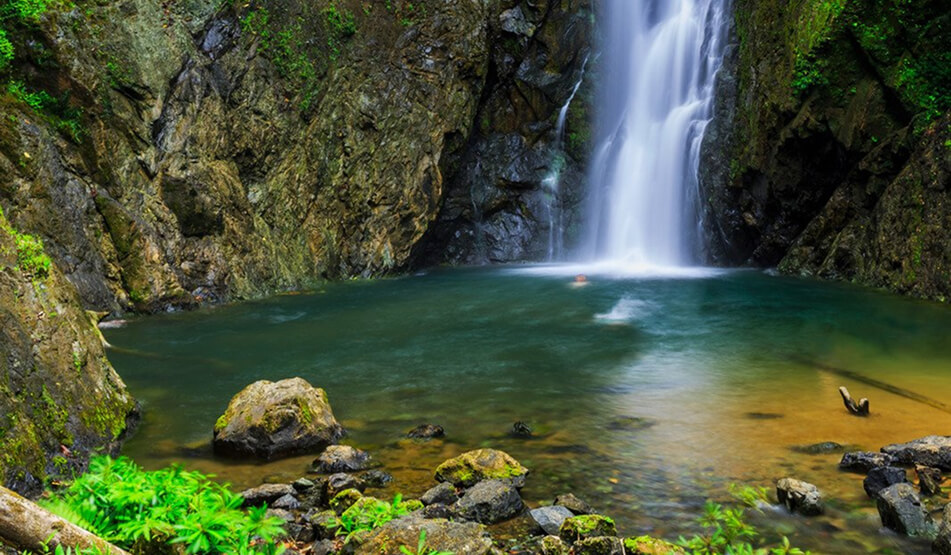
Korolailai Waterfall (Wailoku)
The Korolailai Waterfall in Wailoku is a favorite of the locals. Use the Sikh Temple in Wailoku as your landmark, and the trail starts from here.
The trail passes through local farms and secondary forest.
Also, the main fall features a flat rock ledge directly behind the curtain of water. You can sit there and let the weight of the waterfall pound your shoulders. It’s the best free spa treatment in the Central Division.
Navakavu Blue Hole
Take a short drive toward the Lami side of the bay to reach the Navakavu coastline.
A short drive toward the Lami side of the bay brings you to the Navakavu coastline. This area is a protected tabu (sacred/restricted) site under the local Iqoliqoli (customary fishing grounds).
So, you have to check with the village headman or local guides before entering the village.
Moreover, “Blue Hole” is a stunning turquoise indentation in the reef flats, perfect for snorkeling during high tide.
3. Hiking Suva: From Peaks To Reserves
Are you looking for some elevation and solitude? Do you have the fitness to explore heights? Hike these peaks and explore these reserves.
• Mount Korobaba Summit Hike
It is the best Suva hike experience you can have. Mount Korobaba rises above the Lami harbor, and from the mountain, you can enjoy a panoramic view of the Suva peninsula and Laucala Bay.
This trekking trail starts behind the Lami Cement Factory. So, the start is humble, but it is worth the grand view.
However, the hike is strenuous, and a return trip will take at least 2 to 3 hours. Also, here, you have to be very careful about the mud warning.
If it rains, the trail will become muddy and act like a vertical natural slide. Nevertheless, there are ropes in some sections to help you haul yourself up.
• Savura Forest Reserve
Savura Forest Reserve is like a hidden gem, and it is a quiet academic zone that you would love to explore. It is a vital area for the water supply of Suva.
Furthermore, because it has fewer tourists, the biodiversity of the place remains almost intact. Overall, the condition is meditative and peaceful.
4. Coastal And Island Nature
To cherish the coastal beauty and Island nature of Suva, you must visit the Nukulau Island and My Suva Park & The Seawall.
At these places, you will understand the relationship of Suva with its marine landscape. So, leave the mainland and walk the southern edge.
• Nukulau Island
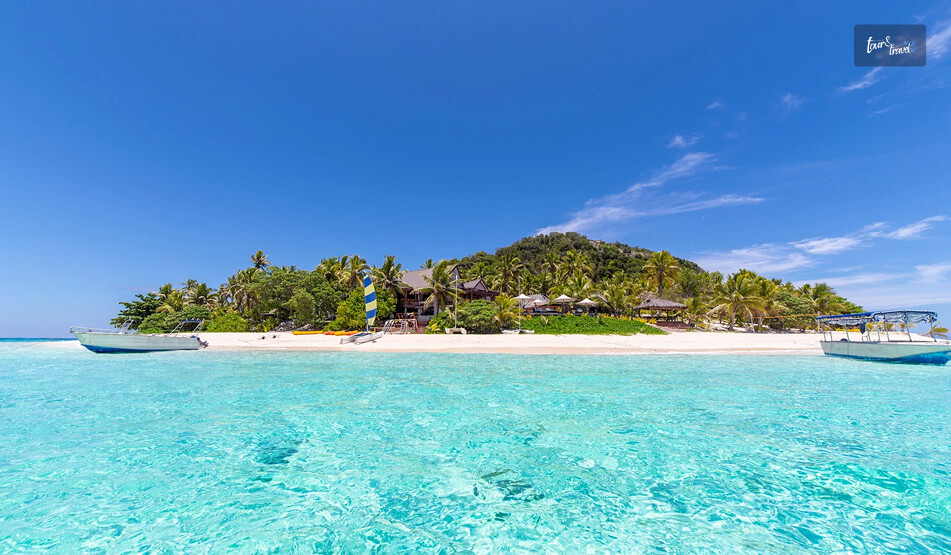
The Nukalau Island is small, but it has a long history. It has served as a quarantine station and a prison. However, ironically, today, it is not a dark tourism site anymore.
In fact, it is now a peaceful place for a picnic.
Sandbank, And The History Of Nukulau Island
When there is a low tide, you will notice a massive stretch of sandbank here. The sandbank is ideal for wading.
You will also find here the remnants of many old structures. Thus, you can blend history with a beach day.
Nukulau Island Boat Logistics
The boats in the Nukulau Island leave from the Suva Wharf or the Vatuwaqa area. Charter a long boat and enjoy a breezy ride across the lagoon for 20 minutes.
A longboat is a fiverglass boat with an outboard motor.
• My Suva Park And The Seawall
You don’t always need a boat to see the coastal beauty of Suva. You can visit My Suva Picnic Park and explore the rehabilitated mangrove walkways.
Here, you will find the most intricate root systems that protect the shoreline from decay.
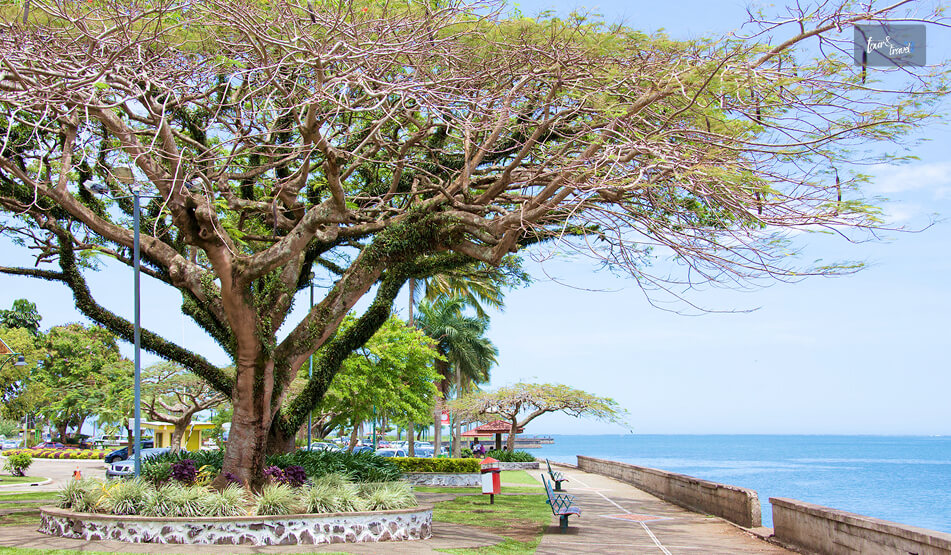
On the other hand, the Suva Seawall is the social hub of Suva City. Here, you will enjoy the sunset views over the peaks of Joske’s Thumb.
Also, don’t miss the view of Mount Korobaba in the distance.
During the sunset, the sky has the most fiery shade of violet, and looking at that, you can end a day of exploration on a perfect note.
5. Urban Greenery: Thurston Gardens
Suva Botanical Gardens, or the Thurston Gardens, is an urban green space. The place got its name in 1976 after Sir John Bates Thurston, the founder of this botanical garden and the fifth governor of the city.
You can see diverse fauna in this botanical garden. It has water lilies, colorful gingers, ferns, and palms. It is also home to a prominent bat colony. In this context, you must know that bats are the only native mammals of Suva.
Currently, the Fiji Museum maintains this urban park, and other historical landmarks in the park are the bandstand and the Clock Tower.
These were built to commemorate the first mayor of the city.
Suva Nature Guide And Tips From Experts
Now, only the locals and taxi drivers know that Mt. Korobaba, “Pacific Cement Limited” factory in Lami, is better than the “Korobaba trailhead.”
You can start your hike behind the factory fence. Now, this is what makes all the difference. The local and expert tips always help to enhance your Suva travel itinerary.
Do you want to know more such tips? Follow the details here.
1. Avoid Heavy Rain Days
The weather in Suva is either wet or very wet. So, while it’s not practical to wait for a sunny morning and you must embrace the rainforest bath, you cannot trade the day of or after a heavy rainfall.
When it rains, the trails and forest tracks of Suva become natural and dangerous mudslides.
2. Take The Bus To Colo-i-Suva If You Are Traveling On A Budget
You don’t need to take a taxi for $15 if you are traveling to Colo-i-Suva from the city.
As a budget traveler, you can take the Sawani Bus from the main bus station and ask the driver to drop you at the park gate.
The ticket price will be just $2.
3. Suva Keeps It Quiet On Sundays
Sundays are great for exploring the natural spots of Suva. These places are less crowded on Sundays.
Quite a surprise compared to the Western standards.
However, there is a catch! Public transport options are very limited on Sundays. So, you must pre-book a taxi for a smooth experience.
4. Follow The Sulu Rule
Suva is very particular about its customs and traditions.
Suppose you are visiting a secluded nature spot and you have to walk through a village, such as Korolailai, to reach that place.
Then, you will have to cover your legs with a sarong as a gesture of respect for the local community.
5. Be Aware Of Leptospirosis
The pools and natural swimming places in Suva have tropical water. So, you cannot swim in them if you have open cuts.
Tropical water carries bacteria, and if you swim in the water with open injuries, you may have Leptospirosis.
6. Use Your Skills To Negotiate
You cannot just agree to whatever the boat owner asks you to pay for a ride to Nukulau. You must negotiate the boat fee at the Suva Carrier Stand, which is near the Suva Market.
If you are taking a private fiberglass boat, a return trip will cost you around $80-$100 FJD.
7. Wear Mosquito Repellent
My Suva Park in Suva, or the mangrove areas and rainforest, has mosquitoes. Also, Dengue is a serious concern here.
So, you have to wear mosquito repellent, and you need to spray to get rid of the mosquitoes.
8. Stay Hydrated
The humidity percentage in Suva Rainforest is more than 90%. So, when you are hiking, sweating will be profuse.
If you are hiking for 1 hour or more, you need to carry around 2 liters of water.
Things To Know In Suva, Fiji, If You Want To Travel Like A Local
You have to embrace Suva, Fiji, as it is, if you want to travel like a local. Also, there are some stories, or rather facts, that only locals know.
For example, the Dakua trees are native to this place. However, the Mahogany Trees were later introduced to stabilize the soil.
Here is more about the reality checks, about the weather quirks, and the food of Suva if you soak in the true spirit.
1. The Reality Of The Rain Capital
The precipitation of around 3000 millimeters in a year, or a wet tropical climate, makes Suva the rain capital of Fiji.
In Fiji, it rains for more than 200 days a year.
So, if you want to explore Suva, you cannot wait for the Sun to shine bright. You have to embrace the rainforest swimming.
It means that you can get wet while it rains while exploring the rainforest, and do not waste time waiting for the Sun.
2. Picnic Like A Local In Suva, Fiji
If you are on a Suva food tour and want to indulge in the real flavors, you will have to picnic like a local.
Once you are tired after a long swimming session, you must buy a Bhuja or a spicy mix and have it with a long loaf as a snack.
So, when you visit these waterfalls, you must not shout or scream.
The guardians can be angry, and they can curse you if you shout and disturb them.
Along with this myth about the Liuliu or guardians, Suva is also known for its Lami vibe. It is at the base of the Mt Korobaba. It is the town that has the perfect fusion of a silent natural retreat and an industrial town.
In addition, the dark past of Nukulau is very intriguing in Suva, Fiji. It was once a quarantine island and later became a prison for coup leaders.
Moreover, this place has a stark contrast between the beautiful sandy beaches and a turbulent past. Thus, it has all the potential of becoming a dark tourism destination.
Do you want to learn more about the culture of this Fijian capital? Read my Suva cultural guide.
Discovering The Real Suva
The primal beauty of Viti Levu, the amber pools of Colo-i-Suva, the mud-slicked trails of Mt. Korobaba, and finding peace in the hidden Korolailai basin!
Also, the Fijian capital asks you to be a little dirty. So, wear your reef shoes, pack your mosquito repellent, and step off the pavement.
Moreover, allow the trees to embrace you and show you the real Suva.
Suva Nature Guide: Frequently Asked Questions And Answers (FAQs)
Here are the frequently asked questions and answers about the Suva nature guide.
1. Is It Safe To Swim In Colo-i-Suva?
Yes, you can swim safely in the freshwater pools of the Colo-i-Suva Forest Park. The pools here are in an inland rainforest, and they are not connected to the ocean. So, there will be no saltwater hazards. However, like other natural pools, these pools also vary in depth, and the surfaces can be rocky or slippery. So, you have to exercise caution when swimming in the natural pools here.
2. How Long Is The Mt. Korobaba Hike?
The Mt. Korobaba hike is around 6 Kilometers or 3.7 miles long. It is a challenging hike, and the elevation gain is around 404 meters. Furthermore, the red clay path is challenging, and the clay route often gets muddy. Also, based on your pace, you will be able to complete the trek in 2 to 3 hours.
3. Are There Crocodiles In Suva’s Rivers?
Unlike many other islands of the Pacific Ocean, the rivers of Suva do not have crocodiles. However, you can spot saltwater crocodiles in Suva, and these crocodiles come from the nearby Solomon Islands or Papua New Guinea. They visit the region due to the strong oceanic currents. However, their sightings are very rare.
4. Do I Need A Guide For The Hikes In Suva?
No, it is not mandatory to have a guide if you’re hiking in the Colo-I-Suva forest or areas near Suva. However, the trails can be slippery, and the presence of wildlife in Suva is abundant. Also, often the major trails are linked to minor trails, and staying on the right tracks becomes difficult. So, it is better to have a local guide for safety purposes, and they will also guide you about the flora and fauna.
5. How Much Is The Entry Fee For Colo-I-Suva?
The entry fee for Colo-I-Suva is around $1 FJD for the local adults and $0.50 FJD for children. However, if you are a foreign visitor, you will have to pay $5 FJD for adults and $1 FJD for children.
6. Can I Camp On Nukulau Island?
Yes, you can camp on Nukulau Island, but you need a permit from the Department of Environment in Suva City beforehand. The permit will cost you around $2 for 24 hours. Also, the island has a shade for camping. However, you will have to bring your own tent, food, and water.
7. What Wildlife Will I See In Suva, Fiji?
Suva is rich in wildlife. Places such as the Suva Botanical Gardens and Colo-i-Suva Forest Park are ideal for watching the birds, mammals, and amphibians. Birds to see in Suva are the Collared Lory (Kula), masked shining parrots, Fiji Goshawk, and blue-crested Broadbill. You will also find amphibians such as the Pacific Boa, Fiji Tree Frog, and Fiji Banded Iguana. Furthermore, while bats are the only native mammals of Suva, you will also find the Samoan Flying Fox, the Fijian Monkey-faced Bat, and the Mongoose. Moreover, Spinner & Bottlenose Dolphins, Banded Sea Krait, Spinner & Bottlenose Dolphins and Reef Sharks are the prominent marine animals found in Suva, Fiji.
8. Is Korolailai Waterfall Free?
Yes, the Korolailai Waterfall is free to visit. However, there is a border of a settlement around the waterfall. You can pay a small donation of around $2-5 as a polite gesture. Also, you will have to pay a taxi fee of FJ$15–FJ$25 to reach the Korolailai Waterfall from Suva City.
9. What Is The Best Time For Birdwatching In Suva?
Early morning is the best time of day for birdwatching in Suva. If you start birdwatching between 5 and 5:30 AM, you will find birds such as the Slaty Monarch, Fiji White-eye, and fruit dove. Season-wise, May to October is the best time for birdwatching. Especially, mid-August
10. Where Can I See Mangroves In Suva?
You will find the mangrove trees along the coastal areas of Suva. The easiest zone to access from the city is, of course, the Suva Seawall & Queen Elizabeth Drive. Another easy zone is the Rewa River Delta. It is around 25 km from Suva. It has an extensive stretch of mangroves. You can take a boat ride from Nausori to explore the area. Furthermore, Kalokolevu Village is a local community that proactively conserves the mangroves and is very particular about the restoration efforts. Moreover, the areas near the University of the South Pacific campus have mangroves. Low tide is the best time of the day to explore the mangrove forests. This is the best time for noticing the intricate root systems and the wildlife in the mangrove zone.
Sibashree is a travel, culture, and leisure writer who has been writing since the age of 12 and professionally since 2014. With more than a decade of travel writing experience and journeys across India and several parts of the world, she brings a deeply personal and thoughtful perspective to her work. A student of English Literature and Mass Communication, Sibashree has always viewed travel as more than movement — for her, it has been a way of understanding people, cultures, and herself. Her passion for spiritual exploration has also led her to many unusual and meaningful destinations over the years. Outside of writing, Sibashree enjoys watching European cinema, reading about global politics, and reflecting on the stories hidden within everyday places.
Before packing your first box, make sure to notify your utility and service providers of your move date and new address. This includes essential services like gas, electricity, water, internet, phone, and cable or satellite TV. Notifying them in advance ensures you receive a final bill for service at your old address so you can pay any remaining balance.
Provide the exact date the service should stop and your new address where the service should start. Also give them a forwarding address for the final bill, which may come later. Taking these proactive notification steps alleviates headaches from missed bills or payments during a busy move.
Avoid Bill Surprises While On The Go
Constantly traveling or relocating for extended periods can make paying and keeping track of utility bills a real headache. Set your accounts for automatic and paperless billing to avoid missing payments or getting hit with late fees. Have electric, gas, cable, internet, phone, and other bills set to autopay directly from your bank account every month while you are away, and make sure you have enough funds available to cover those payments?
Also, set up your accounts so that bills can be viewed and managed electronically online through each provider's website. Retail expert movers recommend routing all bills and statements to a trusted relative or P.O. box that will forward your mail to wherever you end up. With a few preparatory steps before locking up and heading out, you can travel worry-free knowing vital services won't be disconnected.
Forward Important Mail During Transitions
Whether you're moving across town or traveling overseas for months at a time, don't let lapses in mail service leave you in the dark on important communications. Before an upcoming move, submit a change of address to the post office so mail gets routed to your new residence or a trusted contact.
This ensures you receive mail from utility companies, banks, insurance providers, and other services during the transition process. If taking an extended trip, have the post office hold your mail until you return or forward it to a friend or family member who can scan and email you anything urgent.
This way bills, legal documents, and other correspondence don't pile up unchecked at your empty house while you're gone for weeks or months. Staying up-to-date on mail prevents unexpected issues.
Read Also: Corporate Travel Redefined: The Power Of Taxi Amsterdam For Business Rides
Streamline Services While Away
When you're preparing for an extended time away from home, look at temporarily suspending non-vital home services to save money. Cable TV and internet packages often tack on fees, so you end up paying for services never used.
Before an extended trip or during slow relocation periods:
Put cable TV services on seasonal hold - once reactivated, retain your previous channel package without added fees
Suspend internet if wireless access is not essential during your time away
Stop newspaper delivery which will pile up unread
Place gym memberships on hold status so monthly fees aren't wasted
Disable alarm monitoring systems with the assurance of quick reactivation
Pausing unnecessary utilities and home services over weeks or months gives savings that add up. Most providers let you conveniently pick up where you left off for seamless transitions.
As the Federal Communications Commission notes, be aware of any terms or conditions associated with temporarily discontinuing services. With some advanced planning, you can streamline the services you actually need and forego the rest while you’re away.
Get Seasonal Utility Rates For Long Trips
When planning for an extended trip spanning multiple seasons, take advantage of many utility providers' seasonal service plans to maximize savings. Call your gas, electric, and water companies to inquire if they offer special rates for customers who will be away for months at a stretch–common for snowbird travelers and those holding up somewhere warm for the frigid winter months.
Oftentimes providers give breaks on standard bills when they know in advance you won't actually be occupying the home to use services for a fixed duration. Find out what options are readily available for putting gas, electric, water, and even cable on hold status just until your return, even if you come back at a different time annually.
Checking on special cost-saving programs specific to extended seasonal gaps in service can pay off. This allows flexible travelers focused on warm weather destinations to save a little more towards their next adventure on the road.
Reconnect Services Upon Returning Home
Don't come home to a property full of shut-off notices! Be proactive by scheduling and confirming the reactivation of utility and home services shortly before your return.
A few days ahead:
Call the cable company to reopen service on your scheduled move-in date - this prevents lagging connections.
Have the power company resume electrical service by your designated date to avoid dark, warm apartments.
Reactivate your home internet modem and wireless router to get back online for work and entertainment needs as soon as you arrive.
Resume your garbage pickup on the day you move back to prevent waste pile-ups.
As cautioned by USA.gov's household services guidance, don't assume providers will automatically switch your accounts back on. After lengthy absences, directly request all services be transferred or started at your location effective on the precise date of your arrival to avoid any lapses.
Scheduling ahead alleviates having to reboot utilities one by one after coming home tired from travel. Instead, enjoy seamless access to functioning appliances, climate control, and amenities.
Planning Ahead Minimizes Headaches
Whether you're frequently on the go or planning an extended getaway, don't let utility billing and services fall by the wayside. With some advance preparation before transitions, you can redirect mail, suspend non-essential accounts, take advantage of seasonal rates, and seamlessly reconnect everything upon returning home. Staying actively informed and visible to providers while away reduces the chances of penalties, confusion, or disruptions down the road.
A few simple proactive tasks like automating payments or consolidating bills to one trusted advisor can alleviate countless headaches. Embrace solutions that simplify managing obligations from afar. The little time invested upfront in organizing your affairs makes for smooth travels every step of the journey.
Read Also:
Sands Of Splendor: Luxurious Desert Safari Experiences In Dubai
20 Of The Best Places To Travel In Africa In 2024
6 Best Destinations For A Safari In Kenya
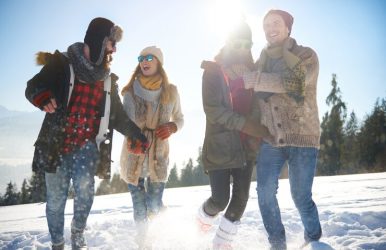
Winter vacations come packed with numerous fun activities. If you like skiing, this is the best time for you.
The season is cold, allowing you to wear the warm clothes you have stuck away for a long time. You get to enjoy the warm coffee and cozy evenings. You can also enjoy watching the starry sky at night as you keep warm around a fire. Those who love being outdoors during the winter have the opportunity to plan a fantastic winter vacation.
A successful vacation begins with proper planning. So, develop a checklist and prioritize the important things. Part of planning is packing all the items you will need during your winter trip, and there are several things to remember.
Here Are Ten Important Things For Winter Vacation
This article will present ten must-have things for winter vacation. This checklist will allow you to plan your winter holiday and enjoy the experience.
1. Medicines
Carrying your medicines is a vital thing when going on a winter vacation. It is cold, meaning you could get the flu. Carry an anti-fungal cream, a cold and cough syrup, a balm for the headache, and flu medicines. Because of the abrupt change in temperatures, you may experience various issues, hence the importance of being prepared for minor illnesses. It is also crucial to carry your menstrual pads and tablets.
2. Thermal Wears
It is vital to carry high-quality thermal wear when going on a winter vacation. The thermals maintain the warmth in your body during severe temperature drops. They are must-haves when packing for winter travel. Remember, thermal wear protects the entire body. It is allowed if you feel you cannot wear more clothes over the thermals, and the thermal wear will keep you warm.
3. Winter Jacket
Winter jackets are the most essential items for a winter holiday. The jacket forms an outer layer over your sweater or thermal wear, insulating you from the cold. A great winter jacket provides warmth throughout the trip. It is a vital addition to the packing checklist. So, choose down jackets or army-type jackets for more comfort. If you want a carry-on bag only, it will be wise to wear some bulkier items like the winter jacket. This will free up space for other things. Furthermore, if you wear bulky items like boots and coats, you can bring more layers in the bag to keep yourself warmer.
4. Shoes
No matter the time of the year you are traveling, carrying several pairs of shoes can be challenging and takes up space in the bag. Especially when traveling in the winter, packing several boots will only take up most of the space in the bag. You are not going to spend the whole holiday indoors. That means you will need quality winter shoes for the vacation. Your holiday will involve walking around and traveling.
So, pack winter shoes with warm socks to keep your feet warm. Wear high winter boots for more protection if snow is in your destination. Select a boot that works when working on the snow and a clear road. If you must pack several shoes, stuff them with gloves, hats, socks, and scarves to utilize the space inside.
5. Gloves and Socks
Ensure your hands are warm throughout by wearing gloves. It is easy to ignore feet and hands essentials when packing for a winter vacation. If you don’t pack gloves and socks, you leave your hands and feet vulnerable to colds and infections. If you are going away with kids, ensure you carry woolen mittens to keep their tiny arms warm. By packing several gloves, hats, and scarves, you will change your daily looks without needing too much space in the bag.
6. Backpack
Choosing a quality backpack or suitcase to keep your items is also essential. It should be light and enough to accommodate all your belongings. Choose a travel bag with several pockets to keep your things organized and categorized.
It is advisable to avoid carrying a heavy load because managing it is tough, and you may miss the chance to have fun. Sometimes, you must pack bulky and thick items when traveling in cold weather. Fortunately, you can utilize packing cubes and compression bags to reduce the space hoarders in the luggage. These items can help maintain small luggage and keep your carry-on organized.
7. Sweaters
A winter vacation packing list is not complete without packing sweaters. They are crucial because they provide warmth by adding protective layers to your thermal wear and jacket. If possible, it is better to carry a thick sweater for more warmth.
8. Thermo Flask Or Water Bottle
Another crucial item on your packing checklist is a thermo flask or a water bottle. You will need to carry water or something warm like coffee in case there are no coffee shops in the area. Taking warm coffee, tea, or water in the flask will give you the warmth you need to relieve the cold.
9. Sunglasses
Sunglasses may be an unlikely option for winter vacation, but they are also essential for packing. The morning sun and snow cause a reflection that could damage your eyes. Furthermore, just because the sun is not hot does not mean it doesn’t have UV rays. Therefore, sunglasses are essential items on the travel checklist.
10. Scarves And Caps
Make sure your head and neck are well-protected from the cold. So, you need to pack some caps and scarves for this. Carry monkey caps since they provide warmth for the head and neck. Even though they may seem unattractive, these caps are the best to protect the whole head region from the cold. Ensure you also pack woolen scarves for the same purpose.
Related: Must Pack Business Travel Packing List Along With Tips
Enjoy Your Winter Vacation
Going on a beach vacation during summer may be the easiest to pack. You only pack light-weight clothes, a swimsuit, and flip-flops, and you are good to go. However, packing for a winter vacation comes with some challenges. For starters, you must carry everything you need to keep yourself warm. You may also have a space problem because most winter clothes are bulky, and you must squeeze them in the carry-on. However, having a checklist is helpful since it helps you pack enough items in the bag.
Read Also:
Must Pack Business Travel Packing List Along With Tips
Why Travel Trailers Are The New Vacation Norm
Utah abounds in natural wonders that will astound even the most seasoned traveler.
Encompassing millions of acres of breathtaking views with sandstone arches, towering buttes, expansive canyons and valleys, surreal salt flats, and lush mountains, the state is home to five national parks: Bryce National Park, Arches National Park, Capitol Reef National Park, Canyonlands National Park, as well as Zion National Park.
It might seem that Alaska should be your first choice when looking for a place to live if you enjoy being outside. If you are not fond of colder climates, Utah's adventurous offerings might be more to your liking.
Let's just say that Utah has it all, with parks like Bryce Canyon, Arches National Park, and Zion National Park. Salt Lake City, one of the state's great natural wonders, even inspired the name of the state capital.
Furthermore, even though Utah recorded over 15 million visitors in 2022, the Beehive State is even more well-liked among recent arrivals.
Utah grew at the fastest rate in the United States between 2010 and 2020, according to U.S. Census data, primarily because of out-of-state migration. The state's economy is another major lure.
Utah's economy grew at the second fastest rate in the nation between 2017 and 2022, with the biggest industries being manufacturing, real estate, and scientific and technical services.
But what are the best cities to live in Utah? Utah has many desirable neighborhoods, each with its own distinct personality and redeeming qualities.
Here, we have compiled a list of some of the best places to live in Utah.
Best Places to Live in Utah
There are certain needs that go beyond demographics when looking for a new house. These include things like accessibility to commuter routes, crime rates, and access to healthcare facilities.
These needs apply whether you're looking for a retirement community or a suburban area in which to raise a family.
We have created a list of the best places to live in Utah based on all the factors important to you to make your life easier.
Park City
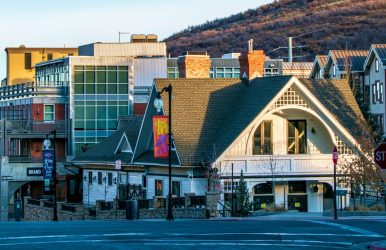
Our list of the best places to live in Utah starts with Park City. You'll have breathtaking views of the Wasatch mountains and the town's ski resort from your home in Park City.
Park City residents can access a variety of outdoor pursuits, including hiking, snowboarding, mountain biking, and multiple shopping establishments.
You will be enthralled by the town's magnificent museums and art galleries as you stroll around it.
Park City has emerged as one of the best places for families to live thanks to its year-round perfect weather and low crime rate. You will create lifelong friendships when residing in Park City.
Park City's unemployment rate is 2.8%, which is significantly lower than the national average.
You can't beat Park City's views and safety, even though its cost of living is about 86% higher than the US average.
Fruit Heights
One of the best places to live in Utah is the beautiful city of Fruit Heights.
Located right outside of Salt Lake City, this property offers plenty of space for outdoor enjoyment, a tranquil neighborhood, and stunning views of the mountains.
Living in Fruit Heights, you'll soon see how friendly the locals are to one another and how many eateries and coffee shops there are.
Fruit Heights' great school system, pleasant weather, abundance of recreational options, and picturesque surroundings are all highly regarded by its residents.
Fruit Heights' unemployment rate is 2.5% lower than the national average.
You can overlook this city despite its 31% higher cost of living than the national average due to its wonderful community and top-notch schools.
Greater Avenues
One of the best places to live in Utah for families in is Greater Avenues, a charming neighborhood in Salt Lake City.
With a population of about 17,000, this community enjoys the benefits of both a suburban atmosphere and many big city amenities, like restaurants and bars.
Greater Avenues is a great place for families to relocate because of its top-notch school system, low crime rate, and favorable reviews.
With an average value of at least six figures, families are well off in this area. If you enjoy living in the suburbs or downtown, you will adore The Greater Avenues!
Summit Park
Summit Park is among the prettiest cities in Utah. It is a stunning mountain town. Beautiful views of the surrounding mountains offer up from this serene, gorgeous town.
Residents of the town take pleasure in outdoor pursuits, including biking, snowboarding, skiing, and hiking.
You may expect to see moose, elk, and deer in and around the town. distinct from the large city.
Families will also love Summit Park because of its many parks, open areas, and top-notch educational system.
Summit Park has a 2.8% unemployment rate and a 58% higher cost of living than the national average. But Utah has so much to offer that the cost is well worth it!
East Bench
Next up is the homely Salt Lake City residential neighborhood known as East Bench. Nearly 7,000 people live in East Bench, which is at the foot of the Wasatch Range.
The neighborhood includes the Salt Lake Country Club and the Bonneville Golf Course. Families will enjoy a day at the Hogle Zoo, which is home to tigers and giraffes.
In East Bench, real estate prices do differ. This is advantageous because there are homes to fit every budget.
Go to Ambassador Way, where a four-bedroom, four-bathroom grand family home with an estimated cost of over a million dollars, if you have seven figures to play with.
A modest 2-bedroom family home with a sun-trapped garden might be a better fit for you if you have less money to invest. It costs just a little bit more than the average.
Snyder Ville
Located in the Wasatch Mountains of Utah, Snyder Ville is a rapidly expanding community. You can enjoy a variety of outdoor activities like hiking, biking, and skiing against the stunning backdrop of the area.
For its size, this little town has a lot, like restaurants serving fresh food from nearby farms.
It's connected to neighboring cities despite its small size, so you can always find what you need when you need it.
Snyder Ville is an ideal place to live in peace and quiet without having to worry about crowds.
Highland
One of the greatest places to live in Utah is Highland, east of Provo. Highland is home to well-known locations like Timpanogos Cave National Monument.
Highland is well-known for its picturesque surroundings, highly educated populace, and projected job expansion. With a 2.5% unemployment rate, it is significantly lower than the national average.
It doesn't get much better than living in a picturesque state like Utah, even though the cost of living in the Highlands is also 57% more than the national average.
Wasatch Hollow
Wasatch Hollow is a neighborhood located just south of Yalecrest. In Salt Lake City, this little suburb is regarded as the greatest place to purchase real estate.
As members of the millennial generation look to buy their first homes, it is growing in popularity. Thus, the value is increasing in addition to the high demand.
Wasatch Hollow's properties are what make the neighborhood so coveted. It's the kind of place you picture classic American avenues lined with trees, detached homes painted white, and children selling lemonade on the sidewalk.
Although the median home value is higher than the national average, more expensive homes appear to be listed for sale more frequently.
North Logan
North Logan, which has about 8,000 residents, is in Cache County. In addition to some of the greatest outdoor pursuits, like camping and fishing, North Logan provides its residents with stunning views of the mountains.
North Logan is renowned for its varied economy, close-by recreational opportunities, and lovely surroundings.
North Logan's unemployment rate is 2%, which is significantly lower than the national average.
By contrast, the cost of living is approximately 7% greater than the average for the country.
Considering the views of the mountains you'll get from home, this is still an amazing choice! North Logan is easily one of the best places to live in Utah.
Farmington
In Utah, Farmington is a small city home to about 18,000 people. You can engage in many outdoor activities, including hiking, mountain biking, camping, and fishing, while in Farmington.
Moreover, Farmington is home to some of the top public and private schools in the state! One of the best places to live in Utah is Farmington, if you're looking to relocate there for leisure.
Farmington is renowned for its lovely surroundings, close-by recreational opportunities, and wonderful climate.
Farmington has a 2.5% unemployment rate and a cost of living that is roughly 26% higher than the national average.
Cedar Hills
Cedar Hills is a quaint and serene suburb located west of Highland.
The neighborhood is home to ten thousand one hundred sixty-five people, who take great pride in maintaining the small-town atmosphere they have established.
On paper, Cedar Hills is a suburb of Salt Lake City, but it's not.
Utah's Cedar Hills is a very family-friendly place with lots of chances to spend quality time with your family.
The community is centered around the church, and gatherings based on religious beliefs inspire community members to get together.
There are a lot of public schools in Cedar Hills (78 to be exact) and this is one of the best places to live in Utah for young adults.
Foothill
It should come as no surprise that Foothill/Sunnyside, with a population of a little over a thousand, is Salt Lake City's safest neighborhood.
If not by name, everyone recognizes each other by face. Starting a family in this area is becoming increasingly popular for couples.
Since this is a Salt Lake City suburb, there are no sacrifices to be made.
There are adequate public schools nearby, and there is convenient access to the city for employment from this base as well.
Even though the average monthly rent is slightly less than $1,000, purchasing a home demands a more resolute investment because home values are higher than the national average.
The selection of properties is superb, ranging from cozy three-bedroom condos to expansive five-bedroom family mansions.
North Salt Lake City
Given that Salt Lake City is the epicenter of the universe in Utah, it only makes sense to end our list of the best places to live in Utah with a suburb near the center of activity.
North Salt Lake is every bit as charming as the other suburbs we've already shown you. This little town of its own has eighteen thousand residents.
There are plenty of homes on the market at any given time with views of Rotary Park, and the median home value is reasonable.
It appears that North Lake is the preferred location for millennials to purchase their first home, so be sure to return in a few years to see how North Salt Lake does on the list.
Eagle Mountain
Eagle Mountain, one of Utah's fastest-growing cities, draws young people and families looking for a superior public school system and a peaceful, safe atmosphere south of Salt Lake City.
With 50 square miles, the city offers easy access to open spaces and outdoor recreation, as well as 30 miles of hiking and biking trails.
Developers are also continuing to build new homes despite the low real estate inventory. Eagle Mountain's median sale price is $480,000.
"You have everything from ranchette properties to mountainside homes with amazing views of Utah Lake, Cedar Valley, and the Wasatch Mountains, to carefree living in beautiful townhome and condominium communities," said Connie Elliott, a realtor.
Draper
The primary attraction of Draper is its thousands of acres of open spaces and protected land, which makes it a sanctuary for those who enjoy an active lifestyle.
The city is renowned for its growing cultural scene and family-friendly amenities.
The Point, a multi-billion-dollar mixed-use development with hotels, a retail promenade along the Jordan River, thousands of housing units, offices, and green spaces with hiking trails, one of the most significant real estate developments in Utah, was recently given the green light by Draper's government.
Wrapping Up
Utah provides a wide range of outdoor recreation opportunities throughout the year, with five national parks serving as highlights.
Utah, which the U.S. Census Bureau listed as one of the states with the fastest growth, is a significant hub for government services, mining, information technology, and cattle ranching.
Provo, West Jordan, Ogden, and Salt Lake City are among the best places to live in Utah. Utah's top universities include Utah State, Weber State, Utah and Brigham Young.
If you have thoughts to share or questions to ask about the best places to live in Utah, please leave a comment below. We would love to hear from you!
Read Also:
A Guide To Adventure And Nature: The Best Things To Do In Moab Utah For Outdoor Enthusiasts
Washington State Bucket List: 6 Amazing Attractions You Can’t Miss
From Museums To Parks: The Top Attractions In St George Utah





 Related