Are you planning a great weekend with your partner, maybe indulging in an enhanced sensory experience and some relaxation with Liquid Gold Poppers?
But you’re not sure which hotels are LGBTQ+ friendly?
Well, you might want to head over to some of the best Palm Springs gay resorts this month. If that’s what you are looking for, you’ve come to the right place!
Palm Springs is a fantastic SoCal retreat for a boys-only vacation with classic Hollywood glamor.
It was formerly the old haunt of Frank Sinatra and the Rat Pack.
This Coachella Valley resort town offers balmy days all year long, breathtaking scenery, quaint shops, a thriving nightlife, and an edgy art culture just a few hours’ drive or train trip from Los Angeles or San Diego.
If you want to know about the best Palm Springs gay resorts you can visit this month, you will find this blog helpful.
Keep reading to the end to learn more…
Best Palm Springs Gay Resorts To Visit In 2023!
Coachella is just one aspect of Palm Springs.
With notable LGBTQ events like Pride in November and Dinah Shore, a five-day lesbian music festival in April, it’s a trendy haven for homosexual travelers.
But if you can’t attend any of those activities, don’t worry.
Gay tourists may still have a good time in Palm Springs at any time.
Visit the farmer’s market, check out the newest restaurants, go hiking in the desert, or party in the LGBT pubs and clubs on the lively E. Arenas Road.
And if you are looking for a place to stay, there are several Palm Springs gay resorts to try out.
In this article, I have discussed the 10 best gay resorts in Palm Springs. So, without further ado, let us get started!
1. Santiago Resort
Here is the first one on the list of the best Palm Springs gay resorts that you should visit.
The Santiago Resort is the location where you believe you have passed into gay heaven.
This opulent private resort offers a getaway from your busy life, set at the base of the remote San Jacinto Mountains.
Although the resort is swimsuit-optional, it rarely leads to wild behavior.
You can be unclothed and take pleasure in a laid-back atmosphere at the same time.
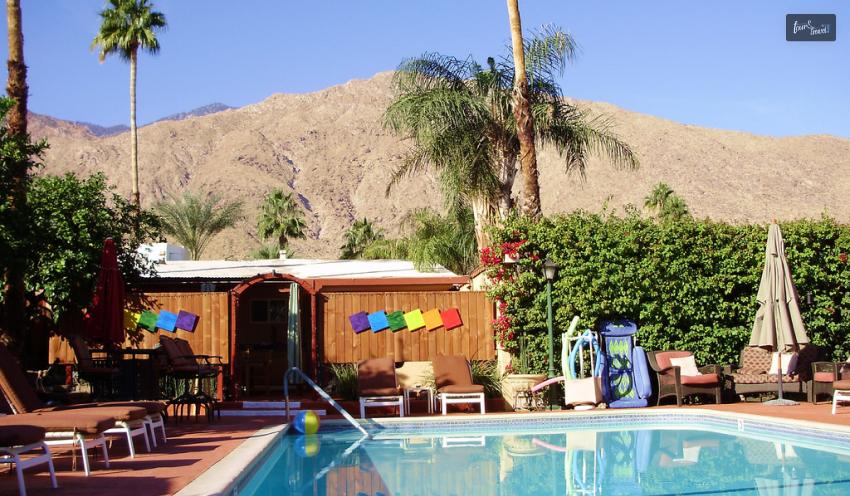
With natural vegetation, cacti, palm trees, and an amazing mountain vista, the property is magnificent.
After a few hours of sunbathing, you may cool off with an outdoor misting system and one of the daybeds beside the pool.
The rooms are roomy and come equipped with flat-screen TVs with DVD players, microwaves, and upscale bath products from Gilchrest and Soames.
Even a two-man rope hammock is available for you and your special someone to relax in. Its heated swimming area is the biggest in all of Palm Springs.
And the Santiago Resort spoils you rotten.
Along with free breakfast, you also get a free “Stay n Splash” poolside lunch every day, where you can order specialized sandwiches, salads, or wraps while relaxing by the pool.
A free pantry, replenished daily and accessible 24/7, is also available.
So, if you feel hungry, you can get anything to satisfy your craving.
If you really must leave this paradise, you can always rent bikes from the hotel and take a self-guided tour of mid-century modern buildings, finishing with lunch at El Mirasol for tacos and margaritas.
2. East Canyon And Spa
Consider East Canyon and Spa as a place to unwind and let go.
An acclaimed, homosexual-owned luxury hotel that previously catered mainly to gay men is now open to all kinds of couples.
Although this hotel is small in comparison to some of the others in the area, East Canyon more than makes up for it with its opulent design.
The 15 rooms are sleek and contemporary, with large, comfortable mattresses, roomy bathrooms, a television, a desk, and, if you choose a Grand or King suite, a living area.
Additionally, a free happy hour is offered every evening at five o’clock near the heated pool. Join the other guests for wine or cocktails.
You may even approach that attractive boy you’ve been admiring from a distance and ask him to spend some time alone in the jacuzzi with you, with a little liquid courage.
If you’d rather pamper yourself than interact with others, use the on-site spa and schedule a massage.
For even improved skin, consider getting a facial.
Afterward, continue the peaceful vibe by soaking in the Jacuzzi or reading a good book in the reading room.
If you want to see a play on a night out, the Palm Canyon Theatre is only a short walk or Uber ride away.
Enjoy a delicious farm-to-table meal at the ever-favorite Workshop Kitchen + Bar before the play.
Before heading to Arenas Road for late-night partying, stop by Bootlegger Tiki or Truss & Twine for craft cocktails.
3. Tortuga Del Sol
The Tortuga Del Sol hotel, owned by Ricardo Gomez and Robert Petro for about 17 years, is a recognized destination for relaxation.
It is situated in the Tahquitz River Estates area and has a Spanish/Mediterranean feel.
The area also boasts serene scenery with lovely palm and citrus trees, a Zen garden, and incredible mountain views that calm the mind.
And speaking of a more natural setting, the property is optional when it comes to clothing, so you’re free to be as bare as a jaybird.
Swim in the heated pool or gather some buddies to relax in the 10-man jacuzzi.
You don’t want to leave your pet at home, do you? Tortuga Del Sol is pet-friendly, so you don’t have to. You can also earn points.
Not because you brought your dog or because you were naked. But because of the hotel’s rewards program.
Therefore, it benefits from returning frequently and being a devoted guest.
4. Bearfoot Inn
The Bearfoot Inn, which opened in 1956, is the only gay hotel in the storied Movie Colony district and is a short stroll from East Arenas Road, the heart of Palm Springs’ gay nightlife.
This hotel is clothes optional if you want to be at the center of the vibrant homosexual scene.
The private suites include a full kitchen and a private balcony, so guests with special dietary needs and food allergies can prepare their own meals instead of eating out or ordering room service.
With amenities including:
A complimentary continental breakfast,
A heated saltwater pool,
Free access
The hotel’s cutting-edge fitness center,
Workout Gym
Moreover, guests can also count on a few extra pleasures.
5. All Worlds Resort
Next on the list of the best Palm Springs gay resorts is All Worlds Resort. It is the place to stay if you wish to roam around unrestrictedly in your natural state.
It’s well known as the largest gay men’s clothes-optional resort in Palm Springs and sits in the heart of the historic Warm Sands District.
However, this resort offers more than just the option to roam about in your knickers.
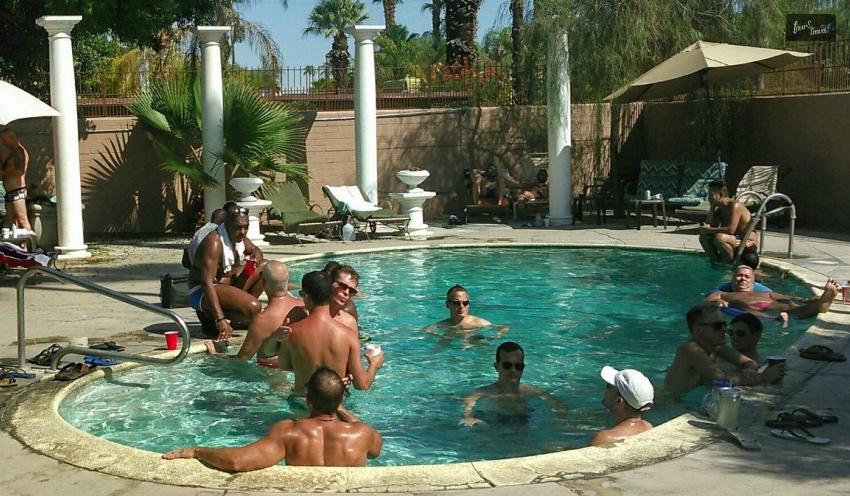
First, it’s enormous, with two properties and five pools (including a reflection pool).
You can even find cabanas spread across the grounds, two hot tubs, a volleyball court, two playrooms for adult entertainment, and community showers.
If you make new friends while visiting and want to invite them over to enjoy the party, they also sell day and night passes.
The day for sin is Sunday. The hotel has a wild BBQ pool party with live DJs, Go-Go dancers, and grilled hot dogs and hamburgers.
If you get tired of the pub scene, the resort is a fantastic option because it stays busy until after sunset.
Since you can relax by the pool in your boys’ without clothing, why would you go out?
6. Desert Paradise Resort
The historic Warm Sands neighborhood is home to the campy-yet-fun Desert Paradise Resort.
This is close to a number of lively gay bars, posh restaurants, and a few casinos if you’re feeling lucky.
The resort apartments were created by the proprietors with homosexual culture in mind as they paid respect to well-known LGBT icons like Judy Garland, Bette Midler, and Madonna, to name a few.
Every room boasts a California King bed, mirrored headboard wall, spacious shower, and a flat-screen TV with 15 pornographic channels for your entertainment.
Each room also features a painting of its namesake on the wall.
Take a stroll about the grounds after checking in; it is an exotic, tropical wonderland with 19 fountains and two koi and turtle ponds.
After that, take a dip in the heated pool or Jacuzzi next to the fireplace.
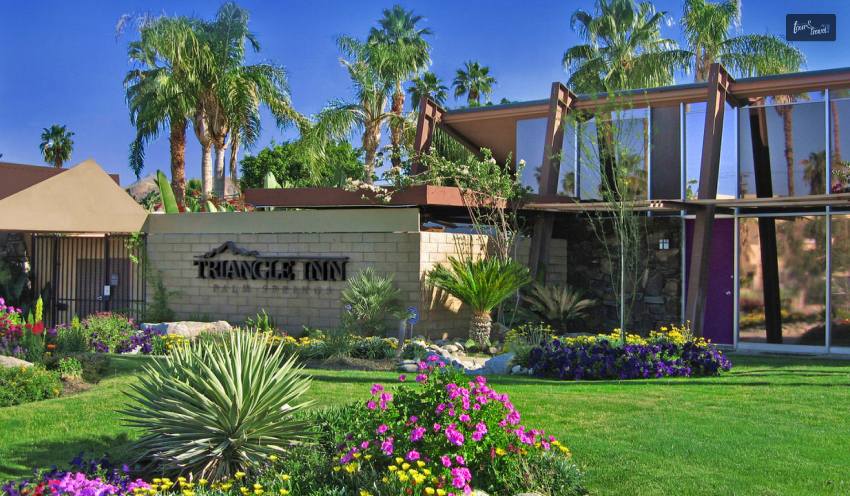
7. Triangle Inn
Only nine rooms make up The Triangle Inn, and most of them come with a complete kitchen and dining area.
Larger groups looking to stay together under one roof can also rent a four-bedroom property.
With a fenced compound, this inn offers seclusion so you can live your best life.
You receive a free newspaper every day, and the staff is happy to share local Palm Springs knowledge with you.
The Moorten Botanical Garden or Baristo Park are both great places to spend the day exploring.
Additionally, the renowned Palm Canyon Drive is a short distance from the Inn and has a busy street fair every Thursday.
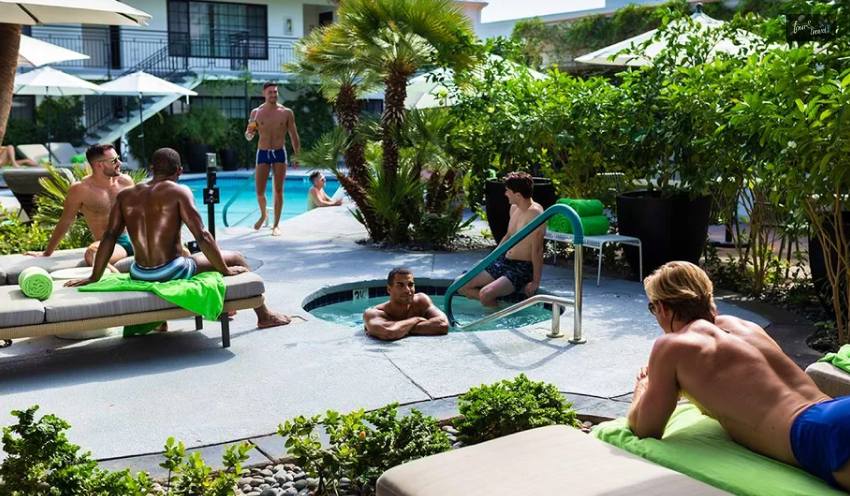
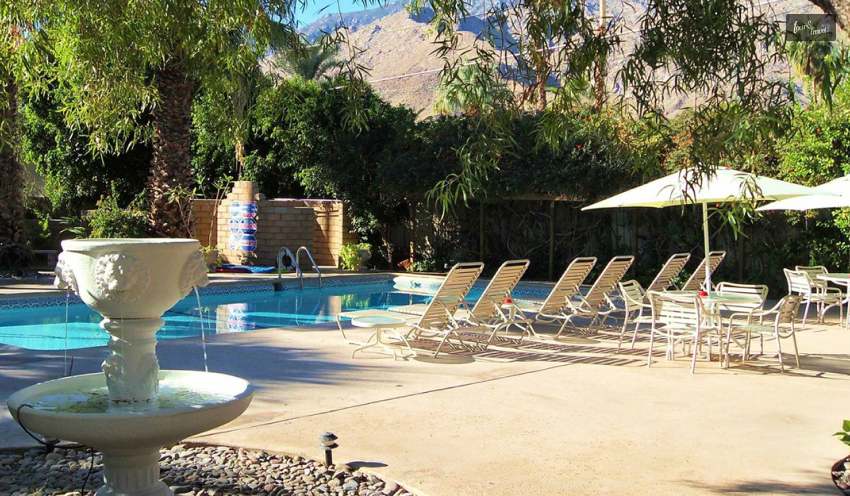
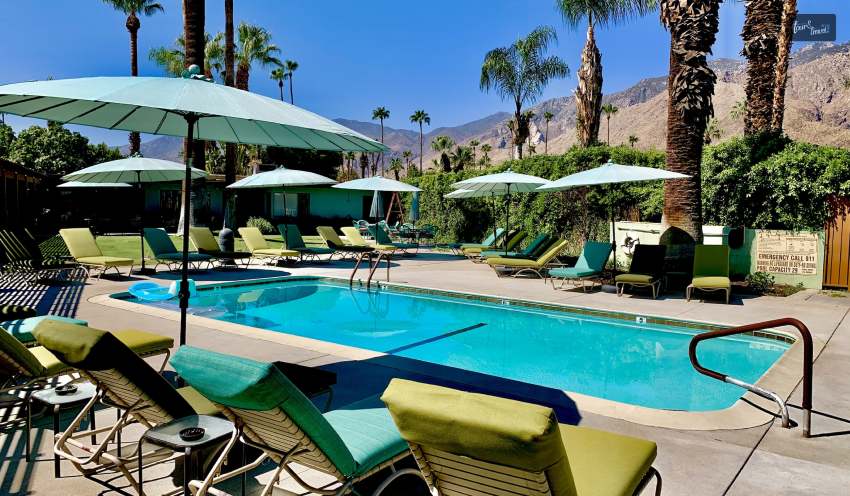
The complex includes a pool, a Jacuzzi, and a sizable sundeck.
Do a few laps in the pool or hit the gym after working on your tan to feel less bad about indulging while on vacation.
During your stay, you can also join up for yoga lessons and rent bikes.
8. Descanso Resort
The Descanso is undoubtedly one of the best gay resorts in Palm Springs.
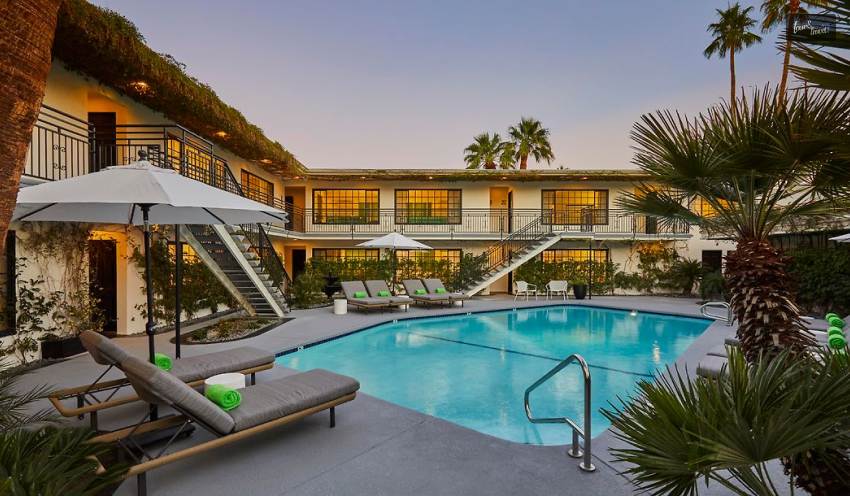
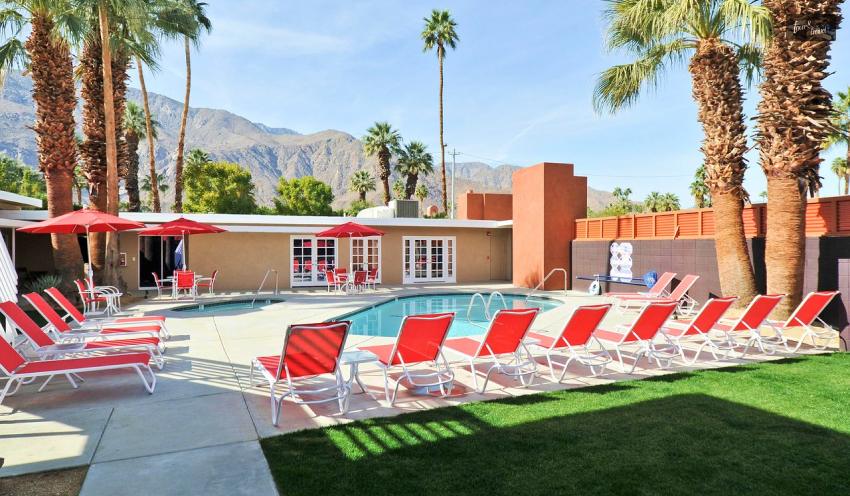
This newly renovated gay men’s resort in Palm Springs pays homage to the golden age of old Hollywood while maintaining a contemporary ambiance.
The Descanso’s extensive list of resort amenities regularly leaves visitors in awe, including the privacy fencing that surrounds the site for enhanced security.
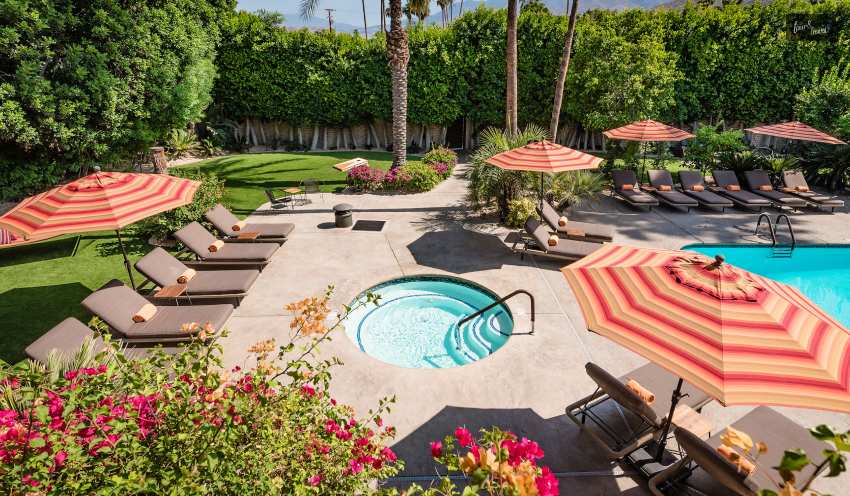
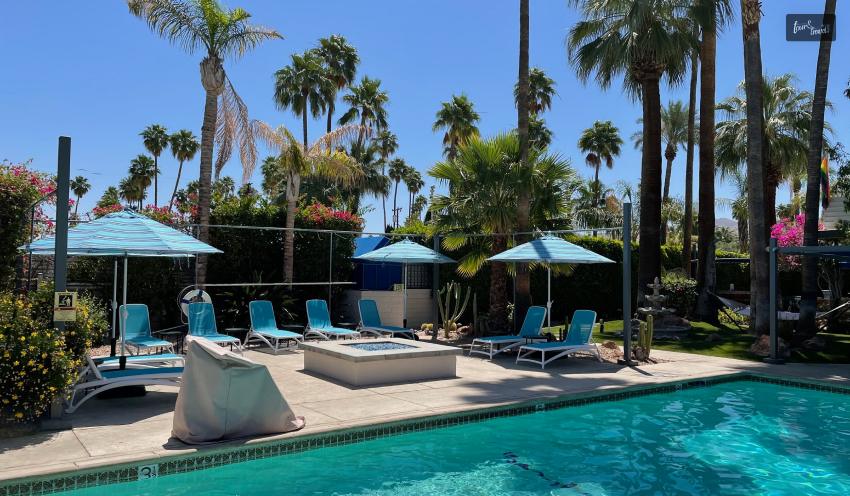
Or the heated pool, outdoor spa, or misting system for extra cooling from the desert heat.
Additional amenities include the shared outdoor fire pit, poolside daybeds, and beautiful landscaping with native plants and trees.
Did I also mention the cantina with its gratis appetizers and drinks? Or the complimentary Weekend ‘Wine O’Clock’ Happy Hour and “stay and splash” poolside lunches.
The resort also features electric vehicle chargers on the grounds for those eco-friendly gays who enjoy having fun.
Numerous contemporary rooms and suites are available, including poolside and balcony accommodations.
If you want to go all out, you can also book a balcony deluxe suite. It features a king bed and a daybed and can accommodate up to three people.
Another feature is a large bathroom with a standalone tub and breathtaking mountain views.
The rooms sleep two people and have one king bed. Every room is smoke-free.
All accommodation options include fast Wi-Fi, a refrigerator, an iron, a safe, and a hairdryer.
Descanso takes great pride in its people and world-class service.
The hotel provides a welcoming environment for homosexual men. It allows guests to feel comfortable being themselves.
This welcoming atmosphere also encourages customers to enjoy the hotel’s unparalleled leisure facilities.
9. El Mirasol Villas
Gay males in Palm Springs are reportedly drawn to the El Mirasol Villas Resort.
Although it’s not a derogatory assertion, it’s difficult to dispute El Mirasol Villas Resort’s right to make it.
It features one of the most all-inclusive resort settings in Palm Springs, or really anywhere. Howard Hughes first built the hotel in the late 1940s.
The property features stunning starry skies at night and mountain vistas throughout the day.
The bungalow-style studios and suites come in a range of lodging options, from straightforward studio rooms to 2-bedroom suites.
Each includes a desk, refrigerator, flat-screen TV, and DVD player, plus a California king bed. Some suites also include wet bars, microwaves, sleeper sofas, and private patios.
The premier two-bedroom bungalow accommodation includes a kitchenette, two private patios, two bathrooms, and two bedrooms.
The resort’s grounds include a lovely garden with citrus trees and a misting system for outdoor comfort.
The hotel’s outdoor space features two swimming pools, a 10-person jacuzzi, an outdoor shower, fountains, and fires. Even a eucalyptus steam room is available.
Many hotels may brag of having such a long list of amenities.
It also offers first-rate service and a gay-focused experience. Just don’t hold it against me when you fall in love with the way of life and decide to migrate to LGBT.
10. Vista Grande Resort
The Vista Grande is the last, but certainly not the least, on the list of top gay hotels in Palm Springs.
With its amazing views of the San Jacinto Mountains, the Vista Grande Resort is aptly named.
For gay guys seeking a welcoming environment that caters to like-minded people.
They look for a place where everyone is free to let loose and be who they are, without inhibitions. This clothing-optional resort is a paradise.
The site features three heated swimming pools, plus a “pleasure garden.” It also has a large steam room and a hot tub.
The resort’s 29 rooms include suites, studio flats, and cabana-style rooms.
The rooms come equipped with a flat-screen TV, air conditioning, a phone, a safe, complimentary toiletries, and bathrobes.
They also include a full kitchen or kitchenette. Along with free parking and Wi-Fi, complimentary breakfast is also included.
They also offer bicycle rentals and daily housekeeping.
Given Palm Springs’ generally open stance towards the LGBTQ population, The Vista Grande has been in business for 37 years and is one of the top options for homosexual males in the city.
It’s a terrific site to start your exploration of Palm Springs.
You are almost certain to find no friendlier location, nor one that goes more out of its way to make LGBT customers feel like royalty.
Bottom Line: Stay At Palm Springs With Pride!
If you were searching for the best Palm Springs gay resorts to visit this Pride Month, I hope this blog helped.
If you have any other questions, feel free to let me know. All you need to do is scroll down to the bottom of the page.
Then leave your queries and comments in the box below. And I will be there to answer them all for you!
Read Also:
10 Best Hotels In Sanibel Island – Tour And Travel Guide
Top 6 Most Popular Wendover Hotels In West Wendover
Ankita Tripathy loves to write about food and the Hallyu Wave in particular. During her free time, she enjoys looking at the sky or reading books while sipping a cup of hot coffee. Her favourite niches are food, music, lifestyle, travel, and Korean Pop music and drama.
I was going through a recent report by Ernst & Young (EY).
It was about how generative AI is changing the tourism industry.
The report features data from the recent WiT Singapore conference. It said that around 60% of travelers from the Asia Pacific use AI tools to research and book travel destinations.
Furthermore, many airlines, hotel chains, and travel booking platforms are using AI for better data management, analysis, and revenue management.
Moreover, the use of AI is offering a customized experience with UX (user experience) highlights, such as voice-based interfaces and personalized itineraries.
Thanks to these efficient virtual assistants, AI is also improving member engagement in corporate travel by making booking easier and personalizing itineraries.
There is a reason why names such as Kayak, United Airlines, and Concur Travel are using AI for travel booking, information updates, and more.
Hi, in today’s blog, we will talk about the role of AI in member engagement in corporate travel.
Why Is AI In Member Engagement Crucial For Corporate Travel?
From creating a personalized visual identity with an efficient profile picture-making tool, such as PFP maker, to offering real-time support and updates, AI is boosting member engagement in corporate travel.
1. Real-Time Travel Updates
Chatbots and virtual assistants are changing the way we used to follow up on our travel bookings and itineraries. They offer real-time support and updates.
Furthermore, a travel booking platform with AI uses predictive analytics to enhance your booking choices.
Also, the automated expense reporting eliminates all paperwork.
In addition, an AI-powered fraud detection mechanism helps to identify unauthorized expenses.
Thus, it ensures compliance with corporate travel policies.
2. Data Analysis To Avoid Delays And Disruptions
The machine learning algorithms of a travel booking or management system can identify cost-saving opportunities by analyzing large amounts of data.
Furthermore, machine learning boosts member engagement by identifying preferred travel modes and patterns.
Also, machine learning keeps you informed about anticipated delays, suggesting alternative routes and the best flight and hotel options in this scenario.
Thus, AI accomplishes two tasks at once. It boosts the operational efficiency of the travel organizer and improves the experience of the traveler.
3. Personalized Travel Recommendations
We all have our travel preferences.
AI analyzes the data and our travel search patterns to create personalized travel recommendations.
AI also takes cues from the previous booking and specific corporate travel policies of a company.
Thus, AI helps save time on the process of finding and booking hotels, airlines, or trains.
Moreover, AI improves employee satisfaction with cost-effectiveness.
So, the employer and the employee are both in a win-win situation.
4. The Use Of AI Makes Travel More Sustainable
Did you know that AI can analyze carbon footprints?
By analyzing carbon footprint, AI offers recommendations for environmentally friendly travel choices.
Thus, it supports corporates to achieve their specific CSR goals.
Also, companies can use these AI insights to optimize their travel budget and reduce environmental impact to make their travel experience more efficient.
5. Policy Enforcement
Every business has a policy or a set of guidelines regarding corporate travel.
AI can assess those policies, and it considers the same policies when completing travel booking and management.
In other words, an AI-integrated system ensures that the booking agrees with the specific corporate travel policies.
This is effective for compliance and cost-effectiveness.
However, this compliance is not just limited to the policies of a specific company.
An AI system knows the changing policies, travel advisories, latest occurrences, and announcements of a place.
Also, there can be wildlife conservation norms or sustainable tourism guidelines.
Breaking any of these can lead to severe legal implications.
When you are choosing a particular place, AI will share all these updates so that your travel experience is hassle-free.
What Are The Drawbacks Of Using AI In Member Engagement For Corporate Travel?
I have already mentioned that data assessment and analytics are important aspects of the use of AI in corporate travel management.
However, what if the data is incorrect?
In reality, there have been instances where incorrect data has put the traveler and the travel company in a difficult position.
In this context, I must share the example of the Air Canada case in 2022.
Jake Moffatt, a passenger, was assured by the chatbot that if he booked a full-fare flight for his grandmother’s funeral, he would be eligible to get a bereavement fare once the trip was over.
However, the claim was wrong, and Air Canada refused to pay the bereavement fare.
So, Jake Moffatt took the legal route.
Despite Air Canada trying to defend its position and establish the chatbot as a separate legal entity, the British Columbia Civil Resolution Tribunal held Air Canada accountable for the false dissemination of information.
So, Moffatt got a compensation of $812.02 from Air Canada. The BBC has also quoted the written response of the tribunal member, Christopher Rivers.
“It should be obvious to Air Canada that it is responsible for all the information on its website. It makes no difference whether the information comes from a static page or a chatbot.”
This incident highlights how any information mistake or “customer hallucination” caused by AI tools will make the concerned company accountable.
Good Data Hygiene And Avoiding Silos: The Future Of Using AI In Corporate Travel Management
A corporate travel booking or management company needs to be particular about good data hygiene.
That is why you have to ensure that duplicates are eliminated, formats are standardized, and formatting is accurate.
When the data is well-structured and clean, a travel management company can offer the best and most accurate travel policies, cost forecasts, and a better travel experience.
Data silos are another challenge in using AI in corporate settings. This happens when data is kept in disconnected, separate stores.
When data is fragmented, AI cannot offer a comprehensive view of anything.
So, the spending estimates and travel patterns will eventually go wrong.
So, the use or incorporation of data needs to be integrated for a comprehensive result of the search or query of a traveler.
Have you ever thought about how much global eco-tourism can help counter the ways traditional travel harms the environment?
The carbon footprint, inefficient resource use, and pollution from non-recyclable waste heavily affect the natural world around us.
Fortunately, the travel industry has recognized this and is taking decisive steps to protect our planet.
For example, when you travel to the UK and want to pick up a car hire at Birmingham Airport, companies now offer electric and hybrid vehicles to reduce emissions.
The same shift is happening with accommodations.
Green or environmentally friendly hotels are those whose activities have virtually no negative impact on nature.
Plus, they actively promote sustainable education and responsible tourism.
So, if you are planning to visit or move to an island for a while and want to take part in environmental initiatives, choosing the right hotel is a great place to start.
Here are the Top 10 sustainable stays in the United Kingdom.
Daylesford Organic Farm, Gloucestershire
Daylesford Organic Farm began as a simple passion for organic produce, helping in Eco-Tourism.
Over time, it has grown to become one of the most sustainable farms in the UK.
Spanning 2,500 acres, it sits in Gloucestershire.
Daylesford is the perfect place for a nature-friendly getaway with the whole family.
Here you can find charming stone cottages, stylish modern country houses, and cozy luxury rooms for two.
The hotel also often hosts interesting events.
Events include tasting evenings with sommeliers, master classes on cooking organic dishes, book clubs for intellectuals, and wellness yoga retreats.
Atlantic View Lodges, Widemouth Bay, Bude
Offering a calm, secluded holiday by the water, Atlantic View is also among the UK's eco-friendly hotels.
The picturesque coastline begins just a few steps from the cottages.
At the same time, the green cottages are surrounded by high cliffs, adding character to the Cornish coastline.
Perhaps their main feature is the comfortable terraces overlooking Widemouth Bay and the endless Atlantic Ocean.
All Atlantic View cottages are designed with the environment in mind.
It uses solar thermal panels as well as energy-efficient air pump systems.
Another sustainable feature is the green roofs, which fit perfectly into the area's hilly landscape.
They create a strong sense of unity between guests and nature.
One Aldwych, London
This eco-friendly option has all the qualities for environmentally responsible travel in the UK.
As a five-star hotel, One Aldwych has adopted green living in almost every area.
It includes a vacuum drainage system, energy-saving LED solutions, and a chlorine-free swimming pool.
It also uses eco-friendly materials inside and out.
Staying at this hotel takes you on an amazing journey into environmental reality.
It gets you thinking about the many ways you can reduce your emissions, just like One Aldwych does.
It is in the prestigious area of Westminster.
This hotel also shows that luxury and tradition can be completely nature-friendly.
The Grove, Hertfordshire
Located near London, this five-star hotel has earned its place on the list of green accommodations in the UK.
It occupies 300 acres of woodlands in Hertfordshire and is a member of The Leading Hotels of the World.
The Grove recently received the Green Apple Environment Award for its contributions to sustainability and environmental protection.
Its signature highlight is its 18-hole top-class golf course.
You can also enjoy on-site outdoor and indoor swimming pools, the Sequoia Spa with excellent service, and rooms with stunning countryside views.
The Ritz London
The Ritz-Carlton hotel chain adopted a responsible attitude towards nature in 1983.
The legendary Ritz in Piccadilly breeds bees of the old English breed Buckfast. They collect nectar in Hyde Park and the gardens of Buckingham Palace.
They also replaced almost all the lamps with LEDs and reduced their consumption of electricity, gas, and water.
Another important step they take to preserve the planet is recycling waste as a part of their Eco-Tourism practices.
They do it so that nothing ends up in a landfill.
It makes a hotel feel even more like a crown jewel of exquisite rooms.
Especially when you know that the hotel is scrupulously and conscientiously adhering to its green policy.
The Ritz also helps reduce its carbon footprint, earning it a Green Tourism Gold certification.
The Scarlet Hotel, Magwan Porth
On the Cornish coastline, between ribbed cliffs, lies The Scarlet Hotel.
It is one of the UK's eco-tourism destinations.
With many coves and bays around, it offers a sophisticated setting for a luxurious stay.
Not to mention the nearby Scilly archipelago, consisting of many small, cozy islands.
The Scarlet strives to offer guests maximum relaxation and tranquility while staying in the heart of this English wilderness.
The Ayurvedic spa attracts visitors from all over the country.
It features an outdoor terrace overlooking the sea, a log hot tub, and a natural pool carved into the rocks.
In addition, the hotel is completely environmentally friendly.
All interior elements are made only from natural or recycled materials.
Plus, the owners try to use rainwater, and electricity comes exclusively from renewable energy sources.
The Cavendish London Hotel
As a rule, premium hotels have little to do with the environment.
However, Cavendish and its staff stand out for their commitment to resource- and energy-saving technologies.
They have also shown consistency in green actions throughout the hotel.
Some of their environment-friendly features are:
Low-flow showers and taps
Energy-saving light bulbs
Sensor-activated hallway lighting
And hydrocarbon-filled refrigerators.
In addition, the local restaurant recycles 100% of its waste and practices sustainable food consumption.
They also support local farmers and producers with orders.
Heckfield Place, Hampshire
An ancient 18th-century English estate and biodynamic organic food and flower farm sits in Hampshire.
It is just an hour's drive from London.
The farm's experts grow grains, harvest organic fruits, herbs, and vegetables, and produce dairy products.
They then serve these items in the local restaurant.
It took the Chen family almost ten years to turn the estate into a luxury hotel.
While working on the interior, they tried to restore the building's former Georgian appearance and adapt it to modern needs.
Now, Heckfield Place has won several awards for its commitment to sustainability and supporting eco-tourism in the UK.
Its owners try to make maximum use of alternative energy production methods, including rainwater and natural materials.
They also try to reduce daily waste.
The Gleneagles Hotel, Perthshire
Opened in 1924, The Gleneagles is a grand private country estate set in 850 acres of beautiful valley land.
Here, nature has been preserved untouched, in its original form.
Everything around breathes true history.
The mighty mountains, the vast expanses, the golf courses, and the main hotel building itself!
At Gleneagles, luxury and impeccable service coexist with a pleasant, relaxed atmosphere created by friendly and courteous staff.
They are also attentive to nature.
The hotel uses pellets for heating, organic cleaning and washing products, and LED lamps for lighting.
Chewton Glen Hotel, Hampshire
In Hampshire, you can stay in a hotel located right in a tree!
It is in the New Forest National Park.
This luxury country accommodation, with spa facilities and large grounds, is the perfect place to reconnect with nature.
Each house hovers high above the ground.
Panoramic windows and spacious terraces also let guests enjoy amazing views from each luxury room.
The suites have a compact kitchenette.
Moreover, every morning you will enjoy breakfast delivered from the main hotel.
So, are you ready for sustainable travel in the United Kingdom?
Choose one of the above hotels for a nature-friendly stay.
Also, follow the basic rules of eco-responsible travel to help protect our planet!
Read Also:
Top 10 Airports In The USA: Navigating Excellence In Air Travel
9 Tips For Authentic Travel Experiences
20 Of The Best Places To Travel In Africa In 2024
Do you want to travel without breaking the bank? Leeds offers affordable options for city breaks that let you discover new things.
We've compiled some ideas for ways Leeds is an inexpensive city destination for singles, families, and couples. It offers inexpensive nights out to the fascinating year-round calendar of festivities as part of Leeds 2023. Most museums and galleries in Leeds are free to enter.
Let's explore and find out the best things to do in Leeds.
Things To Do In Leeds
cloudfront.net
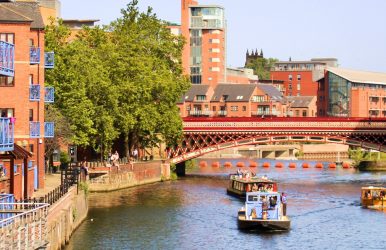
Leeds has gained a reputation in recent years as the liveliest city in the UK, with a broad and welcoming cultural scene. Leeds is a city full of culture, from venues and organizations that are breaking new ground to street art trails.
This is partially attributable to Leeds' abundance of museums and galleries, the majority of which offer free admission. A few of the best art galleries in the city may be found in the cultural district of Leeds, including the Henry Moore Institute, Leeds Art Gallery, Leeds Central Library, and Leeds City Museum, all of which are only a two-minute walk apart.
Leeds City Museum offers amazing exhibitions and artifacts that let you travel through time and experience amazing history. Leeds Art Gallery features exhibits of Victorian art, sculptures, paintings, and portraits. It also has one of the best exhibits of 20th-century modern art outside of London. The Henry Moore Institute, one of the biggest sculpture exhibitions in Europe, honors the art of sculpture. The Leeds Central Library holds a great collection of books from all over the world.
Things To Do In Leeds: Museums & Art
jaga.co.uk
There are always plays or other forms of entertainment in Leeds because of the city's outstanding theaters and touring companies. Leeds Grand Theatre - one of the UK's most stunning Grade II listed theaters - offers shows for as little as £15. This is home to Northern Dance and Opera North, the only resident dance and opera companies in the country outside of London. Some of the most well-liked Westend productions, including Sister Act, The Bodyguard, and Dirty Dancing, are also available online for a reduced price.
Do you need more excuses to visit? Leeds is hosting its Year of Culture in 2023, which makes it an extremely interesting year for the city. A calendar of events is planned for the entire year, all throughout Leeds, with the goal of "letting culture loose." There are countless options for events and activities that highlight the vibrant arts and culture of the city and its residents. Most events are either free or "pay as you feel."
Some of the highlights include 90 painters from throughout the city on display at Leeds Art Gallery. They will be showcased at the "The Leeds Artists Show" through April 30. Pay what you feel for "As You Are," a sound, walk-in musical experience designed by South African cellist Abel Selaocoe. It will be held for the Orchestra and Chorus of Opera North. There is still a lot to look forward to.
Things To Do In Leeds: Food & Cuisine
welcometoleeds.co.uk
Searching for a culinary-themed staycation? Leeds is the ideal place to be. The city, which is home to a booming independent food industry, has several cafes, bars, pubs, and restaurants. Leeds is the unofficial gastronomic capital of the North.
Not sure what you want to do? Visit Trinity Kitchen. Trinity Kitchen is a great spot to visit for lunch, supper, or even an afternoon snack. It features rotating street food vendors serving it all, from pizza to Pho. It has a laid-back, distinctive setting for you to enjoy lunch, dinner, or afternoon snack.
Kirkgate Market also has a similar street food setup. Kirkgate Market, where M&S first made its appearance, is currently the largest indoor market in Europe. Its recently renovated food hall is home to some delicious treats. There is the award-winning Manjit's Kitchen- a vegan Punjabi street food vendor. There is also Fat Annie's- an entirely plant-based restaurant serving American-inspired burgers and hot dogs. You must also visit the renowned Yorkshire Pudding Wrap Company to indulge in one of their delicious wraps.
Searching for new openings in the food and beverage industry? Leeds can take care of that. The brains behind Doh'nut, the greatest doughnuts in town, opened Things in Bread, a brand-new gourmet sandwich store right in the middle of the city center. You're onto a winner when you find traditional sandwich flavors made with premium ingredients and freshly baked bread.
Things To Do In Leeds: Parks & Greens
There are numerous ways to enjoy Leeds, so a trip to this city offers more than just the bustle of the city center. You can find some of the most breathtaking natural beauty in the UK beyond the nightlife, museums, shops, and restaurants.
Roundhay Park, a few miles outside the city center, has more than 700 acres of parkland, lakes, woods, and gardens. Get hot beverages and snacks from the on-site Lakeside Cafe. Visit the nearby Tropical World for a family-friendly island experience. In the desert, meerkats stand boldly, while exotic butterflies and birds are free to roam throughout the recreated rainforest habitat. Adult admission to Tropical World is £7.20, £3.80 for children, and kids under five enter for free.
One of the most well-loved tourist destinations in the city is the medieval ruins of Kirkstall Abbey. It is located just outside of the city. Tickets are £5 for the ruins and expanse of grounds to check out; children under five are admitted free of charge. The Leeds-Liverpool Canal runs alongside Kirkstall Abbey, so why not take a leisurely stroll down it first?
Things To Do In Leeds: Architecture & Heritage
travel-assets.com
Leeds is also an ideal starting point for discovering the splendor of the surroundings. The Yorkshire Dales National Park, which is home to some of Yorkshire's most famous landscapes and attractions, such as the Yorkshire Three Peaks, Ilkley Moor, Bolton Abbey, and the adjacent ancient towns of Harrogate and Knaresborough, is conveniently accessible from Leeds station.
The industrial towns of Yorkshire are also well worth a day trip. Nestled next to the Leeds-Liverpool canal, Saltaire is a UNESCO World Heritage Site. It's a great place to spend a leisurely afternoon strolling through its charming alleys or visiting the well-known Salts Mill. It's certainly worth the journey, with a magnificent variety of Hockney artwork, literature, flowers, cuisine, and 21st-century business, and free admission. When you take an inexpensive city holiday to Leeds, you may discover all of this and more.
Things To Do In Leeds: Lodging
nationalparks.uk
Book a stay at Art Hostel for consistently reasonable and distinctive lodging. It is the first establishment of its kind in the UK and the ideal spot to unwind after a strenuous day of sightseeing. Regional artists from East Street Art designed imaginative, reasonably priced, and distinctive lodging. It is a vibrant, artist-run company that spearheads avant-garde art initiatives and shows. The Art Hostel's themed rooms are all the product of the creative minds of Leeds-based artists working with regional artisans.
Wrapping Up
Leeds is a great place to take an inexpensive staycation in the UK because there is a lot to do there. The city is filled with events that do not break the bank. Use this guide to figure out how to spend your time here, whether you have 24, 48, or 72 hours.
If you have thoughts to share or questions to ask about things to do in Leeds, please leave a comment below. We would love to hear from you!
Read Also:
Brighton Bliss: Crafting Your Perfect Coastal Getaway Itinerary
Unmissable Urban Delights: Things To Do In Glasgow
UK City Hidden Gems: Things To Do In Manchester





 Related