
Aukana Pilimaya Or Aukana Buddha Statue (Avukana): A Standing Giant On The Kala Wewa Shore (2026 Guide)

I drove through Kekirawa and followed a road along the Kala Wewa Reservoir. 

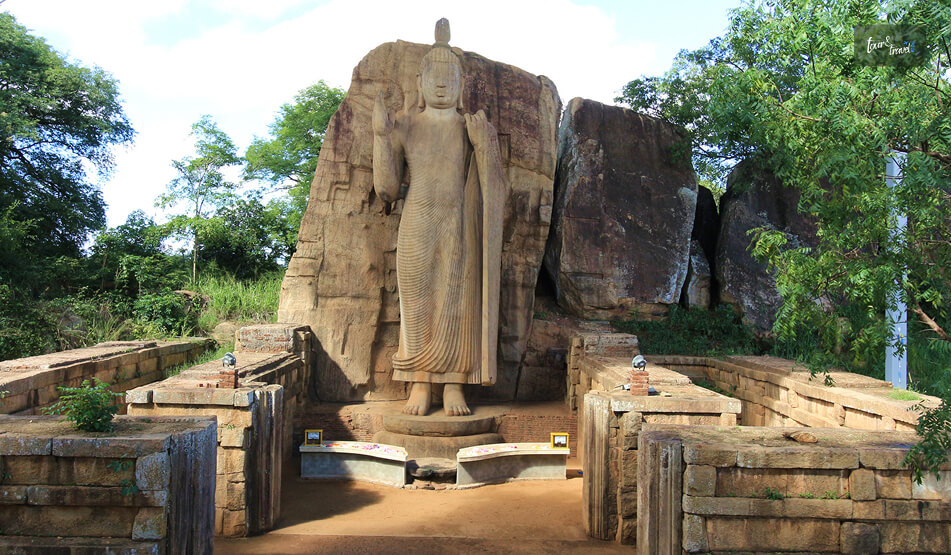
After a few small shops and a car park, I got a glimpse of the 12-meter-long Aukana Buddha statue. 

The history of this granite statue dates back to the 5th century, and King Dhatusena had it carved. 

Also, Aukana Pilimaya is one of the most significant Buddha statues in Sri Lanka, despite having fewer crowds. 

Do you know how the statue got its name? Aukana in Sinhalese means sun-eating, referring to how the first rays of the sun fall on this east-facing statue. 

Pilimaya means image or statue. 

In this article, I will discuss all the details of the statue, including its history, the timings of the visit, and more. 

Aukana Buddha At A Glance

Aukana Buddha At A Glance
DetailWhat to know
LocationNear Kekirawa, Anuradhapura District, North Central Province.It is beside the Kala Wewa reservoir.

Type

Standing Buddha carved from a granite rock face.Raised right hand in a variation of the abhaya mudra.

Height

Around 12 Meters

Date

5th century (King Dhatusena) is the usual attribution.However, there are debates about the actual date. 
Attached to rock?Yes, by a thin strip of stone behind the figure.
Managed byCentral Cultural Fund.
Time needed30–90 Minutes
Best timeDawn or early morning as the statue faces east. 

My Drive To Kekirawa And The Kala Wewa Shore

I traveled to Aukana from the Dambulla side. 

So, I took the A9 road north and turned off at Kekirawa. 

Furthermore, the last stretch on the journey ran beside the vast Kala Wewa. It was a tank built by Dhatusena. 

The Debates Over Who Made It Are Prominent From The First Sight

So, despite the debates, connecting the threads here is easy. The king who built a reservoir here can easily build a Buddha statue here. 

Also, Culavamsa, the medieval chronicle of Sri Lanka, has a record of King Dhatusena commissioning a jeweled diadem for the “Kalasela” image.

Many interpret it as Avukana. 

However, Leelananda Prematilleke, a great scholar of archaeology in Sri Lanka, is of a different opinion. 

I am quoting him from Asian Historical Architecture. 

“...that the image at Avukana is posterior to the 6th century.” 

Moreover, he found certain features of the statue in contrast to the earlier Madavacciya and Veheragala traditions.

About the features he found in contrast, he wrote, “stylistic advance indicated by the double chin, the ridge formation of the lips and the eye-brows, the sharp curve of the robe falling over the left wrist.

Here, one practical piece of advice I want to add. 

You cannot trust Google Maps completely here. Ask locals, especially when moving to the stalls and car park. 

The History: Then, Who Carved It, And When?

The honest answer is that the date is still debated. The most common attribution is the reign of Dhatusena, but there are competing views, summarised below.

Proposed dateAttributed to
5th century ADKing Dhatusena
5th to 8th century ADBroad range for the colossal Buddha tradition.
8th century ADSuggested by Paranavitana, based on a donor inscription on a stone slab.
12th century ADA popular belief credits Parakramabahu I.

First Sight Of The Statue

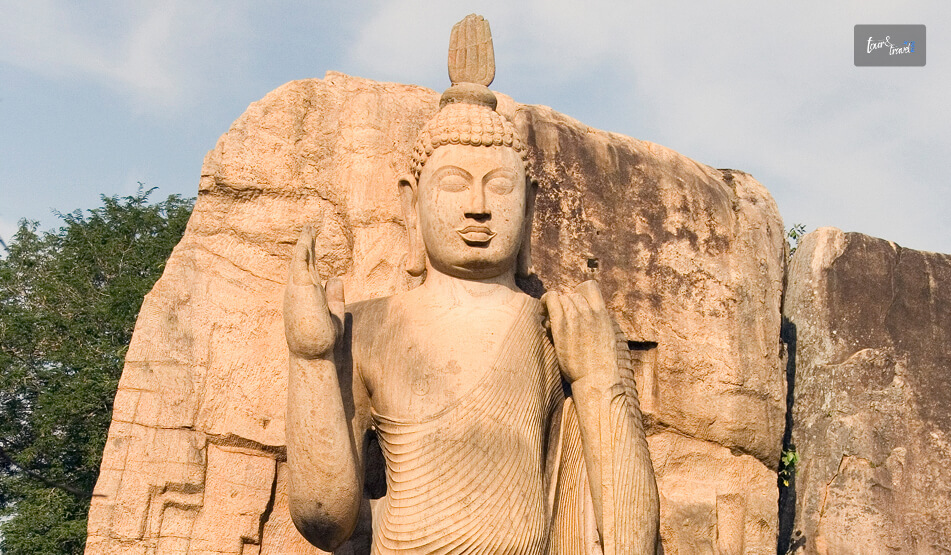
The standing figure of Lord Buddha here rises from a carved lotus pedestal. The expression on the face is calm, and looking at it instantly takes your weight away. 

The figure was tall. So, I went a little farther away and tilted my head back to see the entire statue. 

Next, I walked closer to the statue and noticed the detailing, including the folds of the robe that looked fine as fabric. 

The Detail I Would Have Missed Without Looking Closely

Art historians find the Abhay Mudra hand posture of Lord Buddha influenced by the Amaravati style. 

The same style is also visible in the bulging robe near his ankle. 

On the other hand, the detailing and the proportions of the body parts show prominent influence of the Gupta era.

So, when you take a photograph of this statue, you capture a fusion of notable art styles across various eras. 

The Hidden Deities Under The Pedestal

The pedestal was separately carved and pushed beneath the figure. 

In 1952, during conservation, archaeologists found a small chamber under it. The chamber had five bronze figures. 

Among them, Brahma was in the center, with Indra, Kubera, Yama, and Varuna around him. 

I found this the most human detail of the site, a small protective offering hidden under a colossal one.

Also, as I have seen in Gal Vihara, here also the religious integration of Hinduism and Buddhism is prominent. 

The Canopy Controversy

In 1976, the Department of Archaeology built a huge brick arch over the statue.

Constructed using around a million bricks, it was built as a shelter for the statue. 

However, in 1998, the Sunday Times published a report showing how unstable the arch had become due to tree roots penetrating through it and water seepage. 

It mentioned, 

The brick arch constructed in the ’70s by the Department of Archaeology has been rendered unstable by water seepage and is in imminent danger of collapse, thus threatening the 1521-year-old statue, located in the Anuradhapura District.

However, when I last visited the statue, the canopy was still there. 

Latest Updates For 2026 Visitors

Latest Updates For 2026 Visitors

The Central Cultural Fund (CCF) manages this site, and you can buy the e-ticket for a visit to this heritage site from the CCF. 

Sri Lanka received 1,535,122 visitors from January to August 2026. However, Aukana sits off the main circuit and stays quiet.

Tickets, Timings And How to Get There

Aukana is not part of the Cultural Triangle round ticket. So, buy an e-ticket from the CCF website or pay on site. 

ItemDetail
Entrance fee (reported)LKR 1,000 per person
DressShoulders and knees covered.Take your shoes off near the platform.
BusDambulla to Anuradhapura buses stop at Kekirawa.Local bus No. 548 covers the 19 km to Aukana.
TrainOnly four daily trains stop at Aukana, and the station is 1 km from the statue.
DistanceAbout 30 km northwest of Dambulla.Also, it is roughly an hour from Anuradhapura, Dambulla, or Sigiriya.

Tuk-Tuk Charges

Kekirawa-to-Aukana tuk-tuk charge is around LKR 900, including waiting time.

However, the actual price you need to pay will change based on how much you can negotiate. 

The statue is 800 m from Aukana village.

A One-Day Itinerary With Aukana

Aukana is an ideal mid-morning stop between the Sacred City of Anuradhapura and the cluster of the Dambulla Royal Cave Temple and Sigiriya Rock Fortress. 

TimeStopNotes
7:00 AMDepart AnuradhapuraStart early to beat the heat.
8:30 AMAukana BuddhaThe east-facing statue is lit well in the morning.
9:30 AMSasseruwa (optional)About 11 KM further.
11:00 AMKala Wewa shoreShort stop for views of the reservoir.
12:30 PMLunch in Kekirawa or DambullaSimple rice and curry.
2:00 PMDambulla Cave TempleContinue along the Cultural Triangle.

Nearby Places To Combine With Aukana

You can easily pair a visit to the Aukana Buddha Statue with Ras Vehera or Sasseruwa.

Ras Vehera has a similar Buddha statue in a standing posture, and it is in a jungle setting near Galnewa. 

In this context, it is worth reading what H.C.P. Bell wrote in the “895 edition of the Archaeological Survey of Ceylon.” He excavated Aukana Buddha in 1895. 

This image is of much the same height as its mighty fellow at Seseruwa, but in every respect has the advantage, and impresses the gazer far more strongly.

He further added, 

In contrast the Avukana statue, cut almost in full round from a boulder of about the same height, stands boldly forward, huge, assertive, awe-inspiring. 

The features, members, and robe are better chiselled, and the expression is not wanting in placid dignity. 

Exclusive of the nimbus (sirespota, 3 ft. 8 in.) and pedestal (3 ft. 10 in. in height, 15 ft. 2 in. in diameter), the figure rises 38 ft. 10 in. The Buddha stands in an attitude of blessing.

Also, the Dambulla Royal Cave Temple is around 35 km from Aukana Pilimaya. 

Comparing Aukana With Gal Vihara

If you are interested in the art history of Sri Lanka, you will find out one fascinating fact. 

The colossal Buddhas at Polonnaruwa’s Gal Vihara continue the tradition that Aukana represents. 

If you plan both, see Aukana first, then Gal Vihara, to follow the style forward in time. 

Share on Social Media

Sibashree is a travel, culture, and leisure writer who has been writing since the age of 12 and professionally since 2014. With more than a decade of travel writing experience and journeys across India and several parts of the world, she brings a deeply personal and thoughtful perspective to her work. A student of English Literature and Mass Communication, Sibashree has always viewed travel as more than movement — for her, it has been a way of understanding people, cultures, and herself. Her passion for spiritual exploration has also led her to many unusual and meaningful destinations over the years. Outside of writing, Sibashree enjoys watching European cinema, reading about global politics, and reflecting on the stories hidden within everyday places.

Leave a Reply

Your email address will not be published. Required fields are marked *

title-img Related

READ MORE ahangama

Ahangama: Why Is It More Than Just Another Beach Town In Sri Lanka? 

BY  Sibashree Apr 7, 2026

If you could only cover the beaches in Sri Lanka, you would know how Sri Lanka, despite being a smaller country, carries the spirit of the subcontinent, “Unity in Diversity.”  If the beaches in Jaffna were a lesson to understand the livelihood of the local fishermen, the Hiriketiya Beach, with its unique horseshoe shape, has been a surfer’s delight.  Now, I am going to talk about Ahangama, another popular beach town in Sri Lanka, famous for its cool vibe and surfer breaks.  Earlier, it was known for its 19th-century Buddhist temple and the art of stilt fishing. However,  this beach town, in the southern coast of Sri Lanka, is now also known as a lifestyle destination.  The likes of CondĂ© Nast Traveller are backing its charm as a cool fishing town.  Also, today, you may even ditch the best hotels in Galle, one of the major cities near the beach, thanks to the cafes such as The KIP, Marshmello Cafe or La Cafe Bistro.  Nevertheless, while surfing is Ahangama’s claim to fame and the budding food scene is the most happening thing right now, here are more things you can plan here.  What Are The Things To Do In Ahangama? Ahangama is now emerging as a really cool place, as, despite being a beach town in Sri Lanka, it has the right amenities for digital nomads.  While the surf and beaches offer the right dose of relaxation and the diverse communities offer the most eclectic experience, it also boasts many air-conditioned co-working and co-living spaces.  In fact, despite Galle getting more attention, if you are planning to try things to do in Galle, Ahangama, around 20 km away, will be a better base due to the presence of cool hotels, good food, and cafes.  Nevertheless, it is not just about breaking the waves.  Here are tons of other things to do in Ahangama. 1. Hitting The Surf The reef breaks of Ahangama are the best for intermediate and advanced surfers. The waves on the south coast are world-class.  Kabalana Beach itself is a great place to start your surfing expedition in Ahangama. Furthermore, you will easily get board rentals for around 800 LKR, and the sessions usually cost around 4000 LKR.  You can also surf near the Kabalana Rock, Sticks Surf Break, Rams Right, and Midigama.  2. Some Adventure At The Lamana Skatepark Lamana Skatepark is one of the best places if you want to experience the party scene in Ahangama.  Local skaters hit the bowl here daily. However, the live bands and the DJ music add some spunk to the air.  3. Swimming With The Turtles Dalawella Beach, a short tuk-tuk ride from Ahangama, is the place where you can swim with giant sea turtles.  Here, meeting the sea turtles was a different experience from how I saw them at the Sea Turtles Conservation Centre near Mount Lavinia Beach.  Also, some of the turtles here were around 50 years old, and they weighed around 200 kgs.  You can rent a snorkeling mask for around 300 LKR. However, stay away from feeding these turtles,  4. Safari At The Udawalawe National Park If nothing else, I will remember Sri Lanka for the endless and most delightful encounters with elephants.  I had mentioned spotting the elephants at the Udawalawe National Park as one of the best things to do in Ella.  However, as Ella is just 58 km away from Ahangama, you can also plan a safari if the latter is your base.  Along with the baby and mother elephants, you will also love spotting peacocks, monkeys, and buffalo here.  Moreover, when you are in Ella, don’t miss the iconic train ride on the Nine Arch Bridge.  5. Climbing Devil’s Rock With jungle walkways and eerie rock formations, the Devil’s Rock feels like a piece of Jurassic Park in Sri Lanka.  You will find this group of scary rocks as you go east from Ahangama and stop just before Midigama.  However, the only catch is that you will have to swim through the water with a medium current and during the low tide to reach Devil’s Rock.  The hike is also quite strenuous. So, it may not be the best thing to do in Ahangama if you are not a pro swimmer or fit hiker.  6. Scuba Diving In Unawatuna You have done diving in Raja Ampat, the Maldives, or Bali. However, scuba diving in Unawatuna is something different.  While you cannot expect the grandeur of these diving sites at Unawatuna, you can definitely find the Lord Nelson Shipwreck, exotic micro critters, coral reefs, and more in the water, at a temperature of around 20 degrees Celsius.  You can reach Unawatuna by taking a drive for just 15 minutes from Ahangama.     7. Cruising To Ying Yang Shack The term “hidden gems” has become so clichĂ© these days! However, places like Ying Yang Shack can still keep the magic of the phrase alive.  Here, you literally take a ride in a handmade boat, and our boatman confided that he had made this boat with his brother.  I, along with the other riders to the Ying Yang Shack, had a chilled beer in my hand as our boatman cruised through the water and talked about the lush greenery.  I also spotted a monitor lizard and majestic eagles.  Then came the sunset, and our boatman started singing, and his voice echoed as the bats and birds filled the red sky.  The day ended well as his family made the most delicious and spicy BBQ meal for us. Where Is Ahangama? Ahangama is located in the Galle District of Southern Sri Lanka. It is located between Unawatuna and Midigama.  Furthermore, this surfing and swimming paradise is located at a distance of around 3 hours from Colombo.  How To Reach Ahangama? The Bandaranaike International Airport is the closest to Ahangama. The distance is around 143 km, and that can be covered by a car in around 3 hours.  Furthermore, you can take a train from the Colombo Fort Station and take a train to Ahangama via Galle.  In addition, you can take a tuk-tuk ride from Midigama or Weligama to reach Ahangama. Why Is Ahangama More Than Just A Beach Town In Sri Lanka?  The elite food scene and the amenities for digital nomads make it more than just a beach town in Sri Lanka.  With brunch spots such as Black Honey and dining spaces such as Coco Kitchen, it can now beat Galle for trying local and fusion cuisines in Sri Lanka.  Moreover, it offers a steady 30-80 Mbps internet connection, and the cafes and air-conditioned coworking spaces here have the infrastructure to support the lifestyle of digital nomads.  Ahangama: Frequently Asked Questions (FAQs)  Here are the frequently asked questions and answers about Ahangama Beach Town. 1. Is Ahangama Better Than Mirissa?  It is hard to pick a favorite between Ahangama and Mirissa. Ahangama is famous for its surfing breaks and a laid-back vibe. On the other hand, Mirissa has a classic beach vibe, and it is more famous for whale watching.  2. Should I Stay In Ahangama Or Weligama? Ahangama is your go-to place if you want to enjoy a boho-chic vibe during a beach holiday. On the other hand, Weligama is more of a hub for surfers who are beginning their journey.Also, despite a happening nightlife, Ahangama is a quieter retreat at night as compared to Weligama.  3. What Is The Ahangama To Mirissa Distance?  The distance between Ahangama and Mirissa is around 16 km. The travel time to cover the distance is around 32 minutes by road. However, you can also take a train from Ahangama to Mirissa and travel the distance in 19 minutes. 
READ MORE What to do in Shinjuku

What To Do In Shinjuku As A First Time Traveler? 10+ Attractions You Cannot Miss In 2026 

BY  Sibashree Mar 31, 2026

Shinjuku is a very diverse part of Tokyo with a lot of activity and some rebelliousness, but it’s completely different in style and design compared to the other areas of Tokyo.  As far as contrasts go, Shinjuku is the most contrasting area of Tokyo. You can look at commercial 3D billboards within a couple of minutes’ walk to find very old traditional garden spaces. Shinjuku Station, as the busiest train station worldwide, could be described as a crazy madman's labyrinth for a first visit.  Yet, stepping outside into the bright neon lights of the Shinjuku area exposes a bright, fascinating area to play.  To help you get started, below is a list of “What to do in Shinjuku” as a first timer.  What To Do In Shinjuku As A First Timer?  Shinjuku is a city within a city. It’s loud, it’s crowded, and it’s occasionally a little messy. However, that’s exactly what makes it the most authentic urban experience in Japan.  Here are the things if you are feeling clueless about what to do in Shinjuku.  1. Retro Vibes At Kitamura Camera Kitamura Camera isn't a store. It's a vertical museum built around film cameras.  Rows of vintage gear line the floors, including rare glass lenses and models from the 1930s.  The place hums with quiet energy, untouched by digital noise.  It's tucked into Musashino Street, a lively area where shops mix with daily life. Even pros who shoot in RAW find it worth visiting for its raw craftsmanship and calm atmosphere. 2. The Roar Of Godzilla Road You'll see the Godzilla head before you hear it.   Its massive form stretches over Toho Cinemas, like a guardpost at the entrance to Godzilla Road.  The statue is a fixture in Shinjuku, visible from most sidewalks. Also, Hotel Gracery has rooms shaped like the monster itself. The Toho building bears the giant head of Godzilla, towering over the street corner.  That image sets the tone for everything around it, the kind of visual that sticks in your memory long after you leave.  Hotel Gracery offers themed rooms that let fans step into their favorite scenes.  The area feels unfiltered! Neon signs flash at odd hours, crowds surge during rush times, and alleys smell like food carts and rainwater mixing on pavement. 3. Sky-High Views (For Free!) Most of Tokyo's observation decks are rather expensive, but the Tokyo Metropolitan Government Building provides a magnificent view of the city for exactly zero yen.  The queue is very fast at that point. On a clear day, you may be lucky enough to see the famous Mount Fuji.  Even on a cloudy day, you will still enjoy the amazing view of the city.  Insider Tip: Definitely visit the cafe on the top floor. The matcha desserts there go very well with the sunset view of the skyline. 4. The World’s Largest Projection Mapping Show It's all about timing.  If you can, leave the Metropolitan Government Building just when the Sun goes down so that you can see a projection mapping show that has entered the Guinness World Records.  A huge skyscraper's side gets turned into a screen for colorful animations.  The Pac-Man sequence, which was a throwback to the arcade game, was the highlight of architectural lighting during our visit.  It was as if the entire building was a giant glowing game of Pac-Man. 5. The Shinjuku 3D Cat Forget about Hachiko. If you come near Shinjuku Station East Exit and lift your eyes, you will spot a Giant 3D Cat.  This digital masterpiece "resides" on a curved billboard, and its antics include playful meowing and looking down at the crowd of commuters.  It is remarkably realistic and even more enchanting when it shines under the night lights. 6. The Neon Labyrinth Of Kabukicho Welcome to the largest red-light district in Japan.  Kabukicho is a sensory overload in the most enjoyable way. Moreover, it is a center of entertainment that is always alive with bars, restaurants, and the newly changed Samurai Restaurant Time (formerly the renowned Robot Restaurant).  Though it has a somewhat rough image, it is a place that anyone who wishes to see the "Blade Runner" side of Tokyo should definitely go to. 7. Sing Your Heart Out At Karaoke Kan You haven't truly felt Japanese social rhythm until you're in a private booth at Karaoke Kan.  There, you rent a high-tech room with friends instead of singing to strangers like in Western bars.  Moreover, the selection is vast, thousands of songs in English and Japanese, and it's probably the most common cultural milestone for young adults. 8. A Natural Escape: Shinjuku Gyoen National Garden When the neon lights get overwhelming, head to Shinjuku Gyoen.  It's huge, with an area of more than 100 acres, and you might spend hours wandering through traditional gardens with French, English, and Japanese influences.  Moreover, the paths change shape every few minutes. So, you'll likely lose track of time. Must Try: Muroya offers real sweets or a cute sushi set inside the garden.  This place has been going strong for generations. It's more or less certain that your parents were here too, decades back. 9. Breakfast At St. Marc Cafe St. Marc Cafe is better than chains for local flavor.  Furthermore, their ChocoCro is flaky, buttery, and tends to draw long lines.  Also, breakfast sets cost under $10 and keep people energized during long city walks. 10. Nostalgia In Omoide Yokocho (Memory Lane) Tucked away near the tracks is a narrow alleyway known as Omoide Yokocho.  Years ago, it earned the nickname "Piss Alley," but today it’s a charming, albeit cramped, destination for yakitori and beer.  Moreover, the smoke from dozens of small grills creates a nostalgic atmosphere that feels miles away from the modern skyscrapers nearby. 11. Exploring Musashino Street While walking toward the camera shops, you'll likely find yourself on Musashino Street. It’s a delightful shopping district that feels exceptionally safe and welcoming. Shopping Tip: Look for the specialized Don Quijote here. Moreover, unlike the massive, chaotic branches, this one focuses specifically on products popular with tourists, making it a "souvenir shortcut." Yoi ryokƍ o, guys!  Read Also: What Are The Things To Do In Jimbocho Book Town? Visit The Best Book Stores And Cafes What Are The Things To Do In Nara? How To Plan A Two-Day Trip? What Is Oshino Hakkai Famous For? How To Visit It And More

READ MORE Dambulla Royal Cave Temple

Dambulla Royal Cave Temple: History, Entrance Fee, And More About This UNESCO Heritage Site 

BY  Sibashree Apr 10, 2026

The Dambulla Royal Cave Temple is gearing up for the much-acclaimed “Walk for Peace” which will start from 21st April, 2026.  Respected Paññakāra Thero and 12 other monks from the Maha Sangha will lead the walk.  Furthermore, this walk, originating in the United States, will spread the teachings of Lord Buddha, “Caratha bhikkhave carikam bahujana hitaya bahujana sukhaya lokanukampaya.” It can be roughly translated as a monk should always wander forth out of their compassion for the world and for the happiness and well-being of many.  After the inauguration of the event at Anuradhapura and special observations at Ruwanweliseya premises, the walk will start from the Dambulla Royal Cave Temple, and then it will slowly proceed to Kandy to continue the walk.  Now, it is no wonder that the Rangiri Dambulla Cave Temple has been chosen as the starting point for the walk.  With a history that goes back to the 3rd century BCE, and home to the Buddhist mural paintings and 157 statues, it remains one of the most important Buddhist landmarks in Sri Lanka.  Here is a detailed guide on my experience at Dambulla Royal Cave Temple, its significance, history, entry fee, and more!  The Dambulla Royal Cave Temple: Quick Facts  “Dambulla is an important shrine in the Buddhist religion in Sri Lanka, remarkable for its association with the long-standing and wide-spread tradition of living Buddhist ritual practices and pilgrimage for more than two millennia.” UNESCO World Heritage Convention.  Here are some quick facts about the most well-preserved and largest cave-temple complex in Sri Lanka. Number of Sanctuaries 5Buddhist Mural PaintingsAcross an Area of 2,100 m2Number of Statues157HistorySince the 3rd Century BCEThe Current Interior FormsBuilt in the 18th CenturyType of SculpturesPolychromeOwnership The Asgiriya Chapter of Buddhist monksMonument Protection “Protected Monument under the legal protection of the Department of Archaeology of the Government of Sri Lanka, which administers the Antiquities Ordinance of 1940 (rev. 1998) at the national level.”Entry Fee2000 LKRHours Open7 AM to 7 PM (The Ticket Counter Closes at 5 PM)Steps 300Average Climbing Time20 Minutes  Where Is The Dambulla Royal Cave Temple? (Along With Some Nearby Attractions) The Dambulla Royal Cave Temple is in Dambulla Town. Now, Dambulla itself is the gateway to many places to visit in Sri Lanka.  For example, the Hurulu Eco Park is just a distance of 45 minutes from Dambulla. On the other hand, it is just 52 minutes away from the Kaudulla National Park.  Furthermore, the distance between Dambulla and Kandy is around 73 km. So, many people include a visit to the Dambulla Royal Cave Temple in their itinerary of the things to do in Kandy.  Moreover, Sigiriya is just 17 km away. So, you can plan a combined trip of a visit to the Royal Cave Temple with a hike to the  Sigiriya Rock and Pidurangala Rock.  In addition, you will have a similar experience of exploring an ancient Buddhist monastery and its remains at the Ritigala Forest Monastery, at a distance of 35 km.  Also, if you are a cricket buff like me, don’t miss a visit to the Dambulla International Cricket Ground.  How To Reach The Dambulla Royal Cave Temple? Even if you are not staying in Dambulla, Habarana, or Sigiriya can be your base.  Habarana is just 22 km away from Dambulla, and Sigiriya is just 17 km away.  From both locations, you can take a private taxi or tuk-tuk ride to reach Dambulla Town, which has the Dambulla Royal Cave Temple in the heartland.  Furthermore, from Habarana, you will get Sri Lanka Transport Board - SLTB ICT buses to Dambulla.  Nevertheless, I took a tuk-tuk from Sigiriya to Dambulla, and it cost me around 2500 LKR.  What Is The History Of The Dambulla Royal Cave Temple? As I have mentioned, the history of the Dambulla Royal Cave Temple goes back to the 3rd Century BCE.  Buddhist monks started living here, and these natural caves started functioning as monasteries.  Furthermore, in 100 BCE, King Vattagamani Abhaya (Valagamba) fled his capital and took refuge here for 15 years.  Then, out of his gratitude, he built this majestic Dambulla Royal Cave Temple.  However, most of its constructions, including the sculptures and murals, are from the Anuradhapura and Polonnaruwa periods.  Also, the current interior we see is the outcome of the renovation in the 18th century. In addition, it was designated as a UNESCO World Heritage Site in 1991. Today, it is a part of the prestigious Cultural Triangle of Sri Lanka, along with Anuradhapura, Polonnaruwa, and Sigiriya Rock Fortress.  My Experience Of Visiting The Dambulla Royal Cave Temple (Things To See And Top Attractions) Before I get into the details of my experience at the Dambulla Royal Cave Temple, I want to give you a clear idea about the five main caves.  The Caves of The Dambulla Royal Cave TempleNamesMain Attractions Cave 1Devaraja LenaIt is the Temple of the King of Gods. The reclining Buddha statue here is mesmerizing.Cave 2 Maharaja LenaThis one is the largest among all caves, and it has 56 statues. Moreover, it is the Temple of the Great Kings, and don’t miss the sacred pot with the dripping water here. Cave 3Maha Alut ViharayaThe Maha Alut Viharaya is a wonderful example of 18th-century art. Furthermore, as the Great New Temple, it is home to 18th-century Kandyan-style paintings and statues.  Cave 4Paschima ViharayaIt is the western temple. Cave 5Devana Alut ViharayaIt is the second new temple in the temple complex.  However, to see these caves, you have to take 300 steps. You will not feel the fatigue anyway, as you will love the views and spotting the groups of macaques jumping through branches.  Also, once you reach the top, you will need to take off your shoes and further walk to the cave.  Here are some of the highlights of my visit to the Dambulla Royal Cave Temple.  1. Before Entering The Caves  I entered the cave temple complex, and a massive courtyard opened before my eyes. On one side of the courtyard, there was the shrine and the Bodhi Tree.  Furthermore, on the other side, there is the rock and the cave temples.  The Engraving Of Kirti Nissankamalla I found the engraving of the Kirti Nissankamalla before entering the first cave. Dated to the 12th century, it narrates the contributions of King Nissankamalla to Buddhism.  The engraving, however, is in ancient Sinhalese. So, you can ask a local guide or a local person to help you understand the details.  Or, you can read the translation of the engraving next to it.  2. The Caves  I have already introduced the caves to you. However, everywhere you look, you will find Buddhist murals, depicting the important figures and myths of Buddhism.  Furthermore, there are golden statues of Lord Buddha along the walls, and the lifelike paintings of Buddha-like figures evoke awe.  Moreover, with repeating patterns, the ceilings look kaleidoscopic.  However, the first time I experienced magnificence in these caves was when I saw the reclining Buddha statue.  The Reclining Buddha Statue (1st Cave) The reclining Buddha statue inside the first cave of the complex reminded me of the Lord Vishnu idol of Sree Padmanabhaswamy Temple in Kerala, India.  In fact, in some traditions of the Hindu religion, Buddha is the ninth of the ten Avatars or incarnations of Lord Vishnu. Here, the connection felt real.  The serene expression of Lord Buddha with his head resting on a pillow made me feel peaceful. I offered some fresh lily flowers that I bought on the way up the steps.  Furthermore, the lotus flowers drawn on Lord Buddha’s feet or Buddhapada symbolize spiritual awakening, and these are among the 108 holy marks that represent the holy journey of Buddha on the earth.  The Natural Spring (The Second Cave) It was amazing to find a natural spring in the second cave, and even in the dry season, it has water.  The water of the spring drips through the ceiling, and the drops are collected in a vessel.  Furthermore, it has 56 Buddha statues, and it is the most aesthetic with stunning murals and paintings.  The Series Of Buddha Statues (The Second Cave) Again, inside Cave 2, I found a series of similar Buddha statues in a seated position, and the next one was always a bit bigger than the previous one.  However, instead of the Dhyana mudra or the meditation gesture, the statues here were seated in a Bhumisparsha mudra or as the earth witness. Thus, these statues stare directly into your eyes.  These statues looked more vibrant, and with an earthy tone, they complemented the overall aesthetics of the cave temples.  Also, don’t miss the little lily pond just outside cave 2.  The Stupa Inside The Cave (The Second Cave) The second cave has an entire Stupa built inside it.  Furthermore, the stupa is adorned with an orange robe. Various statues of Lord Buddha in a seated position surround the stupa, and these are accompanied by nagas.  These nagas or snakes play the role of a protector or guardian when Lord Buddha is meditating. Moreover, they symbolize the subjugation of worldly desires and spiritual awakening.  The 3rd cave also has many statues, and the fourth one is smaller with a stupa inside. After exploring the 3rd, 4th, and 5th caves, I finally approached the end of the cave.  You know what stayed with me, that the temples are still alive and they have made people from a different millennium, with humans of today in the same row with the thread of devotion, peace, and love.  Once again, with non-violence and peace having so much power, the current geopolitical situations only look like futility.  3. The Viewpoint  As I got out of the caves, I found a quaint viewpoint behind the entry counter. I saw many young tourists flocking there, and the views from there were simply amazing.  I stopped and took some snaps.  4. The Golden Buddha Statue  I consciously chose a different route while getting down from the caves. I found many aesthetic lampposts along the way.  However, I did not follow the lamp posts and took the left to walk down, and the road was quite steep.  However, the reward I got at the end of the road was absolutely worth it.  There was a magnificent golden Buddha statue on the elaborately designed building of the museum complex.  I could not explore the museum due to a time crunch, and I did not want to dilute what I saw and how I felt at the cave temples. What Is The Best Time To Visit The Dambulla Royal Cave Temple? In a day, early mornings, from 7 AM to 9 AM, or late afternoons, after 4 PM, are the best hours for visiting the Dambulla Royal Cave.  Furthermore, December to February are the best months for visiting these cave temples due to dry and pleasant weather conditions.