
Aukana Pilimaya Or Aukana Buddha Statue (Avukana): A Standing Giant On The Kala Wewa Shore (2026 Guide)

I drove through Kekirawa and followed a road along the Kala Wewa Reservoir. 

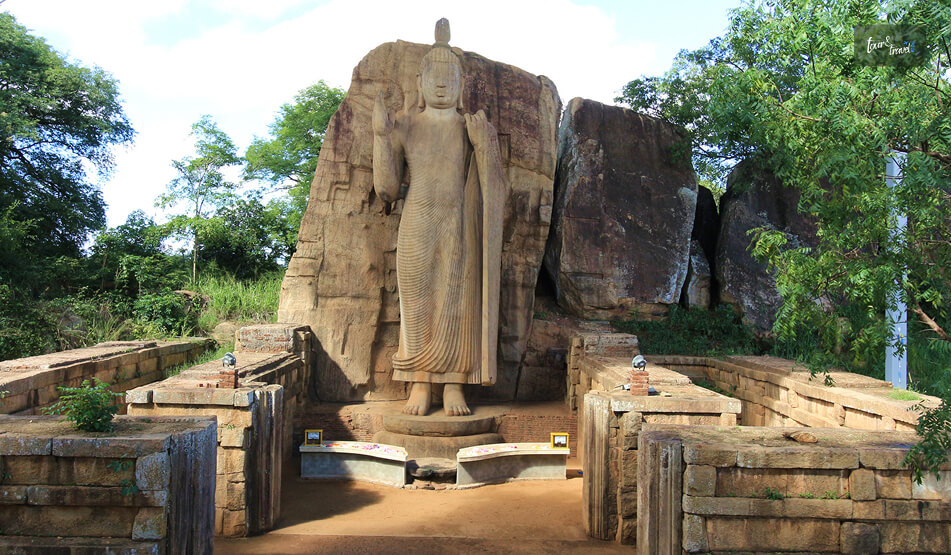
After a few small shops and a car park, I got a glimpse of the 12-meter-long Aukana Buddha statue. 

The history of this granite statue dates back to the 5th century, and King Dhatusena had it carved. 

Also, Aukana Pilimaya is one of the most significant Buddha statues in Sri Lanka, despite having fewer crowds. 

Do you know how the statue got its name? Aukana in Sinhalese means sun-eating, referring to how the first rays of the sun fall on this east-facing statue. 

Pilimaya means image or statue. 

In this article, I will discuss all the details of the statue, including its history, the timings of the visit, and more. 

Aukana Buddha At A Glance

Aukana Buddha At A Glance
DetailWhat to know
LocationNear Kekirawa, Anuradhapura District, North Central Province.It is beside the Kala Wewa reservoir.

Type

Standing Buddha carved from a granite rock face.Raised right hand in a variation of the abhaya mudra.

Height

Around 12 Meters

Date

5th century (King Dhatusena) is the usual attribution.However, there are debates about the actual date. 
Attached to rock?Yes, by a thin strip of stone behind the figure.
Managed byCentral Cultural Fund.
Time needed30–90 Minutes
Best timeDawn or early morning as the statue faces east. 

My Drive To Kekirawa And The Kala Wewa Shore

I traveled to Aukana from the Dambulla side. 

So, I took the A9 road north and turned off at Kekirawa. 

Furthermore, the last stretch on the journey ran beside the vast Kala Wewa. It was a tank built by Dhatusena. 

The Debates Over Who Made It Are Prominent From The First Sight

So, despite the debates, connecting the threads here is easy. The king who built a reservoir here can easily build a Buddha statue here. 

Also, Culavamsa, the medieval chronicle of Sri Lanka, has a record of King Dhatusena commissioning a jeweled diadem for the “Kalasela” image.

Many interpret it as Avukana. 

However, Leelananda Prematilleke, a great scholar of archaeology in Sri Lanka, is of a different opinion. 

I am quoting him from Asian Historical Architecture. 

“...that the image at Avukana is posterior to the 6th century.” 

Moreover, he found certain features of the statue in contrast to the earlier Madavacciya and Veheragala traditions.

About the features he found in contrast, he wrote, “stylistic advance indicated by the double chin, the ridge formation of the lips and the eye-brows, the sharp curve of the robe falling over the left wrist.

Here, one practical piece of advice I want to add. 

You cannot trust Google Maps completely here. Ask locals, especially when moving to the stalls and car park. 

The History: Then, Who Carved It, And When?

The honest answer is that the date is still debated. The most common attribution is the reign of Dhatusena, but there are competing views, summarised below.

Proposed dateAttributed to
5th century ADKing Dhatusena
5th to 8th century ADBroad range for the colossal Buddha tradition.
8th century ADSuggested by Paranavitana, based on a donor inscription on a stone slab.
12th century ADA popular belief credits Parakramabahu I.

First Sight Of The Statue

The standing figure of Lord Buddha here rises from a carved lotus pedestal. The expression on the face is calm, and looking at it instantly takes your weight away. 

The figure was tall. So, I went a little farther away and tilted my head back to see the entire statue. 

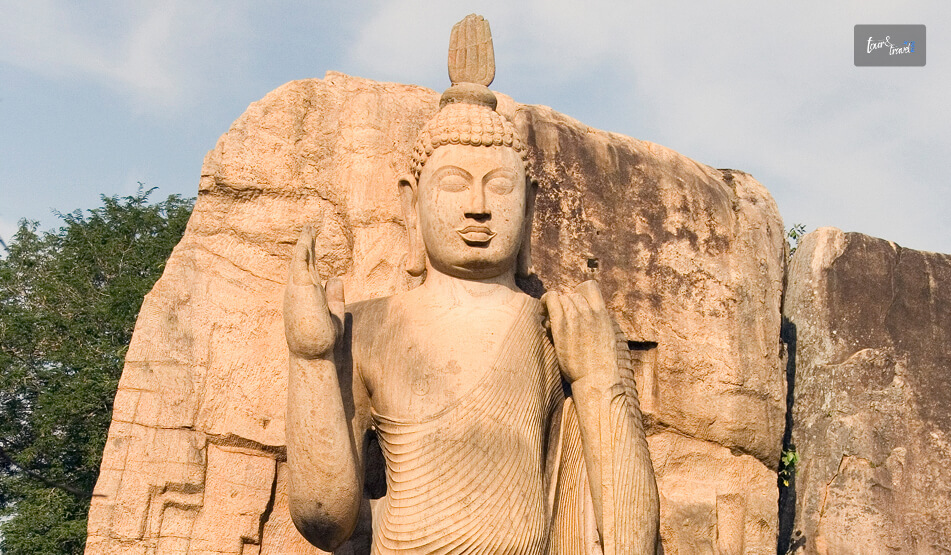
Next, I walked closer to the statue and noticed the detailing, including the folds of the robe that looked fine as fabric. 

The Detail I Would Have Missed Without Looking Closely

Art historians find the Abhay Mudra hand posture of Lord Buddha influenced by the Amaravati style. 

The same style is also visible in the bulging robe near his ankle. 

On the other hand, the detailing and the proportions of the body parts show prominent influence of the Gupta era.

So, when you take a photograph of this statue, you capture a fusion of notable art styles across various eras. 

The Hidden Deities Under The Pedestal

The pedestal was separately carved and pushed beneath the figure. 

In 1952, during conservation, archaeologists found a small chamber under it. The chamber had five bronze figures. 

Among them, Brahma was in the center, with Indra, Kubera, Yama, and Varuna around him. 

I found this the most human detail of the site, a small protective offering hidden under a colossal one.

Also, as I have seen in Gal Vihara, here also the religious integration of Hinduism and Buddhism is prominent. 

The Canopy Controversy

In 1976, the Department of Archaeology built a huge brick arch over the statue.

Constructed using around a million bricks, it was built as a shelter for the statue. 

However, in 1998, the Sunday Times published a report showing how unstable the arch had become due to tree roots penetrating through it and water seepage. 

It mentioned, 

The brick arch constructed in the ’70s by the Department of Archaeology has been rendered unstable by water seepage and is in imminent danger of collapse, thus threatening the 1521-year-old statue, located in the Anuradhapura District.

However, when I last visited the statue, the canopy was still there. 

Latest Updates For 2026 Visitors

Latest Updates For 2026 Visitors

The Central Cultural Fund (CCF) manages this site, and you can buy the e-ticket for a visit to this heritage site from the CCF. 

Sri Lanka received 1,535,122 visitors from January to August 2026. However, Aukana sits off the main circuit and stays quiet.

Tickets, Timings And How to Get There

Aukana is not part of the Cultural Triangle round ticket. So, buy an e-ticket from the CCF website or pay on site. 

ItemDetail
Entrance fee (reported)LKR 1,000 per person
DressShoulders and knees covered.Take your shoes off near the platform.
BusDambulla to Anuradhapura buses stop at Kekirawa.Local bus No. 548 covers the 19 km to Aukana.
TrainOnly four daily trains stop at Aukana, and the station is 1 km from the statue.
DistanceAbout 30 km northwest of Dambulla.Also, it is roughly an hour from Anuradhapura, Dambulla, or Sigiriya.

Tuk-Tuk Charges

Kekirawa-to-Aukana tuk-tuk charge is around LKR 900, including waiting time.

However, the actual price you need to pay will change based on how much you can negotiate. 

The statue is 800 m from Aukana village.

A One-Day Itinerary With Aukana

Aukana is an ideal mid-morning stop between the Sacred City of Anuradhapura and the cluster of the Dambulla Royal Cave Temple and Sigiriya Rock Fortress. 

TimeStopNotes
7:00 AMDepart AnuradhapuraStart early to beat the heat.
8:30 AMAukana BuddhaThe east-facing statue is lit well in the morning.
9:30 AMSasseruwa (optional)About 11 KM further.
11:00 AMKala Wewa shoreShort stop for views of the reservoir.
12:30 PMLunch in Kekirawa or DambullaSimple rice and curry.
2:00 PMDambulla Cave TempleContinue along the Cultural Triangle.

Nearby Places To Combine With Aukana

You can easily pair a visit to the Aukana Buddha Statue with Ras Vehera or Sasseruwa.

Ras Vehera has a similar Buddha statue in a standing posture, and it is in a jungle setting near Galnewa. 

In this context, it is worth reading what H.C.P. Bell wrote in the “895 edition of the Archaeological Survey of Ceylon.” He excavated Aukana Buddha in 1895. 

This image is of much the same height as its mighty fellow at Seseruwa, but in every respect has the advantage, and impresses the gazer far more strongly.

He further added, 

In contrast the Avukana statue, cut almost in full round from a boulder of about the same height, stands boldly forward, huge, assertive, awe-inspiring. 

The features, members, and robe are better chiselled, and the expression is not wanting in placid dignity. 

Exclusive of the nimbus (sirespota, 3 ft. 8 in.) and pedestal (3 ft. 10 in. in height, 15 ft. 2 in. in diameter), the figure rises 38 ft. 10 in. The Buddha stands in an attitude of blessing.

Also, the Dambulla Royal Cave Temple is around 35 km from Aukana Pilimaya. 

Comparing Aukana With Gal Vihara

If you are interested in the art history of Sri Lanka, you will find out one fascinating fact. 

The colossal Buddhas at Polonnaruwa’s Gal Vihara continue the tradition that Aukana represents. 

If you plan both, see Aukana first, then Gal Vihara, to follow the style forward in time. 

Share on Social Media

Sibashree is a travel, culture, and leisure writer who has been writing since the age of 12 and professionally since 2014. With more than a decade of travel writing experience and journeys across India and several parts of the world, she brings a deeply personal and thoughtful perspective to her work. A student of English Literature and Mass Communication, Sibashree has always viewed travel as more than movement — for her, it has been a way of understanding people, cultures, and herself. Her passion for spiritual exploration has also led her to many unusual and meaningful destinations over the years. Outside of writing, Sibashree enjoys watching European cinema, reading about global politics, and reflecting on the stories hidden within everyday places.

Leave a Reply

Your email address will not be published. Required fields are marked *

title-img Related

READ MORE Oshino Hakkai

What Is Oshino Hakkai Famous For? How To Visit It And More 

BY  Sibashree Mar 31, 2026

Everyone knows that you cannot complete exploring Japan in a day. And I had no choice but to miss Oshino Hakkai on the first trip.  However, on the next trip, I made sure to plan a visit.  Of course, an image on Instagram was my major drive behind being so passionate about a trip to Oshino Hakkai.  I saw a series of houses with thatched roofs along the shore of a pond. The magnificent and snow-covered Mount Fuji stood behind, strong and unshakable, as the eternal truth.  Born and raised in the land of spirituality and the Himalayas, I had to visit Oshino Hakkai.  However, as I have explained in my narrative from Tokyo to Mount Fuji day trip, you have to time your trip really well and have to be extremely lucky to see the snow-capped Mount Fuji.  Also, if you are planning a trip in summer, you will only get to see Mount Fuji partially or fully covered by clouds.  Nevertheless, as Mount Fuji continues to act elusive, here is why Oshino Hakkai will win your heart.  Oshino Hakkai: Why Is Visiting The Eight Springs Of Oshino So Special?  As I stood at the center of where both Lake Kawaguchiko and Lake Yamanakako meet in the small village of Oshino, I was able to look at the eight sacred ponds of Oshino Hakkai.  These sparkling, clear water springs are all that is left from a long-lost sixth lake that existed hundreds of years ago. It's as if time stood still when you visit these sacred areas. When I looked into the water, I didn't see just water, and I saw history. The springs were used by pilgrims (Fuji-ko) during Japan's Edo period to cleanse their bodies and souls before climbing Mt. Fuji. What a magical process the water goes through!  From snow accumulation on the summit of Mt. Rainier, through melting and filtration through approximately 80 years' worth of porous lava before it actually emerges at this location, its absolute perfection.  Moreover, it was crystal clear and pure.  Also, as I walked through the "Natural Monuments," I had an intense feeling of appreciation for the many years of waiting, so that each would have such serenity. How To Reach Oshino Hakkai? The journey to the stunning waters of Oshino Hakkai is as much a part of the experience as the location itself.  Here’s my recommendation for how to get to Oshino Hakkai, depending on whether you want a more convenient (train) or an adventurous (rental car) way of doing so. 1. Reaching Oshino Hakkai From Tokyo When travelling from Tokyo, you have several options available.  Highway bus lines go to Oshino Hakkai directly.  If you plan to take the train, either Fujisan Station (the nearest station) or Kawaguchiko on the Fuji Kyuko Line is your best option.  Once at Fujisan or Kawaguchiko, catch a local bus to get to the village. You may take the Fujikko-go (tourist buses), Mt. Fuji World Heritage Loop, or Uchino or Hirano routes via local bus from Fujisan Station.  Generally, there are 1-2 buses/hour on these routes. At Kawaguchiko Station, there are 11 Fuji-Q buses each day that leave for Lake Yamanaka Oriental side, and the 11 Fuji-Q buses that leave for Gotemba and also the Oshino springs. Just watch out for the Oshino Hakkai or Oshino Hakkai-Iriguchi as their stops. 2. Driving And Village Logistics I rented a car, and it is the most convenient way to visit the nearby Five Lakes region.  Parking here is convenient, and there are many public and private parking spaces.  After parking the car, you can explore the nearby villages.  However, you will need 300 JPY to enter the Hannoki Bayashi Shiryokan Museum.  You can visit the museum from 9 AM to 5 PM every day for a deep understanding of the local history.  Moreover, you will find signage in Japanese and English for every pond. My Trip To Oshino Hakkai I felt a bit out of place when I got to Oshino Hakkai.  I thought it would be a nice, quiet area for reflection and meditation, free of other people.  However, I found a busy and fully built-out village of people, shops selling food, and many shoppers and visitors to the area, as well as people engaging with local merchants about the items that were being sold.  There were also a lot of people around Wakuike Pond, and they were excited to see how clear the water of the pond was and the fish that were swimming in the pond. 1. Finding Solitude And Peace Within The City Although I typically search for the peace of solitude, I did not mind being in a populated environment.  I became curious after wandering among the crowds to find out where my curiosity would take me.  I found a quiet, undeveloped area just minutes from the main road, where I could hear the water from the pond, see ducks on the water, and watch an old man with two little boys quietly fishing right next to me. 2. Folklore And Galactic History The folklore & Galactic history of the 8 springs were fascinating to explore. Especially, that water from Wakuike Pond traveled on the Space Shuttle Challenger in 1983 for a snow-making experiment in space! 3. My Personal Highlight  The highlight for me was the open-air museum at the Hanoki Bayashi Shiryokan. It was a true escape from contemporary living, immersing yourself in the cultural heritage of the area. 4. Hannoki Bayashi Shiryokan: The Main Attraction Of The Trip  To tell the truth, I went to Oshino Hakkai because of Hannoki Bayashi Shiryokan.  One of the most amazing sights I've seen in the Five Lakes region was the thatched-roof farmhouses against a colorful garden and the imposing backdrop of Mount Fuji. I became engrossed in the displays of antique household items and rustic farming implements inside the traditional farmhouse.  The tour was brief, but I stayed by the big pond long after I was done because of the subtle beauty of the architecture.  I couldn't resist making another lap because the landscaping was so welcoming. Read Also: What Are The Things To Do In Jimbocho Book Town? Visit The Best Book Stores And Cafes Cherry Blossom Kyoto Japan: 2026 Season And The Top Viewing Spots Osaka Food: Know What To Eat In The Streets Of Osaka

READ MORE Kilinochchi

Kilinochchi, Sri Lanka: The De Facto Capital Of Tamil Tigers Teaching The Story Of Recovery

BY  Sibashree Jul 21, 2026

Killinocchi is a place where the sparks of protests are not extinguished completely.  As I am penning this article in July 2026, the arrest of the Tamil rapper Sangeethsan and the protests of the locals condemning the PTA, or Prevention of Terrorism Act, a month back, make me concerned.  The Kilinochchi District Civil Organisations were behind the demonstrations, and the theme was “Let us unite to break the chains around our voices.” In plain sight, Killinochi is a town where paddy fields, temple bells, and war memorials share the same stretch of road. However, if you want to know about the history of this town and understand how it is getting rebuilt after the Civil War, you need to spend some time in Killinochi.  Moreover, of all the places I have covered on my Sri Lanka trips, Vavuniya and Mannar had already told me that the Northern Province holds a different Sri Lanka altogether. Also, Northern Sri Lanka does not sit on any typical bucket list. Kilinochchi is the next chapter of that same story. Kilinochchi: Quick Facts ProvinceNorthern Province, Sri LankaDistrictKilinochchi DistrictDistance from JaffnaAround 330 kmMain HighwayA9 (Kandy-Jaffna Highway)Founded1936, as a colonization settlement for Jaffna's farmersFormer StatusDe facto administrative capital of the LTTE until 2009Main LivelihoodPaddy farming and agricultureBest Time to VisitThe dry season from May to September Where Is Kilinochchi And How Do I Reach It? Kilinochchi is on the A9 Highway that connects Jaffna to Kandy.  I was traveling from Anuradhapura, and I reached Kilinochchi after three hours in a car. After Vavuniya, it was Kilinochchi that Ravi introduced me to.  However, you can travel to Kilinochchi by train and bus.  Traveling By Train  However, if you are traveling from Colombo, you can take the train on the Yal Devi Line continuing to Jaffna.  Overall, it is a train journey of 5-6 hours. This is one of the most beautiful train journeys of Sri Lanka, with the landscape flattening out into dry-zone scrubland somewhere past Vavuniya. 44089 Kankasanthure Night Mail - Moratuwa - Kankesanthurai, 444421 Intercity Express - Mount Lavinia - Kankesanthurai, and 44477 Yal Devi - Colombo Fort - Kanakasanthurai are the trains plying on this route. A ticket for the second-class reserved category will cost LKR 1700, and the ticket price for the AC saloon car will be between LKR 2400 and LKR 3000.  Traveling By Bus  If you are a backpacker, you can also board a Colombo-Jaffna or an Anuradhapura-Jaffna bus.  You will get semi-luxury and premium-luxury bus options on this route, and the travel time will be around 7 hours.  Also, the ticket price will be between LKR 1800 and 3000. What Is The History Of Kilinochchi? The history of Kilinochchi goes back to 1936.  In the same year, Kilinochchi was constructed as part of a colonization scheme meant to ease overcrowding and unemployment in Jaffna.  The farmers came here to take part in paddy cultivation supported by government land grants. However, the recent history of the Sri Lankan Civil War has primarily shaped it today.  Kilinochchi was the de facto administrative capital of the LTTE (Liberation Tigers of Tamil Eelam) during the final phase of the civil war.  At the same time, Jaffna, with its strong Tamil base, remained under government control.  Then, with the Sri Lankan forces closing in on Kilinochchi in December 2008, the LTTE forced many civilians to flee with them toward Mullaitivu. Thus, the LTTEs used the civilians here as human shields.  However, before fleeing the town, the LTTEs blew up the town's main water tower in an act of scorched-earth destruction, cutting off the town's water supply in an already dry region. Nevertheless, the Sri Lankan army took charge of Kilinochchi on 2nd January 2009.  It was one of the major landmarks toward the end of the Civil War, and it finally ended in May 2009.  After that, Kilinochchi has worked on rebuilding itself.  It now has new water infrastructure, roads, and returning farming communities. Today, it stands as a quiet marker of how a place absorbs a violent past and keeps going. My Day In Kilinochchi Kilinochchi offers a sobering experience, and once you get involved in the history of the Civil War, most of your time will go into pondering and understanding what actually happened.  Nevertheless, here are the highlights of my day in Kilinochchi. 1. The Story Of The Water Tower Ravi first took me to the fallen water tower.  For years, the collapsed remains of the tower bombed by the LTTE in 2008 lay exactly where they fell, fenced off as an informal memorial along the highway. However, in 2020, the structure was finally removed to make space for a new building. While I could not see the fallen tower, it was not difficult for me to visualize the anarchy and destruction.  This was a monument not to victory or grandeur, but to how war strips away the most basic necessities, in this case, clean drinking water in a region where water is already scarce. 2. The Kilinochchi War Memorial The Kilinochchi War Memorial was very close to Kilinochchi Town. It commemorates how the Sri Lankan military recaptured the town in 2009.  I had mixed feelings as I approached the site.  The memorial itself is a straightforward structure offering you the moment of truth.  However, of course, you will interpret the truth depending on which side of the conflict's history you come from. I found a few tourists taking photos of the memorial. However, I spent the time talking to the locals, and I tried to understand what the final months felt like.  3. Elephant Pass The Elephant Pass was just a short distance away from the town of Kilinochchi.  It is a narrow strip of land that connects the mainland to the Jaffna peninsula.  This was one of the most fiercely contested locations throughout the entire civil war, changing hands multiple times between government forces and the LTTE. However, when you visit it today, you will only see a quiet causeway with the Elephant Pass lagoon stretching out on either side. Still, the personnel there will share the details of the war if you approach them.  4. Iranamadu Tank Visiting the Iranamadu Tank was a welcome break after exploring the grim history of civil war in Kilinochchi.  It is one of the largest man-made reservoirs in the region. It was originally built for the water supply to the surrounding paddy fields.  I visited the tank in the late afternoon and spotted local fishermen rowing out onto the water. A few egrets were also picking through the shallows.  5. Chundikulam National Park Chundikulam National Park is a delightful detour if you are visiting Kilinochchi in the winter migratory season.  This wetland hosts large flocks of Greater Flamingos. Furthermore, many other migratory birds pass through the brackish lagoon system in this season.  I did not manage to see the flamingos myself, as I visited outside the migratory window. However, locals I spoke to described early mornings here as one of the best birdwatching experiences in the entire Northern Province. 6. The Local Temples And Kanagapuram Kovil Like the temples in Jaffna, Kilinochchi's Tamil Hindu identity shows up in its temples or kovils. I stopped briefly at Kanagapuram Kovil, a modest temple with local visitors. Also, don’t forget to visit the Kaala Vairavar Temple when you are in Kilinochchi.  7. The Kilinochchi Market Before heading out of town, I walked through the local market, where vendors sold fresh produce, dried fish, and simple Tamil snacks. It was a good reminder that beneath the weight of Kilinochchi's recent history, everyday life here continues much like anywhere else in rural Sri Lanka. What To Eat In Kilinochchi The food in Kilinochchi has the same Tamil roots as the food in Jaffna.  It was a great experience trying Thosai and Idiyappam for breakfast and dinner in a rural setup.  Also, the coconut sambal and sambar were great and spicier than what we are used to having in South India.  Kothu Roti, a chopped roti stir-fried with vegetables, egg, and spices, is another filling option for lunch. Also, you cannot miss the Jaffna-Style Crab Curry. It is a spicy and tangy curry. Pittu, steamed rice flour with grated coconut, is another Tamil staple worth trying here. I ate at a small, no-frills eatery near the town center, and it remains one of the more memorable simple meals of my entire Sri Lanka trip. Where To Stay In Kilinochchi Accommodation options are limited in Kilinochchi, and you will only find budget and mid-range guesthouses and small hotels in the town center. So, if you are planning to spend a night in Kilinochchi, expect modest, rural hospitality.  What Is The Best Time To Visit Kilinochchi? May to September, or the dry season, is the most ideal time for a visit to Kilinochchi.  However, remember that the Northern Province of Sri Lanka is punishingly hot at midday, irrespective of the season of the visit.  Furthermore, if birdwatching at Chundikulam National Park is on your list, plan your visit around the winter migratory season instead.

READ MORE things to do in nara

What Are The Things To Do In Nara? How To Plan A Two-Day Trip?

BY  Sibashree Mar 31, 2026

A trip to Nara was long overdue, and as the first permanent capital of the country, it is a must-visit.  Furthermore, this Japanese capital, before 794 AD (then Kyoto became the capital), has many UNESCO World Heritage Sites.  The Todai-ji Temple is the most famous among these 8 UNESCO World Heritage Sites. You will find one of the largest Buddha statues in the country here, and the statue is made of bronze.  Of course, the deer roaming in the city are beautiful, and you feel like getting transported to a bygone era.  It reminded me of one of the most famous literary works in our country, Shakuntalam Abhigyan, an immortal love story between King Dushyanta and Shakuntala, written by Kalidasa in Sanskrit.  Also, this is a place that will ask you to come back, and most people plan a day trip to experience its historical charm and natural beauty.  But, smitten by its beauty, I chose a 2-day trip, and here is the list of things to do in Nara. Also, I will discuss how I can get to Nara.  How To Reach Nara?  Nara is easily accessible from Kyoto, which is also famous for its history and cherry blossom season.  You can also visit Nara from the Osaka prefecture. So, overall, a visit to Nara can fit well into your itinerary of visiting the Kansai region of Japan.   Also, the robust railway system of Japan makes it easy and budget-friendly to visit Nara. A Japan Railway Regional Pass will be the best for traveling across Nara, Kyoto, Osaka, and Kobe, and the entire Kansai Region.  Also, when in Osaka, don’t forget to explore the street food stalls and have the best Osaka food, including Mochis and seafood delicacies.  Here is how you can travel from Kyoto to Nara. 1. Traveling From Kyoto To Nara Through The JR Nara Line You will get an express train or a local train from Kyoto to Nara every hour.  Furthermore, if you opt for the Miyakoji Rapid Service on this line, you will reach Nara within 45 minutes, and the ticket price will be 720 JPY.  Also, the local train services, with the same ticket price, will take about 70 minutes.  Once you reach the JR Nara station, you will get buses to the Nara Park and other top attractions in Nara.  2. Take The Kintetsu Railway To Reach Nara From Kyoto This is the most convenient way to reach Nara from Kintetsu Railway Station.  The train journey is the fastest, and the journey takes about 35 minutes by the express trains, and the ticket price is 1280 JPY.  Also, the regular trains take about 45 minutes to complete the journey. The ticket price is 760 JPY.  3. How To Reach Nara From Osaka The introduction mentions Osaka as an alternative base for a Nara trip, but the route details that follow only cover getting there from Kyoto.  Since a fair number of travelers base themselves in Osaka instead, here is how that leg compares. 4. JR Yamatoji Line vs. Kintetsu Nara Line RouteDeparture StationDurationTicket PriceJR Yamatoji Line (Rapid Service)JR Namba or Osaka StationAbout 45-50 minutes570 JPYKintetsu Nara Line (Limited Express)Kintetsu Namba StationAbout 35 minutes1,150 JPYKintetsu Nara Line (Regular/Rapid)Kintetsu Namba StationAbout 40-45 minutes680 JPY The Kintetsu Nara Line is the faster and more direct option from central Osaka.  It will drop you at Kintetsu-Nara Station, which sits closer to Nara Park than the JR station does.  If you are holding a Japan Rail Pass or a Kansai-wide JR pass, the Yamatoji Line is the better value even though the ride takes slightly longer.  Either way, both routes run frequently enough that there's no need to book ahead outside of major holidays. What Are The Things To Do In Nara?  From a visit to the Nara Park to exploring Heijo Palace and the temples, there are many things to do in Nara.  Here are the things I did during my 2-day stay.  1. Day 1 In Nara: Exploring The Nara Park  With deer passing by, Nara Park, the home to the main attractions in Nara, is a place you cannot simply miss.  The park is free to enter, and it remains open for 24 hours.  However, many attractions in the park close after 5 PM. So, you have to be early when visiting it.  Also, here are the attractions you will come across in the Nara Park, along with the deer passing by.  Recently, the number of deer in the park has gone up to a record high. However, the tourists bringing unapproved food for the deer remain a concern during Nara Park visits.  You can only feed them shika senbei, the approved crackers for deer. Also, these adorable creatures are revered as sacred. So, you have to be respectful in your behavior.  • Kasuga Taisha One of the UNESCO World Heritage Sites in Nara, Kasuga Taisha, takes us back to the Nara Period from 710 to 794 AD.  It is the most revered shrine among the Fujiwara clan as the tutelary shrine.  Furthermore, the main attraction of the shrine is the “Hall of Lanterns.” There, I saw many bronze lanterns illuminating the darkness.  During the special festivals, Setsubun Mantoro in February and Chugen Mantoro in August, all these lanterns are lit.  Moreover, you will find a cider tree in the inner shrine, and it is 1000 years old.  • Mt. Wakakusa I took the back road from Kasuga Taisha on the way to the Todai-Ji temple.  I came across many small shrines there. However, the highlight was Mt. Wakakusa.  This hill between the two shrines has a height of 350 meters. Also, on the 4th Saturday of January, it becomes the venue for the Wakakusa Yamayaki celebration.  People burn dead grass on the slopes, and this is a ritual that has been celebrated since the 18th century.  • Todai-Ji Todai-Ji is another UNESCO World Heritage Site, and one of the “Historic Monuments of Ancient Nara.” It was built in 752 AD, and it was the head of all the temples in the province. It even had a strong influence on the royal family.  In fact, with Todai-Ji being the seat of control even in the royal decisions, the emperor decided to move the capital to Nagaoka in 784 AD.  However, the main attraction of the Todai-Ji Temple is the massive Buddha statue, or Daibutsu.   A depiction of Dainichi Nyorai,  it represents the primordial Buddha in the orthodox East Asian Buddhist philosophy.  You will also find two similarly sized Bodhisattva statues here.  However, the temple and statues you see today were burned down, and they were rebuilt during the Edo period (1603–1868).  2. Things To Do In Nara: Day 2 I visited the Heijo Palace and many other temples of Nara on day 2.  • Visiting The Heijo Palace  When Nara was the capital, the Heijo Palace was the seat of power for the chrysanthemum throne.  It had a dimension of 1 kilometer, considering the other palaces and architecture of that time.  However, the remains of this UNESCO World Heritage Site in Nara are now at the Toshodai-ji Temple, nearby.  However, since the 1950s, archaeologists have been studying the remains of the Heijo Palace, and this has evoked further public interest.  That is why you can now see many placards there and read about the history and legacy of the site.  Moreover, the audience hall and two other parts of the palace were rebuilt. The restoration of the largest part, the audience hall, happened in 2010.  It was an ode to the 1300th anniversary of Nara as the capital of Japan.  • Toshodai-Ji As I have mentioned, the Toshodai-ji Temple has the remains of the Heijo Palace.  This temple dates back at least a millennium. Ganji, a Chinese monk, built this temple in 759 AD.  Monk Ganji brought Buddhism to Japan, and the Toshodai-Ji today is a UNESCO World Heritage Site.  • Yakushi-Ji It is a UNESCO World Heritage Site, and people here worship Lord Buddha as Yakushi Nyorai or the Medicine Buddha.  The dual main halls here have unique architecture, and each has a dedicated 3-story pagoda.  • Horyu-ji  Horyu-Ji is older than most temples in the Nara region, and Prince Shotoku founded it in 607.  Furthermore, this UNESCO World Heritage Site stands out with its wooden edifices, which are some of the oldest in Japan. This time, I missed many attractions such as Asuka, Omiwa Shrine, and Mount Yoshino. Some day for sure!  And till then, Sayōnara, guys! Also, if you can extend your trip, you can plan a visit to the Archaeological Institute of Kashihara.  It is around 24 km from Nara, and this museum in Kashihara City showcases the evolution of Japanese Civilization.  Here, you will find exhibits from the Jomon, Yayoi, and Muromachi periods. In addition, there have been sites of major excavations, such as the Takamatsuka Tomb. These sites are beyond the repositories of the country's history. They also help to connect to the spiritual heritage of the country.