

Abhayagiri: Walking The Forgotten Monastery That Once Rivalled The Pyramids

It was around 8 AM when I reached Abhayagiri. 

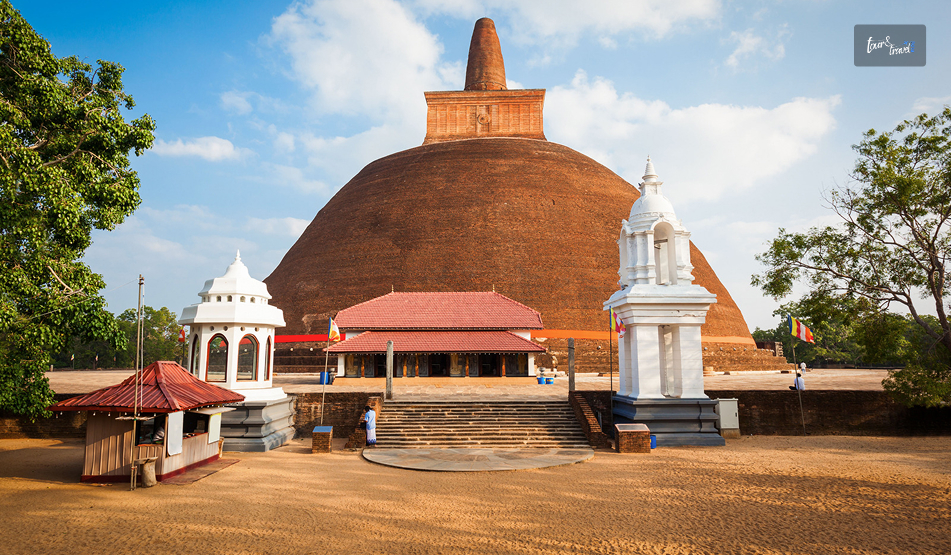
The heat was still bearable, and I noticed the top third of the stupa rising over the trees while waiting in the ticketing queue.  

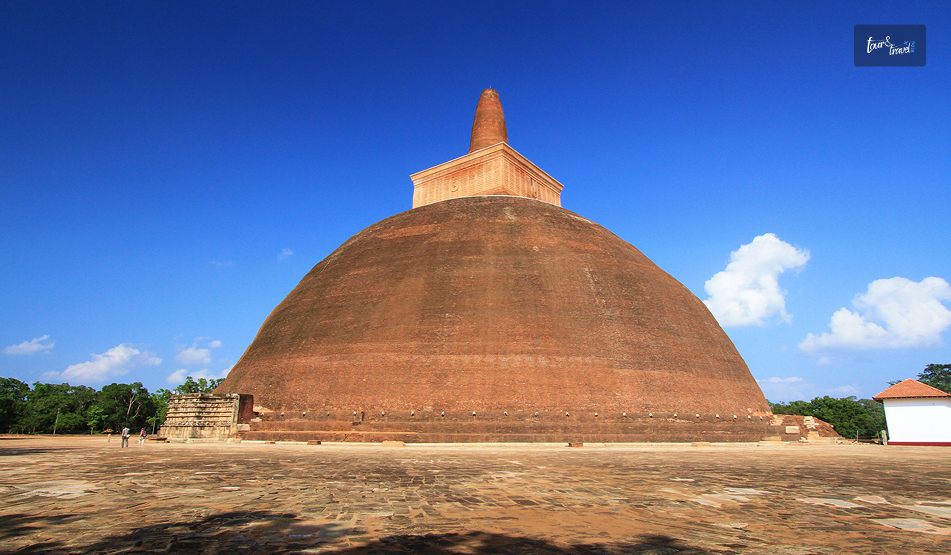
It was a massive brick-red dome. 

I had already spent a day in the southern half of the Sacred City of Anuradhapura, exploring Ruwanwelisaya and Jaya Sri Maha Bodhi.  

So, I had an image in my mind of what a Sri Lankan dagoba looked like.  

However, Abhayagiri changed my perception within minutes.  

For me, it was the site that helped me understand the actual scale of Anuradhapura.  

The scale is beyond the fact that it is the tallest stupa standing.  

Furthermore, the ponds, the moonstones, and the collapsed monastic halls scattered through the forest show how it used to be a small city of five thousand monks.  

Abhayagiri At A Glance 

 Fact   Detail 
 Location   Northern sector of the Sacred City, Anuradhapura Archaeological Park, North Central Province  
 Built   1st century BCE, by King Vattagamini Abhaya (Valagamba), during his second reign  
 Original height  More than 100 meters, comparable in scale to the pyramids of Giza and to the nearby Jetavanaramaya.  
 Current height   Around 75 meters after multiple restorations 
 Tradition  Uttara Vihara (“Northern Monastery”), historic centre of Mahayana and Vajrayana influence within Sri Lankan Theravada Buddhism  
 Status   Part of the Sacred City of Anuradhapura UNESCO World Heritage Site (inscribed 1982)  
 Major restoration   15-year Central Cultural Fund/UNESCO project completed and unveiled in June 2015  
 Nearby structures  Kuttam Pokuna (Twin Ponds) The Abhayagiri Museum The Samadhi Buddha Ratnaprasada One of the finest surviving moonstones of Anuradhapura  
 Hours    5 AM to 7 PM 

The Story Behind The Abhayagiri Stupa

Abhayagiri: Walking The Forgotten Monastery That Once Rivalled The Pyramids

Abhayagiri is not just another Stupa in the Sacred City of Anuradhapura.  

There is a significant religious and political story behind its existence.  

A King’s Debt, And A Monastery Named After A Grudge 

The origin of the monastery goes back to the reign of King Vattagamini Abhaya or Valagamba.  

The king had to leave Anuradhapura due to an invasion around 103 BCE.  

He had to spend 14 years in hiding before he could reclaim his throne. This part of the story is very similar to the Ramayana.  

Lord Ram had to spend 14 years in exile on his father’s command after he became the King of Ayodhya.  

After 14 years of exile and defeating the demon King Ravana, he returned to Ayodhya.  

Nevertheless, King Vattagamini Abhaya was mocked by a Hindu ascetic, Giri, during his exile.  

So, when he got his throne back, he built the monastery on the hermitage of Giri.  

Then, he named the place Abhayagiri, a fusion of his own name with Giri’s.  

You may not believe every detail of the story. However, the monastery was one of the largest Buddhist institutions in the ancient world.  

Splitting From The Mahavihara 

Abhayagiri broke away from the older, conservative Mahavihara tradition. 

The dispute was over the use of Sanskrit texts alongside Pali scripture.  

Also, there were differences about how the monks should engage with the lay community.  

Over centuries, Abhayagiri did not limit itself to being a monastery.  

It was very much like a university and not a single monastery.  

It built connections with Buddhist institutions in India, China, and Java. 

Moreover, it was the first monastic centre in Sri Lanka to have the tooth relic of the Buddha. 

Then, the relic eventually moved to what is now the Temple of the Tooth in Kandy.  

It also became the country’s main center for Mahayana and, later, Vajrayana thought, running in parallel with Theravada orthodoxy for close to 1000 years. 

From Ruin To Restoration 

Abhayagiri fell into decline after Anuradhapura was no longer the capital. 

Also, over centuries the stupa lost around a third of its original height, with the uppermost brickwork collapsing.  

In recent times, the Department of Archaeology of Sri Lanka has been continuing the restoration work of this stupa.  

The most significant among these restoration efforts was a fifteen-year Central Cultural Fund project in collaboration with UNESCO.  

The restoration work ended in June 2015.  

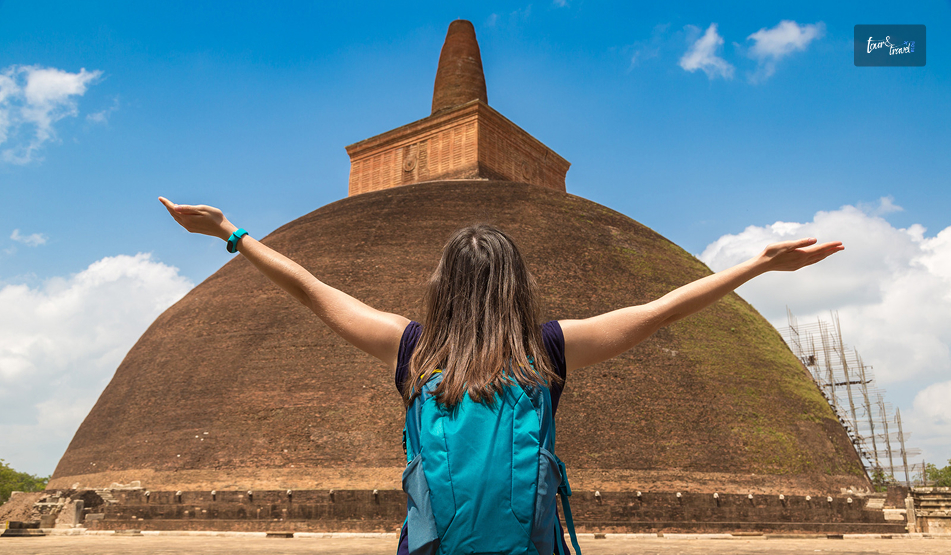
When I visited, there was still scaffolding on one section of the dome. 

So, when you plan a visit, please check with the locals regarding the restoration work.  

Also, take your photos from the paved approach on the eastern side rather than directly underneath, where the working platforms tend to sit. 

What You Will Actually See When You Visit

Abhayagiri: Walking The Forgotten Monastery That Once Rivalled The Pyramids

Abhayagiri is not just a standalone historical monument. 

It is a forested archaeological zone that takes a genuine hour or two to walk properly. 

It took more time for me, as I was exploring the carving details, and here I have discussed the most remarkable things I saw at Abhayagiri.  

The Stupa Itself 

The stupa is the epicenter of the complex.  

Up close, the brick construction and the sheer footprint of the base make it obvious why 19th-century surveyors compared it to the Giza pyramids rather than to other stupas. 

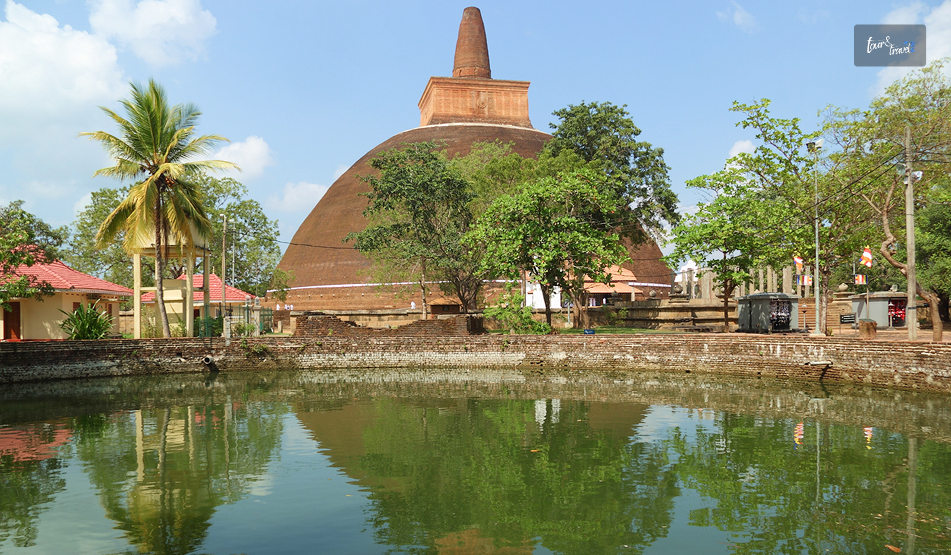
Kuttam Pokuna Or The Twin Ponds 

The two rectangular bathing tanks are genuinely one of the best-preserved pieces of hydraulic engineering anywhere in the ancient city.  

They were restored once in 1885 under British colonial archaeologist Robert Wilson Ievers and again in 1955 by the Department of Archaeology.  

The Moonstone And The Samadhi Buddha 

You will find the sandakada pahana, or the most elaborately carved moonstone, on the northwest side of the stupa.  

This semi-circular moonstone sits before a staircase.  

It has carvings of flame motifs, four animals, a vine scroll, and a lotus at the center in the quintessential Anuradhapura style.  

From there, the Samadhi Buddha was a short walk away. 

In this statue, Lord Buddha is meditating, and it is a significant piece of period culture.  

Ratnaprasada And The Guard Stones 

Ratnaprasada is to the west of the main stupa.   

It was once the largest structure in the whole monastery and housed its more ascetic monks.  

Today, you can mostly see the remains of the foundation work. 

However, it has one of the finest surviving guardstones in the country, carved with a naga king figure.  

The Abhayagiri Museum 

The museum is around 300–400 metres south of the stupa. It was established in memory of the Chinese monk-pilgrim Faxian (Fa-Hsien). 

He studied at Abhayagiri in the early 5th century CE and left one of the only outside written accounts of the monastery at its peak.  

It houses artefacts recovered during the site’s excavation and restoration work. 

Also, it is a useful stop for context before or after walking the ruins. 

However, it requires its own separate entry ticket, distinct from the main Sacred City pass. As a SAARC visitor, I had to pay $12.  

Entry Fees And Tickets

Abhayagiri: Walking The Forgotten Monastery That Once Rivalled The Pyramids
 Ticket  Foreign Adult Price (2026)   Notes 
 Anuradhapura Sacred City combined ticket.  $30 Covers:  Abhayagiri Stupa Jetavanaramaya Ruwanwelisaya Thuparamaya Lovamahapaya Kuttam Pokuna The Moonstone The Abhayagiri Museum  
 Isurumuniya, Sri Maha Bodhi, Mihintale   Ticketed separately  Not included in the main Sacred City ticket. 
 Anuradhapura New Town entry   $3  Separate from the Sacred City archaeological zone  
 Local/SAARC visitors  Free for the Sacred City itself   A separate small fee applies for the SAARC Visitors ($12) for the Abhayagiri Museum.    

Recent Developments Worth Knowing About

Abhayagiri: Walking The Forgotten Monastery That Once Rivalled The Pyramids

Anuradhapura as a whole has had a steady stream of coverage through 2026. 

Most of it is about accessibility and ticketing rather than the archaeology itself.  

There have been repeated revisions in Sri Lanka’s broader Cultural Triangle pricing.  

Furthermore, Sri Lanka’s Department of Archaeology continues to run active protection and monitoring work across the Anuradhapura Sacred City sites. 

These include Abhayagiri’s monastic ruins, moonstones, and guard stones, under its ongoing chemical conservation and maintenance divisions.  

A Half-Day Itinerary Around Abhayagiri 

 Time  Stop  Notes 
 8:00 AM  Arrive and hire bicycles or a tuk-tuk.   Buy your combined ticket at the Archaeological Museum first if you have not pre-booked. 
 8:30 AM  Abhayagiri Stupa  Enjoy the best light and coolest temperatures of the day.  Approach from the eastern paved courtyard.  
 9:15 AM  Moonstone and Samadhi Buddha   A short walk northwest and east of the stupa, respectively. 
 9:45 AM  Ratnaprasada and guard stones   Easy to miss, and it is set slightly back from the main path.  
10:15 AM Kuttam Pokuna (Twin Ponds)   Worth ten minutes just for the stonework and water channels. 
 10:45 AM  Abhayagiri Museum  Requires a separate ticket.  
 11:30 AM  Onward to the rest of the Sacred City or Mihintale   Both are feasible as a half-day add-on if you started early. 

Where Abhayagiri Fits Into A Wider Sri Lanka Trip 

Are you building out a full Cultural Triangle itinerary? 

You can visit Abhayagiri with the other major Anuradhapura stupas and with Mihintale, the hill where Buddhism is traditionally said to have arrived in Sri Lanka. 

The most convenient way to explore the entire circuit is to keep an entire day for Anuradhapura, including Abhayagiri, Ruwanwelisaya, Jetavanaramaya, and Sri Maha Bodhi. 

Mihintale will be a half-day add-on to your itinerary, and the following morning you can head to the Sigiriya Rock Fortress and Polonnaruwa.  

Having said that, Abhayagiri isn’t the single most photographed structure in the Cultural Triangle. 

Sigiriya and the Temple of the Tooth get more attention in most guidebooks or travel itineraries.  

However,  of everywhere I visited in Anuradhapura, it is the one that most convincingly puts you inside the ancient city rather than just looking at a monument within it.

Share on Social Media

Sibashree is a travel, culture, and leisure writer who has been writing since the age of 12 and professionally since 2014. With more than a decade of travel writing experience and journeys across India and several parts of the world, she brings a deeply personal and thoughtful perspective to her work. A student of English Literature and Mass Communication, Sibashree has always viewed travel as more than movement — for her, it has been a way of understanding people, cultures, and herself. Her passion for spiritual exploration has also led her to many unusual and meaningful destinations over the years. Outside of writing, Sibashree enjoys watching European cinema, reading about global politics, and reflecting on the stories hidden within everyday places.

Leave a Reply

Your email address will not be published. Required fields are marked *

title-img Related

READ MORE talalla beach

Where Is Talalla Beach? Know The Top Attractions And The Best Time To Visit 

BY  Sibashree May 4, 2026

The southern shores of Sri Lanka have many amazing beaches stretching from Tangalle to Dondra Head, or the southernmost tip of the country.  Talalla Beach is one of them, and it has sea vines, golden sands, and sleepy hotels lining the coast.  Furthermore, if you are a fan of the TheLowDownUnder Travel philosophy, Talalla is the perfect pick.  Again, if you are visiting the Hiriketiya Beach or the Kudawella Beach, the Talalla Beach is just a short tuk-tuk ride away.  Moreover, it is a peaceful place to see the turtles hatching and surf.  Here is more about the things to do in Talalla Beach, the nearby attractions, and other details. Where Is Talalla Beach?  Talalla Beach is just 6.5 km away from the Dondra Head, the southernmost part of Sri Lanka.  Also, it is between Dickwella and Matara towns.  You can, of course, take a taxi from Colombo to reach Talalla Beach after a journey of 3.5 hours.  However, if you are also traveling on a budget like me, you can take a train from Colombo to Matara, and then you can take a tuk-tuk ride from there. It costs around LKR 1500.  Also, from Matara, you will get a local bus to Talalla Beach, and the ticket price will be LKR 50.  Nevertheless, I was already at the Kudawella Beach, which is around 7 km away. So, I boarded a tuk-tuk, and it charged me 500 LKR. Surfing And More: What Are The Things To Do At Talalla Beach?  Now, many travel guides claim that surfing is one of the best things to do in Talalla Beach. However, the reality is that Talalla Beach is not a surfing spot.  Still, if you are visiting Talalla Beach, you will find many surfing breaks or spots on the southern coast of Sri Lanka nearby.  1. Surfing Near Talalla Beach  Starting from the west to the east, these are some places to surf near the Talalla Beach.  Madiha  The left and right reefs at Madiha are one of the most challenging breaks in the southern coast of Sri Lanka. Early morning is the best time for surfing here. SK Town  SK Town is around 20 minutes away from Talalla Beach.  However, SK Town is still an emerging place for beginners and intermediate surfers.  The A-frame peaks here are powerful, and you will find a sandy bottom.  Dawn and late evening sessions are the best times for surfing in SK Town. Hiriketiya Hiriketiya is the most prominent place for surfing near Talalla Beach. You can do a surf camp here and explore the semi-hollow and fast left-hand break.  However, Hiriketiya is touristy, and that can be a problem for surfers.  Kudawella  If you have never tried surfing before, you must visit the Kudawella Beach.  The beach has its own break, and it is even more protected than Hiriketiya.  2. Watching Turtle Hatching From Mount Lavinia to Uppuveli Beach in Trincomalee, the beaches in Sri Lanka are famous for turtles.  However, at Talalla Beach, I had the unique experience of seeing turtles hatching from their eggs.  The small turtles break the egg shells and come out. Then, they immediately crawl toward the sea.  Furthermore, if you visit the beach at night, you can see turtles laying eggs.  3. Visiting The Lace Factory Now, the lace factory is not a tourist attraction in Talalla Beach. I luckily came to know about it from a local.  It was just a walk of 5 minutes from the beach, and the artwork I saw inside the factory was fascinating.  It was a great cultural experience seeing the locals preserving the traditional art form of the country.  4. Yoga Sessions The Talalla Beach Resort has a Yoga Shala.  If you are an early morning person, you can attend a Yoga session here and rejuvenate your mind and body.  5. Getting An Ayurvedic Massage  Like Southern India, Sri Lanka also has a tradition of Ayurvedic treatments.  You can avail yourself of some relaxing ayurvedic therapies and massages at the Taltalla beach houses. What Are The Places To Visit Near Talalla Beach?  You can combine your time at Talalla Beach with a fascinating wildlife experience, enjoying town life at Matara, and a delightful swimming experience at the Seethagalla natural seawater pool.  1. Udawalawe National Park Spotting elephants in the Udawalawe National Park is one of the best things to do in Ella.  Despite a distance of 161 km, a trip to Udawalawe National Park from Talalla Beach is worth it.  You just cannot miss the early morning safari here and spot the baby elephants and their mothers.  2. Matara  I loved Galle Fort. However, to me, Matara, at a distance of around 44 km, felt more intimate.  I enjoyed the cheerful voices and the sound of the balls getting struck when the youngsters were playing cricket inside the old fort.  Furthemore, I visited the Mid Mountain Tea & Spices here and collected some local brews as souvenirs.  3. Seethagalla Natural Seawater Pool The Seethagalla Beach is to the east of the Talalla Beach. It has sand with black patches and coconut trees.  Furthermore, this rugged cove has a tidal pool. It was a lovely swimming experience.  Where Is The Best Time To Visit The Talalla Beach?  The dry season, from November to March, is an ideal time to plan a trip to Talalla Beach.  These months offer the best wave conditions for swimming and surfing. Especially November to early January is the best window for surfing.  However, the temperature in these months ranges between 32 and 37 degrees Celsius. Moreover, the high humidity in the air makes it stuffy sometimes.  In addition, there can be sudden downpours.  Also, in a day, early mornings and late evenings are the best times for surfing as the winds are the weakest.  Moreover, if you are in Sri Lanka in April onward, you must look further east. Arugam Bay, especially, is a delightful location for surfing on the eastern coast of Sri Lanka in the wet season.   Where To Stay Near The Talalla Beach? Talalla Beach has limited accommodation options. However, the Talalla Sunshine Beach is a delightful option with 10 beautiful rooms and an uninterrupted view of the sea.  Also, it is just a few steps away from the beach. So, you can even walk to the beach at night for a serene experience.  Another popular option here is the Talalla Resort, which also functions as a retreat center and has spa and yoga facilities.
READ MORE Tangalle Beach

What Are The Tangalle Beach Places To Visit? Is It Worth It? 

BY  Sibashree May 18, 2026

Tranquility, raw energy of nature, and the thrill of standing on the southernmost tip of Sri Lanka!  You get all of these when you are at Tangalle Beach. Also, with serenity and relaxation being two essential experiences here, you will get ample time to photograph the picture-perfect shoreline.  So, if you want to explore pristine beaches, have some fun spotting the turtles, and try some amazing local food, you must include a visit to Tangalle Beach in your Sri Lankan itinerary.  Why I Loved Tangalle Beach?  The quaint Tangalle Beach immediately impressed me with its stretches of golden beaches. Also, from the traditional fishing town of Ahangama to this small fishing village, it has been a lifetime experience for me to see how people here live in coexistence with nature.  Furthermore, the Rekawa Turtle Conservation Project was the biggest highlight of my Tangalle Beach visit.  Also, I could soak in the paradisiacal feel of this coastal town, unlike more prominent places such as the Hiriketiya Beach or the Kandy to Ella train, the crowd was way fewer.  That undertourism is a blessing in disguise, as in this way, the nature and wildlife of Tangalle Beach remain untouched.  Furthermore, I found a small but warm homestay on the east side. On the west, there are more high-end accommodations.  So, from backpackers to luxury travelers, everyone will enjoy Tangalle Beach, and you just need to place your feet on warm and golden sand. What Are The Things To Do In Tangalle Beach? Tangalle Beach offers a Bali vibe. As I have mentioned, it is the ultimate place to relax, and along with that, you can indulge in various adventure activities here.  You can even have a delightful wildlife experience here.  A Visit To The Udawalawe National Park At a distance of around 71 km from Tangalle Beach, the Udawalawe National Park is a must-visit.  Furthermore, as a home to around 400 elephants, it is one of the top attractions near Ella.  I loved the jeep safari here, and unlike many other national parks, spotting an elephant here on a jungle safari is almost guaranteed.  The entry fee to the national park is LKR 13,420, and the jeep safari charged me LKR 10000 during the last visit.  I was impressed with the entire conversation process, and it operated around the Elephant Transit Home (ETH).  The Department of Wildlife Conservation established it in 1995, and it runs on a strict 3-tier process.  Rescue Rehabilitate Release  This process ensures very little human interaction, and it works for the release of the orphaned elephants back into the wild.  Also, the conservation job does not end with the release of the elephants. The conservationalists keep monitoring the movement of the reintroduced elephants in the wild.  Watching Turtles At Tangalle Beach  Like Dalawella Beach, Mirissa Beach, and Mount Lavinia Beach, Tangalle is also a wonderful place for spotting endangered turtles.  The types of turtles you can see here are: Loggerheads Leatherbacks Hawksbills These turtles visit the beach when they want to lay eggs. Now, this is a huge advantage Tangalle enjoys as it is free from the impact of overtourism.  A Visit To The Rekawa Turtle Conservation Project Now, many tourists claim that if you visit the Rekawa Turtle Conservation Project between April and July, you can see the turtles hatching eggs.  However, this is not entirely true. There is no guarantee that you will see a turtle laying eggs or hatching.  There is an official announcement from the Rekawa Turtle Conservation Project. They have mentioned that there are high chances of seeing a turtle laying her eggs between 7:30 PM and 8:30 PM.  Furthermore, the conservation center offers a guided tour to the beach for spotting turtles between 7 PM and 6 AM.  Moreover, you cannot use flashlights or flash photography at this conservation center.  Whale Watching At Tangalle  During my stay in Tangalle, I booked an early morning tour that took me west to Mirissa Harbour.  We set sail at 6:30 AM into the calm Indian Ocean. About an hour out, the captain cut the engine.  Suddenly, a massive blue whale breached just seventy meters away, spraying a giant plume of water before diving and flashing its enormous tail flukes. It was breathtaking. While Tangalle itself lacks a major boat harbor, it serves as an excellent base. Most local operators provide seamless hotel pickups for the 60-to-90-minute drive to the boats. December to April is the best time for spotting whales and spinner dolphins at Tangalle Beach.  Also, if you are planning a whale watching tour, you must take sea-sickness pills before boarding.  A Visit To The Mulkiligara Raja Maha Vihara  Sri Lanka is the place where you will find the gems associated with Buddhism in every nook. The Mulgirigala or Mulkiligara Raja Maha Vihara is one such place.  It is an ancient Buddhist rock temple complex, and if you have loved the Dambulla Royal Cave Temple, you will also cherish this.  At a height of 205 meters, it also has the nickname of Little Sigiriya Rock or Punch Sigiriya.  Furthermore, this ancient rock temple complex is revered as an archaeological site. It harbors a religious history of around 2000 years.  King Saddhatissa of Anuradhapura built this Maha Vihara in the 3rd century BCE, and King Kawantissa and King Valagamba expanded it later.  Moreover, it is one of the designated temples in Anuradhapura to receive the Jaya Sri Maha Bodhi sapling.  After years of abandonment, it was finally reconstructed by King Keerthi Sri Rajasinghe in the 18th century.  Why I Loved Mulkiligara Raja Maha Vihara The temple complex spans across five different cave levels, and there are seven cave shrines.  The caves are home to brilliant frescoes, murals, and paintings depicting the stories of the Jataka, Lord Buddha, and other Hindu deities.  What is interesting here is that some of the artwork shows a prominent influence of the Dutch style.  Furthermore, after climbing 533 peaks, I reached the summit of the Stupa. At the summit, there is a small pagoda that houses sacred relics of Lord Buddha.  In addition, the unmarked dirt train behind the courtyard took me to a cliff ledge from where I enjoyed amazing views of the surrounding jungles and palm trees. 

READ MORE Kumana National Park Safari

Kumana National Park Safari Price And Experience: Things I Encountered And Loved

BY  Sibashree Jun 15, 2026

Amidst the concerns of poaching and irregularities, Kumana National Park remains one of the hotspots for wildlife encounters in Sri Lanka.  During my days in Sri Lanka, I had already done the Hurulu Eco Park Safari, a safari in the Kaudulla National Park, and the Kumana National Park was the third place I chose for a safari, where I had delightful encounters with elephants.  Though the park offers various jeep safaris, wildlife tours, and birdwatching tours, I planned it in a different way. I opted for a wildlife ride from Arugam Bay to Kumana National Park instead of taking a safari tour inside.  I took a DIY route and rented a scooter for a day, and started from Arugam Bay, which was just 50 minutes away.  The rental charge was around LKR 2000, and I chose it to make my experience of meeting these amazing animals in their natural habitat more memorable.  And in this article, I will share the adrenaline rush I had at Kumana National Park, the Kumana National Park safari prices, and more.  However, let’s start with where the Kumana National Park is. Where Is Kumana National Park? The southeastern part of Sri Lanka has many gems, and Kumana National Park is surely one of them.  Around 50 km away from Arugam Bay, it shares a contiguous border with the Yala National Park, and the beautiful Kumbukkan Oya river separates it.  In addition, it is located at a distance of around 391 km from Colombo via Panama.  Thanks to its location, the Kumana National Park is also known as Yala East. It offers a more peaceful safari experience than neighboring Yala and other destinations, as it gets fewer vehicles.  Also, it has lagoons, dense mangrove forests, and the central Kumana Villu swamp.  Moreover, along with elephants, deer, leopards, and crocodiles, the Kumana National Park also has birds of different species.  In fact, it is a premier destination for bird watching with the presence of migratory waterfowl, painted storks, and black-necked storks. My Experience Of The Kumana National Park Safari Let me tell you, you will not be able to get inside the Kumana National Park on a scooter. If you want a proper safari inside the park, you will have to be a part of the jeep tours.  The Ride With my scooter plan sorted, I rode south of Arugam Nay and rode for ten kilometers, leading to the Kumana park entrance.  It is an extension of the park, and it took around 1 hour to ride through the park stretch.  Now, as soon as I left Arugam Bay, I started noticing elephants, and there was a complete herd near the Elephant Rock. They were busy among themselves in an open field.  However, the scooter ride became more adventurous after I passed through Panama. The dirt roads start from here, and you feel that you are away from the bustling surfing town of Arugama Bay.  Then, the small roads took twists and turns, and they passed through wetlands and fields just outside the Kumana National Park. Here, I could spot many wildlife variations, including water buffalo and deer.  The Visitor Center And The Kudumbigala Monastery Next, I stopped at the visitor center at the park entrance and spent around 20 minutes there learning about the park and the wildlife there.  I continued my journey to the nearby Kudumbigala Monastery, which was built in 246 BC and is a magnificent Buddhist hermitage spanning across 600 acres.  King Devanampiyatissa, the first Buddhist king of Sri Lanka, built it.  Kumana National Park Jeep Safaris You have many options if you are planning a Kumana National Park jeep safari. Have a look at the table below to know the Kumana National Park jeep safari details.  Types of Kumana National Park Jeep Safaris Kumana National Park Jeep Safari PriceMorning Jeep Safari $71 USD OnwardAfternoon Jeep Safari $71 USD OnwardFull-Day Kumana National Park Safari with Rice and Curry Lunch$97 USD OnwardKumana National Park and Panama Village$76 USD Onward What Is The Best Time For A Kumana National Park Safari?  Late afternoon is the best time to spot an elephant at Kumana National Park. This is the time when these adorable animals gather near water.  I also saw two crocodiles gliding into the water.  I even had a very close encounter with an adult elephant, and honestly, I was scared a little. However, the mother elephant was unbothered, and she passed by showing her regal moves.  And also, I saw a peacock with all its feathers spread out. It was a lifetime experience for me.  Furthermore, seasonwise, April to June, or the dry season in the eastern region, is the best time for a Kumana National Park jeep safari.  These months are also ideal for being the nesting season of the local and migratory waterbirds in the Kumana Villu swamp.  So, in these months, you can spot egrets, herons, ibises, pelicans, and painted storks.  Where To Stay Near The Kumana National Park?  Panama is at a distance of 22 km. Arugam Bay. It is also located around 50 km away. So, these two are the best places to stay if you are planning a visit to the Kumana National Park.  However, do you want the most immersive experience? You can plan a stay in the Kumana Mobile Tented Camp inside the Kumana National Park.  Here, you will stay in simple canvas tents, and the amenities will be basic. You will get facilities such as a portable loo outside the camp and a fresh water supply for bathing.  For me, the biggest attraction in the camp was the communal area. Everyone could sit there and have their food. Furthermore, here you can find the best collection of wildlife books.  In addition, this camp offers excursions to hidden spots, pristine lagoons, and amazing viewpoints on a bicycle.  I chose the camp location close to the ocean. Also, if you want, you can also find a camp closer to the jungle.  However, this is quite an expensive affair, and the tariff was around $330 for a night.