Bakers Falls: The Reward At The End Of The Horton Plains Loop

By the time I heard Baker’s Falls, my legs already knew we were on the return leg of the Horton Plains loop. 

We had started before sunrise to beat the mist at World’s End, walked the open plateau in that strange, cold, grassland light, and then dropped back into cloud forest for the final stretch. 

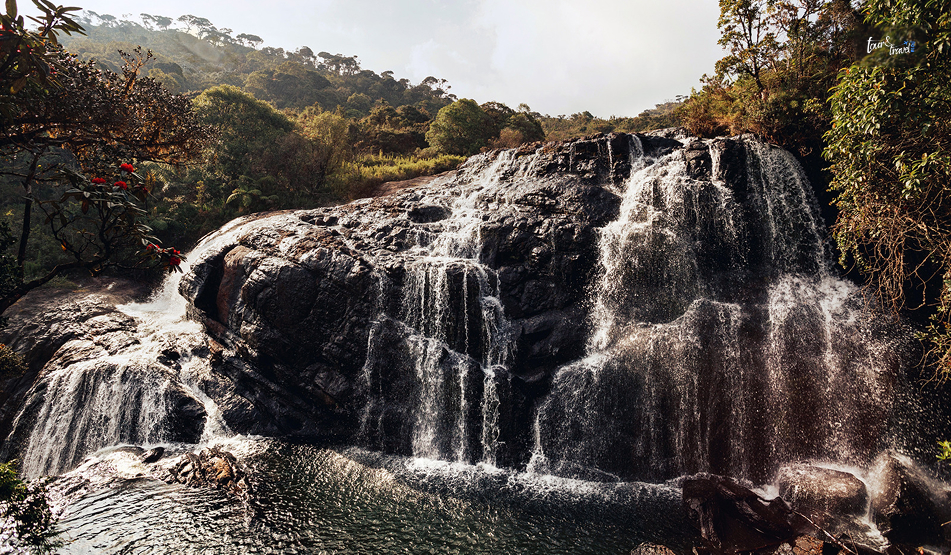
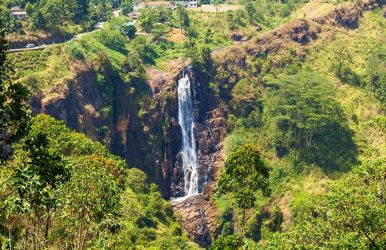
The falls announced themselves before they appeared as a low rush of water through the trees.

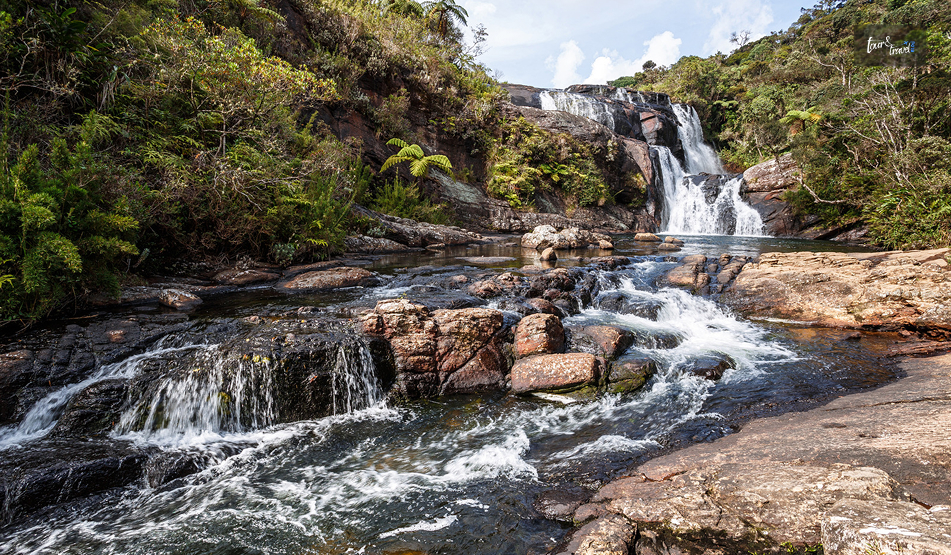
After the wide-open plains, that first glimpse of water tumbling over dark rock into the ferns felt almost intimate by comparison.

Baker’s Falls Quick Facts

DetailInformation
HeightAround 20 Meters
WidthAround 25 Meters
RiverBelihul Oya, a Tributary of the Walawe River
LocationHorton Plains National Park, Nuwara Eliya District
Distance from EntranceAround 3 Km from the Main Loop Trail
Full Loop Distance9.5 Km Round Trip, including Bakers Falls and World’s End
Park ElevationAround 2100 to 2300 Meters
Entry FeeEntry Fee to Horton Plains National Park, No Additional Fee
Named AfterSir Samuel Baker, a British explorer, who is said to have come upon it in 1845

Where Is Bakers Falls And How To Reach?

Bakers Falls: The Reward At The End Of The Horton Plains Loop

Baker’s Falls is inside Horton Plains National Park in the Nuwara Eliya District. You have to walk from the entrance along the main park trail to reach Baker’s Falls. 

Belihul Oya, a major tributary of the Walawe River, has formed this waterfall. 

Reaching The Park Entrance

You can reach Horton Plains National Park from Nuwara Eliya, at a distance of around 32 km. 

You can also travel from the towns of Pattipola and Ohiya, both of which sit on the upcountry railway line. 

If you are traveling by train, you will have to hire a tuk-tuk or taxi for the final stretch to the gate.

The Hike To The Falls

You can reach Baker’s Falls via the park’s main loop trail.

The same trail also takes in Little World’s End and the main World’s End escarpment. 

From the entrance, it is about 4 km to World’s End, then roughly 2 km further around the loop to Baker’s Falls, and another 3.5 km back to the entrance.

So, it is a 9.5 km round trip in total, usually taking about three hours at a comfortable pace. To reach the water itself, you’ll descend a set of steps from the main trail down to the viewing area.

World’s End: The Rest Of The Loop

Almost nobody visits Baker’s Falls on its own.

It is one stop on the wider Horton Plains circuit, alongside Little World’s End (a roughly 300 m drop) and the main World’s End escarpment, where the plateau falls away nearly 880 m.

Horton Plains is unusual among Sri Lanka’s national parks in that visitors can walk the main trail independently, without a mandatory guide.

However, hiring one at the entrance is a good way to learn more about the park’s cloud-forest ecology and resident sambar deer.

What Makes Baker’s Falls Worth The Walk

Baker’s Falls is modest by Sri Lankan standards, with a height of around 20 meters.

It is dwarfed by giants like Bambarakanda further south. 

But its setting is what makes it memorable. 

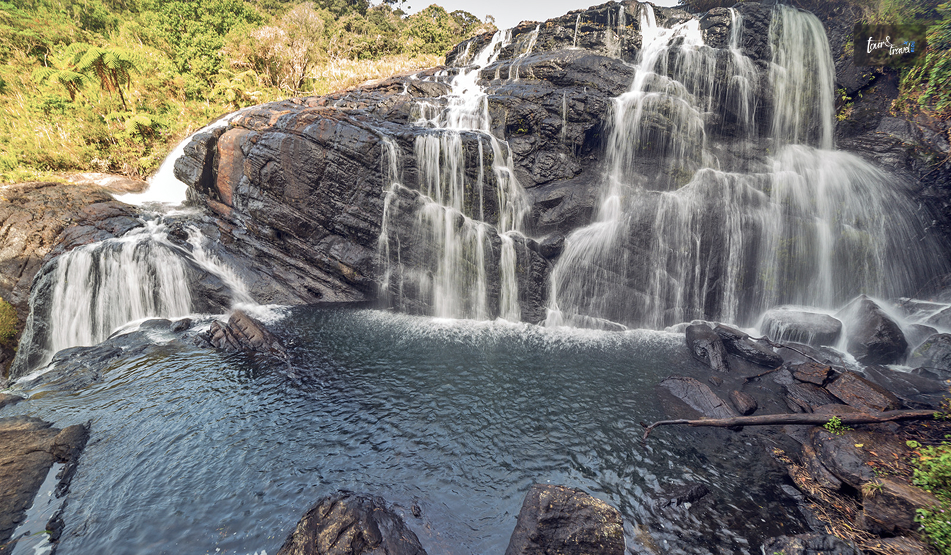
The Belihul Oya spreads across a wide, dark rock face in two stages, hemmed in by rhododendron and tree-fern growth that feels completely different from the open grassland just a couple of kilometres back up the trail. 

Originally known as Gonagala Ella, the falls were renamed after Baker, who is credited with discovering them during his time exploring and hunting in the Nuwara Eliya highlands.

After the exposed walk to World’s End, where wind and cold are the main things you are contending with.

The descent into the forest around Baker’s Falls is a genuine change of pace. It is quieter, greener, and sheltered. 

Most people treat it as the natural place to stop, catch your breath, and refill water before the final stretch back to the entrance.

What Is The Best Time To Visit Bakers Falls?

Bakers Falls: The Reward At The End Of The Horton Plains Loop
SeasonMonthsWhat to Expect 
Dry SeasonJanuary to AprilBest overall conditions.
Clearer views at World’s End and easier underfoot.
Wet SeasonMay to SeptemberFrequent Mist, Especially After Mid-Morning
Slippery Trail Sections
Early MorningAny Season, Before 9-10 AMEssential for a Clear View at World’s End Before the Cloud Rolls in.

A One-Day Itinerary: The Full Horton Plains Loop

Bakers Falls: The Reward At The End Of The Horton Plains Loop
TimeStopNotes
5:30 AMDepart Nuwara EliyaStart Early to Beat the Mist at World’s End
6:30 AMArrive at Park EntranceBuy Tickets and Start the Loop Trail. 
7:15 AMLittle World’s EndFirst Viewpoint, About 45 minutes in
7:45 AMWorld’s EndThe Main Escarpment
Aim to Arrive Before 9 AM for Clear Views
9 AMBaker’s FallsRoughly 2 Km Further Along the Loop.
Descend the Steps to the Base.
10:30 AMReturn to EntranceFinal 3.5 Km Stretch Back Along the Trail.
11:30 AMDepart for Nuwara EliyaYou Can Also Continue Toward Ella if Heading Further into the Hill Country. 

Practical Tips To Keep In Mind For A Trip To Baker’s Falls

  • Start before sunrise because World’s End is frequently shrouded in mist by mid-morning, especially from April to September.
  • Wear proper hiking shoes as parts of the trail are uneven. Also, the steps down to Baker’s Falls can be slippery.
  • Pack warm layers. Horton Plains sits above 2,000 m and mornings are cold, even though the walk itself will warm you up.
  • There is no swimming at the pool below Baker’s Falls. It is deeper than it looks and has a history of drownings.

We reached the park entrance again a little after ten, legs tired and jackets finally shed. 

Of everything on the Horton Plains loop, World’s End is the view people talk about. However, Baker’s Falls is the one I would send someone back for on its own.

Share on Social Media

Sibashree is a travel, culture, and leisure writer who has been writing since the age of 12 and professionally since 2014. With more than a decade of travel writing experience and journeys across India and several parts of the world, she brings a deeply personal and thoughtful perspective to her work. A student of English Literature and Mass Communication, Sibashree has always viewed travel as more than movement — for her, it has been a way of understanding people, cultures, and herself. Her passion for spiritual exploration has also led her to many unusual and meaningful destinations over the years. Outside of writing, Sibashree enjoys watching European cinema, reading about global politics, and reflecting on the stories hidden within everyday places.

Leave a Reply

Your email address will not be published. Required fields are marked *

title-img Related

READ MORE Devon Falls

Devon Falls, Nuwara Eliya: Know The Timings, Entry Fee, Experience, How To Reach And More

BY  Sibashree Aug 29, 2026

Like how I had pulled over for St. Clair's Fall, the same thing happened a few kilometers along the A7.   The driver asked me not to keep my camera aside yet, and suddenly the hillside opened up.   There was a long, narrow ribbon of white water dropping almost straight down into a gorge of tea bushes.  It was Devon Falls, the “Veil of the Valley” in Sri Lanka’s Tea Country. The name comes from how it falls a long way.   So, it more than makes up for the lack of width compared to St. Clair's Waterfall. Here is more about this beautiful waterfall that should be on your Sri Lanka itinerary the next time you visit.   Some Quick Facts About Devon Falls, Nuwara Eliya   Details  Information Height Around 97 Meters Number of Drops  3 Tiers River A Tributary of the Kotmale Oya, Part of the Mahaweli River System Location 6 KM West of Talawakele, Nuwara Eliya District, Central Province Elevation Around 1140 Meters Above Sea Level Entry Fee Free and Viewable from Roadside Platform Nickname The Veil of the Valley Rank 19th Highest Waterfall in Sri Lanka  Where Is Devon Falls And How To Get There? Around 6 kilometers west of Talawakele, Devon Falls is on the A7 highway that connects Colombo to Nuwara Eliya via Hatton.  This waterfall in the Nuwara Eliya District is at an elevation of around 1140 meters. It is in the heart of the Dimbula tea-growing region.   From Nuwara Eliya  The distance between Nuwara Eliya and Devon Waterfall is around 30 kilometers. I took a car from Nuwara Eliya, and it cost me around 3000 LKR.   You can also take a tuk-tuk, which costs around LKR 2000.   The road passes directly above the falls. So, even before you reach the viewpoint, you will get your first glimpse of it through the windscreen.  From Kandy Or Colombo  If you are traveling from Kandy by road, you will reach Devon Falls within 2 to 2.5 hours via Gampola and Nawalapitiya.   Furthermore, from Colombo, it is a 4-hour drive on the Avissawella–Hatton route. Since it is a long journey from Colombo, you can pair it with a night in Hatton or Nuwara Eliya rather than a same-day round trip.  On Foot From The Road  There are two designated car parks along the A7 that double as observation platforms.   Both offer a clear view of the three-tiered drop without any walking required.   If you want a closer look, a short trail leads about a kilometre through the surrounding tea estate toward the base, though the pool itself is not easy to reach.  The Story Behind The Name Of Devon Falls Devon Falls gets its name from Devon, a pioneering English coffee planter.   His plantation once occupied the land nearby.   When coffee cultivation collapsed across Sri Lanka's hill country in the late 19th century due to a leaf-rust blight, tea took its place.  Today, the falls tumble past neat rows of tea bushes rather than coffee, though the name from that earlier era stuck.  What I found most memorable about Devon Falls was not just its height, but how sudden it feels.   St. Clair's spreads its water wide and slow.  Devon narrows it and lets it drop, almost in a single unbroken curtain through the first two tiers before spreading again near the base.   Moreover, standing at the main viewpoint opposite the Mlesna Tea Centre, you get the full length of the fall in one frame, framed by steep, green escarpments on both sides.  What Is The Best Time To Visit Devon Falls?  Season Months What to Expect Wet Season May to September Fuller, more dramatic flow, though mist can obscure the view Dry Season December to March Clearer skies, better for photography, lighter flow Early Morning Any Season, Before 9 AM Less roadside traffic and softer light on the water  Pairing Devon Falls With St. Clair's Because the two falls sit only a few kilometres apart on the same road, almost nobody visits just one.   St. Clair's is the wider, more famous of the pair, while Devon is the taller and, to my eye, the more dramatic.   Seeing both in a single stop along the A7 takes less than half a day, which makes this stretch of road one of the most efficient sightseeing detours in the hill country.  A One-Day Itinerary Around Devon Falls Here's how I'd plan a day trip centred on Devon Falls, starting from Nuwara Eliya or Hatton.  Time Stop Note  8:30 AM Depart Nuwara Eliya or Hatton Aim to reach the falls before the midday tour-bus crowds.  9:30 AM St. Clair's Falls Roadside viewpoint, about 6 km east of Devon.  10:30 AM Devon Falls View from the main platform opposite Mlesna Tea Centre.  11:15 AM Tea estate walk or factory visit Several estates in Dimbula offer short tours.  12:30 PM Lunch in Talawakele Local rice-and-curry spots along the main road.  2:00 PM Onward to Hatton or Nuwara Eliya Or continue toward Adam's Peak if timing allows.   Practical Tips For A Visit To Devon Falls  Both viewpoints are roadside, so no hiking is required if you just want the classic photo.  Traffic along the A7 can be heavy with tour vans in the late morning. So, an early start helps.  Skip swimming here. The pool is difficult to access, and the currents near the base are not considered safe.  Pack a light jacket. At over 1,100 m elevation, mornings can be genuinely chilly even in the dry season.  We only stopped for about fifteen minutes at Devon Falls.  However, it was one of those places that have stayed with me. That long, narrow drop through the tea hills, half-hidden in mist, is hard to shake.

READ MORE ratnapura

What Is Ratnapura Famous For? Know The Best Places To Visit In Ratnapura 

BY  Sibashree Jun 30, 2026

I wanted to begin this article with details about how the air in Ratnapura is different from the air in Colombo.  However, the recent news about the Ratnapura air quality index (AQI) made me stop for a while. The presence of the main air pollutant PM2.5 in the quantity of 11 µg/mÂł in the air is actually 2.5 times higher than the World Health Organization (WHO) standard.  When I read the news, I could not match it with the heavy air of Ratnapura, constantly laden with the scent of wet earth, crushed tea leaves, and the electric promise of an impending downpour. Also, when I first stepped off the bus onto the rain-slicked tarmac of this valley town, wrapped tight by the jagged peaks of the Sabaragamuwa Province, I felt an immediate shift in energy. So, my experience of Ratnapura will always remain soaked in wet soil and very intimate.  Ratnapura: The Story Behind The Name Ratnapura gets its name from the Sanskrit words Ratna (Gem) and Pura (Town). So, literally, the name of the town means the “City of Gems.” It is fascinating how the region has been unearthing unbelievable wealth out of the mud. These gemstones include: Cat’s Eyes Deep Cornflower Blue Ceylon Sapphires Fiery Rubies Alexandrites Still, the glitz of neon lights has not touched Ratnapura. Everywhere you go, you will notice the rugged humility typical of a working class community.  Also, as a traveler, getting my boots caked in mud was a way more rewarding experience for me than walking on a pristine resort floor.  In the next section, I will describe in detail why Ratnapura is so famous and the best places to visit in the City of Gem.  What Are The Best Places To Visit In Ratnapura?  Located in the Sabaragamuwa province, Ratnapura is not just the Gem Capital of Sri Lanka. It is a rich depository of the fossils of extinct elephants and rhinoceroses from the prehistoric age.  Furthermore, it is the gateway to Adam’s Peak, and it is home to the spiritually significant Maha Saman Devalaya.  It is the shrine of Lord Saman, the presiding deity of the region.  Moreover, as a high-rainfall wet zone of Sri Lanka, it is also famous for its waterfalls and ecotourism.  1. Sinharaja Forest Reserve As I entered the forest reserve, for the first 20 minutes, my boots were in the mud.  It is a UNESCO World Heritage Site and it is special as it is one of the last remaining virgin rainforests on Earth.  Even in mid-noon, you will experience the thrill of the emerald twilight in the forest reserve as the canopy grows very dense. The canopy swallows the midday Sun.  Nuwan, a local guide, accompanied me through the forest reserve.  Within an hour, he silently pointed into the dense brush where a purple-faced langur monkey sat watching us with an expression of mild amusement.  We spotted giant squirrels leaping across tree crests and listened to the distinct, symphonic calls of over 130 bird species.  Keep a bottle of saltwater or a stick of soap handy, though, because the forest floor crawls with overzealous leeches who consider trekkers a moving buffet. 2. Udawalawe National Park The Udawalawe National Park, with its sweeping grasslands and skeletal trees, offered a lot of drama.  All these create a stark contrast against the distant highlands. Furthermore, the park is as thrilling as the African savannah for wildlife viewing.  I was on an open-top jeep safari, and our driver had cut the engine near a large watering hole. Then, within minutes, I could spot a large herd of wild Sri Lankan elephants emerging from the scrub.  Those were moments of absolute silence as three matriarchs gently guided a tiny, clumsy calf into the water, spraying mud to shield its skin from the Sun. Along with the elephants, I could also see glimpses of water buffaloes tracking us with heavy gazes and water monitor lizards sliding into the reeds. And the most fascinating part? I could spot a solitary, brief shadow that our driver swore was a Sri Lankan leopard. 3. Bopath Ella Falls Bopath Ella Falls was a short drive from the city center in Kuruwita.  The water flows through a narrow gap at the top and cascades down a stepped rock face, widening out into a shape that perfectly mimics the sacred Bo leaf (Ficus religiosa)  Furthermore, a dense forest surrounds the pool at the bottom. I was a little tired, and I sat on a slick rock and sipped fresh king coconut water bought from a roadside vendor.  He shared a fascinating local folklore with me.  “The old people say the pool is haunted," he murmured, looking at the churning white water. "They believe a great ancient treasure trove lies buried underneath, guarded by spirits." 4. Adam’s Peak (Sri Pada) Climbing Adam’s Peak from the Ratnapura Side is a strenuous job, and the path is known as the “King’s Way.” It is an act of sheer endurance.  The northern route from Nallathanniya is shorter and more popular. However, you cannot deny the allure of this southern trail which climbs over 7,300 feet via thousands of uneven, ancient stone steps. I started climbing the Adam’s Peak under a blanket of stars, my calves burning instantly. The closer I got to the top, the trails got steeper.  Furthermore, as the Sun broke over the horizon, its rays cast a perfect, triangular shadow of the mountain across the misty lowlands below.  The overall ambiance was deeply spiritual, and from pilgrims to adventure lovers, everyone can experience the shift of energy here.  5. Kitulgala  If you want to complement the tranquil ambiance of Ratnapura with something more vibrant, you can head to Kitulgala.  This small tone is home to a wet-zone rainforest that sees two monsoons a year. It holds fame not only for its raw beauty but also as the filming location for the 1957 classic The Bridge on the River Kwai. Furthermore, Kitulgala is the adventure capital of the region. I threw myself into white-water rafting down the churning Kelani River, gripping the paddle tightly as our raft slammed through technical, white-capped rapids. Moreover, if you want to stay in the land, you can enjoy bird-watching, canyoning, and the rides of natural rock slides in the jungle.  6. Maha Saman Devalaya Stepping into the tranquil grounds of the Maha Saman Devalaya was a humbling experience.  It is the spiritual heart of Ratnapura, and Sumana Saman, the presiding deity here, watches over the sacred mountain and the surrounding gem valleys. Furthermore, according to a legend, a royal court minister built this temple after a successful gemming expedition.  Though it carries deep historical Hindu influences, it functions today primarily as a serene place of Buddhist worship, framed by beautiful white Kandyan-style arches. 7. Bambarakanda Waterfalls The Bambarakanda Waterfalls stand at an amazing height of 790 feet, and it is the tallest waterfall in Sri Lanka.  I reached this waterfall after a steep hike through whispering pine forests. So, I did not feel the humidity and heat of the lower valleys here.  The cliff face is regularly shrouded in thick, rolling mountain mist, giving the entire landscape an ethereal quality.  Standing at the rocky base of the falls, looking up as the water plummeted from the clouds, I let the cool spray drench my face. It was the perfect antidote to days of humid trekking. 8. The Gem Mines You cannot leave Ratnapura without visiting a gem mine. I bunked the commercial showrooms and walked out into the surrounding paddy fields to see a traditional, artisanal pit mine.  I saw the miners digging deep, narrow shafts into the mud, reinforcing the walls with logs and fern leaves. They haul up baskets of illam (gem-bearing gravel) using simple wooden pulleys, then wash the dirt away in nearby streams.  A seasoned miner let me watch over his shoulder as he swirled a woven basket in the water, revealing a translucent, rough pebble of purple-blue sapphire.  It was an unfiltered look at the hard, manual labor behind the world's most glamorous stones. 9. Batadombalena If you are a history enthusiast, Batadombalena is a must visit for you.  This ancient rock cave and archeological site, hidden deep within the foothills, contains evidence of the prehistoric Balangoda Man (Homo sapiens balangodensis), dating back over 30,000 years. I hiked up to the cave, walking through rubber plantations and dense thickets.  Furthermore, this cave has excavation trenches where stone tools and charred animal bones were uncovered.  10. National Museum Of Ratnapura The National Museum of Ratnapura is inside the Ehelepola Walauwa, which is a historic colonial mansion.  Here, I became familiar with the natural history of the valley. Also, I spent an hour marveling at prehistoric fossils of hippopotamuses, rhinoceroses, and elephants excavated directly from the local gem pits.  It also holds an incredible collection of traditional weapons, ancient jewelry, and an educational breakdown of the region's complex geology. My 3-Day Ratnapura Itinerary DaysThe Time of the DayActivities/Places to Visit Key Highlights and TipsDay 1MorningMaha Saman DevalayaStart early to beat the heat, enjoy the crisp air, and listen to peaceful morning chants.AfternoonBatadombalena Caves and Bopath Ella FallsHike up to explore prehistoric cave history, then enjoy a picnic lunch by the unique heart-shaped waterfall.EveningCentral Clock Tower Street MarketWander the central streets to watch local merchants rapidly trading rough gemstones right on the pavement.Day 2MorningSinharaja Forest ReserveEnter via Kudawa or Pitadeniya gates by 7:00 AM for the best chances of spotting active wildlife and rare birds. AfternoonUdawalawe National Park SafariHead south and hire a 4x4 jeep for a 3:00 PM safari to see elephants gathering by the water reservoirs.Day 3MorningActive Gem Mine TourCoordinate with a local guide to visit a working mine; remember to tip the miners generously for their time.AfternoonNational Museum of RatnapuraHead back into the city to view ancient fossils of extinct animals that once roamed the valley.EveningLocal Culinary DiningWind down at a local eatery with traditional red rice, jackfruit curry, pol sambol, and sweet kithul jaggery. Ratnapura: Muddy, Chaotic, And Magical  Ratnapura is not the place where you will find curated beauty. It can be wet, muddy, and chaotic.  However, if you don’t mind smelling the coffee, you will experience the magic it offers.  The magic of the smile of a miner hauling up mud and the primeval silence of Sinharaja!  Also, it is not the place where you will just pass through for the sapphires.  Moreover, I would love to come back for the wild, untamed spirit and mist of the waterfalls.  Read Also: Why Is Puttalam Sri Lanka Famous? What Are The Things To Do In Puttalam? What Is Batticaloa Famous For? Know The Best Things To Do In This Eastern Town Of Sri Lanka What Is The Yala National Park Safari Price? Why Is It One Of The Top Things To Do In Sri Lanka?

READ MORE Is Japan expensive

Is Japan Expensive For Tourists? Why Is It Still Seeing A Boost In The Travel Booking? 

BY  Sibashree Sep 24, 2021

I have been to Japan many times, and the cultural richness and the sensory delights the country offers make the experience worth it!  However, these days, I see a lot of people asking, “Is Japan expensive to visit?”  Another question in this regard is why Japan is witnessing a major boost in travel booking.  Now, first, let me answer that Japan is not as expensive as people are projecting it. Be it the day trips from Tokyo or exploring the cherry blossom season in Kyoto, if you plan an itinerary and the modes of transport well, you can complete the trip within a decent budget.  Furthermore, thanks to smart tools such as the Japan Rail Pass, you can now make transport more convenient and flexible.  Also, whether Japan is expensive or not will depend on the country you are traveling from and how the currency of your country fares against the Japanese Yen.  On the other hand, Japan is enjoying a massive surge in popularity among Gen Z tourists due to many reasons. However, sushi, manga, and anime are the three major factors driving this rise.  While Japan can be managed on a moderate budget, and I have shared the three main reasons behind the rising popularity of Japan, let’s delve deeper into how much a trip to Japan costs and the other factors causing a rise in Japanese tourism.  Why Is Japan Expensive To Visit? Is It The Growing Craze?  Do you know that American Express Travel data shows a 1300% hike in the number of Americans visiting Japan since 2019?  Furthermore, Netflix has confirmed that Anime viewership has gone 3 times up in 2025.  Now, these pieces of information show how young Americans, especially the Gen Z travelers, are passionate about Japan.  The country is now a cultural superpower with its “Soft Power” that it has used to build the global landscape of entertainment, aesthetics, and ideas.  Joseph Nye, a political scientist at Harvard University, has highlighted the strength of Japan’s soft power.  Overall, Japan is not just a new country to visit for these young travelers. It is an escape to the land of rich culture, great food, and soaking in the spirit of slow tourism.  However, the rising craze among young travelers is not the reason behind Japan being labelled as an expensive destination.  In fact, it is amazing to see tourism in Japan growing despite the high travel expenses being  high.  Key Reasons For Japan Being An Expensive Destination To Visit  Japan is expensive as a destination primarily for three reasons. First of all, the Shinkansen bullet trains, extensively used for transportation, are very expensive.  Also, while I found Osaka food from the street stalls quite affordable, trying Sushi, Ramen, or other Japanese staples in a fine dining restaurant can be very expensive.  Furthermore, Japan almost entirely depends on imported energy.  Despite an improvement of 22.4% in the net energy import during the period of 2020 to 2024, the net energy import of Japan in 2024 was 87.4% of the total energy supply, according to the International Energy Agency (IEA).  Thus, the fuel cost is always high in Japan, impacting the transportation expenses, the cost of essential commodities, and every other sector in a direct or indirect manner. Is Japan Expensive To Visit? A Breakdown Of Tourist Costs  So, Japan is expensive to visit. However, what can be the overall expense tentatively?  What will be the expenses on food, transportation, and accommodation? Here is a detailed breakdown.  1. Tourist Accommodation Cost In Japan Japan is very sincere about the hospitality it offers. So, even if you are staying at a budget hotel or hostel, you will find good hygiene and the basic amenities.  Furthermore, along with hostels, Japan has unique accommodation provisions such as the capsule hotels.  These are basically sleeping pods, and the cost is similar to staying in hostels.  On the other hand, you will find a minshuku, which is like a Japanese version of homestays. You will get bed and breakfast facilities at these accommodations run by local families.  Nevertheless, have a look at the table below to understand the different types of accommodation for tourists in Japan and their average costs.  Types of Tourist Accommodation in JapanTentative Cost Hostels and Capsule Hotels2000-4500 JPYBudget Hotels5000-10000 JPYBread and Breakfast 5000-8500 JPYStandard Hotels10000 JPY Onward Moreover, if you’re looking to move to Japan after your trip there, check out reliable websites to know the best places for foreigners where you can call home. 2. The Cost Of General Public Transport In Japan  The Japanese Bullet Train or Shinkansen is the most preferred mode of transport in the country.  The Cost Of Traveling In A Bullet Train And The JR Pass However, the travel cost is very high if you are traveling by these bullet trains.  On average, and based on the departing station or the destination, the cost will be around 16000-20000 JPY per ride (the ticket price can go much higher).  For example, if you take a bullet train from Tokyo to Shin Amori, the price for a reserved seat will be 21340 JPY.  On the other hand, for the Green Seat and the GranClass Seats, the ticket prices will be 27410 JPY and 34410 JPY, respectively.  On the other hand, a Tokyo to Kyoto bullet train ticket starts from 16550 JPY.  Now, this is where a Japan Rail Pass becomes handy. As a tourist, you can buy a Japan Rail Pass for 7 days, and the cost starts from 50,000 JPY for an adult. For a child, it is 25000 JPY.  You can even buy passes for 14 days or 21 days. With this pass, you can enjoy unlimited rides during the validity period.  Moreover, if you want to focus on Tokyo and its nearby areas, the Regional Pass will be a more budget-friendly option.   Also, cabs are pretty expensive in Japan. For a ride of 1 to 2 kilometers, you will have to pay around 500 to 700 JPY.  After that, a fee of 80-100 JPY will be added for traveling every 250 to 300 meters.  3. The Cost Of Hiring A Tour Guide In Japan  The cost of hiring a tour guide in Japan is between 25000 and 60000 JPY per month. However, the cost of the travel guide will depend on the services you opt for.  You can choose a guide for a full day, and the cost can be up to 80000 JPY, and for a half day guide, it will be around 25000-47000 JPY.  Furthermore, if you are traveling in small groups or vans, the cost of hiring a guide will be around 24000 JPY.  So, hiring a personal travel guide is expensive in Japan. However, you can save the cost of hiring a guide by seeking help from the local tourist centers or the national tourist departments.  4. Food And Drink Cost In Japan Food is one of the most important factors for Gen Z travelers visiting Japan. A survey said that around 50% of the visitors planned a trip just because they wanted to visit a restaurant or try some specific food.  Also, food and drinks are available in various cost ranges. So if you are planning to take the authentic taste of sushi, you will get plenty of options available there.  From the expensive designer boutiques to Kaiten-zushi style shops everywhere, the multiple authentic sushi dishes are valuable.  You can select the place according to your requirements.  In the boutique’s style restaurant, you have to spend nearly 51000 JPY for sushi, but if you prefer the sushi in a low-cost range, you have to spend only 1593 JPY for sushi.  If you want to explore Japan on a budget. You can quickly shift your choices to Japanese cuisine and cut your travel budget by cutting the foreign food items. How To Plan Budget-Friendly Travel In Japan? Do you want to travel in Japan on a budget? Here are the tips you can follow.  1. Make A Tour Plan In The Off Season  Off-season tour plans are always budget-friendly. The Autumn season is an off-season to travel in Japan, and this time the tourist rush is not very high. 2. Take The Railroad  Take the railroad to explore the city and buy the railway card to see the tourist places in the country. 3. Focus On Local Cuisine  Focus on the local, authentic, fresh Japanese dishes. If you’re looking for cheap food in Japan, you can buy it in small restaurants, street food stalls, and even vending machine cafes.  However, if you stay in the country for an extended period, you can save money on your travel by preparing and cooking most of your meals from scratch. 4. Find An Accomodation Far From The Main Crowded Cities  Try to find accommodation that is a little bit far from the main crowded cities. Make sure to book your accommodation ahead of time to save a lot of money. Hostels and the local guest houses are also charming, clean places to stay. However, when planning a Japan tour, it is better to keep away from the expensive luxury boutique-type accommodations. 5. Look For Free Attractions  Look for free attractions and events to save money.  Whether you want to spend a fun day in a national park or visit a museum, there are incredible activities that allow you to enjoy Japan without paying anything.