

What Are The Best Ella Hotels? Where Can You Stay In Ella? 

From enjoying a train ride on the Nine Arch Bridge to Ella Rock, Ella has endless adventures to offer. 

Exploring the things to do in Ella is also easier as the Ella Hotels offer the most comfortable and safe accommodations. 

As a backpacker, I chose to stay in a hostel on my first visit. However, you can find many budget, mid-range, and luxury hotels in this beautiful hill country town. 

So, here is a list of the best hotels to stay in Ella. 

What Are The Best Ella Hotels? 

What Are The Best Ella Hotels

I have divided the best Ella hotels into three different categories. So, you will find a good mix of luxury hotels, mid-range hotels, and budget hotels.

Furthermore, I have also included the hostels and the eco-stays here. 

And here are the details. 

1. Luxury Ella Hotels

There’s a quiet magic when birds sing in the morning, and mist hangs on the tea bushes. 

Moreover, Ella has upgraded its luxury offerings, blending colonial roots with modern sustainable design.

• Nine Skies: Colonial Elegance

Just outside Ella in Demodara, Nine Skies is a five-bedroom tea bungalow restored from old stock. 

Furthermore, it sits like a piece of the English Lake District transplanted into the tropics. 

Also, you begin your day with a Sri Lankan breakfast and then swim in an infinity pool that stretches over endless tea fields. 

Moreover, the lifestyle is classic tea country, wrapped in a dream-like hotel setting.

• 98 Acres Resort And Spa: Eco-Luxury

Overlooking Little Adam’s Peak, 98 Acres stands out as the region’s top hotel. 

Furthermore, the chalets use upcycled railway sleepers and local granite, with genuine, hands-on design. 

Moreover, their spa features treatments with herbs grown on-site. Just a 15-minute walk from the Nine Arch Bridge, it’s ideal for morning shots. 

So, what else is there to say about this place?

• Hide Ella: Modern Panoramic Views

Hide Ella sits right into a 60-degree slope. 

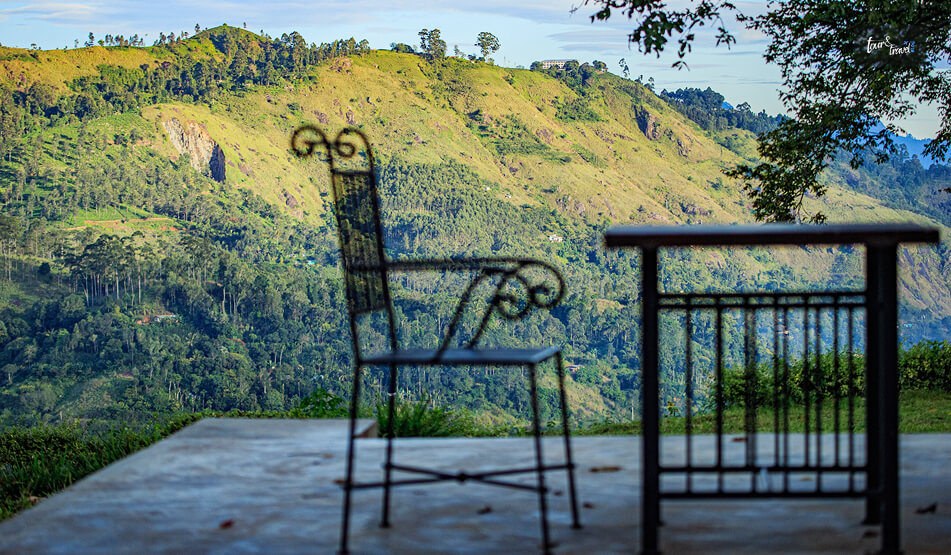
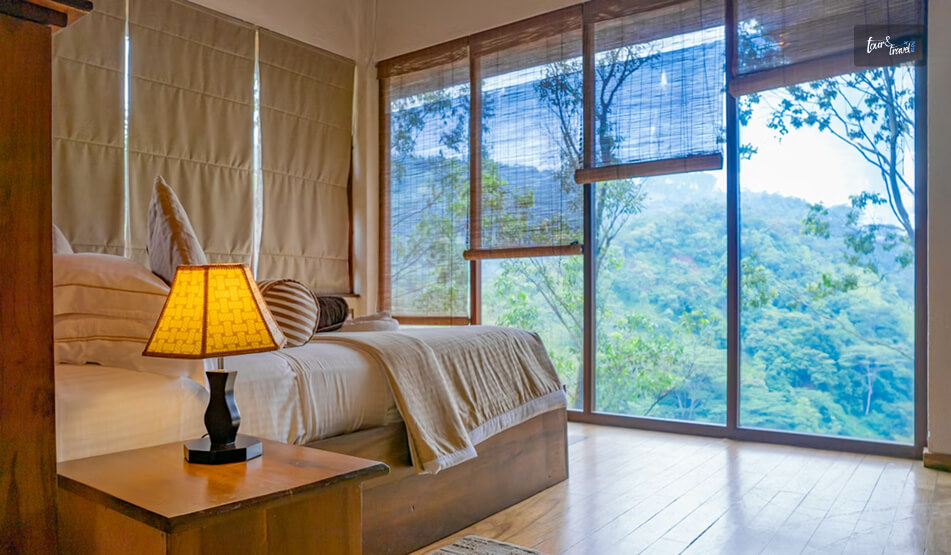
Every room faces the Ella Gap with clear, sweeping views. 

The pool dips into the trees like you are floating through the canopy. It’s a clean, sharp design, with no frills.

Furthermore, it offers just pure view-focused living. 

Why would anyone want anything else in Ella?

2. Mid-Range Ella Hotels

For a bed that works, a shower that flows, and a balcony with real views, without the honeymoon price! 

Ella’s mid-range picks offer the best trade-off. Most focus on the view, which is Ella’s strongest selling point.

• Chill Ville Viewpoint Hotel

It is set into the mountainside, and it is the most welcoming. 

Cabins are clean, modern, with wood and concrete finishes. 

They even include Yoga mats for stretching in the morning light. 

If you want to go early to the Nine Arch Bridge, this is your only real shot, and it’s just 800 meters away. 

It seems like a good fit for quiet travelers who value space and scenery.

• Country Homes Ella 

It looks more like apartments than hotels. 

Warm pine decor gives each suite a cozy feel. 

The wide valley view from your room makes it hard to leave.

In particular, when you know breakfast is often brought right to your balcony by the owners. 

You get coffee at the same time clouds drift through the gap, arguably one of the most consistent perks in town.

• Boutique Vibes: Morning Dew, EKHO, And Tip Top

It seems to be a recurring motif in Ella.

These hotels offer really amazing views and somewhat old-fashioned rooms. 

Morning Dew, EKHO Ella, and Tip Top Boutique Hotel are, to some extent, this kind of hotel. 

The furnishings in these places might give the feeling of the 1990s, but the rooftop pools and jacuzzis with a stunning view of Ella Rock offer a 5-star experience. 

One of the advantages of choosing Tip Top is that you get the opportunity to see the train passing the Nine Arch Bridge from your private balcony.

3. Budget-Friendly Ella Hotels 

Budget-Friendly Ella Hotels

Guesthouses once pulsed with life in Sri Lankan tourism

Staying with a local family still gives the truest view of Ella. 

You learn how daily routines move through the village. Nobody makes curry like a Sri Lankan grandmother.

• Rowinrich Cottages: The Jungle Hideaway

These loft-style cottages sit above a valley wrapped in jungle. 

Backpackers find them ideal, glamping without dorm-sharing. 

Forest sounds carry through at night. 

Sunrises stretch across your terrace each morning. Just be warned: the road up is narrow and full of potholes. It’s not easy to drive.

• The Original Homestays: Idyll And Chamodya

Idyll Homestay opened early in town. 

Anil, who once worked on tea plantations, now manages one of Ella’s most trusted homes. 

Chamodya offers a clear view of Ravana Falls

Both serve breakfasts packed with string hoppers, dhal, and fresh fruit, more than enough for hiking up Ella Rock.

4. The Hostels In Ella: The Most Happening Social Hubs 

Like my trip to Jaffna, I also chose a hostel to stay in Ella. 

The hostel scene in Sri Lanka has really taken off over the past few years. 

Nowadays, staying in a hostel is not only about finding a cheap bed; it is also about experiencing a community, having superfast Wi-Fi, and going on shared adventures. 

• Bunk Station

A fairly new place in a peaceful and friendly atmosphere. 

It’s a quiet location away from the noise, but you can still walk to the town in ten minutes. 

• Hangover Hostel

Being part of a well-known chain of hostels in Sri Lanka, it is the best place to experience a social atmosphere.

You will get AC rooms here, and the location is very central near the train station.

• Backpacker’s Paradise 

If you are looking for the genuine “simple life” experience, you can camp in tents that are set up under thatched roofs. 

Moreover, it is a very basic, cheap option, and they even have their own little dogs as residents. 

So, what else do you need?

5. Eco-Friendly Stays In Ella 

Ella is a place that feels like home. 

Furthermore, Ella’s environment is delicate, and these eco-friendly stays are actively preserving it.

• Living Heritage Koslanda

It lies halfway between Ella and Horton Plains. 

Over the years, they’ve restored the forest and prioritized hiring local women, often left out of tourism jobs. 

The place feels like a quiet, natural escape.

• Arana Eco-Lodge And Yoga Center

The lodge sits just ten minutes from town. 

Rooms are treehouses built around living trunks. 

Moreover, it operates like a forest monastery. 

Also, electronics are minimal here. So, you can take part in sessions of Kundalini yoga and meditation here. 

Moreover, vegan Sri Lankan meals take center stage here. You disconnect from Main Street noise and return to the wild.

Share on Social Media

Sibashree is a travel, culture, and leisure writer who has been writing since the age of 12 and professionally since 2014. With more than a decade of travel writing experience and journeys across India and several parts of the world, she brings a deeply personal and thoughtful perspective to her work. A student of English Literature and Mass Communication, Sibashree has always viewed travel as more than movement — for her, it has been a way of understanding people, cultures, and herself. Her passion for spiritual exploration has also led her to many unusual and meaningful destinations over the years. Outside of writing, Sibashree enjoys watching European cinema, reading about global politics, and reflecting on the stories hidden within everyday places.

Leave a Reply

Your email address will not be published. Required fields are marked *

title-img Related

READ MORE puttalam sri lanka

Why Is Puttalam Sri Lanka Famous? What Are The Things To Do In Puttalam?

BY  Sibashree Jun 24, 2026

Puttalam grabbed everyone’s attention with the sudden visibility of a mysterious object with a length of several feet in the sky.  There were speculations about the object being a missile, rocket, or meteor shower.  A few months ago, on 15th December, 2025, the Geminid meteor shower was clearly visible in the sky.  However, these are not one-off instances. I could clearly see the Milky Way in Puttalam Sri Lanka, in the month of April.  Furthermore, the wilderness surroundings, remote areas such as Eluwankulama, and a relatively flat topography on the southwestern coast, make Puttalam one of the chosen places of stargazing in Sri Lanka.  But beyond the stargazing excitements, Puttalam, Sri Lanka, bears a rich history, exudes serene coastal beauty, and has a colonial heritage.  In this article, I will talk about my days in Puttalam so that you know that coastal beauty better.  Where Is Puttalam? Known for massive coconut production, prawn farming, and salt production, Puttalam town is the capital of the Puttalam district.  It is on the shore of the Puttalam lagoon, the second largest lagoon in the country.  The International Union for Conservation of Nature (IUCN) is now encouraging the most sustainable use of the lagoon resources.  Thus, they are supporting the exploration of new ecosystems here for better fisheries management. Here is an excerpt from a report published by IUCN on 4th April, 2025.  “With 88 fishing villages and approximately 165,000 people dependent on it, fisheries in Puttalam have been identified by its residents as their most important ecosystem service, particularly for women, who participate in bivalve gleaning and other post-harvest livelihoods. The lagoon is an important area for endangered species, such as green sea turtles and dolphins, and contains ecosystems vital for its health, such as seagrass and mangroves.  Tourism is also important in the Lagoon, which hosts seasonal aquatic sports and has year-round visitors to its islands.  The islands additionally have cultural importance as they are connected to local religious values.” Moreover, Puttalam has the Indian Ocean on the west, and it is the gateway to the Kalpitiya peninsula and Wilpattu National Park. How To Reach Puttalam Sri Lanka? Puttam is located around 130 km north of Colombo. It is also located at a distance of close to 95 km from Nogombo.  Furthermore, it is well-connected to Colombo and other major cities/hubs of the country through the Puttalam Railway Line and A3, A10, and A12 highways.  By Train  The train travel from Colombo Fort to Puttalam takes between 3 hours and 45 minutes and 5 hours.  Moreover, the ticket price will be between LKR 250 and LKR 1550 (Source: the Department of Railways. Sri Lanka. By Bus  Also, you can take a bus from the Bastian Mawatha Bus Terminal in Colombo and travel to Puttalam with a stopover in Anuradhapura.  You can even take the direct 87/816 buses. They cover the distance within around 4 to 4.5 hours, and the regular, non-AC bus tickets cost between LKR 500 and LKR 800.  What Is The History Of Puttalam Sri Lanka? Puttalam in Sri Lanka today stands out with its multicultural identity. Here, you will find a fusion of Sinhalese, Sri Lankan Moors, and Tamil cultures, which have lived for generations.  Furthermore, as a commercial and administrative center, it supports diverse activities such as prawn farming, shallow sea fishing, and salt production.  However, this town on the northwestern coast of Sri Lanka has a history spanning 10000 years.  Located on the large Puttalam Lagoon, it has been a maritime trade hub, a center for the colonial spice and coconut industries, and has an enduring and culturally diverse population. Here, I have broken the history of this coastal town into three sections.  Ancient Roots And Indigenous Beginnings The archaeological evidence of the locality shows that human settlements started here 75000-125000 years ago.  Prince Vijaya, 6th century B.C., chose it as the landing site, and thus the Sinhalese lineage started here.  Medieval Trade And Arab Influence  During the medieval period, Puttalam became a major location for maritime trade.  Arab merchants, who established deep roots in the region, laid the foundation for the prominent Moorish population in the area.  Furthermore, the name Puttalam comes from the Tamil word Puthu-kulam. Puthu-kulam means "new tank" or "new pond.” Thus, it indicated the vital irrigation tanks that sustained early agricultural settlements.   The Colonial Era  Many European powers wanted to control the lucrative trade routes of Puttalam because of its natural resources and coastal position.  The Potuguese was the forest to build a built a strategic fort in Puttalam to secure the region and monitor trade in the 16th century.  Then, in the 17th and 18th centuries, the Dutch came. They captured and significantly expanded the Portuguese fortress. Furthermore, during these times, Puttalam became a central transit point for the highly profitable cinnamon trade and salt production within the lagoon. In addition, in the 19th and 20th centuries, the British came to power.  They used the fertile soil of the region for the expansion of the coconut industry. Thus, Puttalam became one of the most critical sources of copra and coconut products in the island.  A Quick Summary Of The History Of Puttalam  Era/PeriodKey Historical Developments and MilestonesOver 10,000 years agoEarly human settlements established, supported by archaeological evidence.Medieval Period- Puttalam became a pivotal west-coast maritime trade hub.- Arab merchants settled, forming the roots of the Sri Lankan Moor community.- Named Puthu-kulam ("new tank/pond") after vital local irrigation tanks.Portuguese Rule(16th Century)A strategic coastal fort was constructed to monitor trade and secure the region.Dutch Rule (17th and 18th Centuries)- Captured and expanded the Portuguese fortress.- Transformed the town into a transit hub for cinnamon and lagoon salt production.British Rule (19th and 20th Centuries)- Developed agricultural infrastructure.- Oversaw rapid expansion of the coconut industry, making it a top source for copra. Why Is Puttalam Famous? Puttalam is famous for its historical ruins, religious centers, and natural attractions. You cannot miss the following attractions. 1. Munneswaram Hindu Temple The Munneswaram Hindu Temple is one of the five historic coastal temples of Lord Shiva in Sri Lanka.  The history of the temple goes back to at least 1000 CE.  Moreover, it is associated with the stories of the Ramayana.  Also, it is a unique spiritual hub where Buddhists and Hindus unite.  2. St Anne’s Church St. Anne’s Church is along the coastline of Thalawila. It has a peaceful ambiance.  Also, it dates back to the Portuguese era.  It serves as a monumental pilgrimage site. Furthermore, it draws hundreds of thousands of believers from across the island for its grand annual feast in July. 3. Alankuda Beach The Alankuda Beach has a tranquil stretch of golden sand, and it is known for dolphin and whale watching excursions.  Located in Kalpitiya, it is a premier eco-tourism destination, highly favored by adventure travelers for thrilling water sports like kitesurfing and windsurfing. 4. Hatthikuchchi Viharaya Tucked away in a peaceful forest landscape, this 3rd-century BCE Buddhist monastic complex is famous for a massive rock formation that resembles an elephant's stomach.  It is highly revered as the legendary sanctuary where the pious, exiled King Sirisangabo self-sacrificially gave up his own head to assist a poor peasant. 5. Anawilundawa Wetland Sanctuary This Ramsar-designated site is an important landmark for ecotourism in Sri Lanka.  It has a historic human-made system of interconnected freshwater tanks crashing right against a coastal lagoon. Furthermore, it is an irreplaceable, thriving sanctuary for thousands of native and migratory birds. 6. Puttalam Lagoon The Puttalam Lagoon, spanning an area of 32,700 hectares, is the second-largest backwater body in the country.  It has calm waters, and it is an ideal hub for small-scale prawn harvesting, wildlife viewing, and kite surfing.  7. Puttalam Station The colonial rulers of Puttalam opened the railway station officially on 12th May 1926.  Today, it is a state-run railway station and attracts many visitors due to its colonial charm and surrounding scenic beauty.  8. Yapahuwa Built by King Buwanekabahu, Yapahuwa was the royal residence in the 13th century.  Today, you will get to see the remains of this royal palace. I was especially mesmerized to see the ornate staircase.  9. Chilaw  Chilaw, located a few kilometers south of Puttalam, is a small town that stands out because of its religious harmony.  People from various traditions, backgrounds, and religions live here.  Furthermore, the beach here offers a calm and relaxing ambiance and the fishing villages here give you insights into the local way of living life.  What Are The Things To Do In Puttalam?  While Puttalam has the most tranquil vibe, it is also the hub of most adventurous activities, such as kite surfing, bar reef snorkeling, and wildlife safaris.  1. Kite Surfing In Kalpitiya  Kalpitiya is a global kite surfing hub. It has consistent wind conditions for over nine months of the year.  Furthermore, the flat-water lagoons here offer a safe space for learning. On the other hand, the ocean waves here challenge the advanced riders.  Also, the Margarita Kite School is the best name in kite surfing training in Kalpitiya today. It trains tourists and locals with the latest equipment.  Moreover, the downwind trips here are epic. You can glide across pristine, uninhabited islands and sandbars dotting the massive lagoon. 2. Dolphin Watching  I could spot hundreds of playful dolphins gathering in spectacular groups just off the Kalpitiya coast.  November to April is the best season to spot these adorable animals as the water remains calm.  Also, local guides follow strict conservation guidelines to protect the natural habitat of mammals. So, you have to follow responsible tourism practices.  3. Diving Puttalam has a diverse marine life. So, you can explore vibrant ecosystems teeming with sea turtles, reef sharks, and manta rays.  It also has historic shipwreck sites where fascinating sunken vessels are wrapped in colorful soft coral colonies. Furthermore, warm waters offer crystal-clear viewing conditions during the calm winter diving months. In addition, when you descend along deep underwater cliffs that host a spectacular variety of macro life. 4. Wildlife Safari At Wilpattu National Park The Wilpattu National Park has villus or natural rainwater lakes. It is famous for its high density of leopard population.  Furthermore, here, you can spot elusive sloth bears, wild elephants, crocodiles, and colorful endemic jungle birds. So, the jeep tour on the rugged off-road tracks was immersive. It cost me around LKR 16000.  5. Bar Reef Snorkeling  Here, you will find the most beautiful coral sanctuary of Sri Lanka.  Also, here, you can swim alongside brightly colored butterflyfish, giant parrotfish, and harmless blacktip reef sharks. Furthermore, you will marvel at delicate, healthy formations of brain and staghorn corals just below the surface. In addition, you can take short boat rides from the mainland to reach these shallow swimming areas.  What Is The Best Time To Visit Puttalam Sri Lanka? January to March and May to September are the best times to visit Puttalam. The dry and sunny weather conditions in the month are ideal for coastal kitesurfing in Kalpitiya, whale watching, and leopard safaris in the nearby Wilpattu National Park.
READ MORE Peradeniya Botanical Garden

A Slow Walk Through Royal History: My First-Person Guide To Peradeniya Botanical Garden

BY  Sibashree Sep 10, 2026

While setting my Kandy itinerary, I thought Peradeniya Botanical Garden would take around two hours. However, I ended up staying four hours in the botanical garden. Still, I felt that I rushed through exploring the spice garden. The time it demands is not just because of its expansion. Every section of the park is worth stopping for.  In this article, I will give you a walkthrough of Peradeniya, along with the fees, timings, and route details I gathered along the way. A Quick Snapshot Before You Visit The Peradeniya Botanical Garden DetailInformationOfficial NameRoyal Botanic Gardens, PeradeniyaLocationPeradeniya, about 5.5 km west of Kandy, Central ProvinceEstablishedIn 1821 as a formal botanic gardenThe site was a royal pleasure garden earlier, under the Kandyan kings.SizeRoughly 147 acres (about 60 hectares), Sri Lanka's largest botanical garden.SettingHeld within a wide loop of the Mahaweli River, the island's longest river.Managed byDepartment of National Botanic Gardens, Sri LankaPlant CollectionMore than 4,000 species, including a well-known orchid collection.Opening Hours7.30 AM - 6.00 PMTicketing Hours7.30 AM - 5.00 PMAnnual VisitorsAround 1.2 million local and 400,000 foreign visitors in a typical year. Sources: Department of National Botanic Gardens The Royal History Behind The Gardens A walk around Peradeniya helped me realize how much of Kandyan royal history is tied up in this particular loop of the Mahaweli River. From Royal Pleasure Garden To Botanic Institution Before the British formalized it in 1821, the Peradeniya Botanical Garden was a royal pleasure garden. The Kandyan kings were the patrons of the site, and it was especially dear to the last queen of Kandy.  Six years after the fall of the Kandyan Kingdom to the British in 1815, the land was converted into a proper botanic garden. It was initially managed by Alexander Moon and centred on coffee and cinnamon cultivation before it grew into the far broader collection it is today. A Living Library Of Over 4,000 Species Today, the park has more than 4000 plant species. You will see palms, ferns, orchids, and shrubs from across the world. So, within the same park, you will walk from the spice garden to the giant bamboo grove. It is like a mix of different ecosystems along the riverbank.  What I Found Walking Through The Gardens Peradeniya spans across 147 acres. So, it is not possible to cover the entire area on a single visit.  So, pace yourself rather than making an attempt to see everything at once.  The Royal Palm Avenue This is the postcard shot everyone takes, and for good reason.  Rows of towering royal palms line a long, straight avenue, and the scale of it is more impressive in person than in any photo I had seen beforehand. The Spice Garden I lingered longest here.  Cinnamon, nutmeg, vanilla, and other spices grow as actual plants rather than the packaged versions most visitors are used to. Also, having someone point out which bark strip becomes the cinnamon on a supermarket shelf made the whole spice trade history of the island feel a lot more concrete. The Orchid House The Orchid House displays Cattleya, Dendrobium, Arachnis, Oncidium, Phalaenopsis, and Vanda varieties and their hybrids, including specimens of Tiger Orchid, the largest orchid species in the world.  I would budget more time here than you think you need. It is easy to walk through in ten minutes, but worth thirty. The Giant Javan Fig Tree And Giant Bamboo These are two of the garden's most photographed non-flowering specimens. There is a sprawling Javan fig with a canopy wide enough to shade a small crowd. Also, the bamboo grove with stalks reaching over 30 metres. ] Both feel less like garden features and more like landmarks in their own right. The River Loop And Great Lawn The Mahaweli River wraps around most of the property. The paths along that loop are noticeably quieter than the main avenues. If you want a break from the crowds near the entrance, this is where to find it. A Realistic One-Day Itinerary TimeWhat I did7:30 – 8:30 AMArrive at openingStart at the Royal Palm Avenue while the light is still soft and the paths are quiet.8:30 – 9:15 AMExploring the Spice Garden with cinnamon, nutmeg, and vanilla plants. 9:15 – 10:15 AMVisiting the Orchid House, then the surrounding orchid garden.10:15 AM – 11:00 AMVisiting the Giant Javan fig tree and the great lawn near the river loop. 11:00 – 11:45 AMExploring the Fernery and the quieter riverside paths.11:45 AM – 12:30 PMVisiting the Giant bamboo grove, then a slow walk back toward the entrance. Planning Your Visit: Fees, Timings And Getting There Visitor CategoryAdults (12+)Children (5–12)Under 5Foreign VisitorsLKR 3,540 LKR 1,770FreeLocal VisitorsLKR 200LKR 30Free The charges for foreign schools and students are LKR 2,360. However, they need to produce the right proof.  Also, for local senior citizens with NIC proof, the entry fee is LKR 50.  How To Reach Peradeniya? Peradeniya sits less than 5.5 kilometres from central Kandy on the Colombo road, which makes it one of the easiest half-day trips out of the city. Take a short tuk-tuk or taxi ride, or a public bus running the Kandy–Peradeniya route.  Several local operators also combine it with a Kandy city tour, pairing the garden with the Temple of the Tooth and viewpoints around town in a single outing. Best Time To Visit Unlike Hakgala Flower Garden, Peradeniya's lower elevation and river-loop setting mean it is a comfortable visit almost year-round. However, a few things are worth timing around. Early morning (7:30–10:00 am) for cooler temperatures and quieter paths. The dry inter-monsoon months for the most reliable weather, since Kandy still sees regular rainfall through much of the year. Weekdays over weekends, since school groups and local families tend to fill the garden on weekends and public holidays. Tips From My Visit To The Peradeniya Botanical Garden Wear comfortable shoes. The paths are flat and wheelchair-friendly, but the total distance covered adds up quickly across 147 acres. Electric buggies and golf carts are available for rent. The 4-seater electric cars cost LKR 1000 per hour, and the 8-seater vehicles cost LKR 2000 per hour.  Carry water and sun protection. Despite the tree cover in places, long stretches of the main avenues are fully exposed. For photography, the light along the Royal Palm Avenue is best in the first hour after opening. Nearby Places To Combine With Peradeniya Botanical Garden Because it sits so close to Kandy, Peradeniya rarely needs to be its own dedicated day trip. The Temple of the Tooth Relic and central Kandy are easy extensions to a trip to this botanical garden.  Also, don’t forget the University of Peradeniya campus, which borders the gardens. Moreover, if you want a journey onward to the hill country, you can include Nuwara Eliya in your itinerary.

READ MORE Bentota

Why Is Bentota Beach, Sri Lanka, Famous? Know About Bentota Beach, River Safari, And More

BY  Sibashree Jul 7, 2026

With the One Love Reggae Festival returning to Bentota Beach, Sri Lanka is now preparing to be a vibrant cultural stage for music lovers from around the world.  The event is slated from 7th to 9th August, and with a laid-back coastal atmosphere, will function as a major tourism catalyst for Bentota.  Nevertheless, Bentota Beach has always been a popular, idyllic destination in Sri Lanka due to the calm waves of the Indian Ocean and soft golden sands.  Furthermore, it is a gateway to the Sinharaja Forest Reserve, a UNESCO World Heritage Site, and another UNESCO World Heritage Site, Galle Fort.  However, for me, the most striking thing about Bentota was the safari on the Bentota Ganga. With dramatic landscapes and surrealism awaiting you in every nook, this was one of the highlights of my trip to Sri Lanka.  Also, very close to Colombo, just a 2-hour drive away, this beach stands out even if tourists show more interest in popular variations such as Tangalle Beach and Mirissa Beach.  Here is more about why Bentota Beach is worth visiting and what the top attractions are.  What Are The Things To Do In Bentota?  The heavenly sunset views of Bentota Beach, the most anticipated boat safari on Bentota Ganga, and a relaxing experience in the Ayurveda Herbal and Spice Garden! Furthermore, if you want an adrenaline rush, you can take part in activities such as parasailing, banana boating, jet skiing, and more! 1. Water Sports At Bentota Beach Bentota has many beaches, such as the Ventura Beach or the Moragalla Beach, where the ocean meets the Bentota Ganga River.  However, together, they are known as the Bentota Beach, and together they look like a long stretch of fine white sand.  A specific stretch of sand is parallel to Bentota Lagoon, which is more commonly called the Bentota Ganga.  It is known as the Paradise Island, looking like a narrow and long peninsula stretching out into the ocean.  Also, it is ideal for the following watersports.  Windsurfing Waterskiing Diving Canoeing Snorkeling Fishing Moreover, centers such as Diyakawa Water Sports and Sunshine Water Sports Center help with the best gear, training, and guidance.  2. Visiting The Kosgoda Sea Turtle Conservation Project I mentioned the Kosgoda Sea Turtle Conservation Project when visiting Kalutara.  However, it is way closer to Bentota, and it is situated at a distance of just 9 km. So, it is just a road journey of 9 km or 15 minutes south by road.  It remains open from 8:30 AM to 6:30 PM, and the ticket price is LKR 500 for locals and LKR 1000 for foreigners.  It is a vital wildlife sanctuary on the southwestern coast of Sri Lanka. Established in 1981, it aims to protect endangered sea turtles from extinction caused by poaching and habitat loss. The hatchery monitors local beaches to rescue vulnerable eggs.  It buries them safely in protected sand nests until they hatch. Impressively, the project cares for all five sea turtle species that visit Sri Lanka. The Green Turtles Loggerhead Turtles Hawksbill Turtles Olive Ridley Turtles Leatherback Turtles.  The sanctuary also rehabilitates turtles injured by fishing nets. However, for me, the most exciting experience in the sanctuary was releasing newborn hatchlings into the Indian Ocean at sunset.  This hands-on experience funds the project while raising global awareness about marine conservation. Overall, it was a great experience learning about the marine ecosystem and how these adorable marine creatures play an important role in maintaining the balance.  If you want to watch and study them further, Sri Lanka has many other destinations such as the Dalawella Beach, Dickwella Beach, and Mount Lavinia Beach.  3. The River Safari On Bentota Ganga  While many people are more excited about the watersports, I visited Bentota for the water safari.  It was late afternoon, and the Sun was getting mellower. Fortunately, the hotel I was staying in had the provision for booking a boat safari.  The boat progressed through the jungle. Also, I could spot eagles flying high and some snakes in the water.  I was looking for crocodiles, but this time, I did not find one.  Moreover, the roots of the trees got entangled, and the roots created some eerie formations that looked straight out of Apocalypse.  Having said that, the river safari was not just an opportunity to spot the wildlife. I also saw the traditional fishing techniques and prawn farming in the wetlands surrounded by mangrove forests.  Another interesting stop was the Cinnamon Island. I spotted old and young men cutting sleek sticks of cinnamon. I bought a few bottles of cinnamon oil from them.  It was a 1.5-hour safari, and it cost around LKR 2500.  4. Exploring The Bentota Market  The Aluthgama town is around 3 km away from Bentota, and the Monday market here is amazing.  I had a talk with Manjula, a college student and a local vendor who helps her mother, Hiruni.  “People from different parts of the southwest coast come here. This is a market mostly dominated by women. So, I love being a part of the market.  The vendors sell various products, including clothes, vegetables, groceries, and other knick-nacks.  I also found the place to be a great spot for socializing. Women were interacting with each other when buying exotic fruits and fresh vegetables.  Moreover, I collected some cinnamon sticks, spices, and clothes as souvenirs.  5. Enjoying The Benefit Of Herbal And Spice Treatment  Bentota is famous for traditional Ayurveda and health treatment. The oils and massage solutions here have spices and local herbs.  The medicines and solutions also have cardamom, cinnamon, seeds, fruits, bark, and leaves.  So, if you want to enjoy the ultimate Sri Lankan spa experience, Bentota is the ideal place.  The big hotels and resorts have spas offering traditional treatments and therapies. Furthermore, there are some specialized Ayurveda centers.  Where To Stay In Bentota Beach?  From budget guesthouse Hotel Hemadan to 5-star hotel Taj Bentota Resort, the accommodation options in Bentota are diverse.  Furthermore, if you want an artistic and boutique experience, you can choose options such as Taj Bentota Resort and NH Bentota Ceysands.  Based on the accommodation you choose, the cost of staying in Bentota will be between LKR 13000 and 60000 per night.