Dazzling Emerald Green Water World’s Luckiest Fishing Village
Anna Maria Island
A Hidden GemStrict Building Limits Preserving Old-Florida Charm Uncrowded Stores
Pensacola Beach
Striking Eco Trails Budget-Friendly Lodging Protected Gulf Islands National Seashore
A Detailed Discussion On The Best Beaches In Florida Gulf Coast
Having shared the list of the best beaches in Florida Gulf Coast, I now want to delve deeper. So, here is more about why you will love the best beaches in the Florida Gulf Coast.
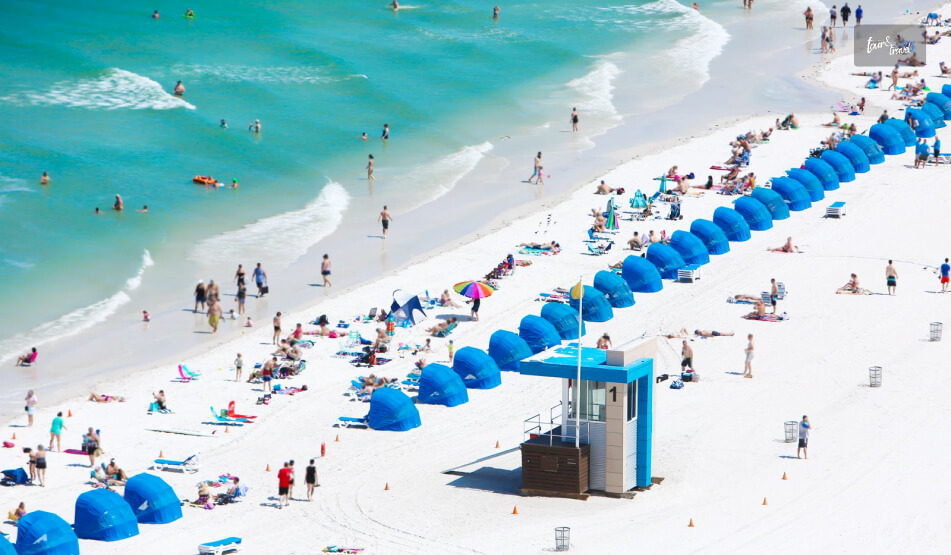
1. Clearwater Beach
With its vibrant atmosphere and wide shorelines, Clearwater Beach has been one of the top beaches in America, fetching ranks among the top beaches in America.
Furthermore, it is the ideal destination if you want a fusion of city amenities and beach relaxation.
Moreover, it has the famous Pier 60, which makes the nightlife in Clearwater Beach the most happening.
• Best Activities In Clearwater Beach
Parasailing, jet-skiing, taking pirate-themed boat cruises, and watching the nightly sunset celebrations at the pier are the best things to do in Clearwater Beach.
• Clearwater Beach Nearby Attractions
You can visit the Clearwater Marine Aquarium, Caladesi Island State Park, and Captain Bligh’s Landing Mini Golf near Clearwater Beach.
• What Is The Best Time To Visit Clearwater Beach?
March to May is the ideal time to visit Clearwater Beach. The weather remains warm in these months.
However, the summer is not intense yet, and there is still time for the humidity to shoot up and storms to arrive suddenly in the afternoon.
• Who Is Clearwater Beach Best For?
Clearwater Beach is the best for families with children, young couples, and solo travelers who enjoy a bustling resort-town atmosphere.
• Parking Info
Parking at Clearwater Beach can be challenging.
However, you can use the public parking garages on Coronado Drive or catch the Clearwater Ferry to skip traffic.
I opted for the latter.
• Water Clarity
The water here is very clear, calm, and shallow.
Furthermore, the brilliant light blue hue makes it perfect for wading.
• Restaurants Nearby
The restaurants near Clearwater Beach are Frenchy’s Rockaway Grill (famous for grouper sandwiches), Palm Pavilion Beachside Grill, and Ocean Hai.
2. Siesta Key Beach
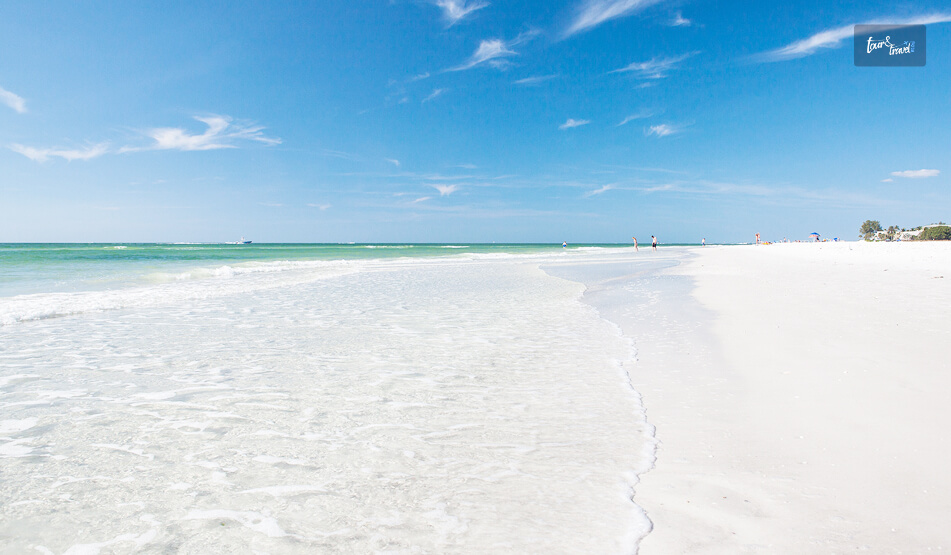
Siesta Key Beach near Sarasota has earned a global reputation thanks to its distinct sand composition.
With 99% pure quartz, the sand looks like powdered sugar, and it does not get hot even when the Sun is scorching.
Furthermore, it has a massive playground, professional tennis courts, a large concession pavilion, and highly active lifeguards, creating a highly active and safe environment for families.
In addition, the wide-open western view of the beach offers flawless sunsets. This stunning sunset view here is often celebrated with the local Sunday night Siesta Key Drum Circle.
Popular Activities
The Siesta Key Beach is popular for a host of water sports, including kayaking, stand-up paddleboarding, and snorkeling near the Point of Rocks area.
3. Naples Beach
High-end sophistication meets natural coastal beauty in Naples Beach. It promises a quiet, refined, and more luxurious vacation experience.
Luxury Atmosphere
Backed by million-dollar mansions, manicured parks, high-end boutiques, and upscale golf resorts, Naples Beach offers the most luxurious experience.
Naples Pier
The historic pier of Naples Beach extends into the Gulf. Thus, it is an ideal spot for walking, fishing, and viewing the coast.
Romantic Travel Angle
You can choose Naples Beach for a romantic date as it is the place where couples can enjoy sunset strolls, fine oceanfront dining, and book luxury spa treatments.
Dolphin Spotting
Naples Beach is ideal for dolphin spotting, as you can find dolphins frequently swimming close to the shorelines.
You can easily find them from the beach or the pier.
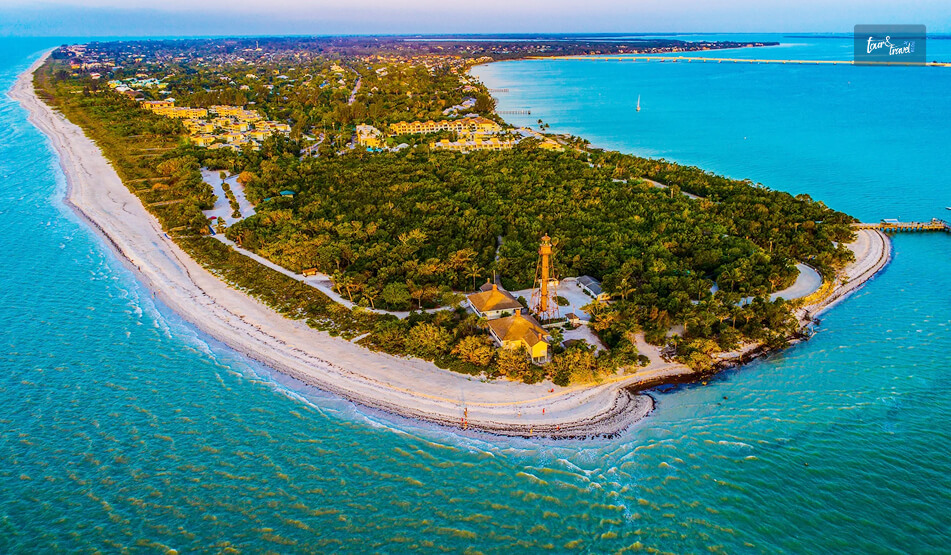
4. Sanibel Island
Sanibel Island is an eco-focused paradise. It stretches from east to west instead of north to south.
Due to this unique geography, the island acts as a natural banana-shaped scoop for treasures from the Gulf.
• Shell Collection
Sanibel Island is known as the “Shelling Capital of the World.” Here, people practice the Sanibel Stoop to gather rare shells.
• Nature Lovers
The island has no traffic lights or high-rise buildings. Thus, it enjoys a raw and authentic coastal environment.
Furthermore, the lack of light pollution makes it ideal for stargazing.
• Wildlife Refuges
Over half of Sanibel Island is protected. The J.N. “Ding” Darling National Wildlife Refuge especially demands special attention.
It is home to manatees and roseate spoonbills.
• Quiet Beaches
Sanibel Island has quiet beaches that offer complete solitude. For example, Bowman’s Beach offers absolute solitude.
Fortunately, many beaches on the island are not commercialized, and there will be no music and crowds.
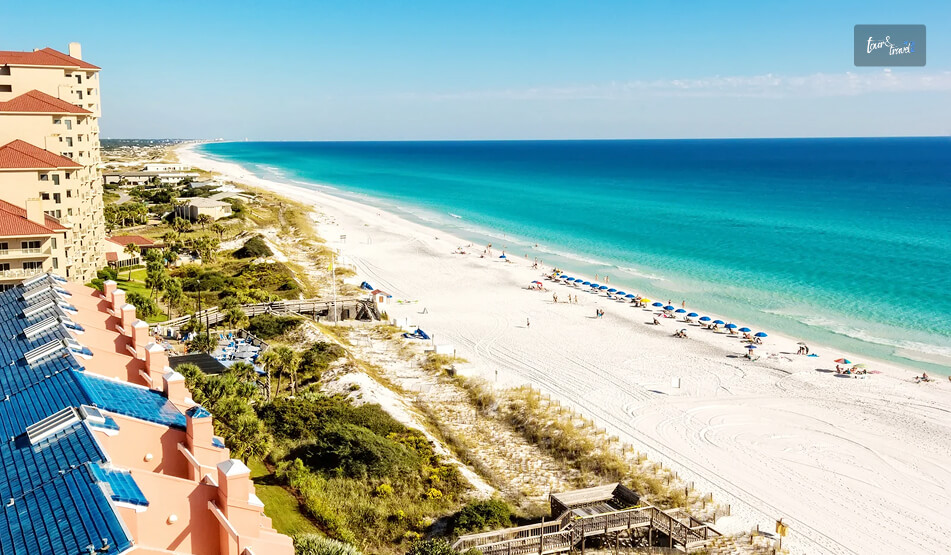
5. Destin Beach
Destin Beach is in the Florida Panhandle. It showcases a dramatic landscape shift, and the amazing color of the water here creates the magic of the Caribbean.
Emerald Green Water
Destin Beach has a combination of pure Appalachian quartz sand and shallow water. Furthermore, the water here looks bright emerald in color.
Fishing Opportunities
Destin Beach is home to the largest charter fishing fleet in the state. Furthemore, it offers world-class deep-sea fishing excursions.
Adventure Activities
Snorkeling at the Destin Jetties, renting pontoon boats, and exploring the famous, lively Crab Island sandbar are the best adventure activities here.
6. Anna Maria Island
You will go on a trip back in time in Anna Maria. You will not find fast food chains or tall condo buildings here, thanks to the strict local laws.
Thus, the island remains peaceful. Also, thanks to the lack of a crowd, the island enjoys a slow pace of life, and the beaches here are devoid of massive tourist crowds.
Furthermore, I loved getting around Anna Maria Island on bicycles, and you can even take a free island trolley to move around.
Also, you will find locally owned boutiques and donut shops on Pine Avenue.
Moreover, you can read a book under an umbrella, walk along peaceful shores, and escape modern city noise.
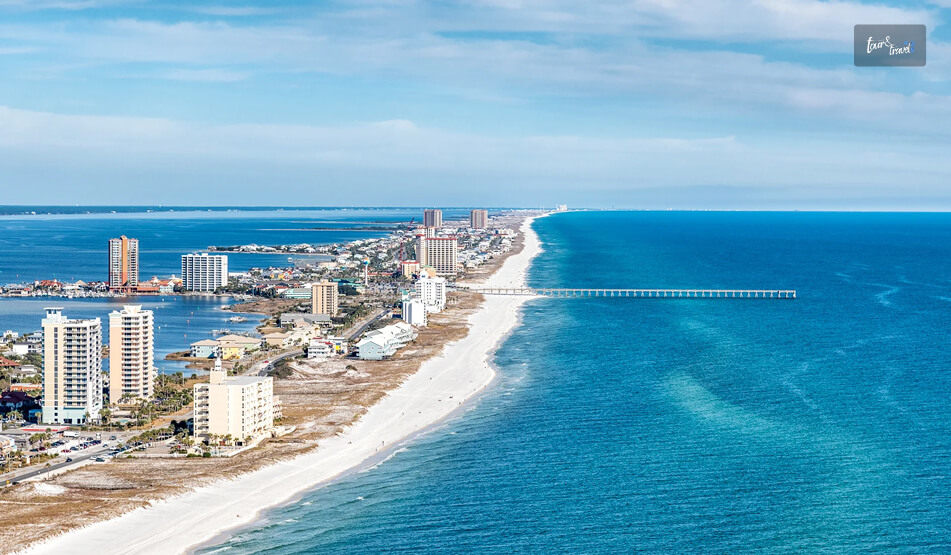
7. Pensacola Beach
Pensacola Beach is on Santa Rosa Island. It stands out with a fusion of a rich military history and the pristine appeal of the national park coastlines.
Moreover, Pensacola Beach is one of the most budget-friendly beaches on the Florida Gulf Coast. You will find affordable beachfront hotels, condo rentals, and dining options compared to those in Southwest Florida.
Furthemore, the Pensacola Beach Boardwalk, the historic Fort Pickens, and regular spectacular airshows by the Blue Angels are the prime family attractions.
In addition, it is bordered by miles of protected, footprint-free sand dunes within the Gulf Islands National Seashore, which offer the most amazing Gulf views.
What Are The Best Florida Gulf Coast Beaches For Families?
Are you traveling with your family, especially with your children?
Then, you have to choose beaches that have calm waves, convenient amenities, and offer
maximum safety.
In this context, Clearwater Beach can be an excellent choice as it has central lifeguards, shallow drop-offs, and endless beachfront playgrounds.
On the other hand, Siesta Key Beach, with its quartz sand, ensures that children can roam around the sands comfortably and without the fear of burning their feet. This beach also has excellent picnic areas.
Moreover, if you are looking for a budget-friendly option, Pensacola Beach is an amazing choice.
What Are The Quietest Beaches On The Florida Gulf Coast?
If you want to escape the crowds, blaring music, and jet-ski traffic, Sanibel Island is the best place to visit.
Here, nature takes center stage.
Secondly, Anna Maria Island is a popular choice, and it offers miles of residential, tranquil shoreline. You will not find high-rise commercial resorts.
Moreover, if you want to find a true hidden gem, you can visit Pass-a-Grille Beach at the southern tip of St. Pete Beach, which offers a historic, sleepy beach-town atmosphere.
What Are The Best Florida Gulf Coast Beaches For Couples?
If you are planning a romantic getaway with upscale experiences, Naples Beach will be the best place to visit.
I loved the sunset at Naples Beach, and it has historic piers.
Furthermore, you have to take a few steps from the water to find a world-class fine dining facility.
Another romantic beach destination for couples is Captiva Island. It is just north of Sanibel.
This island has a secluded vibe, and you will find many sunset cruises and romantic rental cottages.
In addition, Longboat Key near Sarasota comes with quiet, private, and beachfront resorts. These resorts are ideal for couples who want seamless relaxation.
What Is The Prettiest Beach On The Florida Gulf Coast?
Siesta Key Beach is widely considered the prettiest due to its dazzling white sand made of pure quartz.
striking contrast between the powder-white shoreline and the calm, light-blue Gulf water creates a breathtaking, picture-perfect tropical landscape.
Which Gulf Coast Beach Has The Clearest Water?
Destin Beach and the Emerald Coast region feature the clearest water.
The lack of river runoff combined with a unique offshore current keeps the water brilliantly transparent, reflecting a gorgeous, Caribbean-like emerald-green hue.
Are Florida Gulf Coast Beaches Better Than Atlantic Coast Beaches?
Yes, for travelers prioritizing relaxation, the Florida Gulf Coast beaches are the better choice.
The Gulf Coast offers significantly calmer water, softer sand, warmer sea temperatures, and stunning nightly sunsets.
The Atlantic Coast is better suited for surfing, big waves, and sunrises.
What Is The Best Time To Visit Florida Gulf Coast Beaches?
Here is a season-wise breakdown of the best time to visit Florida Gulf Coast beaches.
The Best Time To Visit Florida Gulf Coast Beaches
Florida Gulf Beaches Conditions
Spring (March to May)
The Best Time to Visit Warm Temperature Pleasant Weather Minimal Rain
Summer (June to August)
Very Hot and Humid Daily Afternoon Thunderstorms Higher Crowds of Families Due to Summer Breaks
Autumn (September–November)
Warm Weather Lower Hotel Rates Daily Weather Can Change
Winter (December–February)
Mild and Dry Weather Chilly Weather, Not Suitable for Swimming Perfect for Snowbirds, Sightseeing, and Shelling
Hurricane Season Tips
The Hurricane Season in Florida starts from 1st June and continues till 30th November. Furthermore, the hurricane activity takes place in August and September.
So, if you are planning a visit during these months, you must check regular updates from the National Hurricane Center.
Budget Advice
You must travel to Florida Beaches in late April, May, or October to find the best balance of lower accommodation rates and great beach weather.
What Are The Things To Do On Florida Gulf Coast Beaches?
Dolphin Cruises: Book a catamaran tour to watch wild bottlenose dolphins jump through boat wakes.
Snorkeling: Explore sunken ruins, artificial reefs, and look for sea turtles near rocky points.
Paddleboarding: Rent a board to glide over the calm, glassy morning waters of the Gulf.
Sunset Watching: Gather on the sand facing west to witness vibrant orange, pink, and purple horizons.
Shell Collecting: Walk the tide lines at sunrise to find sand dollars, olives, and conch shells.
Fishing: Drop a line off a historic wooden pier or hire a deep-sea charter boat.
Getting To The Florida Gulf Coast: Best Airports To Fly Into
Picking the right airport can save hours of driving once you land, since the Gulf Coast stretches across several hundred miles of Florida’s western edge.
Tampa International Airport
Tampa International Airport is the most convenient hub for the northern Gulf beaches.
It sits roughly 25 to 30 minutes from Clearwater Beach and about an hour from Siesta Key and Anna Maria Island, making it the best choice if your trip centers on the Tampa Bay area or Sarasota.
Southwest Florida International Airport
Southwest Florida International Airport in Fort Myers is the better option for Sanibel Island and Naples Beach, putting you within 30 to 45 minutes of both, compared to the two-plus hours it would take from Tampa.
Northwest Florida Beaches International Airport And Destin-Fort Walton Beach Airport
For Destin Beach and the Emerald Coast, Northwest Florida Beaches International Airport near Panama City and Destin-Fort Walton Beach Airport both sit within a 30-minute drive of the beach.
They are far more convenient than routing through Pensacola or Tallahassee.
Pensacola International Airport
Pensacola International Airport is naturally the closest option for Pensacola Beach and the Gulf Islands National Seashore, generally under 20 minutes from the sand.
If your itinerary spans multiple beach towns, flying into Tampa and driving south along US-41 or I-75 lets you string together Clearwater, Siesta Key, and Sanibel Island in one loop without backtracking.
Renting a car is close to essential for this kind of multi-beach trip, since public transit along the Gulf Coast is limited outside the trolley systems that operate within individual beach towns.
Fares into Tampa and Fort Myers tend to be the most competitive of the group, since both airports carry heavier low-cost-carrier traffic.
Destin and Pensacola routes are comparatively thinner and can carry a premium, particularly during the June-to-August peak season.
Booking flights three to four months out, and mid-week if your schedule allows it, generally produces the better fares across all four airports.
Travel Tips For Visiting Best Florida Gulf Coast Beaches
Parking is a genuine problem for visiting most Florida Gulf Coast beaches. So, you want to find a decent parking spot, and you can reach the beaches before 9 AM on the weekend.
You can even use local beach trolleys to avoid full lots.
Moreover, you have to be careful about the beach regulations. Using glass bottles, drinking alcohol, and using open fires are prohibited on most Gulf beaches.
Also, not every beach in the Florida Gulf Coast is pet-friendly. Especially public beaches, such as Siesta Key, have strict guidelines regarding the prohibition of pets.
So, if you want to enjoy a beach holiday with your pet, choose places such as Fort De Soto Dog Beach, Davis Islands Dog Beach, Brohard Paw Park & Beach, and Bonita Beach Dog Park.
Sibashree is a travel, culture, and leisure writer who has been writing since the age of 12 and professionally since 2014. With more than a decade of travel writing experience and journeys across India and several parts of the world, she brings a deeply personal and thoughtful perspective to her work. A student of English Literature and Mass Communication, Sibashree has always viewed travel as more than movement — for her, it has been a way of understanding people, cultures, and herself. Her passion for spiritual exploration has also led her to many unusual and meaningful destinations over the years. Outside of writing, Sibashree enjoys watching European cinema, reading about global politics, and reflecting on the stories hidden within everyday places.
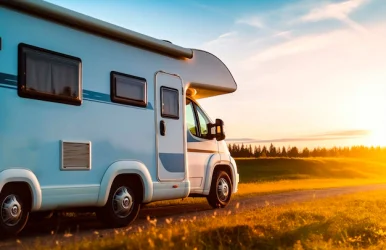
For RV enthusiasts, the open road promises adventure and freedom. But this freedom is best enjoyed with a safety net against unforeseen mechanical issues that can and will arise.
This is where OutdoorWarranty offers specialized RV extended service contracts to protect your RV and offer peace of mind while on your adventures. Additionally, recently, we took an in-depth look at what makes OutdoorWarranty a preferred choice for RV owners.
Here is what we found out.
Who is OutdoorWarranty?:
Outdoor Warranty emerges as a beacon of reliability in the RV warranty landscape. Furthermore, it has been founded by individuals passionate about RV travel, the company focuses exclusively on RV extended service contracts.
Known for its commitment to customer satisfaction, transparency, and tailor-made coverage. Along with Outdoor Warranty has carved a niche in providing peace of mind to RV travelers no matter where the open road may take them.
The OutdoorWarranty Advantage:
Should an RV owner consider OutdoorWarranty? Simultaneously, our review highlights a few key areas: comprehensive coverage plans, a customer-first approach, and an easy claims process.
Customers we interviewed praised the company's dedication to providing personalized and straightforward services. In order to understand, simplicity and transparency of their contracts make them stand out in a market often cluttered with complex terms.
Coverage That Meets Your Needs:
Variety and flexibility are the hallmarks of OutdoorWarranty's coverage options. Whether it's basic engine protection or extensive coverage encompassing electrical and plumbing systems, they offer plans for different needs and budgets. We were particularly impressed by the clarity with which each plan's details were laid out, ensuring customers knew exactly what they were getting.
Seamless Process and Support:
The process of getting an Outdoor Warranty plan is straightforward. For instance, everything is streamlined for ease and convenience, from obtaining a quote to filing a claim. The company's customer service is responsive and knowledgeable, a factor frequently highlighted in customer testimonials. Their online portal further simplifies managing your contract and claims.
Rave Reviews on Google and Facebook:
A significant indicator of OutdoorWarranty’s success is the glowing reviews from customers on Google and Facebook. Customers regularly praise the company for its exceptional service and reliable coverage. These online reviews reflect high trust and satisfaction among the RV community, solidifying OutdoorWarranty's reputation as a top-tier service provider.
Final Thoughts: Beyond Service Contracts:
In conclusion, our review finds OutdoorWarranty is a reliable partner for RV enthusiasts. With their focus on customer satisfaction, clear communication, and comprehensive coverage options, they are well-equipped to meet the diverse needs of the RV community. OutdoorWarranty offers a service contract worth considering for those looking to travel without worry.
Read Also:
Florida Dreams: RV Camping Along the Sunshine State’s Shore
Wonders of the Waves: RV Camping Along Oregon’s Coastal Beauty
E-bikes are changing the world of outdoor adventures, and hunting is no exception. These electric bikes are not just a fad; they're a revolution in how hunters approach their sport. Quiet, efficient, and eco-friendly, e-bikes offer a unique blend of technology and tradition. This article explores the essential things every hunter should know about using e-bikes, from the benefits they bring to the hunt to choosing the right model for your needs. Whether you're a seasoned hunter or new to the sport, understanding the role of e-bikes can transform your hunting experience.
Advantages Of Using E-Bikes For Hunting
E-bikes come with several advantages that make them a fantastic choice for hunting. Firstly, they are much quieter than traditional vehicles, which is crucial for hunting. The less noise you make, the less likely you are to startle your prey. This stealth aspect gives hunters a significant advantage in the field.
Another benefit is their environmental friendliness. E-bikes don't emit fumes like gas-powered vehicles, making them a more sustainable option for the environmentally conscious hunter. Additionally, they can handle various terrains, from muddy paths to rocky trails, which is often required in the wilderness.
Choosing The Right E-Bike For Hunting
Selecting the right e-bike for hunting requires a lot of considerations. The e-bike should have a robust load capacity to carry not just the hunter but also their gear and potentially their game.
Durability is another key factor. Hunting terrains can be challenging, and your e-bike needs to withstand rough conditions. Look for models specifically designed for off-road use, with sturdy frames and reliable components.
When it comes to the specifics, understanding the types of electric bike suspensions is crucial. Suspension systems play a vital role in ride comfort and control, especially on uneven terrains typical in hunting areas. A good suspension system will absorb shocks and provide a smoother ride, which is essential when traversing through the woods or even mountains.
Various models are available in the market, each with different features suited for hunting. Some have camouflage designs to blend in with the environment, while others focus on enhanced battery life and load capacity. Researching and comparing different models is key to finding the e-bike that meets your hunting needs.
Legal Considerations And Regulations
Before you head out on your e-bike hunting adventure, it's important to be aware of the legal aspects. Laws and regulations regarding e-bike use can vary significantly from one region to another. Some areas may have specific rules about where and how you can use e-bikes, especially on public lands or in wildlife reserves.
In some places, you might need a license or registration to use an e-bike, just like any other vehicle. It's essential to check the local regulations before planning your hunting trip. Moreover, riders and hunters must respect wildlife and environmental laws. These rules are in place to protect the natural habitat and ensure that hunting remains a sustainable activity for future generations.
Safety Tips While Using E-Bikes For Hunting
Safety should always be a top priority when using e-bikes, especially in hunting scenarios. First and foremost, wearing a helmet is necessary to protect you in the event of a fall or crash. Also, consider wearing visibility vests, particularly if you're hunting in areas shared with other outdoor enthusiasts. This helps ensure you're visible to others, reducing the risk of accidents.
When riding through rough terrains, keep your speed at a manageable level. It's easy to get carried away with the power of an e-bike, but safety comes first. Be particularly cautious on wet or uneven trails to avoid slips and falls. Similarly, stay aware of your surroundings and be prepared for unexpected wildlife encounters. Animals can be unpredictable, so knowing how to react is essential for your safety.
Maximizing Battery Life And Efficiency
To get the most out of your e-bike's battery life, start with a full charge before heading out. If possible, carry a spare battery or a portable charger for longer trips. You can also conserve battery life by using the pedal-assist feature. Pedal more in easier terrains and save the battery for challenging parts of your journey.
Maintaining your e-bike is key to ensuring it runs efficiently. Regular maintenance can prevent small issues from becoming big problems. Keep an eye on tire pressure, brake pads, and the chain. Proper upkeep not only extends the life of your e-bike but also ensures it performs at its best when you need it.
Charging your e-bike during a long hunting trip can be challenging. If you're camping, consider solar chargers as an eco-friendly option. Planning your route with charging points in mind is another strategy to ensure your e-bike is always ready to go.
Packing And Transportation Considerations
Transporting your e-bike to your hunting location requires some planning. If you're driving, you might need a bike rack. Make sure the rack is sturdy enough to handle the weight of an e-bike, which is typically heavier than a regular bike. When packing your e-bike, remove any detachable parts like batteries or LCDs to prevent damage during transit.
Balancing your load is key when using an e-bike for hunting. You'll likely be carrying additional gear like weapons, ammunition, and possibly camping equipment. Ensure your e-bike has the necessary carrying capacity, and use saddlebags or panniers to distribute the weight evenly. This not only makes your ride more stable but also prevents strain on the bike.
Efficient packing is all about what you bring on your hunting trip. Pack only the essentials to avoid unnecessary weight. Tools for minor repairs, a first-aid kit, and enough water and food are must-haves. Remember, the more efficiently you pack, the more enjoyable your ride and hunting experience will be.
E-Bike Maintenance
After each trip, clean your e-bike to remove any dirt or debris. Pay special attention to the chain, gears, and brakes. These components can suffer the most from rough terrain and require regular checks and lubrication.
Store your e-bike in a dry, cool place to protect it from the elements. If you're not going to use it for a while, make sure the battery is charged to about 50% to maintain its health. Periodic service from a professional can also go a long way in extending the life of your e-bike.
Wrapping Up
E-bikes are a fantastic tool for modern hunters. They offer a quiet, efficient, and eco-friendly way to navigate hunting terrains. Choosing the right e-bike involves considering factors like battery life, load capacity, and durability. Remember to always prioritize safety and abide by local laws and regulations. Lastly, maximizing battery life, packing efficiently, and maintaining your e-bike will also enhance your hunting experience.
Read Also :
Planning A Trip to Las Vegas, USA? Read this blog first
7 Key points Remember while Planning Your Honeymoon Trip
What Can You Expect from the New Year’s in Mexico
Suppose we jump high in the air. We can stay in the air for around half a second.
Michael Jordan could even stay off the ground for only one second.
Now, at many events at the Winter Olympics, we see athletes showing strength and athleticism in the air.
However, ski jumping beats them all in terms of jumping high in the air and staying afloat for so long.
Here, you need to understand the physics of sports, and for many of us, the ski jump is a mesmerizing event in the Winter Games, showcasing sports physics in action.
The athlete who travels the farthest and shows the best style while flying and landing becomes the winner of the event.
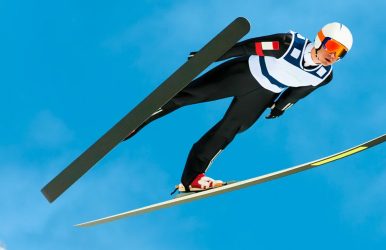
Ski jumpers can fight gravity, and they can turn their bodies and skis into a wing to stay in the air for 5 to 7 seconds.
Within that span, they can travel almost the length of a football field while staying in the air.
But how is it possible for ski jumpers to stay in the air so long and how do they train for that?
Let’s delve into the details.
How To Fly?
The answer to how is it possible for ski jumpers to stay in the air so long and how do they train for that lies in three important concepts of sports physics.
These are drag, lift, and gravity.
Gravity is the power that pulls any object in flight down. Gravity is a force that works on everybody, and ski jumpers cannot avoid it.
However, ski jumpers, as they move, interact with the air. Now, this interaction further produces lift.
Lift refers to an upward force projected by the air for an upward movement of an object.
In this scenario, if the force of gravity and the force to lift balance each other, an object can fly or glide.
However, producing lift is only possible when the object is moving. Moving objects collide with air particles and push them aside.
Pushing air downward creates an equal, upward reaction known as lift. Here it follows Newton’s third law, “For every action, there is an equal and opposite reaction.”
You can increase lift by boosting your speed, expanding your surface area, or optimizing your angle of attack (the object's tilt against the airflow).
If this angle is too flat, you generate no lift; if it is too steep, the object stalls.
The Car Window Example
If the concept feels complicated, you can experience the same by just sticking your hand out of a moving car window.
If you keep your hand perfectly flat, it will yield no movement.
However, if you tilt your palm slightly upward, it will force the incoming wind downward, and thus your hand will be pushed up immediately.
It is a clear example of lift.
The same particle collisions that generate lift also create drag.
Drag is a resistive force that slows objects down.
As an object loses speed, its lift drops, cutting the flight short. Because of this, ski jumpers use highly precise body positions to maximize their lift while minimizing speed-killing drag.
A Brief History Of The V-Style
The history of ski jumping goes back to the 1800s. Norwegian skiers first started competing for distance on snowy slopes.
However, for most of the sport's history, jumpers kept their skis pressed tightly together, parallel to each other, all the way through the flight.
The 1980s brought a major change to these practices.
A Swedish jumper named Jan Boklöv began spreading his skis apart mid-air, forming the V-shape you now see in every competition.
He drew criticism from experts and judges who considered it a “bad style” because it looked unconventional.
However, Boklöv's V-style increased his jump distances by as much as 10%, simply by giving his body and skis more surface area to catch the air.
Then, ignoring the style was impossible.
Within a few years, every serious competitor had switched to the V-style, and judges stopped penalizing it.
Even today, it remains a standard technique, and it is the same aerodynamic principle that more surface area means more lift.
How To Fly On Skis?
We need to observe the skiers to understand how is it possible for ski jumpers to stay in the air so long and how do they train for that.
You will see a skier starting on a high slope, and then they move downhill. They generate speed by skiing in this way.
They also reduce drag by squatting and steer very carefully to minimize the friction between the ramp and skis.
So, when they reach the end, the speed will be close to 60 miles or 96 kms per hour.
Once airborne, ski jumpers use aerodynamics to fight gravity and extend their flight.
While they cannot generate enough lift to stay in the air indefinitely, maximizing this upward force slows their descent and carries them further down the hill.
To achieve the longest flight possible, athletes lean forward until their bodies and skis are nearly parallel to the snow.
By spreading their skis into a V-shape just outside their body's silhouette, they gain two major aerodynamic advantages.
The spread position creates a larger surface area to catch the wind and generate lift. So they get an expanded surface area.
They also get an optimal angle of attack. The forward tilt places them at the perfect angle relative to the airflow to maximize upward pressure.
As the jumper glides forward, drag continuously pushes back against them, draining their forward momentum.
Because lift relies entirely on speed, this deceleration causes the upward force to fade away. As drag robs the athlete of their speed, gravity takes complete control, pulling them faster and faster toward the landing zone.
The Takeoff: The Hardest Half-Second
Out of everything a ski jumper does, takeoff is the most difficult skill to master. It happens in under half a second.
Furthermore, when the jumper reaches the end of the ramp, known as the "table," they must explosively extend their legs and spring forward and slightly upward.
They will do it all while still moving at nearly 60 miles per hour.
However, if they jump too early, they will lose speed and distance. Once again, jumping too late can cause losing control of their body position in the air, which can be dangerous.
In addition, the takeoff also sets the jumper's angle of attack for the entire flight.
Because there's no way to make major corrections once airborne, a fraction-of-a-second error in the takeoff can throw off the aerodynamic position for the whole jump.
This is why ski jumpers spend years drilling this single movement until it becomes automatic.
How Ski Jumpers Actually Train?
Physics explains the reason why ski jumpers fly so far. However, the training behind it is equally crucial.
Training AreaWhat It InvolvesWhy It MattersStrength and Explosive PowerSquats, box jumps, and plyometric drillsBuilds the fast-twitch power needed for the powerful, split-second leg extension at takeoffSummer Training on Artificial TracksYear-round practice on in-run tracks covered with porcelain or plastic bristles instead of snowLet athletes drill their approach, takeoff, and body position even outside the winter monthsWind Tunnel SessionsFine-tuning arm position, back angle, and ski spread with coachesFlight position is highly sensitive to drag and lift, so small posture adjustments can shave off dragVideo and Biomechanical AnalysisFrame-by-frame review of the in-run, takeoff, flight, and landing from multiple camera anglesHelps compare an athlete's actual form against ideal aerodynamic positionsMental PreparationVisualization techniques and gradual exposure, starting on smaller hills and building up to normal and large hillsBuilds the psychological conditioning needed to launch off a mountainside ramp at speed
How Do Judges Score A Jump?
The judges will not just assess the ski jump based on the distance covered. So, the question of who becomes the winner depends on the distance and the style.
Scoring ComponentHow It WorksPurposeDistance Points- Measured against the K-point (a reference point on the hill). - Landing exactly on it earns a fixed score, with points added or subtracted for every meter beyond or short of it.Rewards how far the athlete actually travelsStyle PointsFive judges score the flight and landing, including body position in the air and control of the landing in the "telemark" position (one foot in front of the other, knees bent). Each judge scores up to 20 points; the highest and lowest scores are dropped, and the middle three are added to the distance score.Rewards technique and control, not just distance.Gate and Wind CompensationOfficials apply point adjustments in real time based on wind conditions, since headwinds increase lift and tailwinds reduce it.Prevents a gust of wind from unfairly helping or hurting a competitor's final score.
Normal Hill Vs. Large Hill Vs. Ski Flying
Not all ski jumps are the same size, and the hill itself determines how far a "long" jump actually is.
Hill TypeK-Point (Target Landing Distance)NotesNormal HillUp to 109 metersSmaller competition hillLarge Hill110–184 metersUsed for most Olympic ski jumping eventsSki Flying Hill185 meters or moreIt is a separate discipline where athletes can stay airborne longer, sometimes covering well over 200 meters.
The larger the hill, the faster the in-run speed and the longer the flight.
That is why ski flying produces the most extreme examples of the physics described earlier: maximum lift, sustained over the longest possible time.
Record-Breaking Flights
The current men's ski flying world record stands at 254.5 meters. Domen Prevc completed it in Planica, Slovenia, on 30 March 2025. (Source: Guinness World Records).
Among women’s ski flying, Nika Prevc holds the record. She completed the jump of 236 meters in Vikersund, Norway, on 14 March 2025.
These extreme distances are a direct demonstration of the lift-versus-drag balance.
The longer an athlete can hold an efficient aerodynamic position without losing speed to drag, the farther gravity has to work to finally pull them down.
How Is It Possible For Ski Jumpers To Stay In The Air Long? The Rules Follow The Physics
So, you can see there is pure physics at play behind how is it possible for ski jumpers to stay in the air so long and how do they train for that.
However, the body of an athlete, equipment choices, and the wind can impact the quality of the jump in many ways.
Also, there are a lot of rules and regulations to keep a ski jump fair.
You will see many officials changing the starting and ending points up and down the slope during the events.
This adjustment happens to ensure a safe landing, depending on the speed of the wind.
When the headwinds are faster, there will be more lifts and longer jumps. As a result, an athlete can go past the scure zone for landing.
Moreover, the regulations of a ski jump will also depend on the height and weight of a skier.
Usually, skis have to be “145% of the skier's height.” Also, if the skier has a body mass index of less than 21, they will get shorter skis.
Again, long skis are not the best in every case. When the ski is heavy, you will need more lift to fly and stay in the air.
Also, you have to wear a tight-fitting suit. You cannot wear anything that will need additional lift.
So, when you see a skiing event, think of how the skiers have also mastered the concept of physics.
Why Is Ski Jumping Riskier Than It Looks?
Ski jumping looks graceful. However, we cannot undermine how physically demanding and risky the sport is.
Athletes fly through the air at highway speeds with only their skis and body position keeping them stable.
A poor landing, a sudden gust of crosswind, or a small error in the takeoff can cause a loss of balance that's difficult to correct mid-flight.
This is part of why regulations are so strict that the rules on suit tightness, ski length relative to height and BMI, and the ability of officials to adjust the start gate are all safety measures as much as they are fairness measures.
Wind is the biggest variable officials can't fully control.
Which is why competitions are sometimes paused or delayed when crosswinds pick up, and why the point-compensation system exists to account for conditions that shift mid-competition.
How Is It Possible For Ski Jumpers To Stay In The Air Long? Some Quick Questions And Answers
1. Why Do Ski Jumpers Spread Their Skis Into A V-Shape?
It increases their surface area and creates a better angle of attack, both of which generate more lift and let them fly farther.
2. How Fast Do Ski Jumpers Go Before Takeoff?
Around 60 miles per hour (96 km/h) by the time they reach the end of the ramp.
3. How Long Do Ski Jumpers Actually Stay In The Air?
Roughly 5 to 7 seconds in standard competition, and even longer during ski flying events on the largest hills.
4. Is Ski Jumping Scored Only On Distance?
No. Final scores combine distance points with style points awarded by judges for body position and landing control.
5. What Is The Difference Between Ski Jumping And Ski Flying?
Ski flying happens on larger hills built for greater distances, allowing longer flights and higher speeds than standard normal or large hill ski jumping.
Read Also:
Car Travel On PaxTravelTweaks: How Does It Help In Smartly Planning Budget-Friendly Road Trips?
IWantThatFlight Offering Cheap Flights: The Best Hack For Traveling On A Budget










 Related