


Denver To Colorado Springs Distance: An Overview Of The Ways To Travel

The “Mile High City,” Denver, can be a wonderful base if you are traveling to Colorado Springs.

Both are wonderfully blessed by the Rocky Mountains and beautiful waterfalls. Furthermore, for adults, the things to do or the fun activities in Denver are diverse.

Nevertheless, this time, it is about seeing beyond the hot springs in Denver and the Rocky Mountain National Park.

In fact, it’s time to plan a trip from Denver to Colorado Springs, home to the Pikes Peak Cog Railway, Garden of the Gods, and the U.S. Olympic & Paralympic Committee.

Furthermore, with a distance of less than 100 miles, these two cities are well-connected by bus, air, shuttle services, and smooth driving roads.

Keep reading to know how to travel the distance.

What Is The Denver To Colorado Springs Distance? 

What Is The Denver To Colorado Springs Distance

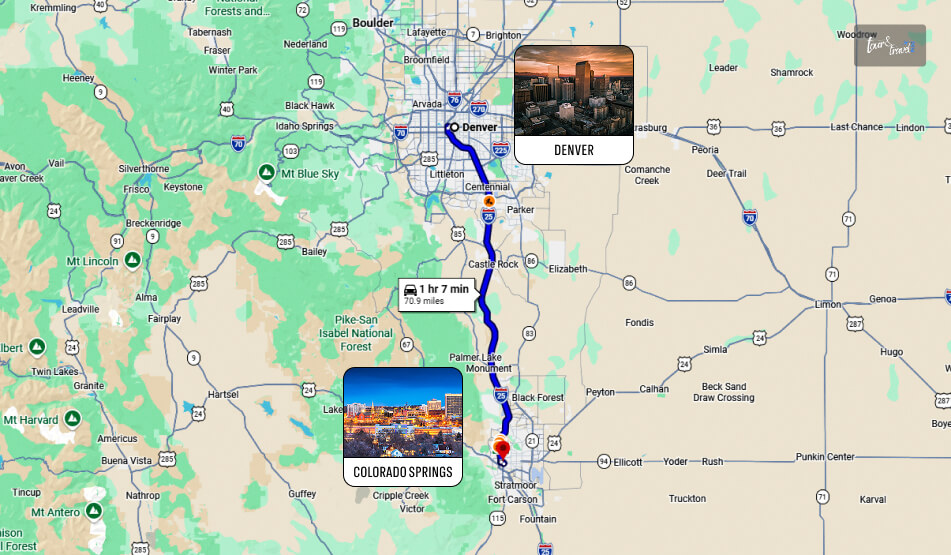
The distance between Denver and Colorado Springs is around 70 miles or 110 km. Traveling this distance by road via I-25 S takes about 1 hour and 10 minutes.

However, you can also take a city-to-city bus or a bus shuttle. Moreover, you can fly from the Denver Airport to the Colorado Springs Airport.

So, here is a summary of the travel time based on the modes of transport.

Denver to Colorado Springs Modes of Transport Travel Time (Approx) 
Denver to Colorado Springs by City to City Bus 1 Hour and 15 Minutes 
Denver to Colorado Springs Shuttle Bus Service 1 Hour and 15 Minutes 
Uber or Lyft Services 1 Hour and 30 Minutes 
By Car 1 Hour and 10 Minutes 
By Flight (Excluding the Airport Transfers) 45 Minutes 

So, taking a bus or a private car rental is the best way to travel from Denver to Colorado Springs. Thus, you can strike a balance between the travel time and budget.

How To Travel From Denver To Colorado Springs?

How To Travel From Denver To Colorado Springs

Have you decided to take a flight from Denver to Colorado? Or, have you booked an Uber service for the trip? 

Know the best choices before preparing your itinerary.

1. Denver To Colorado Springs City-To-City Buses 

Bustang is the best bus service from Denver to Colorado Springs. The Bustang buses start from the Denver Union Station, and the ticket price is just $13.

Furthermore, these buses have free Wi-Fi and washroom facilities.

Moreover, you can take the Flixbus services, and the ticket price starts from around $14.

Unfortunately, the Regional Transportation District, or RTD, does not have a bus from Denver to Colorado Springs.

2. Bus Shuttles 

Bus shuttle services are available from Denver to Colorado Springs. However, you must only opt for trusted options such as Grehound.

Greyhound offers two bus shuttle services from Denver to Colorado Springs. Both buses depart from the Denver Union Station Bus Concourse and travel to Colorado Springs Tejon Park-N-Ride.

One bus departs from Denver at 7 PM and reaches Colorado Springs at 8:30 PM. Furthermore, the ticket price is $35.98.

On the other hand, the second bus departs at 8:10 PM and reaches Colorado Springs at 9:25 PM. The ticket price is $18.98.

3. Uber Or Lyft Services From Denver To Colorado Springs 

If you are traveling from Denver to Colorado Springs for the first time, taking an Uber or Lyft service will be the safest option.

An Uber ride to complete the trip takes around 1 hour and 30 minutes, and the travel price is $135.

On the other hand, a Lyft ride for this route will cost you between $120 and $165. With Lyft, you can make a booking 90 days in advance.

Also, consider a 2% surcharge for airport pickups and drops.

4. Traveling From Denver To Colorado Springs By Car 

A car drive or ride in a rented car from Denver to Colorado is beautiful. The journey via Interstate-25 takes around 1 hour and 10 minutes to 1 hour and 30 minutes.

However, this route can have the most notorious traffic on certain days, and then the travel time will shoot up to 2 to 3 hours. 

Furthermore, from March to May, hailstorms are common in the area. So, when traveling in these months, choose a 4WD or a vehicle that has tires to withstand extreme weather conditions.

Moreover, the road expansion on Interstate-25 has made the ride bumpy. Nevertheless, a car rental for this journey will cost you between $70 and $120.

Also, if you follow traffic updates and find the I-25 route busy, you can opt for alternatives such as Highway US-85/CO-105, Highway 83, and CO-67.

However, these are longer routes and can stretch your travel time by an hour or so.

5. Fly From Denver To Colorado Springs 

The Denver International Airport is located at a distance of around 23 miles from Denver. However, it is not just an airport that serves Denver.

It is often the choicest airport for travelers from other countries due to its mid-continent location.

Furthermore, the Colorado Springs Airport is located around 12 miles away from the city.

The flight duration between these two airports is around USD 120 to 670. The fastest flight on this route takes 45 minutes to complete the journey.

Moreover, private cars, Uber, Lyft services, and buses are frequently available for airport transfers.

Traveling From Denver To Colorado Springs: Tips To Remember

March to May and September to October, or the spring and autumn seasons, are ideal for a trip from Denver to Colorado Springs.

Especially, Denver is one of the best places to visit in December in the USA.

Furthermore, if you want to bypass the traffic on this route, you must plan a trip before 7 AM or after 7 PM.

Also, Friday afternoons are the busiest. So, avoid a car ride in those hours and check the traffic conditions on platforms such as the COtrip website.

Moreover, if you find the I-25 route to be busy, you can take Highway 83, which runs parallel and usually has less traffic.

Traveling From Denver To Colorado Springs: Frequently Asked Questions (FAQs) 

Here are the frequently asked questions and answers related to the Denver to Colorado Springs trip. 

1. Is It Better To Fly Into Colorado Springs Or Denver? 

The better option to fly into between Colorado Springs and Denver airports depends on the part of Colorado you want to explore.
 
For example, if you want to explore the northern part of Colorado and have cheaper and more diverse flight options, the Denver International Airport will be a better choice.
 
On the other hand, the Colorado Springs Airport is ideal for the Southern Colorado attractions.

2. How Much Is The Train From Denver To Colorado Springs? 

No passenger train runs between Denver and Colorado Springs. 
 
However, you can enjoy a scenic train ride in the Pikes Peak Area on the Pikes Peak Cog Railway. This train passes through ethereal Alpine landscapes before it reaches its summit at 14115 foot.

3. Is There A Shuttle Between Colorado Springs And Denver?

Yes, there is a shuttle service between Colorado Springs and Denver. Reputed names such as Greyhound offer shuttle bus services on this route.
 
The travel time is around 1 hour and 15 minutes, and the ticket price is around $18.98 to $35.98. 

Share on Social Media

Sibashree is a travel, culture, and leisure writer who has been writing since the age of 12 and professionally since 2014. With more than a decade of travel writing experience and journeys across India and several parts of the world, she brings a deeply personal and thoughtful perspective to her work. A student of English Literature and Mass Communication, Sibashree has always viewed travel as more than movement — for her, it has been a way of understanding people, cultures, and herself. Her passion for spiritual exploration has also led her to many unusual and meaningful destinations over the years. Outside of writing, Sibashree enjoys watching European cinema, reading about global politics, and reflecting on the stories hidden within everyday places.

Leave a Reply

Your email address will not be published. Required fields are marked *

title-img Related

READ MORE Winter Destinations in Saudi Arabia

6 Must-visit Winter Destinations in Saudi Arabia

BY  Pijus Maity Jan 15, 2025

Saudi Arabia has a typical climate of a desert: hot, dry and intense. People visiting KSA often get fed up with the extremely hot weather conditions, especially in summer. Even in winter, the temperature doesn’t fall below 25 Degrees Celsius. Therefore, it is difficult for people to stay here, especially the ones traveling from cold climatic regions. Pilgrims of Umrah packages from UK and tourists often come here during winter as it offers pleasant weather. Yet, if you want to escape the desert heat, Saudi Arabia houses several cooler regions to your surprise. Here are 6 must-visit winter destinations in Saudi Arabia. Al Bujairi Heritage Park. Al Bujairi Heritage Park is a cultural oasis in Riyadh that comes to life in the winter season. Its traditional architectural style, lush greenery, and various tourist activities add to its significance. Spreading over an area of 60,000 square meters, it hosts various workshops and light shows for visitors. In addition, you can indulge yourself in the local culture through traditional and roadside food stalls.  There are also rides and play areas available for children to enjoy. Al Bujairi Heritage Park is your best choice for a day trip during winter in KSA. Plan a picnic with your family here and spend the day with your loved ones in this scenic and happening area.  Abha. Abha is the ‘City of Fog’ in Saudi Arabia. Present in the Asir region, Abha is famous for its lush green surroundings and misty peaks. The cherry on top, the winter season brings snowfall here as well. Therefore, if you are planning a visit to the Asir region, Abha is the destination you should not miss. Especially if you are a nature lover. Asir National Park here is also a popular tourist spot as it houses more than 300 species of birds. There are also various trails and hiking treks for you to cover and have a memorable stay. So if you are applying for a Ramadan Umrah Packages 2025 UK online plan a visit to Abha after Umrah rituals. Snowy mountains in Tabuk. Tabuk is one of the favorite winter destinations of locals and tourists alike in Saudi Arabia. Covering the northern region of KSA, Allous Mountain is the coldest peak of the Tabuk region. It often receives snowfall during the winter season. Therefore, becoming an ideal spot for skiing, ice skating and snow sledding.  There are more than 15 mountain ranges in the Tabuk region, each offering a unique landscape and cold temperatures. Jabal Al-Lawz (also called ‘Mountain of Almonds’) wears the crown for the tallest peak here. It has a height of 2,549 meters above sea level, present near the Saudi-Jordan border. As Tabuk is a popular tourist destination in winter, there are numerous luxury resorts and restaurants to facilitate them. You can enjoy various winter sports here as well. Such as hiking, camping, skiing, and picnics in the breath-taking scenery. Rawdat Khuraim. Rawdat Khuraim Oasis has its second name, ‘King Abdul Aziz Forest’. It is a serene oasis that possesses stunning lakes, lush green palm trees, and a number of walling trials. This particular tourist spot is popular throughout the year. Though spring is the ideal time to visit this oasis, winter is the second best choice.  Present near Riyadh, you can see diverse flora and fauna here during your visit in winter. Many rare flowers bloom here during the winter season that are not seen elsewhere in the kingdom. So make it a place worth visiting with cheap Umrah packages.  Edge of the World. Jabal Fihrayn (Edge of the World) holds the title of being the tallest peak of the Tuwaiq mountain range in KSA. This cliff suddenly falls off to the ground at a height of 1,131 meters. It’s a truly breathtaking yet thrilling experience.  There are various hiking trails that you can use for trekking to reach the top and have panoramic views of the surroundings. The winter season further adds to your comfort for trekking as pleasant weather conditions persist in the region. Yet, this destination is not for the weak of the heart.  Thumama Desert. A visit to the Thumama Desert is a must during your winter trip to KSA. Though the desert experiences intensely hot weather in the summers, winter brings lush green valleys covered in white snow here. It is the perfect place for traditional Bedouin-style camping and stargazing at night. When you apply for your Umrah visa UK online during winter, plan a visit to these 6 destinations necessarily. Weather In Saudi ArabiaWinter: Here, the winter season is very mild. The Average temperature ranges from 8-20°C (46-68°F).Spring: Saudi Arabia offers a warm and pleasant spring with temperatures ranging from 20-30°C (68-86°F).Summer: Summer feels very hot and dry in SA. The temperature can exceed 40°C (104°F).Fall: You may experience a very warm to hot, with temperatures ranging from 25-35°C (77-95°F). Now Comes The Most Important Part: What To Pack! Knowing what to pack for a trip to the winter destinations in Saudi Arabia is the ultimate key to a successful holiday. When you are traveling to earnestly conservative countries, you would require a lot of pre-planning and, most importantly, an excellent packing list.  ClothingLong-sleeved shirtsLight sweater or fleeceWarm jacketComfortable trousers or jeansScarf and hat for cooler eveningsSocks and underwearModest swimwear for hotel poolsComfortable walking shoesToiletriesToothbrush and toothpasteDeodorantShampoo and conditionerBody washMoisturizerSunscreenLip balmShaving kitElectronicsSmartphone and chargerTravel adapter (Type G plug)Power bankCamera and memory cardHealth And SafetyFace masksHand sanitizerPersonal medicationBasic first aid kitMiscellaneousBooks or e-readerTravel journal and penReusable water bottleDocumentsPassport VisaTravel InsuranceFlight ticketsHotel reservationPhotocopies of important documentsTravel AccessoriesBooks or e-readerTravel journal and pensReusable water bottle Final Words!  Whether you are planning to go hiking to the edge of the world, enjoy the beautiful weather at Rawdat Khuraim, or maybe be escaping this bustling city life to look for a serene place like the snowy mountains in Tabuk, this guide will help you to choose your ultimate winter gateway!  Also read Top 10 Most Popular Paraguay Food That You Must Try. Top 13+ Famous Wonders Of India That You Must Visit. Top Tips For Motorbike Rental In Phuket – A Guide To Exploring The Island On Two Wheels.

READ MORE card-img

Aotea Great Barrier Island Wildlife: The Ultimate Tours & Spotting Guide (New Zealand)

BY  Sibashree Nov 12, 2025

There are three instances I clearly remember from our trip to the Great Barrier Island, New Zealand. The best thing about the Great Barrier Island wildlife tours is that they begin even before you board the ferry.  Here, I will start with some fun moments we had while exploring the wildlife of Great Barrier Island, then gradually discuss the details. So, let’s examine the rugged, predator-free paradise in New Zealand's Hauraki Gulf.  My Great Barrier Island Wildlife Tours: Some Stories That Have Stayed With Me With around 60% of the Great Barrier Island being a conservation area, the Aotea Great Barrier Island in New Zealand shines with sustainability certificates and its commitment to preserving the indigenous flora and the rare and endemic fauna of the island.  1. The Biosecurity Check  We were about to board the ferry to the Great Barrier Island. The Auckland Regional Council and the Ministry for Primary Industries (MPI) people did thorough biosecurity checks of our bags, and we had to clean our boots. Thus, they make a visitor part of the island's conservation effort.  This check is mandatory, and this is the reason the pāteke and kākā are thriving on the island. 2. The Dark Sky Sanctuary And The Great Barrier Island Wildlife Tours  Great Barrier Island’s designation as a Dark Sky Sanctuary has enhanced the wildlife tour experiences. We went out to see the Milky Way at night, and we stood quietly and listened to the sound of silence.  Suddenly, we were startled by the more-pork cry of the Ruru birds. Also, we saw the black petrels or Tākoketai coming back to their burrows.  3. Did I See A Chevron Skink? Did I Not? See, Chevron Skink also feels like a mythical species. These nocturnal species are the masters of camouflage. So, honestly, we did not see them with our naked eyes.  However, we could listen to the squeaks and grunts of the Chevron Skinks. It was thrilling knowing that we were walking through their only habitat in the world, which is protected by sanctuaries like Glenfern.  Why Is Aotea Great Barrier Island A Paradise For Wildlife Tours?  Afar, a US-based travel media brand, has named Aotea Great Barrier Island one of the top 25 off-the-beaten-track destinations in the world.  Aotea, Great Barrier Island in the Hauraki Gulf, is a designated dark sky sanctuary. So, it is ideal for spotting and listening to the nocturnal birds and animals.  Furthermore, the Department of Conservation (DOC) maintains 60% conservation land on the Aotea Great Barrier Island. As a result, it is the island of Firsts" and "Lasts.” It means that the island has birds such as North Island kākā and pāteke (brown teal), which are found nowhere else in the world.  In addition, the "Predator-Free" Secret of the Island is truly special. In the absence of stoats, possums, weasels, or deer, the rare and endemic species here have been able to thrive.  Along with all these endeavors, the Great Barrier Island has been successful in community-led conservation efforts, maintaining biodiversity and species protection. Here are the details.  1. Aotea Great Barrier Island Environmental Trust “The principle activities of the Trust are in protecting, enhancing, developing and maintaining habitats for New Zealand native and endemic species on Aotea Great Barrier Island, with a particular focus on pest management…” Founded in 2002, this trust has been an advocate for conservation policies, has coordinated many conservation efforts, and earned funding for local conservation projects.  2. Aotea Conservation Park  The 2,000-hectare Aotea Conservation Park with walking tracks, DOC huts, and campsites makes the island an ideal destination for exploring the wildlife.  3. Marine Conservation  The Aotea Great Barrier Environmental Trust’s Tai Timu Tai Pari” or “Sea Change” initiative aims to protect the marine ecosystem of the Hauraki Gulf. Furthermore, the Department of Conservation (DOC) has proposed to build a large marine conservation area in the northeast corner of the island.  In addition, beach clean-ups and educational programs have been effective local endeavors to preserve the marine life of the island.  4. Biodiversity And Species Protection  The island is a critical nesting ground for the black petrels. The Department of Conservation takes care of the nesting ground.  Furthermore, around 60% of the pāteke population in New Zealand is present on the Great Barrier Island. These birds are frequently spotted in places such as Kaitoke Wetlands.  You can visit the Kaitoke Wetlands just before dusk. Park at the end of the road, walk the flat boardwalk, and wait quietly by the main pond. You will almost certainly see and hear the rare pāteke (brown teal) as they come out to feed. Chevron skink, 13 different types of lizards, banded rail, and North Island Kaka are some other native species that exist on the Great Barrier Island.  What Are The Must-See Wildlife Attractions On The Aotea Great Barrier Island In New Zealand?  The Glenfern Sanctuary, Aotea Track, Kaitoke Hot Springs, and the coastal areas are ideal for spotting the unique and rich wildlife of the Great Barrier Island, New Zealand.  1. The Pāteke (Brown Teal) Pāteke is one of the rarest ducks in the world. The Great Barrier Island is a stronghold for these ducks, and you will find them in the Kaitoke Wetlands.  The Department of Conservation and Predator Free NZ Trust are two important bodies taking care of the conservation efforts to protect these birds. Habitat management and predator control are two main elements of protecting the Pāteke birds.  Now, you understand why biosecurity is so crucial for these adorable ducks on the Great Barrier Island.  2. The Black Petrel (Takoketai) This seabird breeds only on the Great Barrier and Little Barrier islands. They nest in burrows high in the mountains. The Glenfern Sanctuary protects a key colony of these birds.  However, the main breeding colony on Aotea is at Mount Hobson/Hirakimata. According to the Department of Conservation, around 900-1000 pairs of birds stay there.  These birds are featured on the IUCN Red List as a vulnerable species. Furthermore, they are identified as “Nationally Vulnerable” in New Zealand.  Moreover, there has been a conservation monitoring going on since 1995 to assess the population of these birds and how they are declining.  3. The Chevron Skink (Niho Taniwha) This large, rare lizard is found only on the Great Barrier and Little Barrier. It is almost like a mythical animal, and spotting it is very unlikely.  However, they mostly stay in the Stream-side forests. It is listed as nationally vulnerable by the Threat Classification System of the Department of Conservation.  The sightings of these lizards are so important that DOC asks you to report to the local office or call at +64 9 429 0044 whenever you spot one.  4. The North Island Kākā It is a large, intelligent, and noisy native parrot. It is famous for the loud "screech" and "chatter. I saw a few of them high in the forest canopy along the Mt Hobson track.  The Glenfern Sanctuary is another spot where you will find these parrots. The Great Barrier Island is an important habitat for these birds as it offers a predator-free environment.  5. Dolphins And Marine Life Aotea’s location on the edge of the Hauraki Gulf Marine Park, the national park of the sea, makes it rich in marine life. The Hauraki Gulf and the Great Barrier Island were both formed due to massive volcanic activity at the end of the Ice Age.  In 1769, James Cook named the island because of how it protected the Hauraki Gulf.  The water of the Hauraki Gulf Marine Park has 22 species of marine mammals. Bottlenose and common dolphins are often seen from the ferry or playing in bays like Okupu (Blind Bay) and Whangaparapara Harbour. You may even spot Bryde's whales there.  Furthermore, seabirds are important members of the Marine Park. Black petrels are, of course, the most common among them.  Coastal camping is the best outdoor experience if you want to explore the marine life of the Great Barrier Island, New Zealand. Here are some popular coastal campsites.  Akapoua Bay Campsite Near Port Fitzroy, Ideal for Spotting Pohutukawa Trees and Fishing Awana Beach Campsite, Ideal for Surfers Harataonga Campsite, Great for Swimming and Snorkeling Medlands Beach Campsite, Surfing and Picnic Spot  The Green Campsite at Whangaparapara Harbour, Ideal for a Serene Walk and as a Secluded Retreat Whangapoua Campsite, a Popular Surf-Break.  A Guide To Aotea Great Barrier Island Wildlife Tours: Species, Sanctuaries, And Different Types Of Wildlife Tours  During the wildlife tours, our primary concern was how to spot native birds on Great Barrier Island. Little did we know that we would hear them before actually seeing them flapping their wings.  We heard the screeching call of kākā as we were hiking through the Mount Hobson Track. Then, we saw a cloud of birds passing over our heads.  Nevertheless, it’s not just about the birds. Aotea, Great Barrier Island in New Zealand, is home to endless endemic species.  1. Specialist Day Tours & Sanctuary Visits The Glenfern Sanctuary of the Great Barrier Island is a haven for the endangered and rare species. It is an 83-acre regional park, and it functions as the “gateway to the 240-hectare Kotuku Peninsula of the north-west coastline of the Great Barrier Island.” Furthermore, the Glenfern Sanctuary Trust is committed to the preservation of the endangered flora and fauna and their habitats as you walk through the 2km loop track through a native bush to spot the birds and native species.  The black petrels and the ancient Kauri trees are the biggest highlights of this tour. The sanctuary remains open 7 days a week and from sunrise to sunset.  Moreover, you must hike through the Sanctuary and Loop Track to explore nature, wildlife, and the unique culture of the Great Barrier Island.  Sanctuary And Loop Track The Glefern Loop Track is one of the easiest Great Barrier Island hiking tracks. Here, you will have to walk along the Aotea stream and through the remnants of an ancient native bush.  The bush is protected by the Queen Elizabeth II National Trust of New Zealand, and it is rich in bird life. So, here, you will spot black petrels, Kaka, and Pāteke.  You can contact the regional office at 09 4290 091 to know about the further details.  2. The All-Inclusive Multi-Day Guided Walk If you want a more immersive wildlife experience, you must choose the all-inclusive multi-day guided walks. MoaTours and Go Great Barrier Island Tourism are two such services taking care of your accommodation, food, expert guides, and transport.  They focus on the best tracks, like the Aotea Track, Mt Hobson, and Kaitoke Wetlands. Furthermore, the guides are flora and fauna experts. For example, you can try the “Let’s Go Wild,” “The Aotea Track” package of the Great Barrier Island. Two of the main highlights of this tour are the wetlands and the unique wildlife.  It is a 3-day hiking experience, and the charge per person (adults) will be $541 (Standard Route) or $596 (The Windy Canyon Route).  MoaTours, on the other hand, organizes a 5-day Great Barrier Island small group tour, covering areas such as the Medlands Beach and Tryphena Harbour. The charges will be   $4,390 NZD for solo travelers and $3,890 NZD for twin travelers.  3. Self-Guided Great Barrier Island Wildlife Tours  The self-guided tours to explore the wildlife of the Great Barrier Island are ideal for an independent traveler. For example, you can go for the Glefern Sanctuary self-guided walks and learn about the biodiversity of the sanctuary, its conservation efforts, and more.  You can contact Steve, the manager of the sanctuary, at 0210826670 to be a part of these tours.  Furthermore, you can create your own Great Barrier Island wildlife tours by planning a visit to the Kaitoke Wetlands, Mt Hobson (Hirakimata) Track, Medlands Beach & Onetangi, and Windy Canyon.  How To Spot Native Birds On Great Barrier Island? A DIY Guide For Wildlife Tours  I have already mentioned the Glefern Sanctuary self-guided walks. Along with that, you can visit any of these areas for a perfect wildlife exploration on the Great Barrier Island.  1. Kaitoke Wetlands The Glefern Sanctuary offers a guided tour to the Kaitoke Hot Springs, located on the Mount Hobson Track. You can access the track from the Whangaparapara Road.  Furthermore, you will find a series of geothermal pools on the Kaitoke Hot Springs track. This area, maintained by the Department of Conservation (DoC), is a treasure hub for native birds.  Here, we had to walk through an easy boardwalk and gravel road to encounter pāteke and spotless crakes. And thanks to the new Kai swing bridge here, the route has now become wheelchair and buggy accessible.  Even when we were swimming in the geothermal pools, we could listen to the calls of the pātekes.  2. Mt Hobson (Hirakimata) Track The Peach Tree Track to Mount Hobson is the best route for spotting native birds and the wildlife of the Great Barrier Island. The route passes through regenerating forests, and these forests are home to a lot of native bird species, such as: Kākā Tūī: Tomtit (Miromiro) North Island Robin (Pītoitoi) Black Petrel (Takoketai) You can spot these birds in the dense native bush. Also, you can see them in large numbers near the high slopes and close to the summit. In addition, the 360-degree view of the island is a bonus you will love to count on.  3. Medlands Beach & Onetangi Medlands Beach and Onetangi are famous for coastal and nearshore wildlife like the paradise shelducks and little blue penguins.  Furthermore, wekas are common in these locations, and these are chosen as the reintroduction programs of the North Island brown kiwi.  4. Windy Canyon On the Windy Canyon hiking route, you will find conservation centers such as the Kiwi Park Queenstown. Here, you will find native species such as tuatara and Kiwi.  Furthermore, throughout the route, you will listen to the buzzing cicadas.  The Best Tips For Spotting The Birds On The Great Barrier Island  Dawn and dusk are the best hours of the day for spotting birds on the Great Barrier Island. “Dawn Chorus” is a real experience on the Great Barrier Island.  Once you reach the spot, be patient and wait quietly, as patience is a virtue for bird watching.  Keep your ears open. You'll hear the tūī's "click-whirr-gurgle" and the kākā's "screech" before you see them. Going nocturnal is a great trick for watching the native birds of the Great Barrier Island. That is why being a Dark Sky Sanctuary is crucial for the Aotea Great Barrier Island.  Carry a red-light torch and be alert about the "more-pork" call of the Ruru to spot the birds in the dark.  Talk to the staff of the hotel or the owner of the homestay you are staying in. They will have the best local tips about birdwatching on the Great Barrier Island.  How To Plan The Great Barrier Island Wildlife Tours?  There are three main aspects of planning Great Barrier Island wildlife tours. 1. How To Reach The Great Barrier Island? You can take a Barrier Air flight from Auckland to reach the Great Barrier Island in 45 minutes. You can even take the SeaLink ferry and complete a journey of 4.5 hours to reach the Great Barrier Island.  2. How To Move Around The Great Barrier Island? Renting a car or a bike is the most convenient option to move around the island. Furthermore, kayaking is an excellent way to explore the bays, caves, and diverse marine life of the island.  3. What Is The Best Time To Visit The Great Barrier Island Wildlife? From September to November, or the spring season, is the ideal time to visit the wildlife of Great Barrier Island. This is the nesting season for most birds on the island.  So, these months are the best for listening to the chorus of the dawn and the dusk.  Being A Responsible Tourist To Protect The Wildlife Of The Great Barrier Island Biosecurity is the most important aspect of the Great Barrier Island wildlife tours. The wildlife of the island is thriving as it is maintained as a sanctuary. So, by cooperating with the biosecurity checks at the DoC-approved facilities and cleaning stations, we have to be a part of the conservation effort.  The 3C policy of the biosecurity checks on the Great Barrier Island is: Check Clean Check We have to check our bags, gear, and shoes for pests (rats, mice, insects) and seeds before they leave the mainland.  Your Great Barrier Adventure Awaits The Aotea Great Barrier Island is a nature lover’s dream, with every nook awaiting a surprise with the native birds and their playful chirps. Furthermore, the Glenfern Sanctuary, Mount Hobson Track, and the wetlands on the Great Barrier Island, New Zealand, are a stronghold for rare and endemic birds and animals.  So, the birds are calling. Are you ready to answer? 

READ MORE can i bring makeup on a plane

Can I Bring Makeup On A Plane? – Answering The Most Asked!

BY  sagnika Jul 21, 2023

Are you traveling someplace? Still interested in the issue? Can I bring makeup on a plane? Of Course, you can, but you need to follow the restrictions established by the Transportation Security Administration (TSA). Makeup is essential for many in their personal and professional life. Similarly, when they are traveling, makeup is important for them. Hence, asking about the credibility of carrying makeup while traveling on a flight is important. It is necessary because the security check-in can be performed successfully if the makeup follows the established norms by TSA. According to the norm, the agents must see all the makeup products. Passengers, therefore, must carry makeup in a different clear bag so that there is no issue during screening. Can I Bring Makeup On A Plane? Answering The Most Asked! Makeup is really needed in our daily lives, so imagine how important it must be when you are traveling. You need to look good in those travel pictures! Therefore, pack your makeup with all the information so you are not penalized. At times, passengers are asked to dump makeup in paste, gel, lotion, liquid, or cream form leading to a waste of product and money. Makeup products in recent times have become costly; hence, losing even one product is arduous. Makeup cannot be considered as only lipstick, foundation, eyeliner, and others. It also includes toiletries, skincare, hair care, perfume, etc. The TSA rules are limited to makeup products and other care products. Tsa Rules For Carrying Makeup When traveling, stress soars because of all the norms and regulations. You must follow the rule of TSA called 3:1:1, where one quart-sized bag is allowed with 3.4 ounces or 100 ml liquid, cream, gel, or pastes. If you do not follow the TSA norms, there is a high chance of TSA agents pulling your bag and implementing more screening procedures. There are many instructions based on air travel because of the increasing risks of illegal substance smuggling and others. When discussing carrying makeup products, informing TSA agents about any products taken in large quantities is important. Organizing Makeup Bag Always carry makeup in a clear bag to carry all your makeup. It will make your traveling much easier. Try to use spacious storage bags and containers for transparent makeup products. It will keep clarity between you and the TSA agents. Try to carry makeup only as much as needed. Try to leave the redundant products behind; hence, make a plan and a list. Follow the TSA rules and accordingly carry the liquids and powders. 1. Makeup You can carry any makeup in powder or solid form in your carry-on and checked baggage without any restrictions. However, try to avoid taking powder makeup above 12 ounces. During the screening, the powder product must go in a separate pin when check-in. No restrictions are implemented by the Transportation Security Administration (TSA) concerning the quantity or the size of the product as long as it is in solid or powder form. The restrictions are implemented if the makeup products are in paste, gel, lotion, liquid, or creamy form. The first restriction is that the amount must be 3.4 ounces or less if you carry makeup in paste, gel, lotion, liquid, or creamy form in the carry-on bag. One quart-sized zip-top bag is allowed, where as many as travel-size liquids containing 3.4 ounces can be carried. For one passenger, only one zip-top bag is allowed. However, in the checked baggage, there are no restrictions on the makeup in liquid, gel, or cream. 2. Skincare For skincare, TSA has established the same 3-1-1 rule, especially because skincare is mostly in cream and liquid form, especially when skin care is carried in handbags. Products such as shampoo, lotion, makeup, and sunscreen are mostly in cream or liquid form; hence you must carry these products in a quart-size bag. A quick tip: the low humidity in airplanes is what causes dry and cracked lips while onboard. You're permitted to bring solid lip balms to take care of this. 3. Haircare For hair care products that you might carry, you must remember the 3.4 ounces rule for liquid products. The TSA agents can toss them away if you do not follow this rule. Hence, you can lose the product. Apart from that, you can use a hard shampoo and conditioner bar if you are tired of dealing with all these norms. It will help you follow the rules established by TSA without worrying about your liquid products being tossed out. 4. Bodycare In body care, products are in liquid form. Hence, the rule related to liquid must be followed. The 3.4 ounces norm for the liquid must also be observed, especially when carrying body care products. In checked luggage, you can carry anybody care products. There are no restrictions established for checked baggage. You can carry wet wipes in your handbags, hence because there are no restrictions on carrying wet wipes. 5. Nail Polish Nail Polish is a liquid and inflammable product; hence, you must be careful when carrying nail paint. The amount allowed for carrying nail polish is 100 ml or 3.4 ounces. In your carry bag, you must take a smaller container of nail polish that is less than 3.4 ounces. Be careful when carrying nail polish because airplane turbulence can lead to spillage or leakage in your bags. Nail polish also has a specific smell that can be disturbing for others. 6. Perfume Deodorant, perfume, or Cologne are also a part of makeup because it is used for physical hygiene, smelling good, and others. Considering the products, Cologne or deodorant can be in either aerosol or liquid form, at risk of being inflammable. Try to carry a travel-size bottle so that you do not face any potential issues of TSA agents dumping your products. Overall, passengers must take 3.4 ounces of perfume. Conclusion   Read this article to learn whether you can carry makeup while traveling on a plane. To answer the question, can I bring makeup on a plane? Yes, you can. We have also informed you about other makeup products, such as hair care, skincare, and perfume. Please let us know if you have ever faced any issues regarding carrying makeup products while traveling on a plane. Read Also: Everything About Breeze Airways: Breeze Airways Reviews, Features, And More! Can You Use Bluetooth On A Plane? – Know It All Here! Can You Bring A Lighter On A Plane? Know It All Here! Avelo Airlines Reviews You Were Looking For!