
Kaudulla National Park Elephants: The Adventure Safari, Best Time To Visit, Ticket Price And More  

My trip to Kandy was one of the best cultural experiences I had in Sri Lanka. From Kandy, I decided to further go for a wildlife safari in Kaudulla National Park.  

I certainly could not miss watching the elephants, and more so, because unlike many rehabilitation centers, the elephants are not chained at the Kaudulla National Park.  

Also, I was staying at Habarana, which is very close to the national park. So, traveling was easy for me.  

Hi, in today’s guide, I will talk about my encounters with the most intelligent and empathetic animals in the world, the elephants in Sri Lanka.  

However, before that,  I will share some essential details about visiting the National Park.   

Where Is The Kaudulla National Park?  

Where Is The Kaudulla National Park

The Kaudulla National Park is located in the Polonnaruwa District of Sri Lanka. It is located at a distance of around 197 km from the Sri Lankan capital of Colombo.  

Furthermore, the distance between Kandy and the Kaudulla National Park is around 122 km. Kandy, in the central province, is the cultural capital of Sri Lanka.  

Also, the major gateway near the Kaudulla National Park is Habarana in the Anuradhapura District. The distance between these two places is around 28 km.  

In addition, thanks to the proximity to Habarana, the Kaudulla National Park is close to national parks such as the Kalawewa National Park and cultural and historical attractions such as the Sigiriya RockPidurangala Rock, and the Ritigara Forest Monastery.  

How To Reach The Kaudulla National Park?  

How To Reach The Kaudulla National Park

The Kaudulla National Park is well-connected to many major airports in Sri Lanka. However, the Sigiriya (GIU) Airport is the closest to the National Park, and the travel time from the airport to the national park is around 53 minutes.  

The second-closest airport is Trincomalee, which is around 55 km away.  

Also, if you are traveling from the Colombo Airport, around 157 km away, you have to first reach Habarana, and then you can travel to the Kaudulla National Park.  

How To Reach The Kaudulla National Park From Habarana?  

Buses, taxis, and tuk-tuks are easily available from Habarana to Kaudulla National Park. You will get a bus once a day from Habarana, and the bus to Gayola is run by the Sri Lanka Transport Board (SLTB ICT).  

It takes around 19 minutes to cover the journey. Moreover, you can contact +94 112 581 120 to know about the journey and ticket prices.  

Furthermore, you will get a private taxi from Habarana, and the cost is around INR 240 or 680 LKR.  

What Is The Best Time To Visit The Kaudulla National Park? 

What Is The Best Time To Visit The Kaudulla National Park

August to December, or the dry season, is the best time to visit the Kaudulla National Park.  

It is the best season because the elephants gather here in the dry season in search of water. They migrate here from the nearby national parks.  

Furthermore, in a day, early mornings and late afternoons are the best times to visit the national park, as wildlife sightings are at their maximum in these hours.  

What Are The Kaudulla National Park Ticket Prices And Hours? 

The Kaudulla National Park remains open from 6 AM to 6:30 PM. However, safaris in the national park are conducted early in the morning and late in the afternoon.  

The safari tour tickets in this national park start from $95.  

Moreover, once you pay for the safari tour, the entry fee to the park is also included. The ticket also includes a free pick up and drop off to and from the hotels of Minneriya, Habarana, Sigiriya, Polonnaruwa, Dambulla, and Kandalama.  

Kaudulla National Park Jeep Safari Price And Timings 

Safari Tours Timings Tour Price (5 PAX) 
Kaudulla Evening Safari 1 PM to 3:30 PM $95 for Adults $30 for Children (6-11 Years) Free for Children Under 5 Years  
Kaudulla Morning Safari 6 AM to 9 AM $95 for Adults $30 for Children (6-11 Years) Free for Children Under 5 Years  
Kaudulla & Minneriya Full-day Safari 6 AM to 7:30 AM $190 

You can call the Kaudulla National Park contact number, +94776487757, to know more details about the safari ticket prices.  

My Experience On The Kaudulla National Park Elephant Safari  

My Experience On The Kaudulla National Park Elephant Safari

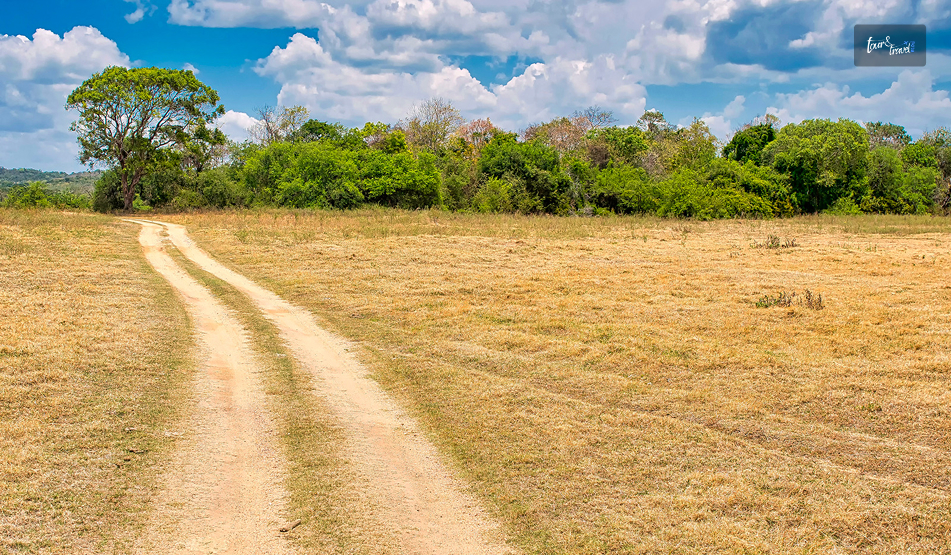
The jeep drove down the extensive stretch of dirt road, and we entered the national park. Within minutes, our first encounter with the wildlife was a jackal.  

As we continued through the main road, Kumar, our guide, kept showing us different monkeys, birds, and lizards.  

I was loving the experience, apart from the dodges we had to do to get away from the low-lying branches of the trees.  

After a drive for a while through the dense forest, we finally reached the grassland, and the Kaudulla Wewa Lake was the first major stop on the way.  

1. Kaudulla Wewa Lake 

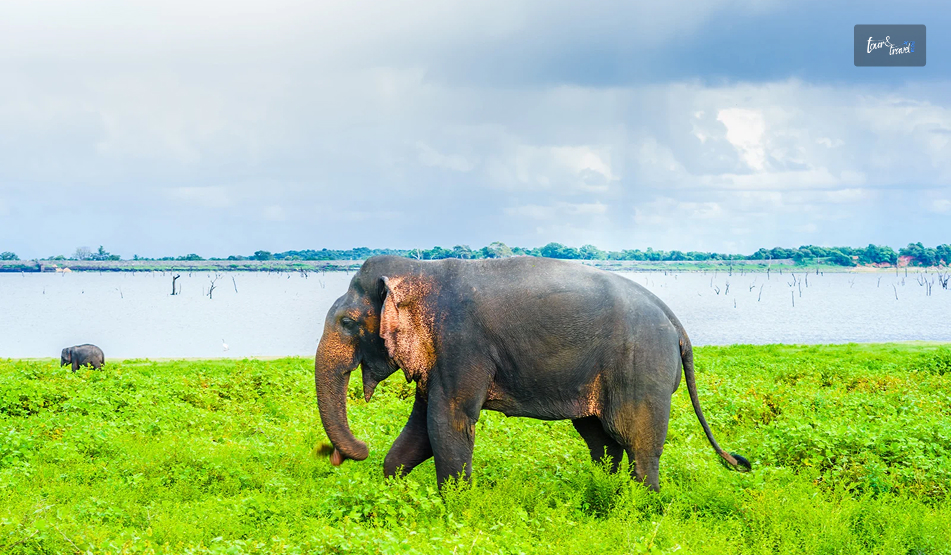
After reaching the Kaudulla Wewa Lake, the first thing that caught my eye was the branch of an old tree. It resembled a telegraph pole, and one member of our safari group also mistook it for the same.  

Furthermore, a majestic sea eagle was sitting on its top.  

Along with this bird with its regal blue plumage, we also spotted storks, peacocks, and egrets.   

Moreover, there was a buffalo that was having its munch time, and it was occasionally playing host to the tiny birds who were sitting on its back and head, making the entire scenario appear very playful.  

2. Spotting The Elephants: The Dream Come True Moment  

We were in the middle of the safari tour, and we were dying to see a glimpse of the majestic grey creatures.  

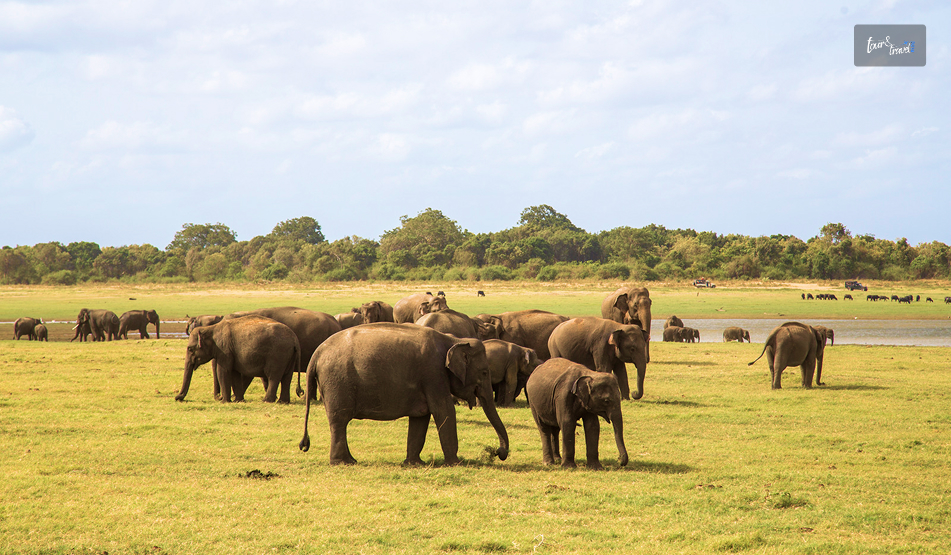
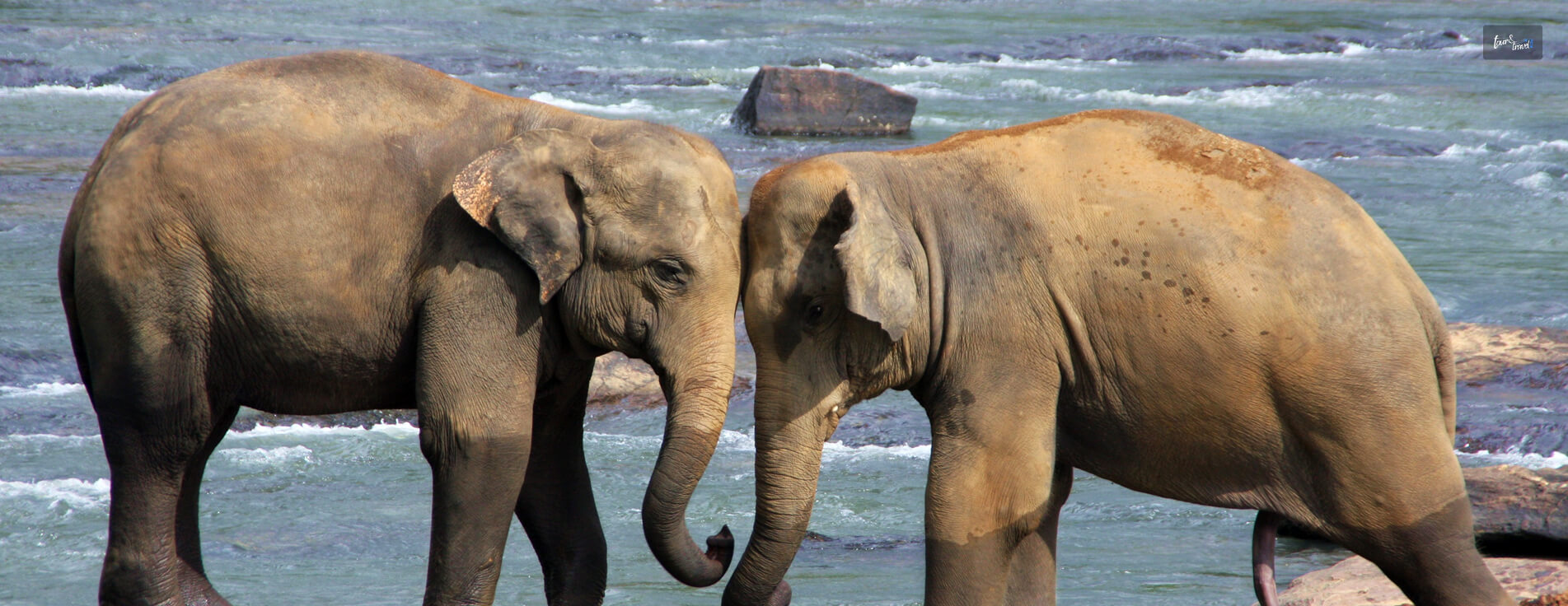
Then suddenly, we reached an isolated wooded area where scores of elephants were waiting for us.  

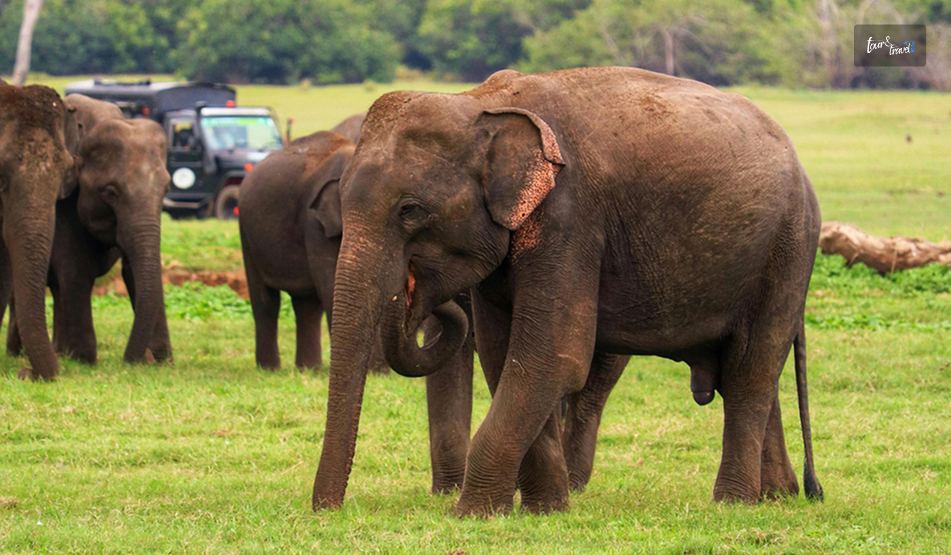
Also, they were busy having a bath, playing, rolling in the mud, and grazing. I had goosebumps as they are truly my spirit animals.   

So, our jeep was around 20 meters away from them, and from a safe distance, each of us in the jeep captured as many photos as possible.  

Moreover, the best thing was that the group had many calves, and it was nice to see them interacting with their mothers.  

Animal Welfare In The Kaudulla National Park 

Let’s be honest! I visited the Kaudulla National Park with some preconceived notions about animal welfare.  

There are many videos and images on the internet showing how solitary animals such as leopards are targeted by photographers and safari tour conductors.  

Moreover, you cannot surround a solitary creature with 20 jeeps and claim the preservation of animal welfare.  

However, during my safari tour, I did not notice such a thing. The number of jeeps was decent, and each of the jeeps maintained a safe distance from the animals.  

Moreover, the elephants were not chained, and they were roaming freely between the Kaudulla Park and other neighboring parks.  

What Are The Other National Parks To Visit Near The Kaudulla National Park?  

Along with the Kaudulla National Park, Habarana is also the gateway to the Minneriya and Kalawewa national parks.  

1. Minneriya National Park  

You can reach the Minneriya National Park with a short drive from the east of the Habarana town.  

However, as I have already mentioned, you can take a combined safari tour of the Kaudulla National Park and Minneriya National Park.  

Moreover, this national park, covering 90 square kilometers, has elephants and many other wildlife.  

2. Kalawewa National Park  

The Kalawewa National Park is home to the rare breed of tusked elephants in Sri Lanka.  

Also, you have to take a drive of around 45 minutes west of Habaraba to visit the Kalawewa National Park.  

Moreover, December to March is the best season to visit this national park.  

Share on Social Media

Meet Sibashree Bhattacharya, a travel enthusiast who has a decade-long experience in transcending virtual barriers with her words! Her deep love for travel is apparent from her travel escapades to the mountain, often taking her readers on a journey, her words acting as Portkey! Fun fact: Sibashree loves to dive deep into the history of the places she is about to visit, making her travels even more wholesome. If you were wondering how her articles are not short of time travel, this answers it!

Leave a Reply

Your email address will not be published. Required fields are marked *

title-img Related

READ MORE Best Places To Travel

Best Places To Travel Around The World And To See Flowers

BY  Sibashree Mar 10, 2023

There are hundreds of thousands of locations where you can find flowers. They can be in the wild or cultivated, making flower tourism a common hobby worldwide. Tulips, roses, and poppies are among the world’s most beautiful flowers. Angiosperms derive from the Greek words for “vessel” and “seed” and are flowering plants.  Checkout Seven Best Places To Travel Around The World And To See Flowers Here are some of the best locations around the world where you can enjoy the wealth and beauty of nature— 1. Jacaranda Trails, Australia The jacaranda tree is native to New South Wales, and Grafton is home to an annual jacaranda festival that paints the town purple. Sydney's top locations for jacaranda trees are Macquarie Street in the city center, Lavender Bay on the north shore, Hunters Hill North Shore, and the Eastern Suburbs. These spots are well-liked by visitors and residents and provide breathtaking views of the harbor and Opera House. Hunters Hill is a terrific spot to spend an afternoon walking along Oxford Street with a coffee in one hand and a camera in the other when the trees are fully bloomed, turning the Downtown into a purple sanctuary. The locations of Sydney's famous harbourside gardens, Glebe market, Parramatta Park, Grafton, and Woolwich Dock are the most crucial information in this article. The finest place to see purple-hued flowers is at the Royal Botanic Garden, while Glebe and Parra Park are fantastic places to explore after lunch. You can use one of these world’s most beautiful flowers even if you want to send flowers brisbane and gift someone with an authentic bouquet of love!  2. Keukenhof Gardens, Netherlands The largest flower garden in the world, Keukenhof in the Netherlands, offers breathtaking vistas of blooming Dutch tulips and other flowers. It provides a variety of events and activities for visitors of all ages but is only open for a short period of time each year, usually from mid-March to mid-May. It is conveniently accessible by vehicle or public transit and is situated in Lisse, close to Amsterdam. For anybody who values the splendor of nature and desires to experience the brilliant hues and aromas of springtime in the Netherlands, Keukenhof is a must-visit location. More than seven million flower bulbs may be found there, and four pavilions are filled with tulips, daffodils, orchids, roses, and other blooms. For the greatest views, go in April or May and cross this off your bucket list. 3. Munnar Flower Valley, Kerala, India Travelers are drawn to Munnar by the Neelakurinji bloom from all over the world. It is renowned for its luxuriant spice, tea, and coffee plantations, forested areas, vibrant species of flora and animals, dramatic weather, and for an exceptional experience. As it only blooms once every 12 years, it is a once-in-a-lifetime event. The next bloom is anticipated to occur in 2030, having occurred last in 2018. The most recent bloom is only a 4-hour drive from Munnar, and thousands of people travel there daily to see it. For couples seeking a romantic getaway, Munnar is the perfect location. A rare occurrence, the Neelakurinji bloom, may be photographed and preserved. Tourists may travel with friends, family, and coworkers, or they may go alone. A magnificent experience of Munnar can be one of the most relevant trips if you’re out to see one of the world’s most beautiful flowers.  4. Japan During The Cherry Blossom Season The cherry blossom season in Japan begins in late March and lasts through mid-May. About 30,000 sakura blanket the Kii Mountains and the town of Yoshino, Kansai, one of over 1,000 spots where you may find them. Himeji Castle, Hirosaki Castle, Tokyo, and Kyoto are a few other excellent locations to see them. If you go at the correct time, you won't have any trouble seeing the cherry blossoms, even if they can be crowded in certain spots. Visit Japan during cherry blossom season for the best experience! In many areas of Japan, cherry blossom season normally begins in late March and lasts until mid-May, with the real full bloom only lasting two weeks. Have a picnic, meet locals, and see temples and castles with stunning cherry blossoms, such as Hirosaki Castle and Himeji Castle. Hanami, or cherry blossom viewing, is mostly associated with home-cooked dinners and BYOB picnics with friends and family. 5. Floral Carpets, Sicily, Italy Italy has a long-standing custom known as the Infiorata, or "covered with flowers," in which the streets are decorated to commemorate the Corpus Domini feast. The entire town of Spello, an ancient Umbrian town, takes part in creating the Infiorata. You can find flower carpets outside of Italy in La Ortawa, the Canary Islands, and Brussels. Sicily in the spring is renowned for its delectable cuisine, extensive history, and Mediterranean scenery. The world’s most beautiful flowers are displayed in vibrant carpets at the Infiorata di Noto, a Baroque Spring Festival.  Using a kaleidoscope of specially produced flower petals, artists produce intricate patterns. Children are permitted to run through the petal-filled streets on the Monday after the festival, bringing the revelry to a close. Go for a cultural adventure tour on the third weekend in May to witness the flower festival! 6. Jeju Island, South Korea Cherry blossoms, vivid yellow rapeseed, and canola blooms are prominent on Jeju Island. Tourists can visit Jeaonnon-ro to see the well-known cherry blossom street, Noksan-ro to witness the six-mile road, and Sanbangsan Mountain to provide the ideal backdrop. Visitors may see the island completely covered in the stunning yellow of the canola blossom seasons every final week of March. An outstanding backdrop for Jeju's springtime splendor is the canola carpet with blue trunks and golden blossoms. Due to its beautiful scenery and vibrant blossoms, Jeju Island is a well-liked tourist destination in the spring. The season of canola blossoms is both visually and olfactorily delightful, as the blooms give out a delicious perfume that permeates the atmosphere. Visitors may stroll or ride bikes across the fields and enjoy the lovely environment. Jeju Island is a haven for nature enthusiasts because of the aromatic flowers, soft sunshine, and sea air. 7. Istanbul Tulip Festival, Turkey The Istanbul Tulip Festival is a vibrant and stunning occasion in Istanbul, where the municipal administration has planted millions of tulips in parks, avenues, traffic roundabouts, and open ground. The tulips bloom for many weeks, beginning at the end of March or early April. The Sultanahmet Hippodrome and Sultanahmet Mosque are the two greatest venues to admire tulips, and the festival's official dates are from April 1 to April 30. Daffodils, purple grape hyacinths, and pansies are among the festival's blooms; in early May, roses will replace the tulips. Tulips may bloom earlier than normal if the current warm weather persists, but a cold snap may still be on the horizon. In the first few weeks of April last year, the pictures below were taken in Emirgan Park. FAQs  Here are a few questions and queries on the topic of world’s most beautiful flowers that others find help and so would you as well. 1. What Are The Best Countries In The World To See Stunning Flower Displays?  Some of the world’s most beautiful flowers destination globally include: • Netherlands – World-renowned for tulip fields and spring blooms. • Japan – Famous for cherry blossom season (Sakura). • India – Home to vibrant flower valleys and seasonal blooms. • France – Known for lavender fields in Provence. • South Africa – Offers breathtaking wildflower landscapes. Each destination offers unique seasonal floral spectacles.  2. Where Can I See The Most Beautiful Tulip Fields?  The most iconic tulip displays are found in the Lisse, home to Keukenhof, one of the world’s largest flower gardens.  The Netherlands’ tulip season typically runs from late March to mid-May, with April being peak bloom time. 3. What Is The Best Place To See Cherry Blossoms?  Cherry blossoms are most famously celebrated in Tokyo and Kyoto during Japan’s spring season (late March to early April). Parks such as Ueno Park attract millions of visitors for Hanami (flower-viewing) celebrations.  4. Where Can I See Lavender Fields In Full Bloom?  The lavender fields of Provence are world-famous, especially around Valensole. Blooming season usually peaks between late June and July, creating stunning purple landscapes.  5. What Is The Best Wildflower Destination?  The Namaqualand region in South Africa transforms into a colorful carpet of wildflowers between August and September. It’s one of the world’s most dramatic natural flower displays.  6. Is There A Famous Flower Valley In India?  Yes, the Valley of Flowers National Park is a UNESCO World Heritage Site known for its alpine flowers and rare Himalayan blooms. The best time to visit is from July to September.  7. When Is The Best Time To Travel For Flower Tourism?  Flower tourism is highly seasonal. Generally: • Spring (March–May): Tulips and cherry blossoms • Summer (June–August): Lavender and alpine flowers • Late Summer (August–September): Wildflowers in South Africa • Monsoon (July–September in India): Himalayan blooms Timing your trip around peak bloom season is essential. 8. Are Flower Destinations Suitable For Photographers?  Absolutely. Flower destinations offer vibrant colors, dramatic landscapes, and unique lighting conditions. Many photographers plan trips specifically around bloom forecasts to capture the best visuals.  9. Are These Flower Destinations Family-friendly?  Yes. Most flower parks and regions are suitable for families and offer walking paths, guided tours, picnic areas, and cultural festivals during bloom season.  10. How Can I Plan A Flower-focused Travel Itinerary?  To plan effectively: • Research bloom calendars for your chosen destination • Book accommodations early (flower seasons attract large crowds) • Consider guided tours for access to the best viewing spots • Monitor weather conditions before travel  Viewing The World’s Most Beautiful Flowers  Traveling to see flowers is more than just sightseeing it’s an immersive experience that connects you with nature, culture, and seasonal beauty.   From the iconic tulip fields of the Netherlands to Japan’s poetic cherry blossoms, Provence’s lavender landscapes, and the wildflower wonders of South Africa and India, each destination offers a breathtaking display that transforms ordinary landscapes into living works of art.  Flower-focused travel encourages mindful exploration, photography, relaxation, and cultural appreciation.   Whether you’re planning a romantic getaway, a family holiday, or a photography expedition, visiting the world’s most beautiful floral destinations promises unforgettable memories.

READ MORE Ritigala Forest Monastery

Ritigala Forest Monastery: Location, Timing, History, Climbing Experience And More

BY  Sibashree Feb 18, 2026

After exploring the Tamil culture and the Hindu temples of Jaffna, it was time to visit an ancient and secluded Buddhist meditation retreat in Sri Lanka.  It has stone ruins from the 1st century BC, and it was once home to the Pamsukulika Sect of monks, who were known for their meditation-based and secluded lives in the forest.  Moreover, the Ritigala Forest Monastery has an association with the stories of the Ramayana. Also, this monastery is inside the Ritigala Forest Reserve. So, it is a place where history, spirituality, and wildlife await you.  Hi, in today’s blog, I will talk about how I climbed up the stone steps to reach the Ritigala Monastery in Sri Lanka, the history, legends, and the main attractions of visiting the ancient monastery today.  I will also talk about the transportation options.  Where Is Ritigala Forest Monastery? Sri Lanka maybe one of the cheapest places to travel in the world. However, its natural beauty and the cultural and historical richness are matchless. The Ritigala Forest Monastery is one of the hidden gems in Sri Lanka.  The Ritigala monastery is located across the mountain of Ritigala. The mountain of Ritigala is the highest mountain in the dry northern region of Sri Lanka.  It is close to Harbarana, which is again the epicenter of the cultural triangle, the Sigiriya Rock Fortress, Dambulla Cave Temple, and Polonnaruwa. It is also the gateway to many wildlife safaris in Sri Lanka.  The distance between Harbarana and the Ritigara mountain is around 21 km. Other important locations near the mountain are Anuradhapura, which is at a distance of 42 km, and Sigiriya, at a distance of 32 km.  Furthermore, the Ritigala Forest Monastery is inside the Ritigala Strict Nature Reserve.  However, remember one thing. As I mentioned in my Jaffna, Sri Lanka, travel guide, you have to rely on the locals when you are exploring the cultural landmarks or a secluded place like the Ritigala Forest Monastery.  You cannot trust Google Maps completely for locating the Ritigara mountains and monastery.  How To Reach The Ritigala Forest Monastery?  Harbarana was the base for my road trip to the Ritigara mountain and trekking further.  1. Reaching Harbarana From The Bandaranaike International Airport (CMB) I took a flight to the Bandaranaike International Airport (CMB). The distance between the Bandaranaike International Airport (CMB) and Habarana is around 151 km. You can take a car rental for the entire journey. However, being a fan of the LowDownUnder Travel, I chose a different path.  After reaching the Bandaranaike International Airport, I took a taxi to Gampaha and then took a train to Harbarana. The ticket cost me around INR 400, and the travel time was around 4 hours and 40 minutes.  The Sri Lankan Railways runs two trains daily from Gampaha to Habarana.  Other airports close to Harbarana are Sigiriya Airport (18 minutes), Kandy Airport (2 hours), and Trincomalee (1 hour and 36 minutes).  2. From Harbarana To The Ritigara Mountain  From Harbarana, I took a taxi to reach Ritigara. It cost around INR 420, and the travel time was around 35-40 minutes.  You can also reserve a car or tuk-tuk to take you to the mountains, wait for you at the entrance gate, and take you back home when you are done trekking. In such cases, the reserve cost will be around INR 1000-1200.  The route from Harbarana to Ritigara was beautiful. My cab driver pointed out the local farming practices and the land on the way.  It was a fulfilling experience, and as Jaffna has a unique food scene based on its local agricultural practices, the food habits of this northern-central region of Sri Lanka. Red rice, jackfruit curry, and river fish are the staples here.   Also, my driver told me to keep my eyes open to spot elephants. However, I was not lucky enough to spot my favorite animal. I noticed some fresh dung in the road, though.  Furthermore, when the car came off the main road, the ride became a little bumpy. The route from here to the Ritigara mountain was a combination of dirt tracks and semi-paved roads.  Finally, I reached the entrance of Ritigara and purchased my ticket. The ticket cost me around INR 450, and I even got a guide for INR 1200. What Is The History Of Ritigala Forest Monastery?  The history of the Ritigala Forest Monastery goes back to the 1st century BC. You will find here more than 70 rock caves, the 9th-century meditation spots of the "Pansukulika” monks, and unadorned stone pathways.  Here is a brief historical timeline of the Ritigala Forest Monastery.  1. Establishment Of The Ritigara Forest Site For Monks Buddhist monks came here and started living in the sacred mountains in the 1st century BC. There were more than 70 caves where monks started meditating in solitude.  Even today, there are many rock inscriptions from which we can learn about how many patrons helped to build and maintain the site, which was home to monks who left the luxury of monasteries and used to meditate in the caves.  2. Receiving Royal Patronage This site received adequate royal patronage, and from the inscriptions, we especially get to know about King Pandukabhaya.  He founded Anuradhapura and built a reservoir at the base of the mountain for the hermits here in the 4th century BC.  3. Building Of The Pansukulika Sect Monastery King Sena I built the Ritigara Monastery in 833, and it was meant for the Pansukulikas or monks in rag robes.  These monks practiced the highest form of asceticism, and they were on a mission to revive the simple teachings of Lord Buddha.  4. The Decline Of The Pansukulika Sect And The Monastery  From the 9th to the 11th century, the Ritigala Forest Monastery and the Pansukulika Sect of monks enjoyed immense glory.  However, with increasing donations and the monks getting inclined toward what they earlier rejected, the core philosophy of the sect was lost.  Two rival sub-sects were formed within the Pansukulika Sect. Finally, King Vijayabahu I confiscated their extensive holdings in 1070-1110 CE as a part of a Buddhist monastic reform.  5. Abandonment And Discovery Of The Ancient Monastery Despite the royal patronage, the Ritigara Forest Monastery was abandoned around the 10th to 12th centuries due to the Chola invasions.  It was an unprotected ruin until James Mantell, the British colonial surveyor, saw the ruins while climbing up the mountain.  Then, he drew the attention of H.C.P. Bell, the first Archaeological Commissioner of Ceylon. He understood the historical and religious importance of the place and expanded it extensively in 1893.  Finally, in 1941, the 1528 hectares of the forest area, including the ruins, were designated as a Strict Nature Reserve.  Today, the conservation efforts strike a balance between the ecological and archaeological preservation of the monastery and the site.  Design And Engineering Of The Ritigala Forest Monastery: The Incredible Ruin The monastery does not look like the traditional stupas. Here, you will find interconnected stones, paved pathways, and stone bridges.  Furthermore, there are bathing areas like the famous Banda Pokuna.  The most unique thing about the Ritigara Monastery is that here you will not find any Bodhi Tree or any Buddha statue.  It is a place where you can walk, meditate, and contemplate.  You may call it a failed attempt to revive the radical simplicity of Buddhism, but for every seeker, it will always be a place to introspect and connect to a higher energy.  I had goosebumps the moment I entered the monastery. Let’s delve deeper into the unique architecture of the monastery.  1. The Padhanaghara And Stone Pathways  The ruins of the Ritigala Forest Monastery cover an area of around 120 acres. You will see around 50 distinct meditation houses or Padhanaghara in the area.  Inside each meditation house, you will find two raised platforms in the east-west direction, and those were made of stone. A small maot surrounded the platforms, and a small stone bridge connected the platforms.  Probably, these structures were used for some rituals or meditation purposes.  Interlinking stone pathways connect these meditation houses. These pathways are 1.5 meters in width, and the width is consistent as the pathways ascend the slope. These pathways also have circular intersections.  2. Water Management System, The water management system in Ritigala Forest Monastery was sophisticated. Banda Pokuna and Kumbuk Wewa, these twin ponds were carved from rocks.  Furthermore, I found a large stone trough in the courtyard, which was used for cooking food.  Also, I saw the ruins of the monastery hospital and stone mortars, which were used to grind and prepare herbal medicines.  Moreover, the monastery did not have any residential complex. The monks lived and meditated in the caves.  However, there were urinal stones, which were the only amenities or the luxury the monks enjoyed in this austere setup.  What Is The Legend Of The Ritigala Forest Monastery?  The Ritigala mountain has a connection to the Hindu mythology, the Ramayana. Attacked by Ravana, Lakshama, the brother of Lord Ramachandra, became unconscious on the battlefield.  Lord Hanuman, on Lord Rama’s command, went to fetch a life-saving medicinal herb from the Dronagiri. However, he forgot the name of the herb and carried the entire mountain on his shoulder.  When he was crossing the Palk Strait, five segments of the mountain fell from his grasp. The biggest fragment fell on the site of the Ritigara Mountain.  Now, you may not believe the legend of the Ritigala Mountain. However, the presence of various medicinal plants in the mountains keeps the myth alive.  Moreover, among the 417 species of plants here, around 96 varieties are for medicinal purposes. Moreover, the northern peaks have names such as the Wannati-kanda and Aushada-kanda.  Climbing To The Ritigala Forest Monastery In Sri Lanka  Climbing up to the Ritigara Forest Monastery was a free-flowing experience. There are many things to see, but more to feel.  Here is how I explored the ruins.  1. The Bathing Pond  As I left the ticket counter behind, I found the first ruin. I took the stone steps to visit a massive bathing area.  You have to be careful with the steps here, as they are cracks and have overgrown tree roots.  Large trees have grown in the bathing area now. However, you can still understand its massive scale.  2. A Winding Stone Path And Ruins Of The Monastery The winding stone pathway took me through various ruins, and they stood like the blueprints from a bygone era.  The most striking one among them was the ruins of the hospital. It still had a sunken bath and grinding stones for preparing medicines.  As I climbed up, I found the meditation platforms, big multi-chambered rooms, and urinals.  3. The Large Pavilion With Columns  I found a large pavilion here with big columns. However, the more intriguing was the Big Tree behind the ruin.  It is so massive that its ground roots have created a labyrinth. The road seems to fizzle out at this stage. However, my gut instinct said that there is something more.  4. The Hidden Ruin  My guide was not happy with me for continuing further. As I headed down, after the initial disappointment of landing on the forest floor, I found another ruin.  There was a stone bridge, and it took me to a promontory with a square structure. It was the ruins of the library that had many precious manuscripts.  The view from the promontory was amazing.  It is a shame that most trekkers miss it, as the signs are not adequate and often hidden in the overgrown bushes. Furthermore, most of them are only in the Sinhalese language, which only locals can read.  However, I used the absence of signboards to my advantage.  Practical Tips For A Visit To The Ritigara Forest Monastery  If you are traveling with your partner or in a group, you must reserve a tuk-tuk or car to bring you back. You may not get a passing traffic. I took the risk as it was a solo adventure.  You have to carry snacks and water. Wear sunscreen and carry insect repellents.  You will find a toilet at the entrance of the ruins. I did not use it. So, I am not sure about the condition or the amenities available.  Ritigala Forest Monastery: Frequently Asked Questions (FAQs)  Here are the frequently asked questions and answers about the Ritigala Forest Monastery. 1. How Much Time Is Needed At Ritigala? Trekking the Ritigala Forest Monastery is going to take around 2 hours. So, overall, you will at least need 3 hours in Ritigala. Trekking up the route is easy. However, walking through the cracked stone steps can be challenging.Also, signboards are scarce and incomprehensible on the route. So, you must take a local guide.  2. Where To Stay Near The Ritigala Forest Monastery? I stayed at Habarana, and the name of my hostel was The Lake Breeze. The tariff for the hostel was around INR 2000. The amenities were basic, with fans, Wi-Fi, and mosquito nets.  3. Is Taking A Tour Of Ritigala Forest Monastery Worth It? Yes, taking a tour of the Ritigala Forest Monastery is absolutely worth it. Here, you will find the ruins of the 1st century BC, and it is great for anyone with a keen interest in the history and evolution of Buddhism. Furthermore, the ambiance of the ruins is introspective and meditative. Moreover, you can easily reserve a car or tuk-tuk to reach the base of the Ritigara Mountain and then start your trek for 1.5 to 2 hours. 

READ MORE Attractions In Dubai

Family Activities & Attractions In Dubai

BY  Arnab Jun 19, 2023

Dubai, the dazzling city of wonders, offers an array of family-friendly activities and attractions that cater to every age group. From thrilling adventures to educational experiences, Dubai has something for everyone.  But we begin our informative guide with a description of the means of transportation in the city. For family trips this point is especially important, so we advise you to think about it in advance. Getting Around Dubai - Exploring the City with Ease Dubai is a well-connected city with an extensive transportation network that allows visitors to navigate effortlessly. You have come to the right place if you are looking for a guide on buying property here. Here’s a comprehensive guide on how to get around Dubai: 1. Metro Dubai's modern and efficient metro system is one of the most convenient ways to travel around the city. It covers major attractions and business districts, making it an excellent option for family exploration. The metro offers separate cabins for women and children, ensuring a comfortable journey. 2. Car Rental Services For those seeking flexibility and independence, renting a car is an ideal choice. Several reputable car rental companies operate in Dubai, offering a wide range of vehicles to suit different needs. If you're looking for a luxurious and stylish option, consider renting a BMW X6 in Dubai. With your car, you can plan your route and not depend on public transport schedules. And the roomy interior of the SUV will provide comfort for the whole family during your family trip. 3. Taxis Taxis are readily available in Dubai and provide a hassle-free way of getting around. The city's taxis are known for their reliability and professional drivers. You can easily spot one of them or find them at designated taxi stands. Importantly, Dubai has regular taxis (cream-colored) and luxury taxis (usually black). Family Activities and Attractions in Dubai Dubai offers an exciting range of family activities and attractions that will captivate the imagination of both children and adults. Let's explore some of the must-visit places. A. Dubai Parks and Resorts Dubai Parks and Resorts offer a realm of entertainment, boasting a vast complex encompassing three prominent theme parks: Motiongate Dubai, Bollywood Parks Dubai, and LEGOLAND Dubai. With an array of exhilarating rides, captivating live performances, and immersive encounters, these parks guarantee boundless thrills and enjoyment for the entire family. B. Aquaventure Waterpark Beat the heat and make a splash at Aquaventure Waterpark. Located within Atlantis, The Palm, this thrilling waterpark offers an array of water slides, wave pools, and a lazy river.  Kids can enjoy the Splasher's Children's Play Area, while adults can relax on the private beach or indulge in a refreshing swim with dolphins. C. Dubai Aquarium & Underwater Zoo Take a mesmerizing journey through the depths of the ocean at the Dubai Aquarium & Underwater Zoo. This colossal aquarium showcases an incredible variety of marine life, including sharks, rays, and colorful fish.  Explore the underwater tunnel or opt for a behind-the-scenes tour to learn more about marine conservation efforts. D. Dubai Miracle Garden Immerse yourself in a vibrant world of kaleidoscopic hues and captivating floral showcases at the Dubai Miracle Garden. This botanical utopia boasts awe-inspiring arrangements of more than 150 million blossoms. Children will be filled with delight as they venture through the themed gardens, such as the enchanting Disney Avenue and the whimsical Butterfly Garden. Meanwhile, parents can unwind and bask in the tranquility of the breathtaking scenery that surrounds them. E. KidZania Dubai Unleash your child's imagination at KidZania Dubai, an enthralling interactive edutainment center. Here, kids have the opportunity to engage in role-playing scenarios of diverse professions, including doctors, firefighters, and pilots, within a meticulously designed child-sized city. This immersive experience not only brings immense joy but also imparts invaluable life skills to children. Prepare for an unforgettable adventure where learning and fun go hand in hand at KidZania Dubai. We believe that Dubai is a remarkable destination for family vacations, offering a multitude of activities and attractions that cater to all ages. Whether you're seeking thrilling adventures or educational experiences, Dubai has it all. So, pack your bags, gather your loved ones, and embark on a journey filled with unforgettable moments in the dazzling city. Read Also: A Cultural Adventure: Dhow Cruise Trip In Dubai Dune Bashing And Beyond: An Adventure Lover’s Guide To Desert Safari Dubai Trip A Luxurious Getaway: Top 5-Star Hotels And Resorts In Dubai For An Unforgettable Holiday Experience