

Unique Things To Do In Oklahoma | 7+ Cool And Unusual Activities You Cannot Miss

Dec 13, 2024

Last Updated on: Jun 17, 2025

Travel Blog

Bearing a rich native American history, Oklahoma is one of the tourist hotspots in the USA. It is also a city bearing the memories of frontier life. 

Further, with many things to do in Oklahoma, the American Bus Association has identified Oklahoma City as the Rising Star in Tourism. Furthermore, the American Bus Association has appreciated the city for the record economic impact of its tourism. 

Moreover, the city authorities are investing heavily in building its infrastructure and amenities. Also, all the efforts have been paid of in the economic boom of the city in 2023. 

The 2024 Visit OKC Economic Impact Report has mentioned that tourism in Oklahoma City has contributed $3.7 billion to the local economy. Moreover, tourism yields a major benefit for the local people in terms of tax revenues and employment.

Today’s visitors become tomorrow’s residents. Tourism impacts perceptions of our city which intersects with economic development as new businesses look to relocate here. 
The more we promote OKC as a tourism destination, the more jobs we can support, the more city revenue is paid by visitors, and additional positive awareness is generated about Oklahoma City.” 
 
Christy Gillenwater, Greater OKC Chamber President and CEO 

So, what are things to do in Oklahoma to boost tourism in the city? Here is a brief guide for you. 

Unique Things To Do In Oklahoma | Try These Unusual Activities 

Unique Things To Do In Oklahoma _ Try These Unusual Activities

The tourism sector in Oklahoma is vibrant. No wonder that the Forbes Advisor has ranked Oklahoma City as one of the most budget-friendly cities in the world for family vacations. 

Nevertheless, when you are in Oklahoma, you can try the following activities. 

1. Visit The Oklahoma City National Memorial & Museum

Address: 620 N Harvey Ave, Oklahoma City, OK 73102, United States

Contact: +1 405-235-3313

Hours Open: Monday to Saturday (9 AM to 5 PM), Sunday (12-5 PM)

Oklahoma witnessed the worst domestic terrorism on 19th April 1995. Timothy McVeigh and Terry Nichols were behind this attack. 

The Oklahoma City National Memorial & Museum is a tribute to the people who survived and lost their lives in this attack. You will find the biographies of the survivors, photos and stories of the survivors here. 

2. Explore The Oklahoma City Museum Of Art

Address: 415 Couch Dr, Oklahoma City, OK 73102

Contact: +1 405-236-3100

Hours Open: Wednesday – Saturday (10 AM to 5 PM), Sunday (12-5 PM), Monday & Tuesday Closed

The Oklahoma City Museum of Art is famous for its collection of glasswork and artwork collected from the globe. However, this museum is the go-to place if you want to know about American art. It also introduces you to postwar abstraction.

Don’t miss the glasswork of Dale Chihuly at this museum. 

3. Visit The Five Civilized Tribes Museum

Address: 1101 Honor Heights Dr, Muskogee, OK 74401

Contact: +1 918-683-1701

Hours Open: Monday – Friday (10 AM to 5 PM), Saturday (10 AM to 2 PM), Sunday Closed

The Five Civilized Tribes Museum is the best place to visit if you are willing to know about the Chickasaw, Cherokee and Creek nations. The name of the music celebrates how the native Americans of five different nations became a part of the Anglo-American culture. 

The artifacts, artwork, and historical detailing are intriguing. 

4. Visit The National Cowboy and Western Heritage Museum

Address: 1700 NE 63rd St, Oklahoma City

Contact: +1 405-478-2250

Hours Open: Monday – Saturday (10 AM to 5 PM), Sunday (12 PM to 5 PM)

The National Cowboy and Western Heritage Museum is famous across the globe. The interactive exhibits here are out of the world, and you will find here many artefacts and artwork. 

Each element in the museum exudes a unique charm, and it reminds you of life in the Old West. You will also get to know about Victorian-era firearms, American cowboys and rodeos here. 

5. Be A Part Of The Entertainment And Dining Scene At Bricktown

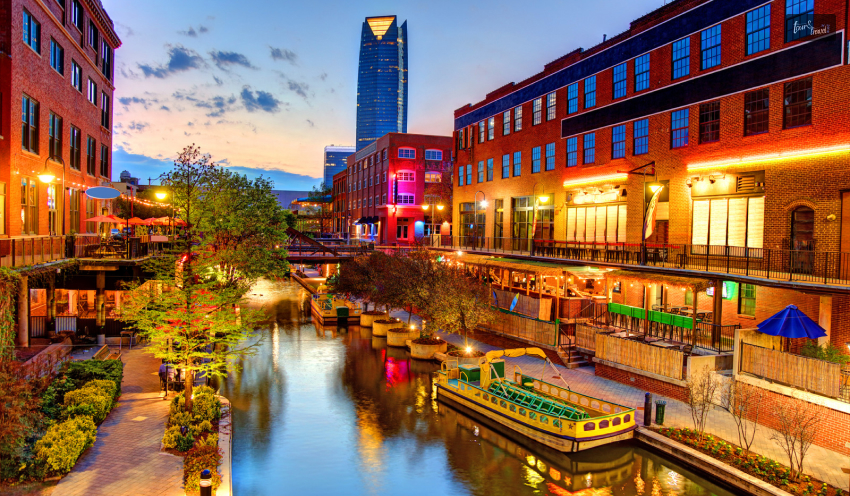
In Downtown Oklahoma City, Bricktown will introduce you to the most happening entertainment and dining scene of the city. Bricktown is on a canal that links Bricktown with the Oklahoma River and Downtown.

Taking a ride in the water taxi here is one of the most unique things to do in Oklahoma. Further, you can explore the 40+ restaurants, pubs and bars here. 

6. Make The Most Of The Unique Experiences At Gathering Place

The Gathering Place in Tulsa is a place for unique things to do in Oklahoma. Currently, it is a space of 65 acres, and soon, it will be a happening activity area of 100 acres. You can explore the following sections of Gathering Place for adventurous activities. 

  • Adventure playground
  • Climbing structures
  • Slides
  • Puzzles
  • Sensory garden
  • Picnic grove
  • Reading tree

You can spend an entire day at the park and the eateries at the park have decent refreshment options. So, you can visit here with your kids or family. 

7. Enjoy The Art Experience At Factory Obscura Mix-Tape

Address: 25 NW 9th St, Oklahoma City, OK 73102, United States

Contact Number:  +1 405-367-1578

Hours Open: Monday, Wednesday, Thursday (11 AM to 7 PM), Saturday (10 AM to 8 PM), Sunday (12–6 PM), Tuesday Closed

If you want an interactive and immersive art experience, you must visit the Factory Obscura Mix-Tape. This 6,000-square-foot area of art and entertainment was created by musicians, muralists, and local volunteers. 

The art objects here are crafted for people with vision or hearing problems. Further, the sensory room is here is a great place for visitors with autism. 

8. Encounter Wildlife At Woolaroc Museum & Wildlife Preserve

Address: 1925 Woolaroc Ranch Rd, Barnsdall, OK 74002, United States

Contact Number: +1 918-336-0307

Hours Open: Wednesday – Sunday (10 AM to 5 PM), Monday and Tuesday (Closed)

Woolaroc Museum & Wildlife Preserve is located in the North of Tulsa. Visiting this 3,700-acre area is one of the unique things to do in Oklahoma for wildlife lovers. 

Frank Phillips, an oil baron, built the Woolaroc Museum & Wildlife Preserve in 1925 as a ranch retreat. However, with time, it became a massive wildlife preserve and museum.

Today, you can meet many cattle, including elk and bison, here. In addition, true to the native American spirit of the city, the Woolaroc Museum & Wildlife Preserve has an elaborate collection of Western Art.

In addition, the old photographs and collections, including a Colt firearm, will transport you to the lands of cowboys.

So, that’s for now from me about the unique things to do in Oklahoma. If you want to explore more places, you can visit the Beavers Bend State Park, Six Flags Frontier City, Oklahoma Route 66 Museum, etc.  

Also read

Share on Social Media

Meet Sibashree Bhattacharya, a travel enthusiast who has a decade-long experience in transcending virtual barriers with her words! Her deep love for travel is apparent from her travel escapades to the mountain, often taking her readers on a journey, her words acting as Portkey! Fun fact: Sibashree loves to dive deep into the history of the places she is about to visit, making her travels even more wholesome. If you were wondering how her articles are not short of time travel, this answers it!

Leave a Reply

Your email address will not be published. Required fields are marked *

title-img Related

READ MORE Global Explorers

Better Travel Timing for Global Explorers

BY  Sibashree Sep 22, 2025

As a global explorer, you just have to make smart planning! This makes international trips smoother and more rewarding.  Once you check the world time differences, it can help you to avoid a lot more surprises during the booking process. So, knowing the time is very necessary. This way, you can ensure a very smooth coordination before you even depart.  You just have to ask “What time is it?” at your destination. Trust me when I say this, this can easily help you to prevent many issues. Thus, you must pay attention to the travel timing to understand the difference between a restful journey and a jet-lagged arrival.  Why Travel Timing Matters for Global Trips Travel timing matters for global trips because it impacts every aspect of the experience, from your budget and comfort to the activities you can enjoy.  Strategic planning around seasons and demand can lead to a more pleasant and rewarding vacation. Travel timing plays a crucial role in  Reducing stress,  Saving money, and  Enhancing cultural experiences.  So what are you planning for? A short getaway or a long journey across multiple continents?  Once you start to align your schedule with time zones and seasonal patterns, it ensures you arrive ready to enjoy your destination.  According to the U.S. Department of Transportation, careful flight planning and awareness of travel times can also improve overall safety and efficiency. How Do I Avoid Jet Lag When Traveling Abroad? Jet lag, probably the worst feeling of all! It occurs when your body is out of sync with a new time zone. There is no proper solution for it, apart from one thing, which is preparation.  But how can you prepare yourself for it?  Well, first things first, you have to adjust your sleeping schedule slightly during the daytime. You have to stay hydrated and further get exposure to sunlight once you arrive.  You can also use the short nap technique. This technique has been a good way to reset yourself so far. However, you must avoid taking long naps as it might disrupt the process.  There are some global explorers who plan their flights to arrive in the evening. This further allows them to reset naturally and wake up fresh!  What Is The Best Way To Check Time Zones Before Booking? Next comes the time zone awareness. This plays a huge role in preventing missed connections and lost vacation days. Before you book your tickets, you can always compare your departure and arrival times across the destinations.  Once you are aware of the time zone, it also becomes very easy for you to make small adjustments in scheduling. This way, you can land at a very convenient hour, rather than in the middle of the night!  Many travelers overlook the International Date Line. This can shift your calendar forward or backward by an entire day.  This matters especially for trips that cross the Pacific. Here, the arrival dates may not match your expectations. Why Is Timing Important For International Travel? Timing can affect almost every aspect of traveling, whether it is about securing the best airfare or maximizing the daylight hours.  Once you can align your itinerary with the local conditions, it can help you save both time and energy.  When you are planning to choose the best time to travel, what does that mean? Well, it often means considering not just weather but also peak seasons.  Arriving during local festivals or avoiding high-demand periods can make your trip more enjoyable and budget-friendly. How Can I Coordinate Flights Across Multiple Countries? Multi-country itineraries require careful coordination. A simple strategy is to book flights in a logical geographical order, reducing backtracking and fatigue. Align layovers with cities you want to explore briefly, turning long waits into mini-trips. When juggling different airline carriers, keep buffer times between connections. This ensures delays in one country don’t derail the rest of your schedule. Best Practices For Smarter Travel Timing To help global explorers manage complex itineraries, here are a few key practices: Check time zone differences before booking flights. Adjust your sleep gradually before departure. Schedule arrival times to match local routines. Use daylight to reset your body clock quickly. Add buffer hours for connecting flights. Timing and Seasonal Considerations Seasonal timing can make or break a trip. Traveling in the off-season often means fewer crowds and lower prices, though it may also bring less predictable weather.  For cultural travelers, timing trips to coincide with major festivals or local holidays offers a chance to experience traditions firsthand. Winter and summer bring different challenges depending on the hemisphere. Always confirm not just weather patterns but also daylight hours, which may impact sightseeing plans. Why Sustainable Travel Matters More Than Ever For The Global Explorers? In 2025, global explorers will seek ways to make travel more sustainable for two primary reasons!  One is to preserve the diversity of ecosystems. Second is to promote cultural diversity for future generations.  The tourism industry has always played a massive role in  Carbon emissions,  Resource consumption, Waste production.  This factor will take a huge toll on climate change! This can further lead to environmental degradation.  Thus, sustainable practices are a partial solution to the problems at hand. Sustainable tourism emphasizes  Genuine culture and community interaction rather than commercialization, Ensuring that tourism benefits the local economy,  Creates jobs,  Sustains livelihoods without overwhelming the community.  Thus, global explorers can support locally owned businesses and choose less-traveled destinations.  This can lead to minimizing the negative impacts of "overtourism," and diluting the unique character of any given destination.  Ultimately, sustainable travel transforms individual journeys into a powerful force for positive change, thanks to the global explorers. Whereas, the most exquisite and least protected regions of the world remain ever spirited and protected. Read Also: Planning To Travel The World? How To Pack Up Your Life So It’s Ready For You When You Get Back Essential Safety Supplies To Pack On Your Backpacking Trip Why Solo Adventures Can Be Life-Changing

READ MORE

Exploring the Geothermal Wonders of Lassen Volcanic National Park

BY  Sibashree Aug 20, 2024

Lassen Volcanic National Park gets its name from the Lassen Peak, an active volcano in the southernmost Cascade Range. Even today, the Lassen Peak has hot springs and you will find fumaroles coming out of the peak’s mouth. These are also signs of volcanic activities in the volcanic mountains. Further, this national park houses all four types of volcanoes: plug domes, cinder cones, composites, and shields. These volcanoes make this national park a chosen destination for geologists and volcano enthusiasts. The presence of these volcanoes has also added unique hydrothermal features to this park. You will find vibrant hot springs, steam vents making hissing sounds, and mud pots with bubbling water here.  Here, I present a brief overview of the geothermal wonders of the park. I will also talk about the park’s camping provisions.  Geothermal Areas In Lassen Volcanic National Park The Lassen Volcanic National Park had 418,978 visitors in 2023, and we can say that its hydrothermal features are a major factor in crowd-pulling here. Snow falling on the park highlands and rainwater keep feeding the geothermal systems. Under the Lassen Peak, there is a molten or hot rock body. This hot rock body makes the water warm once it reaches underground. When the water becomes hot, you see the water boiling in the geothermal pools and mud pots. As the temperature of the water rises, it gets transformed into fumaroles. Fumaroles exude from various cracks in the earth. In Lassen Volcanic National Park, you will observe fumaroles at Sulphur Works, Devils Kitchen, and Bumpass Hell.  Little Hot Springs Valley You can have a look at the Little Hot Springs Valley from Lassen Peak (the largest plug demo volcano in the world) and other mountains lining it.   Further, various seasonal creeks drain into this valley, feeding the geothermal water. If you overlook the valley from the mountain peaks in the summer, you will see many wildflowers smiling. In particular, grass and the wildflower vegetation across the East Sulphur Creek edge is quite dense, thanks to various hypothermal activities. You can also look at the Little Hot Springs Valley from a pullout, just one mile away on the south. The view from this pullout is scenic, with lush green slopes before your eyes. If you look at the slopes with binoculars, you will find black bears roaming around.  Bumpass Hell https://www.youtube.com/watch?v=7OE_c2SzWNw As you walk 7 miles from the southwest entrance of the park, you will find a parking area on the park highway. Here, you will find the trail to Bumpass Hell. With a 3-mile hiking trail(round trip), Bumpass Hell is the largest geothermal area in the park. You can only hike the Bumpass Hell trail in autumn and summer. It remains closed during spring and winter. The temperature of the geothermal water in the Bumpass Hell area can reach up to 322 degrees.  The elevation of this trail is 8,000 feet. However, because of its moderate difficulty level, you will find many visitors here on weekends. The water in this hydrothermal area is emerald green or blue in color. Further, the minerals in the water stain the rocks and soil in yellow and orange shades.  Sulphur Works It can’t get easier than hiking to Sulphur Works if you want to explore the geothermal wonders of Lassen Volcanic National Park. Here, you can see how volcanic activities have created the most interesting geology with shifting new and ancient grounds.  The landscape here experiences regular updates because of geothermal activities and natural activities like erosion. Also, thanks to the volcanic activities, you will encounter colorful rocks, steam vents, and the most pungent sulphuric smell here. Sulphur Works is important in the Lassen Volcanic National Park history, and it was earlier known as Supan's Sulphur Works. Mathias B. Supan, a pioneer of the American West, used to extract minerals from the ground here in the mid-19th century.  https://www.youtube.com/watch?v=sTvAs6VPfIE The hydrothermal area of Sulphur Works is interesting as it is located at the center of a wide basin. Brokeoff Mountain, Mount Conard, Pilot Pinnacle, and Mount Diller surround this basin. According to geologists, these mountains are eroded formations or remains of Mount Tehama or Brokeoff Volcano. Boiling Springs Lake A trail starting from the Warner Valley trailhead will take you to the Boiling Springs Lake, filled with hot and bubbling water. The temperature of the water in this lake is 125 degrees.  You will also find steam vents and mud pots on the shore. The mud pots on the southeastern shore of the lake demand a special mention.  As you continue on the Boiling Springs Lake trail, you will see colorful wildflowers. The vegetation of Douglas-fir, sugar pine, incense-cedar, white pine, and ponderosa pine will soothe your eyes here. This trail is also a birder’s paradise and one of the best places in the park to observe birds.  Devils Kitchen https://www.youtube.com/watch?v=3Pah0QzBkN0 This hike, starting from the Warner Valley Trailhead, is moderate, and it will take you to an area filled with boiling pools, mud pots, and steam vents. You can call Devils Kitchen a  Cauldron. The piled-up cracked red and yellow stones here give this place a colorful appearance. These colorful stones show deposits of various minerals found in volcanic eruptions. The Cauldron will keep making hissing, belching, and plopping sounds, and the unique odor filling the air creates the perfect ambiance of a natural kitchen. Something is definitely cooking in this kitchen!  Terminal Geyser Start hiking from the Warner Valley Trailhead to reach Terminal Geyser. It is a steam vent showcasing the active volcanic activities in the park.  Unlike a geyser, it does not erupt hot water periodically, and it’s actually a fumarole. Even if you can’t see the steam, you will smell a sulfuric odor, and there will be a billowing cloud.  Cold Boiling Lake You can start trekking from Kings Creek Picnic Area to reach the Cold Boiling Lake. The road to the Cold Boiling Lake is almost flat, and the landscape has further descent to the Crumbaugh Lake.  You can see some small gas bubbles near the shore of the Cold Boiling Lake. So, it is known as a dying geothermal wonder of the park.  The Cold Boiling Lake and its shores look the best if you pay a visit in the morning after a night of snowfall.  Pilot Pinnacle Pilot Pinnacle is a remains of volcanic composites. You will find it along the ridges of Mt. Diller and Brokeoff Mountain. You can look at this area filled with mud pots, pools, and steam vents from Park Road.  Lassen Volcanic National Park Camping Lassen Volcanic National Park has seven campgrounds. However, only four campgrounds are available this year. The Dixie Fire 2021 recovery process will keep the three other campgrounds closed in 2024.  The campgrounds open this year are Butte Lake, Summit Lake, Southwest Campground (Southwest Parking), and Manzanita Lake.  Closed campgrounds are Juniper Lake, Warner Valley, and Southwest Campground (Walk-in campground).  Most campsites in the park are available at this national park on a reservation basis. You can make the reservation between June and September. You can make your reservation at recreation or call the park authority at 1-877-444-6777.  Final Words  The Lassen Volcanic National Park is a hub of scenic beauty, active volcanoes, and various geothermal features. Active volcanism and weather forces, like rain and erosion, have given this park a rich geological landscape that goes back thousands of years. With the magnificent Lassen Peak towering over the park, the hydrothermal areas are surrounded by forests and green meadows. So, various species of animals, birds, and insects reside around these geothermal areas.  So, if you are a volcano enthusiast, a wildlife lover, or a hiker, pack your bags, plan a trip to this national park, and share your experience once you come back.  Lassen Volcanic National Park FAQs  What Lives In Lassen Volcanic National Park? Home to around “300 species of vertebrates,” Lassen Volcanic National Park has many mammals, birds, amphibians, reptiles and fish. The park has three ecological zones where you can encounter rich wildlife.  Mammals: Black bear, Sierra Nevada red fox, mountain lion, America pika, snowshoe hare, Douglas’s squirrel, mule deer Birds: Steller's Jay, Clark's nutcracker, Anna’s hummingbird, woodpeckers, round-legged hawks, etc.  Amphibians: Pacific tree frog, long-toed salamander, western toad Reptiles: Sagebrush lizards, northern lizards, alligator lizards, western terrestrial garter snake, rubber boa, Northern Pacific rattlesnake, etc.  Fish: Rainbow trout, Lahontan Redside, speckled dace, etc. Along with these animals, you will also find the most beautiful  California Tortoiseshell butterflies, spiders, and other insects in the park. The total number of invertebrate species living here is 350.  What Is The Closest Town To The Lassen Volcanic National Park? Chester is the closest town to the Lassen Volcanic National Park. You can take a 40-minute drive from the southwest entrance of the park. You can relax at the eateries at Chester, and you will find some decent lodging options here.  Who Died In Lassen Volcanic National Park?  Tommy Botell, a 9-year-old boy, died in an accident in the Lassen Volcanic National Park on 18th March 2010. His elder sister, Katrina, a 13-year-old girl, was severely injured in the same accident.  The mishap took place at the Lassen Peak Trail.  Also read Why Include Whale Watching In Your LA Itinerary. Traveling On A Budget: Tips For Affordable Adventures. Be Soothed And Meet History At Hot Springs National Park.

READ MORE montana national parks

Top 12 Montana National Parks You Must Visit In 2024!

BY  Ankita Jun 6, 2023

Are you thinking about visiting Montana National Parks but are not really sure about which ones should you visit while you are there? Well, there is no need for you to worry. I have you covered! There are a number of national parks that are located in the United States. Whether you want to check out the national parks in Wyoming or Zion, the list is endless. But if you want to try out a new place, Montana might just be the right one for you! In this article, I will be focusing extensively on the best national parks in Montana that you must visit when you are in the states. So, if that is something that you want to know, keep reading the article till the end… Best Montana National Parks That You Must Visit! The fourth-largest state in the US, Montana, lies in the northwest of the country on the border with Canada. It is pretty sparsely populated. It boasts delightfully diverse landscapes. The west is very mountainous. While the east’s endless plains and prairies are only occasionally punctuated by breathtaking badlands and bluffs. Hidden away among its wild and remote realms are incredible wildlife species. There are moose, grizzly bears, and mountain lions all inhabiting its numerous national parks and state parks. Are you planning to travel to the States and Montana, to be specific? You need to check out this list of the best Montana National Parks that you need to visit in 2023: 1. Bighorn Canyon National Recreation Area Bighorn Canyon National Recreation Area sprawls over a vast zone and straddles both Montana and Wyoming. It is home to stunning scenery and landscapes. The area is made up of two delightfully distinct districts. It is a treat to explore, with a wealth of recreational activities to try out. The main feature of the park is the breathtaking Bighorn Canyon. It towers over the large lake and roaring river of the same name. Its craggy cliffs form a formidable backdrop to the tranquil waters below, which offer fantastic fishing, kayaking, and boating. Hiking and camping are very popular. However, the area also has a range of archaeological and cultural treasures to check out. As well as being home to historic ranches, a third of its area is located on the Crow Indian Reservation. Part of the park is a range for wild horses. Visitors can learn all about its history, geology, and nature at one of the site’s two centers. 2. Big Hole National Battlefield The Big Hole National Battlefield is the location of the battle that took place on August 9th and 10th during Nez Perce Flight of 1877. By early August, over 800 nimí·pu· (Nez Perce) and over 2,000 horses were passing peacefully through the Bitterroot Valley after crossing Lolo Pass into Montana. Their leaders believed the military would not pursue them even though many had premonitions warning otherwise. When the nimí·pu· arrived at ?ıckumcılé.lıkpe (known today as Big Hole National Battlefield) on August 7th, they did not know the military was close behind them. On the morning of August 9, 1877, U.S. troops surprised the sleeping nimí·pu· with a dawn attack on the encampment. And that is where and when everything happened that made this area a national historic place. The park's visitor center offers museum exhibits, a film, and a book sales area. The award-winning film Weet'uciklitukt: There's No Turning Back, Battle at Big Hole provides an introduction to the Nez Perce Flight of 1877 and the battle that took place at this site. The film is shown throughout the day and is close-captioned. Audio and braille guides are available upon request. Big Hole National Battlefield is one of the 38 sites that make up the Nez Perce National Historical Park. Together they tell the story of the nimí·pu· (Nez Perce). These sites are spread over much of the traditional homeland of the nimí·pu· in present-day Idaho, Montana, Oregon, and Washington. Staff are located here at the Big Hole National Battlefield, as well as at the visitor center in Spalding, ID, and at the Bear Paw Battlefield. To visit all of the park sites could take a substantial amount of time and cover many hundreds of miles. 3. Glacier National Park Home to stunning scenery, landscapes, and nature, the gorgeous Glacier National Park can be found in the northwest of Montana on the border with Canada. Founded in 1910, it protects a vast swathe of unspoiled wilderness and fully deserves its nickname, the ‘Crown of the Continent’. Very mountainous, it is home to two rugged ranges, with vast valleys and rocky ravines left behind by the gigantic glaciers after which the park is named. Dotted about these damaged yet delightful landscapes are over 130 twinkling turquoise lakes, with gorgeous waterfalls and sparkling streams found here and there. As over half of the park is coated in verdant forests, it is a great place to go wildlife watching with moose, mountain goats and grizzly bears inhabiting its isolated areas. With scenic trails weaving their way amidst the towering trees and mountains and cozy campsites to stay at, Glacier National Park really is one of the most awe-inspiring places to visit in the whole of the States. 4. Fort Union Trading Post National Historic Site Next on the list of the best Montana National Parks is Fort Union Trading Post National Historic Site. Between 1828 and 1867, Fort Union was the most important fur trade post on the Upper Missouri River. Here, the Assiniboine and six other Northern Plains Tribes exchanged buffalo robes and smaller furs for goods from around the world, including cloth, guns, blankets, and beads. A bastion of peaceful coexistence, the post annually traded over 25,000 buffalo robes and $100,000 in merchandise. Fort Union Trading Post National Historic Site and its visitor center in the Bourgeois House are open daily throughout the year except for Thanksgiving, Christmas, and New Years Days. The Trade House, including the trade room and the clerk's office, is open seasonally. There are a number of things that you can do here. One of them is visiting the Fort Union’s Trade House, which was one of the most important buildings at Fort Union. It was in the Reception Room where Tribal leaders met with the American Fur Company Traders to discuss the terms of the trade and also where stories were told, and small feasts were held. Apart from that, you can also plan a great trip with your kids as they can become a Jr. Ranger and Jr. Trader at this historic National Park. 5. Grant-Kohrs Ranch National Historic Site Located almost equidistant between Missoula and Bozeman is the Grant-Kohrs Ranch National Historic Site, which commemorates the cattle industry and cowboy culture of the American West. Lying on the banks of the charming Cottonwood Creek, this colossal living history ranch now offers a fascinating look into the frontier cattle era that shaped the nation. Founded in 1862 by the Canadian fur trader Johnny Grant, the ranch was later bought as well as expanded by the successful cattle baron Conrad Kohrs. At its zenith, over 50,000 head of cattle roamed about his ranch, which sprawled as far as the eye could see. Nowadays, visitors can tour around its historic buildings and see the ranch in operation. Blacksmiths as well as cowboys use techniques that would have been used in the 19th century. 6. Little Bighorn Battlefield National Monument Lying about an hour’s drive to the east of Billings, this moving national monument and memorial commemorates the famous Battle of Little Bighorn. It was here on June 25 and 26, 1876, that General Custer made his ‘last stand’ and lost his life alongside many of his cavalry at the hands of the local Native Americans. At the sprawling battle site, visitors can learn all about the epic encounter that came to symbolize the clash of cultures. The Native Americans fought to protect their nomadic way of life and stop themselves from being forced onto reservations. It was a short but momentary victory for the Native Americans against the ever-expanding advances of the US Army. Through interesting and informative tours, you’ll learn all about the battle as well as its aftermath. Moreover, you will also learn about the legendary Lakota leaders Crazy Horse and Sitting Bull as well. In addition, you can visit the numerous markers and memorials scattered about what is now part of the Crow Indian Reservation. 7. Lewis & Clark National Historic Trail Also considered to be one of the best national parks in Oregon, the Lewis and Clark National Historic Trail winds nearly 4,900 miles through the homelands of more than 60 Tribal nations. It follows the historic outbound and inbound routes of the Lewis and Clark Expedition of 1803-1806 from Pittsburgh, Pennsylvania to the Pacific Ocean. Follow the trail to find the people, places, and stories that make up the complex legacy of the expedition. Boasting lots of large limestone caverns and stunning stalactites as well as stalagmites, Lewis & Clark Caverns State Park makes for a spectacular sight. Located just under an hour’s drive to the northwest of Bozeman, it is one of the most popular parks to visit in the state. First documented by the Lewis and Clark Expedition, after which it is named, the caves cover a substantial underground area. It has illuminating tours that take you around its most fascinating features. Lit up by flickering candles and fairy lights, its subterranean sculptures and formations are a treat to explore. Above ground is equally delightful. The state park’s lovely woods and shimmering streams lend themselves perfectly to hiking. It also offers mountain biking, and camping, with fishing and canoeing also on offer. 8. Ice Age Floods National Geologic Trail Glacial Lake Missoula, a 3,000 square-mile body of water encircling Missoula, Montana, was a result of an ice dam in northern Idaho. It happened at the conclusion of the last Ice Age, between 18,000 and 15,000 years ago. Floodwater came out when the dam burst, traveling across Washington, Oregon, and the Columbia River before reaching the Pacific Ocean. The Ice Age Floods affected the people and terrain of the Pacific Northwest, profoundly. The majority of geologists thought that glaciers and streams slowly eroded rock formations to create Washington's Channelled Scabland. Geologist J Harlen Bretz postulated that cataclysmic floods were responsible for the formation of the Channelled Scabland after finding geologic data that contradicted this theory. Bretz's theory was initially mocked, but it was later proven correct thanks to new technology like satellite photography. By the 1970s, everyone agreed that the Ice Age Floods were to blame for the ravaged terrain of the northwest United States. Today, the terrain is littered with remnants of these Ice Age Floods. It includes massive basalt coulees, dry falls, and big boulders. They have traveled hundreds of miles, high water lines, as well as tremendous current ripples. The Ice Age Floods National Geologic Trail includes spectacular examples of cataclysmic flood geology, breathtaking landscapes, and locations for scientific study. 9. Lone Pine State Park Lying just to the southwest of Kalispell is the lovely Lone Pine State Park. It looms over the city and Flathead Valley. As it is home to wonderful nature and scenic trails, it is very popular with locals and tourists. It also has plenty of recreational activities on offer. Founded in 1941, the park boasts delightful landscapes, with flower-filled meadows and lush forests coating its hilly confines. Reaching 1,110 meters in height, there are more than ten kilometers of trails to explore. It also has fabulous vistas visible from its upper reaches. Besides hiking, mountain biking, and horseback riding along its peaceful paths, visitors can go wildlife watching and birdwatching. In addition, there is an archery range and volleyball court to try out. Cross-country skiing and snowshoeing are on offer in the winter months. 10. Bannack State Park Once a thriving mining town, Bannack became a ghost town as the seams of glittering gold ran out, and so did the prospectors moved on. Set in a scenic yet remote spot in the southwest of the state, the eerie yet enticing ghost town is now under protection as part of a state park. Nestled away among Montana’s majestic mountains are more than 50 decaying buildings for visitors to explore, with log cabins lying alongside a school, hotel, and Methodist church. Although they have long been abandoned to the elements, most of them are in remarkably good condition. As such, it makes for an unsettling experience wandering around the empty streets. One of the best times to visit is in July, during the ‘Bannack Days.’ Re-enactors transform the town into what it would have been like during the gold rush. The rest of the year, visitors can take tours of Bannack or rent bikes and set off hiking from the nearby campsite. Read More: Top 8 List Of National Parks In North Carolina 11. Giant Springs State Park Giant Springs State Park lies just to the northeast of Great Falls on the banks of the Missouri River. It has sparkling springs all around, from which it derives its name. It is a top-rated place with many recreational activities on offer. That is mostly due to its proximity to the city and its peaceful and picturesque nature. Blackfeet Nation has used Giant Springs for centuries. Moreover, it is one of the largest freshwater springs in the States. First described by the Lewis and Clark Expedition in 1805, its waters originate in the Little Belt Mountains. It took around 3,000 years to travel the 100 kilometers underground to surface again at the springs. Besides visiting the springs, visitors can wander around the park’s gorgeous green spaces. They explore the scenic shoreline of the river. As well as its picnic areas and playgrounds, it also offers some great fishing, boating, and birdwatching. 12. Yellowstone National Park Last but definitely not least, we have another immensely famous option. It is a very popular and widely visited Yellowstone National Park. Most of Yellowstone lies within the wilds of Wyoming. Some picturesque parts of the popular park sprawl over into Idaho and Montana. An absolutely incredible place, it is awash with astounding natural sights. There are mighty mountain towers above sweeping valleys, verdant forests, and roaring rivers. The oldest national park in the world came to be in 1872, delighting and dazzling countless generations ever since. Its diverse and dramatic scenery is spectacular. However, it is most known for its more than 10,000 geysers as well as hot springs. There are also thermal features dotting its craggy confines. Of these, one of the most popular is the Grand Prismatic Spring due to its kaleidoscopic colors. Old Faithful never fails to amaze with the staggering size and scale of its spurting spring. Moreover, you cannot miss out on Yellowstone National Park. It has lots of wildlife residing within its remote realms and exquisite hiking, camping, and boating on offer. Wrapping It Up! In case you were searching for the best as well as must-visit Montana national parks, I hope that this article has been of help to you. If there are any other queries related to the same, feel free to let me know. All that you need to do is scroll down till you reach the bottom of the page. Then leave your queries and suggestions in the box below. Read Also: A Guide To National Parks In Wisconsin A Complete Guide For National Parks In Illinois Best National Parks In Missouri That You Must Know