


What Is The Portland To Seattle Distance? How To Travel By Road, Train, Tram, And Air? 

Are you planning a road trip in the Pacific Northwest? The Portland to Seattle journey, covering a distance of more than 170 miles, is one of my favorites in the region. 

I love this route simply because of its diversity. You will find state parks, downtowns, and a beautiful coastline on the way. 

So, in this blog, I will talk about a beautiful road trip from Portland to Seattle, the other modes of travel, and the main attractions on the way. 

What Is The Portland To Seattle Distance? 

What Is The Portland To Seattle Distance

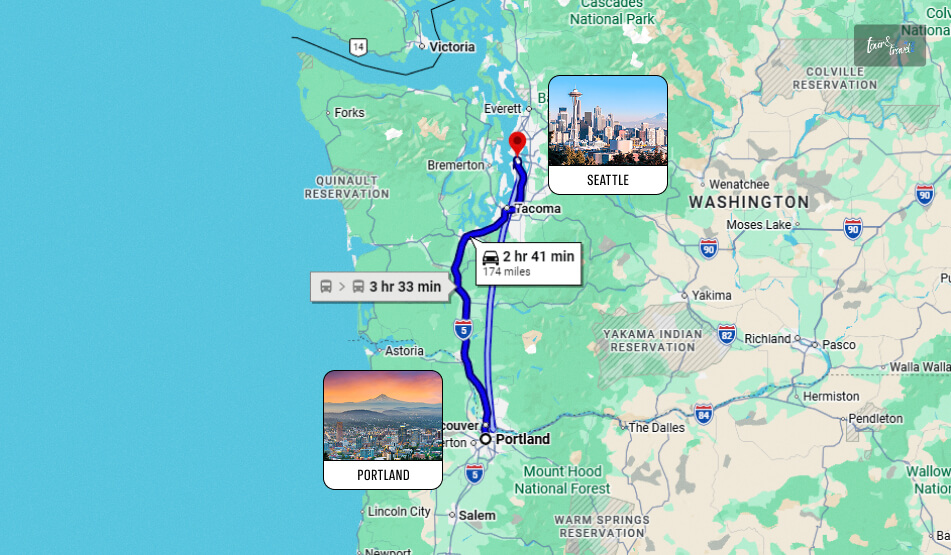
The distance between Portland and Seattle is around 174 miles or 280 km. Furthermore, the travel time between two destinations is around 2 hours and 45 minutes. 

Also, the main route to travel from Portland to Seattle is via Interstate 5 (I-5). 

However, the travel time between Portland and Seattle will depend on the mode of transport you choose. 

So, here is a quick summary. 

Portland to Seattle Modes of TransportTravel Time 
By Car2 Hours and 45 Minutes
By Bus3 to 4 Hours and 30 Minutes
By TrainAbout 3 Hours and 30 Minutes
By Rideshare About 3 to 4 Hours
By Air53 Minutes

Furthermore, the Portland International Airport is around 12 miles away from the city. Also, the Seattle-Tacoma International Airport is about 14 miles away from Seattle. 

So, consider the travel time to and from these airports by road. 

On the other hand, the Portland Union Station is 1 mile away from the city, and the King Street Station serves the Seattle area. From the train station, the Downtown and other main attractions are within walking distance. 

How To Travel From Portland To Seattle? 

How To Travel From Portland To Seattle

The fastest way to travel from Portland to Seattle is to take a flight. However, if you love TheLowDownUnder Travel philosophy and want a more local experience, you can also plan a road trip by car or take a ride share. 

Buses and train services are also available between these two destinations. So, here are the details.

1. How To Travel From Portland To Seattle By Car? 

Traveling the Portland to Seattle distance of 174 miles by car takes around 2.5 hours. The route through I-5 North is quite straightforward, and some important stops on the way are Washington, Olympia, and Tacoma. 

Furthermore, you start the ride early in the morning, before 7 AM. 7 AM to 9 AM and 4 PM to 6 PM are the busiest times on the route.

Also, there is an alternative route via US-101, which passes through Astoria to the coast. 

Nevertheless, based on the route you take and the vehicle you choose, the car rental price will be around $34 to $50.

2. How To Travel From Portland To Seattle By Bus?

Flixbus and Greyhound are the main bus services from Portland to Seattle. The bus services start from as early as 7 AM, and the last bus leaves Portland at 10 PM. 

The bus leaving at 10 PM is also the fastest, completing the journey in just 2 hours and 50 minutes. 

Furthermore, the buses leave from the Portland Curbside Bus Stop, and the popular drop stations are the Seattle Tacoma International Airport, Seattle Bus Station, and Seattle 6th Avenue S and S Lane Street. 

Moreover, the ticket price starts from 30.48 Euros.

3. How To Travel From Portland To Seattle By Train?

Amtrak runs seven daily from Portland to Seattle. Furthermore, the ticket price starts from $27. 

Also, check out the timings of the train from the Portland Union Station to the King Street Station in Seattle in the table below. 

DepartureArrival 
6:45 AM10:10 AM
8:30 AM11:50 AM
10:40 AM2:05 PM
2:10 PM5:37 PM
3:56 PM7:51 PM
5:55 PM9:20 PM
7:25 PM10:50 PM

4. How To Travel From Portland To Seattle By Flights?

As I have mentioned, the flights from Portland International Airport (PDX) to Seattle-Tacoma International Airport (SEA) take around 55 minutes. 

American Airlines and Delta Airlines are some of the popular services on this route. Furthermore, the ticket price will be around $350. 

Moreover, the travel time by road from Portland to the Portland International Airport (PDX) and the Seattle-Tacoma International Airport (SEA) is around 20 minutes.

5. Portland To Seattle Rideshare Or Taxi

Shuttle services such as Portland Express, Uber, and Lyft are other ways to travel from Portland to Seattle. 

Uber and Lyft services are a little expensive, costing around $60 for the ride. 

On the other hand, a ride on the Portland Express from Portland to Seattle will be around $50-$70 based on the vehicle and the group size. 

What Are The Important Stops From Portland To Seattle? 

Portland is one of the best family vacation spots, and Seattle is one of the safest places for women solo travelers

Furthermore, on the way, it has some wonderful attractions such as the Columbia River Gorge, the Oregon Coast, Mount St. Helens, Mount Rainier, and Tacoma. 

Also, throughout the journey, you will find small but wonderful cafes. Don’t forget to spend some time understanding the local vibes at these cafes.

Portland To Seattle: Frequently Asked Questions (FAQs) 

Here are the frequently asked questions and answers about the Portland to Seattle distance.

1. How Much Is A Train Ride From Portland To Seattle?

A train ride from Portland to Seattle starts from $27 and goes up to $68 for standard coaches. Furthermore, the ticket price for business coaches costs around $80 to $90. 
Moreover, the private room amenities come at $182. 

2. Is It Worth Driving From Seattle To Portland?

Yes, the Portland to Seattle journey is every bit worth it. It is an easy and quick journey, 
However, the short route offers the best experiences with various culinary stops, mountain views, and the beauty of the Pacific Northwest. 

3. Can You Do A Day Trip From Portland To Seattle?

Yes, you can easily plan a day trip from Portland to Seattle. The travel time by road is around 3 hours to 4 hours and 30 minutes. 
So, you can easily complete the ride, explore the attractions en route, and come back by evening. However, you have to start really early to avoid the traffic. 

Share on Social Media

Meet Sibashree Bhattacharya, a travel enthusiast who has a decade-long experience in transcending virtual barriers with her words! Her deep love for travel is apparent from her travel escapades to the mountain, often taking her readers on a journey, her words acting as Portkey! Fun fact: Sibashree loves to dive deep into the history of the places she is about to visit, making her travels even more wholesome. If you were wondering how her articles are not short of time travel, this answers it!

Leave a Reply

Your email address will not be published. Required fields are marked *

title-img Related

READ MORE Pecos National Historical Park

Welcome To The Pecos National Historical Park: The Land Of The First American Revolution

BY  Sibashree Sep 12, 2024

I stood before the remnants of the South Pueblo walls, looking over the Mission Church on an autumn day last year. Looking at the archaeological site and standing below the blue fall sky, I was transported to the time of the American Revolution.  Further, I could hear the noise of a bustling trade fair with people from the Pecos Pueblo community doing business. However, the historical importance of the park is much beyond its association with the American Revolution. It is also related to the Civil War in New Mexico and the Independence of Mexico.  So, with centuries of human history etched in every corner, the Pecos National Historical Park is an intersection of past tales and nature. To be honest, The Pecos Pueblo and Santa Fe Trail were the biggest highlights for me when I was at the national park.  Therefore, my ode to the park will start with brief accounts of these places. Then, I will talk about the Glorieta Pass, again a site of historical importance in the park. Finally, you will have a quick look at the park's wildlife.  Pecos National Historical Park: A Land Of Historic Wars And Revolutions  The history of human lives in the Pecos National Historical Park goes back to the Preceramic Period or the 11,500 B.C.E. - 600 C.E. However, the Pecos Pueblo site in the park became a prominent place in the history of the American Revolution in the Early Colonial and Pre-Revolt era.  Spanish people started interacting with the Pueblo people. Further, thanks to the Franciscan Missions, the Spanish rule wanted to have command over the economic life and beliefs of the Pueblo people.  Thus, the first seeds of the American Revolution were sown. To combat the oppression of the Spanish people, the Pueblo Revolt took place on 10th August 1680. As a result, the Spanish Government and Franciscan Friars were expelled from the southwest under the leadership of  Po’pay from Ohkay Owengeh. The Spanish Mission Church, built in 1625, was also destroyed in the revolt of 1680.  However, in 1692, the Spanish People further reclaimed the Pecos Pueblo and many other pueblos. Finally, the Pueblo people declined in numbers in 1700. Before, during, and after the first American Revolution, The Pecos Pueblo emerged as an important location with significant events around it!  Further, around 200 years later (1821-1846 C.E.), another site in the park, the  Santa Fe Trail, witnessed travelers, settlers, and everyone else passing through it. The trail was opened in 1821 after Mexico gained its independence from Spain.  The remains of Pecos Pueblo stood there! By the 1830s, the migration of the Pubelo people was complete, and everyone had shifted to the Pueblo of Jemez and continued their traditions.  Moreover, in 1862, there was the “Battle of Glorieta Pass.” On 26th March 1862, this battle between the Union forces and Confederates occurred at a 700 feet elevation.  The Pecos Pueblo Site Today  https://www.instagram.com/p/Cto5MWnS5Oa/ The rise of the Pecos Pueblo site occurred between 1350 C.E. and 1838 C.E. The Pueblo site had two units, the north and south, and could accommodate around 2000 people. Further, it had 1000 rooms. Therefore, Pecos Pueblo thrived as a busy trading center with trade fairs involving people from Rio Grande Pueblos, Plains Nations, the Gulf of Mexico, and the Pacific Coast. The flint arrowheads and shells found here explain the expansive stretch of the route.  Nevertheless, with time, Pecos Pueblo became instrumental in eliminating Spanish oppression and rule. Still, a drop in the trade, Comanche attacks, and diseases deserted Pecos Pueblo. By 1838 C.E., the last resident of the Pueblo had left and joined the Pueblo of Jemez.  Today, the site stands as a relic from the past. However, it is still equally important for archaeologists and historians.  The Santa Fe Trail  Do you know what the Santa Fe Trail marker near Kozlowski's Trading Post says? It says,  Santa Fe Trail 1822-1879 Marked by the daughters of the American Revolution and the Territory of Nex Mexico.  With the independence of New Mexico and the western territories becoming an annexure to New Mexico, the Santa Fe Trail became the route or passage to the westward movement. Naturalists, journalists, travelers, aspirants, traders, and others took this passage as part of the American expansion. Colonel Henry Inman’s “Stories of the Old Santa Fe Trail,” published in 1881, describes the trail well. If you are a history buff, you must read this book well before visiting the Santa Fe Trail today!  “Kozlowski’s Stage Stop and Trading Post” is the highlight of this trail. You can spend some time here to visualize travelers from the past catching some rest after a long journey through the trail. When on the trail, you can explore the remains of the Pueblo and the Mission Church. You can even consider taking a guided tour of the Forked Lightning Ranch.  Glorieta Pass Battlefield Trail  https://www.instagram.com/p/B9xRKctnb3M/ Important Details About the Glorieta Pass Battle1. Reason for Conflict: Union forces and Confederates wanted to control the Glorieta Pass Route through the Sangre de Cristo mountains and the main supply center (Fort Union) for the passage of soldiers and supplies. 2. Contenders: The Confederates, with volunteers from Texas and under the leadership of General Shipley and the Union forces led by Colonel Canby, and soldiers from Fort Union, New Mexico, and Colorado. 3. Battle Begins: March 26, 18624. Reinforcements: 27th March, 18625. Battle Resumes: 28th March, 18626. Battle Ends: 29th March, 18627. Casualty: Death of 375 People 8. Consequence: The Union forces defeat the Confederates as they fail to ruin the Fort Union. Further, the Union forces maintain complete control over Southwest America.  The Glorieta Battlefield Trail is a popular hiking destination today in Pecos National Historical Park. It is a roundtrip loop, and you will have to cover a distance of 2.25 miles to complete your expedition. Further, the unpaved or graveled hiking route makes it moderately difficult for the hikers. In addition, there is an elevation gain of 152 meters.  You have to drive for around 7.5 miles from the main visitor center of the park. You will need to collect a gate code from the visitor center, which is your access code, to open the locked gate in front of the trail.  As you walk through the forest trail, you get to know more about the Civil War in New Mexico. Many infographics are installed throughout the trail, telling you tales from the past. In addition, there are wayside signs and 14 trail markers to explain the history of the battle on this pass in detail.  More About Hiking The Glorieta Pass Battlefield Trail  Time: Around 1 hour Refreshments (Hikers’ Favorites): Pecos Burger at El Maria Bonita (With a lot of meat and a smoky green chilly flavor!) and Chips and Salsa, of course! The Trail Guide you collect from the visitor center already keeps you hooked on the site's history. Indeed, this trail is less about hiking and more about flipping through the pages of the American Civil War in Mexico.  Let’s Hear It From Other Visitors To The Park  “Really nice park. Easy to find and it is free! Inside the visitor center, they had a really great exhibit that followed the pecos overtime. It was super informative and brought a lot more meaning to the actual park. After looking around the exhibit, you can take the trail up and around the park and church. It's amazing that the walls are still there. The view around the park is also beautiful. We spent about 2 hours here.” - Isabelle M. “I really enjoyed this park. My husband didn't care for it but I think it's really amazing what is still here. He thinks it's all recreation and I can't say if it is or not but I know the current Pecos people don't see it that way. It's pretty awesome that it's free to visit and the visitors center has a little museum that's also free! The trail starts near the restrooms. We accidentally started it from the end. But who cares. We saw everything and I recommend checking it out. Native people history is really cool.” - Lydia G. Exploring Wildlife At The Pecos National Historical Park https://www.instagram.com/p/CA-hAl8nrUW/ This historical national park is a hub of wildlife with a 6,500-acre expansion of forests, rivers, grasslands, and streams. The table below enlists the species that call the Pecos National Historical Park their home.  MammalsElk of Northern New MexicoColorado Chipmunk DeerRock SquirrelBirds*Steller’s JayMountain BluebirdBald EagleFish and AmphibiansRio Grande ChubLongnose DaceRainbow TroutBrown TroutNew Mexico Spadefoot ToadWoodhouse ToadTiger SalamanderPlains Leopard FrogReptilesShort-horned LizardNew Mexico Whiptail LizardBull SnakesGarter SnakesPrairie Rattlesnakes You will find the Prairie rattlesnakes along the trails. So, please exercise caution and inform the ranger if you come across one on your way.  A Quick Glance At Some Important Information About Pecos National Historical Park You must quickly look at the important information available about Pecos National Historical Park before you set in. Location: San Miguel County, New Mexico Established: 28th June, 1965 Area: 27 km² Highest Landscape: Truchas Peak, 3990 Meter Visitor Center: Pecos National Historical Park Visitor Center How to Reach: Via State Road 63  Entry Fee: Free Best Time to Visit: Autumn (Early September to Mid October) Also read Why Include Whale Watching In Your LA Itinerary. From Cocktails To Kickflips: Must-Try Activities In San Diego. Kootenay National Park Or The Land Of Ice And Fire (Experiencing Nature’s Game Of Contrasts)

READ MORE most dangerous country in the world

Navigating The Unseen: Exploring The Most Dangerous Country in The World

BY  Abdul Aziz Dec 26, 2023

One of life's greatest pleasures is always traveling. In addition to looking for and visiting the safest places, it's critical to understand the risks and dangers that exist in different parts of the world. This article will talk about the most dangerous country in the world, emphasizing elements like political unrest, crime, and conflict. Travelers can use this information to make well-informed decisions about their foreign experiences. Most Dangerous Country In The World Some countries are known for their beauty. Some are known for their infrastructure and standards of living. And then there are some countries that are notorious for something that scares people away. Curious? If you want to know about the most dangerous country in the world, here they are: Syria Syria is one of the most violent countries in the world because of the devastation caused by the ongoing conflict. With multiple armed groups fighting for control of territory and resources, the nation has become a hotspot for violence and instability since the civil war broke out in 2011. The most recent devastating incident was the earthquake that struck Turkey and Syria in February 2023. Sadly, the earthquake killed over 50,000 people, leaving a terrible death toll. Significant damage affected 116 medical facilities because of the disaster, depriving a large number of people of access to essential medical care. Consequently, estimates suggest that 18 million people require immediate humanitarian aid. The World Food Programme (WFP) revealed that a startling 90% of Syrians were living below the poverty line and that at least 12 million of the country's remaining 16 million people were facing food insecurity. Yemen Yemen, which is one of the world's most dangerous travel destinations, stands on the southernmost point of the Arabian Peninsula. The nation is in a state of civil war since 2015, with different groups fighting for control of the government. As a result, it led to extensive violence, mass migration, and a humanitarian crisis that has left millions of people in need of immediate assistance. The danger facing tourists is increased by the rise in criminal activity in Yemen, which includes armed robberies and kidnappings. At 68.93%, its crime rate is also the highest in the world when compared to other nations. Major Yemeni tribes are involved in criminal activities like kidnapping and looting. They are highly armed and enjoy independence within their sphere of influence. Unfortunately, visitors run the risk of being abducted and abused by these tribes, and they might have to pay a large ransom to get them back. Traveling here is now risky and challenging due to the heavy rains and flooding that impacted most of the cities. Floods have damaged roads and bridges, making land travel hazardous and difficult. It is now impossible to drive in some areas due to completely washed-out roads and collapsed bridges. Over 11 million children in this country need humanitarian aid, with millions experiencing food insecurity and a lack of basic services, according to UNICEF. There are currently more than 540,000 under-five children suffering from severe acute malnutrition. Remarkably, one child dies from avoidable causes every ten minutes. Travelers to Yemen run a significant risk of becoming targets of extremist organizations. People frequently get caught in the crossfire of the protracted conflict. Afghanistan Afghanistan is the most dangerous country in the world, as per the Global Peace Index. This dubious distinction is a result of the nation's turbulent past, ongoing conflict, and high levels of violence. The country's high concentration of extremist groups is the most concerning factor. For more than twenty years, the Taliban, for instance, have been waging a bloody insurgency against the Afghan government. Many deaths of soldiers and civilians are attributed to them. The presence of other organizations like Al Qaeda and ISIS in the nation has exacerbated instability. Airports and places of worship are frequently the target of terrorist attacks, especially during holy seasons like Ramadan. Somalia Somalia has established a reputation as one of the world's most dangerous nations due to decades of anarchy and lawlessness. Devastated by hunger, piracy, and civil war, it is a place where anarchy is the norm. An offshoot of the infamous Al-Qaeda, the militant organization Al-Shabaab continues to terrorize the country by carrying out deadly attacks on both government forces and civilians. The situation has become worse, with rival clans and factions fighting for control in the absence of a stable government. The standard of living for the typical Somalian citizen is sub-par.  There is widespread corruption and a dearth of essential infrastructure. Enter this dangerous area with extreme caution. Iraq Iraq is a very dangerous country to visit and has experienced many difficulties over the years as a result of war and conflict. Despite their fall, the remnants of ISIS still represent a serious threat to Iraqi forces and civilians. In many regions of the nation, sectarian violence, assassinations, and suicide bombings continue to be commonplace. Both locals and visitors always feel like they're in danger. Complexity is increased due to the conflict between the autonomous Kurdish region and the central government. It has escalated hostilities and led to violence, further destabilizing the situation. Iraq's infrastructure has suffered greatly as a result of years of hostilities. With many businesses finding it difficult to survive, the economy is hit brutally. Read More: Is Costa Rica Safe For Visit For Travelling? Libya Numerous factors have contributed to the conflict, including the competition for control of the nation's enormous oil reserves. Since Gaddafi's downfall, a number of armed organizations and militias have seized control of various parts of the nation. The unpredictability and danger in Libya have increased due to the presence of extremist groups like ISIS. These organizations committed targeted murders and acts of terrorism. They are further destabilizing the nation and posing a challenge to the authority of any government. Naturally, the population of Libya has suffered greatly as a result of the ongoing violence. Many Libyans are struggling to make ends meet as a result of displacement, violence, and limited access to basic services. Numerous schools, hospitals, and other vital services are in poor condition. While progress was necessary, the United Nations and other international organizations have attempted to mediate a peace agreement between the opposing factions. Read More: Is Cabo San Lucas Safe? – Let’s Find Out! Sudan Following a January referendum, South Sudan gained independence on July 9, 2011. Even with the initial exuberance and expectations of a prosperous future, the nation has had difficulty preserving stability. Political power struggles and ethnic tensions have made matters worse since then. Since South Sudan's independence, President Salva Kiir and his former vice president, Riek Machar, have not gotten along. Their conflict over dominance turned into a civil war in December 2013, which displaced millions of people and killed thousands. Rape, murder, and the enlistment of children as soldiers are just a few of the horrific crimes that have occurred during the conflict on both sides. As a result, it ranks first on a list of the world's most dangerous nations. Famine and disease are widespread throughout South Sudan, making the country's humanitarian situation terrible. Over 7 million people in the nation require humanitarian aid as the UN has declared a famine in some areas. Journalists and relief workers have also been the targets of armed groups. Despite having an abundance of natural resources, such as gold, oil, and fertile land, South Sudan has not yet experienced prosperity from these resources. Instead, as various groups compete to control these resources, they have fueled even more conflict and corruption. There have been allegations against the government for mishandling these resources, with minimal advantages for the populace. Wrapping Up You can be sure that there are lots of welcoming and safe places to call home. Even though there is a chance of crime, terrorism, and natural disasters, a lot of daring travelers visit some of the world's most dangerous nations for the temptation of it. Intrepid people are always ready to take the risk, whether it's for employment, adventure, or giving back to their communities. Don't be afraid to see the world, but remember to stay prepared and cautious. If you have thoughts to share or questions to ask about the most dangerous country in the world, please leave a comment below. We would love to hear from you! Read Also: Heatwaves And Adventure: Traveling To The World’s Hottest Destination Crime And Caution: Navigating The Dark Side Of California’s Cities Hidden Gems: Unearthing The Best Things To Do In Nottingham

READ MORE denver to colorado springs

Denver To Colorado Springs Distance: An Overview Of The Ways To Travel

BY  Sibashree Mar 13, 2026

The “Mile High City,” Denver, can be a wonderful base if you are traveling to Colorado Springs. Both are wonderfully blessed by the Rocky Mountains and beautiful waterfalls. Furthermore, for adults, the things to do or the fun activities in Denver are diverse. Nevertheless, this time, it is about seeing beyond the hot springs in Denver and the Rocky Mountain National Park. In fact, it’s time to plan a trip from Denver to Colorado Springs, home to the Pikes Peak Cog Railway, Garden of the Gods, and the U.S. Olympic & Paralympic Committee. Furthermore, with a distance of less than 100 miles, these two cities are well-connected by bus, air, shuttle services, and smooth driving roads. Keep reading to know how to travel the distance. What Is The Denver To Colorado Springs Distance?  The distance between Denver and Colorado Springs is around 70 miles or 110 km. Traveling this distance by road via I-25 S takes about 1 hour and 10 minutes. However, you can also take a city-to-city bus or a bus shuttle. Moreover, you can fly from the Denver Airport to the Colorado Springs Airport. So, here is a summary of the travel time based on the modes of transport. Denver to Colorado Springs Modes of Transport Travel Time (Approx) Denver to Colorado Springs by City to City Bus 1 Hour and 15 Minutes Denver to Colorado Springs Shuttle Bus Service 1 Hour and 15 Minutes Uber or Lyft Services 1 Hour and 30 Minutes By Car 1 Hour and 10 Minutes By Flight (Excluding the Airport Transfers) 45 Minutes  So, taking a bus or a private car rental is the best way to travel from Denver to Colorado Springs. Thus, you can strike a balance between the travel time and budget. How To Travel From Denver To Colorado Springs? Have you decided to take a flight from Denver to Colorado? Or, have you booked an Uber service for the trip?  Know the best choices before preparing your itinerary. 1. Denver To Colorado Springs City-To-City Buses  Bustang is the best bus service from Denver to Colorado Springs. The Bustang buses start from the Denver Union Station, and the ticket price is just $13. Furthermore, these buses have free Wi-Fi and washroom facilities. Moreover, you can take the Flixbus services, and the ticket price starts from around $14. Unfortunately, the Regional Transportation District, or RTD, does not have a bus from Denver to Colorado Springs. 2. Bus Shuttles  Bus shuttle services are available from Denver to Colorado Springs. However, you must only opt for trusted options such as Grehound. Greyhound offers two bus shuttle services from Denver to Colorado Springs. Both buses depart from the Denver Union Station Bus Concourse and travel to Colorado Springs Tejon Park-N-Ride. One bus departs from Denver at 7 PM and reaches Colorado Springs at 8:30 PM. Furthermore, the ticket price is $35.98. On the other hand, the second bus departs at 8:10 PM and reaches Colorado Springs at 9:25 PM. The ticket price is $18.98. 3. Uber Or Lyft Services From Denver To Colorado Springs  If you are traveling from Denver to Colorado Springs for the first time, taking an Uber or Lyft service will be the safest option. An Uber ride to complete the trip takes around 1 hour and 30 minutes, and the travel price is $135. On the other hand, a Lyft ride for this route will cost you between $120 and $165. With Lyft, you can make a booking 90 days in advance. Also, consider a 2% surcharge for airport pickups and drops. 4. Traveling From Denver To Colorado Springs By Car  A car drive or ride in a rented car from Denver to Colorado is beautiful. The journey via Interstate-25 takes around 1 hour and 10 minutes to 1 hour and 30 minutes. However, this route can have the most notorious traffic on certain days, and then the travel time will shoot up to 2 to 3 hours.  Furthermore, from March to May, hailstorms are common in the area. So, when traveling in these months, choose a 4WD or a vehicle that has tires to withstand extreme weather conditions. Moreover, the road expansion on Interstate-25 has made the ride bumpy. Nevertheless, a car rental for this journey will cost you between $70 and $120. Also, if you follow traffic updates and find the I-25 route busy, you can opt for alternatives such as Highway US-85/CO-105, Highway 83, and CO-67. However, these are longer routes and can stretch your travel time by an hour or so. 5. Fly From Denver To Colorado Springs  The Denver International Airport is located at a distance of around 23 miles from Denver. However, it is not just an airport that serves Denver. It is often the choicest airport for travelers from other countries due to its mid-continent location. Furthermore, the Colorado Springs Airport is located around 12 miles away from the city. The flight duration between these two airports is around USD 120 to 670. The fastest flight on this route takes 45 minutes to complete the journey. Moreover, private cars, Uber, Lyft services, and buses are frequently available for airport transfers. Traveling From Denver To Colorado Springs: Tips To Remember March to May and September to October, or the spring and autumn seasons, are ideal for a trip from Denver to Colorado Springs. Especially, Denver is one of the best places to visit in December in the USA. Furthermore, if you want to bypass the traffic on this route, you must plan a trip before 7 AM or after 7 PM. Also, Friday afternoons are the busiest. So, avoid a car ride in those hours and check the traffic conditions on platforms such as the COtrip website. Moreover, if you find the I-25 route to be busy, you can take Highway 83, which runs parallel and usually has less traffic. Traveling From Denver To Colorado Springs: Frequently Asked Questions (FAQs)  Here are the frequently asked questions and answers related to the Denver to Colorado Springs trip.  1. Is It Better To Fly Into Colorado Springs Or Denver?  The better option to fly into between Colorado Springs and Denver airports depends on the part of Colorado you want to explore. For example, if you want to explore the northern part of Colorado and have cheaper and more diverse flight options, the Denver International Airport will be a better choice. On the other hand, the Colorado Springs Airport is ideal for the Southern Colorado attractions. 2. How Much Is The Train From Denver To Colorado Springs?  No passenger train runs between Denver and Colorado Springs.  However, you can enjoy a scenic train ride in the Pikes Peak Area on the Pikes Peak Cog Railway. This train passes through ethereal Alpine landscapes before it reaches its summit at 14115 foot. 3. Is There A Shuttle Between Colorado Springs And Denver? Yes, there is a shuttle service between Colorado Springs and Denver. Reputed names such as Greyhound offer shuttle bus services on this route. The travel time is around 1 hour and 15 minutes, and the ticket price is around $18.98 to $35.98.