Afternoon siesta is a cherished luxury where I come from. Thousand miles away, I did not expect to experience something similar in Chios, Greece. I was driving through Mesta, and the faint, sweet-spicy scent of mastic trees overtook me.
I noticed one strange thing! Not a single shop was open, and even the ATMs were closed, despite it being a weekday. Curious, I asked my guide, and he said,
“We loved our naptime in the afternoon. The shops are closed from 2 to 5 PM. We value our food and rest! There is nothing to rush!” This is the moment I felt at home in Chios.
Chios in the eastern Aegean was hit by one of the largest wildfires of recent times in June and August 2025. These incidents were a major blow to the mastic trees and the entire region, with many trees destroyed by the wildfire.
However, a few months down the line, Chios, Greece, is experiencing a positive rebound in its tourism landscape. Despite being a relatively new name compared to Santorini or the Amalfi Coast, it is gaining attention for its genuine charm.
Despite an increase in interest, the tourism model here is focusing more on sustainability. Also, it is avoiding mass tourism to preserve its cultural heritage.
In terms of accessibility, Chios is going to get a new airport very soon. Also, for hospitality, this eastern Aegean island depends heavily on family-run lodges.
Moreover, the island is capitalizing on its natural beauty and medieval villages to stay true to the official theme of “Experience Chios.”
Hi, in today’s blog, I will talk about the Chios, Greece travel guide that takes you to local artisan workshops, cooking classes, adventurous places, and more.
Exploring The Local Artisan Workshops And Experiences
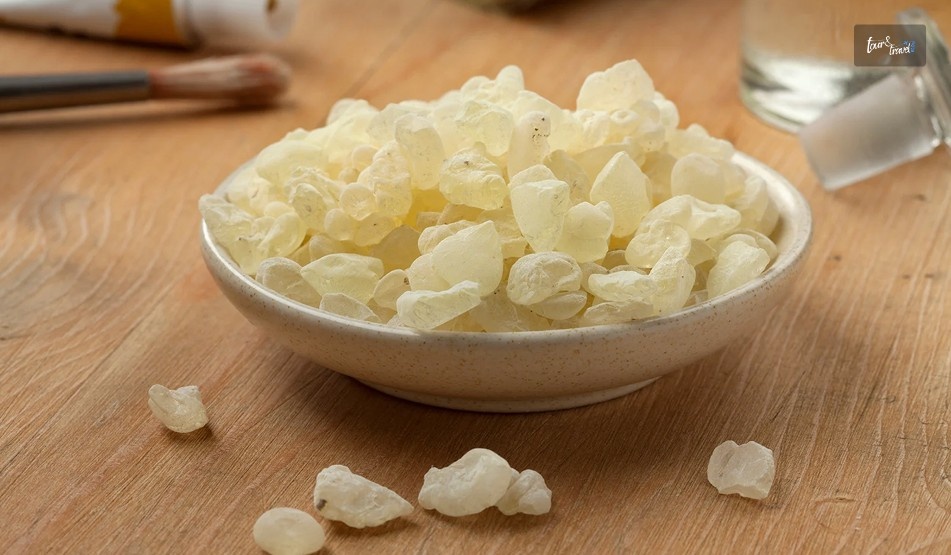
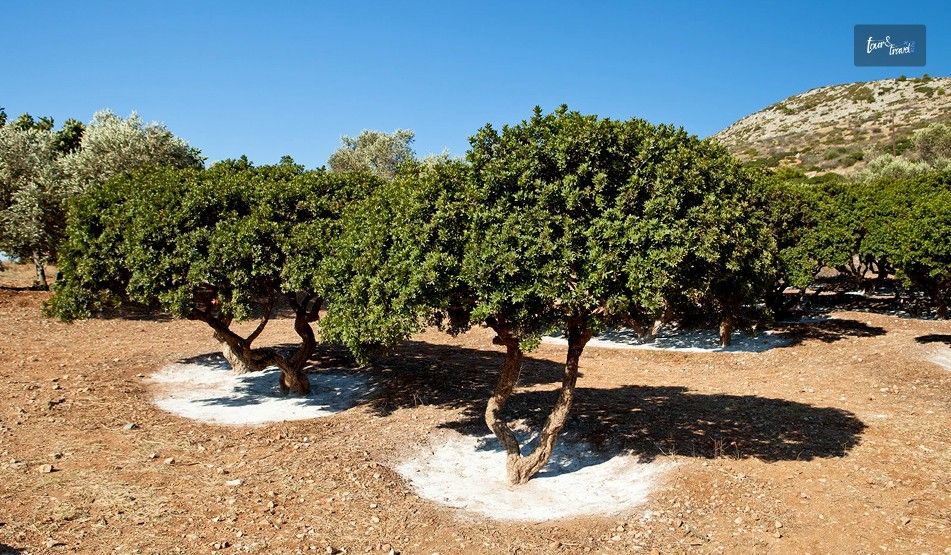
The mastic resin is the signature product of the region. The Pistacia lentiscus var. chia trees produce this resin. These are called the “tears” of Chios.
The aroma is faint, but it lingers just like the most beautiful melody of a flute. My mastic harvesting tour was already set, and the experience I had will stay with me forever. We talk about environmental protection and sustainability. The people of Chios practice it in their lives.
Nevertheless, along with the mastic harvesting tours, attending the weaving workshops, pottery classes, and distillation plants were the best local experiences in Chios. I also enjoyed my time at the local tavernas.
1. Mastic Harvesting Tours In Mastichochoria
Pyrgi, Mesta, or other villages in the south are ideal for farm tours. These have cooperatives and farms, where harvesting takes place during August and September. I was lucky to be in Chios in August.
The farmers here “wound” the trees so that they weep, and the tears are collected. Then, the tears are cleaned using a process called “Kefalari,” and watching the entire process is an immersive slow travel experience.
I talked to an old man in Mesta who was collecting the resin by hand. As I approached him, he said, “We treat the trees like family. If one dies, we plant another. We also pass on these trees to our future generations.”
Standing there, I could almost hear my grandfather, who used to say the same things about the trees he planted.
In Mesta and Pyrgi, I saw the soil getting hardened wherever the resin had fallen. Children love collecting those.
If you want to learn more about mastic harvesting in Chios, you can visit the Chios Mastiha Growers Association (CMGA). It now has around 4500 members from the 20 primary cooperatives spread across 24 villages.
2. Weaving Workshops In Pyrgi
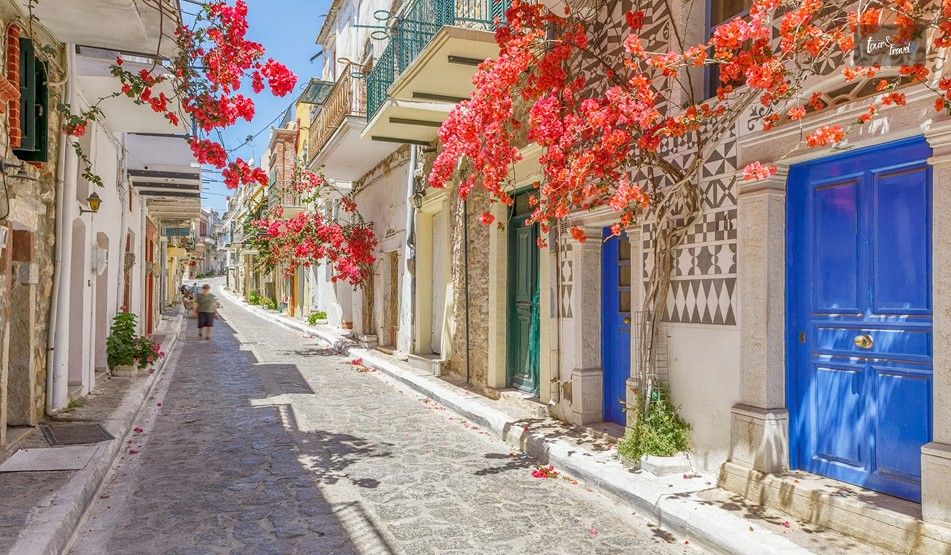
The houses in Pyrgi look wonderful, with distinct black geometric decorations. On some walls, I saw diamond shapes; others had stripes, and some even featured crisscross patterns.
There is also a personalized touch in these geometrical shapes. I was standing near a house appreciating the diamond-shaped designs on the walls. An old lady peeped, and I asked her whether she had done the design or not!
She started giggling like a little girl and said, “I have hidden the name of my husband in these diamond designs. It was a lot of fun when I asked him to spot his name for the first time.”
Once again, I felt that emotions are universal and the art of finding joy in little things.
The village also has a tradition of weaving. Explore the traditional looms and try your hand at the craft.
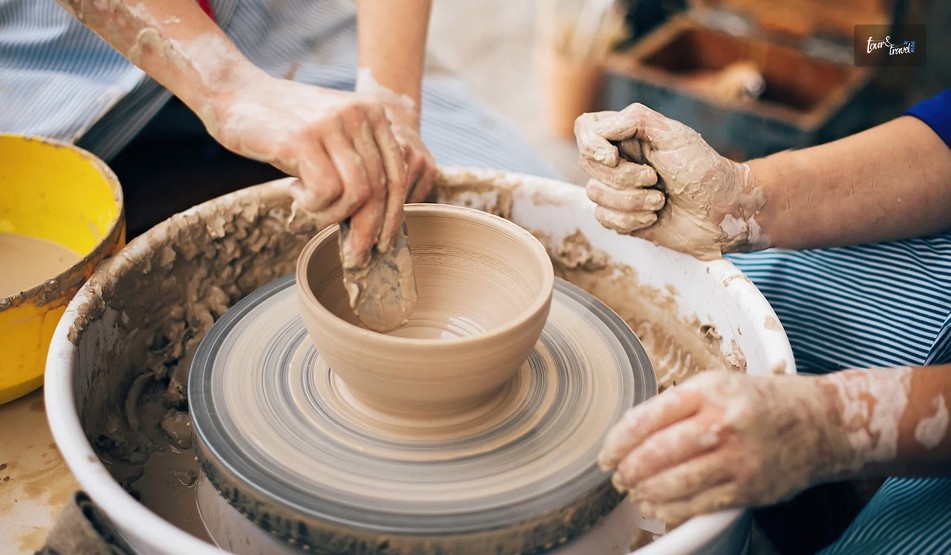
3. Pottery Classes In Armolia
Armolia is the epicenter of pottery traditions in Chios, Greece. It is like a kingdom of brightly colored ceramics. Kefalakia, a one-necked Chian ceramic jug, is a must-buy.
I tried my skills at a hands-on pottery class, and I must say that I was not so proud of what I made!
4. Soap-Making And Herbal Distillation
Chios has the best flowers and herbs. So, you will find many small family-run businesses here, including soap-making and herbal distillation. They also make local olive oil, mastic oil, and distilled water.
These small businesses have kept alive the heritage of natural wellness in Chios.
It may sound a little scary, but it was fun for me. Mesta is like a labyrinth, and exploring this fortified village was like a treasure hunt. Indeed, it was planned this way to confuse the pirates who wanted to rob the town.
After my dinner at the guesthouse, I wanted to take a quick stroll around, and after half an hour, I was clueless about the road to take.
The alleys twisted and turned until I stood before a stone archway and a dead-end courtyard filled with vines. I could listen to my footsteps on the cobblestone road, and after a few minutes, I sat on a rock.
Suddenly, something magical appeared before the eyes. The stars over the Aegean were unreal, and the absence of light pollution made it look like I could reach them by stretching my arm.
I cannot tell you how long I waited there, and suddenly a call from my guesthouse broke my trance. The receptionist asked me to wait for a while and sent a guide from the guesthouse to guide me back.
6. Eating And Drinking At A Local Taverna
Most tavernas I visited during my stay on Chios did not have a printed menu. That’s actually good, considering the menu is decided based on the fresh produce available on that day.
My guide used to ask “Ti echete simera?” or “What do you have today?” The waiter used to read from the list of items that were offered for the day.
Chios opened its first luxury wellness retreat, Pearl Island Chios Hotel & Spa, last year. Nevertheless, Chios has been celebrating its unique wellness tradition for years now.
1. Mastiha And The Herbs Of Chios
Furthermore, Chios has been harvesting mastiha for more than 2500 years, and this natural product has medicinal properties. In fact, this knowledge of cultivating mastiha has been identified as an Intangible Cultural Heritage of Humanity by UNESCO.
Mastiha gum has anti-inflammatory properties, it helps heal wounds, and it improves oral health and the digestive system.
However, mastiha is not the only herbal ingredient grown here. The region also has chamomile, sage, thyme, and oregano. Furthermore, Souma, a traditional fig-based spirit is a crucial element in the wellness tradition of mastic oil and mastiha, the signature of Chios.
2. Holistic Healing In Chios
The holistic healing facilities in Chios include meditation sessions near Mavra Volia beach. Furthermore, you can look for yoga retreats in secluded coastal villas and thermal spa visits in nearby Volissos.
Away from the crowd, the thermal spa visit near Amani was the ultimate rejuvenation for me after a busy day.
Cooking Classes And Culinary Tour In Chios, Greece
I visited a cafe called Citrus Memories inside an old estate near Chios town. They served a citrus drink made with local fruits grown in Kampos.
The juice was not very sweet. In fact, the hint of bitterness in the drink was the kick. The garden of the old estate had orange trees and stone walls around. So, it was like being in a different era.
The citrus smell of the oranges offered the most refreshing olfactory experience, while the sound of cicadas was somehow felt healing. This was one of the best experiences of food and beverage in Chios, Greece.
1. Mastic Liqueur Tastings
I tasted mastic liquor at a local taverna in Mesta. My guide told me that having the mastic liquor after food helps with faster digestion.
The one I tasted had just the right hint of anise. However, it did not overpower the drink’s citrusy finish. The texture of the drink was clean, and it cleansed my palate.
2. Cheese-Making Workshops
I took a guided tour of the Sinanis’ family’s traditional cheese workshop. You will notice a wonderful fusion of modern and traditional techniques in cheese-making. Furthermore, you will get to taste their cheese along with other local produce.
3. Traditional Bread Baking In Wood-Fired Ovens
Making bread in wood-fired ovens is one of the most cherished culinary traditions of Chios. I was fortunate enough to visit the Klossas bakery in the village of Volissos.
Started in 1955, it is still run by the same family. The setup still has a traditional setup without windows, and they bake a limited variety of bread.
4. Farm-To-Table Cooking Classes With Local Chefs
Many local chefs organize a farm-to-table cooking class using locally produced olive oil, citrus fruits, and seafood. I learned to make ipovrihio, a special sweet made using mastic. It is a flavored sugary paste served in cold water.
5. Festivals Celebrating The Food Of Chios
I was lucky enough to be in Chios in the month of August. I could attend many festivals celebrating the local food.
Festivals
Significance
Timing
Souma Festival
• Celebrates the Souma spirit made from figs
• Celebrated with local delicacies and traditional dance
• First two weeks of August
Mountain and Livestock Festival
• A three-day festival in Pityos
• Vendors selling local produce directly to the public
• July or early August
Amateur Fishermen’s Festival
• Celebrated in Mesta
• Kakavia, or fish soup, is served as part of the marine tradition
• August
Panagia Festival and Saint Markella Festival
• Food and drink are shared at the village square
• August and July, respectively
Moreover, festivals celebrating local saints, such as the Feast of Agios Ioannis the Theologian, are ideal for enjoying local food and beverages. Goat or hake delicacies are served at the end of the religious ceremonies.
Adventure Activities Beyond Hiking
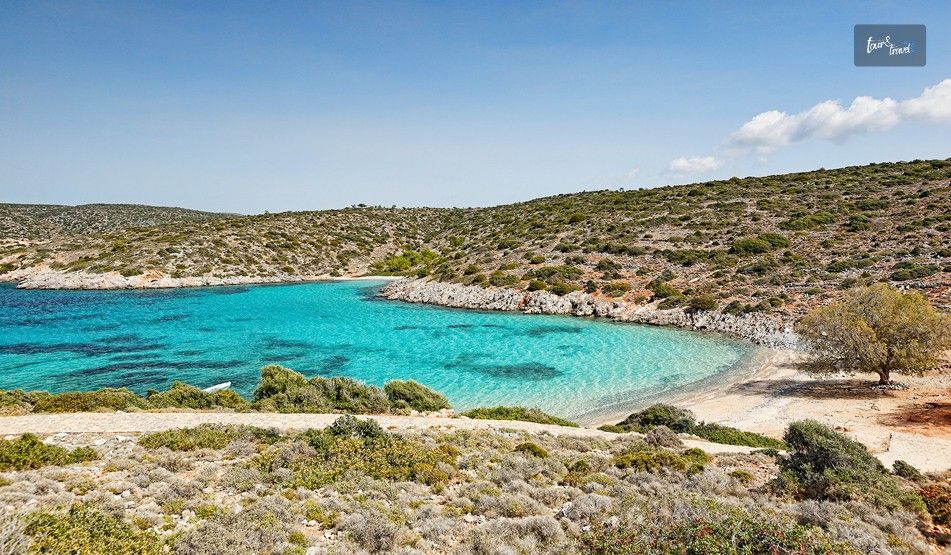
The diverse geography of Chios makes it an ideal place for nature walks and hiking. However, it offers many unique adventures. For example, swimming in the tiny coves near Vroulidia and Agia Dynami was the best experience for me.
I started swimming at Agia Dynami early in the morning. The water was so clear that it felt like glass. I could see schools of tiny fish flickering like silver confetti.
Also, after the swim, I went to the taverna up the hill. The owner there served grilled fresh sardines. The dog under the table, taking a nap, made the picture perfect.
Nevertheless, sea kayaking, rock climbing, cave exploration, and mountain biking are some adventure activities in Chios, Greece.
1. Sea Kayaking Along Volcanic Beaches
The southern coast around Emporios and Mavra Volia of the Black Pebble Beach is dramatic. The clear water here creates the perfect contrast with the dramatic volcanic beach.
I loved kayaking here and explored the surreal geological formations that we cannot reach on foot.
2. Rock Climbing In Kambia
Climbing the limestone cliffs in Kambia offers serious adventure. The crowd here is smaller. Also, you will enjoy the most amazing views of the Aegean from the cliff top.
3. Cave Exploration In Olympoi
Olympoi Cave is an active sinkhole. It has a unique geological formation surrounded by stalagmites and stalactites. It is a cooler retreat from the summer Sun, and every formation here tells the stories of the rich geological past of Chios, Greece.
4. Mountain Biking In The North
The Amani Forest and the northern mountain ranges have many trails challenging the skills of a mountain biker. As the biker winds through the pine forests, they get to see the panoramic views of the surroundings.
Hidden Historical Sites In Chios, Greece
If you are a history buff, you can explore the following locations in Chios, Greece.
Daskalopetra, or the stone formation at the center of this archaeological site near Vrontados, is said to be the birthplace of Homer. The ancient poet of the Iliad and the Odyssey.
Steeped in mythology, the place looks over the sea. It offers moments of quietude and looks the most beautiful during the sunrise hours.
• Anavatos Ghost Village
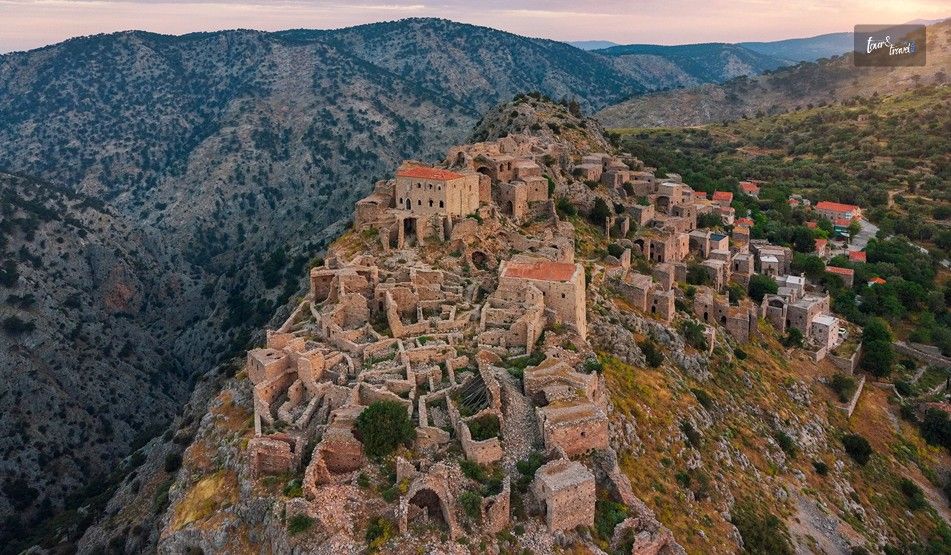
The location of the Anavatos Ghost Village on a sheer granite cliff itself looks surreal. Also known as the “Mistress of the Wind,: Anavatos has been lying vacant since the 1822 Chios Massacre.
I was walking through its alleys just before the sunset hours, and I felt history coming alive and the island celebrating its resilience at the same time.
• Phanai Archaeological Site
The Phanai Archaeological Site is at the southern tip of the island. It has the ruins of an ancient temple dedicated to the God Apollo.
This site does not receive many visitors. So, exploring the remnants of the Hellenic civilization was quite thrilling. The beautiful coastal views add to its appeal.
• Byzantine Churches
Everyone talks about the UNESCO-listed Nea Moni Monastery. However, in search of something lesser known but equally meaningful, I reached Byzantine churches in the mountain villages of the north.
These offer stunning iconography and architectural details, often overseen by a single, welcoming caretaker ready to share local lore.
Interactive Cultural Places In Chios, Greece
If you are traveling with your family, you can explore the following interactive cultural places. These are ideal for multigenerational tourists.
1. Chios Mastic Museum
Hours Open: 1st March to 15th October (10 AM to 6 PM) and 16th October to 28th February (10 AM to 5 PM)
Entry Fee: Standard Ticket – €3, Concession Ticket: €1.5, Free on Specific Days Such as 18th May, 5th June, and the Last Weekend of September
The Chios Mastic Museum celebrates the tradition of mastic production, an intangible UNESCO heritage. Located in the Pyrgi Village, the museum is inside an eco-friendly building.
This museum focuses on the uniqueness of mastic as a versatile product. Further, it shows how cooperatives have played an important role in the production of mastic products in the recent past.
Located in the north of the town center, Chios Castle used to be the fortified core of the town, starting from the Genoese period. Spanning over an area of 180,000 m2, the castle is still inhabited.
3. Giustiniani Palace
Inside the Chios Castle, the Giustiniani Palace was the headquarters of the Genoese administration. As a museum, it holds archaeological and art exhibitions.
4. Chios Archaeological Museum
Hours Open: 8 AM to 7 PM (Closed on Mondays in Winter) (Temporarily Under Renovation)
Entry Fee: 10€
The Archaeological Museum of Chios has art exhibits from the Neolithic period to the Roman era. Furthermore, sculptures from the Prehistoric settlements, coins, inscriptions, mosaics, and more are exhibited in the museum.
5. Chios Maritime Museum
Hours Open: 9 AM to 2 PM (Tuesday, Wednesday, and Thursday)
Standard Fee: €3.00
Concession Fee: €2.00
Nestled in a neoclassical building, Chios Maritime Museum celebrates the rich maritime history of the island. It has nautical artifacts and ship models.
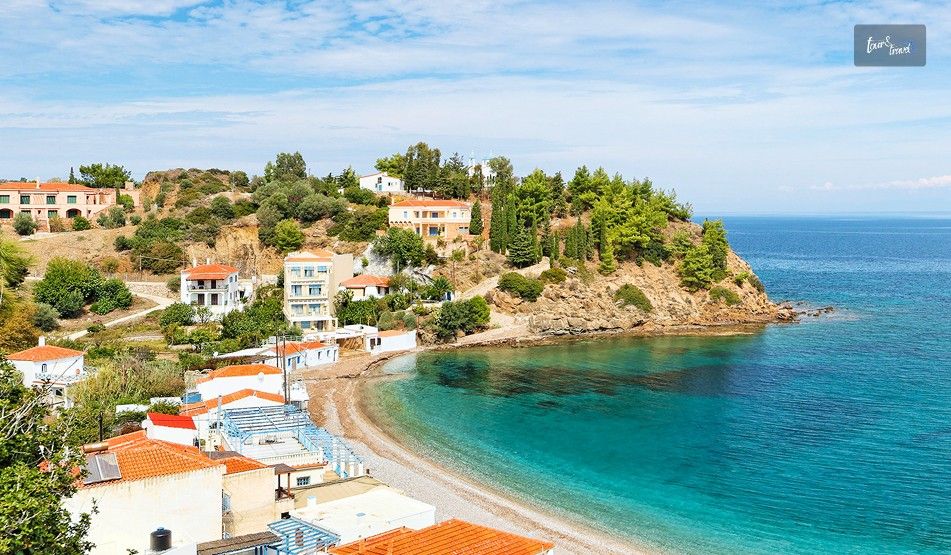
Beaches In Chios, Greece
Agia Dynami will always be my favorite with its calmness and the absence of any loud beach amenities.
However, Mavra Volia is a more touristy one, with its dramatic black pebbles and sapphire water.
Elinda Beach is another beach on the west of the island. It has a hidden cover, and it is famous for amazing sunset views of the Aegean.
A 5-Day Itinerary In Chios, Greece
They say that 3-4 days are enough in Chios. However, for me, even the five days I spent here were not enough.
This is how I spent the days.
Days
Activities
Day 1
• Mastic Harvesting Tour • Pottery Class in Armolia • Sea Kayaking near Mavra Volia • Attending the Souma Festival • Dinner at a Taverna
Day 2
• Early Morning Swim in Agia Dynami • Exploring Pyrgi and its Weaving Scene • Visiting the Mastic Museum • Visiting the Phanai Archaeological Site • Attending a Bread Baking Class
Day 3
• A Trip to Daskalopetra and the Byzantine Churches • Visiting the Chios Castle • Exploring the Anavatos Ghost Village before Sunset Hours • Feasting at the Amateur Fishermen’s Festival • An After-Dinner Stroll and Getting Lost in the Alleys of Chios
Day 4
• Visiting the Chios Archaeological Museum • Mountain Biking near Kambia • Attending a Soap Making ClassTaking a tour of the Sinanis’ Family’s Traditional Cheese Workshop • Back to Chios in the Evening • Thermal Spa Visit near Amani
Day 5
• Attending A Farm-to-Table Cooking Class • Collecting Olive Oil and Mastic Products • Off to the Airport
Things To Remember For A Trip To Chios, Greece
Here are some essential things you need to keep in mind for a trip to Chios, Greece.
Family Travel Tips
• Visit shallow beaches like Agia Fotini • Choose kid-friendly tavernas with playgrounds. • Visit interactive museums and farms
Eco-Tourism & Sustainability Tips
• Stay in an eco-lodge • Visiting the Amani Forest and its protected eco trails
• Sunrise at Daskalopetra • Sunset over Volissos Castle • Colorful alleys of Pyrgi • Black pebble beach of Mavra Volia • Panoramic views from Anavatos
How To Reach Chios, Greece?
You have to reach Chios by air or sea. Here are the details. Also, many people include Chios as an extension of the coastal tour of Turkey, which is just a 30-45 minute ferry ride away.
Nevertheless, here are the details.
By Air
• Route: Direct flights from Athens International Airport (ATH). • Airlines: Aegean Airlines/Olympic Air and SKY Express. • Duration: The flight takes only 50 minutes.
By Ferry
• Route: Piraeus Port (Athens) to Chios Town Port (or sometimes Mesta Port) •Operator: Primarily Blue Star Ferries. •Duration: 7.5 – 10.5 Hours.
From Turkey
•Route: Çeşme, Turkey to Chios Town Port. •Duration: An incredibly short 30–45 minutes by high-speed ferry.
Taking a car rental is the only way to explore Chios. However, if you drive, make sure that you can manage driving on the cobblestone streets.
What Is The Best Time To Visit Chios, Greece?
April to October is the best time to visit Chios, Greece. Furthermore, April to June is the ideal time for adventures, and July and August are the ideal time for mastic harvesting tours, hitting the beaches, and taking part in the festivals.
September onward, the crowd becomes less, and you can enjoy the beauty of the quiet autumn here till October. November onward, the island does not have many tourists, and many facilities also shut down during these months.
Budget For The Chios Trip
My trip to Chios cost me around $2000. However, that does not mean that Chios is a very expensive place. Here is a quick breakdown of the expenses.
Expenses
Cost
Flights
$1200
Accommodation for 4 Nights
$180
Food and Drink
$150
Local Transport
$75
Activities
$150
Total
$1755
So, get ready to experience offbeat Greece and the most authentic Chios. Kaló taksídi!
Here are the frequently asked questions and answers about Chios, Greece.
1. Is Chios A Nice Island?
Less than an hour away from Turkey’s coast, Chios is the fifth-largest island of Greece. It is a nice island with a pristine vibe and a rich heritage around mastic production, natural healing, pottery, and weaving.
Furthermore, its historical ruins have many stories to share about the vivid past of the island.
2. Does It Snow In Chios?
No, it does not snow in Chios because the air is typically around 62% humid. However, temperatures drop significantly in the months of January and February, and the temperature is around 6 to 12 degrees Celsius.
3. What Is Chios Food?
Chios food is an extension of what is available as local produce. So, you will find the use of citrus fruits such as mandarin, local cheese such as mastelo, fish, and mastic resin.
Furthermore, despite its distinct culinary heritage, food here shows an influence of the nearby Asia Minor.
Sibashree is a travel, culture, and leisure writer who has been writing since the age of 12 and professionally since 2014. With more than a decade of travel writing experience and journeys across India and several parts of the world, she brings a deeply personal and thoughtful perspective to her work. A student of English Literature and Mass Communication, Sibashree has always viewed travel as more than movement — for her, it has been a way of understanding people, cultures, and herself. Her passion for spiritual exploration has also led her to many unusual and meaningful destinations over the years. Outside of writing, Sibashree enjoys watching European cinema, reading about global politics, and reflecting on the stories hidden within everyday places.
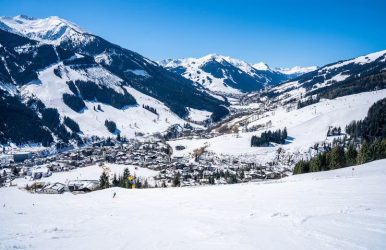
There's something magical about the snowy mountainside that can entice even the most reluctant of travelers to take a chance and experience the exhilaration of skiing. And when it comes to skiing destinations, few places compare to Les Deux Alpes in southeastern France.
In this article, we'll explore the top four reasons why you should visit Les Deux Alpes for your next ski break.
4 Reasons To Visit Les Deux Alpes During Ski Break
Situated right at the center of the French Alps, Les Deux Alpes offers breathtaking views, endless slopes, and an abundance of activities for all levels of skiers.
Reason 1: Extensive skiing terrain
One of the biggest draws of Les Deux Alpes is its extensive skiing terrain. With over 220 kilometers of slopes, skiers of all levels will have plenty of runs to choose from. From gentle beginner slopes to challenging black runs, there's something for everyone. The resort also offers off-piste skiing for the more adventurous skiers, with opportunities for heli-skiing and ski touring.
The resort is also known for its high-altitude skiing, with runs reaching up to 3,600 meters. This means that skiing is possible even in the late season, making Les Deux Alpes a popular destination for spring skiing. Don’t forget to book your ski pass at Erna Low in order not to waste your time waiting in long lines.
Reason 2: Great for families and beginners
While Les Deux Alpes offers plenty of challenging runs for experienced skiers, it's also a great destination for families and beginners. The resort has a dedicated beginners' area with gentle slopes and ski schools for all ages.
The ski institutes provide a range of lessons, from group lessons to private lessons, which is relatively easy for everyone to gain knowledge at their own speed. The resort also has a range of activities for non-skiers, including snowshoeing, ice skating, and tobogganing.
There are also child-friendly activities, like a sledding area and a snow garden, making Les Deux Alpes a great choice for families with young children.
Reason 3: Apres ski and nightlife
Les Deux Alpes isn't just about skiing - it's also one of the most awesome Alpine Apres-ski resorts. The resort has a range of bars, restaurants, and nightclubs catering to all tastes. Whether you want to enjoy a quiet drink after a day on the slopes or party until the early hours, you'll find something to suit your mood.
One of the most popular apres-ski activities in Les Deux Alpes is ice skating. The resort has a large ice rink that is open throughout the day and into the evening, making it the perfect place to unwind after a day on the slopes. There is also a range of restaurants and cafes around the rink, serving everything from hot chocolate to cocktails.
Reason 4: Stunning scenery
Finally, Les Deux Alpes is known for its stunning scenery. Located at the heart of the infamous French Alps, the resort offers breathtaking views of the surrounding mountains and valleys.
There is also a range of activities for those who want to take in the scenery, including snowshoeing and guided mountain walks. One of the most popular activities in Les Deux Alpes is a ride on the Jandri Express cable car.
Tips To Keep In Mind While Visiting Les Deux Alpes
Who doesn’t enjoy a holiday with their favorite set of people at Les 2 Alpes? The snow across the glacier and cannons surely make you refreshed and energized. But there are certain factors one should keep in mind while traveling to Deux Alpes.
Shortlist The Places You Wish To Travel
Visiting a ski resort is fun, but not everyone in your group will agree on a common plan. Different people would want to travel to different parts of the city. Hence, in order to avoid confusion and conflicts, prepare a list beforehand. Hand out the list of common places everyone will visit collaboratively to each group member. This way, each one of you can enjoy without worrying about individual interests.
Catalog Skiing Needs
People with their personal cars and ski equipment have no worries about storing the boards, skis, and shoes in their trunks. But what about the rest? They might want to try new skis. The skis technology never stands still- a titanium and carbon plate adds extra speed to the ski. Choose an all-mountain freeride ski if you wish to travel off-piste.
In case you are a technical skier, rent an additional sharp-carved ski. Maximum hotels have preset agreements and collaborated with ski rental companies offering extra discounts.
Check Out Fun Things To Do In Les Deux Alpes
It’s time to spice things up a bit. This step is also important to determine the individual interests of each group member. Les Deux Alpes offers everyone a range of entertainment zones. Check them out here:
Ice Glider
Who doesn’t love to drive bumper cars? But would you dare to drive them on icy ground? This activity might charge you around 5 euros for 5-6 minutes, and only two people are allowed in a single Ice Glider. Also, it is open from 4 pm to 10 pm on Thursdays.
Bowling
At 12 Place de L’Alpe de Venosc, you get bowling with six lanes. A maximum of 8 players in each lane can play, which makes advance booking highly significant. The cost is somewhere around five euros for each person in the game. There are also darts and air hockey, along with a minibar.
Wrap Up
Winter sports holidays are totally fun for your physical and mental well-being. And when you visit Les 2 Alpes, fun is guaranteed. Make sure you take note of the aforementioned tips to make your stay a pleasurable experience.
So, this was all about it. I hope you liked the article which guided you all the way through ski holidaying in Les Deux Alpes. Don’t forget to share your experiences with us. Happy reading!
Read Also:
Taco Bell Breakfast Hours: When Does Taco Bell Serve Breakfast?
You Won’t Believe The Best Things To Do When In Fiji!
Romantic Weekend Breaks Scotland
Amsterdam is one of the best family vacation spots in the world.
Well, the canals and bikes are legendary.
However, you also get something that you probably did not expect.
Amsterdam teaches you the art of slow traveling and the thrill of “doing nothing” as a tourist looking for meaningful and authentic experiences.
So, as a believer in TheLowDownUnder Travel, the capital of the Netherlands became my instant favorite.
Furthermore, once you reach Amsterdam, you find out that nothing is superficial about it.
Also, the layered history of the city keeps the intrigue alive.
Hence, you always want to come back to Amsterdam.
Hi, in today’s blog, I will talk about the things to do in Amsterdam.
Also, if you are in the Dutch capital for the first time, read my guide on Amsterdam travel tips before booking your tickets.
What Are The Things To Do In Amsterdam? (Beyond Ticking The Bucket List)
The Keukenhof Gardens in Amsterdam have all the credit for being one of the best places in the world to see flowers.
Furthermore, it is home to historical and cultural landmarks such as the Anne Frank House and the Van Gogh Museum.
However, the things to do in Amsterdam are not limited to exploring these places.
The real thing to do here is to soak in the history, culture, and livelihood of the city.
So, this is how I experienced Amsterdam.
1. Know A City Built On Water And Ambition
A UNESCO World Heritage Site, Amsterdam’s Canal Ring was engineered in the 17th century.
The 17th century was the Dutch Golden Age.
So, it is no wonder that Amsterdam was one of the most powerful trade hubs in the world then.
Till today, these waterways lined with tilting canal houses continue to be the backbone of daily life.
You can cycle along the banks like a local or enjoy your time in the houseboats, which bob quietly in the morning mist.
These also connect the neighborhoods.
Moreover, the city is very walkable.
The city centre has a series of concentric canals radiating outward from Central Station.
Also, most of the major attractions are within cycling or walking distance.
2. Explore Culture At Every Corner
The Rijksmuseum is the crown jewel in the cultural landscape of the Dutch capital.
Here, you can see all the great works from the Dutch Golden Age of painting.
Furthermore, it has works by Rembrandt and Vermeer.
A short walk away, the Van Gogh Museum draws visitors from across the globe.
On the other hand, the Stedelijk offers a strong programme of modern and contemporary art.
Are you looking for something more intimate?
The smaller canal house museums like Museum Van Loon or the Willet-Holthuysen give you a glimpse into how Amsterdam's merchant elite actually lived.
Then there's the Anne Frank House on the Prinsengracht.
It is a sobering and essential visit that tells one of history's most important stories within the very walls where it unfolded.
Book tickets well in advance.
Beyond the museums, Amsterdam rewards wandering.
The Nine Streets district is a tangle of independent boutiques, vintage shops, and coffee bars tucked between the Herengracht and the Prinsengracht.
The Jordaan neighbourhood, once a working-class area, is now one of the most charming parts of the city.
It is full of small galleries, brown cafés, and local markets.
3. Enjoy The Food, Drink, And The Art Of Doing Nothing
Dutch food has come a long way from its reputation for simplicity.
Amsterdam's restaurant scene now spans everything from Indonesian rijsttafel, a legacy of the country's colonial history, to outstanding French bistros.
It also has modern European tasting menus, and some of the best street-level snacking in Northern Europe.
Grab a fresh herring from a harbour stall.
Also, settle into a traditional brown café for a local beer, or book ahead at one of the city's many acclaimed restaurants.
The café culture here is worth embracing fully.
Amsterdam's brown cafés, or bruine kroegen, are warm, unhurried spaces designed for long conversations and slow afternoons.
They are as much a part of the city's identity as the canals.
Where To Stay In Amsterdam? Choose Ambassade Hotel
Are you looking for accommodation that feels like an extension of the city itself?
Then, the Ambassade Hotel on the Herengracht is a natural choice.
1. Live The History And Enjoy The Art
It is spread across 16 historic canal houses that date back to the 17th century.
So, a stay here gives you the chance to be a part of the city’s history.
Also, most rooms here look over the Herengracht canal.
So, you can enjoy the streetscape of the city.
Furthermore, this hotel has a rich legacy in the field of Dutch hospitality.
It has been welcoming guests since 1953.
So, the moment you step into this hotel in Amsterdam, you get that whiff of history and feel the warmth.
Moreover, this hotel was an informal art gallery for me, as it has decorations with works from the CoBrA art movement.
Artists from Copenhagen, Brussels, and Amsterdam founded this bold post-war avant-garde school.
2. Check Its Vast Collection Of Literature
This Amsterdam hotel is also famous for its connection to literature.
So, it can be a favorite stay for dark academia fans.
Furthermore, writers and intellectuals have loved gathering here since the 1980s, and it has a Library Bar housing more than 5000 books.
Moreover, each book is signed by an author who stayed here.
So, this Dutch hotel is not just a place to stay. It is a destination in itself.
3. Indulge In The Cuisine
The Brasserie Ambassade serves French-inspired cuisine seven days a week.
Moreover, if you want to explore the city more deeply, you can also join the private tours offered.
These tours cover Amsterdam's art, architecture, and canal history.
Choose A Stay That Gives You The Ease To Explore
Staying at The Ambassade Hotel gives you the freedom to explore the city at your own pace.
It is located at Herengracht 341.
So, this hotel is located within walking distance of the major attractions in the city.
Moreover, booking directly via ambassade-hotel.nl gives you the best available rate.
You can get up to 15% lower than third-party platforms, along with seasonal offers and the possibility of a complimentary room upgrade.
Overall, Amsterdam is a city that rewards travelers who take it slow and yearn for authentic experiences.
Hence, staying at a place that is imbued with the city’s character is very important for a perfect vacation.
My trip to Kotor, Montenegro, is filled with memories of the cats, who are the guardians of the city, and the smell of dew-drenched leaves as I went for a sunrise hike.
It is a hidden gem in the sustainable tourism scene after a successful sustainability assessment by the Global Sustainable Tourism Council (GSTC).
However, it has also emerged as the ultimate budget-friendly location in Montenegro.
In this blog, I will discuss a 3-day travel itinerary for Kotor, Montenegro, including hidden gems and essential tips.
Why Visit Kotor, Montenegro?
The International Trade Administration has confirmed that the tourism sector in Montenegro contributes 30% to the country’s GDP.
In addition, ReportLinker predicts that the number of visitors to Montenegro will reach 3.4 million by 2028.
The same report anticipates that the tourism industry will reach a revenue of $95 million by 2028.
A UNESCO World Heritage Site, With Great Food, Community, Beauty, And Historical Charm
Kotor, a UNESCO World Heritage Site, is the crown jewel of tourism in Montenegro.
The deep bay waters here resemble the Nordic fjords.
On the other hand, the coastal cliffs create the perfect backdrop for the city, exuding a medieval charm.
Now, Kotor and Montenegro as a country are planning to diversify their tourism portfolio, with a greater focus on cultural, ecotourism, and rural tourism.
In addition, the budget-friendly hostels in Kotor are more than cheap accommodations.
They are the base for developing a backpackers' community.
Many of these hostels help you join pub crawls, hikes, local events, and more.
As a result, Kotor, Montenegro, has become a favorite among backpackers, budget travelers, and solo travelers.
In addition, the rugged beauty of the Dinaric Alps meets the calmness of the Adriatic Sea in Kotor, Montenegro.
So, every nook of Kotor is ideal for a photo-op.
Moreover, for me, exploring the maze of medieval lanes and the Venetian architecture was like time travel.
Also, St. Tryphon’s Cathedral, dating back to the 12th century, stands as the eternal witness of human history in Kotor.
Furthermore, the family-run taverns here serve the most delicious yet simple food at an affordable price.
Try the savory pastries!
What Is The Best Time To Visit Kotor Montenegro?
July and August are the peak months for visiting Kotor, Montenegro.
However, if you want to travel to Kotor, Montenegro, on a budget, you need to plan a trip between November and February.
You will enjoy watersports and skiing in these months, and accommodations are available at a much more affordable price.
How To Get To Kotor & Move Around On A Budget?
The Tivat Airport, 7 km away, is the gateway for Kotor to the rest of the world.
You can travel this 7 km distance by road.
Other nearby airports to Kotor, Montenegro, are Dubrovnik Airport (Croatia, 44 km) and Podgorica Airport (40 km).
In addition, Podgorica and Kotor get regular flights from countries such as Bosnia, Serbia, and Croatia.
Once you reach Kotor, you can explore the city and its surroundings by boat.
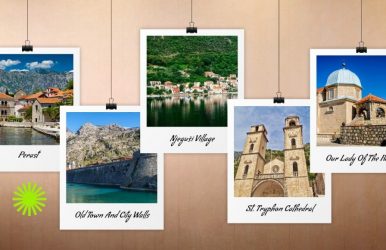
Don’t miss Perast on the route, as this village has fewer than 300 people, and it stands out with amazing scenic beauty.
Taxis, shuttles, and car rentals are other options if you want to explore Kotor by road.
3-Day Budget Itinerary For Kotor, Montenegro
Here is a brief 3-day budget itinerary for Kotor, Montenegro.
I will first share the days and activities, and then discuss why these attractions are special.
DaysActivitiesDay 1 - Exploring Kotor Old Town• Wandering through cobblestone streets.• Visiting St. Tryphon Cathedral.• Climbing the City Walls for panoramic viewsInsider Tip: Visit the City Walls early for a discounted entry. Day 2 - Visiting Perast & Our Lady of the Rocks• Taking a local bus to Perast.• Boat ride to the iconic island church.• Enjoying budget-friendly seafood at a local konoba.Day 3 - Visiting Lovćen National Park & Njeguši Village• Hiking or taking a shared taxi to Lovćen.• Visiting Njeguši for a traditional prosciutto and cheese tasting.
1. Exploring Kotor Old Town And City Walls
Here are some interesting and unknown facts about Kotor Old Town and City Walls.
•The Old Town's fortification system stretches 4.5 km.
•So, it is one of the longest fortification systems in Europe. It is only surpassed by the Great Wall of China.
•You have to climb 1350 steps to reach the San Giovanni Fortress.
•The entry fee is €8. However, you can also take the secret route via the old trade path outside the northern gate. It’s free.
•The Sea Gate Inscription above the main gate is a quote from Tito: “We don’t want others’, we don’t give our own”, commemorating liberation from Nazi occupation in 1944.
Furthermore, the Pillar of Shame, hidden in a square, reminds us of a brutal activity in the city in the past.
Criminals were tied to this pillar, and everyone used to throw stones and rotten food at them as a mark of punishment.
2. Visiting St. Tryphon Cathedral
•Built in 1166, the St. Tryphon Cathedral is even older than the Notre Dame Cathedral in Paris.
•It is one of the most ancient cathedrals on the Adriatic Coast.
•The cathedral has a 14th-century ciborium, which depicts the life of St. Tryphon. It is made of a red stone from Đurići.
•The goldsmiths of Kotor made the golden altarpiece of the cathedral in the 15th century.
•It has the figures of Christ, the Virgin Mary, and 16 saints.
•A devastating earthquake struck Kotor in 1667.
•Then, the bell tower of the cathedral fell, and it could not be rebuilt fully.
•Thus, the current cathedral structure is 2 meters shorter than the original one.
In 2009, the St. Tryphon Cathedral got the status of a Papal Basilica.
It is a rare honor for churches in the Balkan region.
3. Visiting Perast
•The 2-km-long main street of Perast was once a cultural hub during the days of the Venetian Republic.
•The bell tower of St. Nicholas Church was built at a cost of 50000 Ducats in the 18th century.
•It was an unbelievable amount in that era.
•Perast once stood as a reflection of the wealth in the Venetian Era. It had 16 palaces and 19 churches.
4. Knowing Our Lady Of The Rocks
•Rocks have piled up for centuries.
•Also, those rocks, along with sinking ships, have formed Our Lady of the Rocks, the only artificial island in the Adriatic Region.
•The Fašinada festival is a popular ritual here, with its history dating back to 1452.
It is a tradition to celebrate the island's foundation.
Every 22nd July, the people of the island gather in decorated boats, and they throw stones into the sea as a symbolic exercise.
•Furthermore, the Catholic church here has a tapestry made by Jacinta Kunić-Mijović.
It was made using human hair, and Jacinta Kunić-Mijović made this tapestry while waiting 25 years for her fiancé to return from the sea.
•The church also has the Death of the Virgin.
It is a masterpiece by Tripo Kokolja.
In total, the church has 68 paintings by Tripo Kokolja.
5. Visiting Lovćen National Park
•The Njegoš Mausoleum at Jezerski Vrh is one of the main attractions of the Lovćen National Park.
Located at an altitude of over 1,660 meters, it is allegedly the highest mausoleum in the world.
•200,000 Gilded tiles cover the dome of the mausoleum, and 13-ton granite statues of Montenegrin women guard the entrance of the national park.
•Once you climb 461 steps and reach the top of the Mausoleum, you will enjoy panoramic views stretching toward Italy.
6. Exploring Njeguši Village
•It is the cradle of the royal Petrović-Njegoš dynasty of Montenegro.
This family ruled over Montenegro from 1696 to 1918.
•Furthermore, it has the birthplace of Petar II Petrović Njegoš and has many other 19th-century buildings.
The birthplace of Petar II Petrović Njegoš is now a museum housing the first edition of his poem, Mountain Wreath, and original furniture.
How Much Does A 3-day Trip To Kotor Cost On A Budget?
Here is a detailed breakdown of the budget for a 3-day trip to Kotor, Montenegro.
CategoryBudget Cost (EUR)DetailsAccommodation (Hostel)€15–€25 per night, meaning €45–€75 for 3 nightsHostel prices are even lower from November to FebruaryLocal Transportation€6–€12 total• Local buses (€1–2 per ride). • Short taxi/shared rides within the bay (€3–5). • Free walking inside Old Town.Airport Transfers€8–€15 each way, meaning €16-€30• Airport transfer from Tivat is the cheapest.• From Dubrovnik/Podgorica, it will be at least €20-€35. Food (Budget Travelers)€15-€25 per day. So, it will be €45 to €75 in total. Choose Konobas & bakeries: • Pastries (€1–2)• Seafood Meals (€7–10)• Wine/Beer (€2–3)Activities and Entry Fees€20–€35 total• City Walls (€8, discounted early)• St. Tryphon Cathedral (€3)• Perast boat (€5–10) • Lovćen shared taxi/hike (€5–10)Day Trip to Perast & Our Lady of the Rocks€7–€12• Bus to Perast (€1–2), boat (€5–10)Lovćen National Park Day TripFree–€10• Free if hiking; €5–10 for shared taxi. • Mausoleum entry ~€5.Miscellaneous (water, snacks, souvenirs)€10–€20• Refillable water recommended•Collect small souvenirs €3–5.Total Estimated Budget for 3 days €139–€239• This is a cost breakdown for budget travelers. However, the budget for mid-range and luxury travelers will be different.
Day Trips & Hidden Gems Near Kotor
Gornji Stoliv: It is a quiet coastal village.
Vrmac Ridge: You will enjoy this scenic hike, and it is less crowded.
Church of Our Lady of Health: This chapel has a serene ambiance, and because of its location on a hilltop, it is often overlooked by tourists.
Vrmac Ridge: It is famous for the WWII bunkers, and it offers a beautiful panoramic view.
Blue Cave: It is a natural wonder of Kotor, Montenegro, and this natural sea cave has the most beautiful sapphire light and glow. You can reach the cave only by boat.
Secret Wine Bars: These secret wine bars are in the alleys of the Old Town.
These places serve the best rakija and Montenegrin wines.
Final Tips For Your Montenegro Getaway
Kotor, Montenegro, gets busy in the summer season.
Furthermore, early mornings are the busiest, with the cruises docking in large numbers.
Also, there are some tips about the weather and travel you need to keep in mind.
Carry offline maps, as network connections may not always work.
Keep cash and small coins ready, as card transactions may not be accepted in local shops.
You must start hiking the steep route of the San Giovanni Fortress early in the morning to avoid the heat.
Use local buses for transportation, as they cost only €1–2 per ride.
Evenings are cool even in the summer season. So, you will have to pack layered clothes.
Dress modestly in churches, avoid loud behavior in Old Town squares, and learn basic Montenegrin greetings like “Hvala.” meaning Thank you.
Choose konobas or local taverns for breakfast, lunch, and dinner. They are way more affordable than the posh restaurants in the Old Square.
Kotor Montenegro Travel Itinerary For 3 Days: Frequently Asked Questions (FAQs)
Here are the frequently asked questions and answers about the Kotor, Montenegro travel itinerary.
1. Is Kotor, Montenegro, Worth Visiting For 3 Days? Yes, three days are perfect to explore Kotor Old Town, Perast, Lovćen National Park, and enjoy hidden gems without rushing.The budget for your three-day trip in Kotor will be around €139–€239, and Kotor is safe for solo travelers if you follow the basic travel precautions. 2. Can I Visit Kotor On A Day Trip From Dubrovnik? Yes, you can visit Kotor on a day trip from Dubrovnik. However, if you want to at least try its best food and soak in the vibe of the Old Town, you must plan for an overnight stay. 3. Do I Need A Visa To Visit Montenegro? If you are from the USA or a country that is part of the European Union, you will not need a visa to visit Montenegro. If you are from any of these countries, you can enter Montenegro and stay there for 90 days without a visa. You must check the visa requirements of your country. 4. Are There Budget-Friendly Accommodations In Kotor? Yes, the guesthouses in Dobrota and hostels such as the Old Town Hostel Kotor are some of the most budget-friendly accommodations in Kotor, Montenegro. The hostel prices will be around 15-25 Euros per night. 5. What Are The Must-Try Local Foods In Kotor? Kotor is famous for its seafood, and you can have it at local taverns or konobas. Furthermore, if you are in Njeguši, you must try prosciutto, a dry-cured ham with a lot of flavors. Moreover, burek, or the savory pastry, is the highlight of the delicacies of Kotor. 6. Do I Need To Rent A Car In Kotor? No, you don’t need to rent a car in Kotor, Montenegro, if you are a budget traveler. Local buses and shared taxis are easily available, and they are even suitable for day trips to Perast and Lovćen. Otherwise, you can take the boat rides, which are also quite affordable.







 Related