


What Are The Best Japanese Shrines To Visit? Celebrating Nature Spirits And Inherent Spirituality

I am eager to engage with the traditional cultures of Japan through my visit to Japanese shrines.

When you walk right through the enormous torii gate, something almost magical happens to your inner being.

Leaving the hectic modern life behind, you enter a space where time appears to move at a different pace, and that is when you experience a certain tranquility.

Situated in a Japanese Shinto shrine are rich traditions and a belief system that make the shrine a very sacred place.

Moreover, the shrine is the perfect place to practice and get some understanding of the age-old Shinto rituals.

Along with that, every visit to a Shinto shrine, I take a whiff of the smell of burning incense or cedar, or just have a glance at the bright red cedar floor in the forest, and each time I get a different insight into how primitive communities have transformed the land.

Although it is really tough to designate the best Japanese shrines to visit, I would like to show you the ones that left a deep impression on me. You can visit most of these shrines on a day trip from Tokyo.

But before that, let’s talk about the Shinto religion in Japan and what makes Shinto shrines so priceless.

The Shinto Religion In Japan: A History Rooted In Nature

Shinto is an indigenous religion of Japan and is the oldest form of worship in Japan. 

It differs from most Western religions in that there is no central text for Shinto, nor is there a single historical founder of the faith. 

Rather, Shinto grew out of the relationship that early Japanese people had with the land and their environment. 

While Shinto is less about trust through a prescribed belief (or doctrine), it is more about lifestyle, and in particular, how to live life in harmony with nature.

1. The Core Belief Of Kami

At the heart of Shinto lies a philosophy of the universe where various forms of nature (of the divine) are inhabited by divine spirits known as kami (in Shinto). 

The kami can take on many different forms, from mountains, trees, rocks, and waterfalls to winds, rains, fertility, and much more. 

Furthermore, in Shinto, people believe that after humans die, they become kami themselves. 

As a result, it is a profoundly beautiful and cyclical view of existence where our forebears continue to be present with us to influence and guide our lives in the landscape we live in today.

2. Rituals, Offerings, And Evolution At The Best Japanese Shrines To Visit 

Shrines are where kami (gods) receive worship from believers in Shintoism. 

Because kami can be both good and bad for human beings. So, people can make offerings in hopes of receiving blessings from them. 

Shinto uses purification and prayers as a method of avoiding bad kami through Shinto rituals. 

There are no founders, no scriptures, or no absolutes in Shintoism, and it has no preaching or strictures. 

Instead, Shinto relies on time-honoured traditions to help ensure the spiritual well-being of its followers, or for them to receive good fortune.

As a matter of fact, Shintoism was Japan’s official religion from the 1870s until the 1940s. 

It was officially separated from Buddhism at that time. Shintoism continues today to be an important part of Japanese culture and exists amicably with Buddhism.

What Are The Features Of The Shinto Shrines To Visit In Japan? 

Shrines are places where worshippers come to honor the kami. 

If you are staring at a map or walking on a street, you can recognize these locations by their shrine-related words.

Shinto shrines in Japan end in –jinja, –jingu (this one is reserved for Imperial shrines), or –taisha. 

As I travel to a new town, one of my favourite things to do is try to find these suffixed words, as I know there are shrines nearby, and I have a quiet place to relax.

1. The Types Of Shinto Shrines 

Each type of Shinto shrine has a different spiritual purpose to accomplish. In the table below, I have tried to divide the shrines into different categories. 

Types of Shinto ShrinesWhat They Mean
Imperial ShrinesHistorically funded and overseen by the government.
Sengen ShrinesDedicated specifically to the deity of Mt. Fuji
Inari ShrinesThese are for the kami of rice and prosperity (easily spotted by fox statues).
Tenjin ShrinesThese shrines worship the kami of Sugawara Michizane, a famous scholar and politician.
Hachiman ShrinesDedicated to the kami of war and protection.

2. Distinct Architecture Of The Shinto Shrines 

Torii gates are the easiest and most recognizable way to mark Shinto shrines. 

These gates are entrance accessories to the shrines, and are usually made of wood painted in the color combination of bright orange and black.

Although some can be made of stone. 

After the gate, you will find the worship hall (haiden), where you can offer prayers.

Furthermore, the main sanctuary (honden) is the most sacred. 

Also, you will see shimenawa or sacred straw ropes and komainu or guardian lion-dogs in the architectural features of the shrines. 

Moreover, ema are small wooden plaques where visitors express their innermost desires to the gods and hang them to be read.

What Are The Best Japanese Shrines To Visit? 

There are about 80,000 Shinto shrines in Japan.

However, based on the shrines I have visited, I have made choices of which I consider to be the most attractive places to visit for any traveler.

1. Fushimi Inari Shrine, Kyoto 

Fushimi Inari Shrine, Kyoto

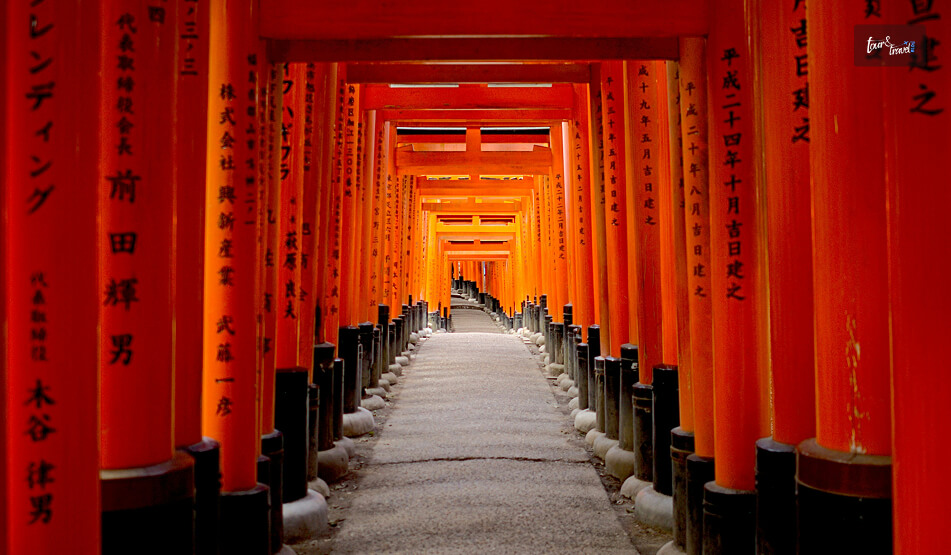
Probably the most widely recognized image of Japan is Fushimi Inari Shrine. 

It is well-known for its thousands of vermillion torii gates “tunnel” that lines the 4 km track going up Mount Inari. 

Being the main shrine of all shrines, Inari, the god of rice and sake, is deeply significant. 

I advise you to hike a bit more on the mountain.

The lower section is very crowded, but the upper trails have a serene atmosphere where you can enjoy the fox statues of the deities in an unhurried manner.

2. Meiji Shrine, Tokyo

Meiji Shrine, Tokyo

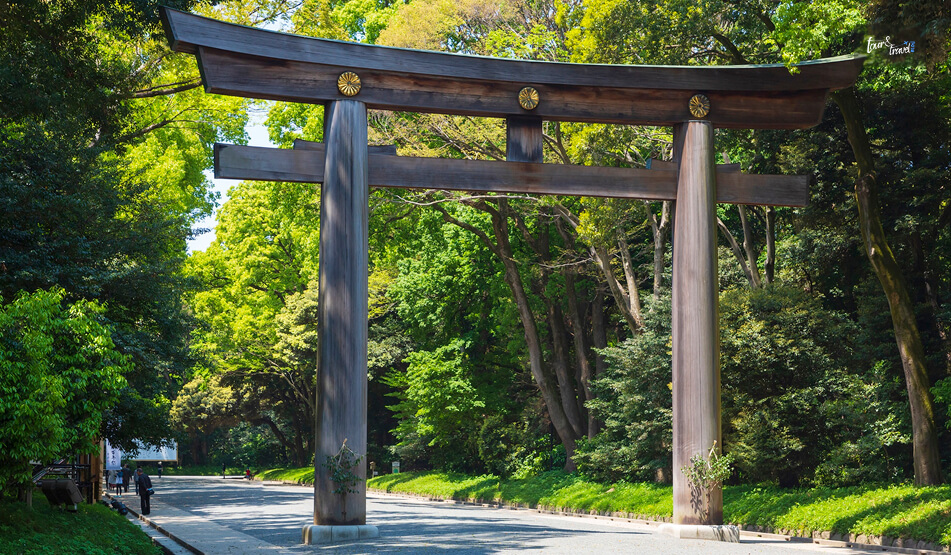
Meiji Jingu is the most magnificent Imperial shrine in Tokyo. 

It is also quite different from the flashing neon lights of the nearby Harajuku. 

It is a shrine devoted to Emperor Meiji and Empress Shoken. 

Moreover, a forest of more than 100,000 trees surrounds it. To me, this shrine stands for the “hopefulness” of Shinto. 

Moreover, it’s a place where you can stroll along wide gravel paths, look up huge sake barrels that brewers have given.

Also, if you’re lucky, see a Shinto wedding ceremony carried by a slow, graceful bridal party crossing the courtyard. 

3. Toshogu Shrine, Nikko

Toshogu Shrine, Nikko

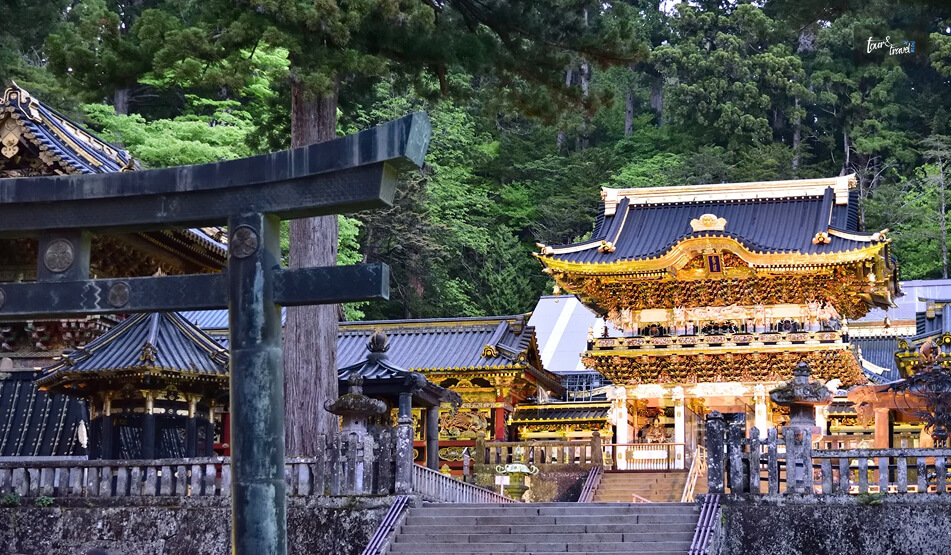
The Toshogu Shrine in Nikko is a very bright and gaudy place with the use of various colors and gold. 

This shrine is the final resting place of Tokugawa Ieyasu, the founder of the Tokugawa Shogunate. 

Detailing here is mindblowing, and you will notice the elements such as “See No Evil” monkeys and the “Sleeping Cat” carving. 

It is a one-of-a-kind place as it has preserved numerous Buddhist features even after the Meiji-era separation of the two religions.

Thus, it is a combination of a regal and an eccentric style, which is a wonder in itself.

4. Itsukushima Shrine, Miyajima

Itsukushima Shrine, Miyajima

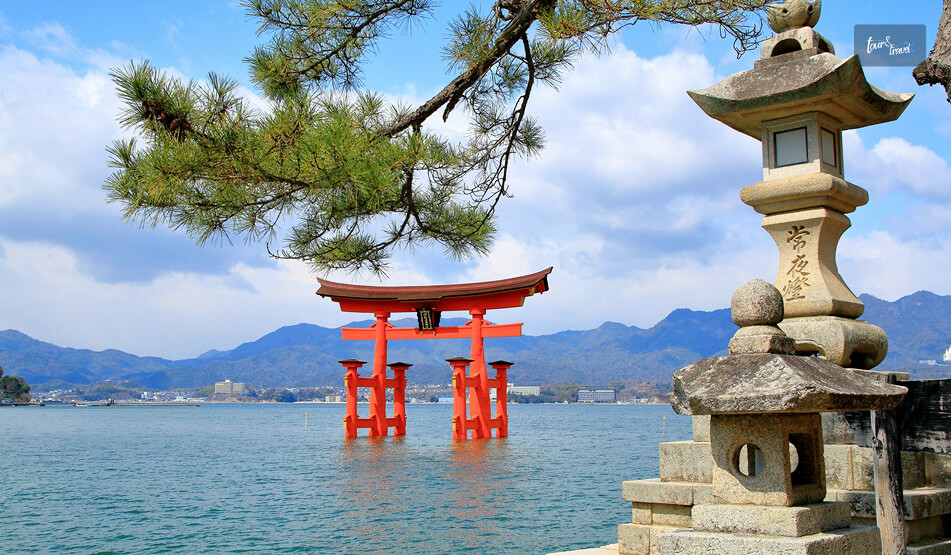
Located on Miyajima Island near Hiroshima, Itsukushima is world-famous for its “floating” torii gate. 

The shrine stands on stilts over the water, so it looks like it’s drifting in with the tide. 

It’s a classic example of Shinden-Zukuri design. 

The thing is that I always go at sunset when the gate fades into shadow against the Seto Inland Sea. 

That moment feels deeply quiet, almost sacred. 

It seems hard to ignore how powerful that stillness can be. And the colors shift with the light. Making it one of Japan’s most striking photo spots.

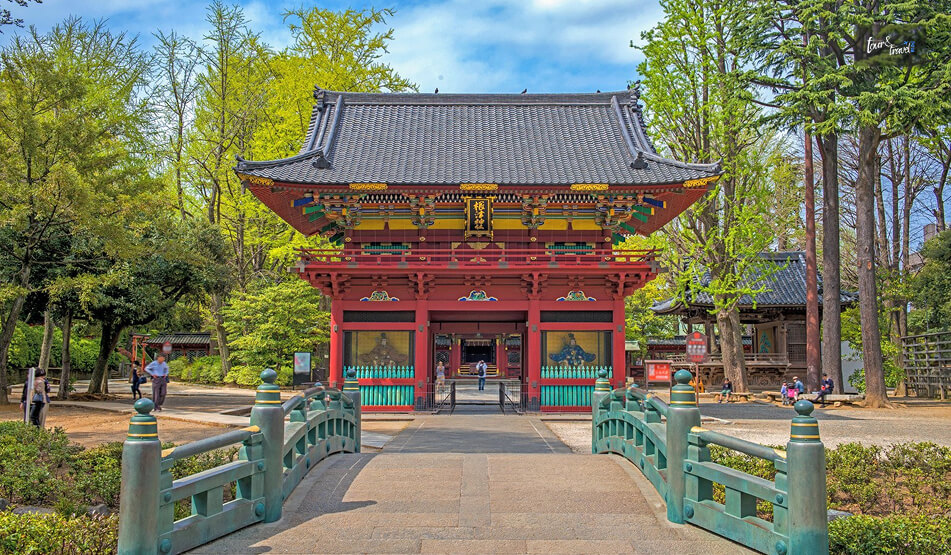
5. Nezu Shrine, Tokyo

Nezu Shrine, Tokyo

Nezu Shrine is perfect if you want some respite from the crowded temples of Kyoto. 

There’s a small tunnel of torii gates like Fushimi Inari, and a koi pond that glows under the Sun. 

The buildings flash red and gold, kind of like Nikko’s Toshogu, but it is smaller and simpler. 

Moreover, late April brings wild azaleas up the hillside and pink waves rolling through purple hillsides. You don’t see that everywhere.

6. The Sengen Shrines Of Mt. Fuji

The Sengen Shrines Of Mt. Fuji

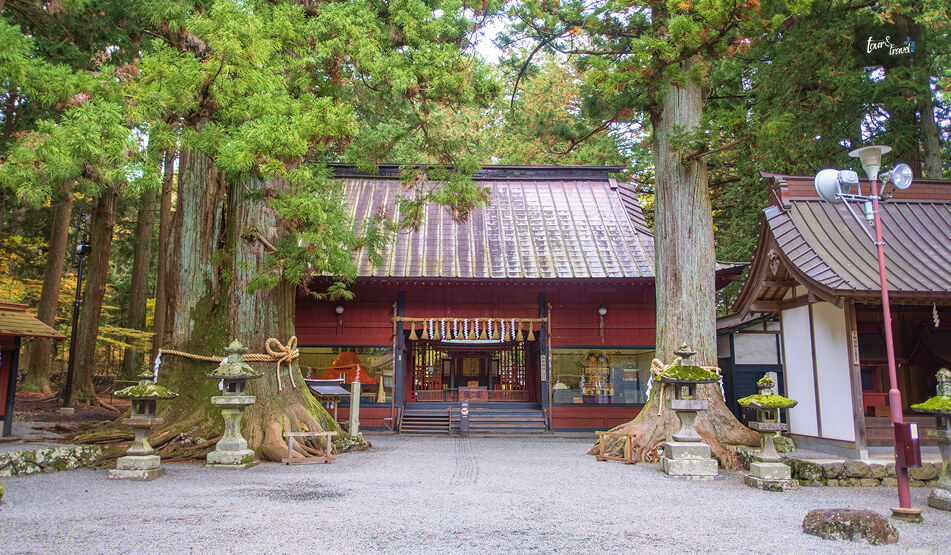
Located in the area of Fuji Five Lakes, I was quite impressed by two shrines that are a must-see for me. 

Fujiyoshida Sengen Shrine is right at the foot of the mountain and was the old point for pilgrims who started climbing the volcano. 

It has a very ancient feel thanks to huge cedar trees that surround and stone lanterns. 

Close to it is the Arakura Sengen Shrine that gives the “typical” Japanese photograph.

It has a red five-tiered pagoda with Mt. Fuji towering in the background. 

If you decide to go to the top, you will have almost 400-step stair climbing, but the panorama is breathtaking.

7. Kumano Nachi Taisha, Nachisan

Kumano Nachi Taisha, Nachisan

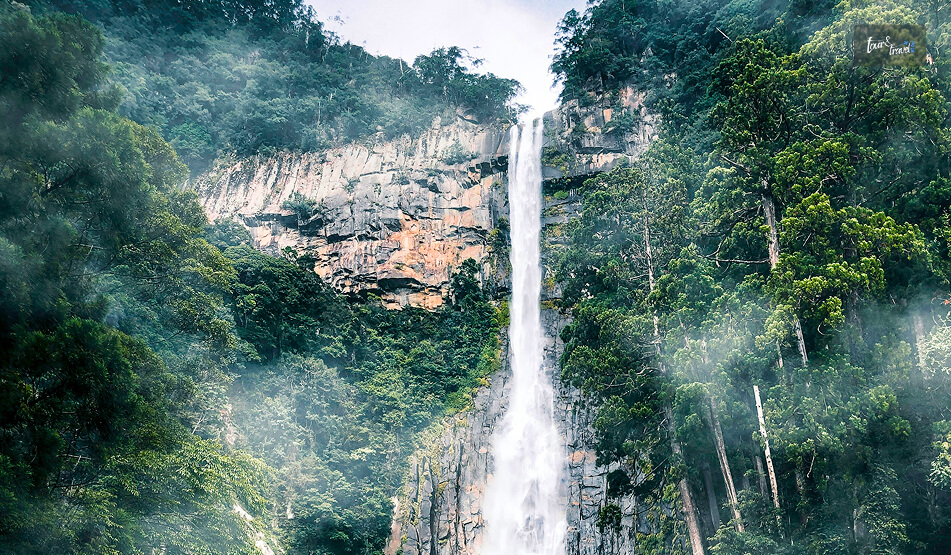
This shrine is the main shrine of about four thousand Kumano shrines and is located on the Kii Peninsula. 

It is extremely beautiful because it is very close to Nachi Falls, which is the highest waterfall in Japan. 

Also, it is quite a spiritual experience to witness the vivid red pagoda of the shrine contrasting with the white thundering falls and the misty mountains. 

Moreover, it is one such place of worship along the old Kumano Kodo pilgrimage route.

Read Also:

Share on Social Media

Meet Sibashree Bhattacharya, a travel enthusiast who has a decade-long experience in transcending virtual barriers with her words! Her deep love for travel is apparent from her travel escapades to the mountain, often taking her readers on a journey, her words acting as Portkey! Fun fact: Sibashree loves to dive deep into the history of the places she is about to visit, making her travels even more wholesome. If you were wondering how her articles are not short of time travel, this answers it!

Leave a Reply

Your email address will not be published. Required fields are marked *

title-img Related

READ MORE Hurulu Eco Park

Hurulu Eco Park Safari: Exploring The Wilder Side Of Sri Lanka

BY  Sibashree Mar 16, 2026

After Kaudulla National Park and Dehiwala Zoo, the Hurulu Eco Park was another destination for me to explore Sri Lanka’s wildlife.  If places such as Jaffna in northern Sri Lanka and Kandy in Central Sri Lanka have been the cultural hubs of the country, these parks have shown how people have lived here since eternity in collaboration with nature and wildlife.  The Hurulu Eco Park is especially very close to Habarana, the epicenter of cultural and historical landmarks such as the Sigiriya Rock Fortress, Pidurangala Rock, Ritigala Forest Monastery, and Ritigala Forest Reserve.  The distance between Habarana and the Hurulu Eco Park, at the edge of the Hurulu Forest Reserve, is just around 3 to 4 kilometers. However, despite the short distance, this eco park is quiet and understated.  Also, you know what makes Hurulu Eco Park different? Here, you relish the art of slow traveling and the scent of wet soil after a fresh spell of rain.  Furthermore, elephants are the heart of this eco park, and watching them grazing through the golden light is a delight.  Here is more about this beautiful eco park in Sri Lanka.  Hurulu Eco Park, Sri Lanka: Quick Details  Hours Open7 AM to 6 PMLast Time to Enter5 PMPark Entrance Fee- $15-25 for an Adult- $5 for Children above 6 Years- Free for Children below 6 YearsSafari Cost$65 OnwardSafari DurationAround 3 HoursBest Time to VisitDecember to June Where Is Hurulu Eco Park And How To Reach?  In Sri Lanka’s North Central Province, Hurulu Eco Park is between the landmarks such as Polonnaruwa (1 hour and 15 minutes), Anuradhapura (1 hour and 50 minutes), Dambulla (45 minutes), and Sigiriya (45 minutes).  So, often there is a safari add-on to explore these ancient cities and the cultural landmarks.  Furthermore, as mentioned, it is closest to Habarana. So, ideally, it should be your base.  Habarana also has many budget, mid-budget, and luxury accommodations. Moreover, most hotels in Habarana, Dambulla, and Sigiriya offer door-to-door safari facilities.  You can expect a pick up around one hour before the safari time.  Moreover, you can take a train from Trincomalee, Kandy, or Colombo to reach Habarana Junction. From there, you can take a 10-minute tuk-tuk ride to reach the eco park.  However, online booking for these train tickets may not work most of the time.  The Landscape Of Hurulu Eco Park  Hurulu Eco Park is a mix of open plains, rock, and jungle.  Furthermore, as a part of the dry evergreen forest area of Sri Lanka, it functions as an important corridor for elephants roaming between Minneriya and Kaudulla National Parks.  So, you can easily spot Sri Lankan elephants here, especially the mothers and babies making small groups and moving.  Along with elephants, you can also spot peacocks, spotted deer, macaques, langurs, and many birds here.  What I Saw At Hurulu Eco Park  I was initially disappointed the day I had to visit the Hurulu Eco Park. I thought that the tropical rain would mess up my safari experience.  However, I opted for an afternoon safari, and by the time I reached Hurulu, except for the heavy dampness in the air, everything was fine.  Also, the mud on the track was not a problem to start the safari in full swing.  After a few turns in the park, I could spot a herd of elephants, and they were winding up leaves and fruits with their trunks. Moreover, they were flapping their ears.  Then, after waiting for 15 minutes, the herd passed by and we continued our safari.  We passed through rocks, canopies, and bushes. I spotted a peacock and monkeys before reaching an open land. And that was the moment of the entire safari.  At least 25 elephants were grazing, and the younger ones were rolling in the mud.   Finally, the air became cooler, and the sky started getting red. So, our jeep driver planned a return.  How To Plan A Safari In The Hurulu Eco Park?  Safaris in Hurulu Eco Park include a guide, a jeep, park entry, and a pickup and drop off from Hurulu Eco Park.  Morning safaris are the best, ideally starting from 7 AM. Furthermore, like me, you can also opt for an afternoon safari at 1 PM.  Furthermore, each jeep carries about 6 tourists. Also, you must carry some water, wear sunscreen, and a hat. What Is The Best Time To Visit Hurulu Eco Park? The best time to visit Hurulu Rco Park is between December and June. Especially, February to April is the ideal time to see the lush landscapes and the biggest elephant herds.  Furthermore, the number of jeeps is quite low in these months.  Again, from May onward, the conditions become drier, and the elephants start moving from the Kaudulla National Park to the Minneriya National Park. So, in Hurulu Eco Park, you will notice smaller herds of elephants.  Moreover, from October to January is the wet season, and the jungle becomes the most vivid. So, these months are the best for photographers.  Photography Tips For Hurulu Eco Park  You will find a mix of open plains, forest shades, and red earth in Hurulu Eco Park. So, the landscape is challenging yet interesting for photographers.  Furthermore, for photography, you must bring a 70-200 mm lens. It is ideal to capture wildlife, and the wider lens is the best to frame the color and scale of Hurulu Eco Park during the golden hour.  Moreover, after the rain, the conditions become more ideal for photography. Grey elephants, red dust, and the green foliage create wonderful frames.  Again, the light filters through the tree branches becomes low in the late afternoon. So, you can capture the texture and warmth of the Hurulu Eco Park. Things To Keep In Mind For A Visit To Hurulu Eco Park  Do not use single-use plastic bottles during the safari to minimize the impact on the environment, wildlife, and marine life.  Furthermore, keep the water use to a minimum level to reduce the pressure on water resources.  Moreover, collect your souvenirs from the local shops and eat at the local eateries to help the economy of the community.

READ MORE things to do in galle

What Are The Things To Do In Galle Fort, Sri Lanka? Exploring A UNESCO Heritage Site

BY  Sibashree Mar 24, 2026

Galle has been my ideal dreamy, sepia-toned travel destination located on the southwestern coast of Sri Lanka.  Moreover, the city’s stunningly beautiful old fortified peninsula reaches defiantly out into the Indian Ocean and boasts many crumbling colonial-style buildings, narrow cobblestone streets, and swaying palm trees.  However, the true magic of Galle comes from taking it slowly.  Hi, in today’s blog, I will talk about the things to do in Galle Fort. However, I will begin with why a visit to the Galle Fort is worth it and how to get there.  Why Visit Galle Fort? A UNESCO World Heritage Site And The Fortress That Defied Time “Founded in the 16th century by the Portuguese, Galle reached the height of its development in the 18th century, before the arrival of the British.  It is the best example of a fortified city built by Europeans in South and South-East Asia, showing the interaction between European architectural styles and South Asian traditions.” • UNESCO World Heritage Convention.  The trading post was once impenetrable, and the rampart walls kept the invaders at bay.  However, centuries later, during the 2004 Tsunami, the same stone walls that stood against cannons also protected the people from the ocean.  Thus, the Galle Fort remained intact even though the surrounding coastline was devastated. Today, it stands as a UNESCO World Heritage Site for being a unique example of a fortified city.  How To Reach The Galle Fort? You can easily reach the Galle Fort from Colombo or down the coast.  From Colombo  You can take a train from Colombo Fort, and after a three-hour journey and amazing ocean views, you will reach Galle.  However, currently, this route is being reconstructed. So, you can take a Highway AC bus from the Makumbura Station.  Furthermore, it is a 2-hour journey through the Expressway.  From Mirissa Or Weligama If you’re already beach-hopping the south coast, you can just hop on any local bus headed toward Matara or Galle.  It’s cheap, frequent, and gives you a real taste of local life, and that’s amazing as a follower of TheLowDownUnder Travel philosophy.  Also, from my days in Jaffna to the things to do in Kandy, I have always ditched comfort and the obvious for a more authentic experience.  What Are The Things To Do In Galle Fort, Sri Lanka?  When talking about the things to do in Galle Fort, you have to think beyond the tourist checklist.  Furthermore, Galle is a place of contrasts! You have the rugged, salt-sprayed stone of the ramparts on one hand, and on the other hand, you have the most polished boutique shops.  So, Galle is beyond your usual Instagram photo op.  And one of the best things to do in Galle is to understand how the fortress and the neighborhood have survived empires and natural disasters.  Moreover, in Galle, you become a part of the history as you watch the sunset from an ancient bastion or sip cold beer at a wine bar on a cobblestone street.  Also, you will see an extension of all these in my detailed account of two days in Galle Fort.  Day 1: Getting Lost In The Living Museum Walks, exploring the architecture, culture, and the much hyped sunset experience! These were the things to do in Galle Fort on day one.  Morning: The Rampart Walk Walking is the best way to begin your exploration of Galle Fort. It is small and, therefore, a great destination for pedestrians.  In the morning, I climbed to the top of the stone ramparts and walked the entire way around the edge of the Fort, obtaining a 360-degree view of Galle. I saw the sparkling, turquoise ocean to one side and the red tiled roofs of the original buildings of the town on the other. On your walking tour, look for the famous Galle Clock Tower and the historic Galle Lighthouse, which is probably the most photographed place in all of Sri Lanka.  The whitewashed lighthouse is stunning against the clear blue sky, but I found that the late afternoon light gives it that soft, golden color that makes the palm tree shadows cast perfectly across the grass. Afternoon: Culture And Architecture After you’ve finished exploring the upper level of the walls, it’s time to explore the narrow alleyways of the city.  Throughout the streets, you are going to notice something extremely wonderful. You will see the cultural and ethnic diversity and the same inclusive culture of Sri Lanka, prominent through the iconic Ambuluwawa Tower in Colombo.   In just a matter of blocks, I was able to visit the Dutch Reform Church, All Saints Anglican Church, Meeran Mosque, and Sri Sudharmalaya Buddhist Temple.  All these places serve as a testament to the many different people who have influenced the development of Sri Lanka over many hundreds of years. If the heat of the sun becomes unbearable, I recommend that you check out either the Historical Mansion Museum or the Maritime Museum.  Both of these museums are in beautifully restored colonial structures and provide visitors with great artifacts dating back to Sri Lanka’s colonial period. Evening: The Sunset Ritual When the sun is going down, I suggest that you make your way to the western walls of the fort.  At Flag Rock Bastion, you will find the locals performing their “cliff jumping” tourism attraction.  You will have the opportunity to see how far they will go into the crashing waves.  If you would rather have a quieter spot to watch the sunset, I would recommend that you go to Triton Bastion.  I spent an hour there on the grassy ramparts watching as the sky slowly burned with bright oranges. What a way to see Mother Nature's fireworks show. Day 2: Boutiques, Buffets, And Beaches Day 2 was more relaxed as I shopped, gorged on grand feasts, and explored the beaches.  Morning: The Shopping Mecca Galle is now Sri Lanka's shopping capital. Pedlar Street is the epicenter of the boutique shops, from where you can collect elegant souvenirs.  A few of my personal favorites are in the table below.  Places to Visit for ShoppingThings to BuyStick No BillsVintage-Style PostersThe Tea Room by Evergreen GroupBuy Tea in BulkOld Dutch HospitalThis former colonial hospital is now a chic shopping and dining precinct. It’s the perfect place to grab a coffee and browse. Lunch: A Local Feast After the spicy food in Jaffna, the food in Gelle was comforting. So, trying the Coconut Sambal is one of the best things to do in Galle.  You will get the curries with chicken and vegan-friendly options here. Also, to beat the midday Sun, have some homemade ginger beer or treat yourself to a scoop at Isle of Gelato.  Moreover, don’t forget to try the cashew caramel at Isle of Gelato.  Afternoon: Beyond The Walls As the Sun starts getting softer, you can explore the surrounding coast. Also, if you want to extend your coastal hunt, head to Dewata Beach.  Here, you will find many beginners and professionals surfing the waves.  Furthermore, if you want to just relax, take a tuk-tuk ride to the Jungle Beach in Unawatuna. It is a small sandy cove with lush greenery. 

READ MORE Jimbocho Book Town

What Are The Things To Do In Jimbocho Book Town? Visit The Best Book Stores And Cafes 

BY  Sibashree Mar 30, 2026

Jimbocho Book Town is a massive book district or book town with more than 400 book stores.  It is one of the oldest and biggest in the world and is often uttered with respect equal to the Kaifeng and China book towns.  Also, it is a great place for dark academia fans, students, and readers, as they will find most of the second-hand books in Japan here.  Furthermore, it’s not just about the love for the book and the “intellectual” aspect of it.  Time Out has named it the best neighborhood in the world in 2025.  But do you know about the best book stores and cafes in the Jimbocho Book Town? Here is a detailed list.  However, let’s talk about the history, accessibility, and the best things to do in this book town.  Jimbocho Book Town: A Neighborhood That Survived World War II The Kanda-Jinbōchō area started getting many law schools in the late 19th century and early 20th century, and this is how the book town came.  Many bookshops opened then, and students of the law schools often sold their old books to these shops at a cheaper rate. Thus, this concept of second-hand books came.  New students used to buy these books because they were cheaper.  Furthermore, it is nothing short of a miracle that this book town survived the bombing and destruction during World War II.  Jimbocho started flourishing as a book town once World War II was over, and today, it is the most fascinating place for bibliophiles.  Furthermore, Shūeisha (Jump Manga Magazines), Iwanami, and many other leading publication houses have their headquarters in the Jimbocho Book Town.  Moreover, the curry restaurants and cafes here have been hosting the most famous authors for the longest time.  I must mention Ladrio in this context. It was built in 1949 as the reading room of a bookstop. It was also the first place that brought Viennese coffee to Japan.  Now, it was more than an elevation in the texture and flavor. The whipped cream helped to keep the coffee warm for longer as the intellectuals here took part in debates and hot discussions.  How To Reach The Jimbocho Book Town?  The central location of Jimbocho in Tokyo makes it easy to visit. You can take a ride on the Subway network to make this commute.  Reach Jimbocho Book Town By Subway  The nearest subway station is the Jimbocho Station. You will take the subway to the station on the following lines.  Toei Mita Line Tokyo Metro Hanzomon Line And, Toei Shinjuku Line Moreover, once you reach the subway station and exit from A5 or A6, you can find the book stores along Yasukuni-dori.  Reach Jimbocho Book Town From Shinjuku And Shibuya The journey through the Toei Shinjuku Line from Shinjuku Station is the easiest way to reach the Jimbocho Book Town. It does not need any transfer.  Furthermore, the travel time is about 15 minutes.  On the other hand, from Shibuya Station, you can take a ride through the Tokyo Metro Hanzomon Line to reach Jimbocho Station within 20 minutes. Reach Jimbocho Book Town From Tokyo Station From Tokyo Station, you have to take a Rapid ride on the R Chuo Line and reach Kanda Station.  Then, you have to reach the Toei Mita Line or the Toei Shinjuku Line to complete the journey in 5 minutes. Shopping For Old And Rare Books And Magazines: The Best Thing To Do In Jimbocho Book Town  From antiquarian books and documents to specialized books and first editions, you will find all the books in the Hakusan-dori and Yasukuni-dori intersections of the Jimbocho Book Town.  Starting from the Meiji Era(1868-1912) to today, it has been a book town par excellence.  Furthermore, the Aozora Kohon Ichiba, or the annual Kanda Used Book Festival, draws book lovers across the globe to the Jimbocho Book Town.   This festival is held in late October or early November, and it was celebrated from October 24th to November 3rd in 2025.   What Are The Book Stores You Must Visit In The Jimbocho Book Town?  Do you think that the Jimbocho Book Town only has Japanese books? You will get books in various languages in the book stores here.  Here are the book stores you must visit.  1. Kitazawa Book Store  The Kitazawa Book Store is the best book store to find English books and classics in the Jimbocho Book Town.  It started in 1902 and has thus completed more than 125 years in serving as a beacon of Western literature connoisseurs in Jimbocho Book Town.  You will mostly find foreign and humanities-related books here.  2. Magnif Zinebocho Magnif Zinebocho is a paradise for readers and lovers of retro magazines. You will mostly find lifestyle and fashion magazines from the last few decades here.  Though it mostly sells Japanese retro magazines, you will also find magazines that overcome language barriers.  Furthermore, the Mondrian artwork on the bookstore’s facade is really impressive, and you will find retro magazines such as Olive and Relax. 3. Books Tokyodo Built in 1890, Books Tokyodo is one of the oldest book stores in the Jimbocho Book Town. Here, you will find books of different genres from the bygone eras and modern times.  Furthermore, it is one of the book stores that has helped to create a community of book lovers, and that is the most cherished thing about it.  4. Komiyana Tokyo The history of Komiyana Tokyo goes back to 1939. It is a dedicated 4-story building with each floor offering distinct attractions to book and art lovers.  You will find here books on history, Japanese art, Western art, and fashion.  Furthermore, it has the widest collection of photo books, and most of them are by the original photographers or painters.  Also, watch out for the weekend “Garage Sale” behind the shop.  You never know when you can find a diamond.  5. Bohemian’s Guild  The Bohemian’s Guild is a great place to find vintage books on visual art and design.  Furthermore, the bookstore has been there since the Taisho era (1912-1926). The first floor of the store has all the books and a warm lighting that, along with the brown wooden floor, creates an inviting atmosphere.  Furthermore, on the second floor, the book gallery allows you to explore the lithographs, paints and prints.   What Are The Best Cafes To Visit In The Jimbocho Book Town?  Kissaten, or the coffee house culture of Japan, is unique. The best cafes in the Jimbocho Book Town allow you to get familiar with that.  Furthermore, the cafes here celebrate the history and origin of the book town. So, here are my favorites. 1. Sabouru With an origin in 1955,  Sabouru stands out with its unique Showa-era charm and nostalgic vibe.  You must try the cream soda here, and it is available in seven colors. They also make an excellent strawberry juice smoothie.  Moreover, the adjacent Sabouru 2 is a popular place here to have classic “Japanese Napolitan Spaghetti.”  2. Milonga Nuova Built in 1953, Milonga Nuova is a paradise for Tango lovers.  Furthermore, the charcoal-roasted coffee here hits different, and that is often accompanied by the signature desserts.  Moreover, you will find more than 30 varieties of imported beers here.  Along with these cafes, Jimbocho Book Town also has various curry restaurants. From Mandala to Bondy, these restaurants celebrate the tradition started in the Meiji era.  The book lovers found it very convenient to eat curry with one hand while the other hand was busy holding the book or flipping the pages.  Read Also: Is The Japan Rail Pass Worth It In 2026? Should I Buy Or Avoid It As A Conscious Tourist? Cherry Blossom Kyoto Japan: 2026 Season And The Top Viewing Spots Osaka Food: Know What To Eat In The Streets Of Osaka