Hiking the Aotea Track up to the summit view of the Hirakimata Peak was one of the most rewarding experiences I had on the Great Barrier Island. The view after reaching the top took all our fatigue away.
However, the Great Barrier hiking trails are not just about panoramic summits. Hiking here also means walking along the rugged coastline, through the native forests, and to the geothermal springs. To cut a long story short, the best hikes on Aotea Great Barrier Island, New Zealand are the best routes for exploring its dramatic island.
Furthermore, you can be a beginner or a seasoned hiker. Great Barrier Island has trails that can accommodate all. So, this guide is about the trails you can explore for the perfect eco adventure.
Why Is The Great Barrier Island A Hiker’s Paradise?
Cultural exploration, stargazing, off-grid living, exploring the biodiversity of the island, and the dramatic geothermal features make the Great Barrier Island a hiker’s paradise.
1. Dark Sky Sanctuary
“Ecotourism is extremely important to Great Barrier Island and this International Dark Sky Sanctuary status will not only provide further tourism development and economic growth opportunities but also ensure the preservation of our exceptional starry skies.“
Izzy Fordham, Great Barrier Local Board Chair.
The designation of the Great Barrier Island as a Dark Sky Sanctuary in 2017 was not about getting a label to boost tourism. The island’s 60% area is a conservation park, and the local Maori people believe that the protection of the sky is important for the health and well-being of the local community.
Also, if New Zealand becomes a Dark Sky Nation, as aimed by the Royal Astronomical Society of New Zealand, the Great Barrier Island will have a pivotal role to play.
Nevertheless, as an activity, stargazing seems the most surreal experience during a multi-day hike on the Aotea track. Just relax and prepare for the next day after completing your day’s hike.
2. Off-Grid Living
Sustainability is a choice or a way of living on the Great Barrier Island. So, there is complete reliance on solar power, and people here use composting toilets. Rainwater harvesting is another sustainable practice followed by the people of this island.
Nevertheless, thanks to the island’s off-grid living, it has minimal to no light pollution and air pollution. Also, because of off-grid living, life on Great Barrier Island is deeply connected to nature. So, you can be the biggest homebody, but here you will feel the urge to experience the outdoors more intimately.
3. Biodiversity Of The Island
“Great Barrier is at an exciting point in its history where the future of the islands flora and fauna looks bright.” – Go Great Barrier Island.
The fact that 60% of the island is a conservation park speaks volumes about the island’s biodiversity. Furthermore, it is home to countless endangered species, including 13 species of lizards, the North Island Kaka Parrot, the Black Petrel, the Banded Rail, and the Pateke.
In addition, the native forest here is getting replenished quickly with the island authority being particular about pest control.
4. Geothermal Features
Located within the Hauraki Rift, the Great Barrier Island has the Taupō Volcanic Zone and the Kaitoke Hot Springs. These geothermal zones, along with being natural spectacles, are also home to unique ecosystems where you will find New Zealand pigeon or kererū, fernbird, etc.
So, hiking through these geothermal zones is an exciting outdoor activity in the Aotea Great Barrier Island.
A Brief Comparison Table Of The Best Great Barrier Island Hiking Trails
Trail Name
Duration
Difficulty
Highlights
Accessibility
Aotea Track
2–3 days
Moderate
Forest, summit, huts
DOC huts, remote
Kaitoke Hot Springs
1.5 hrs
Easy
Geothermal pools
Wheelchair-friendly
Windy Canyon
1 hr
Moderate
Cliffs, panoramic views
Car park access
Harataonga Coastal Walk
4 hrs
Moderate
Beach, forest, birds
Trailhead parking
Palmers Track
2–3 hours
Moderate
Stream crossings, dense bush
Not recommended for people with fitness or mobility issues
Warren’s Track
30–45 minutes
Easy
Family-friendly loop near Tryphena, Kid-friendly
It is not wheelchair-accessible.
Whangaparaoa Beach Walk
1–2 hours
Easy
Dune ecology, remote beach
It is not wheelchair-accessible due to a steep loop-walk area.
Glenfern Sanctuary
1–2 hrs
Easy
Conservation, native birds
Guided tours available
What Are The Best Great Barrier Island Hiking Trails? (Brief Overview)
Most of the hiking trails on the Great Barrier Island come with an easy to moderate difficulty level. Also, the Aotea track here is the only multi-day hiking trail on Great Barrier Island and the entire Auckland Region.
Let’s find out more about the Aotea track and other Great Barrier Island hiking trails.
Aotea track allows you to experience the ultimate fusion of history and natural beauty. Here, you will find the surviving trees and a unique wildlife of Kahikatea, Rimu, and Kauri.
The plants you will come across here are the cabbage tree, Horoeka or lancewood, Mānuka, Kānuka, etc. Furthermore, you will spot birds like Riroriro (Grey Warbler), Kererū (Wood Pigeon), etc.
This hiking route allows an encounter with the remnants of the ancient native bush, such as lancewood and cabbage tree. Also, while walking, you can meet the endangered Chevron Skink, a symbol of the rich biodiversity of the Great Barrier Island.
This easy hiking track continues along the Kaitoke Swamp to the Kaitoke Hot Springs. You can continue your walk and continue on the Peach Tree Track to reach the Hirakimatā peak.
Kererū or wood pigeon and Kōtare or kingfisher are the most popular birds here.
The Windy Canyon track is one of the most popular short hiking trails on the Great Barrier Island. You have to climb up the steps through rock walls, which look dramatic thanks to the rampage of the ancient force of nature.
As you reach the top of the canyon, you will see the wonderful views of the Okiwi Basin, Whangapoua Beach, Medlands Beaches, and Kaitoke.
5. Palmers Track
After completing the Windy Canyon Track hike, you can continue on the Palmers Track. Here you will walk along the steep ridgeline, and it is the shortest route to Mount Hobson.
Furthermore, on your way, you will spot the endemic kānuka plants, and the wooden horse here is a telltale of the logging history of the island.
6. Harataonga Coastal Walk
It is one of the easiest hiking trails in Harataonga. It is associated with the history of transportation on the island, as it used to be the connecting route between the northern and southern parts of the island.
7. Warren’s Track
It is a beautiful hike to a waterfall with a gently graded climb. Once you reach the waterfall, you can take a swim in the stream beneath. The food passes through the Kauri plantation before it joins the Bridle Track.
Here, you will walk through an exotic forest. However, the last lap of the trek is a little difficult with a rocky surface.
This peaceful route takes us to the Stanmore Bay Beach through the Rata Road walkway. Most of the walk continues on a paved road. However, some sections have a boardwalk and gravel.
This road is ideal for a pram walk. However, the stretch between the Rata Road Reserve and Whangaparāoa town centre is steep enough, and you will have to cross a few roads.
The Glenfern Sanctuary is a family-friendly loop track that continues along the Aotea Stream. You have to walk through a stretch of regenerating bush and climb around 100 meters.
After climbing up, you will enjoy the most amazing views of the Hauraki Gulf. On the stretch, you will be able to spot black petrel and kaka nesting. Also, you will find here the Chevron skink, the rarest and largest reptile in New Zealand.
How To Reach The Best Great Barrier Island Hiking Trails?
You will have to take a Great Barrier Flight or a ferry ride to reach the Great Barrier Island. Upon reaching the island, you will have to take local transport to reach the following trail heads.
Great Barrier Island Hiking Trails
Trail Head
Aotea Track
Windy Canyon/Whangaparapara Road
Mount Hobson / Hirakimata Summit Track
Brownlee Avenue
Kaitoke Hot Springs Track
Whangaparapara Road
Windy Canyon Track
Okiwi-Claris Road
Palmers Track
Windy Canyon
Harataonga Coastal Walk
Harataonga Campsite
Warren’s Track
Opposite the Akapoua Campground Entrance
Whangaparaoa Beach Walk
1.5 Km up from Okiwi Airfield
Glenfern Sanctuary Walks
20 Glenfern Road
What Are The Best Family-Friendly Trails On Great Barrier Island?
Best for Seniors
• Kaitoke Hot Springs • Glenfern Sanctuary
Best for Kids
• Warren’s Track • Harataonga Beach Walk
Facilities
• Toilets at Major Trailheads • Picnic Areas • DOC Signage
What Is The Best Time For The Great Barrier Island Hiking Trails?
Glenfern Sanctuary Tours and Māori Cultural Tours are the two most popular guided tours on the Great Barrier Island.
1. Glenfern Sanctuary Tours
The Guided Loop Track tour of Glenfern Sanctuary is an amazing experience as you walk through the native bush. Here, you will spot the magnificent kauri tree and the resident black petrel.
The tour is 1 hour and 30 minutes, and a group must have at least five members. The tour’s charges are $50 per person.
2. Māori Cultural Tours
Whangaparapara Harbour Historic Treks, Harataonga, and Aotea Track are some of the best hiking trails to learn about authentic Māori culture and tradition.
The Whangaparapara Harbour Historic Treks take you to places of Kauri logging and whaling in ancient times. On the other hand, at the Harataonga DOC Campsite, you will find the old settlement sites of the Māori tribe.
Moreover, the Aotea Track has Māori archaeological sites, and Hirakimata Peak itself reflects local Māori spiritual beliefs and significance.
Where To Stay Near The Best Great Barrier Island Hiking Trails?
DOC huts, eco-lodges, hostels, and camping are the best accommodation options near the best Great Barrier Island hiking trails.
Trail Name
Nearby Accomodation
Aotea Track
• Mt. Heale DOC Hut • Kaiaraara DOC Hut
Kaitoke Hot Springs
• Barrier Beach Cottage • Wiltshire Manor
Windy Canyon
• Aotea Lodge
Harataonga Coastal Walk
• Tipi and Bob’s Waterfront Lodge
Palmers Track
• Tipi and Bob’s Waterfront Lodge
Warren’s Track
• Medlands Beach Backpackers and Villas
Whangapoua Beach Walk
• Aotea Lodge
Glenfern Sanctuary
• Glenfern Sanctuary
Things You Don’t Know About The Great Barrier Island Hiking Trails: (Unearthing The Secrets)
From housing, the only multi-day hike in Auckland, to being the home to many endangered species, the Great Barrier Island has many secrets to share.
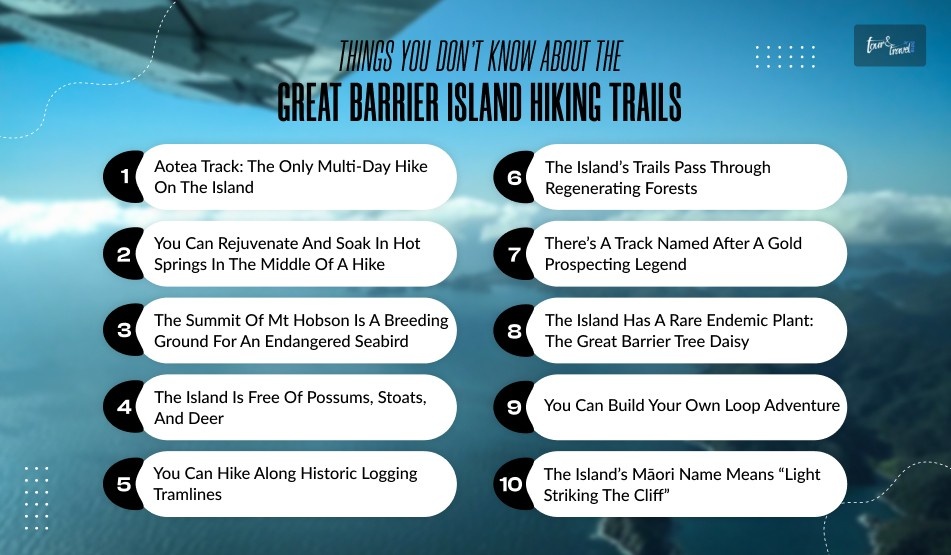
1. Aotea Track: The Only Multi-Day Hike On The Island
The 25–30 km loop of the Aotea Track is the only multi-day hiking track in the Auckland region. It passes through volcanic terrain, native bush, and summit views.
It’s a rare wilderness experience so close to a major city.
2. You Can Rejuvenate And Soak In Hot Springs In The Middle Of A Hike
As you walk through the Kaitoke Hot Springs track, you will find geothermal pools, offering you a natural spa experience.
These pools, hidden in bushes and set in an underdeveloped setting, offer the purest connection to nature.
3. The Summit Of Mt Hobson Is A Breeding Ground For An Endangered Seabird
Black petrel (tāiko) is one of the rarest seabirds of New Zealand. Hirakimatā / Mt Hobson is the home ground of these birds.
So, hikers have to continue on the boardwalks to protect the nesting areas of the birds.
4. The Island Is Free Of Possums, Stoats, And Deer
Because the Great Barrier Island is free of Possums, Stoats, And Deer, you will be able to spot more birds such as kākā, kākāriki, and pāteke, and different types of wildlife.
5. You Can Hike Along Historic Logging Tramlines
Some parts of the Aotea Track pass through the old tramlines used during the kauri logging era. In these pockets, you will find the ruins of machinery and dams that were used in carrying the logs.
6. The Island’s Trails Pass Through Regenerating Forests
Much of the forest you hike through is regrowth from early 20th-century logging, dominated by manuka and kanuka, with pockets of ancient kauri, rimu, and kahikatea still surviving.
7. There’s a Track Named After A Gold Prospecting Legend
The Te Ahumata Track to the White Cliffs was a popular site of gold prospecting. The locals still believe that gold may be hidden in the mountain. Thus, the hike has an element of myth.
8. The Island Has A Rare Endemic Plant: The Great Barrier Tree Daisy
On many trails of the Great Barrier Island, especially on the Mt Heale Hut route, you will find the endemic species of the Great Barrier Tree Daisy.
This plant grows nowhere else in the world.
9. You Can Build Your Own Loop Adventure
You can customize your Aotea Track hiking route based on your interests and fitness level. It has feeder tracks such as:
Palmers Track
Peach Tree Track
Tramline Track
10. The Island’s Māori Name Means “Light Striking the Cliff”
The Great Barrier Island has geological and spiritual significance in the Māori tradition. Mount Hobson is called Hirakimatā in the Māori language.
It means the “lightning striking the cliff face.”
Great Barrier Island Hiking Trails: Frequently Asked Questions (FAQs)
Here are the frequently asked questions and answers about the Great Barrier Island hiking trails.
1. Do I Need A Permit To Hike On The Great Barrier Island?
No, if you are on a day trek on any Great Barrier Island trail, you do not need a permit. However, if you are trekking the Aotea Trail, you will need to book the huts of the Department of Conservation well in advance.
You can contact the booking office at +64 7 867 9080 or the DOC Customer Service Centre at 0800 275 362. The last time I checked, the huts were under maintenance. So, confirm the availability of these huts.
2. Is It Safe To Hike Solo On Great Barrier Island?
Yes, hiking solo is safe on the Great Barrier Island trails. However, the trails are in remote locations, and mobile coverage is limited in these areas.
So, you must keep someone informed about your hike, and carry a Personal Locator Beacon (PLB) and an offline map.
3. Are Dogs Allowed On Hiking Trails?
No, dogs and pets are not allowed on the hiking trails on Great Barrier Island. The trails here are ideal for wildlife spotting. So, dogs are not allowed on these tracks to protect native wildlife.
In addition, dogs are not allowed on these trails to prevent the spread of kauri dieback disease.
4. How To Reach The Great Barrier Island From Auckland?
Taking a flight is the easiest option to reach the Great Barrier Island from Auckland. Barrier Air operates this flight service from the Auckland Domestic Terminal to the Claris Airport.
Also, you can take a Sealink ferry from Auckland’s Wynyard Wharf to Tryphena. It is an unforgettable journey of 4.5 hours.
Sibashree is a travel, culture, and leisure writer who has been writing since the age of 12 and professionally since 2014. With more than a decade of travel writing experience and journeys across India and several parts of the world, she brings a deeply personal and thoughtful perspective to her work. A student of English Literature and Mass Communication, Sibashree has always viewed travel as more than movement — for her, it has been a way of understanding people, cultures, and herself. Her passion for spiritual exploration has also led her to many unusual and meaningful destinations over the years. Outside of writing, Sibashree enjoys watching European cinema, reading about global politics, and reflecting on the stories hidden within everyday places.
It’s time to take a Tampa to Siesta Key road trip. The distance between the two places is around 108 Km and you can journey via bus or cab.
Despite the distance, the Tampa to Siesta Key journey takes little time. If you are on a self-drive trip and driving without a break, you will reach Siesta Key from Tampa Bay within an hour. However, if there are traffic issues, it may take close to 1 hour and 30 minutes.
Further, this road trip is going to be the most fulfilling, with a lot of activities to do in Tampa and Siesta Key and multiple engaging stopovers in between.
So, are you ready for this most amazing road trip from Tampa Bay to Siesta Key? Let’s explore the best of Florida.
In this Tour and Travel guide, we will highlight the routes, stopovers, and things to do in Tampa Bay and Siesta Key.
Tampa To Siesta Key | Know The Different Routes
There are two routes to reach Siesta Key from Tampa Bay. You can take Highway 75 and Highway 275. The trip duration both ways is almost the same.
However, as we consulted the local experts, everyone preferred the route via Highway 275. Everyone agreed that the route was more scenic.
Tampa To Siesta Key Via Highway 75
On this route, you must take the E State Rd 60 E from Tampa International Airport. Then, you will continue on the I-75 S and take the exit 207 on the State Highway 758. This highway is in Sarasota County.
You must stick to Highway 758 to reach the Midnight Pass Road in Siesta Key.
Tampa To Siesta Key Via Highway 275
On this route, your drive starts from the Tampa International Airport, and then the merger with the I-275 S takes place.
Next, you must take exit 5 to take US-19 S. Continue on the right 2 lanes toward Palmetto.
Further, you take the US Highway 41 S and US-301 S to reach Siesta Key, Midnight Pass Road.
Tampa To Siesta Key | Know The Best Stopovers | Making The Most Of Sarasota
There are multiple stopovers between Tampa to Siesta Key. So, if you are not in a super rush, you can get multiple places to relax and steal some fun moments.
1. Riverview
Home to the Bell Creek Nature Preserve, Riverview is known for its parks. Don’t forget to take a walk in the Alafia Scrub Nature Preserve.
Are you eager to know about the history of carnival in America? You must plan a visit to the International Independent Showmen’s Museum.
2. Sun City Center
Tourists taking a road trip from Tampa to Siesta Key usually stop at Sun City Center for lunch. There are places like Bella Cucina Italian Family Restaurant (+1 813-634-7521) and Old Castle Restaurant (+1 813-633-3331) for quick bites and refreshments.
Further, to have some moments in nature, you can plan a visit to the Little Manatee River State Park.
3. Bradenton
A melting pot of culture and natural abundance, Bradenton is an important stopover between Tampa Bay and Siesta Key.
The fascinating enclave of the Village of the Arts is a great place to explore galleries and studios. Further, the Bishop Museum of Science & Nature has manatees and is a great place to learn about local culture.
Finally, the Robinson Nature Preserve is a great place for outdoor pursuits like kayaking, walking, and bird-watching.
4. Sarasota | The Fun Begins Here On The Journey From Tampa To Siesta Key
Sarasota is the place where you will meet wildlife on the journey from Tampa to Siesta Key. The Sarasota Jungle Gardens has alligators, tortoises, flamingos, etc. Further, the Big Cat Habitat Conservation and Education Center has African lions, Bengal tigers, Brown bears, and birds.
Also, the Mote Marine Laboratory and Aquarium is the best place to meet marine animals. Moreover, don’t miss visiting the John and Mable Ringling Museum of Art.
Once you are done with all the outdoor pursuits, you can relax at the cafes and restaurants of Sarasota.
Breaking Wave Coffee at 1310 Main Street Sarasota is a great place to hang out. Buddy Brew Coffee - Sarasota is another beautiful cafe here.
Road Trip From Tampa To Siesta Key | Know The Things To Do In Tampa Bay And Siesta Key
Tampa Bay, or the Cigar City, has always been an important spot when it comes to tourism in Florida. Warm weather and affordability have been two major factors in boosting tourism here.
So, when traveling from Tampa to Siesta Key, you cannot miss the top attractions or the things to do here.
Things To Do In Tampa
https://www.instagram.com/p/DEXv4ORzpe3/?img_index=1
You need a separate travel plan if you want to explore the best of Tampa. It is the city that offers you the best wildlife experience and cultural insights with its preservation and museum facilities.
Further, as mentioned, Tampa is the go-to destination for traveling on a shoestring. The city offers you a lot of free activities. For example, the most delightful Tampa Riverwalk is absolutely free.
Places To Visit In Tampa Busch GardensFlorida AquariumTampa GolfZooTampa at Lowry ParkGlazer Children's MuseumYbor CityHenry B. Plant MuseumAmerican Victory Ship & MuseumHillsborough River State Park
Walk around 2.5 miles along the scenic paved trail to the Hillsborough River. During the walk itself, you will come across hotspots like Water Street Tampa, Sparkman Wharf, and Channel districts.
If you don’t walk to walk, you can even take a bike ride along the trail.
Armature Works is another free attraction in Tampa. This public market is the best place to try the delicacies of Tampa. Visit the place between 7:30 AM to 10 PM to explore the cafes and eateries here.
Moreover, Tampa Electric's Manatee Viewing Center is an amazing place to visit in the city, and that too free of cost. You cannot take your eyes off the water here. However, the place also has educational exhibits like the manatee bones.
Things To Do In Siesta Key
https://www.instagram.com/p/DD98nh4T1qT/
The Tampa To Siesta Key journey takes you to pristine quartz beaches. Siesta Key is the place where you can have the most immersive experience. However, it’s a sin to miss the kayaking and charter tours at Siesta Key.
Places To Visit In Siesta KeySiesta BeachCrescent BeachTurtle BeachSiesta Farmers MarketShell BeachRide and Paddle By Siesta Sports Rentals (Location: South Bridge Mall, Contact Number: +1 941-346-1797)Siesta Key Wine Bar (Location: 5138 Ocean Blvd Suite C, Sarasota, Contact Number: +1 941-552-9105)
You will find mangroves, manatees, and dolphins here. Also, the explorer in you will be elated to find the hidden beaches.
Moreover, you can opt for a dreamy electric bike ride along the beaches of Siesta Key. Are you someone into wellness? You can even practice Yoga on the beaches of Siesta Key.
Also read
Ultimate Guide to Your Next Family Vacation in Israel.
Boat Charter Miami: Essential Tips for a Great Experience.
You Cannot Miss These Things To Do In Wilmington, NC (With Tour And Travel Tips And Tricks)
Tourism in New Orleans, Louisiana, is growing. We have the latest data from the Louisiana Department of Culture, Recreation, and Tourism. The data says that in September 2024, the hotel occupancy in Louisiana was 2.1% more than in September 2023.
Now, the places to visit and activities here have always helped tourism to this part of the world. If you are aware, New Orleans is a melting pot of jazz music, historic architecture, Cajun cuisine, brass bands, and so much more!
However, traveling to New Orleans has always been a little expensive, and we often overlook it as a tourist destination for kids. So, when someone thinks of a kid-friendly destination or traveling on a budget, New Orleans is probably not the first choice.
So, with this Tour and Travel guide of free things to do in New Orleans with kids, we want to bridge that gap. Here, you will discover New Orleans as a budget-friendly tourist destination for kids.
Free Things To Do In New Orleans With Kids | Traveling On A Shoestring | Traveling Like A Local
January to March is the best time if you want to explore the free things to do in New Orleans with kids. The average temperature in these months ranges between 45-70 degrees F. Further, these months are the season of festivity in New Orleans.
Of course, you have the New Year celebrations. However, a friend of mine there says that Tet is the festival you must attend in New Orleans. An important festival for the Vietnamese population in the city, it demonstrates the perfect fusion of Eastern and Western cultures.
Furthermore, the Carnival Season in New Orleans begins on 6th January. The last day of the festival, Mardi Gras is in mid-February or early March. Moreover, the city celebrates Black History Month with great sincerity. The Black History Month will be celebrated from 1st February to 1st March 2025.
So, if you explore the free things to do in New Orleans with kids during this time, they will learn about the history and culture of the city from these festivities.
The Economic Modeling Specialist International or EMSI data shows how inclusive New Orleans is as a city. According to the 2021 data from EMSI, 59% of the population in the city is black. In the other 41%, the city has white Latinos, non-white Latinos and Asians. So, visiting New Orleans can be a great thing to learn about inclusivity for a child with a sensitive heart and an impressionable mind.
Let’s check out what more the city has in store for them.
1. Visit The Audubon Nature Center
https://www.instagram.com/p/DCW-62VRd5M/?hl=en
Location: 11000 Lake Forest Blvd. New Orleans
Contact Number: (504) 861-2537
Hours Open: 8:30 AM to 3:30 PM (Sunday Closed)
Entry Fees: Free Entrance to the Interpretative Center and Nature Center Walking Trails (Tickets Needed For Entry to the Zoo and Aquarium)
Your to-do list of the free things to do in New Orleans with kids starts with a visit to the Audubon Nature Center. The aquarium, insectarium, and zoo are the prime attractions here. However, these three attractions do not allow free entry.
It is smart if you opt for a combo ticket. The combo ticket costs “$49.95 Adult / $44.95 Youth / $44.95 Seniors.”
Moreover, if your little one is interested in stargazing or astrotourism, you must visit the Audubon Louisiana Nature Center Planetarium and Nature Dome Theater. It is temporarily closed. However, it will resume its operations from February with new films and content.
2. Visit A New Orleans Public Library Branch | Best Free Things To Do In New Orleans With Kids
https://www.instagram.com/p/DAZrMeGpt1L/?img_index=1
Main Library Location: 219 Loyola Avenue. New Orleans
Contact Number: (504) 596-2610
Hours Open: 10 AM to 7 PM
If your little one loves to read, a visit to any branch of the New Orleans Public Library will be fulfilling to them. However, I especially recommend visiting the Children's Resource Center Library.
The Children's Resource Center Library is located at 913 Napoleon Avenue. You can reach out to them at (504) 596-2628. The library remains open from 10 AM to 7 PM. Further, it hosts regular events like Storytime, Craft and Lit, and Tween Chess Club.
I was exploring their Instagram page, and it’s so much fun! Particularly, one post drew my attention. It was a poster from a 2019 event where drag Queen Ariel Androgyny had a story-reading session. Further, the poster said that the event was about celebrating diversity.
Events like these are great for teaching diversity and inclusivity to the children.
3. Explore Arnaud’s Mardi Gras Museum
https://www.instagram.com/p/DEVONpWRDC9/
Location: 813 Bienville Street, New Orleans
Contact Number: (504) 523-5433 And Toll Free: (866) 230-8895
If your kid is eager to know about the history and true spirit of New Orleans, a visit to the Mardi Gras Museum at Arnaud's Restaurant will be great.
It has two dozen Mardi Gras costume collections of Germaine Cazanave Wells. These are the costumes worn by queens during this high society extravaganza.
So, take your kids to the Arnaud’s Mardi Gras Museum and let them cherish their moments of fantasy and wonder.
4. Plan A Tour Of The Jean Lafitte National Historical Park & Preserve
https://www.instagram.com/p/DCHMeMbO72W/?img_index=1
Location: 419 Decatur Street, New Orleans
Contact Number: (504) 589-3882
Hours Open: 24 Hours
Do your little ones want some adventure, and you are looking for free things to do in New Orleans with kids? Take them to the Jean Lafitte National Historical Park & Preserve. At this historical park, they will meet the native snakes and alligators.
Further, the Barataria Preserve is at the epicenter of a visit to the Jean Lafitte National Historical Park & Preserve. This preserve consists of 26,000 acres of Louisiana Wetlands.
Other points of attraction in the park are Chalmette Battlefield, French Quarter Visitor Center, Prairie Acadian Cultural Center, etc.
5. A Visit To The LA Children’s Museum
https://www.instagram.com/p/DD2KljRieGh/?img_index=1
Address: 15 Henry Thomas Dr., City Park, New Orleans
Contact Number: (504) 523-1357
Entry Fee: Free Entry On The Second Sunday Every Other Month (11 AM to 4:30 PM)
Hours Open: Wednesday to Saturday (9:30 AM to 4:30 PM), Sunday (11:30 AM - 4:30 PM), Monday and Tuesday Closed
The Louisiana Children’s Museum has fun programs to boost the creativity of your children. Your little one can be a part of the camps. These camps offer interactive learning experiences in math, science, and nature.
Living with Water is another great program to learn about the survival and evolution in wetlands and wet environments.
Moreover, the museum hosts Sensory-friendly Playtime. If your child has sensory-specific needs, they can explore the museum at their own pace without noise and crowd.
Reaching New Orleans | Know This Travel Details Before Exploring The Free Things To Do In New Orleans With Kids
New Orleans is well connected to the other states of the USA and the rest of the world thanks to the Louis Armstrong New Orleans International Airport and New Orleans Lakefront Airport.
Further, you can take the service of the Airport Shuttle New Orleans to reach your hotel or destination from the airport. Airport Shuttle New Orleans is located at 4220 Howard Avenue and you can reach out to them at +1 504-522-3500.
Also read
Top 10 Most Popular Paraguay Food That You Must Try.
Top 13+ Famous Wonders Of India That You Must Visit.
Top Tips For Motorbike Rental In Phuket – A Guide To Exploring The Island On Two Wheels.
Kotor, Montenegro, is emerging as an underrated gem for young professionals, digital nomads, people on the autism spectrum, and budget travelers.
In this article on Kotor Montenegro transport tips, you will know about the modes of transport, such as the Blue Line Buses, water taxis, and private transfers. Also, nobody says how reliable the Blue Line Bus Service is, or that the water taxi is not available for regular commuting.
Here, I will share my travel experiences and the secrets no one spills about getting around Kotor on a budget.
Kotor is very walkable, and that is one of the reasons why it is a paradise for backpackers and budget travelers. Furthermore, there is the Blue Line Bus, making your transport in and around the city more affordable.
However, during my Kotor Montenegro budget travel, I faced some serious issues regarding transportation.
I have missed the Blue Line bus more than once, as nobody gives you the exact pickup location. And I was new to the city, and it was not easy for me to follow the “Yellow Bus Markings” on the pavements. Those were the only indicators of where I would get the bus.
Also, I was often confused about the water taxis. Everyone talks about the tours and packages, such as the Blue Cave Tours. But until you get into the thick of it, you don’t actually realize that water taxis are private transfers in most cases.
In addition, planning a trip to Kotor in the off-season (October to April) requires you to really WALK. Nobody says that transport availability is at least 70% less during the off-season. And this lack of transportation options can actually make your Kotor Montenegro travel itinerary and budget go for a toss.
So, to clear the air of confusion, I thought of sharing some Kotor Montenegro transport tips, which will give you a clear picture of how to move around the city on a budget.
What Are The Best Ways To Move Around Kotor? A Quick Summary of The Transportation Tips
The best modes of transportation in and around Kotor will depend on how much you are ready to spend. Also, the kind of experience offered by each mode of transportation is very different.
Here is a quick summary of the modes of transportation in Kotor, Montenegro.
Modes of Transportation in Kotor Best For Average Expense Blue Line Bus Budget Travelers Around $4-$51 based on the route Red Taxi & Transfers Comfort and Speed $25-$40 Car Rental & Scooter Flexibility, Speed, and Comfort$45-$60 a day for small and medium cars and $15-$30 a day for bikes.
You will get the car and scooter rental services offering the best deal if you are staying in a homestay or hostel in Montenegro. These hostels are like social hubs where tourists, locals, and tourist service providers meet to celebrate the authentic charm and history of Kotor while doing business.
Why Are Budget Transportation Tips So Crucial For Travelers To Montenegro?
Though the tourist demographics in Kotor, Montenegro, are a mixed bag, most travelers in Montenegro are young explorers between the ages of 20 and 30. The reason? Take any major Western European country, Germany, Spain, Portugal, or Italy!
Exploring the historic landmarks of these countries is challenging for young students and professionals due to budget constraints and the impact of overtourism.
The overtourism thing is so big in these countries that there is a social backlash in cities such as Barcelona, Naples, and Lisbon.
Kotor, on the other hand, is a sustainable tourism gem after a successful sustainable assessment by the Global Sustainable Tourism Council (GSTC). Also, with hostels and cheap eating places, it really attracts travelers who want to experience history and culture but at a lesser price and in a less crowded setup.
I was talking to Sohini, a 23-year-old digital marketing professional who works as a digital nomad. She said,
“I have heard so much about Kotor, Montenegro, that I just had to go and visit this place.
I did not want to spend a lot on expensive homestays there. A friend of mine suggested staying in a hostel, as well as all the means of transportation.”
The words of Sohini echo what young travelers feel like or look for when traveling to Kotor on a budget. And as a young professional or a digital nomad, you will need the transportation tips that align with your budget and backpacking itinerary.
Easy Transportation In Kotor: Making The Travel Scenario More Inclusive
Kotor is not just a dream destination for budget-friendly travelers. At a cafe in the Old Town, I met Suzanne and Richard, who were traveling with their 7-year-old son with autism. I was curious and may be borderline intrusive as a friend of mine has an autistic daughter, and I knew how traveling was difficult for her.
I asked them, “Why Kotor?” Suzanne said,
“The cats! They have been absolutely delightful, and they offered the first sense of familiarity to my son in Kotor. He was instantly at ease with them. Also, moving around the Old Town is so straightforward for the children on the spectrum. And when visiting the outskirts, we took golf carts.
So, he never had to stay cooped up in a bus or car for longer. That was the highlight for us while exploring Kotor.”
Again, Kotor's walkability and compactness play a major role in making it suitable for autism-friendly travelers. Also, thanks to the Blue Line bus services and Red Taxis, traveling in and around Kotor requires fewer transitions.
How To Get Around Kotor Montenegro On A Budget? A Detailed Guide
I had a slimmer face and stomach when I came back from Kotor, and it’s because I really walked while I was there. Exploring the medieval lanes, ancient walls, and the 12th-century churches, Kotor was all about a delightful time travel.
Nevertheless, with the Blue Line Bus and various car and bike rental services across the city, Kotor has a well-managed public and private transportation system. Here are the details.
1. Walking The Old Town (Stari Grad)
Walking along the pedestrian-only historic squares and medieval cobblestone streets is the best way to experience Kotor. This is an experience everyone loves! Be it an introvert who just wants to be by themselves and introspect, or the young and curious minds who want to explore new places and people!
After exploring the Old Town, you can also take a walk or cycle along the flat promenades, taking you to the waterfront. Walk or cycle and stop by to interact with the cats, the guardians of the city, or have the best meal at a quaint coffee shop. Life is beautiful in Kotor when you walk and discover.
2. Using The Blue Line Bus System
When traveling to Kotor on a budget, the smartest method is to buy the Blue Line Hop-on Hop-off tourist bus service. The pass will cost around 25 Euros for a day, and it departs from the Central Bus Station of Kotor.
The bus route is like Kotor, Risan, Perast, Bajova Kula, and Kotor.
However, you can also take the regular intercity buses to Podgorica, Budva, Belgrade, and Herceg Novi. You can check the bus timings and fare on https://www.checkmybus.com/.
Also, you can travel to areas such as Dobrota, Tivat, and Muo within 20 to 30 minutes and for a ticket price of 1 to 3 Euros.
3. Taxis And Private Transfers In Kotor
Taxis and private transfers are easily available in Kotor, and most vehicles operate with a metered fare or a standard tariff rate. Red Taxi Kotor and GarGo Taxi Kotor are some trusted taxi services in the city.
You will easily find the taxis from the Lower Station of the spectacular Kotor-Lovćen Cable Car or the DUB Station. The charges will be around $45-$60 a day, or based on the destination, it can vary from $15-45.
4. Kotor Water Taxis: Tours Vs. Commute
Kotor water taxis are not public transport services. These are private tourist services, taking you to the Blue Cave of Montenegro, Perast Island.
Montenegro Water Tours and Rijo Tours are popular water taxi services in Montenegro. Rijo Tour offers speed boat tours to the Blue Cave and Our Lady of the Rock at 40 and 20 Euros, respectively. You can even book a private boat tour for 100 Euros per hour.
Montenegro Water Tours is a little expensive, charging 150 to 250 Euros for its most popular tours.
How To Reach Kotor From The Nearby Airports?
Tivat Airport, Podgorica Airport, and Dubrovnik in Croatia are airports near Kotor. Know how to travel to Kotor from these airports.
1. From Tivat Airport
Tivat Airport is the closest to Kotor Old Town. If you want to explore the scenic view of Kotor Bay from the water and avoid the traffic, go for a private water taxi service. However, the best way to travel from the airport to Kotor is to take a private taxi.
Also, if you are a budget traveler, you can take a walk to the Tivat Bus Station and then take a Blue Line bus from there.
2. From Podgorica Airport
The Podgorica Airport is located at a distance of 79 km from Kotor. The travel time is close to 2 hours. If budget is not a constraint and you want to experience the highest comfort, you can take a taxi from Podgorica Airport’s Arrival Hall.
The metered taxi fare from Pogrocia Airport will be around 85 Euros.
There is no direct bus service from Podgorica. You will have to reach the Podgorica Central Bus Station at Golootočkih žrtava Square, and from there, you will get a bus to Kotor.
You can book your bus ticket by calling busticket4.me at Golootočkih žrtava Square at +382 (0)20 633 010. There is also a storage service near the bus station where you can keep your luggage for 1 Euro.
The first bus for Kotor from Podgorica Bus Station starts at 12:30 AM and the last one for the day departs at 10:25 PM. The bus ticket price will be between 7 and 9.5 Euros.
3. Dubrovnik In Croatia
There are four ways to travel from the Dubrovnik Airport in Croatia to Kotor, Montenegro.
Bus from Dubrovnik Central Station to Kotor
Private Transfer
Ferry Ride
Car Rental
However, for a budget traveler, the bus ride is a more suitable option. You can take the airport shuttle or the Platanus service to reach the Central Bus Station, from where buses to Kotor are available.
You can check the options on flixbus.com. One bus starts at 11 AM from Dubrovnik Central Bus Station and reaches Kotor at 1:10 PM. The next bus departs at 5:30 PM and reaches Kotor at 7:30 PM. The ticket price is 32 Euros.
However, keep 1 hour or so as a buffer as passport checking at the border of Debeli Brijeg can take up to one hour.
Expert Kotor Montenegro Transportation Tips: The Secret Hacks You Must Know
This is where I will talk about how to travel like a local around Kotor. Follow these hacks to avoid missing a Blue Line Bus, get rid of the parking worry, and make the overall transportation experience easier.
1. The "Yellow Paint" Bus Stop Rule
Are you looking for signs or vertical poles to catch a “Blue Line” bus from a stop? You will inevitably miss the bus. Kotor is different from other European cities in this matter. To keep the visual appeal of the city intact, Kotor has the word "BUS" painted on the asphalt.
It is the only indication that the bus will stop here. You will have to stand at the mark and wave your hands so that the bus stops to pick you up.
2. Use The Lepetane-Kamenari Pedestrian Loophole
You can save 40 kms of driving if you are crossing the narrow strait at Verige. Furthermore, when crossing the bay, the crossing charge for a car will be $5. However, if you are crossing as a pedestrian, there will be no charge.
I used this hack, and our hostel owner suggested it to me. I took a bus to Lepetane and boarded the ferry for free. Then, upon reaching the Kamenari side, I took a bus to Herceg Novi.
3. Red Taxi And Red Taxi Apps Are Safer And Cheaper Than Regular Taxis
Red Taxi is the most reliable mode of transportation in Kotor. The metering system is the most accurate. You can contact Red Taxi at +382 67 319 714. Also, you can install the Viber app on your phone.
If you are travelling in the Red Taxi or a Viber Cab, you will have to pay around $15-$40, based on the distance you are traveling.
4. Know About The "Kamelija" Parking Validation
Parking anywhere in and near the Old Town of Kotor is tricky and expensive. So, if you are traveling in a private or rented car/bike, you will need a parking hack to save money.
You can park your car at the Kamelija Shopping Centre parking lot. If you are shopping for $5 or more, you will get free parking. Keep the receipts handy to show the proof.
You will have to validate the receipt at the information desk before you make an exit.
5. Sunday Schedules For The Blue Line Buses Are Irregular
Blue Line buses are the saviors when you are on a budget travel in Kotor. However, Sundays are not the best if you want to travel by bus. The frequency becomes less, and the buses running on hourly intervals can run every two to three hours.
So, if you are traveling in Kotor on a Sunday evening, you need to look for an alternative, like a taxi or a bike.
6. Remember That There Is No Direct Bus To The Podgorica Airport
Many buses run between Podgorica and Kotor. However, only a local knows that the buses do not take you to the airport. You can go to the City Center or the Bus Station.
From the bus station, you will have to take a taxi, which will cost around $15-16, and the journey will take around 45 minutes.
7. Be Extra Careful During The Tivat Airport "Highway Walk"
The Tivat Airport is the closest to Kotor. The nearby bus station is just 800 meters away. For a traveler in their twenties, walking this distance seems like a breeze.
However, being a budget-friendly traveler does not mean that you have to compromise on your safety. Here, you will have to walk along the Adriatic Highway, and there is no designated sidewalk.
So, walking along this way with luggage, especially in the evening, can be dangerous. It is okay to spend $5-$6 on the taxi ride from the Kotor Airport to the Kotor Bus Station.
8. Remember This Hack To Avoid The Hiked Fortress Wall Fee
You know, in 2026, Kotor is probably the most unexpected European travel destination to be on everyone’s bucket list. Also, recently, it has been getting a lot of attention from the young and budget travelers in the USA and the UK.
It happened after the US News called it an underrated destination, and British Airways made an announcement about starting new flights to Tivat in 2026.
Now, Kotor, a postcard-perfect fjord, will make your camera drop, and the “Ladder of Kotor” is one of the most interesting features of Kotor.
This zigzag hiking route with 70 switchbacks takes us to Cetinje and Njegusi. This route, built by the Austrians, was an important trade and military route. It is just behind the Kotor Old Town and near the River Gate exit, which you can access via Tabačina Street.
However, only locals know that it is the trusted alternative route to reach San Giovanni fortress. After the recent hike, the entry fee to the San Giovanni fortress is 15 Euros. So, now you know how to explore the fortress walls for free!
The route is moderately challenging with its steepness and loose rocks, and climbing up and down the route takes around 1.5 to 2 hours.
After ascending for 20-30 minutes, you will find the famous “Window” through which you can get into the fortress. I know it’s not right, but many locals do it.
Updates About The Ladder Of Kotor Route
The famous “Window,” the access point to the fortress from the Ladder of Kotor, has been blocked. The authorities were always against it, but this time, it has finally blocked.
So, while the Latter of Kotor will not give you access to the fortress anymore, you can choose a free hike along the route for the best views of the Kotor Bay and the fortress.
Also, on this route, I tasted the best cured ham at a family-run smokehouse. I had the ham with honey, cheese, and rakhija.
9. The Perast "Upper Road" Bus Trap Is A Nightmare
Following the “Bus” sign in yellow is a task when taking a Blue Line bus; the traffic on the Perast waterfront also makes it difficult to catch a bus.
To avoid the traffic, the bus drivers often stick to the upper highway only and skip the waterfront. So, if you are standing by the waterfront and waiting for a bus that never arrives, you need to run up the stairs to the main highway stop. You will get the bus from there.
10. Luggage Storage Is Old School
You will not get a digital locker for storing your luggage in Kotor. However, there is a cloakroom near the Kotor Bus Station. This garderobe or cloakroom service allows you to keep your bags at a charge of 2-3 Euros per bag. You will have to pay the charges in cash.
However, in the peak season, the cloakroom can get full. Then, check the House 44 Seafront Apartments in Muo for your luggage storage. Also, some nearby hostels offer similar services.
Kotor Montenegro Transportation Tips: Frequently Asked Questions (FAQs)
Here are the frequently asked questions and answers about the Kotor Montenegro transport tips.
1. Is There Uber Or Lyft In Kotor? No, Uber, Lyft, or any other international app cab service does not operate in Kotor, Montenegro. You have to rely on Red Taxi or local cab services. Furthermore, the Blue Line bus service is another trusted mode of transportation in Kotor. 2. How Much Is The Bus From Kotor To Perast? Perast, a small coastal town to the north, is a popular day trip destination from Kotor. The distance between Kotor and Perast is around 15 km, and a Blue Line bus ticket will cost 1.5€. Children below 6 years can travel for free on this Blue Line Bus route. The travel time is around 35-40 minutes in ideal traffic conditions. The first bus, the Blue Line, departs from Kotor to Perast at 5:18 AM, and the last bus departs at 11:18 AM. From Perast to Kotor, the first bus departs at 6:29 AM, and the last bus departs at 10:34 PM. 3. Can I Drive Inside Kotor Old Town? No, you cannot drive inside Kotor Old Town. It is a pedestrian-only area, and you have to trust your feet to take you through the medieval cobblestone streets. You must park your car or bike outside the city walls, and from there you will have to walk. However, finding a free and safe parking spot near the city walls can be a challenge. 4. How Do I Pay For The Blue Line Bus? You can pay for the Blue Line Bus rides with cash and small coins. Keep the ticket price, around 1 to 2 Euros, handy. The drivers usually don’t have change for the 20 or 50 Euro notes. You can buy the ticket immediately after boarding the bus. However, make sure that the bus goes to your destination. 5. What Is The Main Bus Station In Kotor? Kotor Main Bus Station, or Autobuska stanica Kotor in the Škaljari neighborhood, is the main bus station in Kotor. You can reach the bus station after a walk of just 5 minutes from the Kotor Old Town. From this bus stop, you will get domestic buses to Tivat, Budva, and Podgorica. You can even get international buses like the ones to Albania from Kotor Main Bus Station. 6. Is The Blue Line Bus Reliable? The Blue Line bus service in Kotor is trusted for moving in and around Kotor Bay on a budget. It also offers transfer services to Tivat and Perast. However, the summer heat and traffic on the Kotor roads often cause delays in these bus services. These buses can get late by 30 minutes or so. Also, due to cheap ticket prices, the buses often get overcrowded, and the ACs in these buses may not always work.So, the Blue Line Bus Service is reliable for its affordability and scenic journey to Perast. However, it is not so dependable regarding timeliness and comfort. In fact, the digital display of these Blue Line Buses often does not work. 7. What Is The Best Taxi Company In Kotor? Red Taxi is probably the most popular private taxi company in Kotor. Djir Taxi and Orahovic Taxi are other trusted taxi companies in Kotor. Furthermore, you can use the MonteGO app to book taxis for Kotor and other cities in Montenegro. Irrespective of the service or app you use, make sure that the taxi only charges the metered fare. Also, carry small coins and cash to pay the taxi driver. 8. Can I Rent A Scooter In Kotor? Yes, you can rent a scooter or bike in Kotor. These scooters and bikes are the best modes of transport to beat the summer traffic of Kotor and enjoy flexibility while moving in and around the city on a shoestring budget. You will get scooters and bikes ranging from 50 to 650 CC from local companies such as Boka Rent-a-Scooter and Step Up Scooter. Motoroads.com is an online platform from which you can rent a moped. The average cost of renting a bike is around $15-30 per day. However, make sure that you have a valid driving license, especially if you are renting a gas-powered bike. 9. Is There A Water Taxi From From Kotor To Tivat Airport? Yes, you will get a water taxi service from Kotor to Tivat Airport. Montenegro Water Taxi (MWT RIBS) offers this private transfer service in RIB boats. Remember that it is not a public ferry service, and it would cost more, around 30 to 50 Euros. It is ideal for a touristy experience through a scenic route and to avoid the dense traffic on the road. However, taking a bus or a taxi service to Tivat Airport is the most budget-friendly way. Remember that the bus only goes till the Tivat Bus Station, and from there it is around an 800-meter walk to the airport. So, despite a cheap ticket price (around 2-5 Euros), it may not be the best choice.Take a private taxi instead and reach the Tivat Airport from Kotor within 10 minutes at a cost of around 5 Euros. 10. How Do I Cross The Border From Dubrovnik To Kotor? You have to cross the border of Debeli Brijeg or Karasovići to reach Kotor from Dubrovnik. You can take a bus from the Gruž bus station. However, you have to book it in advance as there is always a rush, and the journey takes around 3 hours. Tickets are available on platforms such as BusTicket4.me and from the Dubronik main station. Also, remember that Montenegro is not a Schengen country. So, there will be stringent passport checks at the border. As a result, the travel time will be around 4 hours or more during the peak season. FlixBus, Blue Line, and Croatia Bus run buses on this route, and the ticket price will be between $30-40 based on the distance you travel. You can even take a car rental or drive a car through E80/M2 to Debeli Brijeg and cross it to reach Kotor. The charge will be around $150 for the rental. If there is heavy traffic on the route, you can choose the smaller Vitaljina crossing. Start early so that you get a free parking space near Tanjga Grill or the city walls. Otherwise, you will have to pay for the parking.





 Related