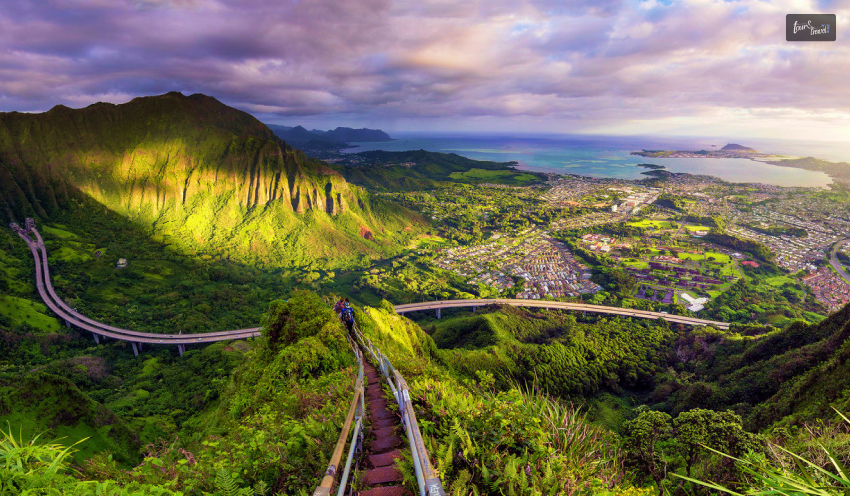
Going on a hike up the infamous Stairway to Heaven Hawaii on the island of Oahu calls for in-depth preparation on your part. It is one of the most dangerous hiking trails. It is also known as the Haiku Stairs.
In this article, you will find information on the hike’s history, current status, alternate routes, incline, security, distance, best weather conditions, helpful gear, and a guide to get there.
History Of The Stairway To Heaven Hawaii
lifeonearth.com
In 1942, contractors for the U.S. Navy began the construction of the Haiku Radio Station. It was a top-secret facility that transmitted radio signals to Navy ships that were operating in the Pacific. To get the right altitude for the antennae, they stretched them across the haiku valley, which is like a natural amphitheater. You might still see the remnants of the wooden ladder beside the new metal steps.
The radio station was commissioned in 1943. A stronger transmitter that could relay powerful signals was necessary. This could not be done with the vacuum tube technology used at the time. So they chose to go with an Alexanderson alternator, which uses a huge device that can generate powerful yet low-frequency radio signals. It would need a large antenna.
When the Naval Air Station Kaneohe Bay was transferred to the Marine Corps around the 1950s, the U.S. Coast Guard used the Haiku Radio Station site for an Omega Navigation System station. In the mid-1950s, the wooden stairs were replaced by sections of metal steps and ramps. The total number of stairs stood at 3,922. The Coast Guard did not stop hikers in the 1970s but had to stop after it featured in the Magnum P.I. movies, which increased the number of visitors. The station as well as the trail have both been closed to the public since 1987.
Recent History
In 2003, plans were made to reopen the stairs to the public, and the cost incurred to repair the stairs was $87,500. The public access being shut down, residents found themselves surrounded by unknown faces of hikers and tourists and litter all around. In early 2018, the City and County of Honolulu released a statement to not open the stairs to the public, showing liability concerns. Some hikers, however, continued to trespass, which only strengthened the local community’s resolve to keep the structure closed to the public.
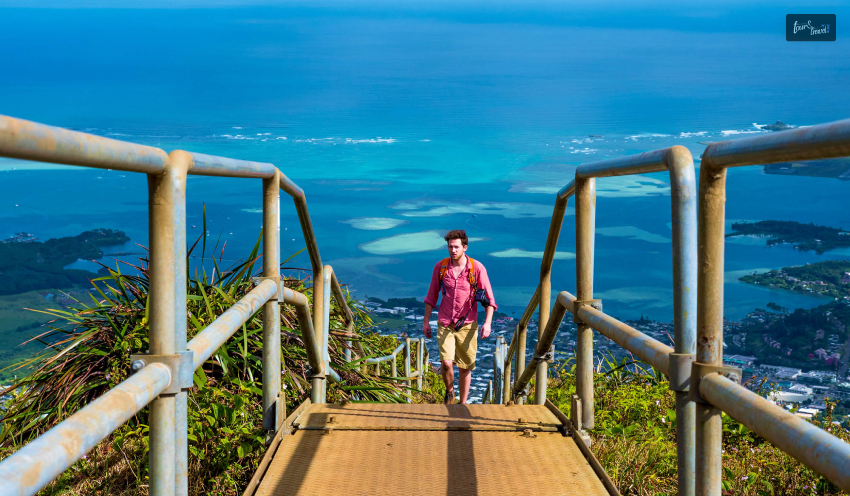
The Friends of Haiku Stairs, a volunteer group that aims to preserve the trail, pitched that there could be an alternative to a no-trespass, safe public access to the trail without taxpayer costs. The trail now is a disputed one with all its beauty and thrill. However, it has not stopped the locals, hikers, and travelers from stealing past the guards posted at the bottom of the stairs. This hike is a strong dose of adventure, climbing nearly 4,000 steps along an 18-inch wide staircase to reach an elevation of more than 2,000 ft.
Incidents
squarespace-cdn.com
The hiking trail is not a site for any major injuries or accidental Stairway to Heaven Hawaii deaths on the stairs. There have only been minor incidences in the last decade. However, between 2021 and 2022, there have been more number of injuries and rescues of hikers trying to get to the top of the stairs. The rescues have mostly taken place for hikers going through the Moanalua Ridge, which is the longer and more difficult of the trails. Many hikers are rescued “near the Haiku Stairs” and not the Hawaii Stairway to Heaven itself.
In 2014, 6 people were arrested, and 135 were quoted to have climbed the stairs. According to the City Prosecutor’s Office, a criminal trespass in the second degree carries a $1000 fine.
The Stairway To Heaven Hike Hawaii: My Experience
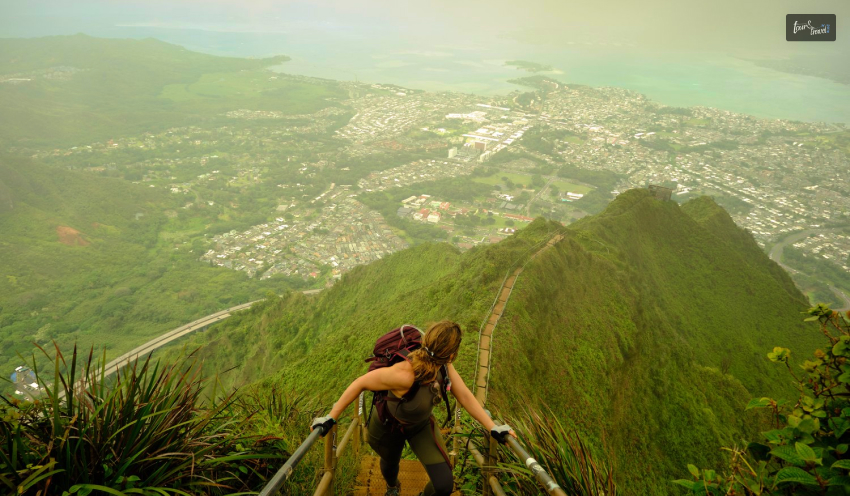
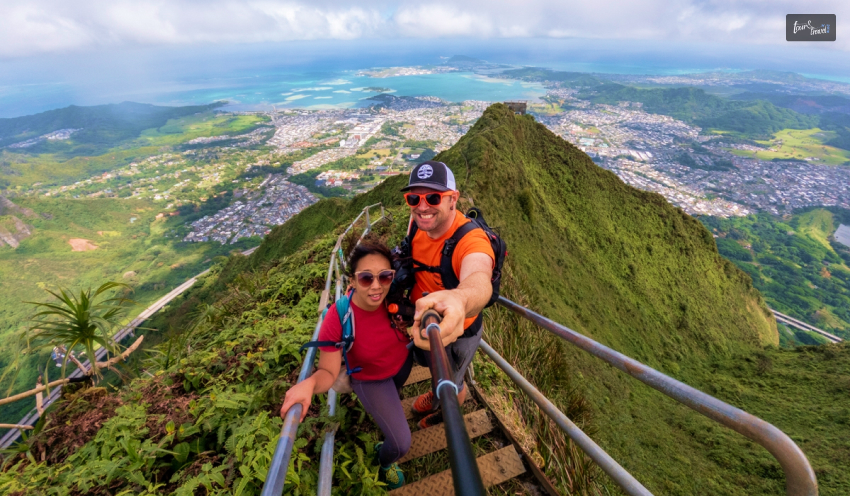
The Stairway To Heaven hike on Oahu, Hawaii, is possibly the biggest attraction on the entire island. A grueling number of 3,922 stairs go up to the imposing mountain ridge. Most of the time, the incline is vertical, with only a handrail to save you from falling into the valley below. It sounds dramatic, but it is what it is. But it isn’t too dangerous if you are prepared for it.
Distance: 2 miles or 3 km round trip
Elevation Gain: 2,630 feet or 800m
Duration: 2-3 hrs up, 1-2 hrs down
We started out by being dropped off in the neighborhood at 2 am in the morning. It was a clear night with just a few light clouds hovering over the mountains. As soon as we got out of our car, a resident came rushing out of his front yard, yelling at us. Thus, startled by the old man, we hurried away to the “main entrance” to get our eyes fried with a beaming flashlight.
The Trail
We silently went off in the opposite direction toward an alternate entry point, keeping in mind that the old man quite possibly called the guard or the police to warn them about us. We were thrilled by the idea of being caught and afraid of being caught, actually.
Walking through the neighborhood as quietly as possible, the barking of dogs totally blew our cover, making our presence known. We ran down the street to a small alley that led up to the hill. We had to cross over the barbed wire fence, which was close to a residential area. It is understandable why the residents are so annoyed with trespassers.
From here, we had to steal past the knee-high undergrowth as quietly as we could go. We were nervous when approaching the guard, understanding that we had trespassed multiple sites that were strictly no-go. As we approached the red car of the guard, we found that no guard was around. We walked past it and towards the stairs. As we ascended the stairs, we finally felt relieved to think that the police or guards didn’t go after the trespassers on the stairs.
On The Stairs
change.org
We felt much safer, and we could now enjoy our 3 a.m. hike along the Stairway to Heaven. In 2015, a storm damaged many parts of the stairs to the point where they could not support use. It is not dangerous per se, but it makes your ascension more thrilling. A few of the steps were loose, and we had to keep that in mind while treading on each of them.
We did not have headlamps. We followed the full moon up the narrow and damp stairway. I managed to keep looking back to see the highway, which kept getting smaller as we went higher in order to reach platform one.
Grasping the slippery railing tightly, we made our way to the second platform, where an abandoned cabin lay with old machinery inside. It looked straight out of a post-apocalyptic movie. Another two hours went by, and we almost reached the summit. The final section of the hike consists of boards instead of stairs, which make it a catwalk at 2000 ft. in the air on top of a sharp ridge.
At The Top
squarespace-cdn.com
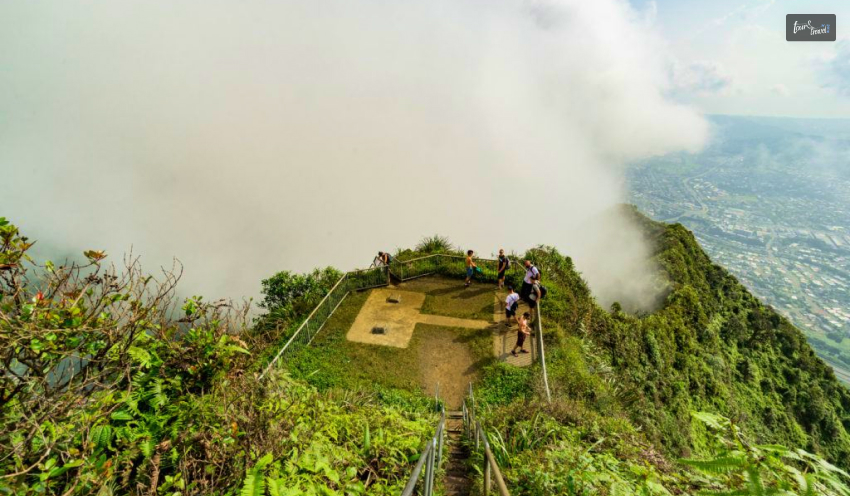
At the summit, we found an old cabin with huge antennae on top. We moved around the space on top among the clouds. We then returned to the bunker to wait for the spectacular sunset this place always has. Putting on a fresh pair of dry shirts and jackets made the experience much more comfortable while at the summit.
The sky became a pale blue and then shades of purple. With that, the sun came tearing through the haze. It shone yellow and gold over the Haiku Hawaii Valley. Many others witnessed the sunrise along with us, who began their descent once the spectacle of the sunrise was over. One of the trails downward is the Moanalua trial, which is a 6-mile route, but you can miss out on the views. It also helps you avoid the guards if that is your main issue, but it is 3 to 4 times longer than other routes.
The hike down was a treat for photographers. We were in no rush, so we got down at our own pace, taking in the views and shots for our socials. It feels amazing to have ascended in the dark and then descending in broad daylight. It took less than 2 hours to reach the bottom. We saw the guard’s red car where it was in the morning, but this time, we took the risk and did not avoid it.
The Guard Below
.journeyera.com
Meeting guard, he joked, saying, “I’ve called the cops, they must not have come,” as he began laughing to himself. His sense of humor eased our anxiety. He gave us the look of get-out-of-here-before-you-get-caught, and we crept away on queue.
The situation has become much more serious in the recent past, so the guards may not be as friendly as they were. Be careful if you go in 2023.
At the final gate, we saw no signs of police or angry residents. We were free! We could not believe we had just hiked the Stairway to Heaven Hawaii! This is truly a place for one and all. It looks like the real version of Jurassic Park. It is dreamy as well as eerie. You can totally attempt this hike if you visit Oahu.
Try to have someone who has visited before guide you through this hike if you visit here for the first time.
Alternate Route
thatadventurelife.com
The alternate route is the Moanalua Trail. The route is 9.3 miles in length. It gets you all muddy and is not the easier option, either. It can help you avoid the guards at the beginning of the trail. But it is not hassle-free. It all depends on when you go and how well-prepared you are for any kind of situation.
Things To Pack For The Stairway To Heaven Oahu Hawaii Hike
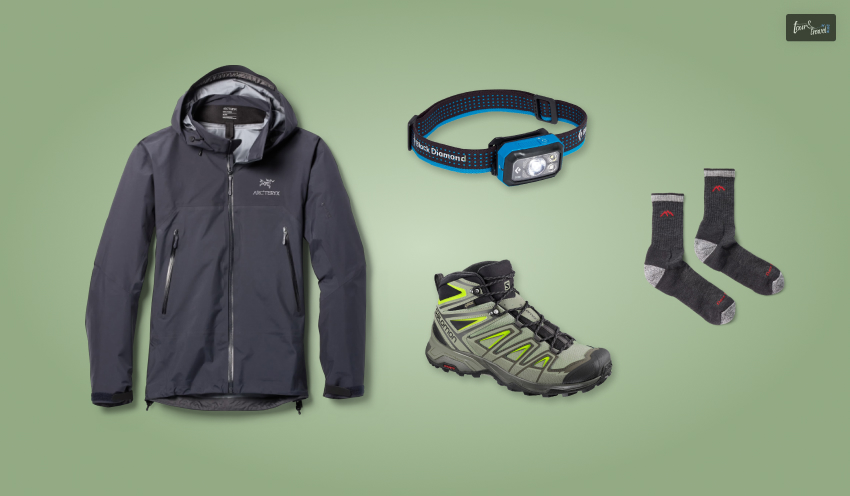
Going unprepared for the hike is one of the biggest mistakes you will make. You must have the basics and stay prepared for bad weather. Here is a list of essentials you must consider among everything else.
Arcteryx BETA AR Rain Jacket: This is the rain jacket of your dreams. They are super light. They will fold into the tiniest ball and save you from the harshest storm.
Salomon X Ultra 3 Mid GTX Hiking Boots: For better ankle support on that 400-step long hike, waterproofing and toughened exterior are necessary for your boots. These Solomons can easily be your best buddy.
Black Diamond Head Torch: In case you return incredibly late from your hike and it gets dark, a headlamp will help you as nothing else will. Keep this one handy for sure.
Darn Tough Socks: These will be the most comfortable hiking socks you will own. They don’t wear out easily, either. They have a lifetime warranty. You simply send them with any sign of wear and tear, and they will replace it without further questions.
Frequently Asked Questions (FAQs):
Here are some common questions people ask about this hike, take a peek:
1. How Did The Stairway Come About?
The stairs were originally built in 1942 by the U.S. Navy as a top-secret facility to transmit radio signals to ships that were sailing in the Pacific Ocean. The stairs went public, deeming it fit until 1987, when it became dangerous due to disrepair. Residents of Oahu have fond memories of hiking up the stairway to heaven legally a long time ago.
The city of Honolulu reportedly spent almost a million dollars in renovating the stairs and considered re-opening the stairs to the public in 2002. Resident complaints and safety concerns halted the re-opening, and the stairs have stayed closed ever since.
2. What Are Some Of The Other Places To Visit In Oahu?
You could take a helicopter flight tour without the doors. The view from above will blow you away. A shark cage tour can ensure you don’t talk about thrilling adventures for another year or so. It will give the adrenaline rush like no other. Ecofriendly dolphin and snorkel tours are also available.
Wrapping Up
The Stairway to Heaven Hawaii trail is dangerous when seen from below. It is only when you undertake the hike (with proper planning and preparedness, of course) that you understand it is not as daunting as it looked. All you need is a thirst for thrill and sharp wit that comes in handy when you go face to face with adversity. There is also the added fear of strict laws around the hike, which will keep you on your toes.
Let us know if you visit this amazing trail. And if you have questions or thoughts to share, please leave a comment below. We would love to hear from you!
Abdul Aziz Mondol is a professional blogger who is having a colossal interest in writing blogs and other jones of calligraphies. In terms of his professional commitments, he loves to share content related to business, finance, technology, and the gaming niche.
We planned XXXX brewery tours - visit Brisbane as a tribute to an Australian icon. I was traveling with my partner, and neither of us had ever done a brewery tour in Australia before.
So, naturally, the start was a little jittery. Still, we opted for it for a unique and fun experience. Also, we scheduled our XXXX brewery tours - visit Brisbane on our last day in Australia.
Moreover, we planned that our tour would start at 11 AM so that we had the rest of the day for leisure.
Still, we got late somehow and had to skip our breakfast to catch up with the tour. And, rushed and huffing and puffing, we reached the brewery 10 minutes late. We were hot and sweaty.
Moreover, at first we lost our way to the entrance, making us late by another five minutes. The moment I started thinking of it as a lost opportunity, the amazing people there told me that we could still join the 11 AM tour.
So, though the day did not start on a great note, it did not feel bad anymore.
How To Reach The XXXX Brewery?
I don’t want you to lose your way to the XXXX brewery tours - visit Brisbane like us. That is why I am sharing the details about how you will reach the brewery.
The brewery is located opposite the Milton Railway Station. Furthermore, you will have to take a brief walk from the Suncorp Stadium.
Once you reach the brewery, you need to locate the entrance. It is at the corner of Paten Street and Black Street.
Confused, we ran up and down Milton Street. Don’t make this mistake.
How Was Our Experience Of XXXX Brewery Tours - Visit Brisbane?
So, the XXXX brewery tour started. It was a delightful step-by-step process, and we enjoyed it thoroughly.
1. Getting Ready For The Tour
When we reached the brewery, we got baseball caps with an XXXX branding. We also had to wear lanyards, fluorescent vests, and goggles.
In addition, they gave me plimsolls to wear as I had open-toe shoes on. I loved my look when I was ready in the gear.
Also, the best thing was that there were not many people on the tour. A guy called Rickie took charge of our tour. He was quite goofy, but he had in-depth knowledge of the brewery and ale-making.
2. And The Tour Started
He started the tour with a crisp video of the XXXX story and took us around. We saw how everyone was in action inside the brewery. He actually showed us the process of beer making.
You have to take the tour yourself to understand the things I saw.
3. Exploring The History And Making Of The Beer
We saw the bottles whizzing, and there were brewing tanks. Then, the bottles were moving on the conveyor belts for storage and labelling.
Afterward, Rickie took us to a small museum, and we learned about the history of beer there. The bottle designs were diverse, and they had the XXXX mascot and other paraphernalia.
Once again, unless you are a part of the tour, you will not understand why the XXXX brewery is the most iconic brewery of Queensland, and it has a history of 145 years.
The tour took us around 90 minutes, and then came the most exciting part, the beer tasting. The things we can do for free beer! Cheesy? Can’t help it.
Enjoying Free Beer On XXX Brewery Tours - Visit Brisbane
We had to take off our health and safety gear at the end of the tour. Then, Rickie took us to the bar.
There, we sample four different types of beers brewed there.
I cannot remember the names because, anyway, the Australian diction is not the easiest thing to decipher for my Indian sensibilities. However, I liked the taste of each variant.
I was missing my colleagues and friends badly. Those people, the beer towers kept me going, where evenings turned into nights and the work hours were never-ending.
Nevertheless, once we finished sampling, Rickie handed us a full-sized bottle of beer. It was so much fun at the bar.
And that was not all. The bartender had an extra glass of beer ready, and he offered it to me as a great gesture.
My partner even tried a glass of champagne there, as everyone present was celebrating the Melbourne Cup. It is indeed “The Race that stops a nation.” They poured so many glasses that even a handsome crowd could not finish them.
Our Brunch Plan Changed Into A Lunch Session Soon
With adequate beer tasting and having champagne, both of us were drunk. This was surely the booziest brunch I ever had.
We were naughty and even felt hungry. So, we decided to have lunch at the XXXX bar. I ordered a salmon dish. Of course, I don’t remember the name, and my partner opted for a huge burger to soak in the alcohol.
The Lovely Atmosphere Of The Bar
We loved the atmosphere of the bar. The tour did not have many people. However, many people were already present at the bar, and they were watching the Melbourne Cup on a big screen.
Still, all of us found comfortable seats and had a fun meal. Probably, great beer makes you feel in a way, but I enjoyed everything about the hours I spent there.
Also, the staff was really friendly. So, if you are in Brisbane and relax in a safe space, you must plan a XXX brewery tour.
Things To Keep In Mind For XXXX Brewery Tours - Visit Brisbane
If you want to join the XXXX brewery tours - Visit Brisbane, you need to have an ID proof, and you have to be above 18 years.
Furthermore, you can book the tours in advance through Viator.
You can take the tours from Wednesdays to Saturdays.
It is better to wear covered shoes. Otherwise, you will have to wear plimsolls like me.
The only disadvantage I found in the brewery was the absence of wheelchairs or clutches. Also, you will have to take steps. So, the tour will be difficult for you if you have mobility issues.
Read Also:
Australia’s Best-Kept Secret: Tailored Travel Experiences In The High Country
8 Beaches of Melbourne, Australia Where You Can Cool Off!
Interesting Facts about Australia that will surprise you!
Lincoln offers a unique blend of the past and the future.
Visitors can find high-rise buildings as well as sophisticated old architecture. The city offers everything, including the magnificent cathedral, to the cobbled streets of the historic Bailgate. The city also offers some of the most mesmerizing collections at the Museum of Collections.
Moreover, tourists of all kinds equally enjoy visiting the place. Families and solo travellers equally enjoy visiting the place.
In addition, the city offers the best parking facilities, the best transportation options, and several other amenities. So, up for a group travel in Lincoln?
Understanding Your Group Transport Options
Group Travel in Lincoln involves selecting the ideal type of transportation. Moreover, the travel arrangements depend on the number of people traveling with you.
Travellers should choose the ideal vehicle for their trip based on their group size and destination. Smaller groups like 8-16 people should go for mini buses. The minibusses navigate well through the narrow streets of the city.
The mini buses provide ideal luggage housing while travelling overnight. However, mid-sized groups with 17 to 35 passengers require midi-coach solutions. The large-sized groups, on the other hand, need atleast full-sized coaches. Moreover, the full-sized incorporate amenities and facilities like automatic recliners and others.
The midi-sized and the full-sized coaches are ideal for travelling long distances.
Professional Driver Benefits
The value of professional drivers extends far beyond simply operating the vehicle.
Moreover, experienced drivers familiar with Lincoln are aware of which routes avoid congestion.
The drivers thoroughly understand which approaches to attractions offer the easiest access.
Moreover, the drivers exactly understand where drop-offs cause the least disruption to schedules.
This local knowledge proves invaluable when navigating a historic city. Moreover, satellite navigation systems often overlook details.
Satellite navigation systems often suggest inappropriate routes through pedestrianized zones or streets that are too narrow for larger vehicles.
Popular Lincoln Destinations Perfect For Group Visits
Here are some of the places that travellers should consider visiting during their Group Travel in Lincoln.
1. Lincoln Cathedral And Castle
The twin jewels of Lincoln's Uphill area, the Cathedral and Castle, welcome thousands of group visitors annually.
Thousands of group visitors annually visit the twin jewels of the Lincoln Uphill area. Moreover, the cathedral provides people with a 900-year history. Tourists also visit the adjacent Lincoln Castle, which houses an original Magna Carta. Furthermore, tourists experience walking the medieval walls for panoramic city views
Group visits here benefit enormously from coordinated arrival. Moreover, Cathedral and Castle tours operate on a timed-entry system.
Thus, having everyone arrive together ensures that no one misses the scheduled start.
The Uphill location's limited parking makes minibus hire Lincoln particularly advantageous, as drivers can drop groups directly at entrances before parking in designated coach bays.
2. The Bailgate Quarter
This charming historic district immediately surrounding the Cathedral offers independent shops, cafes, and restaurants.
Moreover, beautifully preserved medieval and Georgian buildings preserve all the amenities.
Hence, Groups often enjoy browsing together here after cathedral visits. Moreover, tourists enjoy walking on the traffic-free streets around the cathedral.
3. Brayford Waterside
Lincoln's regenerated waterfront district combines the historic Brayford Pool. The place incorporates Britain's oldest inland harbor, which remains in use to date.
Moreover, the area provides contemporary bars, restaurants, and the University of Lincoln's striking modern campus.
Hence, this area provides excellent options for group dining and entertainment, particularly for corporate events or celebrations.
4. Beyond Lincoln: Regional Day Trips
Lincoln's central location in Lincolnshire makes it an excellent base for exploring regional attractions.
Moreover, the beautiful Lincolnshire Wolds, designated an Area of Outstanding Natural Beauty, lie just thirty minutes away, offering scenic villages, walking trails, and traditional country pubs.
Hence, the seaside resorts of Skegness and Mablethorpe provide classic British coastal experiences within an hour's drive.
Things To Keep In Mind About Group Travel In Lincoln
Tourists should designate someone to count heads at each stop, particularly with larger groups.
Moreover, a quick headcount before departing ensures no one gets left behind—surprisingly easy when groups split to use facilities or browse shops.
Keep valuables with you rather than leaving them in vehicles during stops. While drivers secure vehicles, personal responsibility for belongings prevents unfortunate losses.
People should consider shuttle services between the ceremony and reception venues if they're separated.
Moreover, Continuous loops ensure all guests make the transition efficiently.
Therefore, having transport available throughout the evening allows guests to depart at their preferred times.
For wedding parties themselves, quality transport becomes part of the celebration.
Hence, modern vehicles provide comfortable, stylish travel between locations, and some couples use journey time for photographs at scenic Lincoln viewpoints.
Moreover, group visits allow people to get the best experience with proper convenience. Organized traveling allows people to achieve the best results without leaving anyone behind.
Hence, Group Travel in Lincoln allows people to explore more without the hassle of keeping a plethora of things in mind.
Events like weddings often create demands for group travel. Hence, several travel agents provide the ideal transportation to the iconic venues like cathedrals and others.
Frequently Asked Questions:
Here are the answers to some of the most commonly asked questions about
1. How Far In Advance Should I Book Group Transport In Lincoln? People should book things early. Moreover, tourists should book atleast two to three weeks in advance. However, people should book early during peak tourist seasons, such as Christmas and others. 2. What Happens If Our Group Size Changes After Booking? The tourists should inform the travel agent immediately after the group size changes. Moreover, small increases can be incorporated depending on the available space in the vehicle. However, it can not be guaranteed. 3. Can We Make Multiple Stops During Our Journey? Most travel agents offer the option for multiple stops. However, this often influences the overall pricing. 4. Are Group Transport Vehicles Accessible For Passengers With Mobility Issues? Some vehicles provide travellers with options like wheelchairs and other assistance. However, people should book them in advance. Moreover, the travel agents provide such vehicles based on availability. 5. What's Included In The Rental Price And What Costs Extra? The travel organization often charges extra for traveling off the planned route. Moreover, people do not have to pay for everyday expenses like driver, fuel, insurance, and basic route mileage.
Read Also:
How Weather Impacts Your Car Service from Attleboro to Logan Airport
Essential Car Checks Before a Long Journey: Road Trip Ready
Car Safety Tips for Traveling with Puppies and Small Dogs
Most people planning a trip are not thinking about their driving record, and most people dealing with a DUI charge aren't thinking about their next vacation.
But the two intersect more often, and more disruptively, than either group expects.
It can be a car rental, a cross-border trip, or a flight booked months in advance!
An open or recent DUI charge can complicate travel in ways that are easy to miss until it's too late to plan around them.
Understanding these DUI travel restrictions and effects early, and knowing when to consult an impaired driving defence lawyer, can prevent a second unpleasant surprise on top of the first.
Car Rentals: The Immediate Complication
If you have plans for hiring a car for an amazing road trip, DUI travel restrictions can cause hiccups.
Rental agencies keep checking driving records regularly.
So, whenever there is a restriction or suspension, they will get to see it. Also, even if the restriction or suspension is temporary, they can reject the rental or ask for a significantly higher fare.
These DUI travel restrictions for car rentals are applicable for domestic and international travel.
Moreover, the worst part is that you will not get to know about these restrictions during the booking process.
You will usually discover them at the counter, leaving hardly any room for a plan B or alternative travel plans.
Crossing The Border: Where Timing Matters Most
If you have a DUI charge, you can face the most annoying problems during international travel. Unless you are a first-timer, you at least know the basics of the traffic rules or travel etiquette in your country.
However, these rules change from one country to another. So, DUI travel restrictions hit the hardest during international travel.
Here are more details about how these restrictions impact you.
Entry requirements vary significantly by country, and some treat any impaired driving charge, regardless of final outcome, as grounds for potential denial of entry.
A charge alone, even before conviction, can appear on background checks that certain border agencies have access to, depending on jurisdiction and information-sharing agreements.
Advance planning matters more than most people realize. Discovering an entry issue at the border, rather than beforehand, turns an inconvenience into a cancelled trip.
A Realistic Look At The Timeline
Travel Plan TimingPractical ConsiderationTrip booked before the chargeReassess entry requirements for the destination as soon as possibleTrip planned during an open caseConfirm whether any release conditions restrict travel at all.Trip planned after resolutionUnderstand how the final outcome, not just the charge, affects entry eligibility.
Why Release Conditions Sometimes Restrict Travel Directly
Beyond the border-entry question, some release conditions imposed after a charge include explicit travel restrictions.
This happens particularly around leaving the province or country while the case is active.
These conditions aren't automatic in every case, but ignoring the possibility and booking travel without checking is a common and avoidable mistake.
Business Travel and Professional Impact: The Hidden Corporate Cost
We usually associate travel with leisure. However, an unexpected DUI charge can derail your professional life, especially when your growth is related to extensive site visits or travel.
Also, in the current scenario, business operations frequently demand that employees travel on short notice.
So, there is hardly any time left for the employee to navigate the complex legal loops or apply for the special entry waivers.
Nevertheless, here are some scenarios where DUI travel restrictions can cause professional dilemmas.
1. The Surprise Business Trip
Suppose you have to attend a business meeting in Toronto suddenly. Or, you may have to meet a client in Tokyo.
Your DUI charge can create a bottleneck, especially if a conviction is enforced just before the trip.
2. The Disclosure Dilemma
If you have a DUI charge, you may be denied entry to a foreign country. Also, the car rental agency can reject your application for a car rental after a corporate background check.
To avoid this, you must disclose these sensitive details to your HR first, or you can come up with any other excuse for why you cannot travel right now.
3. Corporate Policy Violations
Many companies maintain strict internal policies regarding employee driving records.
If your job involves driving a company vehicle, managing fleet operations, or even renting a vehicle on the company card, a DUI can result in an immediate suspension of those privileges, directly threatening your job security.
Steps Worth Taking Before Booking Anything
1. Check your specific release conditions first, rather than assuming general travel is unaffected.
2. Research the destination country's specific entry policy regarding impaired driving charges or convictions, since policies vary considerably.
3. Ask about documentation you may need, as some countries have processes for addressing past charges directly with border authorities.
4. Get legal guidance before finalizing travel plans, particularly for any international trip, rather than after a problem surfaces.
Why This Gets Overlooked So Often
Travel planning and criminal defence feel like unrelated categories to most people, which is exactly why this overlap catches so many off guard.
The charge itself, not just a conviction, is often enough to trigger scrutiny at a border crossing, which surprises people who assume nothing changes until a case is formally resolved.
DUI Travel Restrictions: Frequently Asked Questions (FAQs)
Here are the frequently asked questions and answers about DUI travel restrictions.
1. Does A DUI Charge Automatically Prevent International Travel?
A DUI charge does not automatically prevent international travel.
However, it can trigger additional scrutiny or entry denial depending on the destination country's specific policies.
2. Can Rental Car Companies Deny A Rental Over An Open Charge?
Yes, particularly if any driving restriction is currently in effect, a car rental company can deny a rental over an open charge.
This is a common and often overlooked complication.
3. Is It Worth Getting Legal Advice Specifically About A Planned Trip?
Yes, it is worth getting legal advice, especially for international travel.
The entry requirements vary, and the consequences of an unexpected denial can be significant.
References
Government of Canada – Impaired Driving Laws
Government of Canada – Travel Advice and Advisories
Ontario Ministry of Transportation – Impaired Driving
Read Also:
The Ultimate Guide To Planning A Southwest Desert Adventure From Las Vegas
Villa Or Yacht? Why The Best Luxury Croatia Trips Combine Both
How To Promote Your Upcoming Summer Camp





 Related