
Ritigala Forest Monastery: Location, Timing, History, Climbing Experience And More
BY
Sibashree
Feb 18, 2026
After exploring the Tamil culture and the Hindu temples of Jaffna, it was time to visit an ancient and secluded Buddhist meditation retreat in Sri Lanka.
It has stone ruins from the 1st century BC, and it was once home to the Pamsukulika Sect of monks, who were known for their meditation-based and secluded lives in the forest.
Moreover, the Ritigala Forest Monastery has an association with the stories of the Ramayana. Also, this monastery is inside the Ritigala Forest Reserve. So, it is a place where history, spirituality, and wildlife await you.
Hi, in today’s blog, I will talk about how I climbed up the stone steps to reach the Ritigala Monastery in Sri Lanka, the history, legends, and the main attractions of visiting the ancient monastery today.
I will also talk about the transportation options.
Where Is Ritigala Forest Monastery?
Sri Lanka maybe one of the cheapest places to travel in the world. However, its natural beauty and the cultural and historical richness are matchless. The Ritigala Forest Monastery is one of the hidden gems in Sri Lanka.
The Ritigala monastery is located across the mountain of Ritigala. The mountain of Ritigala is the highest mountain in the dry northern region of Sri Lanka.
It is close to Harbarana, which is again the epicenter of the cultural triangle, the Sigiriya Rock Fortress, Dambulla Cave Temple, and Polonnaruwa. It is also the gateway to many wildlife safaris in Sri Lanka.
The distance between Harbarana and the Ritigara mountain is around 21 km. Other important locations near the mountain are Anuradhapura, which is at a distance of 42 km, and Sigiriya, at a distance of 32 km.
Furthermore, the Ritigala Forest Monastery is inside the Ritigala Strict Nature Reserve.
However, remember one thing. As I mentioned in my Jaffna, Sri Lanka, travel guide, you have to rely on the locals when you are exploring the cultural landmarks or a secluded place like the Ritigala Forest Monastery.
You cannot trust Google Maps completely for locating the Ritigara mountains and monastery.
How To Reach The Ritigala Forest Monastery?
Harbarana was the base for my road trip to the Ritigara mountain and trekking further.
1. Reaching Harbarana From The Bandaranaike International Airport (CMB)
I took a flight to the Bandaranaike International Airport (CMB). The distance between the Bandaranaike International Airport (CMB) and Habarana is around 151 km.
You can take a car rental for the entire journey. However, being a fan of the LowDownUnder Travel, I chose a different path.
After reaching the Bandaranaike International Airport, I took a taxi to Gampaha and then took a train to Harbarana. The ticket cost me around INR 400, and the travel time was around 4 hours and 40 minutes.
The Sri Lankan Railways runs two trains daily from Gampaha to Habarana.
Other airports close to Harbarana are Sigiriya Airport (18 minutes), Kandy Airport (2 hours), and Trincomalee (1 hour and 36 minutes).
2. From Harbarana To The Ritigara Mountain
From Harbarana, I took a taxi to reach Ritigara. It cost around INR 420, and the travel time was around 35-40 minutes.
You can also reserve a car or tuk-tuk to take you to the mountains, wait for you at the entrance gate, and take you back home when you are done trekking. In such cases, the reserve cost will be around INR 1000-1200.
The route from Harbarana to Ritigara was beautiful. My cab driver pointed out the local farming practices and the land on the way.
It was a fulfilling experience, and as Jaffna has a unique food scene based on its local agricultural practices, the food habits of this northern-central region of Sri Lanka. Red rice, jackfruit curry, and river fish are the staples here.
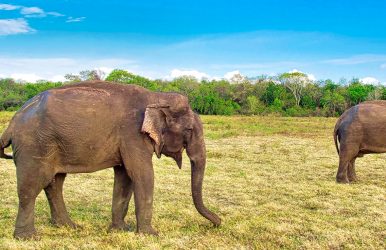
Also, my driver told me to keep my eyes open to spot elephants. However, I was not lucky enough to spot my favorite animal. I noticed some fresh dung in the road, though.
Furthermore, when the car came off the main road, the ride became a little bumpy. The route from here to the Ritigara mountain was a combination of dirt tracks and semi-paved roads.
Finally, I reached the entrance of Ritigara and purchased my ticket. The ticket cost me around INR 450, and I even got a guide for INR 1200.
What Is The History Of Ritigala Forest Monastery?
The history of the Ritigala Forest Monastery goes back to the 1st century BC. You will find here more than 70 rock caves, the 9th-century meditation spots of the "Pansukulika” monks, and unadorned stone pathways.
Here is a brief historical timeline of the Ritigala Forest Monastery.
1. Establishment Of The Ritigara Forest Site For Monks
Buddhist monks came here and started living in the sacred mountains in the 1st century BC. There were more than 70 caves where monks started meditating in solitude.
Even today, there are many rock inscriptions from which we can learn about how many patrons helped to build and maintain the site, which was home to monks who left the luxury of monasteries and used to meditate in the caves.
2. Receiving Royal Patronage
This site received adequate royal patronage, and from the inscriptions, we especially get to know about King Pandukabhaya.
He founded Anuradhapura and built a reservoir at the base of the mountain for the hermits here in the 4th century BC.
3. Building Of The Pansukulika Sect Monastery
King Sena I built the Ritigara Monastery in 833, and it was meant for the Pansukulikas or monks in rag robes.
These monks practiced the highest form of asceticism, and they were on a mission to revive the simple teachings of Lord Buddha.
4. The Decline Of The Pansukulika Sect And The Monastery
From the 9th to the 11th century, the Ritigala Forest Monastery and the Pansukulika Sect of monks enjoyed immense glory.
However, with increasing donations and the monks getting inclined toward what they earlier rejected, the core philosophy of the sect was lost.
Two rival sub-sects were formed within the Pansukulika Sect. Finally, King Vijayabahu I confiscated their extensive holdings in 1070-1110 CE as a part of a Buddhist monastic reform.
5. Abandonment And Discovery Of The Ancient Monastery
Despite the royal patronage, the Ritigara Forest Monastery was abandoned around the 10th to 12th centuries due to the Chola invasions.
It was an unprotected ruin until James Mantell, the British colonial surveyor, saw the ruins while climbing up the mountain.
Then, he drew the attention of H.C.P. Bell, the first Archaeological Commissioner of Ceylon. He understood the historical and religious importance of the place and expanded it extensively in 1893.
Finally, in 1941, the 1528 hectares of the forest area, including the ruins, were designated as a Strict Nature Reserve.
Today, the conservation efforts strike a balance between the ecological and archaeological preservation of the monastery and the site.
Design And Engineering Of The Ritigala Forest Monastery: The Incredible Ruin
The monastery does not look like the traditional stupas. Here, you will find interconnected stones, paved pathways, and stone bridges.
Furthermore, there are bathing areas like the famous Banda Pokuna.
The most unique thing about the Ritigara Monastery is that here you will not find any Bodhi Tree or any Buddha statue.
It is a place where you can walk, meditate, and contemplate.
You may call it a failed attempt to revive the radical simplicity of Buddhism, but for every seeker, it will always be a place to introspect and connect to a higher energy.
I had goosebumps the moment I entered the monastery. Let’s delve deeper into the unique architecture of the monastery.
1. The Padhanaghara And Stone Pathways
The ruins of the Ritigala Forest Monastery cover an area of around 120 acres. You will see around 50 distinct meditation houses or Padhanaghara in the area.
Inside each meditation house, you will find two raised platforms in the east-west direction, and those were made of stone. A small maot surrounded the platforms, and a small stone bridge connected the platforms.
Probably, these structures were used for some rituals or meditation purposes.
Interlinking stone pathways connect these meditation houses. These pathways are 1.5 meters in width, and the width is consistent as the pathways ascend the slope. These pathways also have circular intersections.
2. Water Management System,
The water management system in Ritigala Forest Monastery was sophisticated. Banda Pokuna and Kumbuk Wewa, these twin ponds were carved from rocks.
Furthermore, I found a large stone trough in the courtyard, which was used for cooking food.
Also, I saw the ruins of the monastery hospital and stone mortars, which were used to grind and prepare herbal medicines.
Moreover, the monastery did not have any residential complex. The monks lived and meditated in the caves.
However, there were urinal stones, which were the only amenities or the luxury the monks enjoyed in this austere setup.
What Is The Legend Of The Ritigala Forest Monastery?
The Ritigala mountain has a connection to the Hindu mythology, the Ramayana. Attacked by Ravana, Lakshama, the brother of Lord Ramachandra, became unconscious on the battlefield.
Lord Hanuman, on Lord Rama’s command, went to fetch a life-saving medicinal herb from the Dronagiri. However, he forgot the name of the herb and carried the entire mountain on his shoulder.
When he was crossing the Palk Strait, five segments of the mountain fell from his grasp. The biggest fragment fell on the site of the Ritigara Mountain.
Now, you may not believe the legend of the Ritigala Mountain. However, the presence of various medicinal plants in the mountains keeps the myth alive.
Moreover, among the 417 species of plants here, around 96 varieties are for medicinal purposes. Moreover, the northern peaks have names such as the Wannati-kanda and Aushada-kanda.
Climbing To The Ritigala Forest Monastery In Sri Lanka
Climbing up to the Ritigara Forest Monastery was a free-flowing experience. There are many things to see, but more to feel.
Here is how I explored the ruins.
1. The Bathing Pond
As I left the ticket counter behind, I found the first ruin. I took the stone steps to visit a massive bathing area.
You have to be careful with the steps here, as they are cracks and have overgrown tree roots.
Large trees have grown in the bathing area now. However, you can still understand its massive scale.
2. A Winding Stone Path And Ruins Of The Monastery
The winding stone pathway took me through various ruins, and they stood like the blueprints from a bygone era.
The most striking one among them was the ruins of the hospital. It still had a sunken bath and grinding stones for preparing medicines.
As I climbed up, I found the meditation platforms, big multi-chambered rooms, and urinals.
3. The Large Pavilion With Columns
I found a large pavilion here with big columns. However, the more intriguing was the Big Tree behind the ruin.
It is so massive that its ground roots have created a labyrinth. The road seems to fizzle out at this stage. However, my gut instinct said that there is something more.
4. The Hidden Ruin
My guide was not happy with me for continuing further. As I headed down, after the initial disappointment of landing on the forest floor, I found another ruin.
There was a stone bridge, and it took me to a promontory with a square structure. It was the ruins of the library that had many precious manuscripts.
The view from the promontory was amazing.
It is a shame that most trekkers miss it, as the signs are not adequate and often hidden in the overgrown bushes. Furthermore, most of them are only in the Sinhalese language, which only locals can read.
However, I used the absence of signboards to my advantage.
Practical Tips For A Visit To The Ritigara Forest Monastery
If you are traveling with your partner or in a group, you must reserve a tuk-tuk or car to bring you back. You may not get a passing traffic. I took the risk as it was a solo adventure.
You have to carry snacks and water. Wear sunscreen and carry insect repellents.
You will find a toilet at the entrance of the ruins. I did not use it. So, I am not sure about the condition or the amenities available.
Ritigala Forest Monastery: Frequently Asked Questions (FAQs)
Here are the frequently asked questions and answers about the Ritigala Forest Monastery.
1. How Much Time Is Needed At Ritigala? Trekking the Ritigala Forest Monastery is going to take around 2 hours. So, overall, you will at least need 3 hours in Ritigala. Trekking up the route is easy. However, walking through the cracked stone steps can be challenging.Also, signboards are scarce and incomprehensible on the route. So, you must take a local guide. 2. Where To Stay Near The Ritigala Forest Monastery? I stayed at Habarana, and the name of my hostel was The Lake Breeze. The tariff for the hostel was around INR 2000. The amenities were basic, with fans, Wi-Fi, and mosquito nets. 3. Is Taking A Tour Of Ritigala Forest Monastery Worth It? Yes, taking a tour of the Ritigala Forest Monastery is absolutely worth it. Here, you will find the ruins of the 1st century BC, and it is great for anyone with a keen interest in the history and evolution of Buddhism. Furthermore, the ambiance of the ruins is introspective and meditative. Moreover, you can easily reserve a car or tuk-tuk to reach the base of the Ritigara Mountain and then start your trek for 1.5 to 2 hours.
Have you ever thought about including a little bit more than just your articles? I mean, what you say is important and all. But think about if you added some great photos or video clips to give your posts more, “pop”! Your content is excellent but with pics and videos, this blog could certainly be one of the best in its niche. Excellent blog!
Hi there! I’m at work browsing your blog from my new apple iphone! Just wanted to say I love reading your blog and look forward to all your posts! Keep up the outstanding work!
Thank you. Stay tuned for our upcoming feature stories.
I really like your writing style, fantastic info , appreciate it for putting up : D.
I was very pleased to find this web-site.I wanted to thanks for your time for this wonderful read!! I definitely enjoying every little bit of it and I have you bookmarked to check out new stuff you blog post.
Thanks for your valuable comment. Till then stay tuned for upcoming posts…
Hi my family member! I wish to say that this article is amazing, great written and come with almost all important infos. I would like to see more posts like this .
Thank you very much for your appreciation. Till then, stay tuned for upcoming posts…
I went over this site and I conceive you have a lot of good info, saved to bookmarks (:.
Thanks for your valuable comment. Till then stay tuned for upcoming posts…
Some genuinely good information, Gladiola I noticed this.
Thank you very much for your appreciation. Till then, stay tuned for upcoming posts…