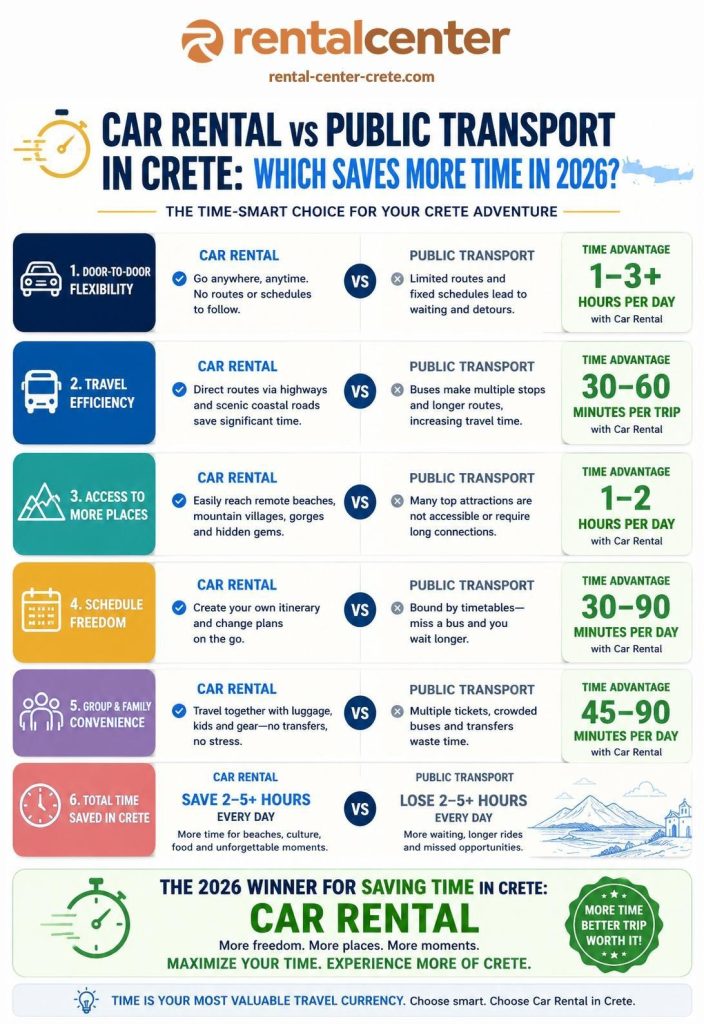
Car Rental vs Public Transport in Crete presents a significant choice for visitors planning their 2026 itineraries.
Speed, convenience, and flexibility serve as the primary metrics for evaluating these transportation modes. Travelers prioritize time savings to maximize their limited holiday duration on the island.
Comparing the direct routes of motor vehicles against the fixed schedules of the KTEL bus network reveals distinct advantages for each.
Comparison Between Car Rental Crete And Public Transport
Efficient planning requires a detailed understanding of the practical travel considerations across diverse Cretan landscapes.
A comparison of Car rental vs. public transport in Crete is shown in the table below.
Visiting multiple towns in one day
Car rental
Time-efficient and flexible
Staying in one city
Public transport
Cost-effective
Traveling in peak summer
Car rental with early pickup
Avoid crowded buses
Budget-conscious travelers
Public transport
Lower cost
Exploring rural villages
Car rental
Buses limited
City-To-City Speed: Car Vs. Bus
Driving between major cities such as Heraklion and Chania takes at least two hours through the National Road.
Moreover, a car rental Crete option cuts out all unnecessary delays. This lets you head straight to your destination.
Public KTEL buses require at least three hours for the exact same cross-island route.
Additionally, the extra hour disappears into passenger boarding and scheduled highway stops.
It also includes terminal transitions in busy city centers.
Choosing a car rental Crete vehicle frees you from rigid timetables completely.
You can also pack up and depart at any hour of the day without waiting around at crowded stations.
Efficient navigation relies on securing a reliable car hire Crete for the duration of the stay.
Island Transit: Driving Vs. Fixed Routes
Yes, renting a car is faster than taking buses in Crete.
Motor vehicles provide direct access to destinations without the intermittent stops required for passenger pick-ups.
Public buses follow strict routes that include deviations into smaller towns along the main highway.
Private transport eliminates the waiting periods associated with fixed bus schedules and terminal queues.
Travelers reach remote beaches or mountain villages in half the time compared to when public services are limited.
Private cars bypass the need to transfer between lines at major hubs.
The average time savings for cross-island journeys exceed sixty minutes per trip. Every journey benefits from the lack of passenger boarding delays.
How To Book The Right Car Rental In Crete: Practical Tips
Booking early makes the single biggest difference to price.
Reserving a car rental in Crete three to four months ahead of a summer trip typically locks in rates well below what is available two or three weeks out, since the island’s rental fleet is limited and July-August demand from European travelers fills up availability fast.
Know What The Fare Includes
Always check what the quoted price actually includes.
Many budget listings show a low headline rate but then add mandatory extras at the counter, such as a second-driver fee, a young-driver surcharge for renters under 25, or a fee for crossing between regions if you plan to pick up in Heraklion and drop off in Chania.
Reading the fine print on excess/deductible amounts for damage waivers matters too.
The standard excess on budget bookings in Crete can run into several hundred euros.
Many travelers opt for a separate excess-reimbursement policy bought in advance, which is usually cheaper than the rental company’s own upgrade.
Carry A Valid Driving License
A valid driving license held for at least one year is required, and non-EU visitors should carry an International Driving Permit alongside their home license.
Some rental desks ask for it even though Greek law does not always strictly require one for short stays.
Fuel policy is worth confirming before you drive off. “Full-to-full” is the fairest option.
Avoid pre-paid fuel plans that charge for a full tank regardless of how much you actually use.
For navigating rural roads, a compact or small SUV is more practical than a full-size sedan.
Many south-coast and mountain-village roads narrow considerably, and parking in old-town centers like Chania and Rethymno is tight.
Automatic transmissions cost more to rent than manual and should be requested well ahead of time, as the automatic fleet is smaller.
Lastly, photograph the car from all angles at pickup, including existing scratches, and keep the rental agreement and roadside assistance number accessible on your phone throughout the trip.
Saving Time On Day Trips: Car Vs. Bus
Hiring a car rental Crete vehicle can easily save you at least three to five hours on a single day trip.
Iconic spots such as Balos Lagoon and Elafonisi Beach require complex travel routes that public buses simply cannot handle efficiently.
Public transport schedules usually offer just one morning departure and one afternoon return for these remote landmarks.
Additionally, missing that single return bus completely ruins your plans while forcing you into paying for an incredibly expensive taxi.
A car rental Crete option lets you arrive early in the morning before the massive tour buses show up.
Moreover, you can take scenic backroads, stop at quiet villages, and enjoy a completely predictable travel schedule.
Route Comparison: Navigating Crete’s Wild Terrain
Getting around this massive Greek Island requires a detailed understanding of its unique geography. Furthermore, the north and south coasts offer completely different driving and transit experiences.
Choosing a car rental Crete offers you the freedom to navigate both regions without stress. Furthermore, your choice of transport dictates exactly how much of the island you can actually see.
The North Coast Highway Advantage
The northern national highway connects major hubs such as Chania, Rethymno and Heraklion.
Public buses run frequently along this well-paved, smooth coastal road.
In case you are sticking strictly with the northern cities, public transit is relatively straightforward. On the other hand, a car rental Crete option cuts down travel times even on these direct routes.
Reaching The South Coast And Mountain Villages
The south coast is a completely different story, which is defined by rugged mountains and steep gorges. Moreover, public buses to remote southern beaches such as Preveli or Frangokastello are incredibly rare.
Missing the single daily bus can leave you completely stranded in a quiet village. Additionally, with a reliable car rental Crete option, you are ensured to conquer winding mountain passes safely on your own schedule.
Bus Delays Vs Car Rental Crete: The Risk Of Getting Stranded
Relying on public transport means having your holiday timeline be fully at the mercy of summer traffic.
Furthermore, heavy peak-season congestion along the narrow National Road usually throws off bus schedules completely.
Missing a connecting bus at a major station results in hours of waiting around in the heat.
Even worse, you risk getting completely stranded in rural areas. That is if the final bus of the day fills up or fails to arrive.
These unexpected transit delays create a frustrating domino effect that can ruin your dinner reservations or pre-booked tour slots.
By securing a reliable car rental Crete vehicle, you get to protect your holiday from these stressful bottlenecks.
Convenience: Total Freedom Vs Rigid Routes
Exploring the island with a car rental Crete option gives you absolute control over your daily holiday schedule. Buses strictly connect the major northern cities. This leaves the rest of the wild island out of reach.
On the contrary, with a private vehicle, you get to drive straight to different locations. The list includes hidden monasteries, deep mountain gorges, and traditional family tavernas. You can pull over for a sudden photo opportunity without having worries about a ticking clock.
Instead of hunting for luggage lockers at chaotic transit hubs, you can easily leave your beach gear in the boot.
This feels much more relaxing when you are able to control your own air conditioning than navigating crowded public places.
Managing Heavy Luggage: Car Vs Public Bus
Hauling bags on a public bus is physically exhausting compared to tossing them into a private vehicle.
Handling multiple bags across cracked and uneven pavements and packed terminals can wear you out pretty quickly.
In addition, bus passengers must constantly lift heavy suitcases into lower cargo compartments before boarding.
Families that are traveling with young children find a private car essential for stowing bulky strollers and beach toys.
With a car rental Crete vehicle, they get to secure a locker for belongings while sightseeing without any additional stress.
Comfort From Buses On Long Island Transits
Public buses do not offer a consistently comfortable ride for long cross-island journeys. The local KTEL coaches have basic air conditioning, but they quickly become overcrowded during the peak summer rush.
Passengers face limited legroom and a lack of privacy during three-hour transits across the island.
High demand leads to standing-room-only conditions on certain local routes between popular beaches. Noise from other travelers and frequent stops disrupt the relaxation of the journey.
A car rental Crete option offers a controlled climate and the ability to choose personal music or silence. Long bus trips feel restrictive for those accustomed to the space of a personal vehicle.
Saving Money From Car Rental Crete
Yes, car rental Crete saves groups money when the total cost is divided among passengers.
In addition, four people paying for individual bus tickets for multiple daily trips frequently exceed the daily hire rate of a vehicle. Costs for a mid-sized car range from [£30 to £70 ($40 to $90, €35 to €85)] per day.
Groups eliminate the need for extra taxi fares to reach bus stations from their accommodation. Shared expenses for fuel and insurance make private transport a cost-effective alternative for families.
The flexibility to carry groceries and supplies further reduces the holiday expenditure. Large groups benefit from the economies of scale provided by a single rental agreement. Budget management is simpler with a flat daily fee.
Spontaneous Sightseeing and Hidden Gems
A private vehicle opens up endless opportunities for unexpected discoveries that buses completely skip.
Additionally, you can follow local road signs to a hidden cove or a quiet village on a whim.
Catching a beautiful sunset at a remote lighthouse is practically impossible. But not when you have a car rental Crete option.
Fixed public bus routes force you to stare at beautiful scenery through a window without ever stopping.
Your holiday turns into a genuine adventure shaped entirely by your curiosity instead of a rigid transit book.
Having the freedom to stay an extra hour at a beautiful beach makes your vacation feel truly personal.
The Hidden Costs Of Cretan Travel
On paper, a bus ticket looks much cheaper than hiring a private vehicle. However, budget travelers usually overlook the hidden fees that quickly pile up on public transit.
A realistic cost assessment requires looking closely at the extra expenses of both options. Here is how the logical math actually breaks down for a Cretan holiday.
Bus Tickets Add-Ons
Bus terminals are rarely located right outside your specific hotel or vacation rental.
Furthermore, you will often need to pay for local taxis just to haul your heavy luggage to the station.
These short taxi rides can quickly drain your wallet. This is further applicable when you move between towns frequently.
Furthemore, peak-season luggage fees can add unexpected costs to your cheap public bus ticket.
Rental Car Extras
Opting for a car rental Crete means you must budget for current fuel prices and parking.
Popular beaches and city centers often charge small daily fees for secure parking spots.
Even with fuel expenses, the total cost is usually lower than paying for multiple individual bus tickets.
Moreover, the upfront price of a car rental Crete package gives you predictable costs without hidden surprises.
Road Safety: Evaluating Your Options In Crete
Both highway commuting and private driving maintain excellent safety records across the island. The local government continues to improve highway infrastructure. This makes the primary routes much smootheer for tourists.
Public bus operators are highly experienced professionals who handle the narrow streets as well as sharp turns on a daily basis.
However, when you choose a car rental Crete vehicle, you get modern built-in safety features such as advanced braking or comprehensive insurance.
Traffic remains quite predictable and calm once you drive away from the crowded city centers of Heraklion and Chania. Following the basic local traffic regulations ensures a completely secure journey through any region.
Is Driving Riskier Than Taking A Bus In Crete?
Navigating the local roads is not inherently riskier than taking a public bus, provided you stay alert.
Road safety always comes down to your personal driving behavior and following posted speed limits.
While buses offer a professional driver, they are still subject to the exact same unexpected traffic delays and highway risks. A private vehicle lets you control your immediate environment and react safely to changing road conditions.
Driving through steep mountain passes requires focused concentration, but a modern vehicle handles these roads beautifully.
The anxiety of driving usually disappears completely after your first afternoon behind the wheel.
GPS Navigation And Roadside Support
Modern fleets on the island come fully equipped with updated satellite navigation and mobile connectivity features.
Moreover, a car rental Crete package allows you to navigate confusing village roads and city intersections with absolute confidence.
Reputable local rental agencies always offer full 24-hour emergency roadside assistance with their agreements.
In case you experience a mechanical breakdown or a flat tire, a support team will heat oyut immediately.
This round-the-clock emergency care will ensure that an unexpected vehicle issue will not ruin your vacation plans.
Additionally, when you have a reliable support network, you get total peace of mind throughout the trip.
The Ultimate Verdict For 2026
Choosing between a public bus and a private vehicle ultimately depends on your personal holiday goals.
If you plan to stick strictly to the northern resort towns, the local bus network offers a decent and low-cost transit option.
However, a car rental Crete is the undisputed winner when you crave authentic adventure with total time efficiency.
Also, private vehicles protect your limited holiday hours from rigid bus schedules, hot transit terminals, and unexpected highway delays.
Investing in a private vehicle opens up the freedom to discover the hidden south coast beaches and quiet mountain villages on your own terms.
Furthermore, you can customize your daily route, skip the crowded tourist groups, and experience the island at a relaxing pace.
Sibashree is a travel, culture, and leisure writer who has been writing since the age of 12 and professionally since 2014. With more than a decade of travel writing experience and journeys across India and several parts of the world, she brings a deeply personal and thoughtful perspective to her work. A student of English Literature and Mass Communication, Sibashree has always viewed travel as more than movement — for her, it has been a way of understanding people, cultures, and herself. Her passion for spiritual exploration has also led her to many unusual and meaningful destinations over the years. Outside of writing, Sibashree enjoys watching European cinema, reading about global politics, and reflecting on the stories hidden within everyday places.
For RV enthusiasts seeking the best RV parks in Florida, the state's extensive coastline offers a haven of beachfront parks that combine the ocean's natural beauty with modern amenities.
Imagine parking your RV just steps away from pristine beaches, where you can listen to the soothing sound of waves and feel the warm sand under your feet.
Many of these parks provide easy access to outdoor activities such as swimming, fishing, and beachcombing, making them ideal destinations for relaxation and adventure.
What Are The Best RV Parks In Florida?
With various parks ranging from the Panhandle to the Atlantic Coast, there's a perfect spot for every traveler seeking the unique charm of Florida's beachfront locations.
1. Sunshine Key RV Resort And Marina
The Sunshine Key RV Resort and Marina has beautiful scenic beauty that won’t disappoint you at all. Located in Ohio Key, it is a slice of heaven on Earth.
CategoryDetailsTop Features• Ocean views• Private Marina• Full-Hookup space• Resort-style pool• Pet-FriendlyBenefits• Enjoy fishing and boating• Ample space for big rigs• Easy access to water sports• Welcoming community• Pet-friendly policiesBest For• Oceanfront living• RV enthusiasts craving luxury livingCons• Occasionally overcrowded• Premium pricing
2. Bluewater Key RV Resort
The Bluewater Key RV Resort combines opulence and seclusion with a lush, thoughtfully decorated private space.
CategoryDetailsTop Features• Private docks available• Tiki huts at each site• Upscaled facilities• Landscaping for privacy• Pet-friendlyBenefits• Exclusive waterfront access• Serene environment• Personalized space• Plentiful wildlife sightings• Proximity to Key WestBest For• Campers seeking a tranquil and premium RV experienceCons• Reservations fill up fast• High price range
3. Boyd’s Key West Campground
If you are looking for a beckoning adventure at one of the best RV parks in Florida, then look no further than Boyd’s Key West Campground, at the southern edge of the United States.
CategoryDetailsTop Features• Heated pool• Tiki hut picnic area• Waterfront sites• Fishing pier• 24-hour securityBenefits• Water-based activities on-site• Pet-friendly atmosphere• Quick access to Key West• Variety of site options• Full-service amenities availableBest For• Outdoor fun• Experiencing Key West attractionsCons• Noisy due to proximity to Key West• Lack of privacy
4. Bahia Honda State Park
For all the nature lovers out there, the best park for you is Bahia Honda State Park, with its numerous water sports for you to enjoy as well.
CategoryDetailsTop Features• Snorkeling opportunities• Marina services• Pristine beaches• Nature trails• Historic bridge viewsBenefits• Abundance of marine life• Direct beach access• Picturesque surroundings• Quiet environment• Opportunities for stargazingBest For• Nature buffs• Water sports lovers• A tranquil beachfront camping experienceCons• Limited space during peak season• Strict regulations for pet access
5. Fiesta Key RV Resort And Marina
If you are looking for the perfect tropical getaway, then look no further than Fiesta Key RV Resort and Marina.
CategoryDetailsTop Features• Oceanfront sites• Full-hookup capabilities• Resort-style pool• Marina with boat slips• On-site restaurant and barBenefits• Engage in social events• Dine without leaving the resort• Enjoy fishing and boating• Experience waterfront living• Access all-encompassing amenitiesBest For• A self-contained resort experience• Abundant activities and social opportunitiesCons• Higher cost for the premium setup• Mostly busy with less privacy
6. Leo’s Campground – Key West's Hidden Gem
Looking for a budget-friendly getaway, kept hidden like a jewel with all the genuine Key West culture, then you need to visit Leo’s Campground.
CategoryDetailsTop Features• Waterfront and shaded sites• Close to Key West• Community experience• Competitive pricing• Free Wi-FiBenefits• Easy access to local attractions• Intimate camping grounds• Significant cost savings• Friendly staff• A cozy vibeBest For• Proximity to Key West's lively downtown• Budget-conscious travelersCons• Fewer amenities compared to larger resorts• Smaller property size
7. Big Pine Key Fishing Lodge
For the Anglers and their families, the Big Pine Key Fishing Lodge is among the best RV parks in Florida, with dockside amenities and a welcoming ambiance.
CategoryDetailsTop Features• Boat ramp access• On-site fishing options• Bait and tackle shop• Heated pool• Waterfront lodgingBenefits• Family-friendly environment• Variety of lodging options• Great for fishing• Engaging community events• Easy boatingBest For• An activity-rich, nautically themed camping experience• Families and anglersCons• Highly popular and difficult to reserve• Heavily fishing-focused, which may not appeal to everyone
8. Jolly Roger RV Park And Resort
If you are looking for a stunning oceanfront view right from your RV, then the Jolly Roger RV Park is the one for you.
CategoryDetailsTop Features• Plethora of activities• Pet-friendly• Sunset viewpoints• Oceanfront sites• Welcoming staffBenefits• Wake up to the sound of waves• Stunning sunset views• Engaging water sports and activities• Pet-friendly environment• Friendly communityBest For• An activity-rich atmosphere• RV campers wanting direct ocean accessCons• Limited privacy within the campsite• Packed during peak season
9. Grassy Key RV Park & Resort
If you want to experience a serene, tailored, intimate camping atmosphere, then Grassy Key RV Park and Resort is the one for you.
CategoryDetailsTop Features• Stunning ocean view access• Secluded setting• Pet-friendly• Access to private beaches• Full hookup utilities• Inviting community areasBenefits• Bask in the natural surroundings• Pets are welcome to accompany you• Personal space away from crowds• Convenient amenities• Access private beaches for leisure timeBest For• Campers looking for peace and quiet• A scenic getaway with pets• Relaxing and unwinding by the waterCons• Somewhat remote compared to other tourist hubs• Fewer on-site activities than larger commercial parks
10. Key Largo Kampground And Marina
Here at Key Largo Kampground you are gonna camp in style with a diverse community and superb areas for fishing and coral reefs.
CategoryDetailsTop Features• Wide range of site options• Marina access• Swimming pool access• Beach area access• Kayak rentals availableBenefits• Accommodates RVs of different sizes and styles• Direct access to water activities• Multiple pools for swimming• Wildlife sighting opportunities• Fun, family-friendly environmentBest For• Welcoming diverse groups• Family-friendly communal atmosphere• Direct access to Key Largo’s aquatic activitiesCons• Gets very busy during peak seasons• Premium sites can be costly
The Ultimate Best RV Parks In Florida
For a smooth experience, the Fireflies and Campfires Florida RV Directory can help you read reviews and gather tips from other travelers.
Prepare your RV by checking all systems, including water, electricity, and waste disposal. Keep a first aid kit and basic tools on hand for minor repairs.
These steps help ensure you're ready for the journey and your stay at your beachfront destination.
No matter which park you choose, Florida's beachfront locations provide a wonderful mix of natural beauty and opportunities for fun.
Whether savoring a quiet moment by the ocean or enjoying activities with your loved ones, the right RV park will help you create lasting memories.
Planning to check out the Traverse City beach sometime soon? But what beach will you go to - there are so many beautiful beaches in this area of the United States that you will be left spoilt for choice - we know we were! So, the next time you are planning a trip to the beach, don’t forget about Traverse City.
Keep reading to find out!
A Guide To Traverse City Beach - 10 Best Beaches To Explore!
There are so many beautiful hotels that you will b spoilt for choice - so choosing the location based on the popular hotels of the area would be a wrong choice. Instead, how about finding out which is the prettiest beach first before you can book your hotels?
But here’s a list of hotels to help you out anyway!
Bayshore Resort,
The Baywatch Resort,
Grand Beach Resort Hotel,
Delamar Traverse City,
Parkshore Resort,
Cherry Tree Inn & Suites,
Sugar Beach Resort Hotel,
Pinestead Reef Resort,
The Beach Haus Resort, and
Pointes North Beachfront Resort Hotel.
Once you are done going through the hotels, scroll down to read about the prettiest beaches in Traverse City.
1. West End Beach:
West End Beach is perhaps our favorite Traverse City beach - it was so pretty and, more importantly, not crowded. Perfect for your next weekend getaway, you can’t miss out on this pretty little beach.
Review By Kasey Chappel:
“Beautiful serene views, relaxing by the bay is bar none! Watching the sailboats listening to the birds, and staring at the water is very relaxing! I recommend anybody stop by, hang up a hammock and chill out for a while ?”
2. Clinch Park:
There are several beaches in Traverse City but none like the beautiful beaches in Clinch Park. Not just the internet but our personal experience tells us that these beaches are hand down the prettiest!
Review By Desi Carpenter:
Chilled little water pad & "obstacle" course for the kids. The beach area is usually (always) clean, with friendly people and amazing views right on the pier. Great area to park and be able to access downtown or walk behind the buildings on the boardwalk.
3. Haserot Beach:
Honestly, Haserot Beach is a gem - one of the prettiest hidden gems that we came across on our trip to the different beaches in and around Traverse City. Plus, this beach is free from rocks and comes with a nice picnic area, vault toilet, and playground.
Review By Sebastian Cowgill:
Great swimming spot with a nice scenic drive on the way in. On the day we went there were only two other groups so it was nice and private. It was the only beach we went to in the area that wasn’t crowded. There’s also a great boat launch right there so you can drop in easily.
4. Traverse City State Park Beach:
Another Traverse City beach we really loved was the Traverse City State Park Beach. It’s so family-friendly and perfect for anyone planning to travel to the beach with children.
Review By Doug Smith:
This is a fairly long beach that runs West of the entrance and all the way to the Pinestead Reef timeshare resort. It used to be a deep beach but the water levels are up (can't fault the park). Picnic tables and benches are well maintained (many beaches lack these). Long grassy area (another plus that many lack). Pedestrian bridge from the state campground on another side of the highway.
5. East Bay Park:
It’s highly possible that you might not be a fan of those big city beaches that are always crowded and even the water’s so deep. In that case, the beaches in East Bay Park are perfect for you - it’s relatively less crowded and the water’s pretty shallow.
Review By Citallwic:
I’ve visited a number of the parks and trails in the East Bay Regional Park District over the years, most recently enjoying May afternoon walks on the Contra Costa Canal Trail and the new George Miller Trail. Briones Regional Park remains my favorite component of the district system, and I especially like to be there when the raptor migration is in full swing. I am SO grateful for all the hard work and cooperative efforts that have made the East Bay Regional Park District one of the finest park/trail systems in America.
6. Bryant Park:
Amongst the different Traverse City beaches, the ones in Bryant Park are perhaps the most popular amongst the local residents. So, if you want a local beach flavor then heading over to Bryant Park is a great idea.
Review By Lucky M:
This beach is lovely. The parking lot is really small, which can be a problem, but it also limits the crowds. There is lots of room on the expanse of nice, clean sand to spread out. The water is mostly pretty shallow, so it's great for the kids to play safely, and there's also a great playground. There is a nice bathhouse with flush toilets and sinks. For visitors with disabilities, there is a special path all the way down the beach that a wheelchair can easily navigate, and a special bench to accommodate them. In fact, the path is so nice that everyone was using it to walk on! The city has really done a beautiful job with this beach.
7. M.C. Beach:
Another one of our favorite Traverse City beach is located at M.C. Beach! It’s beautiful, and the beach has cute tables - up for a gateway with your girl gang? Then this one’s surely your best shot!
Review By B9008UBmichaelm:
We have known the Marbella Club for many years, but due to circumstances this is the first time we have been back for a few weeks in 3 years. The significant and noticeable development always invites us to spend the days and evenings there. Especially for lunch the last few days at MC Beach - to enjoy the warm welcome by Federica, the cool service and the delicious recommendations by Benjamin, Borja or Tani (in no particular order) cannot be surpassed in terms of professional nonchalance. The entire team does a terrific job and it is a great pleasure to be there. Bravo and chapeau! We are already looking forward to lunch today.
8. Taylor Park Long Lake Township:
You don’t need to search with terms like ‘beach traverse city Michigan’ - if you are looking for a beach that’s local and small, then definitely head over to the beaches at Taylor Park Long Lake Township!
Review By Mitchman1964:
I am a local Realtor residing in Long Lake Township who spends a great deal of time recreating on Long Lake with friends and family. I've sold many lakefront homes on this gorgeous inland lake located just 10-15 min. West of Traverse City. The roughly 3,000 acre all-sports lake is popular for swimming and boating with its 5 islands, nesting bald eagles and loons, deer and other wildlife. It's crystal clear waters, sandy bottom and relatively shallow depth make for a user friendly experience for families and fishing.
There are two public boat launch access points, one at he North end of the lake just West of the Village and the other on the West side of Long Lake off of Crescent Shores. This is one of the most desirable inland lakes and bodies of water in all of the Grand Traverse Region. For more info, I can be reached at (231) 645-2323 and I'm happy to assist you in your vacation plans or finding the lakefront property of your dreams!
Read More: Discovering The 11 Most Beautiful Places Of Adventure In The World
9. Sunset Park:
While people will recommend the sugar beach traverse city area, it will be so much better to just head over to Sunset Park - it’s pretty and perfect, plus you get to see one of the most beautiful sunsets.
Review By Susan Page:
Very nice, quiet park. It's very clean. There are swings and another piece of playground equipment. Close to the water and far enough from the road. It's fairly quiet and has benches and picnic tables. Can enjoy a terrific sunset. Parking is plentiful. Enjoy this park.
10. Suttons Bay Beach:
If you find Suttons Bay gorgeous, then there’s no point in not visiting Suttons Bay Beach! It’s beautiful - again, people might recommend the grand beach resort traverse city, but it’s better to just hit the area around Suttons Bay for the perfect beach weekend getaway.
Review By Mike Gardner:
Nice little beach right behind the downtown area. Not far from restaurants and shops. For your convenience, you will find two private unisex restrooms to use to change and clean up in private. This is a family-friendly beach with a nice playground for the kid as well.
Frequently Asked Questions (FAQs):
Check out the most frequently asked questions related to the Traverse City beach mentioned below in detail!
1. What Town Has The Best Beach In Traverse City? Ans: Perhaps, the most popular beach in Traverse City is located in Clinch Park, just minutes away from downtown. The stretch is beautiful and runs along the entire West Grand Traverse Bay - it’s only a very short walk from different shops, restaurants, and coffee bars. 2. What Is The Prettiest Beach In Michigan? Ans: The prettiest beaches in Michigan are as follows,a. South Haven,b. P.J. Hoffmaster State Park,c. Grand Haven,d. Warren Dunes State Park, ande. Pictured Rocks National Lakeshore. 3. What Are The Best Swimming Lakes Near Traverse City? Ans: One of the best swimming lakes near Traverse City is Perch Lake. While there are several lakes located in Michigan that go by the same name, the one we are talking about spreads over 40 acres in the East Bay Township, just outside of Traverse City. 4. Which Great Lake Has The Prettiest Beaches? Ans: The prettiest beaches in Great Lake are as follows,a. The Grotto - Lake Huron,b. Bluffer's Park Beach - Lake Ontario,c. Pancake Bay Beach - Lake Superior,d. Sleeping Bear Dunes National Lakeshore - Lake Michigan, ande. Long Point - Lake Erie.
And It’s A Wrap!
So which is your favorite Traverse City beach - which one do you plan to check out any of these days? We can’t wait to find out! If you do plan a trip to Traverse City, don’t forget to let us know about your experience in the comments below!
Read Also:
10 Best Nude Beaches In The World
6 Things To Do At The Beach This Fall
Let’s be real, Victoria’s High Country is one of those spots that feels kind of hidden, like it’s been waiting for someone to stumble in and go “Whoa, how did I not know about this place?”
Seriously, tucked up in the northeast, you get these rolling vineyards, pointy mountain tops, and small towns with old brick buildings that seem frozen in some movie scene.
There’s room to breathe here—like, actual space where you don’t find thirty strangers photobombing your sunset shot.
It’s slow, in the best way. Want to go wine tasting, hike, or just kick back by a crackling fire? Sorted.
No crowds, no stress. It’s basically paint-your-own-adventure, but with better cheese.
So, if you are looking for some of the best-secret travel experiences in Australia, I have got you covered.
In this blog, I am going to bring together all the hidden gems around Australia. Helping you to choose your next vacay spot.
So, keep reading to know more!
Why Australia Is Popular Among Tourists?
Generally, Australia comes with its incredible stretch of natural destinations covering pristine waters, long beaches, coral reefs, and more.
So, basically, offering a single vacation spot for all kinds of tourists. Whether you love beaches or mountains, in Australia, you’ll find the best place to enjoy.
Moreover, it attracts worldwide tourists for its unique wildlife— koalas, platypuses, kangaroos, capybara, and many more.
In addition to this, it has the perfect balance of compelling cityscapes with iconic landmarks like the Sydney Opera House and natural places like the Ayers Rock.
Naturally, the famous tourist areas remain crowded throughout the year.
Why The High Country Is Australia’s Best-Kept Secret?
Magic? Yeah, kind of—if magic means huge open skies, rivers you’re tempted to splash in, vineyards everywhere, and little towns like snapshots from a hundred years ago.
You take a walk, and it’s weirdly quiet (the good kind). Unlike beach spots where everyone and their dog shows up, here it’s calmer per minute.
Moreover, think summer meadows exploding with wildflowers, autumn leaves that look like pure gold, winter with that snowy hat on the mountains, and spring… well, green everywhere.
You get the idea. Honestly, it’s almost like the scenery is trying to show off.
Moreover, it doesn’t matter if you’re the cultural sort, a view-chaser, or a fan of silence—this place just adapts to whatever mood you drag in. No two trips end up feeling the same.
The Appeal Of Tailored Travel Experiences In Australia’s High Country
Here’s the fun part: you don’t have to follow anyone’s checklist. High Country feels custom-built for daydreamers and doers.
You could do a private wine tour (some of these tiny wineries? Absolute legends), wander through hills on a route a friendly local mapped out just for you.
Moreover, have a chef show up at your rental to cook dinner while you argue about whether altitude affects your appetite.
These “tailored” experiences aren’t marketing fluff—they’re real.
People actually talk to you, swap stories, offer shortcuts to the best lookout or bakery, stuff that isn’t in guidebooks.
Your sunrise—just yours. A roaring fire after dark, maybe with wonky marshmallows. Everything feels a little personal, even the random bits.
Best-Secret Travel Experiences In Australia
Unlike the common belief, the best secret travel spots in Australia offer a more tranquil and exquisite experience.
So, if you want to explore a new place without rushing through the crowds, here are the best travel experiences in Australia to try—
1. Curated Outdoor Adventures
Not the outdoorsy type? Eh, don’t worry—you might still find yourself hiking and loving it here.
There’s so much: chill river walks, wildflower chasing, the classic “get lost then get found” moments.
Moreover, cycle on country roads (watch for surprise sheep), or try horseback riding across wide open spaces where your phone signal dies and your smile doesn’t.
In the cold season, get ready for ski slopes, snowboard runs, maybe a snowball fight if you’re feeling childish.
Warm months? Kayaks, lazy fishing, lakes that invite you to nap on a picnic blanket.
Moreover, you don’t have to go all-out—there’s always someone happy to point you to a gentle trail if, like me, you still haven’t recovered from yesterday’s bike ride.
2. Boutique Stays & Accommodation Gems
Here’s where the High Country goes next-level.
Also, you’ve got heritage cottages with lumpy but lovable beds, eco-retreats shadowed by gum trees, and boutique lodges that scream “retreat” in a way big hotels literally never do.
Every spot has this mad personal touch—maybe cookies baked by your host, or a recommendation for tomorrow’s adventure scribbled on a napkin.
Privacy? Tons of it, plus character in bucketloads.
Moreover, hosts here treat visitors like friends on holiday, sometimes even inviting you to join a barbecue with neighbours.
It’s everything big chains try (and fail) to fake. You don’t just stay—you belong, for a little while.
3. Culinary & Cultural Delights
Hungry? Good, because High Country food honestly deserves its own chapter. You’ll be sipping wine at vineyards run by folks who might let slip their secret grape nicknames.
Moreover, meals come farm-to-table, straight-up local: think bread still warm, cheese so creamy you’ll wonder if you’ve tasted the real deal before.
And the markets—buzzy and brimming with jams, loaves, and pastries. But there’s more than just eating.
Moreover, heritage towns, pocket-size galleries with art that makes you squint and nod, and festivals where the party just keeps rolling.
You may accidentally join a winemaker’s gossip session, or get pulled into a debate over which honey is “actually best.” It’s a low-pressure, high-reward scene.
Your High Country, Your Way
No matter how many photos you take from your travel experiences in Australia, you’ll still leave with details stuck in your head.
Maybe it’s the view at dusk, the weird bird you saw on the rail trail, or the taste of a random pastry so good you bought three more for the car ride home.
Adventures? Up to you. Chilled days just watching the fire? Totally fine.
Moreover, this place shapes itself around your vibe, not the other way round. Relaxed, wild, somewhere in-between—the High Country delivers.
Go ahead, plan your escape, and make sure to leave at least one day unscheduled for whatever surprise catches you. It’s good like that.
Read Also:
The Crest Marquee Range In Australia: Premium Design For Professional Events
9 Best Beaches In Australia That Will Make It The Trip Of Your Life!
8 Best Places To Live In Australia For You If You Have A Family






 Related