
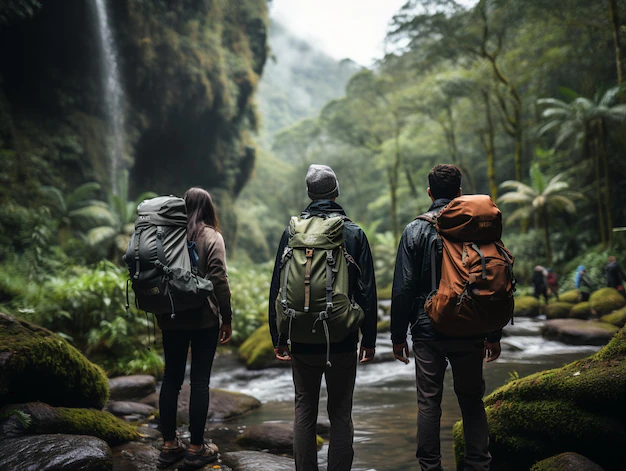


Here’s A Quick Guide To The Top 12 Hiking Destinations In The US

Nov 30, 2023

Last Updated on: Sep 1, 2025

Adventure

With an astonishing variety of landscapes and mountain ranges, the US is truly a hiker’s paradise. From the towering peaks in Montana to the sun-drenched trails in California, there is an adventure for every outdoor enthusiast.

This guide will take you through some of the best hiking destinations in the US, each offering its unique allure and unforgettable experiences.

1. Glacier National Park, Montana

Renowned for its stunning vistas and diverse wildlife, Glacier National Park offers some of the best hiking trails in the United States. The Grinnell Glacier Trail is a favorite, known for its breathtaking views of glaciers and lakes. 

The Highline Trail offers panoramic views of the park’s rugged terrain. For a glimpse of the park’s diverse ecosystems, the Iceberg Lake Trail is unbeatable, leading to a spectacular lake with floating icebergs. The Hidden Lake Overlook Trail provides picturesque views of Hidden Lake and the surrounding peaks, making it a must-visit for any hiker.

2. Zion National Park, Utah

Utah’s Zion National Park is a treasure trove of scenic trails that offer diverse hiking experiences. This is a unique hike where you wade through the Virgin River, enclosed by towering canyon walls. This adventure offers a refreshing and exhilarating experience as you navigate through the river’s shallow waters and admire the massive, narrow canyons. 

Angel’s Landing offers a thrilling hike with extended views of Zion Canyon, combining physical challenges with a vast overlook. For a more serene experience, the Emerald Pools trail offers a peaceful walk with beautiful waterfalls and lush vegetation. Observation Point gives you bird’s-eye views of the entire park. It’s a favorite among photographers.

3. Grand Teton National Park, Wyoming

Grand Teton National Park in Wyoming boasts more than 200 miles of trails, catering to every level of hiker. The Cascade Canyon Trail winds through rocky mountain scenery and diverse wildlife, making it a top pick among hikers. 

For those seeking the park’s full spectrum, the challenging climb up to Delta Lake rewards with crystal-clear waters and a striking landscape. The Jenny Lake Loop is less strenuous. It skirts the lake’s shoreline, offering serene views of the Tetons reflected in the lake. Taggart Lake Trail provides easy terrain and a picturesque ending at the lake, is perfect for families or a relaxed day hike.

4. Yosemite National Park, California

Yosemite National Park offers some of the most scenic trails in the United States. Mist Trail leads to the iconic Vernal and Nevada Falls where the payoff is unique water features. 

For a challenging hike, Half Dome is a must-try. It’s a thrilling journey, culminating in a steep cable-assisted final climb. This challenging hike rewards the brave with unparalleled views of the Sierra Nevada and Yosemite Valley below. 

Another gem, the Glacier Point Trail, offers easier access to the grand vistas of Yosemite Valley. For those seeking tranquility, Tuolumne Meadows presents serene paths through high-elevation meadows and granite landscapes. The John Muir Trail winds through the park. It’s ideal for experienced hikers seeking a multi-day adventure. 

5. Rocky Mountain National Park, Colorado

Rocky Mountain National Park boasts a variety of trails that cater to all skill levels. The park’s diverse landscape ranges from lush forests and serene lakes to rugged peaks, offering breathtaking views. One of the most popular trails is the Emerald Lake Trail, a relatively easy hike leading to three alpine lakes. 

For a more challenging adventure, the Sky Pond Trail winds through beautiful scenery, culminating at a secluded mountain pond. History enthusiasts will appreciate the Flattop Mountain Trail, which ascends to a summit with perspective views, tracing paths used by early park explorers. 

Wildlife sightings, especially of elk and bighorn sheep, are common, adding a thrilling element to the hikes.

Rocky Mountain National Park, Colorado

6. Grand Canyon, Arizona

A hike in the Grand Canyon is a bucket-list experience for any hiking enthusiast. The Bright Angel Trail is a classic, descending into the canyon with endless passages and historical rest houses along the way. It’s ideal for both day hikes and overnight trips

The North Kaibab Trail is the only maintained trail into the canyon from the North Rim. It offers diverse ecosystems and dramatic views of the inner canyon. Though steeper and without shade, The South Kaibab Trail rewards hikers with overarching views, especially at Ooh Aah Point and Skeleton Point. 

The Rim-to-Rim hike, combining North and South Kaibab Trails, is a once-in-a-lifetime experience for seasoned hikers, showcasing the canyon’s vastness and geological wonders. 

7. Pisgah National Forest, North Carolina

Located deep in the Appalachian Mountains of western North Carolina, Pisgah National Forest offers a variety of exceptional hiking trails. One of the most famous is the Looking Glass Rock Trail, a strenuous 6.5-mile round trip that rewards hikers with amazing payoff views. 

Another notable trail is the John Rock Loop, a 5-mile journey that provides breathtaking views of the surrounding mountains and forest. For waterfall enthusiasts, the Moore Cove Falls Trail is a must-visit, offering an easy 1.5-mile round trip to a picturesque waterfall.

The challenging but rewarding Art Loeb Trail, spanning 30 miles, traverses diverse landscapes and offers an immersive experience in the heart of the forest.

8. Olympic National Park, Washington

Olympic National Park in Washington offers over 600 miles of trails. From the majestic mountain peaks to the enchanting rainforests and rugged coastlines, there is something for everyone to explore. One of the popular trails is the Hurricane Ridge Trail to Hurricane Hill, offering breathtaking views of the surrounding mountains. 

The Sunrise Ridge via the Sunrise Point Trail takes you through beautiful wildflower meadows. Another notable trail is the Klahhane Ridge Trail to Mount Angeles, rewarding hikers with 360-degre lookouts. Don’t miss the picturesque Marymere Falls, the adventurous Mount Storm King, and the cascading Sol Duc Falls.

9. Pictured Rocks National Lakeshore, Michigan

Pictured Rocks National Lakeshore offers some of the most stunning hikes in Michigan. At 10 miles long, the Chapel Loop is a must-see with its breathtaking views of Chapel Falls, Chapel Rock, and Lake Superior. 

For a shorter journey, Mosquito Falls Trail is a 4-mile round trip that leads hikers through lush forests to a charming waterfall. Miners Castle Trail is an easy 0.6-mile hike that provides a view of the iconic Miners Castle rock formation. 

If you love lakeside scenery you’ll enjoy the Beaver Basin Overlook trail, a 1.2-mile trek offering views of the Beaver Lake and its pristine surroundings. Each trail in Pictured Rocks National Lakeshore presents a unique slice of Michigan’s natural beauty, making it an ideal destination for nature enthusiasts.

10. Acadia National Park, Maine

Offering a diverse range of trails that cater to all skill levels, Acadia National Park is a haven for hikers. The Precipice Trail is known for its steep climbs and breathtaking views. It is a challenging hike leading to the summit of Champlain Mountain. This trail is not for the faint-hearted but rewards with long-range views of the park. 

Jordan Pond Path offers a more tranquil experience, circling the pristine Jordan Pond and providing serene forest and mountain scenery. For a moderate hike, the Gorham Mountain Trail is ideal, winding through varied landscapes and culminating in rugged coastal views. 

The Beehive Trail, another exhilarating option, combines climbing and hiking, offering a unique adventure with dramatic cliffside views. These hikes in Acadia not only provide physical challenges but also immerse visitors in the park’s natural beauty.

Read Also:

Share on Social Media

Ankita Tripathy loves to write about food and the Hallyu Wave in particular. During her free time, she enjoys looking at the sky or reading books while sipping a cup of hot coffee. Her favourite niches are food, music, lifestyle, travel, and Korean Pop music and drama.

Leave a Reply

Your email address will not be published. Required fields are marked *

title-img Related

READ MORE how is it possible for ski jumpers to stay in the air so long and how do they train for that

How Is It Possible For Ski Jumpers To Stay In The Air Long And How To They Train For That?

BY  Sibashree May 18, 2026

Suppose we jump high in the air. We can stay in the air for around half a second. Michael Jordan could even stay off the ground for only one second.  Now, at many events at the Winter Olympics, we see athletes showing strength and athleticism in the air.  However, ski jumping beats them all in terms of jumping high in the air and staying afloat for so long.  Here, you need to understand the physics of sports, and for many of us, the ski jump is a mesmerizing event in the Winter Games, showcasing sports physics in action.  The athlete who travels the farthest and shows the best style while flying and landing becomes the winner of the event.  Ski jumpers can fight gravity, and they can turn their bodies and skis into a wing to stay in the air for 5 to 7 seconds.  Within that span, they can travel almost the length of a football field while staying in the air.  But how is it possible for ski jumpers to stay in the air so long and how do they train for that?  Let’s delve into the details.  How To Fly?  The answer to how is it possible for ski jumpers to stay in the air so long and how do they train for that lies in three important concepts of sports physics.  These are drag, lift, and gravity.  Gravity is the power that pulls any object in flight down. Gravity is a force that works on everybody, and ski jumpers cannot avoid it.  However, ski jumpers, as they move, interact with the air. Now, this interaction further produces lift.  Lift refers to an upward force projected by the air for an upward movement of an object.  In this scenario, if the force of gravity and the force to lift balance each other, an object can fly or glide.  However, producing lift is only possible when the object is moving. Moving objects collide with air particles and push them aside.  Pushing air downward creates an equal, upward reaction known as lift. Here it follows Newton’s third law, “For every action, there is an equal and opposite reaction.” You can increase lift by boosting your speed, expanding your surface area, or optimizing your angle of attack (the object's tilt against the airflow).  If this angle is too flat, you generate no lift; if it is too steep, the object stalls.              The Car Window Example  If the concept feels complicated, you can experience the same by just sticking your hand out of a moving car window.  If you keep your hand perfectly flat, it will yield no movement.  However, if you tilt your palm slightly upward, it will force the incoming wind downward, and thus your hand will be pushed up immediately.  It is a clear example of lift.  The same particle collisions that generate lift also create drag. Drag is a resistive force that slows objects down.  As an object loses speed, its lift drops, cutting the flight short. Because of this, ski jumpers use highly precise body positions to maximize their lift while minimizing speed-killing drag. A Brief History Of The V-Style  The history of ski jumping goes back to the 1800s. Norwegian skiers first started competing for distance on snowy slopes. However, for most of the sport's history, jumpers kept their skis pressed tightly together, parallel to each other, all the way through the flight. The 1980s brought a major change to these practices.  A Swedish jumper named Jan Boklöv began spreading his skis apart mid-air, forming the V-shape you now see in every competition. He drew criticism from experts and judges who considered it a “bad style” because it looked unconventional.  However, Boklöv's V-style increased his jump distances by as much as 10%, simply by giving his body and skis more surface area to catch the air. Then, ignoring the style was impossible.  Within a few years, every serious competitor had switched to the V-style, and judges stopped penalizing it. Even today, it remains a standard technique, and it is the same aerodynamic principle that more surface area means more lift. How To Fly On Skis?  We need to observe the skiers to understand how is it possible for ski jumpers to stay in the air so long and how do they train for that. You will see a skier starting on a high slope, and then they move downhill. They generate speed by skiing in this way.  They also reduce drag by squatting and steer very carefully to minimize the friction between the ramp and skis.  So, when they reach the end, the speed will be close to 60 miles or 96 kms per hour.  Once airborne, ski jumpers use aerodynamics to fight gravity and extend their flight.  While they cannot generate enough lift to stay in the air indefinitely, maximizing this upward force slows their descent and carries them further down the hill. To achieve the longest flight possible, athletes lean forward until their bodies and skis are nearly parallel to the snow.  By spreading their skis into a V-shape just outside their body's silhouette, they gain two major aerodynamic advantages. The spread position creates a larger surface area to catch the wind and generate lift. So they get an expanded surface area.  They also get an optimal angle of attack. The forward tilt places them at the perfect angle relative to the airflow to maximize upward pressure. As the jumper glides forward, drag continuously pushes back against them, draining their forward momentum.  Because lift relies entirely on speed, this deceleration causes the upward force to fade away. As drag robs the athlete of their speed, gravity takes complete control, pulling them faster and faster toward the landing zone. The Takeoff: The Hardest Half-Second Out of everything a ski jumper does, takeoff is the most difficult skill to master. It happens in under half a second.  Furthermore, when the jumper reaches the end of the ramp, known as the "table," they must explosively extend their legs and spring forward and slightly upward. They will do it all while still moving at nearly 60 miles per hour. However, if they jump too early, they will lose speed and distance. Once again, jumping too late can cause losing control of their body position in the air, which can be dangerous. In addition, the takeoff also sets the jumper's angle of attack for the entire flight.  Because there's no way to make major corrections once airborne, a fraction-of-a-second error in the takeoff can throw off the aerodynamic position for the whole jump.  This is why ski jumpers spend years drilling this single movement until it becomes automatic. How Ski Jumpers Actually Train? Physics explains the reason why ski jumpers fly so far. However, the training behind it is equally crucial.  Training AreaWhat It InvolvesWhy It MattersStrength and Explosive PowerSquats, box jumps, and plyometric drillsBuilds the fast-twitch power needed for the powerful, split-second leg extension at takeoffSummer Training on Artificial TracksYear-round practice on in-run tracks covered with porcelain or plastic bristles instead of snowLet athletes drill their approach, takeoff, and body position even outside the winter monthsWind Tunnel SessionsFine-tuning arm position, back angle, and ski spread with coachesFlight position is highly sensitive to drag and lift, so small posture adjustments can shave off dragVideo and Biomechanical AnalysisFrame-by-frame review of the in-run, takeoff, flight, and landing from multiple camera anglesHelps compare an athlete's actual form against ideal aerodynamic positionsMental PreparationVisualization techniques and gradual exposure, starting on smaller hills and building up to normal and large hillsBuilds the psychological conditioning needed to launch off a mountainside ramp at speed How Do Judges Score A Jump? The judges will not just assess the ski jump based on the distance covered. So, the question of who becomes the winner depends on the distance and the style.  Scoring ComponentHow It WorksPurposeDistance Points- Measured against the K-point (a reference point on the hill). - Landing exactly on it earns a fixed score, with points added or subtracted for every meter beyond or short of it.Rewards how far the athlete actually travelsStyle PointsFive judges score the flight and landing, including body position in the air and control of the landing in the "telemark" position (one foot in front of the other, knees bent). Each judge scores up to 20 points; the highest and lowest scores are dropped, and the middle three are added to the distance score.Rewards technique and control, not just distance.Gate and Wind CompensationOfficials apply point adjustments in real time based on wind conditions, since headwinds increase lift and tailwinds reduce it.Prevents a gust of wind from unfairly helping or hurting a competitor's final score. Normal Hill Vs. Large Hill Vs. Ski Flying Not all ski jumps are the same size, and the hill itself determines how far a "long" jump actually is. Hill TypeK-Point (Target Landing Distance)NotesNormal HillUp to 109 metersSmaller competition hillLarge Hill110–184 metersUsed for most Olympic ski jumping eventsSki Flying Hill185 meters or moreIt is a separate discipline where athletes can stay airborne longer, sometimes covering well over 200 meters. The larger the hill, the faster the in-run speed and the longer the flight. That is why ski flying produces the most extreme examples of the physics described earlier: maximum lift, sustained over the longest possible time. Record-Breaking Flights The current men's ski flying world record stands at 254.5 meters. Domen Prevc completed it in Planica, Slovenia, on 30 March 2025. (Source: Guinness World Records).  Among women’s ski flying, Nika Prevc holds the record. She completed the jump of 236 meters in Vikersund, Norway, on 14 March 2025. These extreme distances are a direct demonstration of the lift-versus-drag balance. The longer an athlete can hold an efficient aerodynamic position without losing speed to drag, the farther gravity has to work to finally pull them down. How Is It Possible For Ski Jumpers To Stay In The Air Long? The Rules Follow The Physics So, you can see there is pure physics at play behind how is it possible for ski jumpers to stay in the air so long and how do they train for that.  However, the body of an athlete, equipment choices, and the wind can impact the quality of the jump in many ways.  Also, there are a lot of rules and regulations to keep a ski jump fair.  You will see many officials changing the starting and ending points up and down the slope during the events.  This adjustment happens to ensure a safe landing, depending on the speed of the wind.  When the headwinds are faster, there will be more lifts and longer jumps. As a result, an athlete can go past the scure zone for landing.  Moreover, the regulations of a ski jump will also depend on the height and weight of a skier.  Usually, skis have to be “145% of the skier's height.” Also, if the skier has a body mass index of less than 21, they will get shorter skis.  Again, long skis are not the best in every case. When the ski is heavy, you will need more lift to fly and stay in the air.  Also, you have to wear a tight-fitting suit. You cannot wear anything that will need additional lift.  So, when you see a skiing event, think of how the skiers have also mastered the concept of physics. Why Is Ski Jumping Riskier Than It Looks? Ski jumping looks graceful. However, we cannot undermine how physically demanding and risky the sport is.  Athletes fly through the air at highway speeds with only their skis and body position keeping them stable.  A poor landing, a sudden gust of crosswind, or a small error in the takeoff can cause a loss of balance that's difficult to correct mid-flight.  This is part of why regulations are so strict that the rules on suit tightness, ski length relative to height and BMI, and the ability of officials to adjust the start gate are all safety measures as much as they are fairness measures. Wind is the biggest variable officials can't fully control. Which is why competitions are sometimes paused or delayed when crosswinds pick up, and why the point-compensation system exists to account for conditions that shift mid-competition. How Is It Possible For Ski Jumpers To Stay In The Air Long? Some Quick Questions And Answers 1. Why Do Ski Jumpers Spread Their Skis Into A V-Shape? It increases their surface area and creates a better angle of attack, both of which generate more lift and let them fly farther. 2. How Fast Do Ski Jumpers Go Before Takeoff? Around 60 miles per hour (96 km/h) by the time they reach the end of the ramp. 3. How Long Do Ski Jumpers Actually Stay In The Air?  Roughly 5 to 7 seconds in standard competition, and even longer during ski flying events on the largest hills. 4. Is Ski Jumping Scored Only On Distance?  No. Final scores combine distance points with style points awarded by judges for body position and landing control. 5. What Is The Difference Between Ski Jumping And Ski Flying?  Ski flying happens on larger hills built for greater distances, allowing longer flights and higher speeds than standard normal or large hill ski jumping. Read Also: Car Travel On PaxTravelTweaks: How Does It Help In Smartly Planning Budget-Friendly Road Trips? IWantThatFlight Offering Cheap Flights: The Best Hack For Traveling On A Budget
READ MORE RV Extended Service Contracts

Exploring With Confidence: A Review Of Outdoor Warranty’s RV Extended Service Contracts

BY  Mashum Jan 8, 2024

For RV enthusiasts, the open road promises adventure and freedom. But this freedom is best enjoyed with a safety net against unforeseen mechanical issues that can and will arise. This is where OutdoorWarranty offers specialized RV extended service contracts to protect your RV and offer peace of mind while on your adventures. Additionally, recently, we took an in-depth look at what makes OutdoorWarranty a preferred choice for RV owners.  Here is what we found out. Who is OutdoorWarranty?: Outdoor Warranty emerges as a beacon of reliability in the RV warranty landscape. Furthermore, it has been founded by individuals passionate about RV travel, the company focuses exclusively on RV extended service contracts. Known for its commitment to customer satisfaction, transparency, and tailor-made coverage. Along with Outdoor Warranty has carved a niche in providing peace of mind to RV travelers no matter where the open road may take them. The OutdoorWarranty Advantage: Should an RV owner consider OutdoorWarranty? Simultaneously, our review highlights a few key areas: comprehensive coverage plans, a customer-first approach, and an easy claims process. Customers we interviewed praised the company's dedication to providing personalized and straightforward services. In order to understand, simplicity and transparency of their contracts make them stand out in a market often cluttered with complex terms. Coverage That Meets Your Needs: Variety and flexibility are the hallmarks of OutdoorWarranty's coverage options. Whether it's basic engine protection or extensive coverage encompassing electrical and plumbing systems, they offer plans for different needs and budgets. We were particularly impressed by the clarity with which each plan's details were laid out, ensuring customers knew exactly what they were getting. Seamless Process and Support: The process of getting an Outdoor Warranty plan is straightforward. For instance, everything is streamlined for ease and convenience, from obtaining a quote to filing a claim. The company's customer service is responsive and knowledgeable, a factor frequently highlighted in customer testimonials. Their online portal further simplifies managing your contract and claims. Rave Reviews on Google and Facebook: A significant indicator of OutdoorWarranty’s success is the glowing reviews from customers on Google and Facebook. Customers regularly praise the company for its exceptional service and reliable coverage. These online reviews reflect high trust and satisfaction among the RV community, solidifying OutdoorWarranty's reputation as a top-tier service provider. Final Thoughts: Beyond Service Contracts: In conclusion, our review finds OutdoorWarranty is a reliable partner for RV enthusiasts. With their focus on customer satisfaction, clear communication, and comprehensive coverage options, they are well-equipped to meet the diverse needs of the RV community. OutdoorWarranty offers a service contract worth considering for those looking to travel without worry. Read Also: Florida Dreams: RV Camping Along the Sunshine State’s Shore Wonders of the Waves: RV Camping Along Oregon’s Coastal Beauty

READ MORE sigiriya rock

Climbing The Sigiriya Rock In Sri Lanka: Ravana’s Golden Palace Or An Ancient Buddhist Monastery?

BY  Sibashree Mar 5, 2026

The Sigiriya Rock was my next big cultural stop in Central Sri Lanka after the Ritigala Forest Monastery.  Also known as the “Lion Rock,” it is a UNESCO World Heritage Site with whiffs of mythology and major archaeological importance.  Despite the absence of any archaeological evidence, there is a strong mythological belief that it is the place of Ravana’s Golden Palace.  However, scientific evidence says that the rock fortress with its massive columns was once the seat of power of King Kashyapa (477-495 AD).  He built the fortress with magnificent frescoes and the palace at the top of the rock column. Also, the palace got such a name because one had to access the fortress through the mouth of an enormously carved lion.  The area was earlier used as a Buddhist monastery from the third to the first century BCE.  So, along with the Hindu temples of Jaffna and the Ambuluwawa Tower, which has Hindu, Buddhist, Christian, and Muslim sites, the Sigiriya Rock also remains a major attraction for religious and spiritual seekers.  Hi, in today’s blog, I will talk about the location of the Sigiriya Rock, how to reach it, the climbing experience, history, the entry fee, the structure, and other details.  What Is The History Of The Sigiriya Rock?  Sigiriya Rock was a Buddhist Monastery. It rose in prominence after King Kashyapa took the throne and shifted the monks to Pidurangala, a nearby outcrop.  He found the top of this near-vertical rock formation more defensible and built a fortress on its top. It had a magnificent moat, water gardens, temples, and meeting halls.  However, deserted by his own force, King Kashyapa killed himself as he did not want to be a captive of his brother.  The Sigiriya Rock again became a monastery after Anuradhapura became the capital again.  However, after a few years, the place was abandoned until George Turnour translated the Buddhist texts and identified the Sigiriya Rock. Further, in 1831, Jonathan Forbes located the city. Then, after 20 years, Harry Bell, the Archaeological Commissioner of Ceylon, at that time discovered the Lion’s Paws.  Finally, the Sigiriya Rock became a UNESCO World Heritage Site in 1982.  Where Is The Sigiriya Rock? How To Reach The Sigiriya Rock?  The Sigiriya Rock is located in the central region of Sri Lanka. Dambulla is the closest town, and it is the gateway to the Sigiriya Rock by road from Colombo and Kandy, the capital of the central province.  The distance is around 17 km, and the travel time is close to 25 minutes.  The distance between Kandy and the Sigiriya Rock is around 89 km, and the travel time by road is close to 2 hours and 31 minutes.  Furthermore, the distance from Colombo to the Sigiriya Rock is 177 km. So, the travel time is around 3 hours and 50 minutes.  Nevertheless, I took a bus from Dambulla to the Sigiriya Rock. The bus ticket price was around 50 LKR.  You will also get taxis and tuk-tuks from Dambulla.  Moreover, Habarana railway station, at a distance of around 20-30 minutes, is the closest to the Sigiriya Rock. Once you are done exploring Colombo or the things to do in Trincomalee, you can easily take a train ride to the Habarana railway station and take a taxi or tuk-tuk from there to the Sigiriya Rock.  What Are The Opening Hours And Entry Fee To The Lion Rock And Museum?  Sigiriya remains open from 7 AM to 6 PM. However, 5:30 PM is the latest time you can enter.  The entry fee to the Sigiriya Rock is around 11,149 LKR or 36 USD. This charge includes the museum entry fee.  However, you can also visit the museum on a different day and pay a fee of $5 or 1600 LKD.  Climbing The Sigiriya Rock  I started from the ancient water garden with the caves on the left. Furthermore, the octagonal man-made lake was in the shadow of the massive monolith.  As I proceeded, I found two big boulders forming a natural arch and creating a circular road upward. The path took a turn to the left.  The entire path was a part of the natural rock garden and was a sheer contrast against the water gardens below.  I met some spiders, monkeys, and street dogs on the way until I reached the Lion’s paws. 1. The Lion’s Paws The Lion’s Paws had a staircase in the center. This stone-made staircase is ancient, and the claws with the Lion’s paws are now the only remnants explaining why the Sigiriya Rock has the nickname of the Lion Rock.  The head and body of the lion are decayed and mostly engulfed by the jungle.  Furthermore, this ancient stone staircase is like a transition from history to the metal route up the mountain.  However, here, you have to be careful and be as silent as possible to avoid the wasp attacks.  2. From The Top Of The Lion Rock After climbing around 1200 steps, I reached the top of the Lion Rock. As Sigiriya is the tallest peak in the region, it offered me a 360-degree view of the surroundings. The sparkling rivers and lakes and the lush greenery of Central Sri Lanka won me over. The Pidurangala Rock was to the north, and it rose like a little volcano from the forest beneath.  3. The Mirror Wall  I walked through the remnants of the Sigiriya Rocks, the platforms, and the pools before I finally reached the Mirror Wall.  On my way, I also had an encounter with a giant lizard and a street dog who just knew how to pose.  Between the first plateau and the Lion’s Paws, there is a fork in the path. I took that path and turned left to come across the Mirror Wall.  With a plaster casing, the ancient Mirror Wall used to shine and reflect light. Also, today, when you visit the mirror wall, you can see thousands of graffiti. 4. The Frescoes From the Mirror Wall, I took a spiral staircase to reach the frescoes. However, for me, the cave paintings were more fascinating. There is a major debate about the figures drawn on the caves. Some claim that these are holy entities and they make offerings to them.  On the other hand, many say that these depict the concubines from the harem of the king.  5. The Cobra Head  I spotted the Cobra Head Cave while descending from the Sigiriya Rock. The cave resembles a cobra, which is ready to attack you with its fangs.  Furthermore, I spotted a reception hall and an ancient urinal.  Wildlife And Safety While Climbing The Sigiriya Rock  I could spot many monkeys while climbing the Sigiriya Rock. Also, the moat has signs that crocodiles can be spotted here. However, I could not find any.  Having said that, the lizards here are huge, and they are no less scary than crocodiles.  Furthermore, there is a caution regarding elephants roaming in the water gardens after dark.  Now, the scariest part. You will see huge wasp nests across various sections of the Sigiriya Rock. Keep silent and be responsible not to disturb those nests.  Amenities Available At The Sigiriya Rock Site There are toilet facilities at the base of the Sigiriya Rock. Furthermore, you will get a cafe or food stall near the ticket counter.  You can collect chips, ice creams, soft drinks, and water for this cafe.  Also, you can refill your bottle from the free fountain.  Tips And Tricks While Visiting The Sigiriya Rock  You have to carry enough water while climbing the Sigiriya Rock. Otherwise, you will be dehydrated, especially when climbing up after 8 AM.  Furthermore, you cannot take photos of the frescoes and cave paintings. Noone will allow you to ruin the historical artwork which has been there for more than 1600 years now.  Moreover, the stairs and paths are steep. So, if you have vertigo issues, you have to take precautions. Also, the path is full of wasps. So, be careful while climbing up the rock.